Generect vs HitHorizons: Which B2B Data Tool Wins in 2026
Generect sells contact-level lead data pulled in real time; HitHorizons sells European company records sourced from Dun & Bradstreet. They solve different halves of the same problem — here's which one your pipeline actually needs.
TL;DR
- Generect vs HitHorizons is not really a head-to-head fight. Generect sells contact data. It finds people in near real time, mostly from public work profiles. HitHorizons sells European company records built on Dun & Bradstreet data: reg numbers, VAT IDs, industry codes, size bands.
- Pick HitHorizons if you need to know which firms exist in Europe. Pick Generect if you need to know who to email at those firms.
- Neither tool is a full outbound stack. HitHorizons gives you almost no contact data. Generect gives you thin company detail outside its profile-based footprint.
- The price models differ. HitHorizons sells packages and credits for company profiles. Generect sells plans and API calls for leads.
- Most teams add an email layer on top. A finder plus a verifier turns a company list into inboxes you can reach. Tomba and Findymail fill that gap for $49–$99 a month.
What are Generect and HitHorizons?#
Generect vs HitHorizons comes down to one split: people or companies.
Generect is a B2B lead data tool built around APIs. Its pitch is freshness. It does not serve a stale warehouse dump. It looks up people and firms close to the time you ask. It pulls from public work profiles and the open web. Then it hands back clean fields: name, title, company, and often a work email. Devs use the API. Sales teams use the search screen and the export button.
HitHorizons is a very different beast. It is a European company database. It holds about 80 million firms across 50+ countries. The data comes from Dun & Bradstreet and national registries. You search by country, industry code, revenue band, or staff count. You get legal entity records back: name, address, ID codes, sector, and size band. Web search is free. The full detail and the API sit behind paid plans.
Five things set them apart:
- Unit of data. A HitHorizons record is a legal entity. A Generect record is a person at a firm. You cannot email a legal entity.
- Source. HitHorizons uses what states record: setup date, address, sector. Generect uses what people post: job title, level, employer.
- Map. HitHorizons is Europe first. It covers the long tail of Czech, Polish, Nordic, and Baltic firms. Most US-built tools skip those. Generect follows profile density: North America, Western Europe, tech.
- Decay. A firm's registration rarely changes. A job title changes every 18 to 24 months. Refresh each set on its own clock.
- Buyer. HitHorizons often sells to risk, KYC, and research teams. Generect sells to sales and growth teams.
Generect vs HitHorizons: how do they compare head-to-head?#
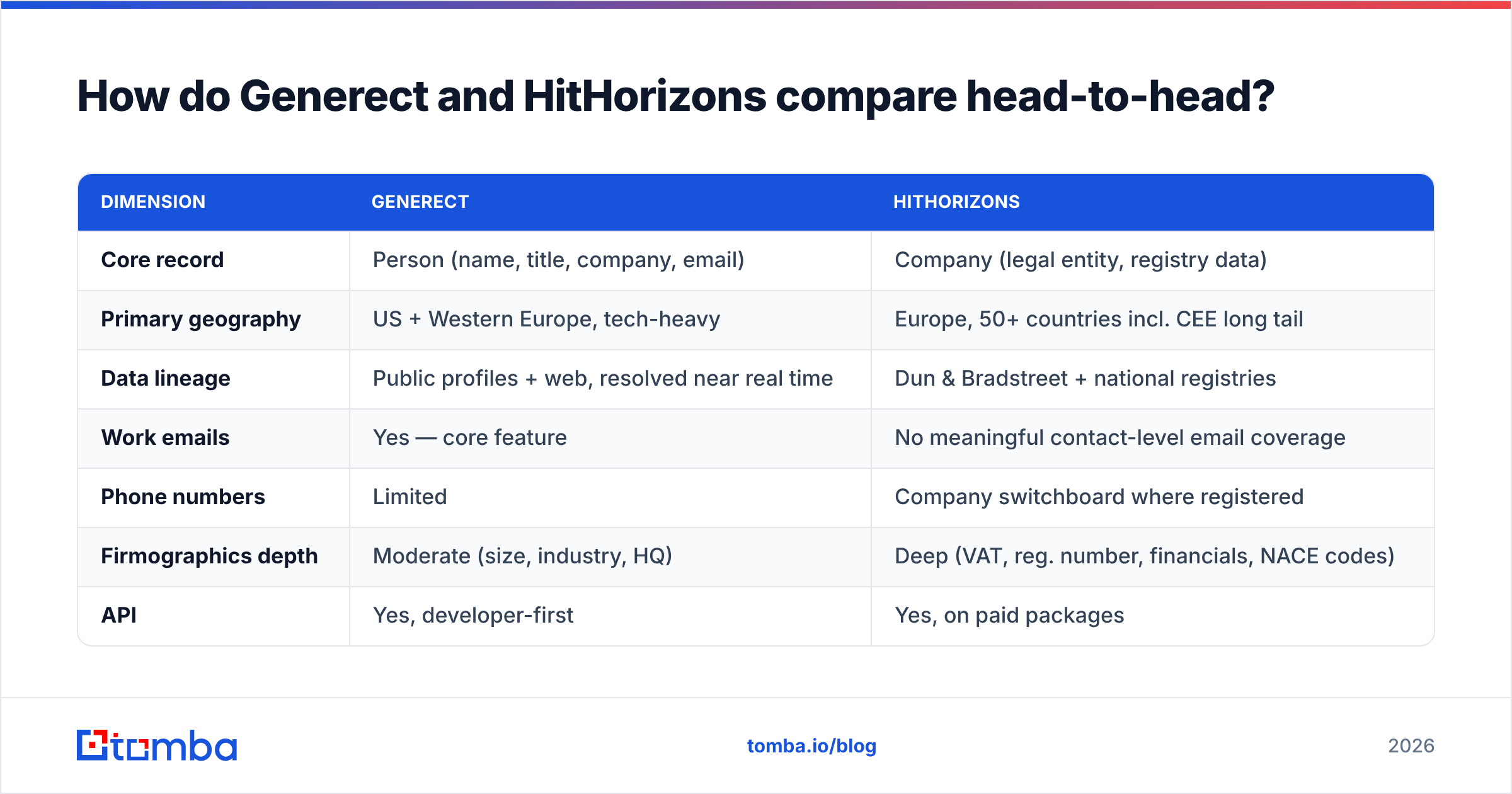
| Dimension | Generect | HitHorizons |
|---|---|---|
| Core record | Person (name, title, company, email) | Company (legal entity, registry data) |
| Primary geography | US + Western Europe, tech-heavy | Europe, 50+ countries incl. CEE long tail |
| Data lineage | Public profiles + web, resolved near real time | Dun & Bradstreet + national registries |
| Work emails | Yes — core feature | No meaningful contact-level email coverage |
| Phone numbers | Limited | Company switchboard where registered |
| Firmographics depth | Moderate (size, industry, HQ) | Deep (VAT, reg. number, financials, NACE codes) |
| API | Yes, developer-first | Yes, on paid packages |
| Free option | Trial / demo access | Free web search with limited detail |
| Pricing model | Subscription + credit/API volume | Package or credit-based, quote for volume |
| Best for | Building contactable prospect lists | Market sizing, TAM mapping, KYC, EU coverage |
Two honest notes on that table. Both vendors change their packages often. Treat the price rows as a guide and check the vendor pages first. And "no email data" is not a flaw at HitHorizons. It is a choice. They sell registry truth, not outreach fuel.
Which one gives you contactable leads?#
Only one of them, and only in part. In the Generect vs HitHorizons split, contact data sits on one side.
Say you pull 5,000 German plants with 50 to 200 staff from HitHorizons. You get a clean, legal target list. You also get zero people to contact. Next you have to name the buyers and find their emails. Most teams under-price that second step.
Generect closes more of the loop. You get a person, and often a work email. But "often" is doing real work in that line. Hit rates drop fast outside tech and big services. That is true of every vendor in this class. A 500-person SaaS firm in Berlin resolves well. A 40-person coatings maker in Ostrava often does not. That is the exact segment HitHorizons is best at surfacing.

So the real stack for European mid-market outbound has four steps. Find the firms. Name the buyers. Resolve the emails. Verify them.
Skip that last step and you burn your sender score. It is the most common own goal in outbound. Run every list through an email verifier before it hits your sequencer. Do that no matter who sold you the data. Check for catch-all domains on their own, too. They are common in the European SMB space that HitHorizons covers so well.
Generect vs HitHorizons: what does each one cost?#
Neither vendor posts a simple per-seat price the way an SEO tool does. So compare structures, not just headline figures.
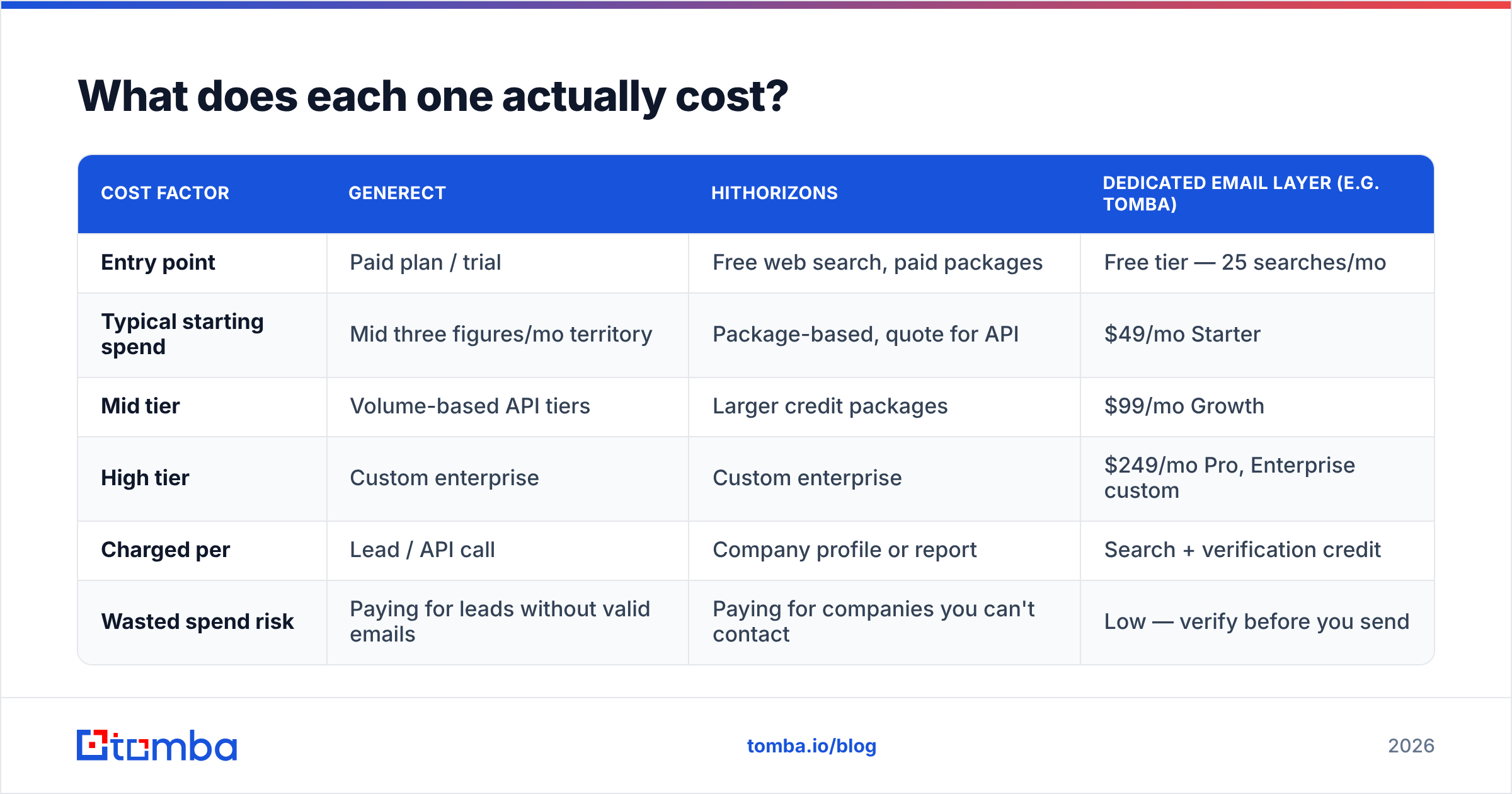
| Cost factor | Generect | HitHorizons | Dedicated email layer (e.g. Tomba) |
|---|---|---|---|
| Entry point | Paid plan / trial | Free web search, paid packages | Free tier — 25 searches/mo |
| Typical starting spend | Mid three figures/mo territory | Package-based, quote for API | $49/mo Starter |
| Mid tier | Volume-based API tiers | Larger credit packages | $99/mo Growth |
| High tier | Custom enterprise | Custom enterprise | $249/mo Pro, Enterprise custom |
| Charged per | Lead / API call | Company profile or report | Search + verification credit |
| Wasted spend risk | Paying for leads without valid emails | Paying for companies you can't contact | Low — verify before you send |
The lesson sits in that table. With a company database, you pay for rows you may never act on. With a lead database, you pay for contacts that may not land. A verify step is the cheapest insurance in the stack. Tomba pricing starts at $49 a month for Starter. The free tier lets you test coverage on your own ICP before you spend a cent.
Always run a sample test on your segment. Take 100 domains you know well. Do not trust a global accuracy claim from any vendor, ours included. Coverage is segment by segment. A tool that hits 92% on US SaaS may hit 40% on Slovak logistics.
When should you choose HitHorizons?#
Choose HitHorizons when the company is the unit of choice:
- European market sizing. You need a count of firms in NACE code 25.62 with 20 to 99 staff in Poland, Czechia, and Hungary. Few US-built tools answer that well.
- KYC, supplier vetting, and risk. Registry IDs matter when you onboard a vendor or screen a partner.
- Territory planning. A fair split of a European patch needs a solid account count per region.
- CRM enrichment. You have company names. You need clean legal entities, VAT numbers, and size bands on top.
- Long-tail SMB targets. Is your ICP a 10 to 200 staff industrial firm in Central Europe? Few sources see those firms at all.
It will not hand you a sequencer-ready CSV. Budget for the contact layer on its own.
When should you choose Generect?#
Choose Generect when the person is the unit of choice:
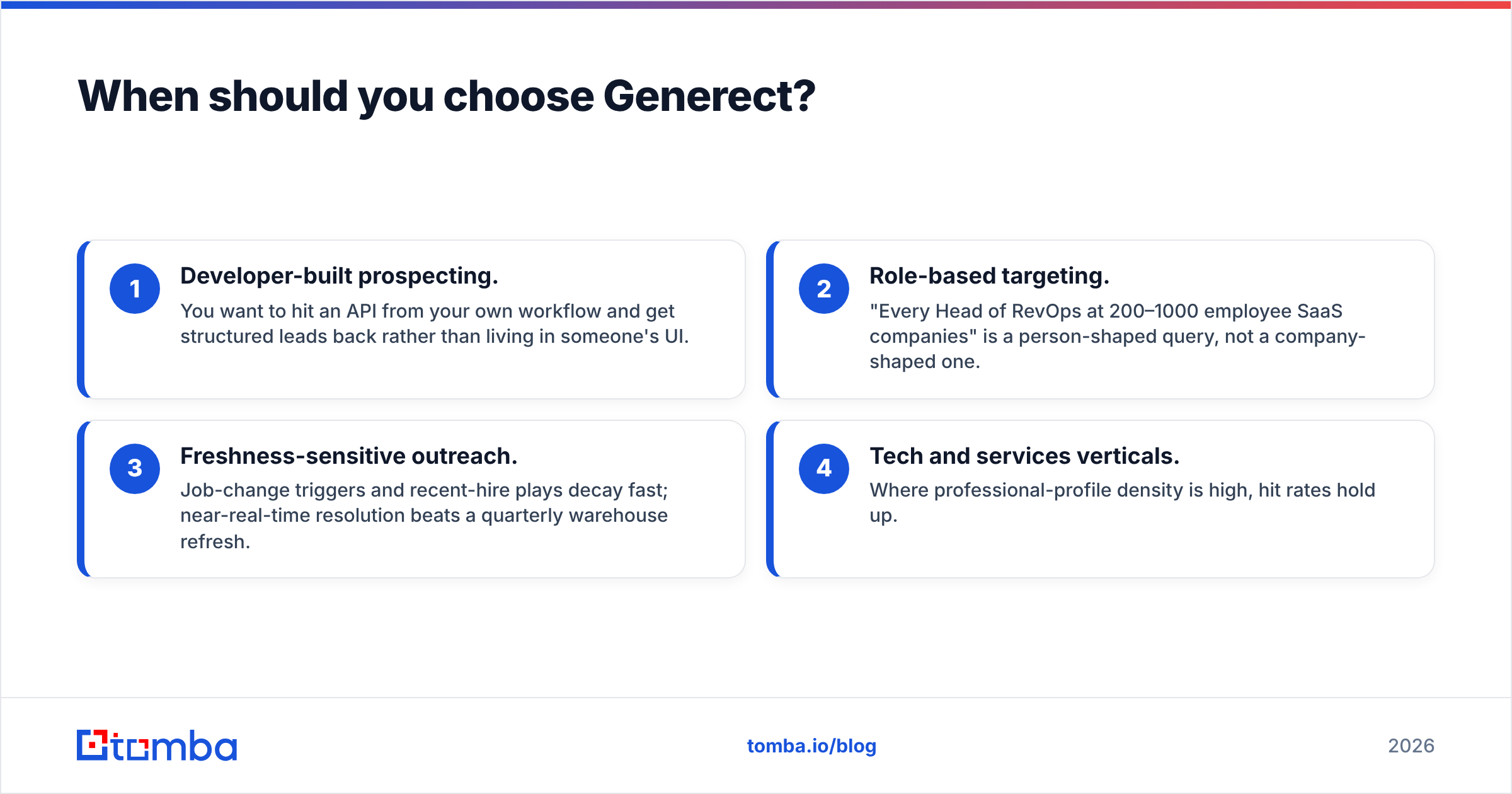
- Dev-built prospecting. Call an API from your own workflow. Get leads back as clean fields. No need to live in someone's UI.
- Role-based targeting. "Every Head of RevOps at a 200 to 1000 staff SaaS firm" is a people query, not a company one.
- Fresh-trigger outreach. Job-change and new-hire plays decay fast. A near real-time lookup beats a quarterly refresh.
- Tech and services verticals. Where profile density is high, hit rates hold up.
The trade-off is depth. You get title and employer. You do not get VAT numbers, filed accounts, or registry IDs. Coverage also thins out where people keep no public profile.

Is there a better third option for outbound teams?#
It depends on the gap you need to fill. Three cases are worth being blunt about:
- Need company breadth in Europe? HitHorizons is hard to replace. Keep it.
- Need ready-to-buy verified lists? BookYourData is a strong pick. It sells credits as you go, with no lock-in. That suits teams who run a campaign now and then, not always-on outbound.
- Need an email and verify layer on top? That is its own product class. It has its own accuracy tests. It is also where cost per valid contact gets decided.

For that third slot, ask for three things. Domain-level search, so a company list turns into named people. Verification in the same flow. And an API that does not bill you twice to find and check one address. Tomba's domain search does the first job. Feed it a domain from a HitHorizons export. You get back the people and the email patterns behind it. The email finder API does the same job in code. It works well as a fallback when Generect hit rates dip in a given segment.
That fallback trick is underrated. No single vendor wins every segment. Chain two resolvers and take the first verified result. Teams often lift usable coverage by double digits that way. Check user reviews on G2 to see how real stacks get built. A vendor's own benchmark is not enough.
How do you build a stack from these pieces?#
Both halves of Generect vs HitHorizons plug into the same flow. Here is one that survives real use:
- Set the account list at company level. Use HitHorizons for Europe. Use your CRM or another source elsewhere. Filter hard. 2,000 good accounts beat 40,000 scraped ones.
- Find the buyers. Generect gets you the person and the email in one call. A domain-level finder works if you already have the firm.
- Verify before the sequencer. No exceptions. Catch-all domains get their own bucket and their own risk rule.
- Enrich only what survives. Adding phone, tech stack, or headcount data to unverified contacts is money set on fire. Run data enrichment after the check, not before.
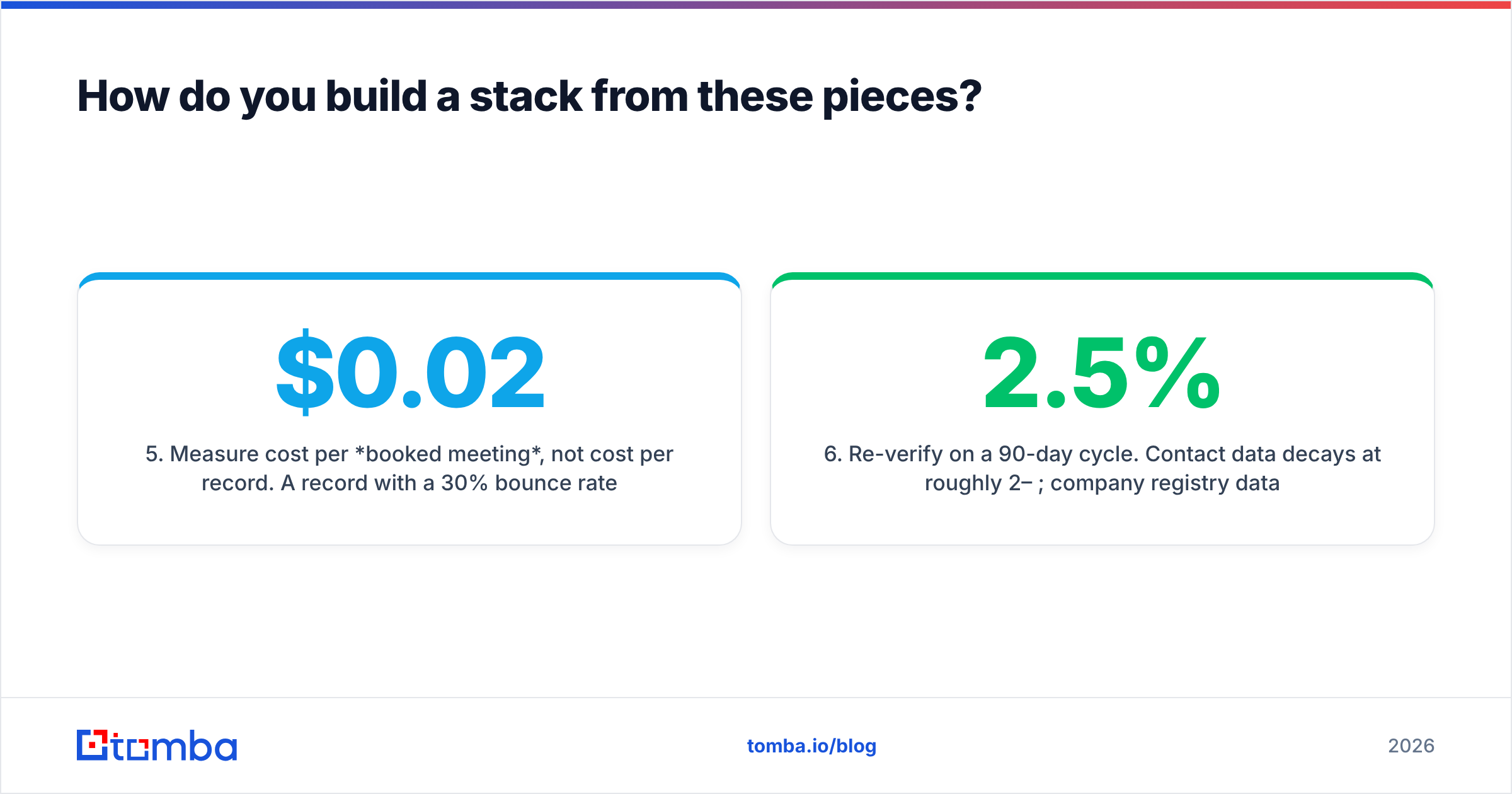
- Track cost per booked meeting. Not cost per record. A $0.02 record that bounces 30% of the time costs more than a $0.15 record that lands.
- Re-verify every 90 days. Contact data decays about 2% to 2.5% a month. Registry data barely moves. Use two schedules.
Frequently asked questions#
Is HitHorizons GDPR-compliant? Its core data is company registry data. That is largely public record, so it sits outside personal data. Personal contact data is a different case. Any B2B contact vendor, Generect included, needs a lawful basis to process it. That is usually legitimate interest. You must honour opt-outs, too. Ask your own counsel. This is not legal advice.
Can I use HitHorizons for cold email? Only in a roundabout way. Use it to build the account list. Then use a second tool to find and verify the real addresses.
Does Generect cover Central and Eastern Europe? In part, and unevenly. Coverage tracks profile density. That is thinner in CEE small firms than in Western European tech. Test your segment before you commit.
Which is cheaper, Generect vs HitHorizons? The two models are too different for one clean answer. Model it as cost per usable contact, not cost per row. Both pictures change fast when you do.
The verdict#
Generect vs HitHorizons is not the same fight. HitHorizons wins on European company coverage, registry depth, and clean firmographics. Generect wins on handing you a real human with a real inbox. Doing market sizing or European territory work? Buy HitHorizons. Filling a sequencer this quarter? Generect gets you there faster.
Either way, you still need an email layer. It turns domains into verified addresses you can send to. Test it before you pay. Start with the free tier of the Tomba Email Finder. You get 25 searches a month and no card is needed. That is enough to check coverage on 25 of your own target domains. You will see fast whether your current source leaves good prospects on the table. Then decide where the rest of the data budget goes.
Related guides#
Ready to find emails that actually work?
Join 150,000+ professionals who stopped guessing and started sending. Free credits on signup — no credit card required.
Get the Tomba newsletter
Practical outbound tactics and product updates — once every two weeks.
About the author