Generect vs Kaspr (2026): Which B2B Contact Data Tool Wins?
Generect sells an API-first lead database. Kaspr sells a LinkedIn extension with mobile numbers. They solve different problems — and one of them is probably wrong for your team. Here's the honest breakdown.
TL;DR
- Generect is an API-first B2B lead platform. You query it programmatically, get company and people records back, and wire it into your own stack. It suits RevOps, data teams, and agencies building pipelines — not a rep clicking through profiles.
- Kaspr is a LinkedIn Chrome extension owned by Cognism. It shines when an SDR is already on a profile and wants a mobile number in one click. Its European mobile coverage is its strongest card.
- They are not really competitors. One is infrastructure, the other is a rep-side tool. Buying the wrong category is the most common mistake teams make here.
- Pricing models diverge hard. Kaspr charges per seat. Generect charges by volume and API access. A 10-rep team and a 1-engineer automation project will get wildly different quotes.
- If you mostly need verified work emails at domain scale, both are heavier and pricier than you need — a dedicated email finder with an API covers that job for less.
What are Generect and Kaspr, exactly?#
Think of it like plumbing versus a faucet. Generect is the plumbing — it sits behind the wall and pushes data wherever you point it. Kaspr is the faucet on the wall in front of the rep, one handle, instant output.
Here's what each actually ships:
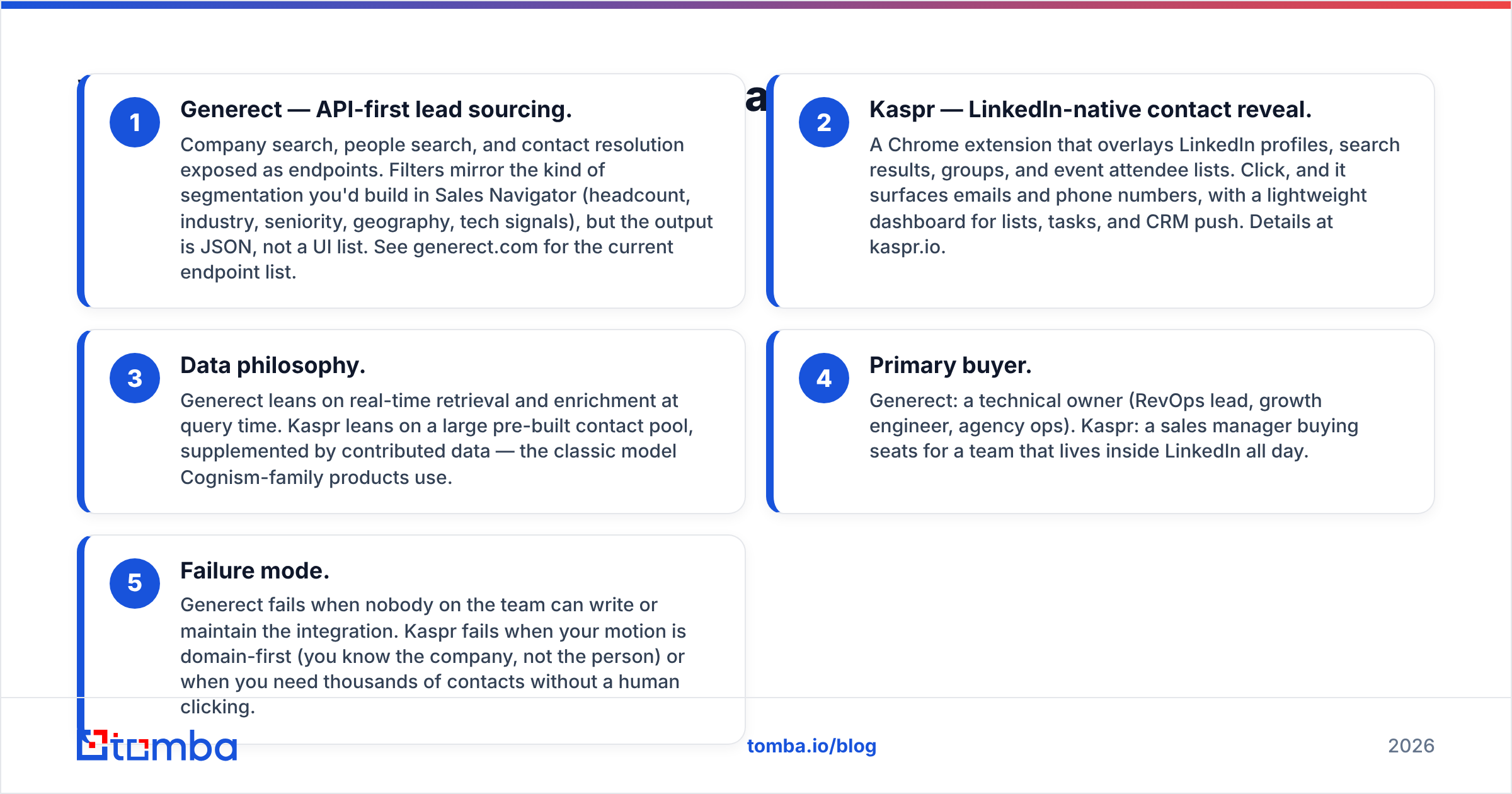
- Generect — API-first lead sourcing. Company search, people search, and contact resolution exposed as endpoints. Filters mirror the kind of segmentation you'd build in Sales Navigator (headcount, industry, seniority, geography, tech signals), but the output is JSON, not a UI list. See generect.com for the current endpoint list.
- Kaspr — LinkedIn-native contact reveal. A Chrome extension that overlays LinkedIn profiles, search results, groups, and event attendee lists. Click, and it surfaces emails and phone numbers, with a lightweight dashboard for lists, tasks, and CRM push. Details at kaspr.io.
- Data philosophy. Generect leans on real-time retrieval and enrichment at query time. Kaspr leans on a large pre-built contact pool, supplemented by contributed data — the classic model Cognism-family products use.
- Primary buyer. Generect: a technical owner (RevOps lead, growth engineer, agency ops). Kaspr: a sales manager buying seats for a team that lives inside LinkedIn all day.
- Failure mode. Generect fails when nobody on the team can write or maintain the integration. Kaspr fails when your motion is domain-first (you know the company, not the person) or when you need thousands of contacts without a human clicking.
That last point matters more than any feature-by-feature score. Most disappointed reviews of either product trace back to a category mismatch, not a data problem.
How do Generect and Kaspr source their data?#
This is where the accuracy conversation starts, and it's the only part of the comparison that survives a pricing-page redesign.
Generect's model is retrieval-heavy. Instead of serving you a row that was cached eighteen months ago, it resolves the record closer to query time. The upside is freshness — job-change decay is the single biggest killer of B2B data quality, and a record assembled today beats one assembled in 2024. The downside is latency and rate limits: real-time resolution is slower per record and harder to run at 500,000-row scale in one afternoon.
Kaspr's model is database-plus-contribution. It maintains a large pool of profiles and phone numbers, enriched by what its user base surfaces. The upside is instant response and unusually deep mobile coverage, particularly across France, the UK, and DACH. The downside is the same as every static database: coverage looks excellent in the regions and job families where its users are concentrated, and thinner elsewhere. Ask for a sample against your ICP, not their published totals.
A few honest cautions that apply to both:
- Published database sizes are marketing numbers. "500M+ profiles" tells you nothing about how many are decision-makers in your segment with a currently-valid work email.
- Neither vendor's email output should go straight into a sequence. Whatever tool you pick, run a verification pass before send. Bounce rate above roughly 3% is where inbox providers start treating your domain as suspect — you can use a standalone email verifier as the last gate regardless of where the address came from.
- Catch-all domains break both. Large enterprises frequently run catch-all MX configs, which means a "valid" result is unfalsifiable by SMTP alone. That's a scoring problem, not a vendor problem.

Generect vs Kaspr: how do the features compare?#
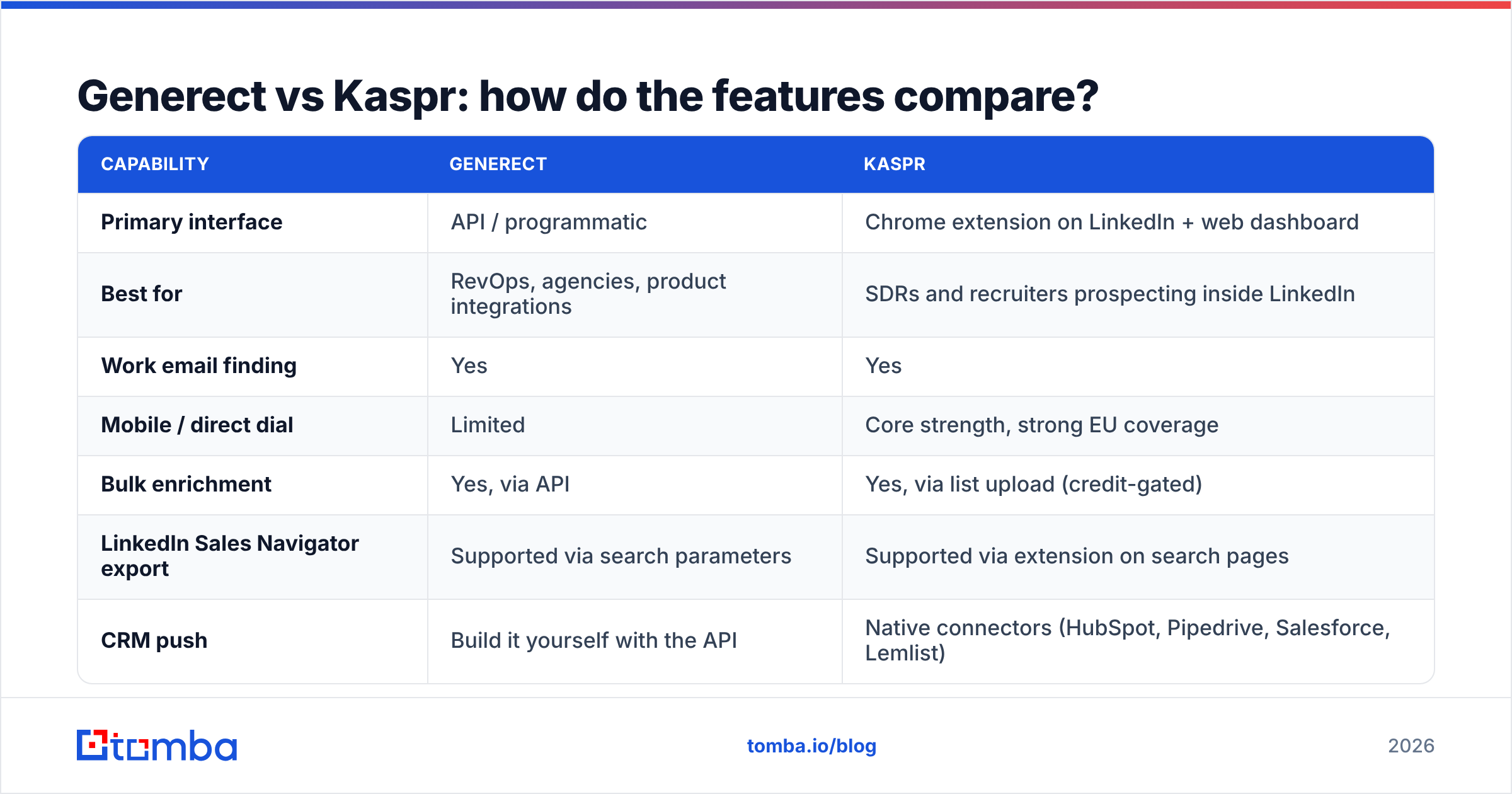
| Capability | Generect | Kaspr |
|---|---|---|
| Primary interface | API / programmatic | Chrome extension on LinkedIn + web dashboard |
| Best for | RevOps, agencies, product integrations | SDRs and recruiters prospecting inside LinkedIn |
| Work email finding | Yes | Yes |
| Mobile / direct dial | Limited | Core strength, strong EU coverage |
| Bulk enrichment | Yes, via API | Yes, via list upload (credit-gated) |
| LinkedIn Sales Navigator export | Supported via search parameters | Supported via extension on search pages |
| CRM push | Build it yourself with the API | Native connectors (HubSpot, Pipedrive, Salesforce, Lemlist) |
| Real-time freshness | Retrieval at query time | Cached pool, refreshed periodically |
| Pricing shape | Volume / API tiers | Per user, per month |
| Free tier | Trial / demo access | Yes, limited monthly credits |
| Learning curve | Developer required | Ten minutes for a rep |

Read that table as two columns describing two different jobs. If more than three rows in the Generect column read as "we'd never use that," you're not shopping for Generect — you're shopping for Kaspr or a rep-side alternative, and vice versa.
Which one is better for phone numbers?#
Kaspr, clearly, and it isn't close on European mobiles.
Phone data is the hardest B2B data type to acquire and the fastest to decay. Kaspr's entire positioning is built around it, and it inherits credibility from the Cognism side of the house on compliance — including a notified-prospects process and a do-not-call list scrub that matters if you're dialing in Germany, France, or the UK. If your motion is cold calling first and email second, that alone can decide the purchase.
Generect will return phone data in some records, but treating it as a dialer feed will disappoint you. Its center of gravity is company and people resolution at scale.
If you need numbers but not a per-seat LinkedIn tool, a standalone phone finder plugged into your existing sequencer is usually the cheaper path — you're buying the data type without buying the workflow wrapper around it.
How much do Generect and Kaspr actually cost?#
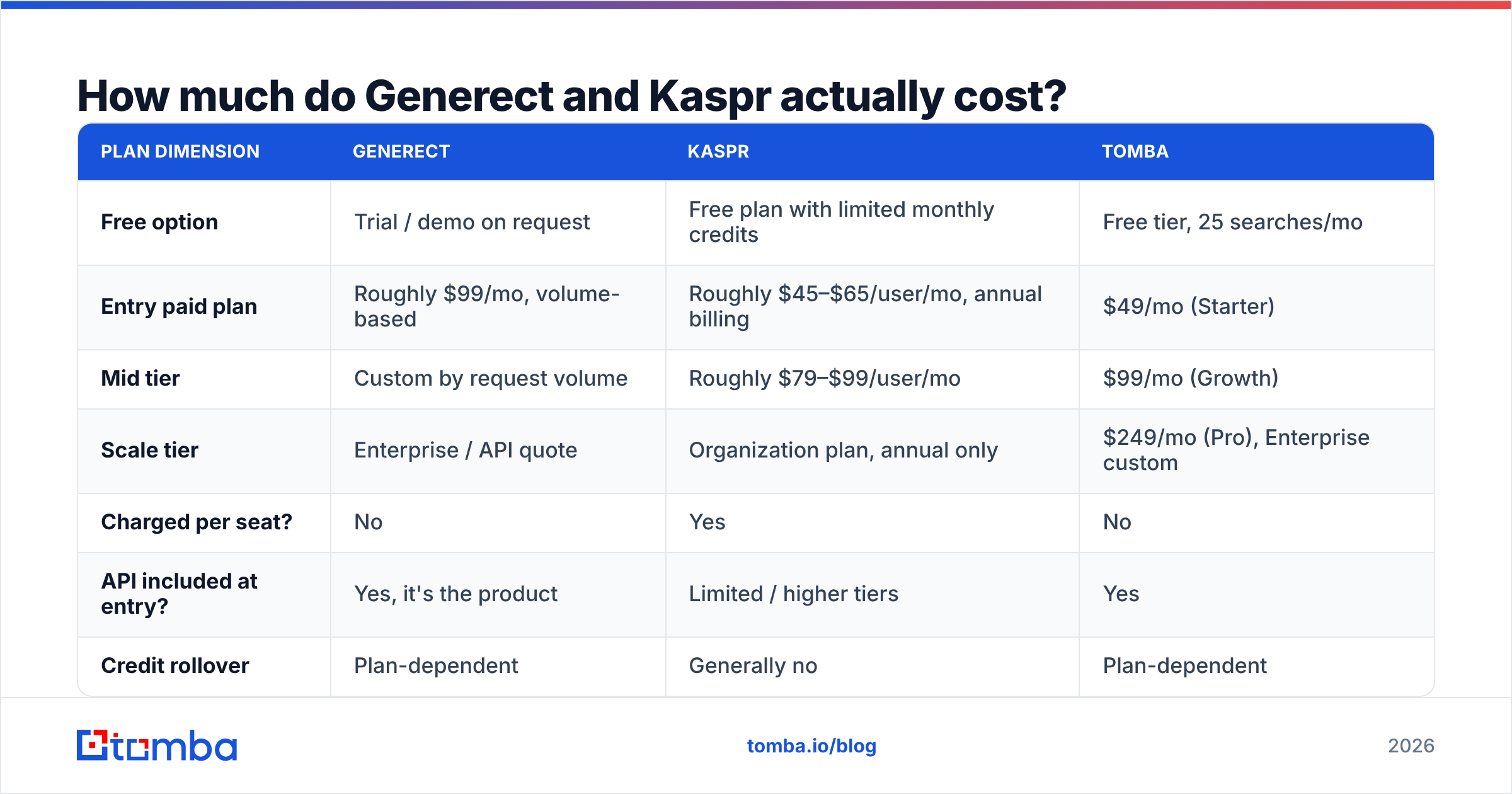
Both vendors move plans around, so treat the following as directional and confirm on their pricing pages before you sign anything.
| Plan dimension | Generect | Kaspr | Tomba |
|---|---|---|---|
| Free option | Trial / demo on request | Free plan with limited monthly credits | Free tier, 25 searches/mo |
| Entry paid plan | Roughly $99/mo, volume-based | Roughly $45–$65/user/mo, annual billing | $49/mo (Starter) |
| Mid tier | Custom by request volume | Roughly $79–$99/user/mo | $99/mo (Growth) |
| Scale tier | Enterprise / API quote | Organization plan, annual only | $249/mo (Pro), Enterprise custom |
| Charged per seat? | No | Yes | No |
| API included at entry? | Yes, it's the product | Limited / higher tiers | Yes |
| Credit rollover | Plan-dependent | Generally no | Plan-dependent |
Two structural points worth more than the exact numbers:
Per-seat pricing punishes growth. Kaspr at ~$79/user/mo across eight SDRs is roughly $7,600 a year before anyone has sent an email. That's fine if all eight reps use it daily. It's terrible if three of them prospect once a week.
Volume pricing punishes idleness. Generect-style plans are efficient when you're pulling continuously and wasteful when your pipeline is seasonal. Ask specifically about unused-credit behavior and minimum commitments.
If you want a middle path — no per-seat tax, predictable monthly cost, API included from the first paid tier — that's the shape of Tomba pricing, and it's the reason a lot of teams end up running a lean finder alongside (not instead of) a specialist phone tool.

Which tool fits your workflow?#
Match the tool to the motion, not to the feature list.
- You run outbound calling in Europe. Kaspr. The mobile coverage and the compliance posture are the product. Nothing here beats it on that axis.
- You're building an internal enrichment service. Generect. You want endpoints, not a UI, and you want to control the orchestration layer yourself.
- You're an agency running 20 client campaigns. Generect or a finder API. Per-seat pricing across multiple client workspaces gets ugly fast.
- Your reps live in LinkedIn Sales Navigator all day. Kaspr, or a dedicated LinkedIn finder if you only need the email and not the dialer stack.
- You know the company but not the person. Neither is ideal. Domain-first search — give me a domain, return the pattern plus every reachable contact — is a different primitive, and it's where a purpose-built email finder outperforms both.
- You need one-off enrichment a few times a month. Buy neither on annual terms. Start on a free tier and measure hit rate against your own list before committing.
What do users actually complain about?#
Across public reviews on G2 and similar sites, the recurring themes cluster predictably.
For Kaspr, the common friction points are credit exhaustion faster than expected, annual-billing lock-in on the better tiers, and coverage that drops off outside its strongest European markets. The mobile data itself is rarely the complaint — the commercial packaging usually is.
For Generect, the recurring theme is that non-technical teams underestimate the implementation lift. There's no army of reps who will self-serve their way into an API. Teams that assign an owner and budget a week of integration work report good outcomes; teams that expected a plug-and-play dashboard do not.
Neither pattern is a scandal. Both are what you'd predict from the product category. The lesson is to pilot against your own ICP list of 200 accounts before you scale a contract — measure hit rate, bounce rate, and connect rate on data you can independently verify.
Is there a better alternative to both?#
It depends entirely on which half of the job you actually need.
If your bottleneck is verified work emails at domain scale, both Generect and Kaspr are heavier than the problem requires. You're paying for phone infrastructure or for a general-purpose data platform when what you need is: give me a domain, return every contact with a confidence score and a verification verdict.
That's the narrow slice Tomba is built for. Domain search returns the company's email pattern plus known contacts. The finder resolves name-plus-domain to an address. The verifier runs SMTP and catch-all checks before you send. All of it is reachable through the Tomba API on every paid plan, with no per-seat charge, starting at $49/mo. That last detail is what makes it viable to hand access to a whole team, or to an automation that runs nightly, without a procurement conversation.
What Tomba deliberately does not do: it isn't a dialer data provider with deep European mobile coverage, and it isn't a LinkedIn workflow suite. If cold calling French mid-market is your motion, Kaspr is the honest answer and you should buy it. If you need a general enrichment platform your engineers will build on, Generect deserves a demo.
The stack most teams land on looks like this: a specialist tool for the one data type that's genuinely hard (phones), plus a fast, cheap, API-accessible finder and verifier for the volume work (emails). Trying to buy one tool that does both well usually means overpaying for half of it.
How should you run the evaluation?#
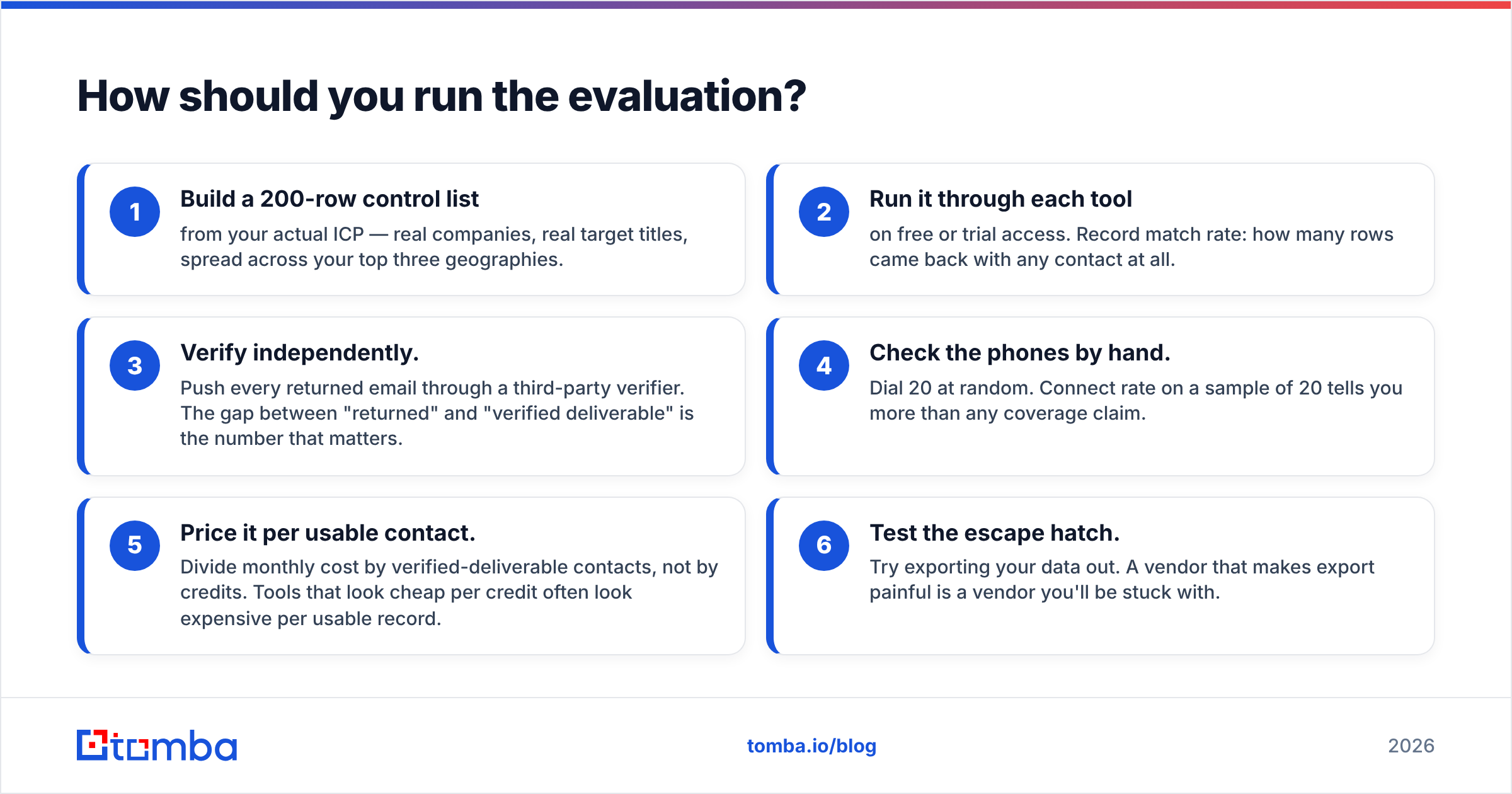
Give both a fair test with the same inputs, and score on outcomes rather than dashboards:
- Build a 200-row control list from your actual ICP — real companies, real target titles, spread across your top three geographies.
- Run it through each tool on free or trial access. Record match rate: how many rows came back with any contact at all.
- Verify independently. Push every returned email through a third-party verifier. The gap between "returned" and "verified deliverable" is the number that matters.
- Check the phones by hand. Dial 20 at random. Connect rate on a sample of 20 tells you more than any coverage claim.
- Price it per usable contact. Divide monthly cost by verified-deliverable contacts, not by credits. Tools that look cheap per credit often look expensive per usable record.
- Test the escape hatch. Try exporting your data out. A vendor that makes export painful is a vendor you'll be stuck with.
That evaluation takes about a day and will save you a year of paying for the wrong category.
Ready to fix the email half of the problem?#
If your reps are burning credits on a per-seat tool just to get work email addresses, you're paying dialer prices for a task that costs a fraction of that. Start with the Tomba Email Finder — 25 free searches a month, no card, and the same API on the free tier that runs on Enterprise. Run your control list through it, verify the results, and compare cost per usable contact against whatever quote is sitting in your inbox. If Generect or Kaspr wins on your data, buy it with confidence. If they don't, you just saved a five-figure line item.
Related guides#
Ready to find emails that actually work?
Join 150,000+ professionals who stopped guessing and started sending. Free credits on signup — no credit card required.
Get the Tomba newsletter
Practical outbound tactics and product updates — once every two weeks.
About the author