Generect vs Kipplo (2026): Which B2B Lead Data Tool Wins?
Generect sells real-time LinkedIn-sourced lead data; Kipplo bundles data with outbound sending. We compare accuracy, pricing, API depth, and the workflows each one actually fits.
TL;DR
- Generect is a data-first platform: real-time LinkedIn-sourced lead search, company and people APIs, and bulk enrichment. You bring your own sequencer.
- Kipplo leans all-in-one: contact database plus native email sending, so a solo founder can prospect and send from a single tab.
- Neither publishes independently audited accuracy rates. Treat every "98% accurate" claim from either vendor as a marketing number until you verify a sample yourself.
- If your bottleneck is data quality and API access, Generect wins. If it is tooling sprawl, Kipplo wins. If it is email deliverability, neither is enough on its own — you still need a dedicated verification layer.
- Cheapest honest setup for most teams: a focused email finder like Tomba ($49/mo Starter) plus a sending tool you already trust, rather than paying twice for overlapping features.
What are Generect and Kipplo, exactly?#
Generect positions itself as a B2B lead-data engine. Its pitch is freshness: instead of serving a static database snapshot that ages every month, it pulls leads on demand against live LinkedIn search filters, then enriches them with work emails and firmographics. It ships people search, company search, and bulk enrichment endpoints, plus an API most of its customers use to feed CRMs and internal scoring models.
Kipplo takes the opposite architectural bet. Rather than being the best possible data layer for someone else's stack, it tries to be the only tab you open: search a contact database, build a list, write the sequence, and send — all in one product. That appeals hard to solo founders, agencies running lean, and first-time SDRs who do not want to wire four subscriptions together.
The strategic difference matters more than any feature checkbox:
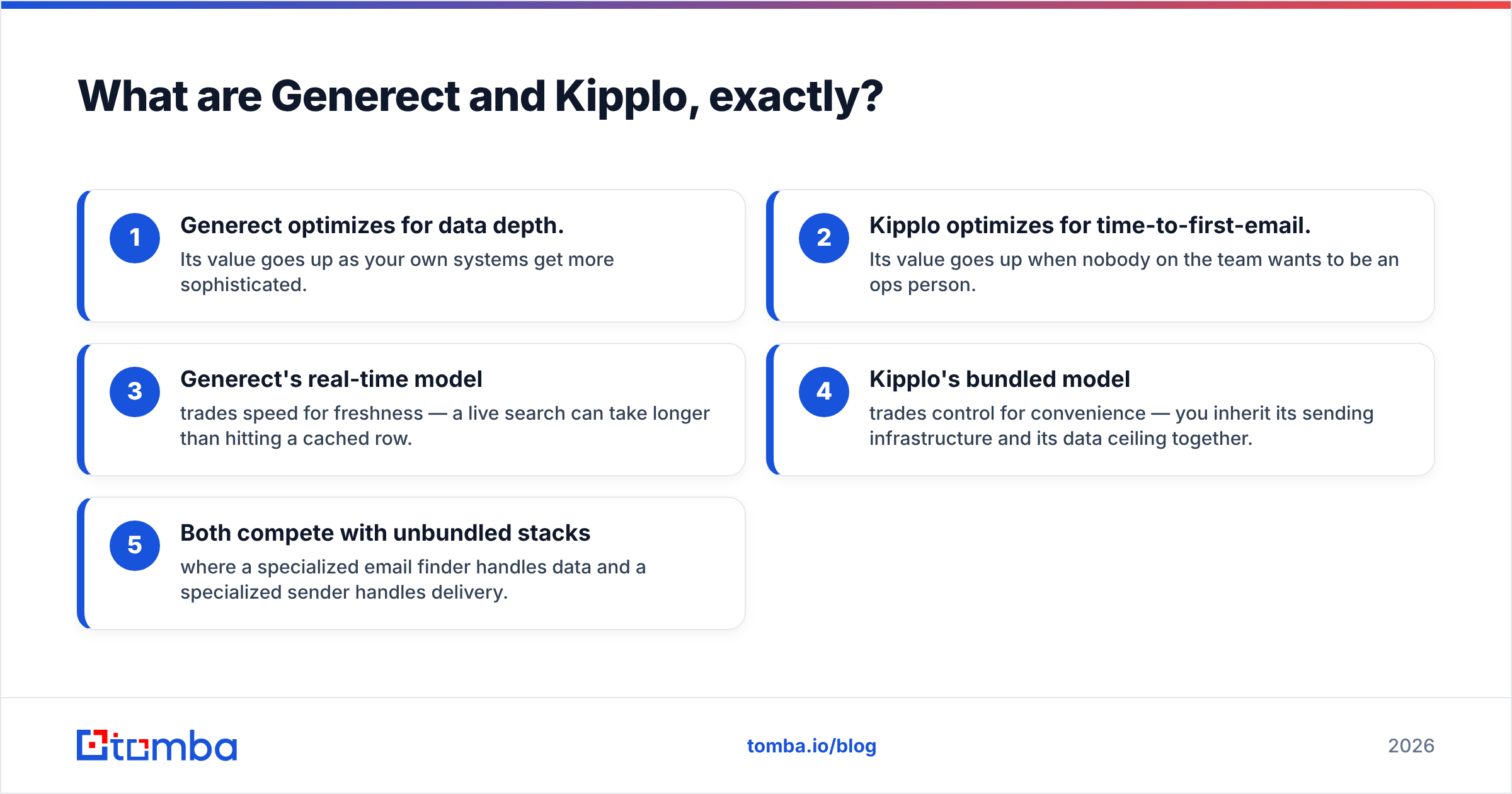
- Generect optimizes for data depth. Its value goes up as your own systems get more sophisticated.
- Kipplo optimizes for time-to-first-email. Its value goes up when nobody on the team wants to be an ops person.
- Generect's real-time model trades speed for freshness — a live search can take longer than hitting a cached row.
- Kipplo's bundled model trades control for convenience — you inherit its sending infrastructure and its data ceiling together.
- Both compete with unbundled stacks where a specialized email finder handles data and a specialized sender handles delivery.
How do Generect and Kipplo compare on features and pricing?#
Public pricing for both tools moves, and both run custom quotes above a certain volume. Verify current numbers on their own sites before you sign anything — the table below reflects the shape of each offer, not a locked-in quote.
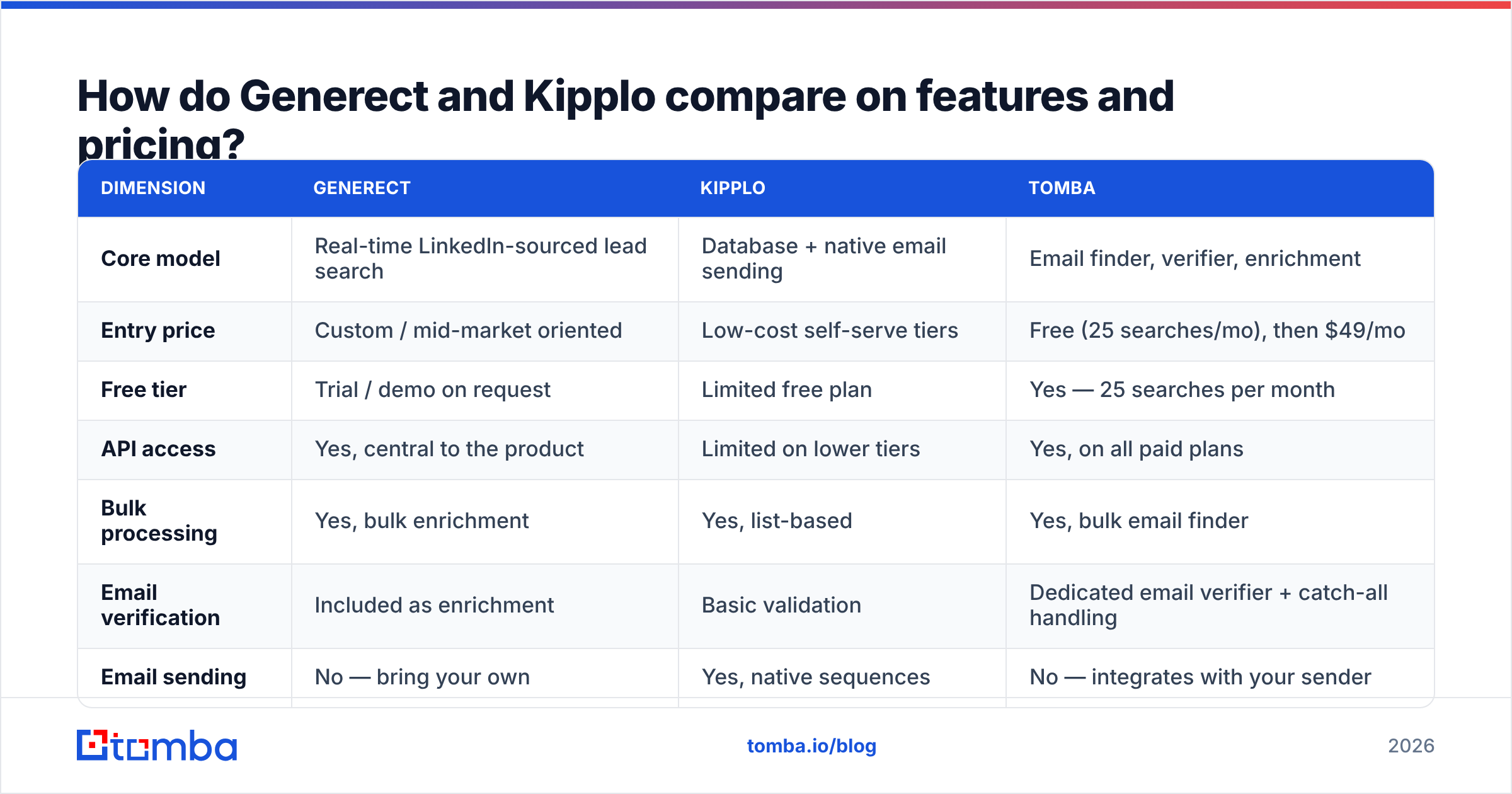
| Dimension | Generect | Kipplo | Tomba |
|---|---|---|---|
| Core model | Real-time LinkedIn-sourced lead search | Database + native email sending | Email finder, verifier, enrichment |
| Entry price | Custom / mid-market oriented | Low-cost self-serve tiers | Free (25 searches/mo), then $49/mo |
| Free tier | Trial / demo on request | Limited free plan | Yes — 25 searches per month |
| API access | Yes, central to the product | Limited on lower tiers | Yes, on all paid plans |
| Bulk processing | Yes, bulk enrichment | Yes, list-based | Yes, bulk email finder |
| Email verification | Included as enrichment | Basic validation | Dedicated email verifier + catch-all handling |
| Email sending | No — bring your own | Yes, native sequences | No — integrates with your sender |
| Phone data | Available | Limited | Yes, phone finder |
| Best for | Data teams, RevOps, API builders | Solo founders, small agencies | Teams that need accurate contact data at a predictable price |
The row that decides most evaluations is email sending. If you already pay for Instantly, Smartlead, Lemlist, or an Outreach alternative, Kipplo's sending module is a duplicate cost. If you pay for none of them, it is the entire reason to choose Kipplo.
The second decisive row is API access. Generect treats the API as the product. Kipplo treats it as a feature that unlocks on higher plans. Ask yourself a blunt question: in six months, will an engineer on your team need to pull this data programmatically? If yes, an API gated behind an upgrade tier becomes an annoying tax.
Is Generect's real-time data actually more accurate?#
Sometimes — and the mechanism is worth understanding because it explains where the freshness advantage disappears.
A static database is a photograph. Someone crawled a profile in March, wrote a row, and served that row to every customer until the next refresh cycle. When your prospect changed jobs in May, the row is now wrong, and nothing in the system knows it. Industry churn estimates put B2B contact data decay somewhere in the 25–30% per year range, which means a database refreshed annually is meaningfully broken by month nine.
A real-time approach is a live camera. Generect runs the search against current LinkedIn results when you ask, so job-title and company fields reflect what the profile says today. That genuinely reduces the "she left eight months ago" problem.
Here is the caveat vendors skip: fresh does not mean deliverable. Knowing that Sarah is now VP Marketing at Acme tells you her title is current. It does not tell you whether sarah@acme.com accepts mail, whether Acme runs a catch-all domain that accepts everything and bounces nothing, or whether that mailbox is a role account routed to a shared inbox. Pattern-guessed emails validate as "syntactically fine" and still bounce.
That is why serious outbound teams keep verification as a separate step regardless of where the data came from. A catch-all verifier is the specific tool for the hardest case — domains configured to accept all inbound mail, which defeat naive SMTP checks and quietly wreck your sender reputation when the invalid addresses bounce later.

Practical test before you buy either tool: pull 100 contacts from a segment you know well — ideally an industry where you can eyeball whether the companies and titles are real. Run all 100 through an independent verifier. Count hard bounces after a small send. That number is your actual accuracy rate, and it will be lower than the marketing page. Both vendors will look worse than advertised; the question is which looks less worse on your specific ICP.
Which one fits your workflow better?#
Match the tool to the bottleneck, not to the feature count.
Choose Generect if:
- You have engineering capacity. The API is the point. If nobody will use it, you are paying for the expensive half of the product and ignoring it.
- Your ICP shifts frequently. Real-time search means you can chase a new segment without waiting for a database refresh.
- You run enrichment on existing records. Bulk enrichment against a CRM export is a strong use case here.
- Your sending stack is already good. No reason to rip out a sequencer that works.
Choose Kipplo if:
- You are one person doing everything. Consolidation has real value when context-switching is your main cost.
- Your volume is modest. Low hundreds of emails a month, not tens of thousands.
- You want predictable billing. One line item beats three.
- You are testing whether outbound works at all. Cheap all-in-one is the right shape for an experiment.
Choose neither if:
- Your problem is that emails land in spam. No data vendor fixes email deliverability. Warmup, SPF/DKIM/DMARC alignment, and sending volume discipline do.
- You need data for a specific narrow job — finding article authors, reversing an email back to a person, extracting contacts from a domain. Point tools are cheaper and better at those.

What are the real alternatives to Generect and Kipplo?#
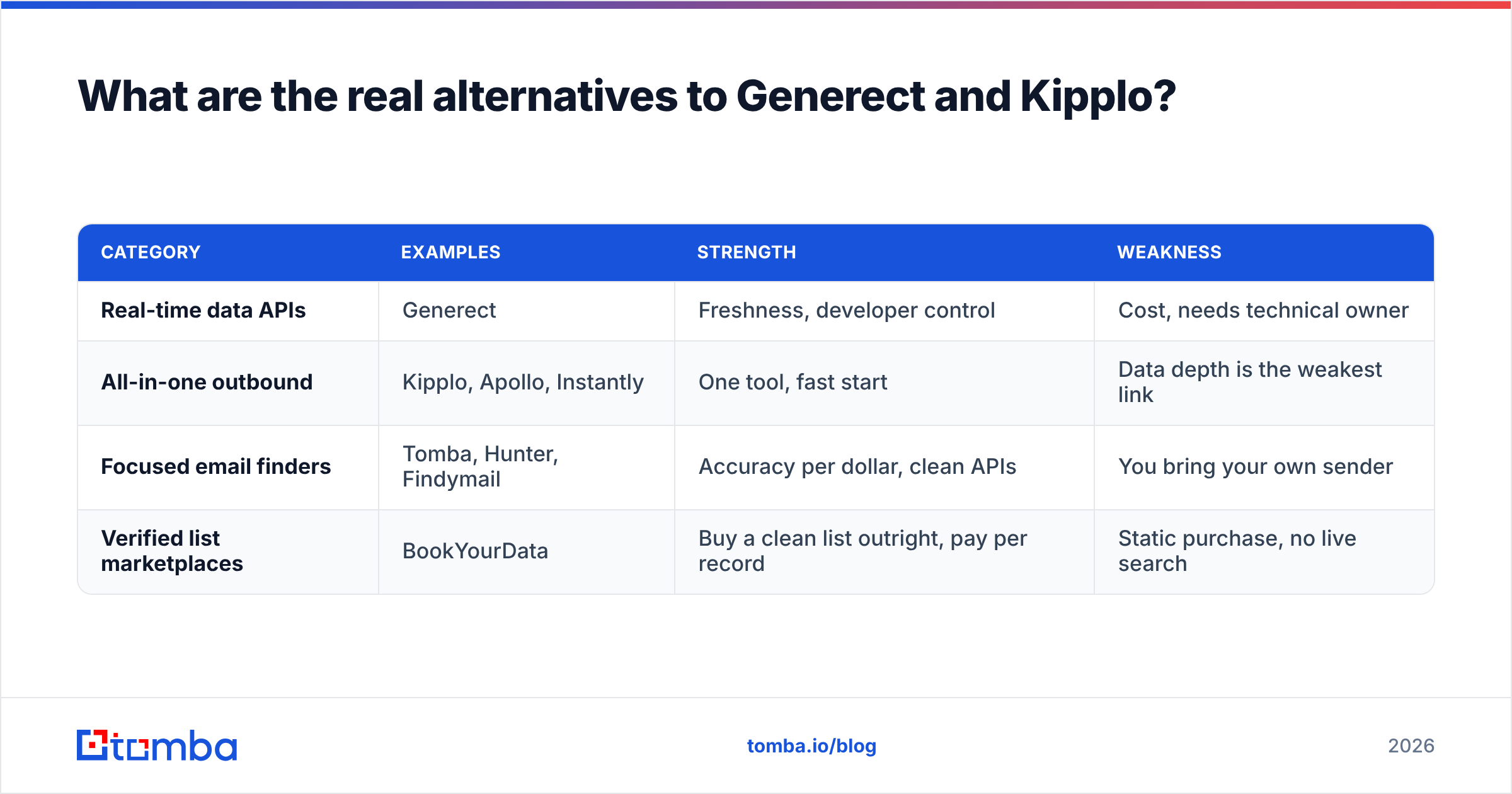
The two-way comparison is a false frame. The B2B data market has at least four distinct product shapes, and picking the wrong shape costs more than picking the wrong vendor within a shape.
| Category | Examples | Strength | Weakness |
|---|---|---|---|
| Real-time data APIs | Generect | Freshness, developer control | Cost, needs technical owner |
| All-in-one outbound | Kipplo, Apollo, Instantly | One tool, fast start | Data depth is the weakest link |
| Focused email finders | Tomba, Hunter, Findymail | Accuracy per dollar, clean APIs | You bring your own sender |
| Verified list marketplaces | BookYourData | Buy a clean list outright, pay per record | Static purchase, no live search |
BookYourData deserves a specific note because it solves a problem the others do not: sometimes you do not want a subscription or a search UI, you want a verified list of 5,000 contacts in a defined segment, delivered as a file, with a bounce guarantee attached. That is a legitimately different purchase from either Generect's live API or Kipplo's bundled sender, and for one-off campaigns it can be the cleanest option.
For most teams reading a "Generect vs Kipplo" comparison, though, the honest recommendation is the unbundled middle: a focused finder plus a sender you chose separately.
Here is why that math usually wins. Bundled tools charge for the average customer's usage of every module. If you use the data heavily and the sender lightly, you subsidize other people's sending. Focused tools let you scale the line item that actually correlates with your pipeline. Tomba pricing starts free at 25 searches per month, moves to $49/mo Starter, $99/mo Growth, and $249/mo Pro — and the API is available on paid plans rather than gated behind an enterprise conversation.

Independent review sites are the right place to sanity-check any of this. G2 and Capterra both carry verified-buyer reviews for this category, and reading the two-star reviews teaches you more than the five-star ones. Look specifically for complaints about bounce rates, billing surprises, and support response times — those are the three things that actually hurt once you are committed.
How should you run the evaluation?#
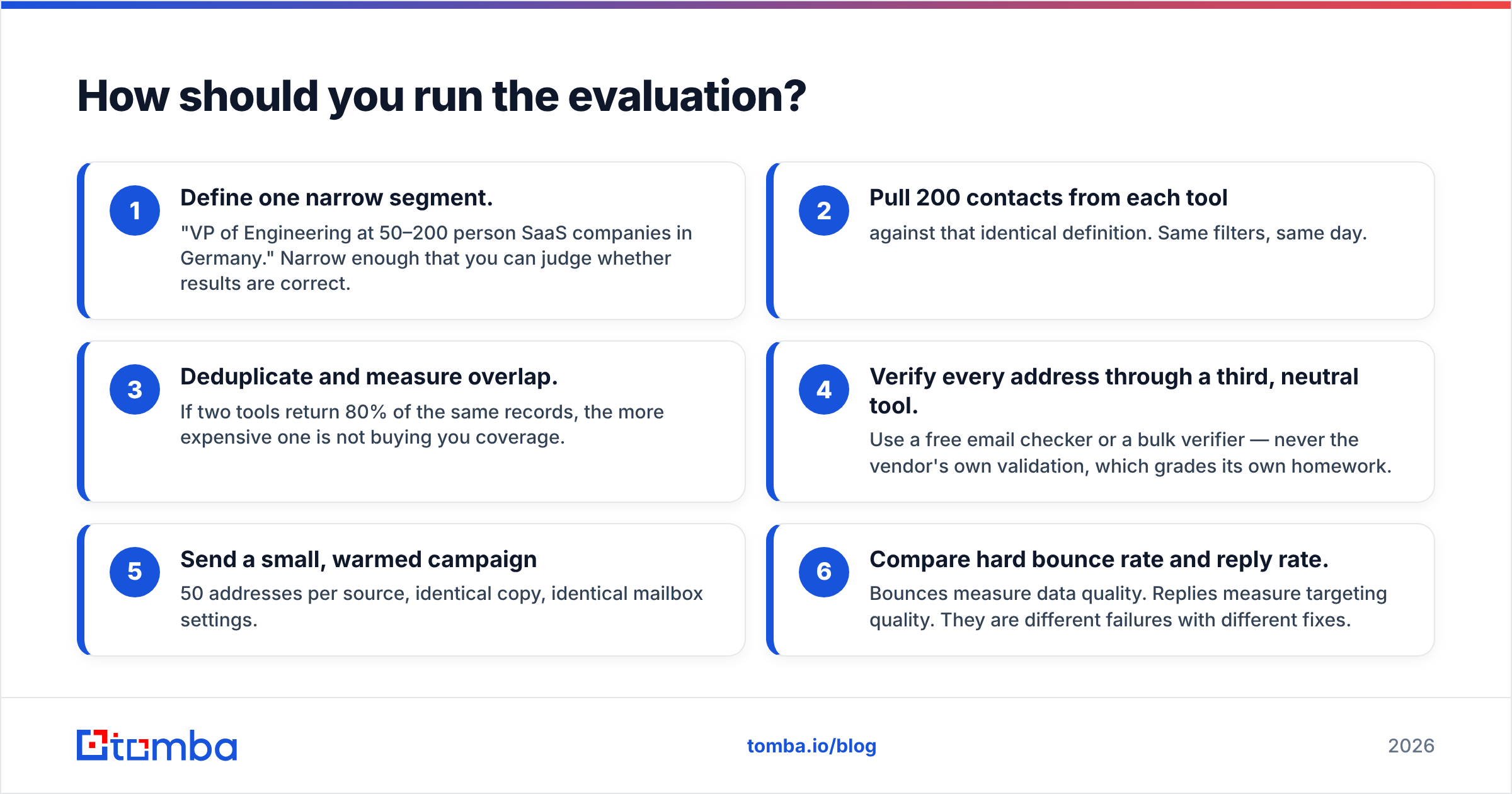
Do not compare feature pages. Run a controlled bake-off, and budget about a week for it.
- Define one narrow segment. "VP of Engineering at 50–200 person SaaS companies in Germany." Narrow enough that you can judge whether results are correct.
- Pull 200 contacts from each tool against that identical definition. Same filters, same day.
- Deduplicate and measure overlap. If two tools return 80% of the same records, the more expensive one is not buying you coverage.
- Verify every address through a third, neutral tool. Use a free email checker or a bulk verifier — never the vendor's own validation, which grades its own homework.
- Send a small, warmed campaign — 50 addresses per source, identical copy, identical mailbox settings.
- Compare hard bounce rate and reply rate. Bounces measure data quality. Replies measure targeting quality. They are different failures with different fixes.
The result usually surprises people. Coverage differences between vendors are often smaller than expected, while deliverable coverage differences are large. One tool returns 190 addresses and 140 are valid; another returns 150 and 138 are valid. The second tool is better despite looking worse on the dashboard.
Also check the boring operational stuff during the trial: does the export include the fields your CRM requires, does the HubSpot integration or Salesforce sync map cleanly, and what happens to your credits when a search returns garbage? Credit-refund policy on invalid results is a real differentiator that almost nobody evaluates until they are angry about it.
What is the verdict for 2026?#
Generect is the better tool if data is your product input and you have someone who can use an API. Its real-time model genuinely addresses the staleness problem that plagues static databases, and its bulk enrichment fits RevOps workflows well. You will pay mid-market prices and you will still need a sender and a verifier.
Kipplo is the better tool if you are one person who wants to start sending this afternoon. The bundle is the feature. Just go in knowing that all-in-one products almost always have one module that is clearly weaker than the rest, and in this category it is usually the data.
Most teams should unbundle. Buy the best data layer you can afford, verify independently, and send from a tool chosen on deliverability merits alone. That stack costs less than it sounds like and each piece is replaceable without a migration project.
If accurate contact data at a predictable price is what you actually need, start with the Tomba Email Finder. The free tier gives you 25 searches a month to run the bake-off described above — enough to test against your real ICP before any card comes out. Paid plans start at $49/mo with full API access, bulk processing, catch-all handling, and native integrations into the CRM you already run. Test it against whatever Generect or Kipplo quotes you, measure the bounce rate yourself, and let the numbers pick the winner.
Related guides#
Ready to find emails that actually work?
Join 150,000+ professionals who stopped guessing and started sending. Free credits on signup — no credit card required.
Get the Tomba newsletter
Practical outbound tactics and product updates — once every two weeks.
About the author