Generect vs LakeB2B: B2B Data Accuracy, Pricing, and Fit
Generect sells live, API-first B2B contact lookups. LakeB2B sells custom-built lists you buy once. Here is how the two models compare on accuracy, price, compliance, and which one actually fits your outbound motion.
Generect vs LakeB2B is a choice between two data models, not two brands. One sells live lookups. The other sells lists built to order. Here is the short version.
TL;DR
- Generect is an API-first B2B data provider. You query for people and companies, and you get contacts back in near real time. Much of the data is LinkedIn-derived. It suits engineering-adjacent teams that want data on demand.
- LakeB2B is a list and database vendor. You describe an audience, their team builds or pulls a targeted file, and you buy it. It suits campaign-driven teams and industries like healthcare, where curated segments matter.
The rest of the trade-off is about what that split costs you later.
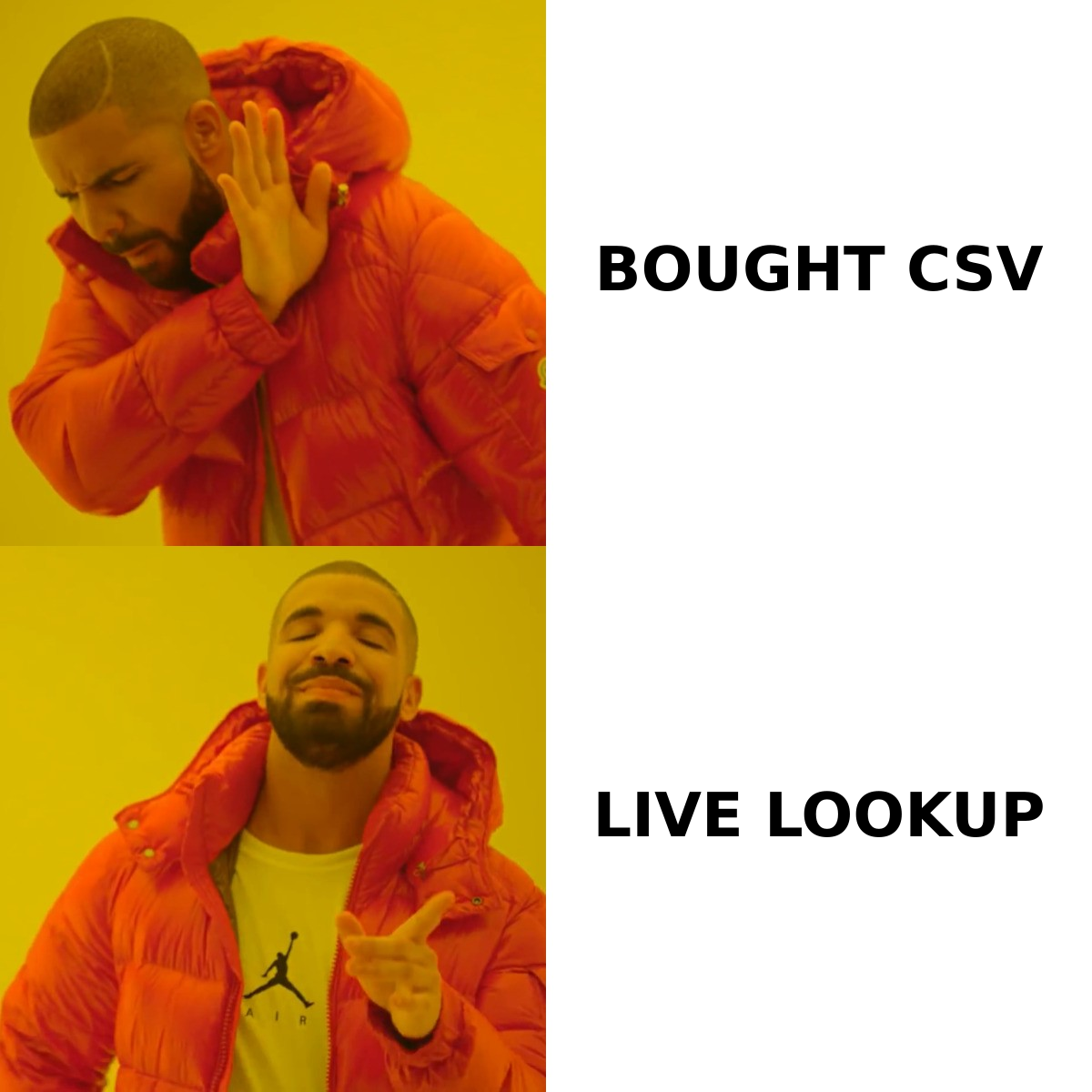
- The real split is not "which brand is better." It is live lookup vs delivered file. Live lookups decay slower. Delivered files are cheaper per record, but they start aging the day you receive them.
- Neither model removes your obligation to verify. Re-verify any list older than about 90 days before it touches a sending domain.
- If your bottleneck is "I have companies and names, I need valid work emails," a dedicated email finder plus verification usually costs less than either vendor's full data contract.
What are Generect and LakeB2B, exactly?#
They solve the same surface problem — "get me contacts to sell to" — from opposite directions.
Generect calls itself a real-time B2B lead data platform. You send a query: job title, seniority, geography, company size, tech signals, or a LinkedIn URL. It returns matching people and companies with work emails and firmographics. The product is built around an API and bulk search, not a static warehouse you browse. That matters for one reason. The record is built or refreshed close to the moment you ask for it, instead of being pulled off a shelf.
LakeB2B is a database and list provider. Its roots are in curated, industry-specific audiences. Healthcare and life sciences are its most-cited verticals, alongside technology, education, and manufacturing. You come with an audience brief, such as "US-based hospital procurement directors, 200+ beds." Their team builds the file from their database, plus appending and research, and delivers it. They also sell append, data cleansing, and intent overlays as separate services.
So: Generect is a faucet. LakeB2B is a delivery truck. Both bring water. Only one of them keeps running after the drop-off.
Generect vs LakeB2B: how does the data sourcing differ?#
This is the section most comparison pages skip. It drives every other difference below.
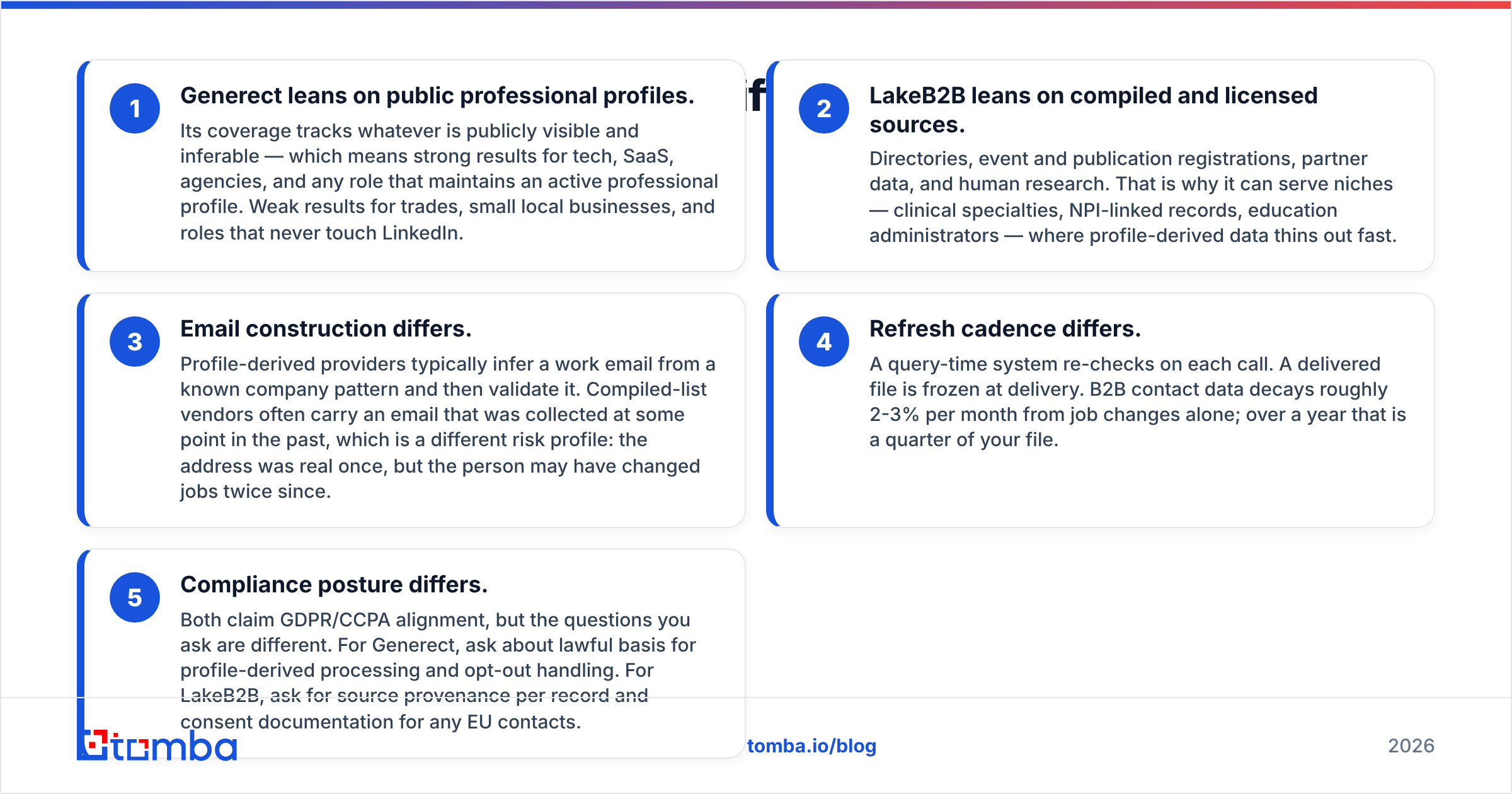
- Generect leans on public professional profiles. Its coverage tracks whatever is public and easy to infer. That means strong results for tech, SaaS, agencies, and any role with an active professional profile. It also means weak results for trades, small local businesses, and roles that never touch LinkedIn.
- LakeB2B leans on compiled and licensed sources. Directories, event and publication sign-ups, partner data, and human research. That is why it can serve niches where profile-derived data thins out fast, such as clinical specialties, NPI-linked records, and school administrators.
- Email construction differs. Profile-derived providers usually guess a work email from a known company pattern, then validate it. List vendors often carry an email that was collected at some point in the past. That is a different kind of risk. The address was real once, but the person may have changed jobs twice since.
Two more differences decide what the data is worth six months from now.
- Refresh cadence differs. A query-time system re-checks on each call. A delivered file is frozen at delivery. B2B contact data decays roughly 2-3% per month from job changes alone. Over a year, that is a quarter of your file.
- Compliance posture differs. Both claim GDPR and CCPA alignment. But you should ask each of them different questions. For Generect, ask about lawful basis for profile-derived data and how opt-outs are handled. For LakeB2B, ask for source provenance per record and consent records for any EU contacts.
If you only remember one thing: you are not comparing two datasets. You are comparing two freshness models.
Which one delivers better data accuracy?#
Treat neither vendor's self-reported accuracy number as a benchmark. Both publish figures above 90%, and so does nearly every provider here. "Accuracy" usually means "did the record pass our own check at build time." It does not mean "did it land in an inbox six weeks later."

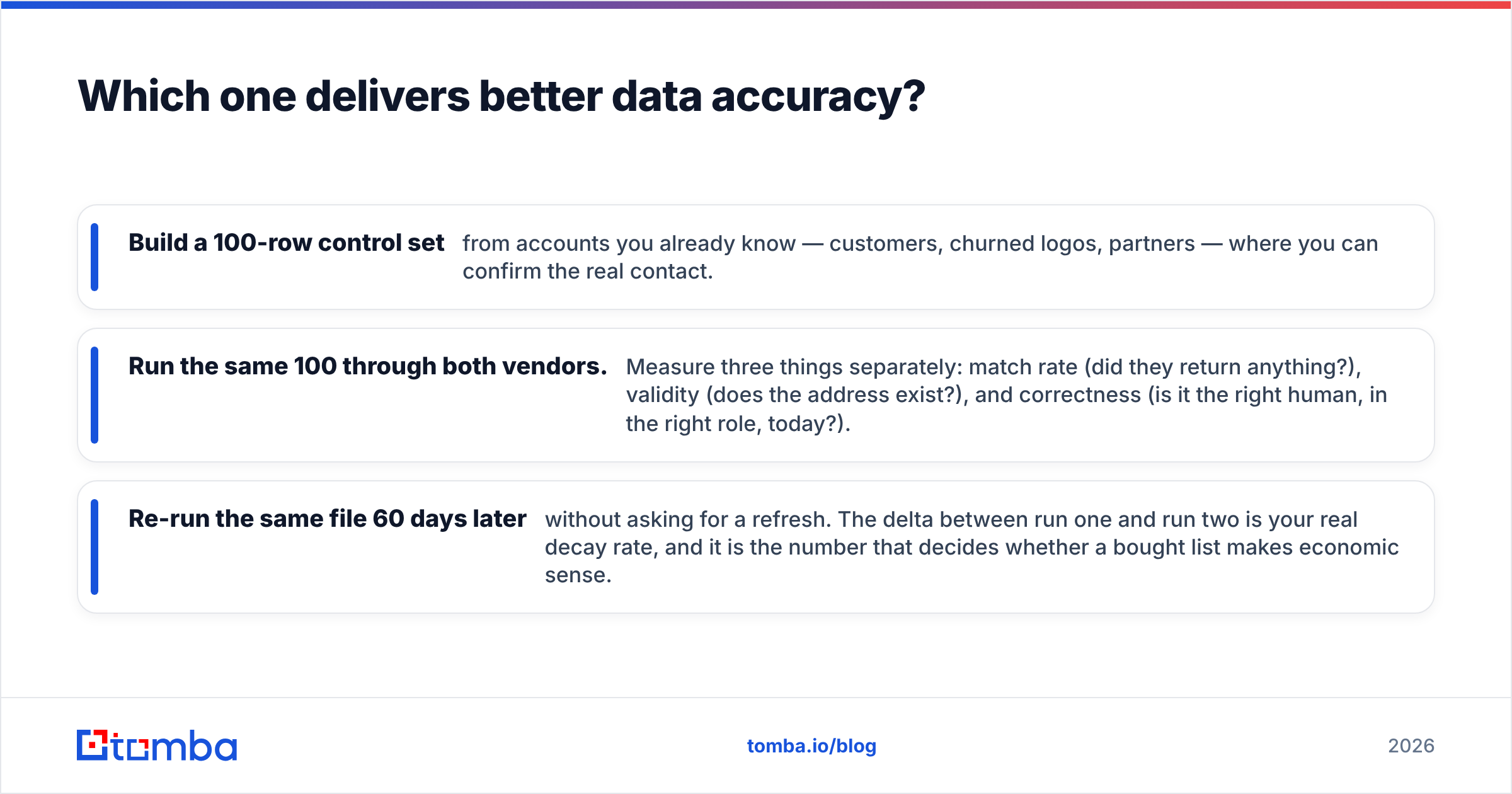
Here is a more useful way to test them, and it costs you a weekend:
- Build a 100-row control set from accounts you already know — customers, churned logos, partners — where you can confirm the real contact.
- Run the same 100 through both vendors. Measure three things separately: match rate (did they return anything?), validity (does the address exist?), and correctness (is it the right human, in the right role, today?).
- Re-run the same file 60 days later without asking for a refresh. The delta between run one and run two is your real decay rate. That number decides whether a bought list makes economic sense.
In most head-to-head tests of this shape, query-time providers win on correctness for tech-forward segments. List vendors win on match rate in verticals where public profiles are sparse. Bounce rate is a separate story. It is almost always decided by whether you re-verified before sending, not by which logo was on the invoice. Run everything through an email verifier whatever the source. Treat catch-all domains as their own bucket, with a catch-all verifier pass.
Generect vs LakeB2B pricing: how do the packages compare?#
Both vendors route most buyers through a sales call. So treat any number you see quoted on a third-party page — including this one — as a starting point to confirm, not a price list. What is stable is the shape of the pricing.

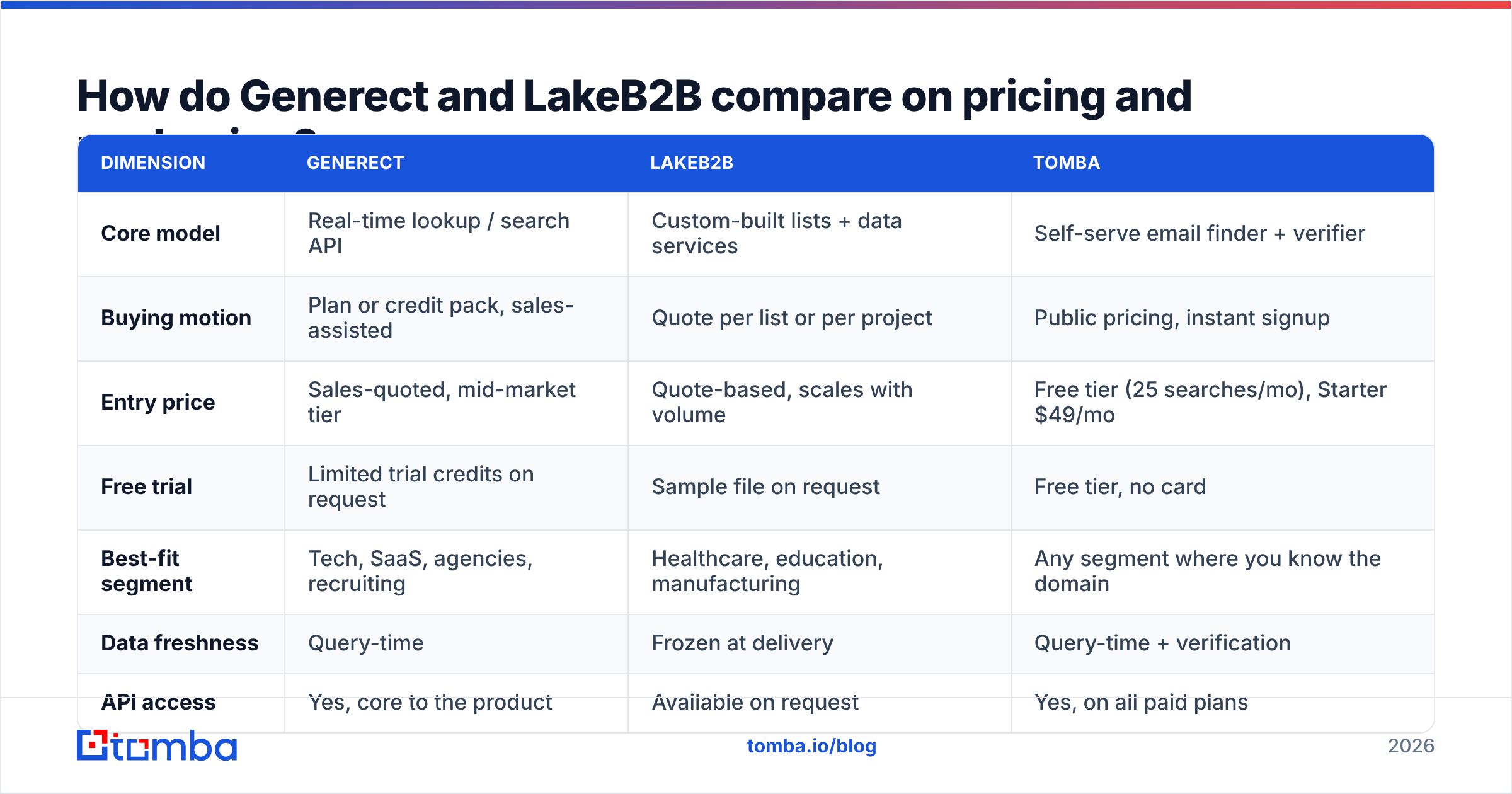
| Dimension | Generect | LakeB2B | Tomba |
|---|---|---|---|
| Core model | Real-time lookup / search API | Custom-built lists + data services | Self-serve email finder + verifier |
| Buying motion | Plan or credit pack, sales-assisted | Quote per list or per project | Public pricing, instant signup |
| Entry price | Sales-quoted, mid-market tier | Quote-based, scales with volume | Free tier (25 searches/mo), Starter $49/mo |
| Free trial | Limited trial credits on request | Sample file on request | Free tier, no card |
| Best-fit segment | Tech, SaaS, agencies, recruiting | Healthcare, education, manufacturing | Any segment where you know the domain |
| Data freshness | Query-time | Frozen at delivery | Query-time + verification |
| API access | Yes, core to the product | Available on request | Yes, on all paid plans |
| Verification included | Bundled validation | Add-on cleansing service | Built-in verifier |
| Phone numbers | Yes, on select records | Yes, on select records | Via phone finder add-on |
| Contract | Monthly or annual | Typically per-project or annual | Monthly, cancel anytime |
Two things fall out of that table.
First, list purchases look cheap per record and expensive per meeting. A $0.15 record that is 30% stale is not a $0.15 record. It is a $0.21 record, plus the deliverability damage from the bounces you did not catch.
Second, API pricing looks expensive until you count the credits you do not spend. Query-time systems let you enrich only the accounts that clear your ICP filter. A delivered file charges you for the whole segment, whether you work it or not.
Want a public reference point for self-serve pricing in this category? Tomba pricing runs Free (25 searches/mo), Starter $49/mo, Growth $99/mo, Pro $249/mo, and custom Enterprise. No quote call is needed to see the numbers.

Which one should you pick for your use case?#
Match the tool to the motion, not to the feature grid.
- Pick Generect if your ICP lives on LinkedIn, and you want enrichment fired by workflow events: a form fill, a site visit, a new account in the CRM. You also need someone who can wire up an API or a Zapier step. The value is on-demand freshness.
- Pick LakeB2B if you run channel campaigns against a defined vertical audience, above all in healthcare, education, or manufacturing. Public profiles are thin there. You also need firmographic depth like bed count, NPI, or institution type. The value is reach into places scrapers cannot go.
- Pick a dedicated email finder if your gap is narrower than either. You already have target companies and names from your CRM, a conference list, or an intent tool. You just need current, verified work addresses at a low cost per record.
The last two options are the ones teams reach after a bad quarter.
- Pick two of the above if your motion is realistic. Most teams that scale outbound use one source to discover people and a second, cheaper source to verify and refresh them. Paying discovery prices to re-check an address you already own is a waste.
- Pick neither if you have not fixed sending infrastructure first. A perfect list on an unwarmed domain with a broken SPF record still lands in spam. Check the basics with an SPF checker before you spend a dollar on data.
For teams in the third bucket, domain search plus bulk email finder covers the workflow without a procurement cycle: paste domains, get patterns and verified contacts, export.
What do reviewers and buyers actually say?#
Read the reviews, but read them structurally. On G2 and similar marketplaces, the complaint patterns here are much the same across vendors:
- For real-time providers: praise for freshness and API ergonomics. Complaints about coverage gaps outside tech, and about credits burned on searches that return nothing.
- For list vendors: praise for reaching niche audiences nobody else has. Complaints about bounce rates on older segments, and about the gap between the sample file and the full delivery.
The single most useful thing you can do before signing either contract: ask for a sample built from your actual ICP, not their demo segment, and insist on 100+ rows. A 20-row sample is a curated highlight reel. A 100-row sample starts to show the tail. The tail is what you will actually be emailing in month three.
Also ask, in writing: what is the replacement policy on hard bounces, and does it cover records you verified yourself after delivery? Vendors differ sharply here. The answer tells you how confident they are in their own numbers.
How do you keep either dataset from rotting?#
Buy the data once, maintain it forever. That is the part no vendor page covers.
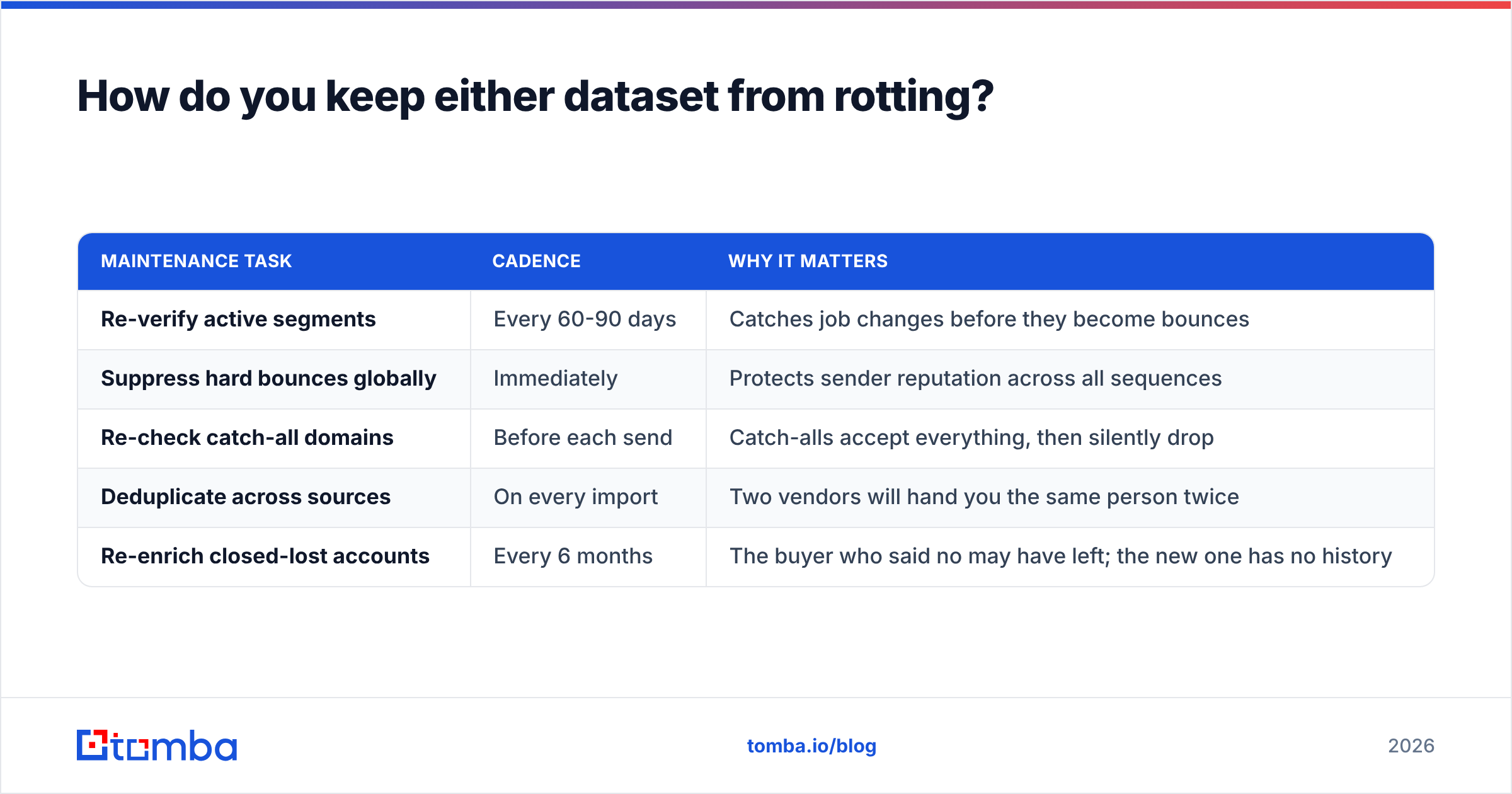
| Maintenance task | Cadence | Why it matters |
|---|---|---|
| Re-verify active segments | Every 60-90 days | Catches job changes before they become bounces |
| Suppress hard bounces globally | Immediately | Protects sender reputation across all sequences |
| Re-check catch-all domains | Before each send | Catch-alls accept everything, then silently drop |
| Deduplicate across sources | On every import | Two vendors will hand you the same person twice |
| Re-enrich closed-lost accounts | Every 6 months | The buyer who said no may have left; the new one has no history |
That loop is where a cheap, high-volume verification layer earns its keep. You paid $0.15 a record for the file. Running a $0.001-class verification pass over it is not wasted spend. It is insurance on the whole purchase. You can automate it through the Tomba API, or push it into your existing stack via integrations, so nothing enters the CRM unverified.
So which one wins?#
There is no single winner in Generect vs LakeB2B, and any page telling you otherwise is selling something.
Generect wins on freshness and workflow fit. Is your outbound triggered, event-driven, and aimed at buyers who are easy to find online? Then a query-time API is the right answer.
LakeB2B wins on reach into hard verticals. If you sell to hospital systems, school districts, or regional manufacturers, compiled and researched data covers ground that profile-derived data does not.
Both lose to a disciplined process. The teams with the best reply rates are not the ones who bought the best list. They are the ones who narrowed the ICP hard enough that a 400-row file was enough. Then they verified every address before sending, and re-verified before the second campaign.
Start by scoping what you actually need. If it is "discover audiences I cannot describe by domain," pay for a data platform. If it is "turn the companies and people I already know about into valid, current work emails," you need a finder and a verifier, not a contract.
Try that narrower path first. The Tomba Email Finder gives you 25 free searches a month with no card, built-in verification on every result, and public pricing from $49/mo if you scale up. Run your control set through it alongside whichever vendor is in your pipeline. Compare correctness on records you can confirm, and let the numbers pick the winner instead of the sales deck.
Related guides#
Ready to find emails that actually work?
Join 150,000+ professionals who stopped guessing and started sending. Free credits on signup — no credit card required.
Get the Tomba newsletter
Practical outbound tactics and product updates — once every two weeks.
About the author