Generect vs Lead411 in 2026: Which B2B Data Tool Wins?
Generect sells LinkedIn-native lead data through an API. Lead411 sells US-heavy sales intelligence with intent signals and direct dials. Here is which one actually fits your motion — and when neither is the right buy.
TL;DR
- Generect is a developer-first lead data platform built around LinkedIn-style search logic and an API. You define an ICP filter, it returns companies and people with emails attached. Best for teams that want to script prospecting, not click through a UI.
- Lead411 is a classic US-focused sales intelligence database: verified emails, direct-dial mobile numbers, Bombora-powered intent data, and growth triggers. Best for AE/SDR teams selling into North America who want phone numbers as much as email.
- Pricing shape differs more than pricing level. Lead411 charges per seat with export caps on annual contracts; Generect leans toward volume/API-based plans. Both quote custom for anything real-sized.
- Neither is a great fit if all you need is email discovery and verification. A dedicated email finder costs a fraction of a full intelligence suite.
- Our pick: Lead411 if you cold-call the US. Generect if you build automated pipelines. Tomba if your bottleneck is finding and verifying addresses, not buying another database.
What are Generect and Lead411, actually?#
They get compared because both sell B2B contact data, but they were built to solve different problems.
Generect (generect.com) positions itself as a lead generation engine with an API-first delivery model. The pitch: instead of exporting CSVs from a UI and re-importing them into your stack, you send a filtered request — industry, headcount, geography, job title, technology, LinkedIn activity — and get structured lead records back. It leans heavily on LinkedIn-derived signals for company and people search, which means its strength is targeting precision rather than raw record count.
Lead411 (lead411.com) has been in the sales intelligence category for well over a decade. It's a database product: search by title, industry, revenue, tech stack, or growth signals; get triple-verified emails and direct-dial mobile numbers; layer on Bombora intent data to see which accounts are already researching your category. It also ships a Chrome extension, CRM syncs (HubSpot, Salesforce, Pipedrive), and a light cadence tool.
The short version: Generect is infrastructure. Lead411 is a workspace.

How do Generect and Lead411 compare head-to-head?#
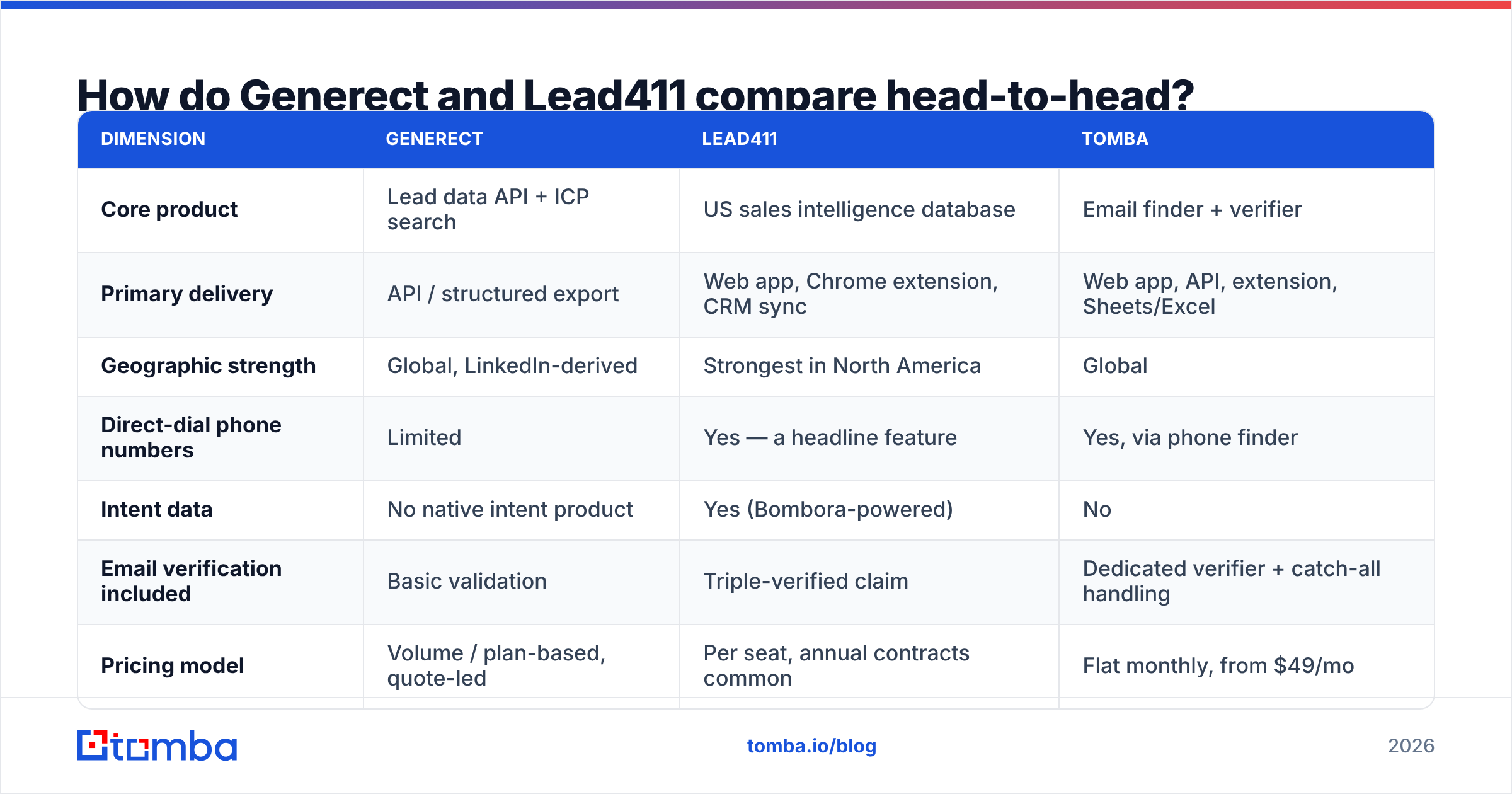
Here's the practical comparison. Treat all pricing as directional — both vendors quote custom for team plans, and published figures move. Verify on the vendor's own pricing page before you sign anything.
| Dimension | Generect | Lead411 | Tomba |
|---|---|---|---|
| Core product | Lead data API + ICP search | US sales intelligence database | Email finder + verifier |
| Primary delivery | API / structured export | Web app, Chrome extension, CRM sync | Web app, API, extension, Sheets/Excel |
| Geographic strength | Global, LinkedIn-derived | Strongest in North America | Global |
| Direct-dial phone numbers | Limited | Yes — a headline feature | Yes, via phone finder |
| Intent data | No native intent product | Yes (Bombora-powered) | No |
| Email verification included | Basic validation | Triple-verified claim | Dedicated verifier + catch-all handling |
| Pricing model | Volume / plan-based, quote-led | Per seat, annual contracts common | Flat monthly, from $49/mo |
| Free tier | Trial / demo-led | Limited free trial | 25 searches/mo, no card |
| Best for | Engineering-led GTM, automated pipelines | SDR/AE teams cold-calling the US | Teams that need accurate addresses cheaply |
Four things worth calling out from that table.
- Phone coverage is the clearest separator. If your motion is cold calling, Lead411's direct-dial database is a genuine differentiator over Generect. Generect's value is in who to contact; Lead411 also answers how to reach them by phone.
- Intent data is not a tie. Lead411 bundles Bombora intent topics. Generect has no equivalent. If you're running an account-based motion where timing matters more than volume, that's a real gap.
- API maturity flips the other way. Generect's whole architecture assumes you're calling it programmatically. Lead411 has an API, but it's an add-on to a UI product, and most customers use the app.
- Seat economics bite differently. Per-seat pricing punishes teams that want data available to ops, marketing, and RevOps — not just closers. Volume pricing punishes teams with one heavy user. Model your actual headcount before comparing sticker prices.
Which has better data accuracy?#
Nobody should take a vendor's accuracy percentage at face value — including Tomba's. Every provider defines "verified" differently, and the number is always measured on the subset of records where verification is easy.
What you can reason about is methodology:
- Lead411 claims triple verification and re-verifies on a rolling cycle. Its US coverage is genuinely dense; European and APAC records thin out noticeably, and GDPR constraints limit what's available for EU contacts. Reviewers on G2 consistently praise the direct dials and flag international coverage as the weak spot.
- Generect derives much of its people data from LinkedIn-style profiles, then infers and validates email patterns. That approach produces excellent targeting accuracy — the job titles and company attributes are current — but email deliverability depends entirely on the validation layer behind it.
Both approaches leave the same residual problem: catch-all domains. Roughly a fifth of business domains accept every address at the SMTP layer, so no provider can confirm a mailbox exists without additional signals. If a large share of your ICP sits on catch-all infrastructure, neither Generect nor Lead411 will give you a clean answer — you need a dedicated catch-all verifier in the pipeline before you send.
The practical rule: whatever database you buy, run the output through an independent email verifier before it reaches your sending tool. Double-verification costs pennies per thousand and protects the one asset you can't buy back — your sending domain reputation.
What does each one actually cost?#
This is where most comparison articles get vague, so let's be concrete about the shape of the cost rather than inventing precise numbers.
Lead411 sells primarily on a per-user, annually-billed basis with an export allowance attached. That means three cost drivers: number of seats, exports per seat per month, and add-ons (intent data and unlimited-export tiers are typically upcharges). A three-person SDR pod with intent data enabled lands in low-four-figures per month territory in most quotes we've seen described publicly. Overage on exports is the line item that surprises people.
Generect prices around volume and access rather than seats, and is quote-led for anything beyond an entry plan. That's better for small teams with big data appetites and worse if you want predictable per-user budgeting.
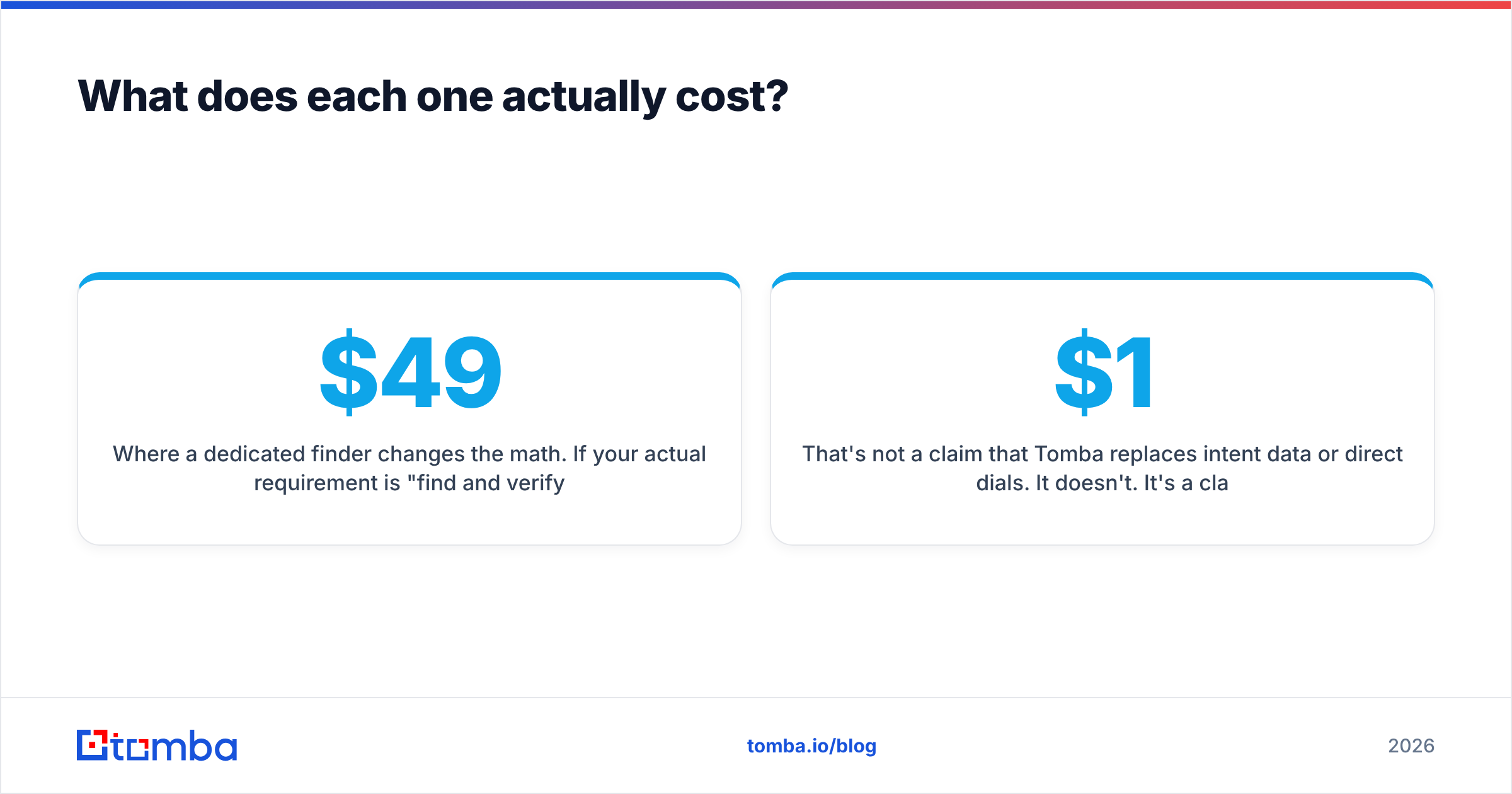
Where a dedicated finder changes the math. If your actual requirement is "find and verify professional email addresses at scale," a full intelligence suite is a lot of overhead. Tomba pricing starts at a free tier with 25 searches per month, then $49/mo for Starter, $99/mo for Growth, $249/mo for Pro, and custom at Enterprise — flat, no seat multipliers, with the same Tomba API available on every paid plan.
That's not a claim that Tomba replaces intent data or direct dials. It doesn't. It's a claim that many teams buy a $1,500/mo suite to solve a $99/mo problem.

When should you choose Lead411?#
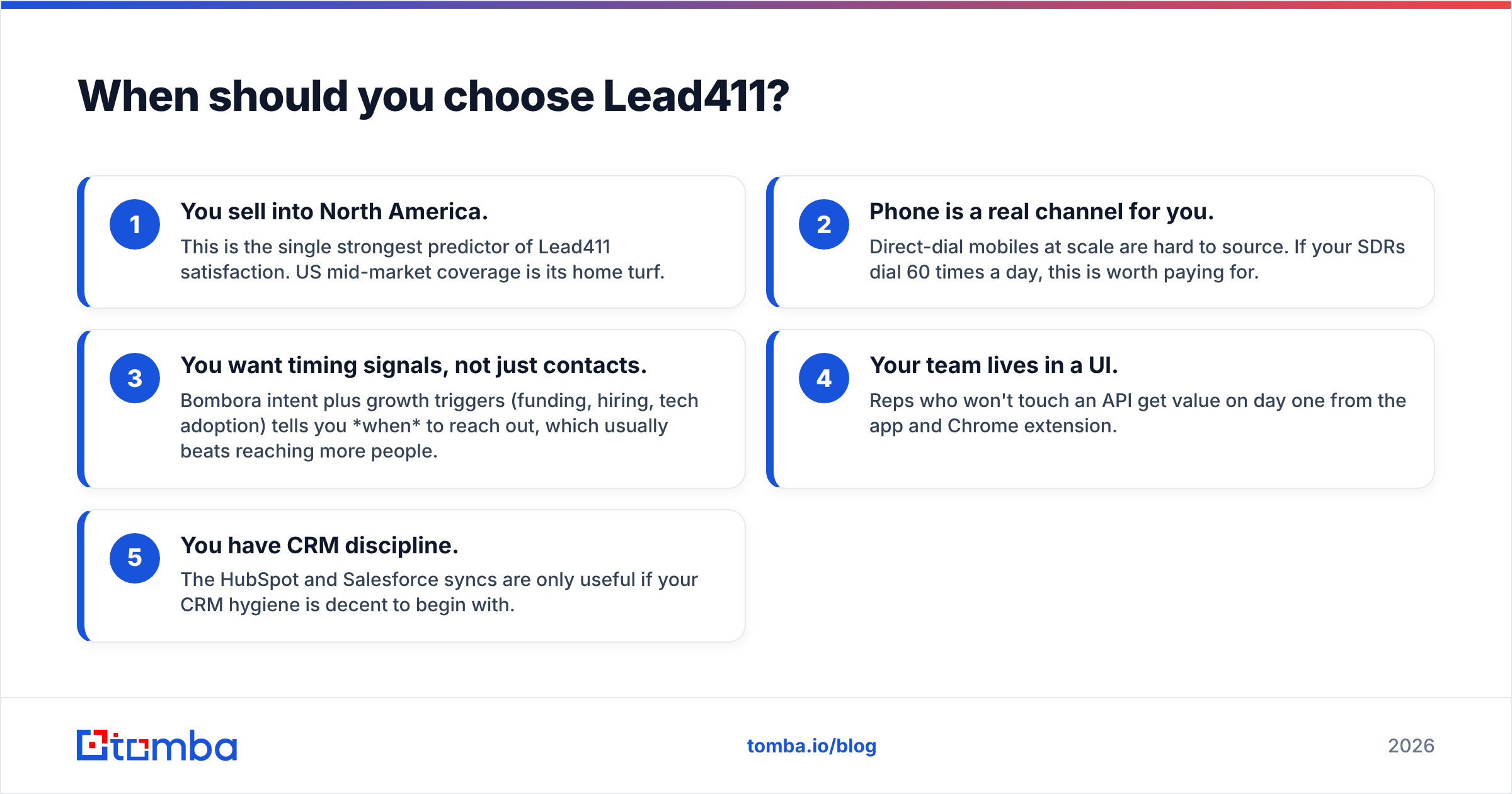
Pick Lead411 when at least three of these are true:
- You sell into North America. This is the single strongest predictor of Lead411 satisfaction. US mid-market coverage is its home turf.
- Phone is a real channel for you. Direct-dial mobiles at scale are hard to source. If your SDRs dial 60 times a day, this is worth paying for.
- You want timing signals, not just contacts. Bombora intent plus growth triggers (funding, hiring, tech adoption) tells you when to reach out, which usually beats reaching more people.
- Your team lives in a UI. Reps who won't touch an API get value on day one from the app and Chrome extension.
- You have CRM discipline. The HubSpot and Salesforce syncs are only useful if your CRM hygiene is decent to begin with.
Skip it if your ICP is majority-European, if you're a solo founder who can't justify seat minimums, or if you already own an intent platform.
When should you choose Generect?#
Pick Generect when:
- A developer owns your GTM data layer. If someone on your team can write a scheduled job, the API-first model turns prospecting into infrastructure instead of a weekly chore.
- Your ICP is defined by attributes, not lists. Generect's filtering — headcount bands, tech signals, role seniority, activity — is its real product. You're buying a query engine.
- You operate globally. LinkedIn-derived data doesn't degrade at the US border the way Lead411's does.
- You want fresh job-change data. Role changes are the highest-signal trigger in B2B, and profile-derived sources surface them faster than static databases.
- You don't need phone as a primary channel.
Skip it if you need direct dials, if nobody on the team writes code, or if you want a bundled sequencer.
Is there a third option worth considering?#
Yes — and it's worth being honest about what it is and isn't.
Most teams comparing Generect vs Lead411 are really asking one of two questions:
- "Which database gives me more good contacts per dollar?" → This is a coverage-and-price question. Compare exports-per-dollar in your actual territory, run a 200-record bake-off on both, and measure bounce rate, not record count.
- "How do I get valid email addresses for accounts I've already identified?" → This is a finder question, and buying an intelligence suite to answer it is expensive.
If you're in the second camp, the cheaper architecture is: source your target accounts however you like (a CRM list, a conference attendee list, a scraped site, an existing database), then use a dedicated email finder to resolve contacts and a verifier to clean them. Domain search returns every discoverable address at a company plus the pattern it uses, which is often all you need to build a full account map without a per-seat contract.
The same logic applies to enrichment. If your CRM has 8,000 records with missing fields, data enrichment against those records is a one-time job — not a reason to onboard your whole team onto a new platform.
What should you test before you buy either one?#
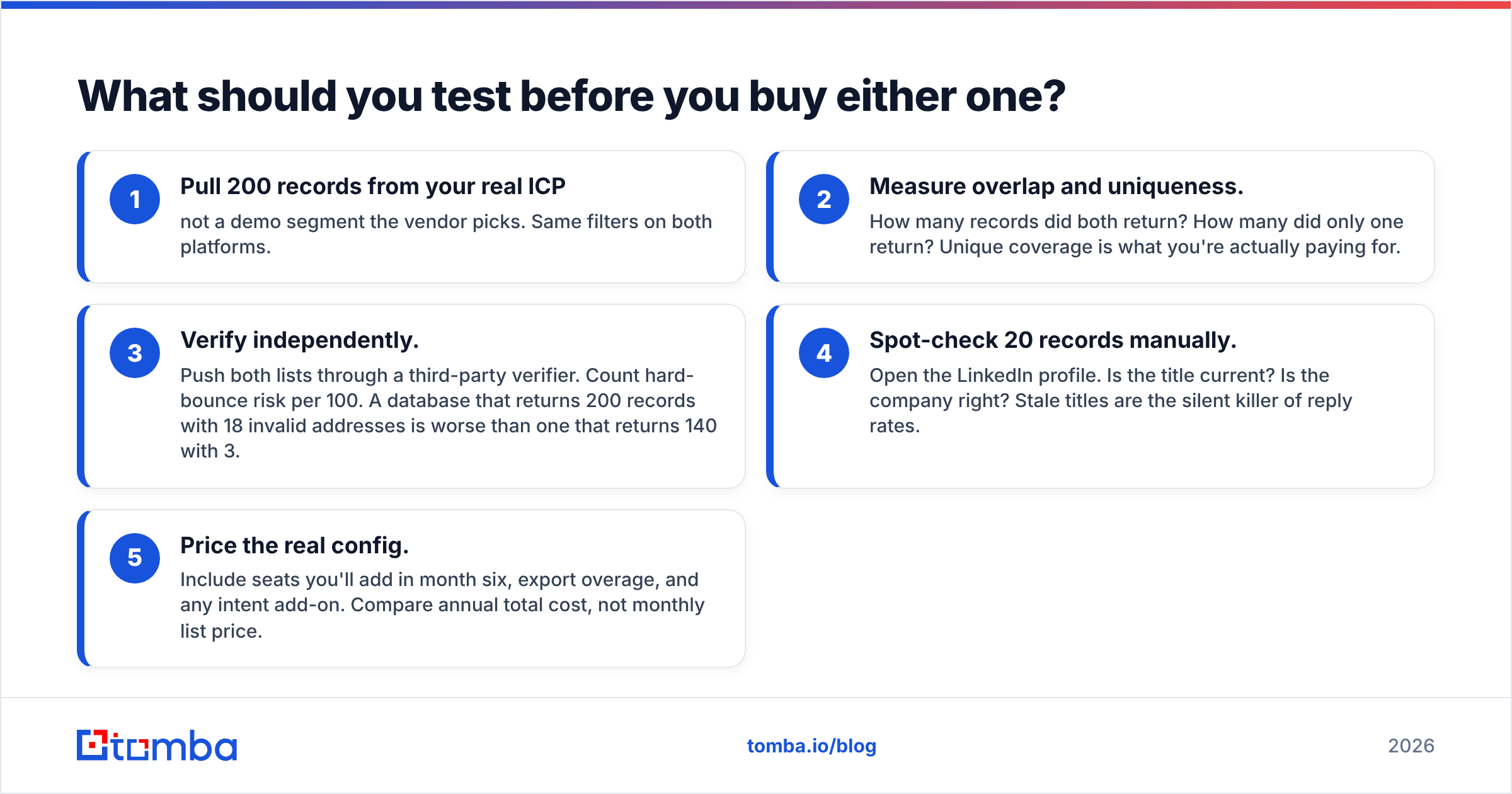
Run the same three-step bake-off against both vendors. It takes an afternoon and saves a year of contract regret.
- Pull 200 records from your real ICP — not a demo segment the vendor picks. Same filters on both platforms.
- Measure overlap and uniqueness. How many records did both return? How many did only one return? Unique coverage is what you're actually paying for.
- Verify independently. Push both lists through a third-party verifier. Count hard-bounce risk per 100. A database that returns 200 records with 18 invalid addresses is worse than one that returns 140 with 3.
- Spot-check 20 records manually. Open the LinkedIn profile. Is the title current? Is the company right? Stale titles are the silent killer of reply rates.
- Price the real config. Include seats you'll add in month six, export overage, and any intent add-on. Compare annual total cost, not monthly list price.
If both vendors refuse a meaningful trial on your own ICP, that tells you something.
The verdict#
Lead411 wins for North American, phone-heavy, intent-driven outbound teams. The direct dials and Bombora integration justify the seat cost if you're actually dialing. Generect wins for global, engineering-led GTM teams who want prospecting to run as a scheduled job rather than a manual workflow.
But if you strip the question down and find that what you actually need is accurate, verified email addresses for companies you've already targeted — you're overbuying with either one.
That's the gap Tomba fills. Start with the Tomba Email Finder on the free tier: 25 searches a month, no card, no seat minimum, and the same API and Chrome extension you'd get on a paid plan. Run it against your next 100-account list, check the bounce rate against whatever you're using now, and let the numbers decide whether you need a full intelligence suite at all.
Related guides#
Ready to find emails that actually work?
Join 150,000+ professionals who stopped guessing and started sending. Free credits on signup — no credit card required.
Get the Tomba newsletter
Practical outbound tactics and product updates — once every two weeks.
About the author