Generect vs LeadGenius (2026): Which B2B Data Tool Wins?
Generect sells real-time LinkedIn-sourced lead lists; LeadGenius sells human-verified custom data research. They solve different problems at very different prices. Here's the honest breakdown.
TL;DR
- Generect is a real-time lead-generation platform built around live LinkedIn and Sales Navigator queries. You give it a search, it returns enriched contacts pulled fresh rather than from a static warehouse.
- LeadGenius is a managed data service. Human researchers plus automation build custom datasets to your spec — fields nobody else sells, like store count, hiring signals, or packaging type.
- The real split is self-serve speed vs bespoke depth. Generect fits SDR teams that need volume this week. LeadGenius fits RevOps teams that need a field no database contains.
- Price gap is enormous: Generect starts in the low hundreds per month; LeadGenius is a custom annual contract that typically starts in the five figures.
- If you mostly need accurate work emails at predictable cost, neither is the cheapest path — a dedicated finder-verifier stack does that job for a fraction.
What is Generect and who actually uses it?#
Generect is a B2B lead-generation and enrichment platform whose core claim is freshness. Instead of querying a snapshot database refreshed on a quarterly cycle, Generect executes searches against live LinkedIn and Sales Navigator infrastructure at request time, then enriches the results with emails, phone numbers, and company attributes.
That architecture matters more than it sounds. Static B2B databases decay at roughly 2-3% per month as people change jobs — a list that was 95% accurate in January is meaningfully worse by June. A real-time pull sidesteps the decay problem because the record is generated at the moment you ask for it.
Who buys it: outbound agencies running many client campaigns, SDR teams that burn through lists fast, and growth engineers who want an API they can wire into their own sequencing stack. Generect ships both a UI and an API, and the API is the reason most technical teams end up there.
Where it strains: Generect inherits LinkedIn's worldview. If a persona doesn't maintain a LinkedIn profile — plant managers, franchise owners, regional distributors, most of the SMB long tail outside tech — the coverage thins out fast. It is also, by design, a contact-and-company tool. It will not tell you how many forklifts a warehouse operates.

What is LeadGenius and why does it cost so much more?#
LeadGenius is not a self-serve database. It is a data-as-a-service operation: a managed team of researchers, supported by automation, that builds a dataset to your written specification and keeps it refreshed on an agreed cadence.
The pitch is custom fields. Standard providers all sell roughly the same columns — name, title, company, size, industry, email, phone. LeadGenius sells the columns that don't exist anywhere: which ecommerce brands use a specific shipping carrier, which retailers stock a competitor's SKU, which manufacturers list sustainability commitments on their site, which companies just posted three roles that imply a tooling migration.
That's genuinely hard to replicate. It's also why the pricing model is a custom annual contract rather than a credit pack. You're buying an outcome and a team, not a lookup.
Who buys it: enterprise RevOps and marketing-ops teams with a defined ICP that standard firmographics can't express, plus companies selling into non-tech verticals where LinkedIn density is low. G2 reviews consistently praise data quality for niche criteria and consistently flag turnaround time and cost as the tradeoffs.
Where it strains: you cannot log in on a Tuesday and pull 500 contacts. Onboarding, spec definition, and the first delivery run on a timeline measured in weeks. If your ICP changes monthly, the model fights you.
How do Generect and LeadGenius compare head to head?#
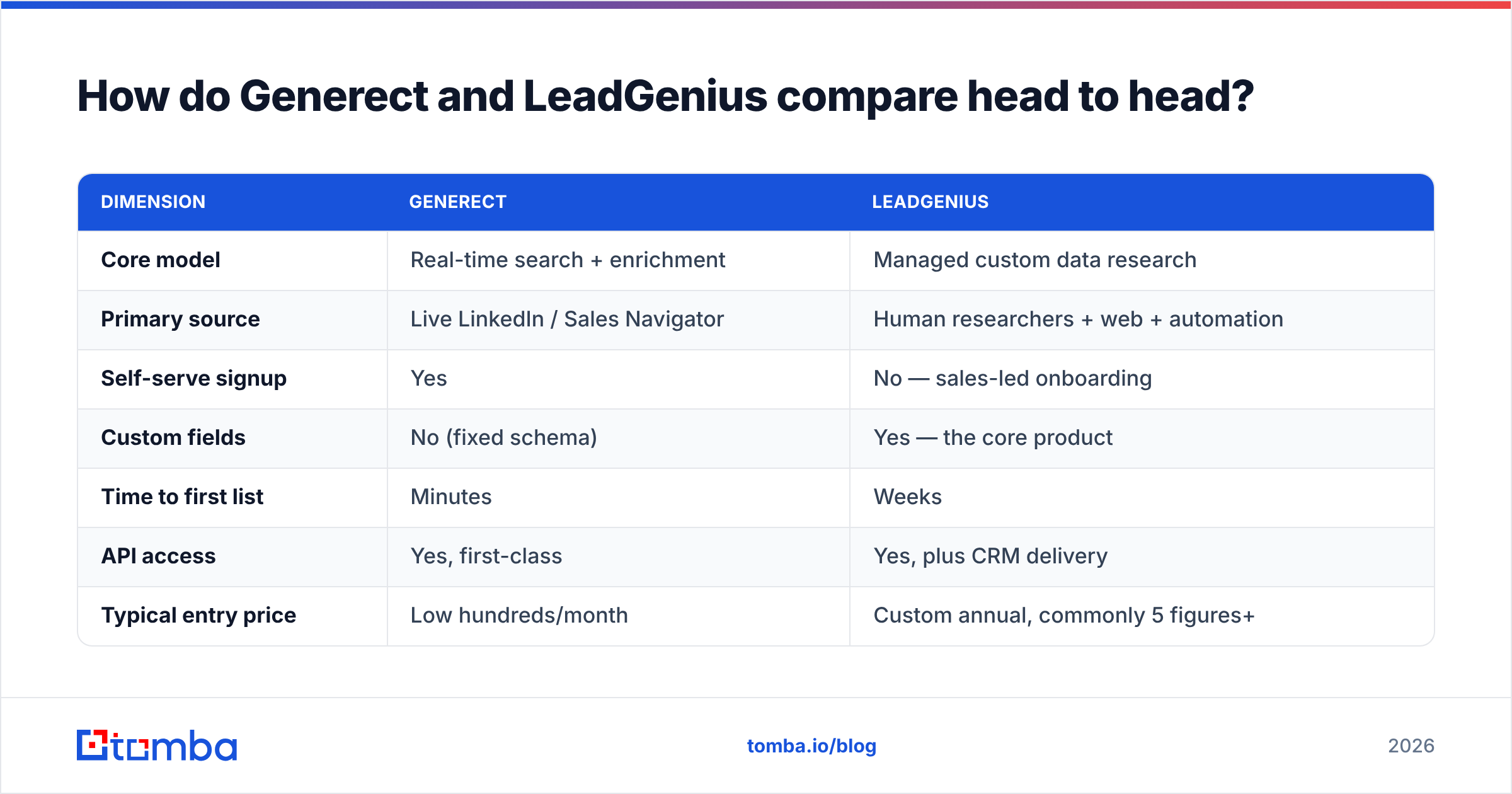
| Dimension | Generect | LeadGenius |
|---|---|---|
| Core model | Real-time search + enrichment | Managed custom data research |
| Primary source | Live LinkedIn / Sales Navigator | Human researchers + web + automation |
| Self-serve signup | Yes | No — sales-led onboarding |
| Custom fields | No (fixed schema) | Yes — the core product |
| Time to first list | Minutes | Weeks |
| API access | Yes, first-class | Yes, plus CRM delivery |
| Typical entry price | Low hundreds/month | Custom annual, commonly 5 figures+ |
| Best for | SDR volume, agencies, growth engineers | Enterprise RevOps, niche verticals |
| Weakest at | Non-LinkedIn personas, offline industries | Speed, small budgets, changing ICPs |
| Contract flexibility | Monthly plans | Annual commitment typical |
Read that table as two different purchases rather than two versions of the same one. Generect competes with Apollo, Wiza, and other LinkedIn-derived tools. LeadGenius competes with in-house research analysts and offshore data teams.
Which one has better data accuracy?#
Accuracy means two different things here, and conflating them is how teams overpay.
Generect's accuracy is a function of freshness plus verification. Because records are assembled on demand, job-change decay is largely neutralized — the title you see is the title on the profile right now. The weak link is the email layer: derived work emails still need SMTP-level validation before they hit a sequence, and no LinkedIn-sourced tool escapes that.
LeadGenius's accuracy is a function of human review. A researcher confirming that a company runs 40 retail locations produces a higher-confidence fact than any scraper does, because a human read the store locator. That's the entire value proposition. The cost is throughput — humans do not scale linearly.
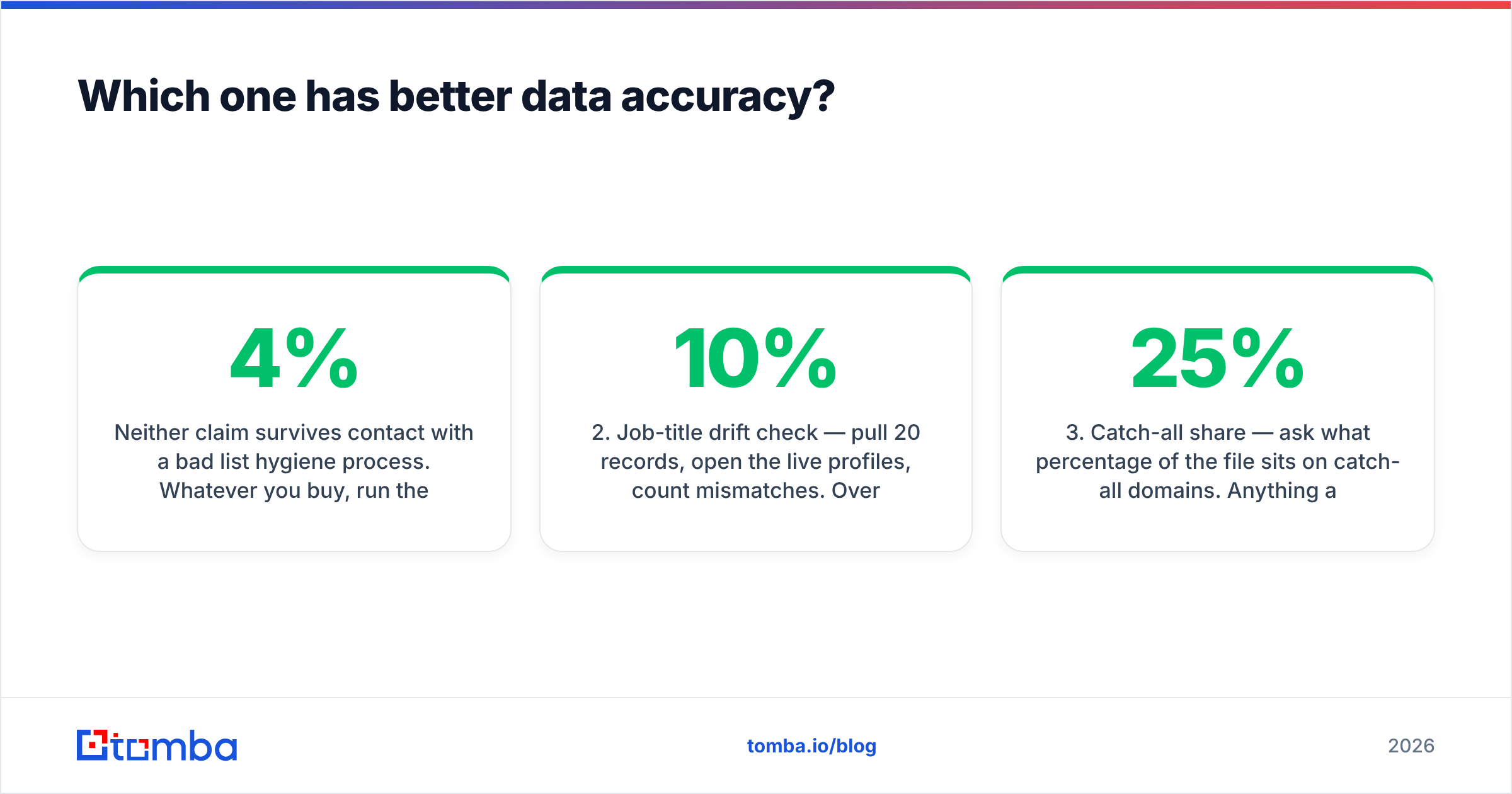
Neither claim survives contact with a bad list hygiene process. Whatever you buy, run the file through an email verifier before it reaches your ESP. A 4% bounce rate on a cold domain is enough to trigger filtering at Google and Microsoft, and both tightened bulk-sender enforcement further after the 2024 rules landed (Google's bulk sender guidelines remain the reference document). Buying premium data and skipping verification is like buying organic produce and leaving it in the trunk.
Four checks worth running on any vendor sample before you sign:
- Bounce test a 200-row sample — not their sample, yours. Pick accounts you already know.
- Job-title drift check — pull 20 records, open the live profiles, count mismatches. Over 10% is a red flag.
- Catch-all share — ask what percentage of the file sits on catch-all domains. Anything above 25% inflates the "valid" number, and you'll need a catch-all verifier to sort it out.
- Field completeness — measure the percentage of rows with a usable phone and a usable email, not just one or the other.
Is Generect better than LeadGenius for cold outbound?#
For pure cold email volume, yes — Generect is the better fit, and it isn't close.
Cold outbound is a throughput game. You need lists in hours, you need to iterate on ICP hypotheses weekly, and you need cost per contact low enough that a 2% reply rate still pencils out. Generect's self-serve model, monthly billing, and API all serve that loop. LeadGenius serves a slower, higher-stakes loop where a single well-defined segment is worth six figures in pipeline.
The exception: account-based outbound into a vertical LinkedIn barely covers. If you sell to independent pharmacies, regional food distributors, or industrial equipment dealers, Generect's source material thins out and LeadGenius's researchers earn their fee. That's a genuine structural advantage, not marketing.
One caveat on both: neither vendor solves deliverability. You still need SPF, DKIM, DMARC, warmed domains, and sensible sending volume. Great data into a cold domain still lands in spam.
What are the cheaper alternatives to both?#
Here's the part vendors don't lead with: most teams comparing Generect vs LeadGenius don't actually need either one. They need accurate work emails for a list of companies they can already name, at a price that doesn't require a procurement cycle.
That's a narrower, cheaper problem. A dedicated finder-plus-verifier stack solves it directly.
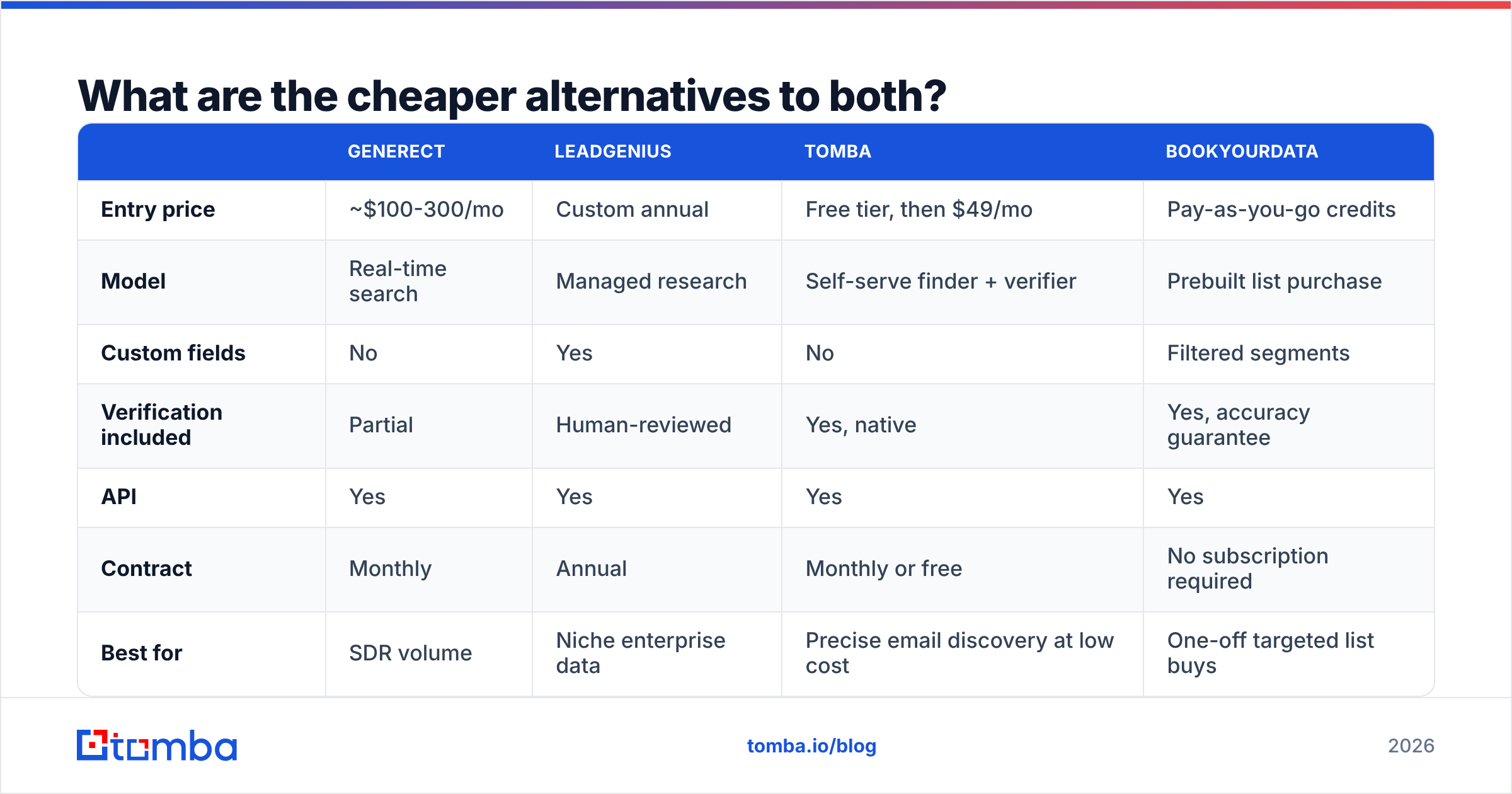
| Generect | LeadGenius | Tomba | BookYourData | |
|---|---|---|---|---|
| Entry price | ~$100-300/mo | Custom annual | Free tier, then $49/mo | Pay-as-you-go credits |
| Model | Real-time search | Managed research | Self-serve finder + verifier | Prebuilt list purchase |
| Custom fields | No | Yes | No | Filtered segments |
| Verification included | Partial | Human-reviewed | Yes, native | Yes, accuracy guarantee |
| API | Yes | Yes | Yes | Yes |
| Contract | Monthly | Annual | Monthly or free | No subscription required |
| Best for | SDR volume | Niche enterprise data | Precise email discovery at low cost | One-off targeted list buys |
BookYourData is worth a serious look if your need is transactional — you want a clean, filtered list once, without a subscription, and with an accuracy guarantee attached. It's a different shape of purchase than either tool in this comparison, and for many teams a better-matched one.
Tomba sits at the other end: you already know the companies, you need the people. Run a domain search to map every public address at a target company, use the email finder for named individuals, then verify in the same pass. Pricing runs Free (25 searches/month), Starter $49/mo, Growth $99/mo, Pro $249/mo — see Tomba pricing for current limits. For engineering teams, the Tomba API does the same work programmatically.
The honest framing: Tomba doesn't build custom datasets and doesn't run live LinkedIn queries. It finds and verifies business emails accurately and cheaply. If that's the actual job, paying enterprise data-service rates for it is a budgeting error.

How do you choose between them in practice?#
Answer four questions in order. The first "yes" is your answer.
- Do you need a data field that no vendor sells off the shelf? (Store counts, equipment types, shelf presence, compliance status.) → LeadGenius. Nothing else does this.
- Do you need thousands of LinkedIn-visible contacts, refreshed continuously, wired into your own stack? → Generect.
- Do you already know your target accounts and just need verified emails for specific roles? → A finder-verifier stack. Cheapest correct answer, by a wide margin.
- Do you need one clean list right now with no ongoing commitment? → A pay-as-you-go list provider like BookYourData.
Two failure modes to avoid. First, buying LeadGenius for a Generect problem — enterprise research contracts sitting idle because the team just wanted more SDR contacts. Second, buying any database for a verification problem — teams that blame data vendors for bounce rates when they never ran the file through validation.
A practical hybrid many teams land on: use a low-cost finder for the 80% of targets that are straightforward, reserve a research service for the 20% of strategic accounts where a custom field decides the deal. That splits spend along the line where value actually differs, and it's how most mature revenue operations teams structure data budgets.
What does the total cost actually look like?#
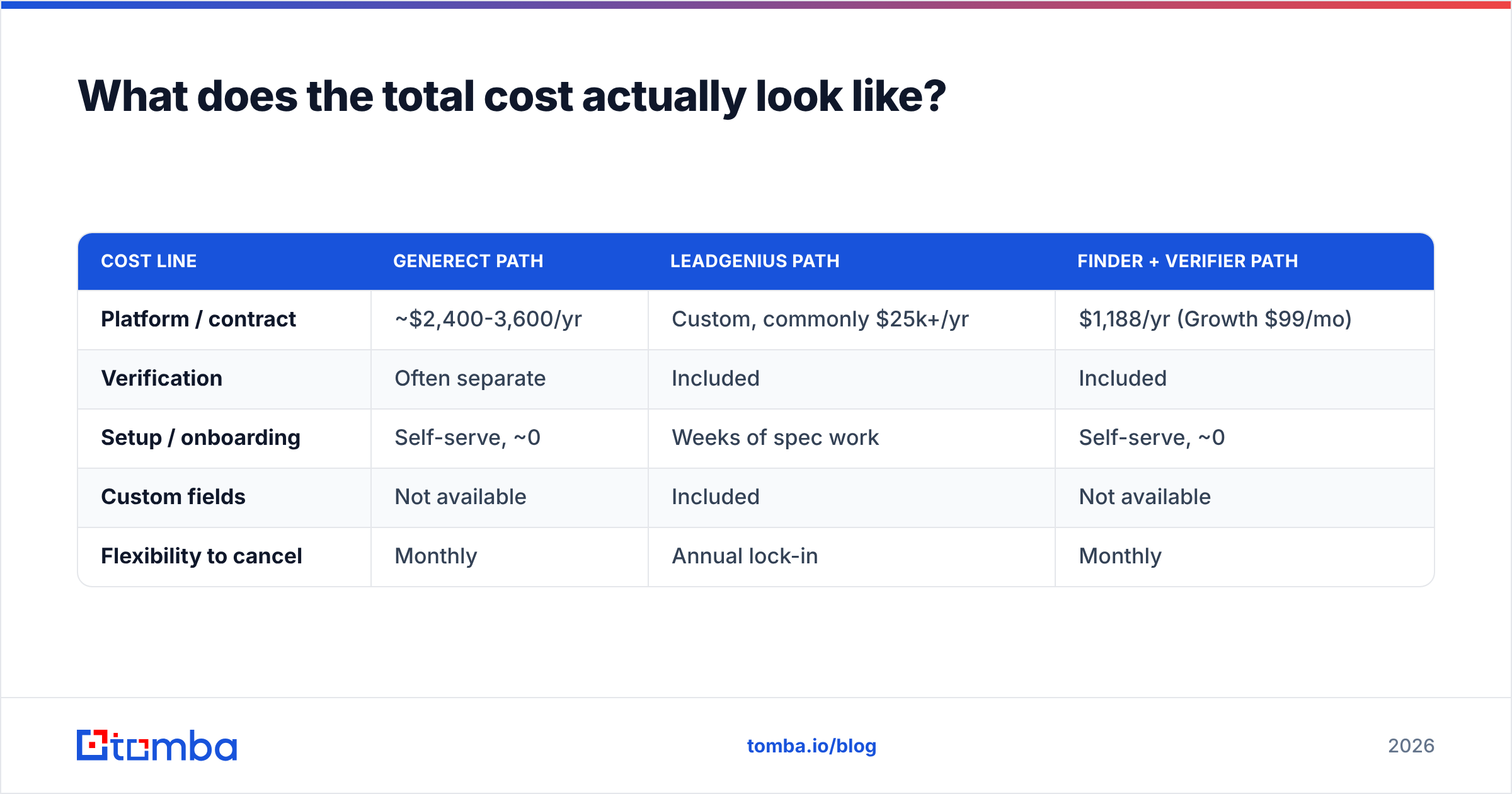
Model 12 months for a 5-person SDR team needing roughly 3,000 verified contacts per month.
| Cost line | Generect path | LeadGenius path | Finder + verifier path |
|---|---|---|---|
| Platform / contract | ~$2,400-3,600/yr | Custom, commonly $25k+/yr | $1,188/yr (Growth $99/mo) |
| Verification | Often separate | Included | Included |
| Setup / onboarding | Self-serve, ~0 | Weeks of spec work | Self-serve, ~0 |
| Custom fields | Not available | Included | Not available |
| Flexibility to cancel | Monthly | Annual lock-in | Monthly |
Numbers are directional — both vendors quote by seat, volume, and scope, so confirm against your own quote. The structural point holds regardless: the gap between paths is 10-20x, and it's only justified when custom fields genuinely drive revenue.
Also budget for the invisible line: time. LeadGenius consumes internal hours in spec definition and QA review. Generect consumes hours in filter tuning and list cleanup. Self-serve finders consume the least, which is part of why they win on smaller teams.
The verdict#
Generect wins on speed, price, and API ergonomics for LinkedIn-visible personas. LeadGenius wins, decisively and without a real competitor, when you need a data field that doesn't exist in any database. They are not substitutes, and any comparison that declares a flat winner is selling something.
But run the decision tree honestly first. If your real requirement is "verified work emails for people at companies I've already targeted," both tools are the wrong shape of purchase — one is over-engineered for volume you may not need, the other is over-engineered for research you may not need.
Start with Tomba's email finder: the free tier gives you 25 searches a month with no card, enough to test accuracy against your own known-good contacts before you commit a dollar. Verify a sample, measure the bounce rate, then decide whether you actually need a real-time platform or a research team on top of it. Most teams find the finder-verifier layer covers more of the job than they expected — and the budget saved funds the specialist tool where it genuinely matters.
Related guides#
Ready to find emails that actually work?
Join 150,000+ professionals who stopped guessing and started sending. Free credits on signup — no credit card required.
Get the Tomba newsletter
Practical outbound tactics and product updates — once every two weeks.
About the author