Generect vs LimeLeads (2026): Which B2B Data Tool Wins?
Generect sells live, API-first lead search. LimeLeads sells cheap, self-serve US list building. They solve different problems, and picking wrong costs you a quarter of wasted outbound. Here is the honest breakdown.
TL;DR
- Generect is an API-first lead generation platform built around live LinkedIn-sourced search. You query it programmatically, get fresh company and people records back, and wire it into your own system. Strong for engineering-led GTM teams.
- LimeLeads is a self-serve, US-heavy B2B list builder. You filter in a web app, preview counts, buy credits, export CSV. Strong for small teams who want a list today without a sales call.
- They are not really competing on the same axis. Generect competes with data APIs; LimeLeads competes with cheap list vendors.
- Neither is primarily an email verification engine, so both need a verifier in front of your sending tool if you care about bounce rate.
- If your bottleneck is finding and validating work emails at a known company rather than building a giant list, a dedicated email finder like Tomba (free tier, then $49/mo) covers that layer more cheaply than either.
What are Generect and LimeLeads?#
Two very different products get lumped into the same "B2B data" bucket, and that is where most bad purchase decisions start.
Generect positions itself as a lead generation data provider with a real-time engine. The pitch is that instead of querying a snapshot database that was scraped six months ago, you hit an API that resolves company and contact records closer to request time, with LinkedIn-shaped filters: headcount, industry, job title, seniority, geography, recent hiring signals. There is a UI, but the product's centre of gravity is the API and the integrations built on top of it. Agencies and sales-tech companies use it as an upstream data source rather than as a place where an SDR sits all day.
LimeLeads is the opposite shape. It is a browser-based list builder with a large US business contact database. You pick filters, the app shows you a live count, you spend credits to unlock and export the rows. There is no long onboarding, no mandatory demo, and no annual contract required to start. Its reputation on review sites like G2 is consistent on this point: people like the price and the simplicity, and the complaints cluster around data freshness on smaller or fast-changing companies.
So the honest framing of Generect vs LimeLeads is not "which has more records." It is: do you want a data pipe or a data store?
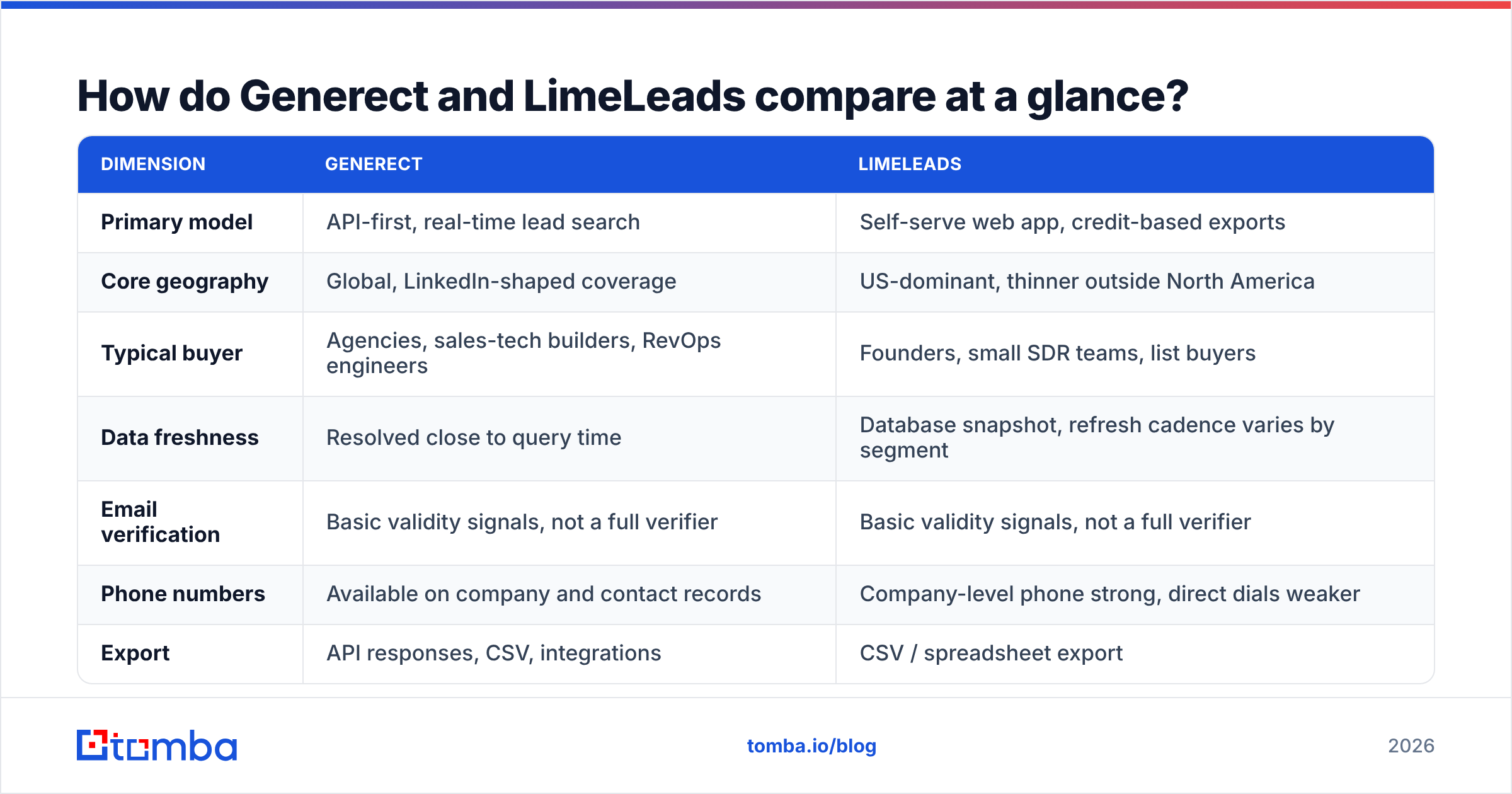
How do Generect and LimeLeads compare at a glance?#
| Dimension | Generect | LimeLeads |
|---|---|---|
| Primary model | API-first, real-time lead search | Self-serve web app, credit-based exports |
| Core geography | Global, LinkedIn-shaped coverage | US-dominant, thinner outside North America |
| Typical buyer | Agencies, sales-tech builders, RevOps engineers | Founders, small SDR teams, list buyers |
| Data freshness | Resolved close to query time | Database snapshot, refresh cadence varies by segment |
| Email verification | Basic validity signals, not a full verifier | Basic validity signals, not a full verifier |
| Phone numbers | Available on company and contact records | Company-level phone strong, direct dials weaker |
| Export | API responses, CSV, integrations | CSV / spreadsheet export |
| Contract friction | Often quoted, sales-assisted | Card-on-file, start in minutes |
| Learning curve | Needs a developer or automation platform | Anyone can build a list in ten minutes |
Pricing on both moves, and both publish less than they used to, so treat any number you read on a blog (including this one) as a starting point to verify on the vendor's own page before you commit budget.

Which one has better data coverage and accuracy?#
Coverage and accuracy are different questions, and vendors love to blur them.
Coverage is "does a record exist for this person." Generect wins outside the US. Its LinkedIn-shaped index means European, LATAM and APAC records show up at rates LimeLeads generally cannot match. If your ICP is "Series B SaaS ops leaders in DACH," LimeLeads will return counts that look thin and skew toward US HQs.
Accuracy is "is the email on that record actually deliverable today." This is where both tools sit in the same uncomfortable middle. Neither is built as a verification engine. They return an email with a status flag, and that flag is usually derived from format checks, MX lookups and historical activity rather than a full per-send validation pass. That is fine for a mid-funnel enrichment job. It is not fine as the last step before you load 5,000 addresses into a cold sequence.

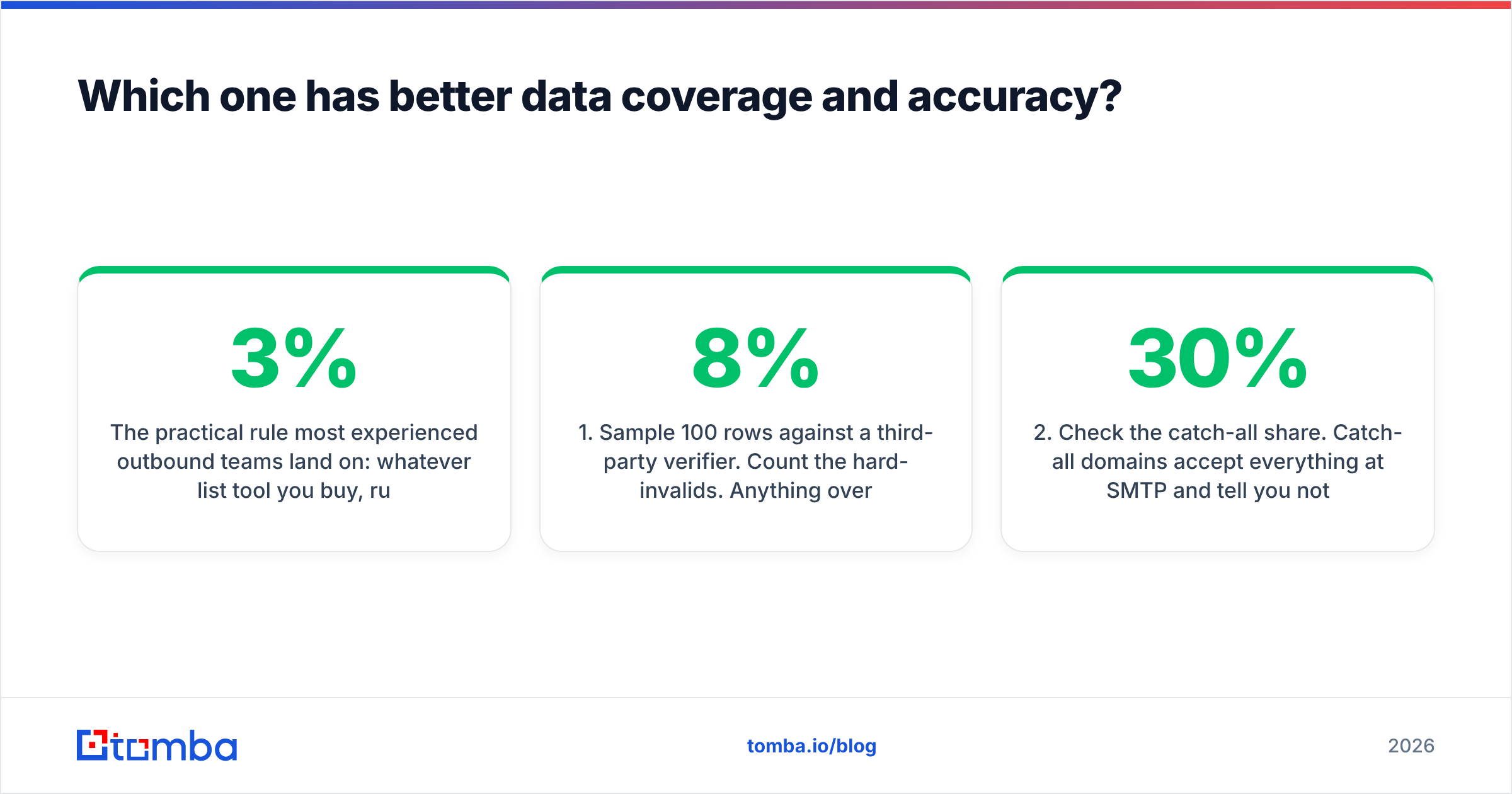
The practical rule most experienced outbound teams land on: whatever list tool you buy, run the output through a dedicated email verifier before it touches your sending domain. A 3% bounce rate is survivable. A 12% bounce rate on a fresh domain, and Google Postmaster starts treating you like a spammer for the next two months. The cost of verification is trivially small next to the cost of rebuilding sender reputation.
Four accuracy checks worth running before you trust either vendor's export:
- Sample 100 rows against a third-party verifier. Count the hard-invalids. Anything over 8% means the underlying data is older than the marketing suggests.
- Check the catch-all share. Catch-all domains accept everything at SMTP and tell you nothing. If 30% of your list is catch-all, you need a catch-all verifier, not a bigger list.
- Spot-check job titles against LinkedIn. Title drift is the silent killer. A record can have a perfect email and a role the person left 14 months ago.
- Test the same 20 companies in both tools. Coverage overlap is usually lower than you expect, which is an argument for a cheap second source rather than a bigger contract with one.
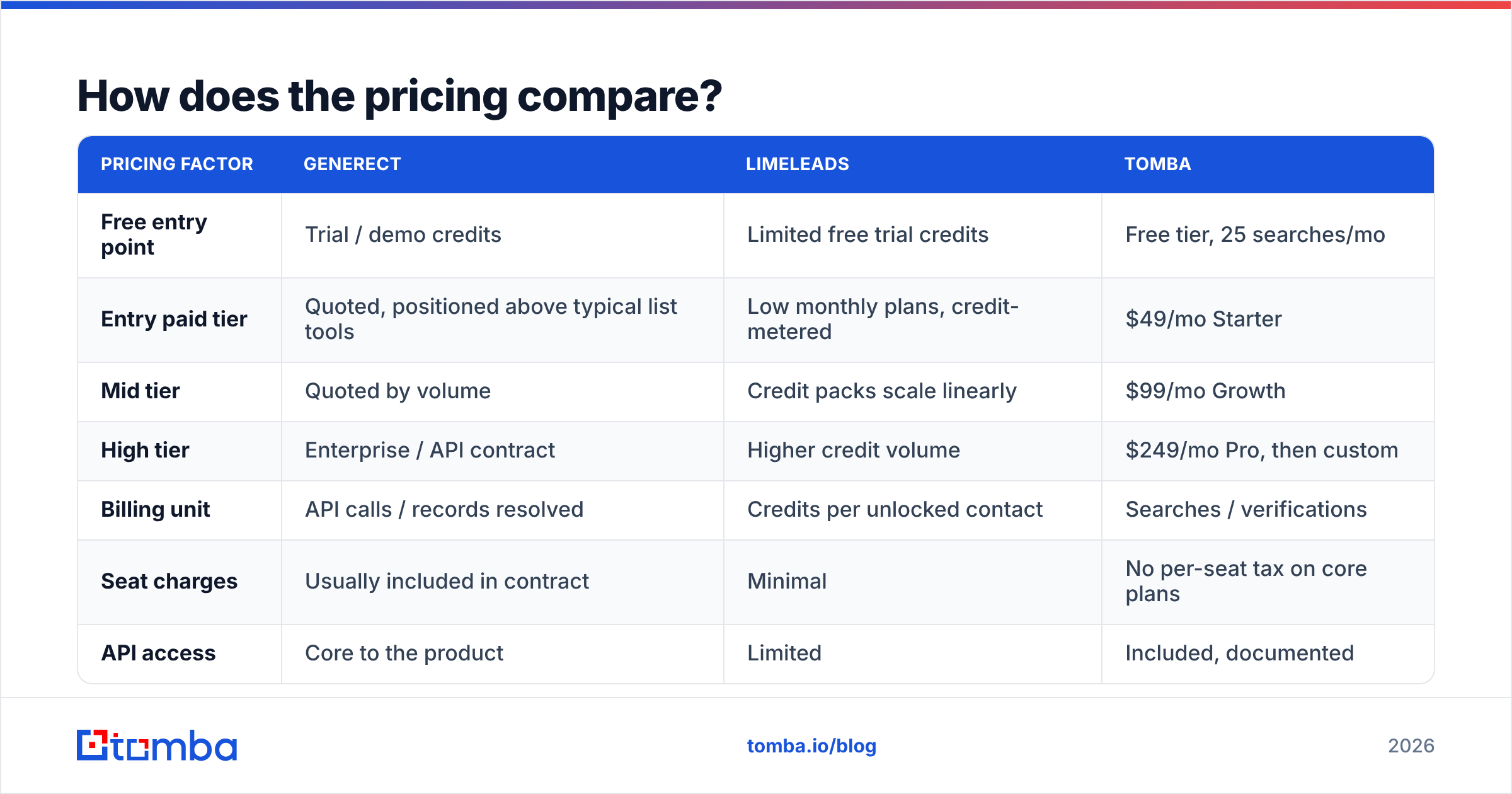
How does the pricing compare?#
Both vendors have moved toward quoted pricing for larger volumes, so the headline numbers matter less than the unit economics.
| Pricing factor | Generect | LimeLeads | Tomba |
|---|---|---|---|
| Free entry point | Trial / demo credits | Limited free trial credits | Free tier, 25 searches/mo |
| Entry paid tier | Quoted, positioned above typical list tools | Low monthly plans, credit-metered | $49/mo Starter |
| Mid tier | Quoted by volume | Credit packs scale linearly | $99/mo Growth |
| High tier | Enterprise / API contract | Higher credit volume | $249/mo Pro, then custom |
| Billing unit | API calls / records resolved | Credits per unlocked contact | Searches / verifications |
| Seat charges | Usually included in contract | Minimal | No per-seat tax on core plans |
| API access | Core to the product | Limited | Included, documented |
The trap on credit-based pricing is not the sticker price, it is the waste ratio. If 25% of the contacts you unlock are undeliverable, your effective cost per usable contact is 33% higher than the price you agreed to. Run that math on any quote before you sign. You can compare it against transparent Tomba pricing as a baseline, since every tier there is published rather than quoted.
The other trap is the annual commitment. Both vendors will discount hard for a year up front. That discount is only real if your ICP does not change, and in 2026 most GTM teams are re-cutting their ICP every two quarters.
What is Generect actually best for?#
Generect earns its keep in three situations.
You are building a product on top of the data. If you run an agency that spins up 40 campaigns a month, or you are a sales-tech vendor that needs to enrich records inside your own app, an API-first provider is structurally the right answer. You do not want humans exporting CSVs on a schedule.
Your ICP is non-US. The coverage gap is real and it is the single clearest reason to pick Generect over a US-focused list tool.
You care about freshness over volume. Resolving records closer to query time means fewer "this person left in March" moments. It costs more per record. For a $60k ACV motion where each wrong contact burns a week of cycle time, that trade is obviously correct. For a $400 ACV motion, it is not.
Where Generect frustrates people: it assumes technical capability. If nobody on your team can call an API or wire up a Zapier integration-style automation, half the value stays locked behind a doc page nobody reads. And the sales-assisted pricing means you cannot just try it at 11pm on a Tuesday.
What is LimeLeads actually best for?#
LimeLeads is a good answer to a narrow, common question: "I need 2,000 US SMB contacts by Friday and I do not want to talk to anyone."
It nails that. The filter UI is fast, the live count preview means you know what you are buying before you spend, and the credit model means a solo founder can spend $50 instead of signing a $12k annual deal. For local services, US SMB SaaS, staffing, and agency prospecting, it is often all the data layer you need.
The honest limits:
- Geography. Outside the US it thins out quickly.
- Freshness on churn-heavy segments. Startups under 50 people rotate staff fast, and snapshot databases lag that.
- Direct dials. Company switchboards are well covered. Mobile numbers for individual reps are not. If your motion is phone-first, you will need a separate phone finder layer.
- No meaningful API. You are exporting CSVs. That is fine until it is not.
None of these make it a bad product. They make it a specific product. Buying LimeLeads for a global enterprise ABM programme is a self-inflicted wound, and buying Generect to pull 500 US plumbing contractors is overpaying for capability you will not use.

Where do both tools leave a gap?#
Both are list tools. Neither is a find-this-specific-person tool, and that distinction shows up constantly in real workflows.
Concretely: your AE gets a warm intro to a VP at a company that is not in either database. Or marketing hands you 300 domains from a webinar and you need the head of RevOps at each one. Or you are running a content-led motion and need to reach the author of a specific industry article. List filters do not solve any of those. You need targeted lookup by domain and name.
That is the layer where a dedicated finder fits alongside, not instead of, your list provider:
- Domain search returns the people and email patterns at a company you already care about, rather than making you find that company through filters.
- Bulk email finder takes a list of names and domains you already have (from a CRM export, an event list, a scraped set of accounts) and resolves the emails.
- Tomba API covers the programmatic case at a published price, which matters if the reason you were looking at Generect was API access rather than the underlying index.
- Catch-all handling is treated as a first-class problem rather than a status flag, because on many enterprise domains it is the difference between a usable list and a guess.

It is worth naming the broader market honestly here. There are good alternatives on both sides of this comparison. BookYourData is a solid pay-as-you-go option if you want prebuilt, verified lists without a subscription and value a straightforward credit model. Apollo dominates the all-in-one seat-based end. Clearbit-style enrichment sits upstream of your CRM. The point is not that one vendor wins everything, it is that "B2B data" is four different jobs and most teams buy one tool hoping it does all four.
How should you choose between Generect and LimeLeads?#
Answer these in order and the decision usually makes itself.
- Is your ICP majority-US? No, and Generect moves ahead on coverage alone. Yes, and LimeLeads stays in the running at a fraction of the cost.
- Do you need programmatic access? If the data has to flow into your own product or a nightly job, you want an API-first vendor. CSV exports do not scale to that.
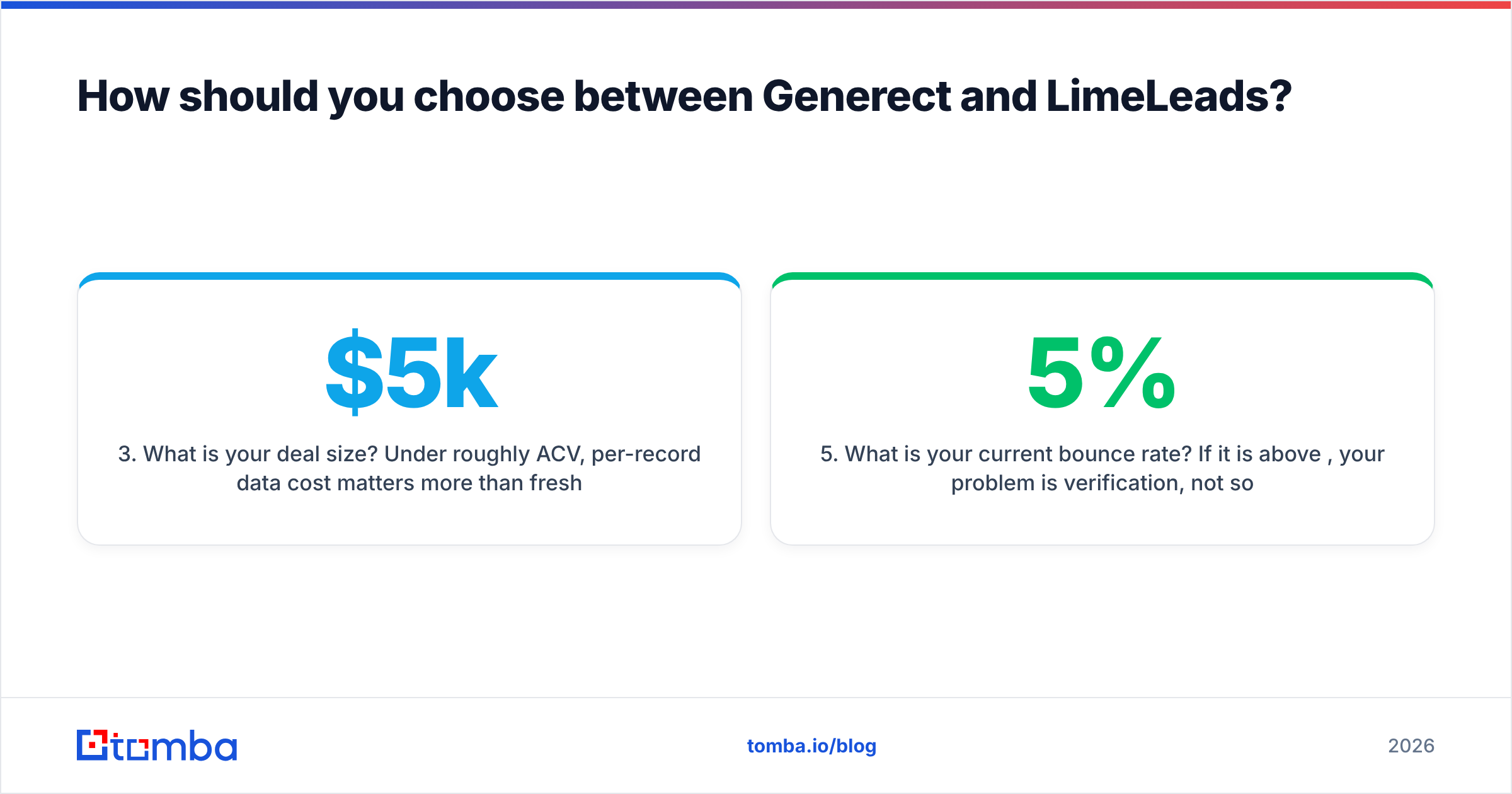
- What is your deal size? Under roughly $5k ACV, per-record data cost matters more than freshness. Above $25k ACV, freshness matters more than price.
- Who is operating it? A non-technical founder or a two-person SDR team will get more out of a self-serve UI than a well-documented API they never call.
- What is your current bounce rate? If it is above 5%, your problem is verification, not sourcing, and neither purchase fixes it.
- Can you run a paid pilot? Buy the smallest possible unit from each, run the same 200 target accounts through both, and measure valid-email rate and title accuracy yourself. Two weeks and a few hundred dollars beats any comparison post, including this one.
What is the verdict?#
Generect wins if you are technical, global, and treating data as infrastructure. You are paying for freshness and an API, and both are real.
LimeLeads wins if you are US-focused, cost-sensitive, and want a list in an afternoon without a procurement cycle. It does the simple thing well and does not pretend otherwise.
Neither wins the verification and targeted-lookup layer, and that is the layer that actually determines whether your sequences land in an inbox. Whichever you pick, budget for a verifier and a finder on top. The teams with the best reply rates in 2026 are not the ones with the biggest database. They are the ones whose lists are small, current, and clean.
Start with the layer that decides deliverability. Run any Generect or LimeLeads export through the Tomba Email Finder to fill gaps and confirm the addresses you are about to send to. The free tier gives you 25 searches a month to test the overlap on your own accounts, Starter is $49/mo, and every tier is published rather than quoted, so you can compare cost-per-usable-contact honestly before you sign anything longer than a month.
Related guides#
Ready to find emails that actually work?
Join 150,000+ professionals who stopped guessing and started sending. Free credits on signup — no credit card required.
Get the Tomba newsletter
Practical outbound tactics and product updates — once every two weeks.
About the author