Generect vs Logvalid (2026): Which B2B Data Tool Wins?
Generect sells LinkedIn-sourced lead lists and real-time search. Logvalid sells bulk email validation. We compare accuracy, pricing, and workflow fit — and name the winner for each job.
TL;DR
- Generect and Logvalid solve different halves of the same problem. Generect finds contacts (LinkedIn-sourced search, lead lists, API). Logvalid cleans them (bulk email validation, SMTP checks, syntax and MX filtering).
- If you have no list yet, Logvalid is useless to you. If you already bought a list from a broker, Generect is redundant.
- Generect's model is real-time lookup against LinkedIn-derived data, which keeps job-change decay low but makes per-contact cost harder to forecast.
- Logvalid competes on price per verification, not on data breadth. That is a commodity market where the spread between vendors is measured in fractions of a cent.
- Buying both means paying two vendors, reconciling two credit systems, and stitching two APIs. A combined find-and-verify platform like Tomba — Free tier at 25 searches/mo, Starter $49/mo — usually ends up cheaper than the pair.
What Are Generect and Logvalid, Exactly?#
They get compared because they both show up in "B2B email tool" listicles. That is the only thing they have in common.
Generect is a lead data provider. It pulls from LinkedIn-derived profiles and company records, and exposes them through a web app, ready-made lead lists, and an API. You give it a filter — job title, company size, geography, tech stack — and it returns contacts with work emails attached. The pitch is freshness: because lookups run against live-ish profile data rather than a static warehouse dump, the contact you pull today reflects where that person actually works today.
Logvalid is an email verification service. You upload a list you already have. It runs syntax checks, MX record lookups, disposable-domain detection, role-account flagging, and SMTP handshakes, then hands back a scored file: valid, invalid, risky, unknown. It does not source anything. It has no idea who the VP of Engineering at a target account is; it only knows whether first.last@target.com bounces.
That distinction decides the entire comparison. Asking "Generect vs Logvalid" is close to asking whether a fishing rod beats a filleting knife.
Where Each One Sits in the Outbound Pipeline#
- Define the ICP — job titles, firmographics, intent signals. Neither tool does this for you.
- Source contacts — this is Generect's slot. Also the slot for Apollo, Cognism, BookYourData, and Tomba's domain search.
- Verify deliverability — this is Logvalid's slot. Also the slot for ZeroBounce, NeverBounce, and Tomba's email verifier.
- Enrich — add phone numbers, LinkedIn URLs, tech stack. Generect partially; Logvalid not at all.
- Sequence and send — Instantly, Smartlead, Lemlist. Neither tool.
- Measure and re-verify — lists decay ~2.1% per month. Logvalid's slot again; Generect's freshness model partially sidesteps it.
Steps 2 and 3 are the whole fight. Everything else is noise in this particular matchup.

How Do Generect and Logvalid Compare Head to Head?#
Here is the honest side-by-side. Prices move; check each vendor's page before you sign anything.
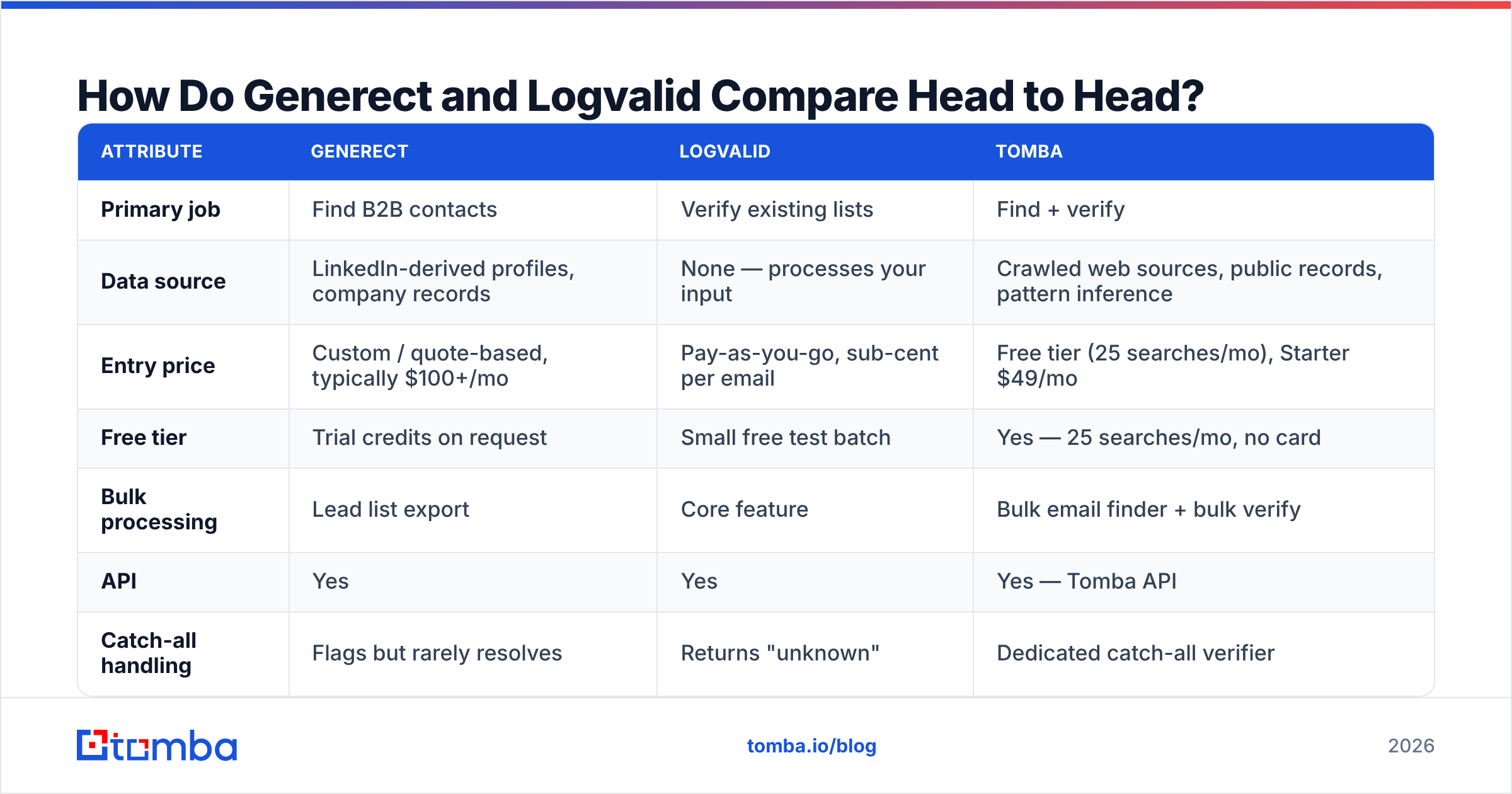
| Attribute | Generect | Logvalid | Tomba |
|---|---|---|---|
| Primary job | Find B2B contacts | Verify existing lists | Find + verify |
| Data source | LinkedIn-derived profiles, company records | None — processes your input | Crawled web sources, public records, pattern inference |
| Entry price | Custom / quote-based, typically $100+/mo | Pay-as-you-go, sub-cent per email | Free tier (25 searches/mo), Starter $49/mo |
| Free tier | Trial credits on request | Small free test batch | Yes — 25 searches/mo, no card |
| Bulk processing | Lead list export | Core feature | Bulk email finder + bulk verify |
| API | Yes | Yes | Yes — Tomba API |
| Catch-all handling | Flags but rarely resolves | Returns "unknown" | Dedicated catch-all verifier |
| Phone numbers | Limited | No | Yes — phone finder |
| CRM integrations | HubSpot, Salesforce via API | CSV in/out, API | Native HubSpot, Salesforce, Pipedrive, Zapier |
| Best for | Teams with no list and a defined ICP | Teams sitting on a stale 50k-row CSV | Teams that need both without two invoices |
The row that matters most for budget planning is the pricing model. Generect quotes; Logvalid meters. Quote-based pricing means you cannot model your cost per booked meeting until after a sales call. Metered verification pricing means you can — but only for the half of the pipeline Logvalid touches.

Which One Has Better Data Accuracy?#
Wrong question, but it's the one everyone asks, so here's the answer split into the two accuracies that actually exist.
Sourcing accuracy (Generect's metric). This is: of the contacts returned for your filter, what percentage are (a) real people, (b) currently at that company, and (c) matched to a working email? LinkedIn-derived sourcing is genuinely strong on (b) — profile updates propagate faster than most warehouse refresh cycles. It's weaker on (c), because LinkedIn does not publish work emails. Generect infers or matches them, and inference is where accuracy leaks. Any vendor that starts from a profile and ends at an email address is doing pattern matching plus verification under the hood, same as everyone else.
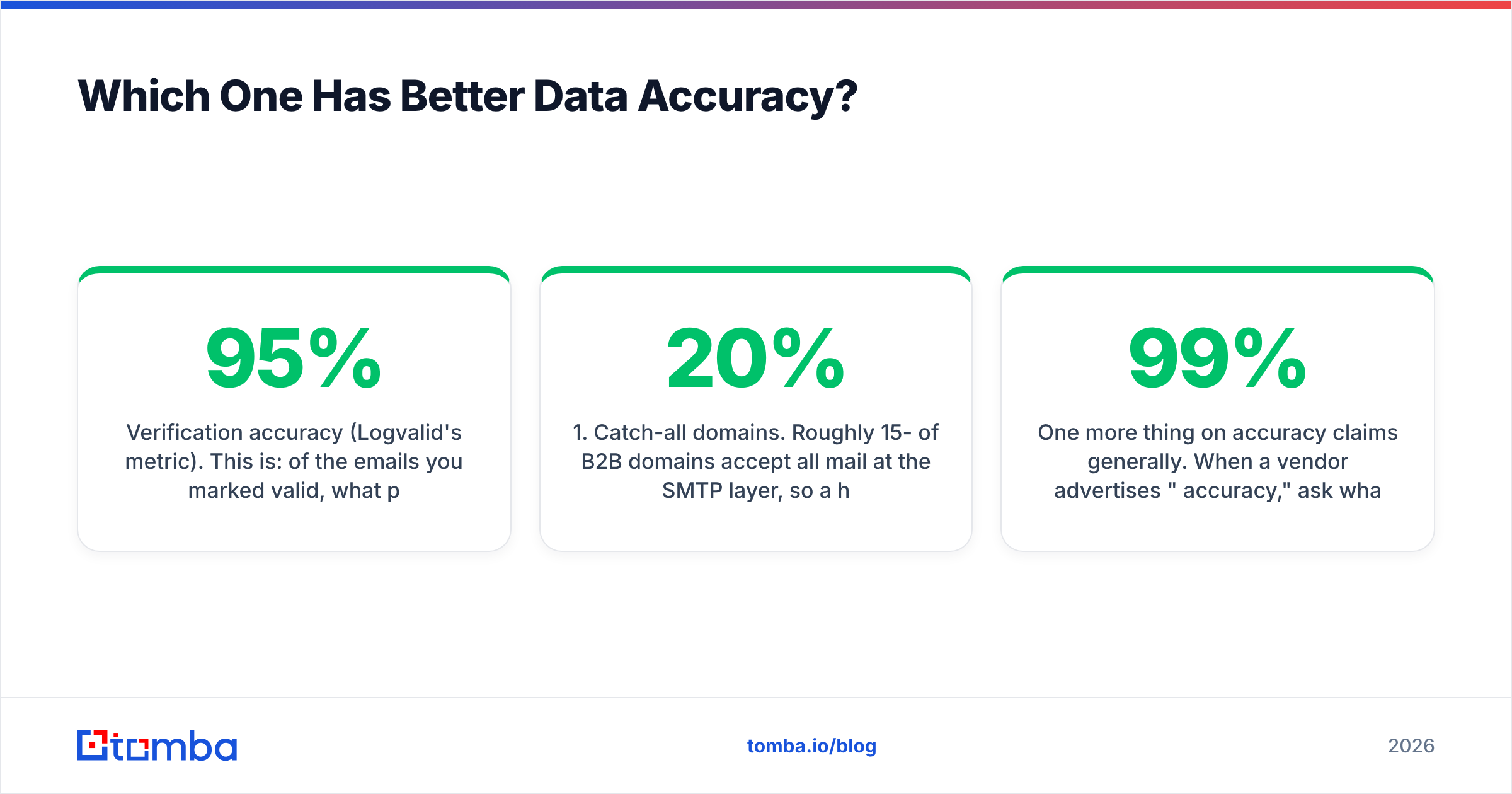
Verification accuracy (Logvalid's metric). This is: of the emails you marked valid, what percentage actually deliver? Modern verification is a mature commodity. Every serious vendor clears 95%+ on clean, non-catch-all domains. The spread between vendors shows up in exactly three places:
- Catch-all domains. Roughly 15-20% of B2B domains accept all mail at the SMTP layer, so a handshake proves nothing. Weak verifiers dump these into "unknown" and let you gamble. Stronger ones apply secondary signals — engagement history, pattern confidence, subdomain behavior. This is where a catch-all finder earns its keep.
- Greylisting and rate limits. Aggressive SMTP probing gets your verifier's IPs throttled by Google Workspace and Microsoft 365. Vendors with small IP pools return more false "invalid" results under load.
- Role and alias handling.
info@,sales@,support@are technically deliverable and commercially worthless. Whether they're flagged or silently passed changes your effective bounce rate.
So: Generect wins on knowing who to contact. Logvalid wins on knowing whether the address works. Neither wins outright, because neither does the other job.
One more thing on accuracy claims generally. When a vendor advertises "99% accuracy," ask what the denominator is. Most exclude catch-alls, unknowns, and role accounts from the calculation. Exclude enough categories and 99% becomes trivially achievable. G2 reviews are more useful than vendor landing pages here, because reviewers report bounce rates from real sends.

Is Generect Worth It If You Already Have a List?#
Mostly no, with one exception.
If you have a list and it's stale, the correct spend is verification, not re-sourcing. A 40,000-row CSV from 18 months ago will have roughly 30-38% decay — people changed jobs, companies got acquired, mailboxes were decommissioned. Running that through Logvalid at sub-cent pricing costs a few hundred dollars and salvages the 60%+ that still works. Buying the same 40,000 contacts fresh from a sourcing vendor costs an order of magnitude more.
The exception: if your ICP changed. If you sold to marketing managers last year and you're selling to CISOs this year, your old list has no salvage value regardless of deliverability. Verification cannot invent contacts you never had. That's a sourcing problem, and Generect (or Tomba, or Apollo, or BookYourData, which sells pay-as-you-go verified lists and is a legitimate option when you want a one-time purchase rather than a subscription) is the right category.
Quick decision rule:
- Old list, same ICP → verify. Logvalid category.
- Old list, new ICP → source. Generect category.
- No list at all → source, then verify. You need both categories.
- Ongoing outbound program → you need both, continuously, forever.
That last case is where the two-vendor setup starts to hurt.
What Does It Actually Cost to Run Both?#
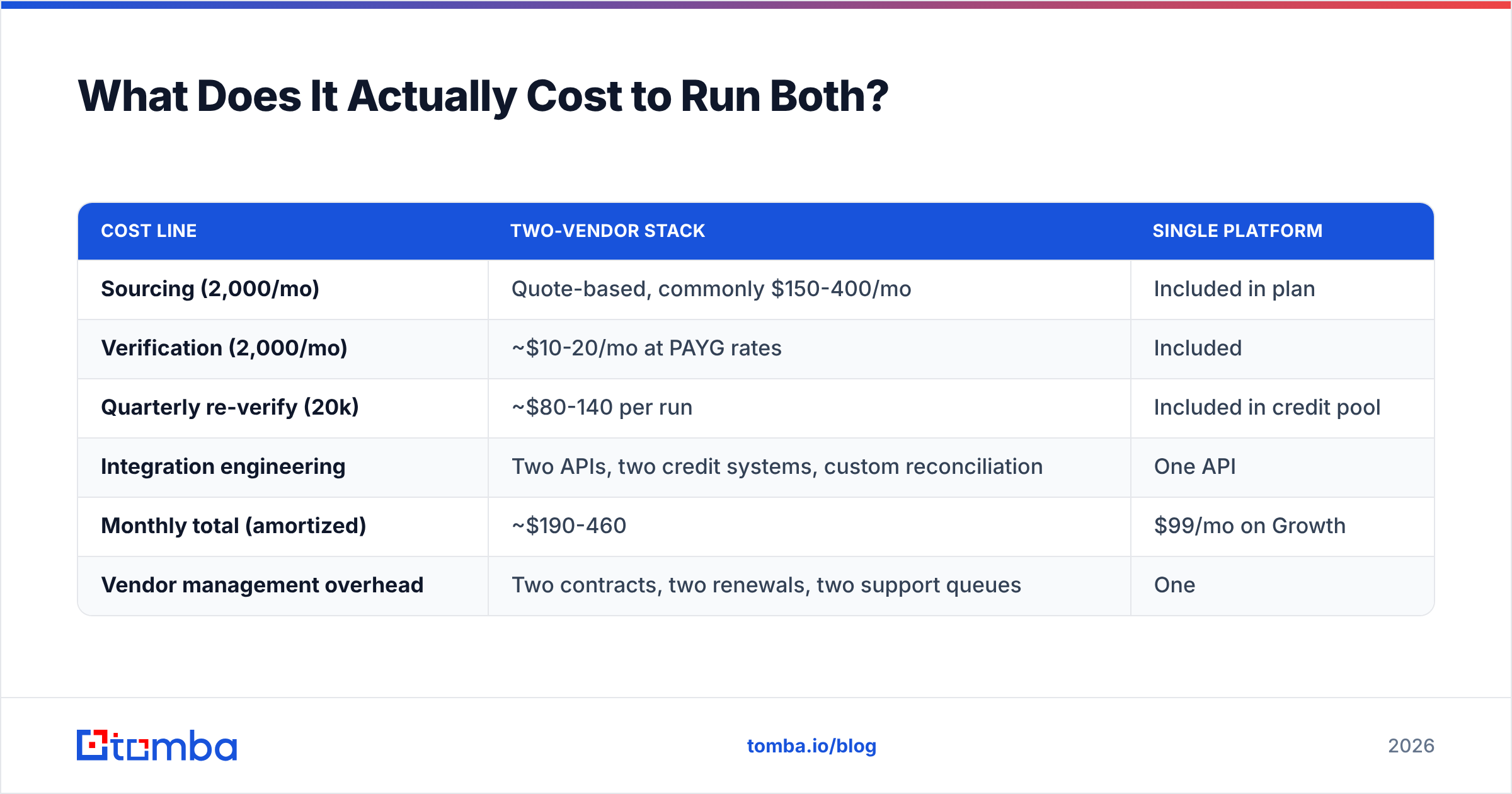
Model it on a realistic monthly outbound volume: 2,000 new contacts sourced, 2,000 verified, plus a quarterly re-verification of your 20,000-row house list.
| Cost line | Two-vendor stack | Single platform |
|---|---|---|
| Sourcing (2,000/mo) | Quote-based, commonly $150-400/mo | Included in plan |
| Verification (2,000/mo) | ~$10-20/mo at PAYG rates | Included |
| Quarterly re-verify (20k) | ~$80-140 per run | Included in credit pool |
| Integration engineering | Two APIs, two credit systems, custom reconciliation | One API |
| Monthly total (amortized) | ~$190-460 | $99/mo on Growth |
| Vendor management overhead | Two contracts, two renewals, two support queues | One |
The raw per-unit prices on the two-vendor side are not unreasonable. The problem is the seams. Two credit systems means you run out of one while sitting on a surplus of the other. Two APIs means someone on your team writes and maintains glue code. Two contracts means two renewal negotiations and two security reviews.
That reconciliation cost is invisible on the invoice and very visible in your RevOps engineer's calendar. If you want the formal framing, this is straightforward revenue operations tooling consolidation — the same argument that collapsed the martech stack over the last decade, applied to the top of the funnel.
Check Tomba pricing against your actual volume before assuming the consolidated option is more expensive. For most teams under 10,000 contacts/month, it isn't.

Which Should You Pick for Your Use Case?#
Match the tool to the job, not to the review score.
Pick Generect if: you have a tightly defined ICP, no existing list, and your buyers change jobs frequently (tech, startups, agencies). The LinkedIn-derived freshness advantage is real in high-churn segments. Budget for the quote and ask specifically about per-contact cost at your volume, not the headline plan price.
Pick Logvalid if: you already have volume — an inherited CRM, a conference badge scan dump, a purchased list — and your only problem is bounce rate. Verification is a commodity, so buy on price per verification and catch-all handling policy. Ask the vendor what percentage of a test batch they return as "unknown." If it's above 12%, that's a lot of contacts you paid to verify and learned nothing about.
Pick neither if: you're running continuous outbound and need both functions every week. At that point the two-vendor tax compounds. A platform that does find emails and verifies them in the same credit pool removes the seam entirely, and you can pull emails straight into Google Sheets or push them to HubSpot without middleware.
Pick a data broker instead if: you want a one-time list purchase with no subscription. That's a genuinely different buying motion and worth considering on its own terms.
Five Questions to Ask Any Vendor Before You Sign#
- What's your catch-all policy? Ask for the exact percentage of a 1,000-row test batch that comes back "unknown" or "risky." Vendors that dodge this question are telling you the answer.
- How is a credit consumed? Does a failed lookup burn a credit? Does re-verifying the same address twice cost twice? These details swing effective cost by 30%+.
- Where does the data come from? Public crawl, licensed partners, user contribution, scraping? This determines both accuracy and your GDPR exposure. Tomba publishes its data sources for exactly this reason.
- What's the refund policy on bounces? Serious verification vendors credit you back for addresses they marked valid that bounced. Ask for the threshold and the claims process.
- What happens at renewal? Quote-based vendors often price year one aggressively. Get year-two pricing in writing before signing year one.
How Do You Keep Bounce Rates Low Regardless of Vendor?#
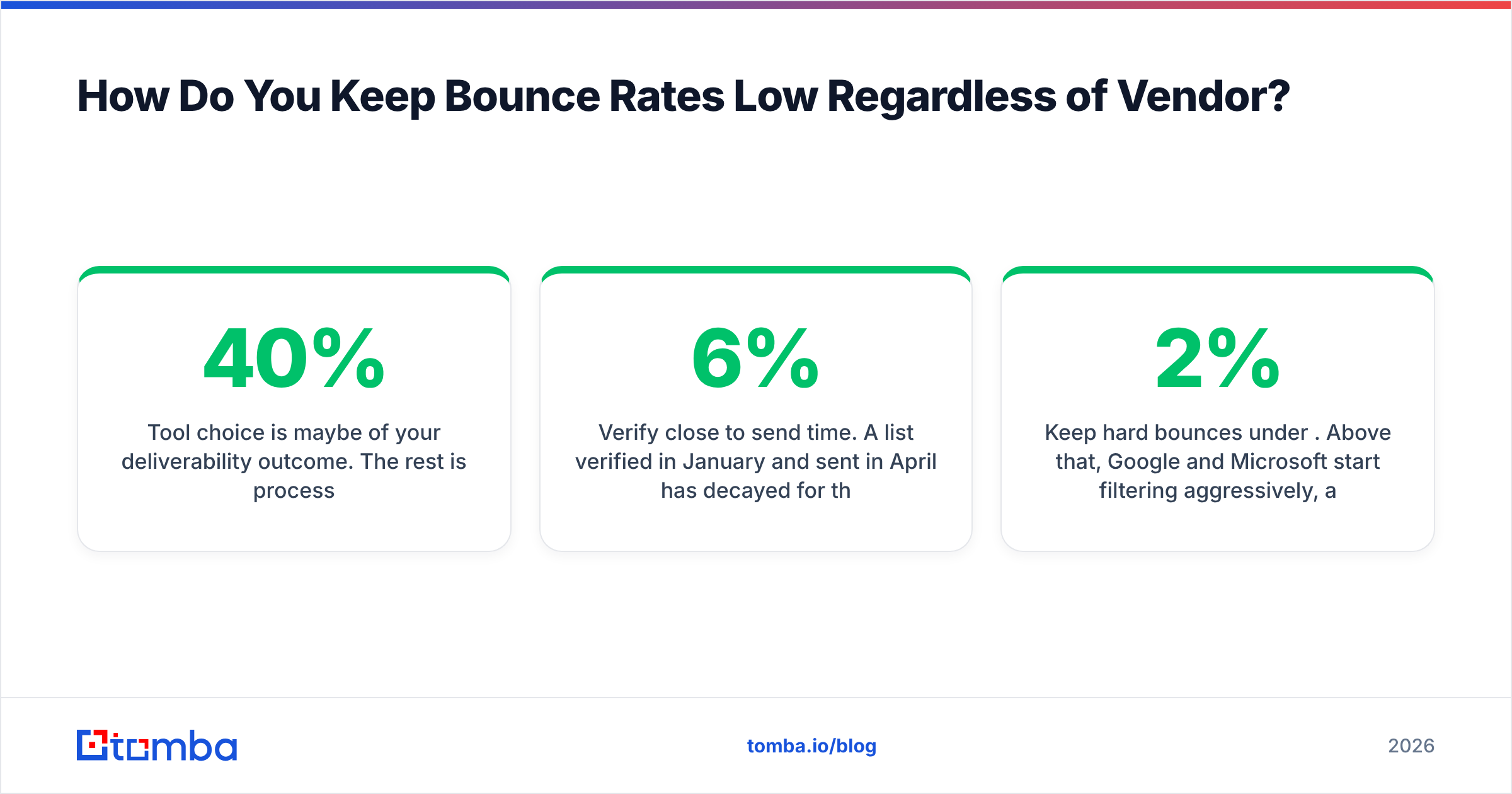
Tool choice is maybe 40% of your deliverability outcome. The rest is process.
Verify close to send time. A list verified in January and sent in April has decayed for three months — roughly 6% of it is now wrong. Verification is a perishable good; treat the result as valid for about 30 days, not forever.
Segment by risk tier instead of binary include/exclude. Send confidently to verified-valid. Send to catch-all and risky addresses from a separate, warmed subdomain so their bounce impact doesn't contaminate your primary sender reputation. Drop role accounts and unknowns entirely unless you have a specific reason.
Keep hard bounces under 2%. Above that, Google and Microsoft start filtering aggressively, and above 5% you're in genuine reputation trouble that takes weeks to recover from. Google's Postmaster Tools is free and shows you your actual reputation grade — check it weekly during any outbound push.
Finally, re-verify your house list quarterly. It's the cheapest deliverability insurance available. At sub-cent verification rates, cleaning 20,000 contacts costs less than a single wasted sales hour chasing a bounced sequence.
The Verdict#
Generect and Logvalid are not competitors — they're sequential steps. Generect is the better buy when your problem is "I don't know who to email." Logvalid is the better buy when your problem is "I know who to email but half of them bounce." Buying the wrong one for your actual problem wastes 100% of the spend, which is why the framing of this comparison matters more than the feature checklist.
If your honest answer is "both, every month, indefinitely," then the two-vendor stack is the expensive path. You'll pay two invoices, maintain two integrations, and spend RevOps hours reconciling credit pools that don't talk to each other.
Try Tomba's Email Finder free — 25 searches per month, no credit card, with verification built into the same credit pool. Find the contact, confirm it delivers, and export it to your CRM in one pass. When you outgrow the free tier, Starter is $49/mo and Growth is $99/mo, which for most teams lands below the combined cost of a sourcing subscription plus a verification vendor. Run 25 lookups against your current ICP and compare the results to whatever you're paying for now.
Related guides#
Ready to find emails that actually work?
Join 150,000+ professionals who stopped guessing and started sending. Free credits on signup — no credit card required.
Get the Tomba newsletter
Practical outbound tactics and product updates — once every two weeks.
About the author