Generect vs Mailshunt (2026): Which Email Finder Wins?
Generect sells a lead-data API. Mailshunt sells a cheap finder-and-verifier bundle. They solve different problems — here is which one actually belongs in your outbound stack in 2026, and where each one quietly fails.
TL;DR
- Generect is a lead-data and LinkedIn-sourced contact API built for engineering-led teams that want to pipe B2B records into their own system. It is not a self-serve tool you hand to an SDR on Monday morning.
- Mailshunt is a budget-tier email finder plus verifier bundle aimed at solo founders and small agencies. Cheap entry, thinner coverage, less rigorous catch-all handling.
- The two rarely compete for the same buyer. If you are comparing them head to head, you probably have a data-pipeline problem (pick Generect) or a cost problem (pick Mailshunt).
- Both leave the same gap: verification depth on catch-all domains, which is where most cold-email bounce rates actually come from.
- If you want API-grade data and self-serve UI and real catch-all verification on one bill, that is the slot Tomba fills — free tier at 25 searches/mo, paid from $49/mo.
What are Generect and Mailshunt?#
They are both sold as "email finders," but that label hides how differently they are built.
Generect positions itself as a B2B lead-generation data provider with a strong API story. Its pitch centers on programmatic access to company and people records — LinkedIn-derived profiles, firmographics, and contact points — delivered to developers who want to build lists or enrich a CRM without clicking through a dashboard. The buyer is usually a RevOps engineer, a growth team with a Python script, or an agency running lead-gen as a productized service.
Mailshunt sits at the other end. It bundles an email finder, a verifier, and (depending on the plan) light outreach features into a low-cost package. The buyer is usually a solo founder, a freelancer, or a two-person agency who needs a few thousand addresses a month and cares more about the invoice than about SLAs, uptime dashboards, or bulk throughput.
So the honest framing for generect vs mailshunt is not "which is better." It is: do you need a data pipe or a cheap toolbox? Answer that first and the comparison mostly resolves itself.
How do Generect and Mailshunt differ under the hood?#
Email-finding tools differ in four places, and the marketing pages almost never tell you which approach a vendor uses.
- Source of truth. Generect leans on scraped and licensed professional-network data — profiles, job changes, company pages. Mailshunt leans more on pattern inference plus crawled web data. Network-derived data wins on who exists; crawl-plus-pattern wins on cheap volume.
- Pattern inference. Both guess formats like
first.last@orf.last@when they lack a confirmed record. The difference is what happens next — whether the tool SMTP-probes the guess, scores confidence, or just ships it to you as "found." - Verification depth. A real verifier does syntax, MX, disposable/role detection, SMTP handshake, and a separate strategy for catch-all domains. Cheap verifiers stop at MX and call it a day. This is where budget tools quietly cost you money.
- Delivery surface. API-first (Generect), UI-first (Mailshunt), or both. If your workflow is "SDR needs 40 emails before a 10am call," an API-only vendor is friction. If your workflow is "enrich 200k CRM rows nightly," a UI-only vendor is a non-starter.
- Freshness cadence. B2B contact data decays roughly 2–2.5% per month as people change jobs. A vendor that refreshes quarterly is shipping you a list that is already 7% wrong on arrival.

Which one finds more valid emails?#
Neither vendor publishes an audited accuracy figure, and you should treat any number on a vendor's own homepage as marketing until you run your own test. That includes ours.
What you can do is run a controlled bake-off, and it takes about an hour:
- Build a 200-row seed list of contacts you can independently confirm (LinkedIn profile + company domain + full name).
- Run the identical list through each tool.
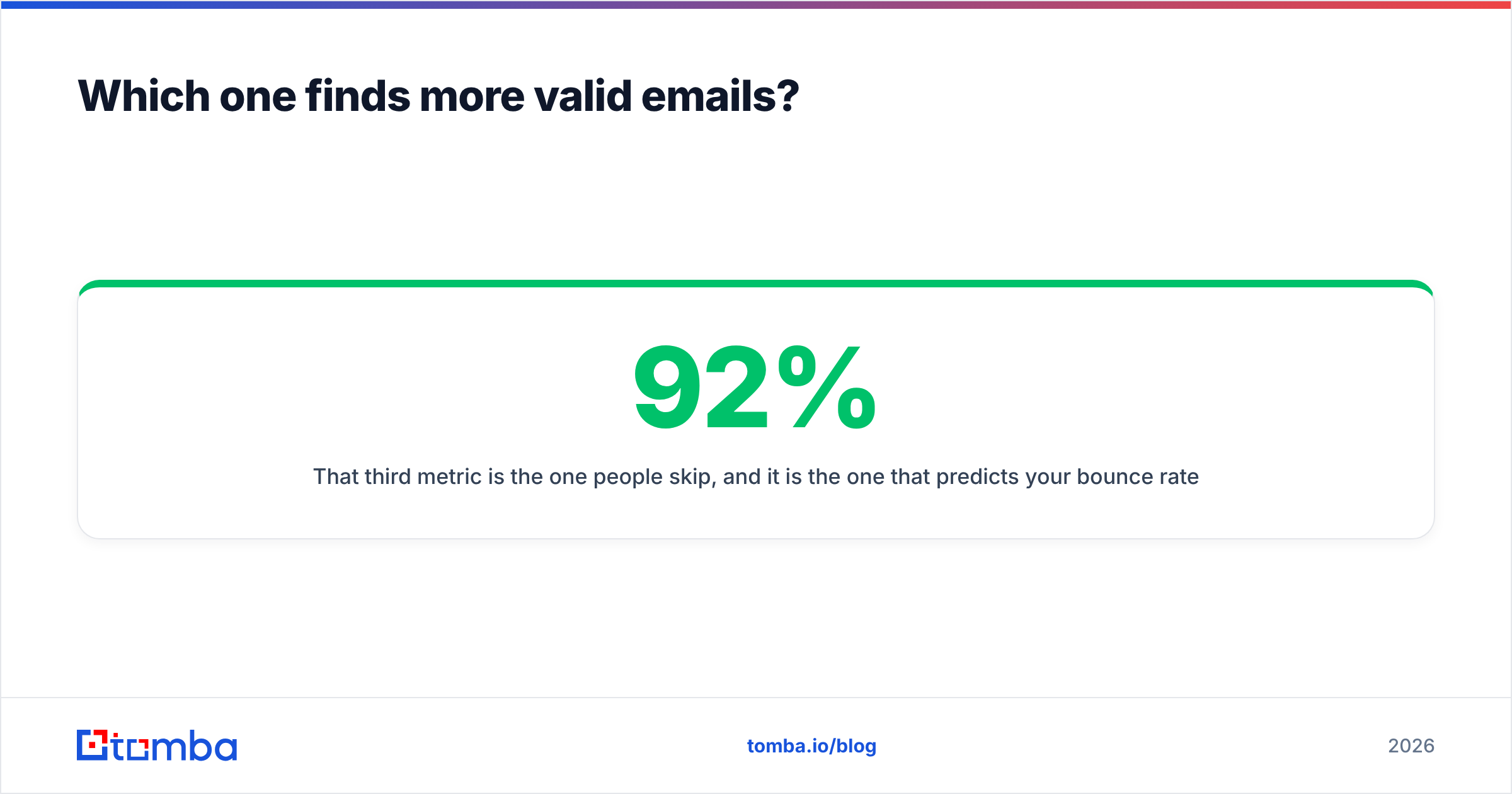
- Measure three things separately: hit rate (how many rows returned an address), accuracy (how many of those actually deliver), and catch-all share (how many came back as "accept-all" and therefore unverified).
That third metric is the one people skip, and it is the one that predicts your bounce rate. A tool showing a 92% hit rate where 30% of the hits are unverified catch-alls is functionally a 64% tool. Read the fine print on how each vendor counts a "found" email — some count catch-all guesses as hits, some do not, and the definition swing alone can move a headline number by 20 points.

In broad terms, from public reviews on G2 and from how each product is architected: Generect tends to win on coverage of who exists at mid-to-large companies, because network-derived profile data is deeper there. Mailshunt tends to be adequate on common SMB domains with predictable formats and weaker on enterprise domains that block SMTP probes and run catch-all. Neither is a great fit if your ICP is heavily European mid-market with GDPR-restricted records — that segment punishes every provider.
How do Generect and Mailshunt compare feature by feature?#
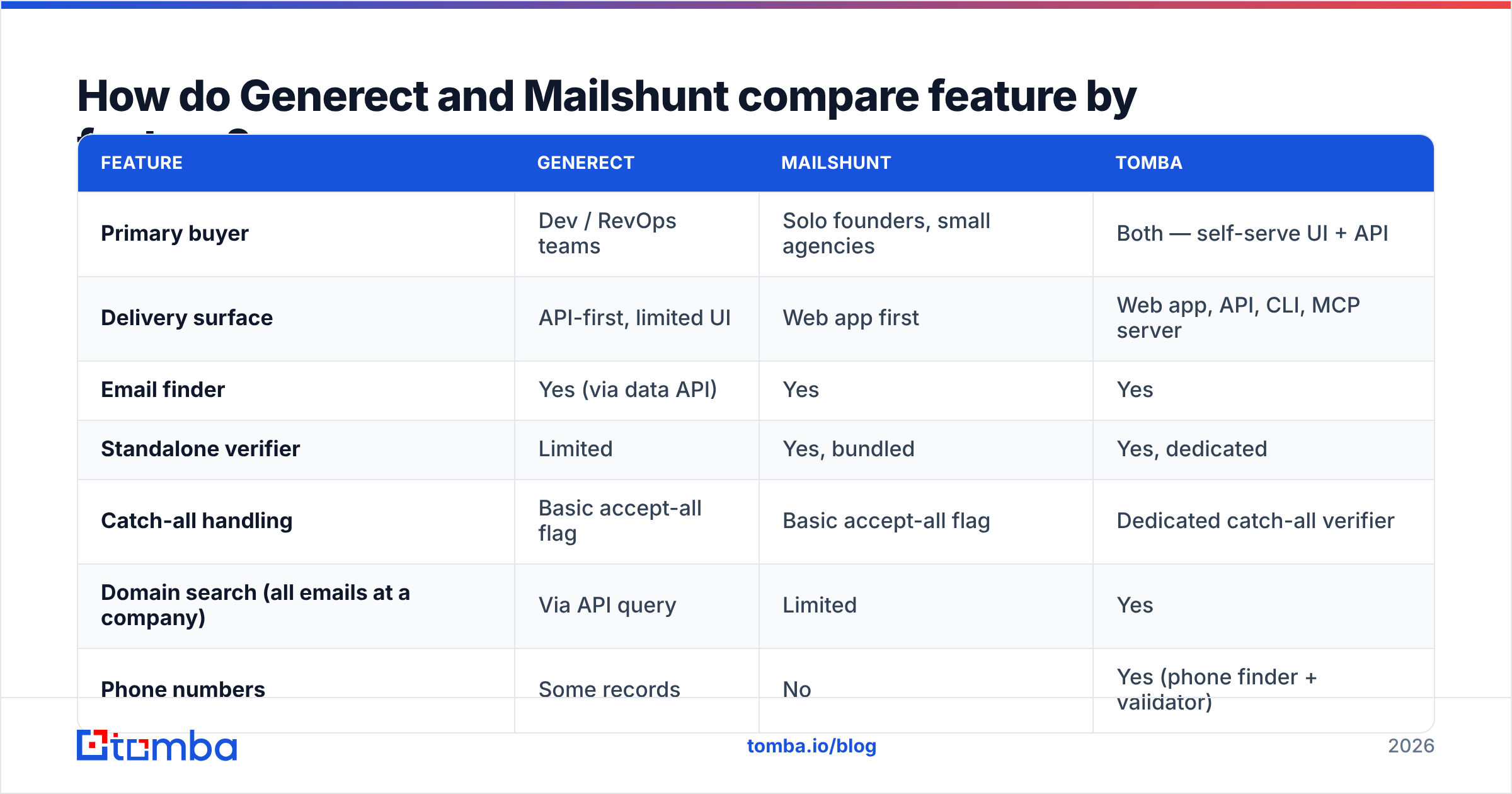
Here is the practical comparison, with Tomba included as the third reference point since it overlaps both.
| Feature | Generect | Mailshunt | Tomba |
|---|---|---|---|
| Primary buyer | Dev / RevOps teams | Solo founders, small agencies | Both — self-serve UI + API |
| Delivery surface | API-first, limited UI | Web app first | Web app, API, CLI, MCP server |
| Email finder | Yes (via data API) | Yes | Yes |
| Standalone verifier | Limited | Yes, bundled | Yes, dedicated |
| Catch-all handling | Basic accept-all flag | Basic accept-all flag | Dedicated catch-all verifier |
| Domain search (all emails at a company) | Via API query | Limited | Yes |
| Phone numbers | Some records | No | Yes (phone finder + validator) |
| Bulk processing | API batch | Small CSV batches | Bulk finder + bulk verify |
| Chrome extension | No | Limited | Yes |
| Spreadsheet add-ons | No | No | Excel + Google Sheets |
| Free tier | No public free tier | Small trial credits | 25 searches/mo, no card |
| Entry paid price | Quote-based | Low-cost credit packs | $49/mo |

The row that matters most for cold outbound is catch-all handling. Roughly a quarter of B2B domains are configured to accept all inbound mail regardless of whether the mailbox exists, which defeats the standard SMTP verification handshake. If your tool just flags those as "accept-all — proceed at your own risk," you are the one absorbing the bounce. A catch-all verifier that runs additional signal checks is not a nice-to-have at scale; it is the difference between a 2% and a 12% bounce rate.
What does each one actually cost?#
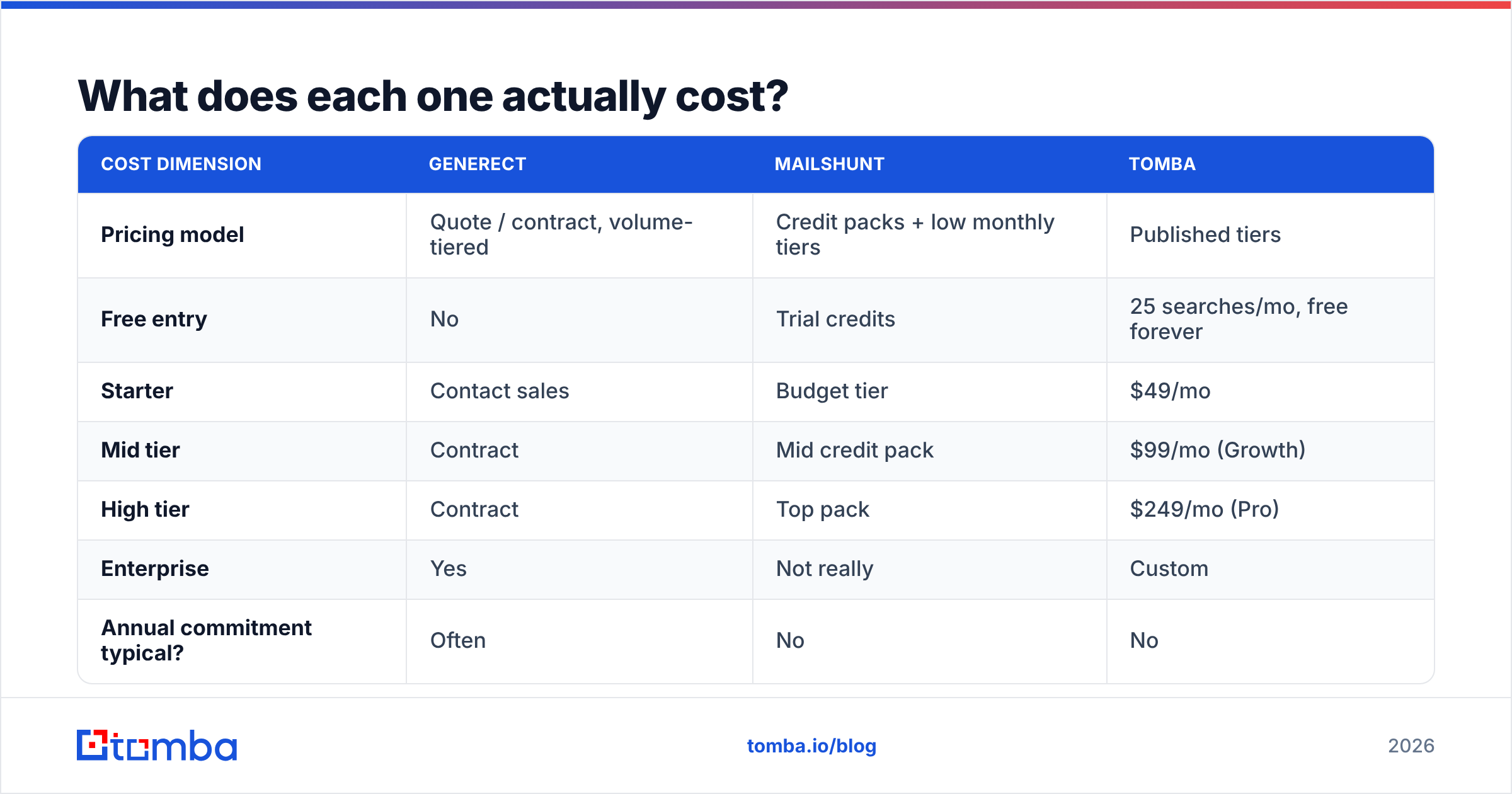
Published pricing changes often, so confirm on each vendor's page before you sign anything. The structure of the pricing is more stable than the numbers, and structure is what burns budgets.
| Cost dimension | Generect | Mailshunt | Tomba |
|---|---|---|---|
| Pricing model | Quote / contract, volume-tiered | Credit packs + low monthly tiers | Published tiers |
| Free entry | No | Trial credits | 25 searches/mo, free forever |
| Starter | Contact sales | Budget tier | $49/mo |
| Mid tier | Contract | Mid credit pack | $99/mo (Growth) |
| High tier | Contract | Top pack | $249/mo (Pro) |
| Enterprise | Yes | Not really | Custom |
| Annual commitment typical? | Often | No | No |
| Do failed lookups burn credits? | Check contract | Check plan terms | No charge for no-result finds |
Two cost traps worth naming.
Trap one: quote-based pricing hides the floor. Vendors that route everything through "contact sales" usually have a contract minimum that makes them irrational below a certain volume. If you need 3,000 emails a month, a contract-minimum vendor may quote you the same as a team needing 50,000. That is not a criticism of Generect specifically — it is how enterprise data contracts work — but it means a small team comparing generect vs mailshunt on price is comparing an annual commitment to a $20 credit pack, and the comparison is meaningless without the actual quote in hand.
Trap two: credits burned on failures. Some tools deduct a credit whether or not they return an address, and some deduct again when you verify what they found. On a 10,000-row list with a 65% hit rate, that accounting difference can double your effective cost per usable contact. Always ask: what is my cost per verified, deliverable address — not per search. Tomba's published pricing doesn't charge for lookups that return nothing, which is the norm you should demand from any vendor.

Which tool fits which team?#
- Pick Generect if you have engineering capacity, you're building lists programmatically, your ICP skews mid-market-to-enterprise, and you're comfortable with a contract. The API-first model is a genuine strength when your CRM enrichment runs as a nightly job.
- Pick Mailshunt if you're pre-revenue or running a lean agency, your volume is a few thousand lookups a month, your targets are SMBs with predictable email formats, and the invoice matters more than the last 8% of coverage.
- Pick neither if your bottleneck is verification rather than discovery. Both tools will happily hand you addresses; neither is primarily a deliverability product. Pair whatever finder you choose with a dedicated email verifier before anything touches your sending domain.
- Pick a consolidated platform if you're paying for a finder, a separate verifier, and a separate enrichment vendor. Three bills, three credit systems, and three sets of API keys is a tax most teams under 20 people shouldn't be paying.
Where does Tomba fit in this comparison?#
Honest positioning: Tomba is not the cheapest option on this page, and it is not the deepest enterprise data contract on this page. It targets the middle — the team that needs Generect-style API access without a sales cycle, and Mailshunt-style self-serve without the coverage cliff.
Concretely, that means one account covers the email finder, domain search, catch-all verification, phone lookup, and data enrichment, reachable through a web app, a Chrome extension, Google Sheets, Excel, a CLI, and a REST email finder API. The free tier is 25 searches per month with no card, which is enough to run the 200-row bake-off described earlier before you commit a dollar to anyone.
Where Tomba is not the right answer: if you need a licensed intent-data feed, account-level buying signals, or a 200-field enterprise firmographic record, you want a Clearbit- or 6sense-class vendor, not an email finder. Know which problem you're solving.
What about verification and deliverability?#
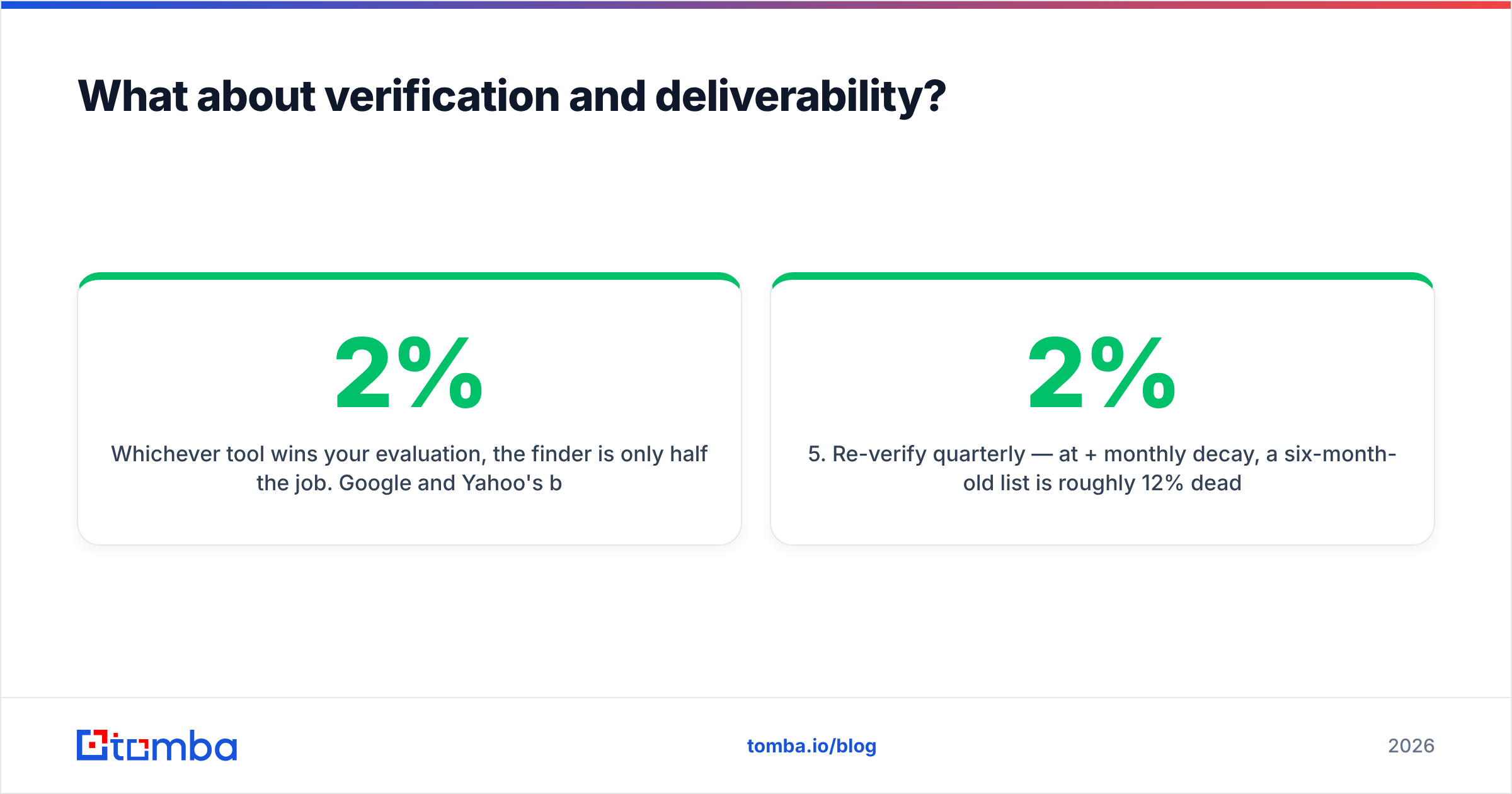
Whichever tool wins your evaluation, the finder is only half the job. Google and Yahoo's bulk-sender requirements made bounce discipline non-optional — sustained hard-bounce rates above roughly 2% will visibly degrade inbox placement, and Google's own sender guidelines spell out the spam-rate threshold you're expected to stay under.
The workflow that holds up under audit:
- Find — pull addresses from your chosen provider.
- Verify — run every address through a real verifier, not just the finder's confidence score.
- Segment catch-alls — don't discard them, but send to them on a separate, lower-volume subdomain so a bad batch can't torch your primary domain.
- Suppress role accounts —
info@,sales@,support@inflate complaint rates and rarely convert in outbound. - Re-verify quarterly — at 2%+ monthly decay, a six-month-old list is roughly 12% dead.
Skip step two and it doesn't matter which of these tools you picked; your reply rate is going to be a function of your sender reputation, not your copy.
The verdict#
Generect is the better choice when the job is programmatic data acquisition at scale and you have someone who writes code. Mailshunt is the better choice when the job is "get me a few thousand plausible addresses for under a hundred dollars." Neither is a mistake within its lane — the mistake is buying one for the other's job, which is exactly what happens when teams compare them on hit rate alone.
If you'd rather not choose between an API you can't self-serve and a budget tool that struggles on catch-all domains, run all three against the same seed list. Start with the Tomba Email Finder free tier — 25 searches a month, no card, full access to domain search and verification — and let the results on your own ICP decide instead of anyone's homepage claim.
Related guides#
Ready to find emails that actually work?
Join 150,000+ professionals who stopped guessing and started sending. Free credits on signup — no credit card required.
Get the Tomba newsletter
Practical outbound tactics and product updates — once every two weeks.
About the author