Generect vs Mailsso: Which B2B Email Finder Wins in 2026?
Generect sells a lead database with real-time search. Mailsso sells fast, cheap email lookups. We compare accuracy, credits, pricing and API depth so you know which one actually fits your outbound motion.
TL;DR
- Generect is a lead-database play: real-time company and people search, LinkedIn-oriented lookups, and enrichment aimed at teams building lists from scratch.
- Mailsso is a lookup play: give it a name and a domain, get an email back, verify it, move on. Lighter, cheaper, less to learn.
- The real difference is not accuracy claims. It is what you pay for a failed lookup and whether the tool verifies before it charges you.
- If you need list building plus enrichment plus a real API in one subscription, neither is automatically the winner. Compare credit rollover and seat costs before the logo.
- Run the same 100-contact test file through both. Vendor-published accuracy numbers are marketing; your ICP is the only benchmark that matters.
What are Generect and Mailsso?#
They solve overlapping problems from opposite directions.
Generect positions itself as a B2B data platform. The pitch is real-time search: instead of querying a stale snapshot, it assembles company and contact records on demand, with LinkedIn-based people search as a core entry point. That suits teams who start with a filter ("Series B fintechs in DACH, 50-200 employees, hiring RevOps") rather than a spreadsheet of names.
Mailsso is narrower and blunter. It is an email finder and verifier: feed it a person and a domain, get a deliverable address. There is bulk processing and an API, but the product surface is small on purpose. You are buying a lookup utility, not a database subscription.
That distinction drives everything else. A database tool charges you for access to records. A lookup tool charges you per answer. Teams routinely pick the wrong one, buy a database when they already have the names, or buy a lookup tool when they have no list to look up.
How do Generect and Mailsso compare head to head?#
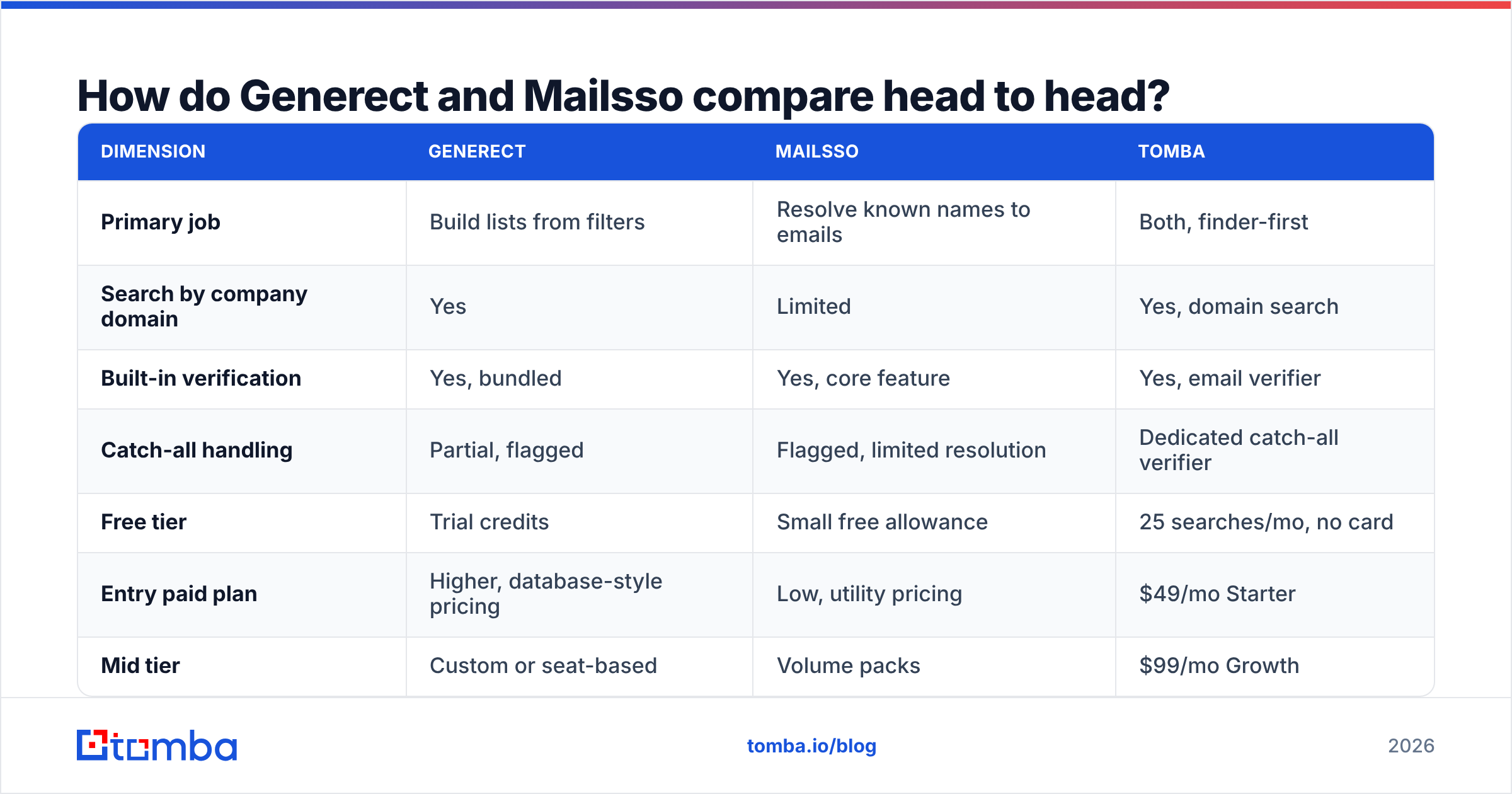
Here is the honest side-by-side. Plan names and prices move constantly, so treat the pricing row as directional and verify on each vendor's page before you sign anything.
| Dimension | Generect | Mailsso | Tomba |
|---|---|---|---|
| Primary job | Build lists from filters | Resolve known names to emails | Both, finder-first |
| Search by company domain | Yes | Limited | Yes, domain search |
| Built-in verification | Yes, bundled | Yes, core feature | Yes, email verifier |
| Catch-all handling | Partial, flagged | Flagged, limited resolution | Dedicated catch-all verifier |
| Free tier | Trial credits | Small free allowance | 25 searches/mo, no card |
| Entry paid plan | Higher, database-style pricing | Low, utility pricing | $49/mo Starter |
| Mid tier | Custom or seat-based | Volume packs | $99/mo Growth |
| API access | Yes | Yes | Yes, on all paid plans (Tomba API) |
| Phone numbers | Available on higher tiers | No | Yes, phone finder |
| Best for | SDR teams building net-new TAM | Solo founders, agencies, one-off enrichment | Teams that need finder + verifier + API in one bill |
Read that table as three different buying motions, not a scoreboard. A four-person agency enriching client lists has almost nothing in common with a 20-rep SDR floor that burns through 40,000 records a quarter.

Which one actually finds more valid emails?#
Nobody can answer this for you, and any blog that claims a clean winner is guessing.
Here is why. Email finder hit rates are a function of three things you control and one you do not:
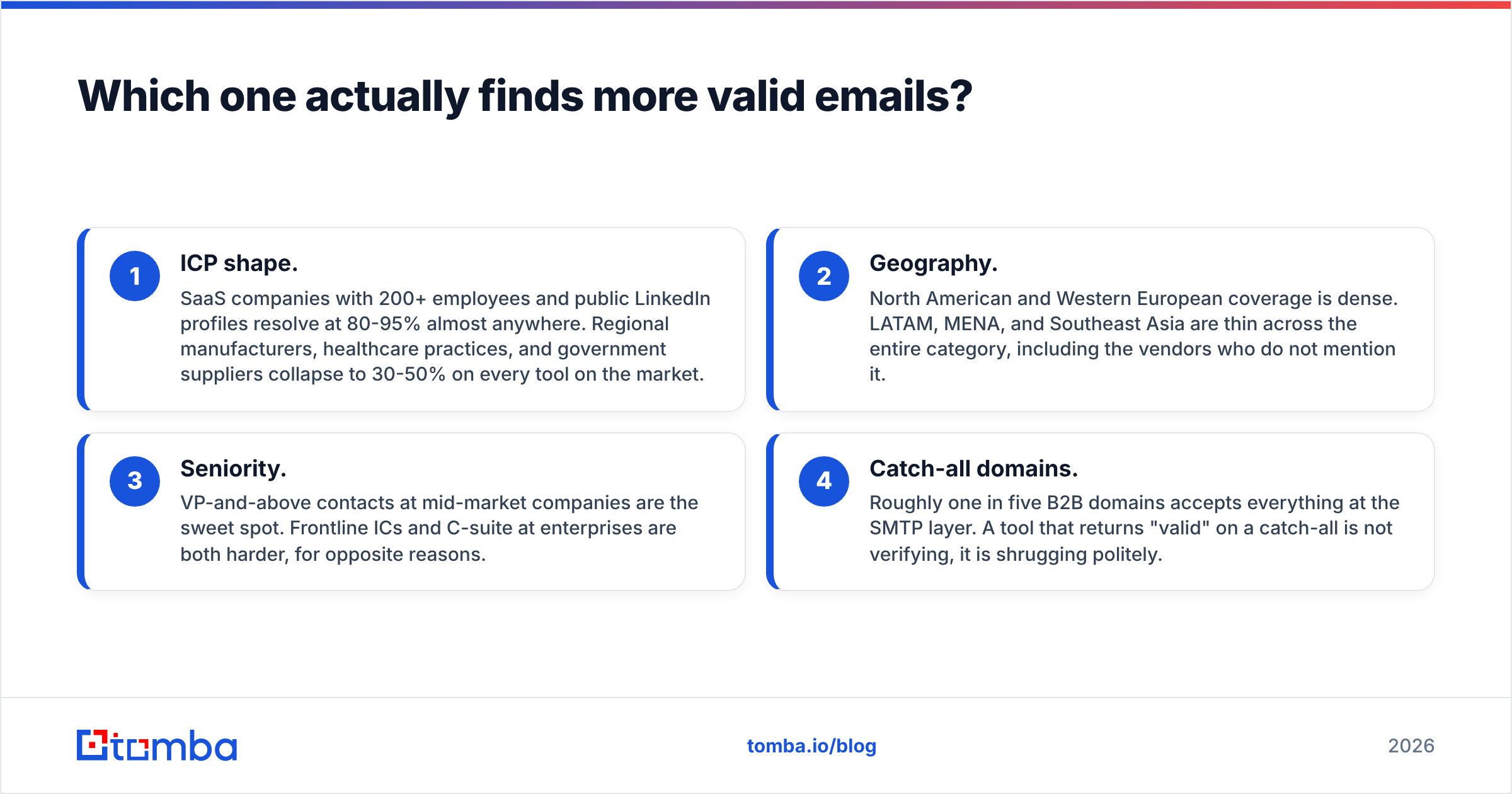
- ICP shape. SaaS companies with 200+ employees and public LinkedIn profiles resolve at 80-95% almost anywhere. Regional manufacturers, healthcare practices, and government suppliers collapse to 30-50% on every tool on the market.
- Geography. North American and Western European coverage is dense. LATAM, MENA, and Southeast Asia are thin across the entire category, including the vendors who do not mention it.
- Seniority. VP-and-above contacts at mid-market companies are the sweet spot. Frontline ICs and C-suite at enterprises are both harder, for opposite reasons.
- Catch-all domains. Roughly one in five B2B domains accepts everything at the SMTP layer. A tool that returns "valid" on a catch-all is not verifying, it is shrugging politely.

That last point is where most head-to-head tests fall apart. If Tool A returns 90 addresses from 100 rows and Tool B returns 70, Tool A looks like the winner until you send. Then Tool A's 20 catch-all guesses bounce, your sender reputation takes the hit, and the "cheaper" tool cost you a warmed domain.
Score the test on verified-and-delivered, not returned. Anything else is theater.

What does each one really cost?#
Sticker price is the least interesting number on the pricing page. Four line items decide your actual cost per usable contact.
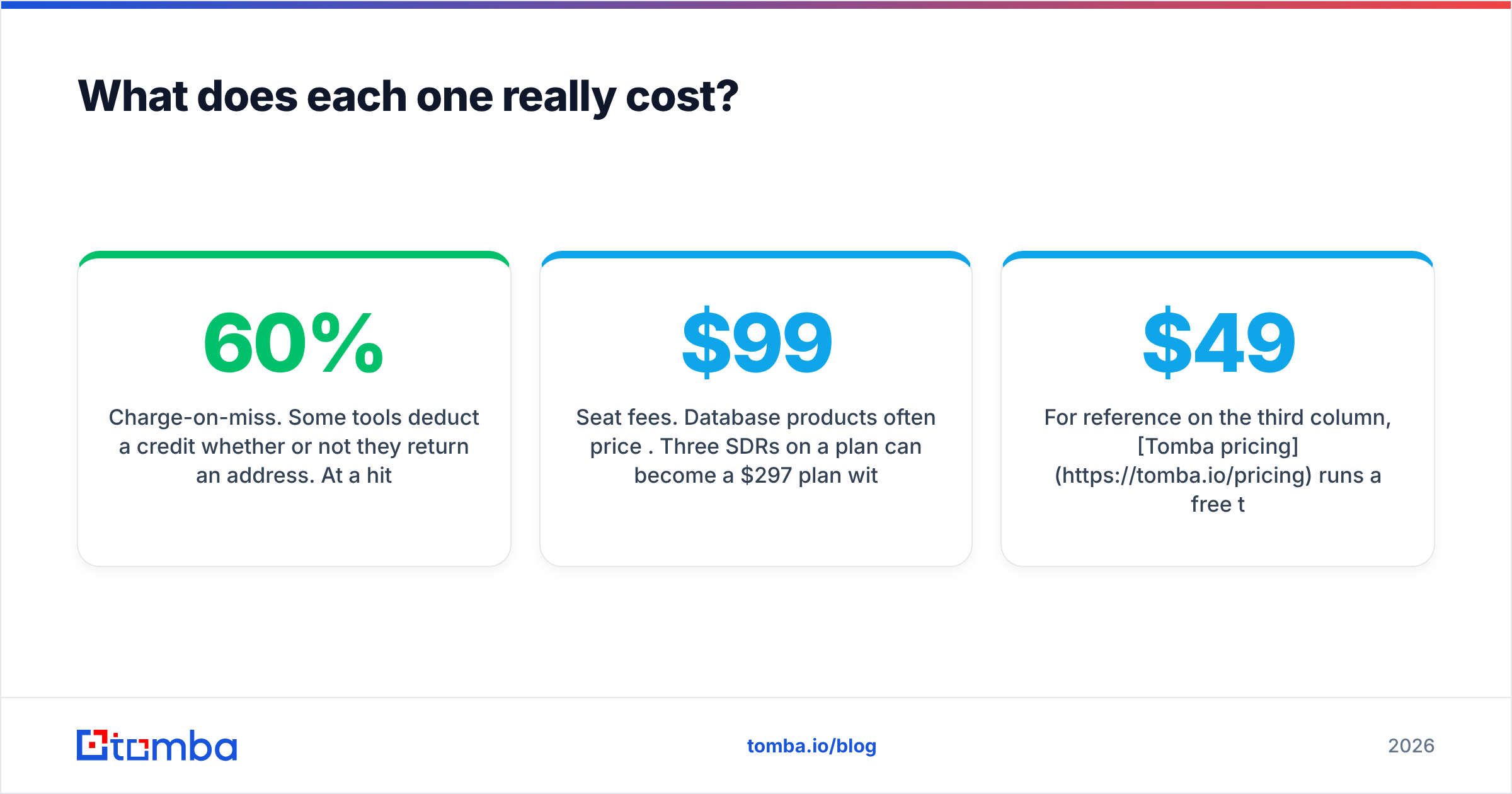
- Charge-on-miss. Some tools deduct a credit whether or not they return an address. At a 60% hit rate on a hard ICP, that quietly inflates your effective price by 66%.
- Verification billed separately. If finding costs one credit and verifying costs another, your per-contact cost doubles for the only workflow that matters.
- Seat fees. Database products often price per user. Three SDRs on a $99 plan can become a $297 plan without a single extra lookup.
- Credit expiry. Monthly credits that reset to zero punish spiky outbound. If you run campaigns in bursts, rollover is worth more than a bigger allowance.
Generect's model leans database: higher entry commitment, richer records, seat-aware pricing on team plans. Mailsso's model leans utility: low entry price, volume packs, less included per record. Neither is wrong. They are priced for different buyers.
For reference on the third column, Tomba pricing runs a free tier at 25 searches per month, Starter at $49/mo, Growth at $99/mo, Pro at $249/mo, and custom Enterprise, with the finder, verifier, and API included rather than sold as add-ons. Check current numbers on all three vendors before you compare, because everyone in this category reprices at least annually.
Who should pick Generect?#
Pick Generect when the bottleneck is finding the accounts, not the addresses.
You are a fit if you build territory lists from filters, run ABM motions that need firmographic and headcount signals, work LinkedIn-sourced prospecting heavily, or want one vendor covering search plus enrichment plus contact data. Real-time assembly matters most when your ICP moves fast, funding rounds, hiring spikes, tech stack changes, because a quarterly snapshot is already wrong by the time you export it.
You are not a fit if you already have the names. Paying database pricing to resolve a CSV of 800 contacts you exported from a conference app is the classic overspend in this category.
Who should pick Mailsso?#
Pick Mailsso when the bottleneck is the addresses, and the volume is modest.
You are a fit if you are a founder doing your own outbound, an agency enriching client-supplied lists, a recruiter working from a shortlist, or a developer who wants a simple endpoint without onboarding a platform. The small surface area is a feature: there is nothing to configure, nothing to train a team on, no seat math.
You are not a fit if you need list building, phone data, or deep integrations. And you should stress-test catch-all behavior specifically, because lightweight tools are where "risky" results most often get returned as "valid."
Where does Tomba fit in this comparison?#
Tomba sits between the two, and we will be direct that this is our blog, so weigh accordingly.
The design goal is a single subscription that covers the whole find-verify-enrich loop instead of splitting it across a database vendor and a verification vendor. The email finder resolves name plus domain. Domain search pulls every discoverable address at a company with role and department context. The verifier runs SMTP, syntax, and disposable checks, with a separate catch-all path so you are not handed a coin flip labeled "valid." Bulk processing, a documented API, a CLI, and native Google Sheets and HubSpot connections cover the plumbing.
Practical selection logic:
- Choose Generect if list building from filters is the core job and you have budget for a data platform.
- Choose Mailsso if you want the cheapest possible per-lookup cost and you already own your list.
- Choose Tomba if you want finder plus verifier plus API on one bill, with a free tier to test first and $49/mo as the real entry point.
- Choose two tools if you are running at scale. Serious outbound teams routinely stack a database for discovery with a specialist verifier for the final gate. That is not indecision, it is redundancy.

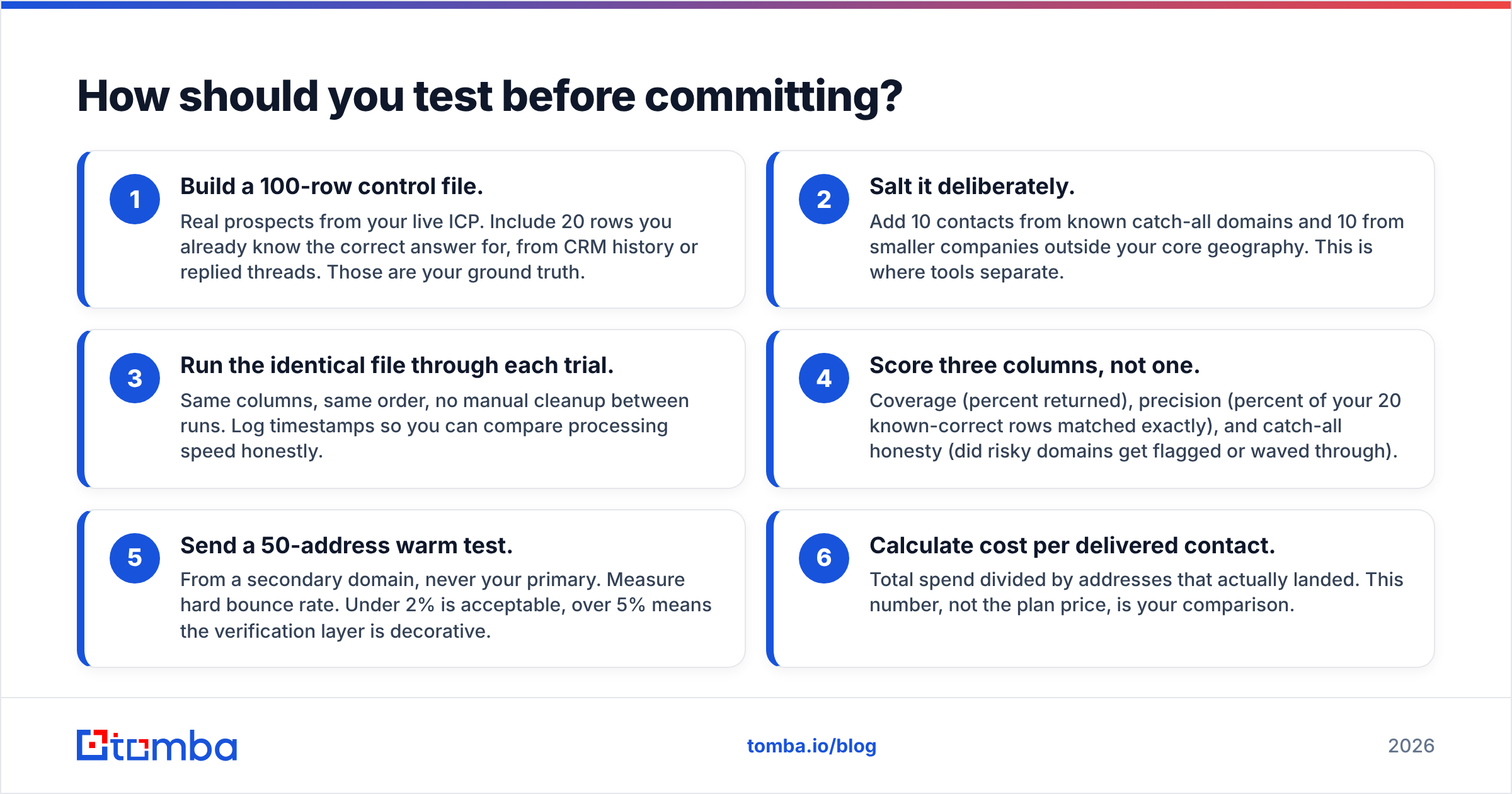
How should you test before committing?#
Do not buy on a demo. Run a bake-off. It takes an afternoon and it is the only evidence that survives contact with your actual pipeline.
- Build a 100-row control file. Real prospects from your live ICP. Include 20 rows you already know the correct answer for, from CRM history or replied threads. Those are your ground truth.
- Salt it deliberately. Add 10 contacts from known catch-all domains and 10 from smaller companies outside your core geography. This is where tools separate.
- Run the identical file through each trial. Same columns, same order, no manual cleanup between runs. Log timestamps so you can compare processing speed honestly.
- Score three columns, not one. Coverage (percent returned), precision (percent of your 20 known-correct rows matched exactly), and catch-all honesty (did risky domains get flagged or waved through).
- Send a 50-address warm test. From a secondary domain, never your primary. Measure hard bounce rate. Under 2% is acceptable, over 5% means the verification layer is decorative.
- Calculate cost per delivered contact. Total spend divided by addresses that actually landed. This number, not the plan price, is your comparison.
Most teams discover the expensive tool wins on precision and loses on cost-per-delivered, or the cheap tool wins on volume and loses everything at step five. Either result is worth knowing before you sign an annual contract.
What do reviewers say about tools in this category?#
Cross-check anything you read here, including this post. Practical sources:
- G2's lead intelligence category for volume-weighted reviews and recency filters. Sort by most recent, not highest rated, because 2023 reviews describe products that no longer exist.
- Capterra for small-business perspective, which skews closer to the Mailsso buyer profile.
- Each vendor's own API documentation. Docs are the most honest artifact a data company publishes: rate limits, response schemas, and error codes tell you what the product actually does, and what it quietly does not.
Also read the one-star reviews first. In this category the recurring complaints are always the same three: credits burned on failures, support latency on billing, and bounce rates that did not match the advertised accuracy. If a vendor has none of those, it is either genuinely good or genuinely small.
Final verdict on Generect vs Mailsso#
There is no universal winner, and any post that declares one is selling something. Generect wins when discovery is the constraint. Mailsso wins when cost per lookup is the constraint and your list already exists. The failure mode is buying on brand instead of on which constraint you actually have.
Whichever way you lean, do not skip verification. Deliverability is the compounding asset in outbound, and a burned domain costs more than any subscription in this comparison.
Want to test a third option before you decide? Tomba's Email Finder gives you 25 free searches a month with no credit card, so you can run the same 100-row control file through it alongside your Generect and Mailsso trials. Finder, verifier, catch-all checks, and API access are on the same plan, starting at $49/mo, so the bake-off costs you nothing but an afternoon.
Related guides#
Ready to find emails that actually work?
Join 150,000+ professionals who stopped guessing and started sending. Free credits on signup — no credit card required.
Get the Tomba newsletter
Practical outbound tactics and product updates — once every two weeks.
About the author