Generect vs Market Location: B2B Data Compared for 2026
One is an API-first, LinkedIn-sourced lead engine built for engineers. The other is a UK business database built for direct marketing. Here is how Generect and Market Location actually differ, and which one earns your budget.
Generect vs Market Location is a short list a lot of B2B teams end up with. One is a live data API. The other is a UK list file. This guide breaks down what each one does well, and which one earns your budget.
TL;DR
- Generect is an API-first B2B lead engine. You query companies and people in code. You get clean records back. You wire them into your own stack. Best for technical teams.
- Market Location is a UK-focused business database with a direct-mail heritage. It holds phone-checked company records, postal addresses, and licensed list files. Best for UK phone campaigns, mail, and territory planning.
- They are not the same product. Generect vs Market Location is a data pipe against a data file.
- Neither one ships a strong email checker. Plan to add one before you send.
- Do you just need work email addresses at scale? A finder plus verifier will cost you less per valid contact. Tomba starts at $49/mo.
What is Generect?#
Generect is a B2B data provider. It sells company and people records through an API and a web app. The pitch is fresh, structured data. You do not download a CSV dump each quarter. Instead you query a segment — industry, headcount, region, job title, tech signals. You get back clean JSON. You push that straight into a CRM, a sequencer, or your own scoring model.
The real story is about who owns the work. With Generect, an ops engineer or a backend developer owns the setup. They build the enrichment job and schedule the refreshes. Reps never see the raw source. They just see full records inside HubSpot or Salesforce.
That helps if you have developers. It hurts if you do not. A five-person agency with no coder will get little out of an API. A thirty-person team with an ops function will get a lot. Check the current features and country coverage on generect.com first. Do not assume your segment is covered.
What is Market Location?#
Market Location comes from the other tradition. It is a UK data house. Its core asset is a kept-up database of British firms: registered addresses, sites, phone numbers, staff bands, SIC codes, and named contacts. The roots are direct marketing — post, phone lists, and data licensing. Not developer APIs.
The workflow is different by design. You brief a segment. Say, factories in the Midlands with 50–250 staff. You get a counts report. You license a file for a set number of uses. Then you run a campaign against it. Humans check the records by phone on a rolling cycle. That is slower than a scraped feed. It is also more solid for address and phone data.
Is your plan "call 400 UK makers this quarter"? That model works. Is it "enrich every signup in 200 milliseconds"? It does not.

Generect vs Market Location: how do they compare?#
Here is the honest side-by-side. Some pricing is quote-only, so it is listed that way. We did not invent numbers. Both firms price by volume and seat count. Any figure you see quoted elsewhere is someone's deal, not a rate card.
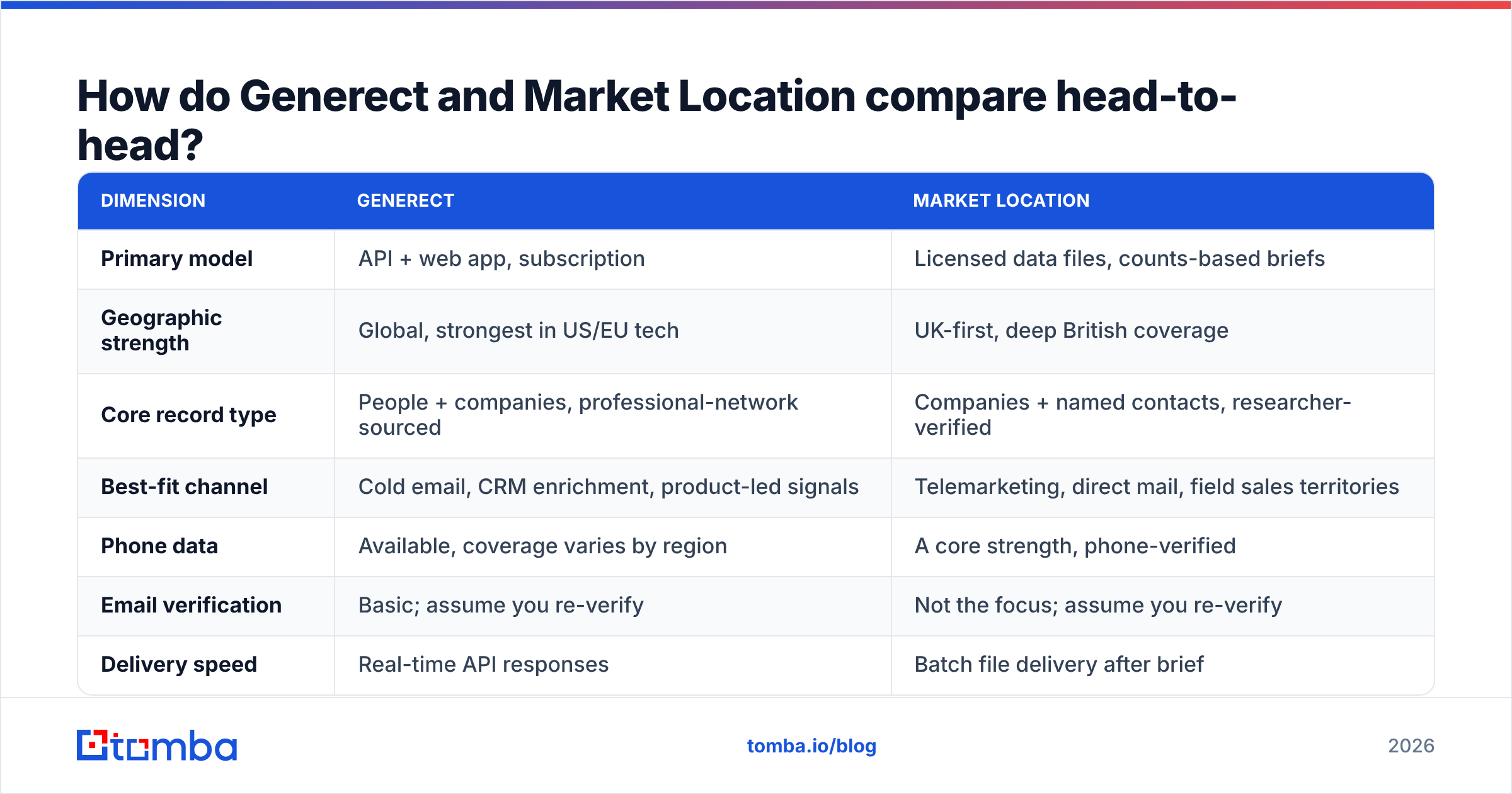
| Dimension | Generect | Market Location |
|---|---|---|
| Primary model | API + web app, subscription | Licensed data files, counts-based briefs |
| Geographic strength | Global, strongest in US/EU tech | UK-first, deep British coverage |
| Core record type | People + companies, professional-network sourced | Companies + named contacts, researcher-verified |
| Best-fit channel | Cold email, CRM enrichment, product-led signals | Telemarketing, direct mail, field sales territories |
| Phone data | Available, coverage varies by region | A core strength, phone-verified |
| Email verification | Basic; assume you re-verify | Not the focus; assume you re-verify |
| Delivery speed | Real-time API responses | Batch file delivery after brief |
| Typical buyer | RevOps / engineering | Marketing ops / demand gen |
| Pricing model | Subscription, quote-based by volume | Licence fee per file, usage-limited |
| Setup effort | Developer time required | Minimal technical setup |
The row that settles most calls is "best-fit channel." The rest follows from it.
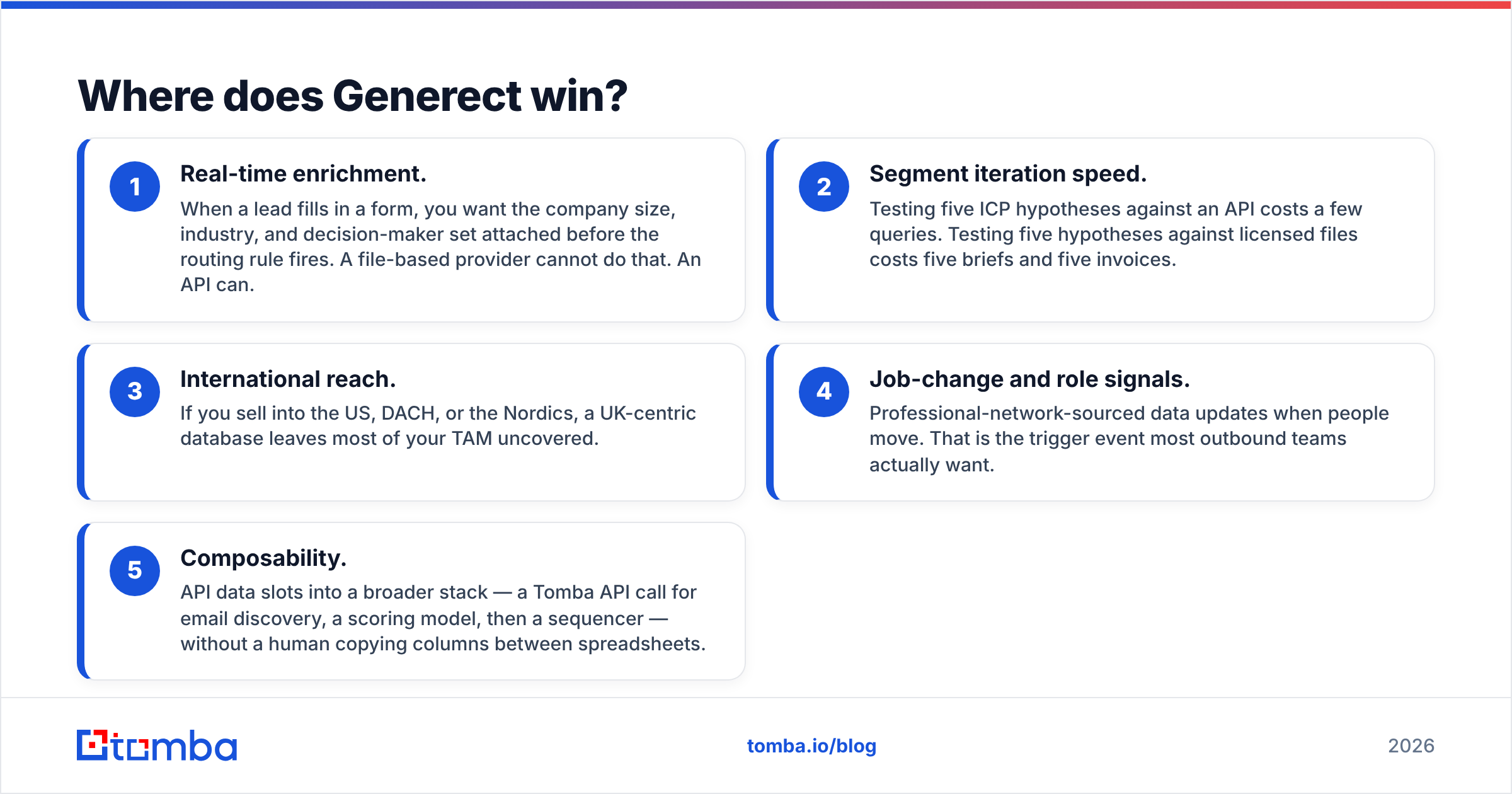
Where does Generect win?#
- Live enrichment. A lead fills in a form. You want company size, industry, and buyer roles attached before the routing rule fires. A file cannot do that. An API can.
- Faster tests. Testing five ICP ideas against an API costs a few queries. Testing five ideas against licensed files costs five briefs and five invoices.
- Global reach. Do you sell into the US, DACH, or the Nordics? A UK-only database misses most of your market.
- Job-change signals. Network-sourced data updates when people move jobs. That is the trigger most outbound teams want.
- It plugs in. API data slots into a wider stack. A Tomba API call finds the email. A model scores the lead. A sequencer sends it. No one copies columns by hand.
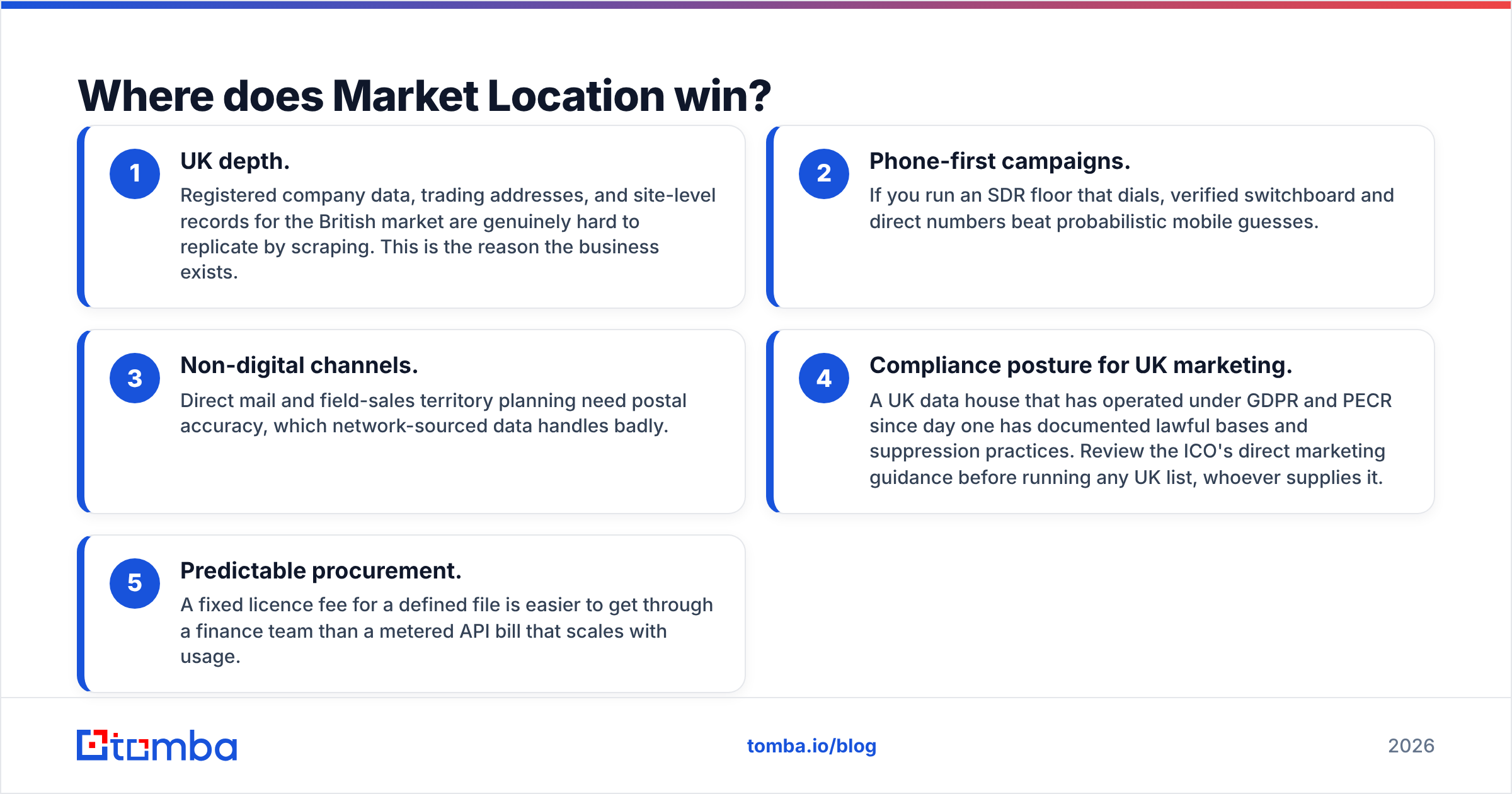
Where does Market Location win?#
- UK depth. Company records, trading addresses, and site data for the UK are hard to scrape. This is why the business exists.
- Phone-first work. Do you run a team that dials? Checked switchboard and direct numbers beat guessed mobile numbers.
- Off-screen channels. Direct mail and field sales need correct postal data. Network-sourced data is weak there.
- UK compliance. A UK data house has worked under GDPR and PECR from day one. It can show you its lawful basis and its suppression rules. Read the ICO's direct marketing guidance before you run any UK list, whoever supplies it.
- Simple buying. A flat licence fee for a set file is easy to get past finance. A metered API bill that grows with use is not.
How accurate is the data on each side?#
"Accurate" is the wrong single word. Split it into three questions.
Is the record real? Both do fine here. Firms exist. People exist. Market Location may edge ahead on company details, because a researcher actually phoned the switchboard.
Is the record current? Generect wins on people data. Job changes show up fast in a live network. Market Location wins on address and firm data, which moves slowly anyway.
Will the email land? Here both leave you exposed, as do most vendors in this class. Bundled emails are often guessed from a pattern, not checked. Few vendors publish how they test a mailbox. G2 reviews in the B2B data category repeat one complaint: the list looked fine, the bounce rate did not.
Treat every bought email as unchecked until you prove it. Run the file through an email verifier before it touches your sending domain. A 4% bounce rate on 10,000 records is not a data problem you fix later. It is a sender reputation problem, and you carry it for months.

Generect vs Market Location: what do they cost?#
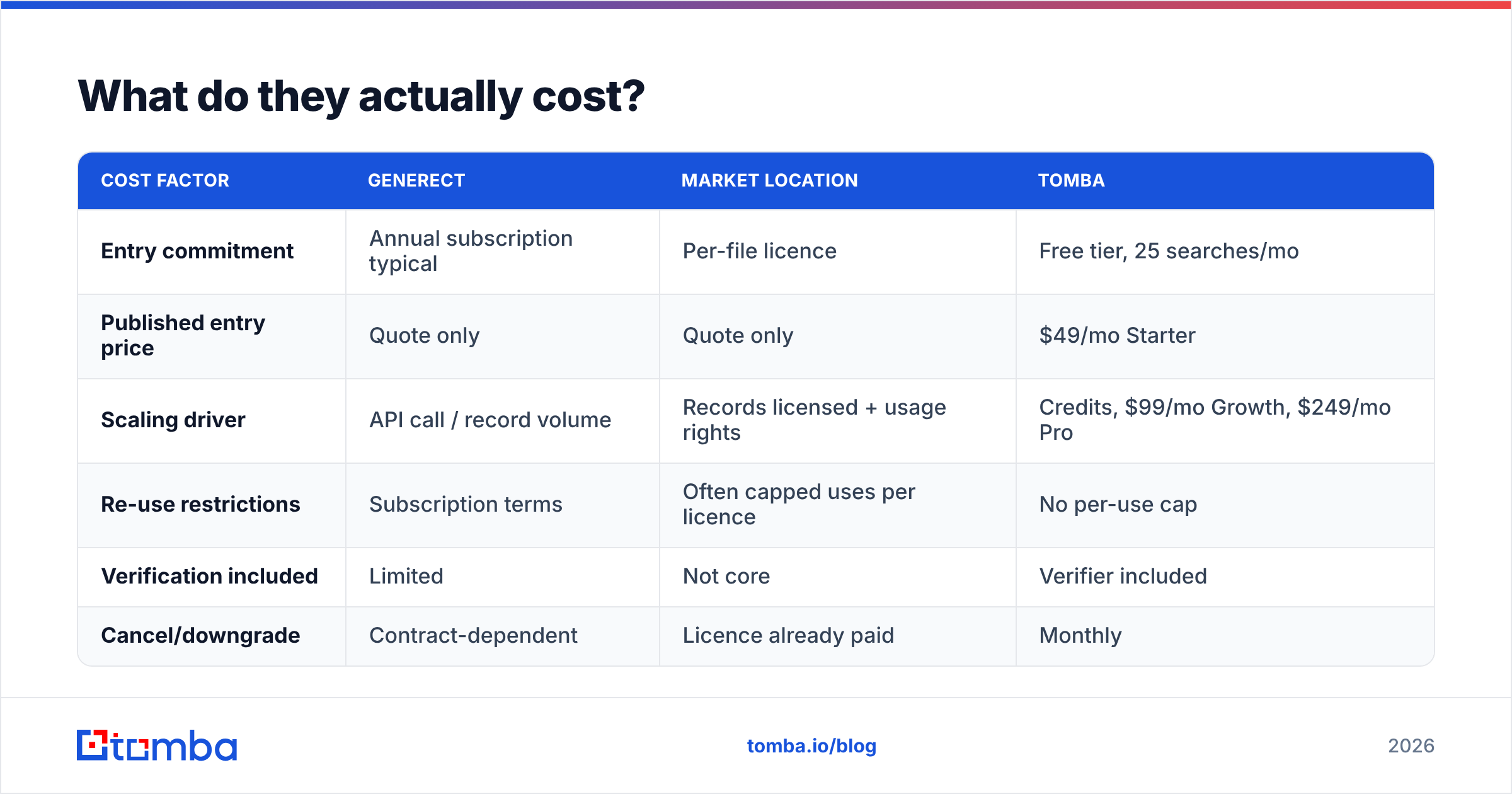
Both quote rather than publish. So you cannot compare prices without a sales call. You can compare cost structure. Structure predicts your real bill better than a headline number.
| Cost factor | Generect | Market Location | Tomba |
|---|---|---|---|
| Entry commitment | Annual subscription typical | Per-file licence | Free tier, 25 searches/mo |
| Published entry price | Quote only | Quote only | $49/mo Starter |
| Scaling driver | API call / record volume | Records licensed + usage rights | Credits, $99/mo Growth, $249/mo Pro |
| Re-use restrictions | Subscription terms | Often capped uses per licence | No per-use cap |
| Verification included | Limited | Not core | Verifier included |
| Cancel/downgrade | Contract-dependent | Licence already paid | Monthly |
The hidden cost is waste. Say 20% of a licensed file is junk and you paid per record. Your real cost per valid contact is 25% above the invoice. Model that before you sign. Clear per-credit pricing makes the math easy — see Tomba pricing for one published example. Quote-based pricing does not.
Which one fits your go-to-market motion?#
Match the tool to the motion, not to the feature list.
- UK only, phone and post heavy, marketing-led: Market Location. No global API replaces checked British phone data.
- Global, email-led, with developers: Generect. The API is the point. If you cannot use it, you overpay.
- UK only but email-led: Neither one is enough alone. Take the firm data from a UK house. Add a finder and a verifier for the emails.
- Many regions, small team, no developer: Skip both. A self-serve domain search plus bulk enrichment covers the same ground.
- Enterprise ABM with a set account list: You do not need broad coverage. You need depth on 500 named accounts. That means data enrichment against a list you already own.
Do you need a third option instead?#
Often, yes. It is worth saying plainly. This is not a clean two-horse race.
Generect and Market Location both sell databases. Their model rewards breadth: more records, more coverage, a bigger file. But most outbound teams do not fail for lack of records. They fail because those records never reach an inbox.
Do you already know your target accounts? Maybe from a conference list, a trade directory, LinkedIn Sales Navigator, or your CRM. Then you do not need to buy a database. You need to turn names and domains into checked, sendable email addresses. That is a smaller job. Specialist tools do it cheaper and better than broad data houses.
Here is the honest test. Export 100 target accounts. Run them through three providers. Count how many give you a checked, sendable contact in the exact role you want. Divide the monthly cost by that number. Cost per usable contact settles the Generect vs Market Location question faster than any feature grid, this one included.
These tools are not mutually exclusive, either. A common 2026 stack looks like this. Firm data from a regional specialist. People data from an API provider. Checks from a dedicated verifier. Orchestration in the CRM. Buying one product for all four jobs is how teams pay enterprise prices for weak coverage in every layer.
Frequently asked questions#
Is Generect a direct Market Location competitor? Only in part. They overlap on UK company data. They differ on delivery model, geography, and buyer.
Can I use either for cold email in the UK? You can. But UK B2B email sits under specific PECR rules. Sole traders and partnerships are treated differently from limited companies. Document your lawful basis before you send. Then suppress hard.
Which has better phone numbers? Market Location for UK landlines and switchboards. Generect for direct dials abroad, though coverage varies by region.
Do I still need a verifier if I buy from either? Yes. Assume every bought email needs a mailbox check before it enters a sequence.
Is Generect vs Market Location even a fair comparison? Only if you frame it by channel. Judge them on the job you need done, not on raw record counts.
The bottom line#
Generect vs Market Location comes down to channel and team. Buy Generect if you have developers and sell abroad by email. Buy Market Location if you sell into the UK by phone and post. Buy neither if what you really need is checked email addresses for accounts you have already picked.
For that last case — and it is the most common one — start with the Tomba Email Finder. Find work emails by name and domain. Check them in the same pass. Pull it all through an API or a bulk upload, with no procurement cycle. The free tier gives you 25 searches a month. That is enough to run the cost-per-usable-contact test above. Starter is $49/mo if the numbers hold up. Run the test on your own target list before you sign anything annual.
Related guides#
Ready to find emails that actually work?
Join 150,000+ professionals who stopped guessing and started sending. Free credits on signup — no credit card required.
Get the Tomba newsletter
Practical outbound tactics and product updates — once every two weeks.
About the author