Generect vs Mattermark 2026: B2B Data Tools Compared
Generect sells fresh, request-time B2B leads. Mattermark built its name on company growth signals. They solve different halves of the same problem — here is which one belongs in your 2026 stack, and where both leave gaps.
TL;DR — Generect vs Mattermark in one line: one builds contact lists, the other ranks accounts.
- Generect is a lead data provider. It pulls LinkedIn-style profiles and company pages at the moment you ask. Strength: fresh data. Weakness: you verify the emails yourself.
- Mattermark made its name on company signals: headcount growth, funding, momentum scores. It tells you which accounts are worth chasing. It does not hand you a person's inbox.
- The two are not real substitutes. Generect vs Mattermark pits a contact list builder against an account intelligence layer.
- Neither tool is a true email verifier. Both hand you data that still needs an SMTP check before you send.
- Have the account list but need reachable people? An email finder plus a verifier is cheaper. Tomba's free tier starts at 25 searches a month, and Starter is $49/mo.
Generect vs Mattermark: what is each tool built for?#
Start here. Most head-to-head posts assume the two tools do the same job. They don't.
Generect sells B2B lead generation. It does not ship you a stale snapshot of a database. It runs the search when you ask for it. You get leads that match your filters: job title, seniority, company size, region, industry, sometimes tech signals. The pitch is freshness. A lead pulled today shows today's job title, not one from an 18-month-old crawl.
Mattermark came from a different world. It was built to score and rank companies. It looks at growth, funding stage, hiring trends, and web traffic. The first buyers were VC analysts and corp-dev teams. Sales teams came later. Its output is a ranked list of companies, not a rolodex.
That gap shapes everything else: price, integrations, what you can automate, and how much cleanup lands on your SDR team.
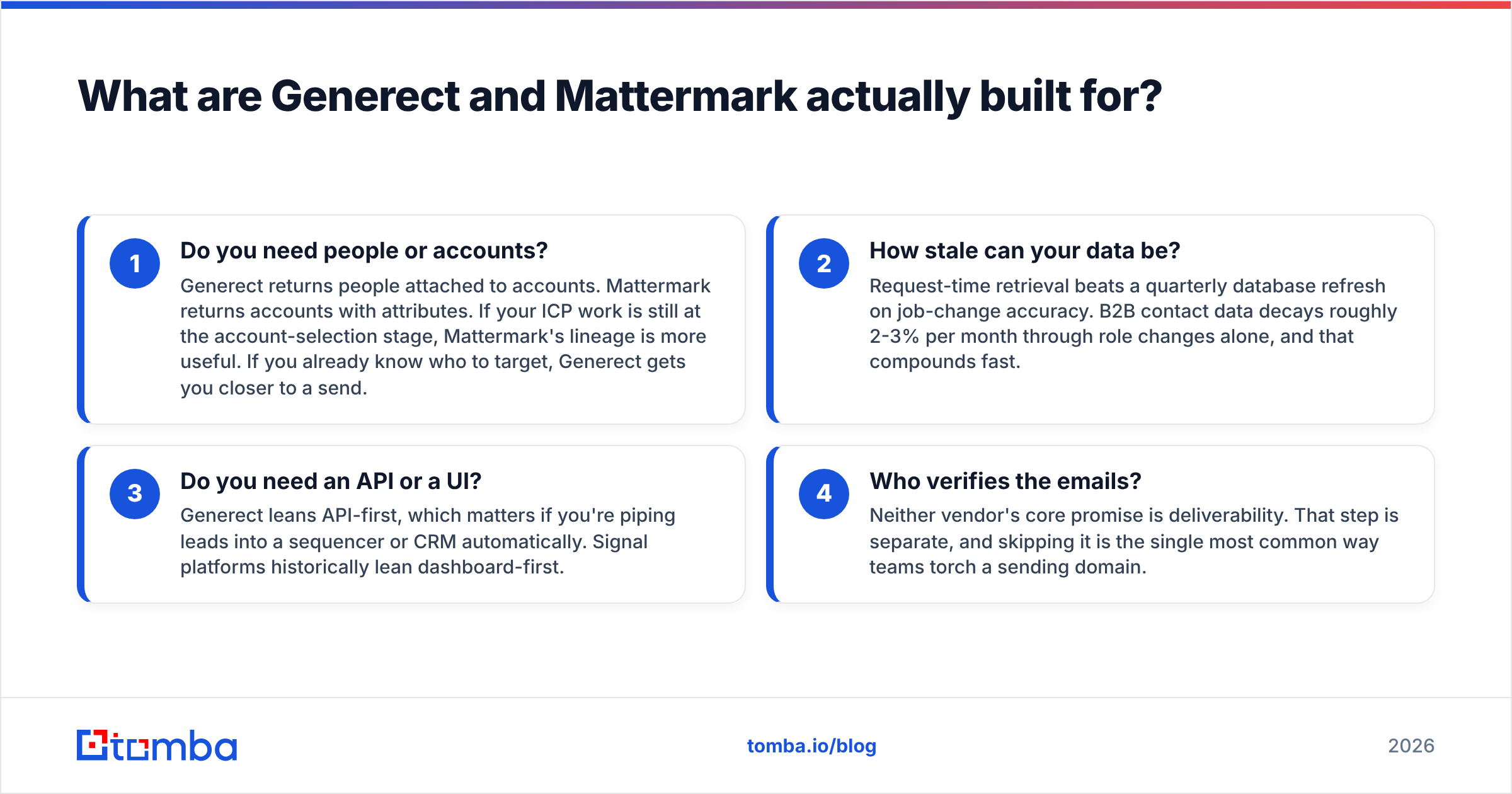
The four questions that settle Generect vs Mattermark:
- People or accounts? Generect returns people. Mattermark returns accounts with attributes. Still picking accounts? Mattermark helps more. Already know who to target? Generect gets you closer to a send.
- How stale can your data be? A live pull beats a quarterly refresh on job changes. B2B contact data rots by 2-3% a month from role changes alone. That adds up fast.
- API or UI? Generect leans API-first. That matters if you push leads into a sequencer or CRM. Signal tools lean dashboard-first.
- Who verifies the emails? Neither vendor promises deliverability. That step is on you. Skip it and you burn your sending domain.
Generect vs Mattermark: how do they compare head to head?#
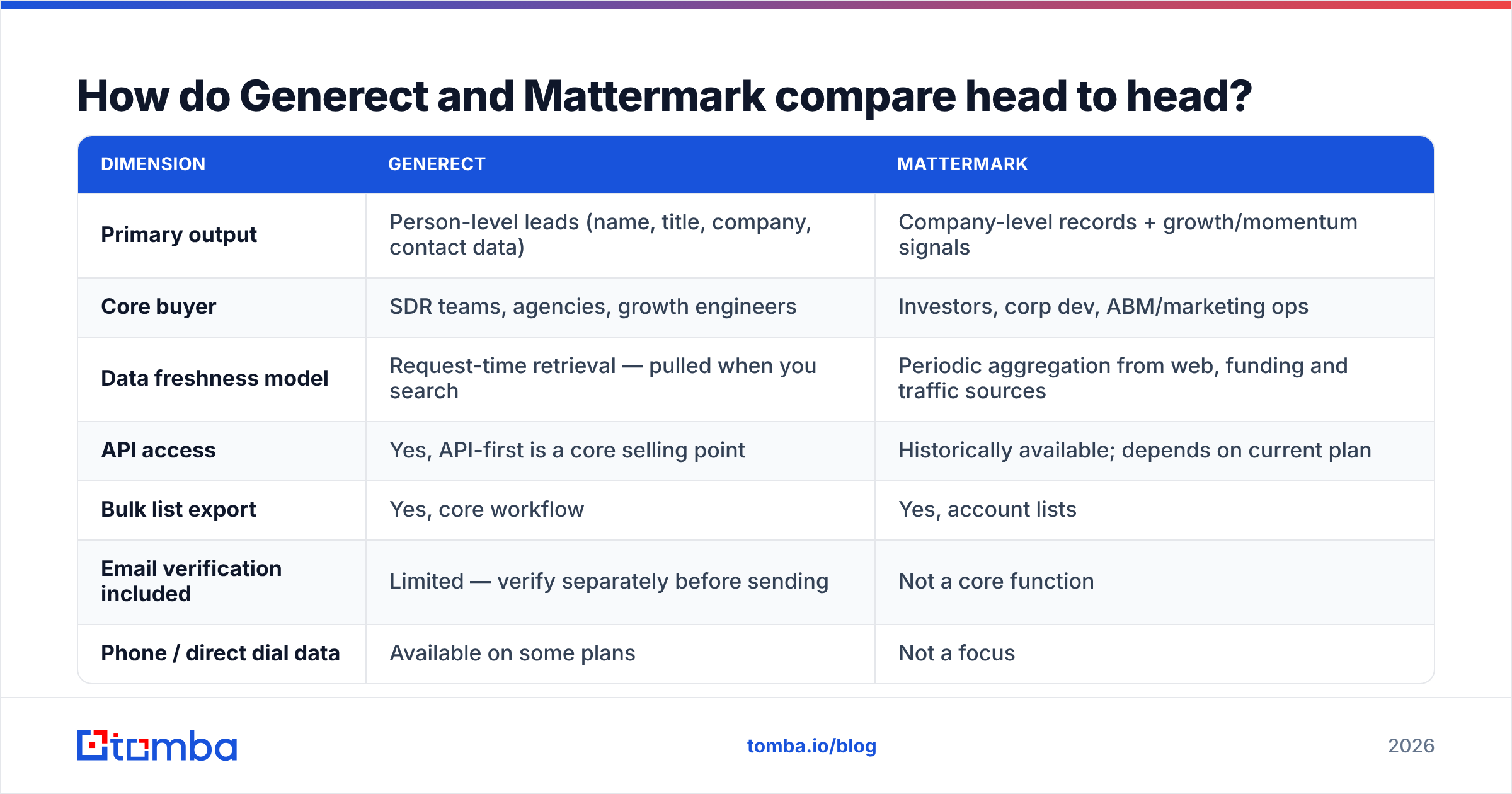
Here is the practical view. Treat pricing as a rough guide. Both vendors have changed their packaging over the years. Mattermark has also changed owners, which reshaped its plans. Check the vendor's own pricing page before you spend.
| Dimension | Generect | Mattermark |
|---|---|---|
| Primary output | Person-level leads (name, title, company, contact data) | Company-level records + growth/momentum signals |
| Core buyer | SDR teams, agencies, growth engineers | Investors, corp dev, ABM/marketing ops |
| Data freshness model | Request-time retrieval — pulled when you search | Periodic aggregation from web, funding and traffic sources |
| API access | Yes, API-first is a core selling point | Historically available; depends on current plan |
| Bulk list export | Yes, core workflow | Yes, account lists |
| Email verification included | Limited — verify separately before sending | Not a core function |
| Phone / direct dial data | Available on some plans | Not a focus |
| Intent / funding signals | Limited | Strong historical differentiator |
| Pricing model | Subscription + volume-based lead credits | Subscription, quote-driven at the upper tiers |
| Free entry point | Trial / demo-gated | Trial / demo-gated |
| Best fit | Building fresh outbound contact lists at volume | Deciding which accounts deserve outbound at all |
Read that table twice. The row that ends most evaluations is "Primary output". Buy Mattermark and expect a ready-to-send prospect list, and you will be let down. Buy Generect and expect funding-round alerts, and you will be let down too.

Which one gives you more accurate contact data?#
Generect wins on contact data. But there is a catch, and it is a big one.
A live pull does help with the top cause of B2B data rot: job changes. Say someone left Head of Growth at Company A four months ago and is now VP Marketing at Company B. A database that refreshes twice a year still shows the old row. A live pull reads the current profile.
But "the profile is current" and "this inbox accepts mail" are two different claims. Profile data tells you where a person works. It does not tell you if first.last@company.com is the live pattern. It does not tell you if the mailbox exists, if the domain is catch-all, or if the address is an old spam trap.
Here is where teams get burned. They pull 5,000 fresh leads. They trust the freshness label. They load them into a sequencer. Then a 20-40% bounce rate wrecks their sender score in two weeks. Google and Microsoft both read high bounce rates as a spam signal. A burned domain takes months to heal.
The fix is boring, and you cannot skip it. Run every list through an email verifier before the first send. Treat catch-all domains as their own bucket. Do not assume they are valid. A clean list of 3,000 beats a raw list of 5,000 on replies and on long-term domain health.
Mattermark's accuracy question is a different one. Company data ages more slowly. Last quarter's headcount is still a useful hint. The risk with signals is not age. It is reading them wrong. A rising headcount score does not mean the account will buy this quarter. Signals narrow the field. They do not qualify the deal.
How do pricing and total cost compare?#
Neither vendor lists simple public prices. That alone tells you something about the sales motion. Expect a demo call before you see real numbers at the top end.
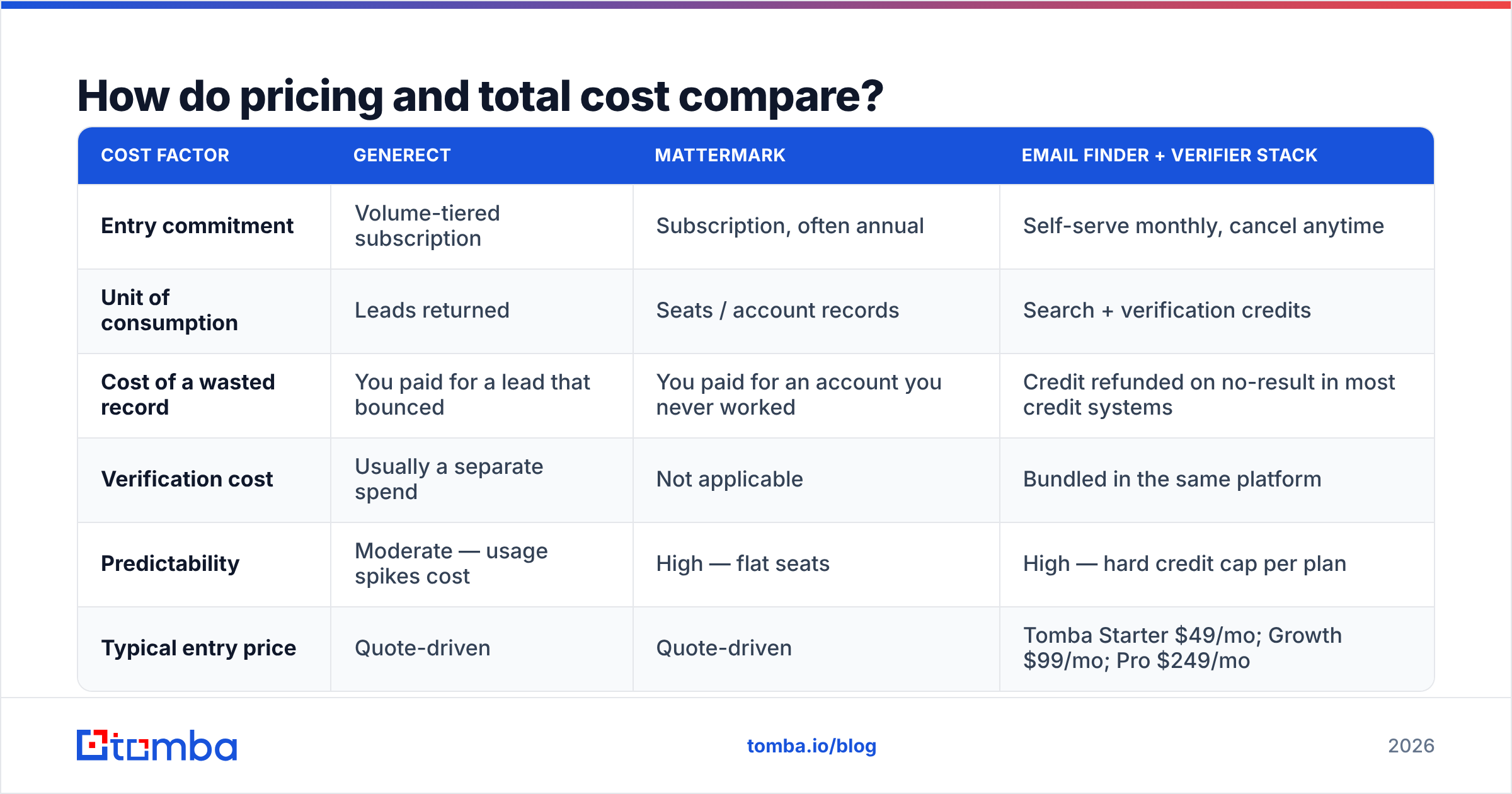
You can still compare the shape of the spend. Here is the Generect vs Mattermark cost picture:
| Cost factor | Generect | Mattermark | Email finder + verifier stack |
|---|---|---|---|
| Entry commitment | Volume-tiered subscription | Subscription, often annual | Self-serve monthly, cancel anytime |
| Unit of consumption | Leads returned | Seats / account records | Search + verification credits |
| Cost of a wasted record | You paid for a lead that bounced | You paid for an account you never worked | Credit refunded on no-result in most credit systems |
| Verification cost | Usually a separate spend | Not applicable | Bundled in the same platform |
| Predictability | Moderate — usage spikes cost | High — flat seats | High — hard credit cap per plan |
| Typical entry price | Quote-driven | Quote-driven | Tomba Starter $49/mo; Growth $99/mo; Pro $249/mo |
The number people miss in procurement is cost per usable contact. Not cost per record. Buy 10,000 leads, and 30% bounce or hold the wrong role. Your real unit cost is then 43% higher than the invoice says. Run that math first. It often flips the winner.
Need reachable inboxes at a price you can predict? Self-serve is much cheaper. See the full breakdown on Tomba pricing. There is a free tier with 25 searches a month for testing. Then $49/mo Starter, $99/mo Growth, and $249/mo Pro. Enterprise is quoted for heavy API use.
Is Generect better than Mattermark for outbound prospecting?#
For pure outbound, yes. Generect sits closer to the metal.
An SDR's day looks like this: get a list, enrich it, verify it, sequence it, follow up. Generect covers step one and part of step two. Mattermark covers step zero. That is the call on which 300 accounts out of 30,000 deserve a human this quarter.
Running outbound on Generect alone still leaves three gaps:
- Verification. Covered above. Not optional.
- Roles that never show up on LinkedIn. Many buyers in manufacturing, logistics, healthcare, and local services have thin profiles or none at all. Profile data misses them. A domain search reads the company's own site and finds people that profile scraping never sees.
- Multi-channel reach. Email-only sequences underperform. If you need dials too, check whether direct-dial data is in your tier or sold on the side.
Mattermark's honest role is as a filter upstream of everything else. Rank the accounts. Then hand the winners to a contact-discovery layer. Used that way, Generect vs Mattermark is not even a fight. One feeds the other.

Where does Mattermark still earn its place?#
Three cases where the signal layer is worth the money:
- Investor and corp-dev work. Which companies are speeding up? Who just raised? Who is quietly cutting staff? That is Mattermark's home turf. No contact-list tool answers it.
- ABM tiering. Marketing needs a Tier 1 / Tier 2 / Tier 3 split it can defend. Growth signals give a fair input beyond "accounts our AEs like".
- Territory planning. Momentum data helps you decide where to add headcount next year.
Where it does not earn its place: as the main source of emails for a cold campaign. That was never the job. Judging it on that axis is unfair.
Skim user reviews on G2 for both vendors before you buy. Read the one- and two-star ones first. They show support quality and contract terms better than any feature grid.
What does a complete stack actually look like?#
Most teams that get this right run three layers, not one platform:
- Account selection — signals, company data, intent. Mattermark-class tools, or your own CRM history.
- Contact discovery — find the real people at those accounts, with current roles.
- Verification and enrichment — confirm the mailbox is real. Add phone numbers, titles, social profiles, and company data before anything hits the sequencer.
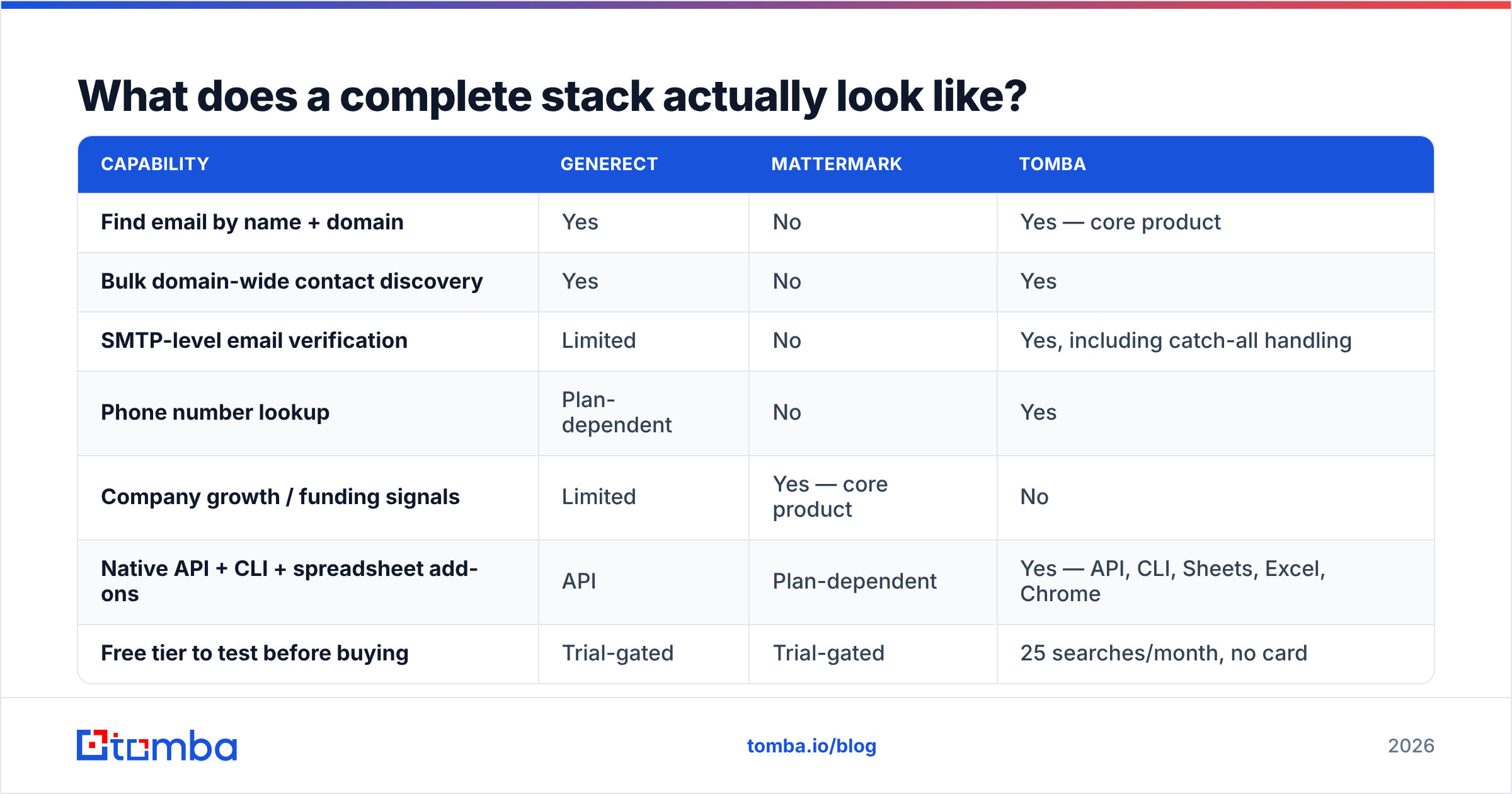
Layer three is where most stacks leak. Here is how the options compare on that job:
| Capability | Generect | Mattermark | Tomba |
|---|---|---|---|
| Find email by name + domain | Yes | No | Yes — core product |
| Bulk domain-wide contact discovery | Yes | No | Yes |
| SMTP-level email verification | Limited | No | Yes, including catch-all handling |
| Phone number lookup | Plan-dependent | No | Yes |
| Company growth / funding signals | Limited | Yes — core product | No |
| Native API + CLI + spreadsheet add-ons | API | Plan-dependent | Yes — API, CLI, Sheets, Excel, Chrome |
| Free tier to test before buying | Trial-gated | Trial-gated | 25 searches/month, no card |
| Transparent public pricing | No | No | Yes |
No single row wins this. The point is that Generect vs Mattermark is the wrong frame for most buyers. The better question: which layer costs you the most pipeline, and what is the cheapest fix?
Reply rates fine but the wrong accounts? Buy signals. Account list solid but half your sends bounce? That is not an account problem. It is a contact-data problem, and it is the cheaper of the two to fix.
How should you run the evaluation?#
Do not take anyone's accuracy claim on faith. Not even this post's. Run a bake-off:
- Build a 100-row gold list. Pick people you can confirm on your own. Include hard cases: catch-all domains, non-English company names, small firms with no marketing presence.
- Run the same list through each tool. Track match rate and accuracy rate apart. One says how many rows came back. The other says how many were right.
- Verify every email you get back. Match rate means nothing if a third of them bounce.
- Time the workflow. Count the manual steps from "I have a target account" to "the contact is in my sequencer". Every handoff loses records.
- Test the API, not just the UI. If you plan to automate, a clean email finder API with sane rate limits and honest error codes beats any dashboard feature.
A hundred rows takes an afternoon. It will teach you more than three demo calls.
Ready to fix the layer that is actually leaking?#
Is your account targeting already good? Then the real job is turning company names into verified inboxes. Start with the Tomba Email Finder. Search by domain, name, or company. You get results with a confidence score and sources. Verify each address in the same platform before it reaches your sequencer. No second vendor. No separate contract. The free tier gives you 25 searches a month, so you can test it on your own gold list. Starter runs $49/mo when you are ready to scale. Bring your worst 100 contacts and see what comes back clean.
Related guides#
Ready to find emails that actually work?
Join 150,000+ professionals who stopped guessing and started sending. Free credits on signup — no credit card required.
Get the Tomba newsletter
Practical outbound tactics and product updates — once every two weeks.
About the author