Generect vs Minelead: Which B2B Email Tool Wins in 2026?
Generect sells API-first, real-time LinkedIn lead generation. Minelead sells cheap, self-serve email lookup. They are not the same product, and picking the wrong one costs you a quarter of pipeline.
TL;DR
- Generect is an API-first, real-time lead generation platform. It builds lists from LinkedIn-style company and people data on demand rather than serving a pre-scraped database. Best for engineering-led teams and agencies that pipe leads straight into their own systems.
- Minelead is a lightweight, self-serve email finder and domain search tool with a genuinely usable free tier and a simple REST API. Best for solo founders, recruiters, and small teams doing manual prospecting.
- They are not really competitors on features. They are competitors on budget — you usually have room for one contact-data line item, not two.
- Neither tool is a full verification stack. If your bounce rate matters (it does), you need SMTP-level verification and catch-all handling on top of whatever finder you choose.
- If you want find + verify + enrich under one API with predictable pricing, a consolidated platform like Tomba ($49/mo Starter, free tier at 25 searches) usually beats stitching two half-tools together.
What are Generect and Minelead?#
Start with the honest framing: these two tools solve different halves of the same problem.
Generect positions itself as a real-time B2B lead generation engine. Instead of selling you access to a static database that was scraped eighteen months ago, it queries live sources when you make the request — company filters, headcount, industry, job title, LinkedIn presence — and returns structured lead records. The pitch is freshness and API-native delivery. There is a UI, but the product clearly wants to live inside your automation.
Minelead is the opposite shape. It is a classic email finder: give it a domain, get back the email addresses associated with that domain and the pattern the company uses. Give it a name plus a domain, get back a single best-guess address. It has a Chrome extension, a bulk upload, a free plan that does not immediately dead-end, and an API that a junior developer can wire up in an afternoon.
So "Generect vs Minelead" is less "which is better" and more "which failure mode can you tolerate." Generect can leave you with rich lead records you still have to verify. Minelead can leave you with valid-looking emails attached to people who no longer work there.
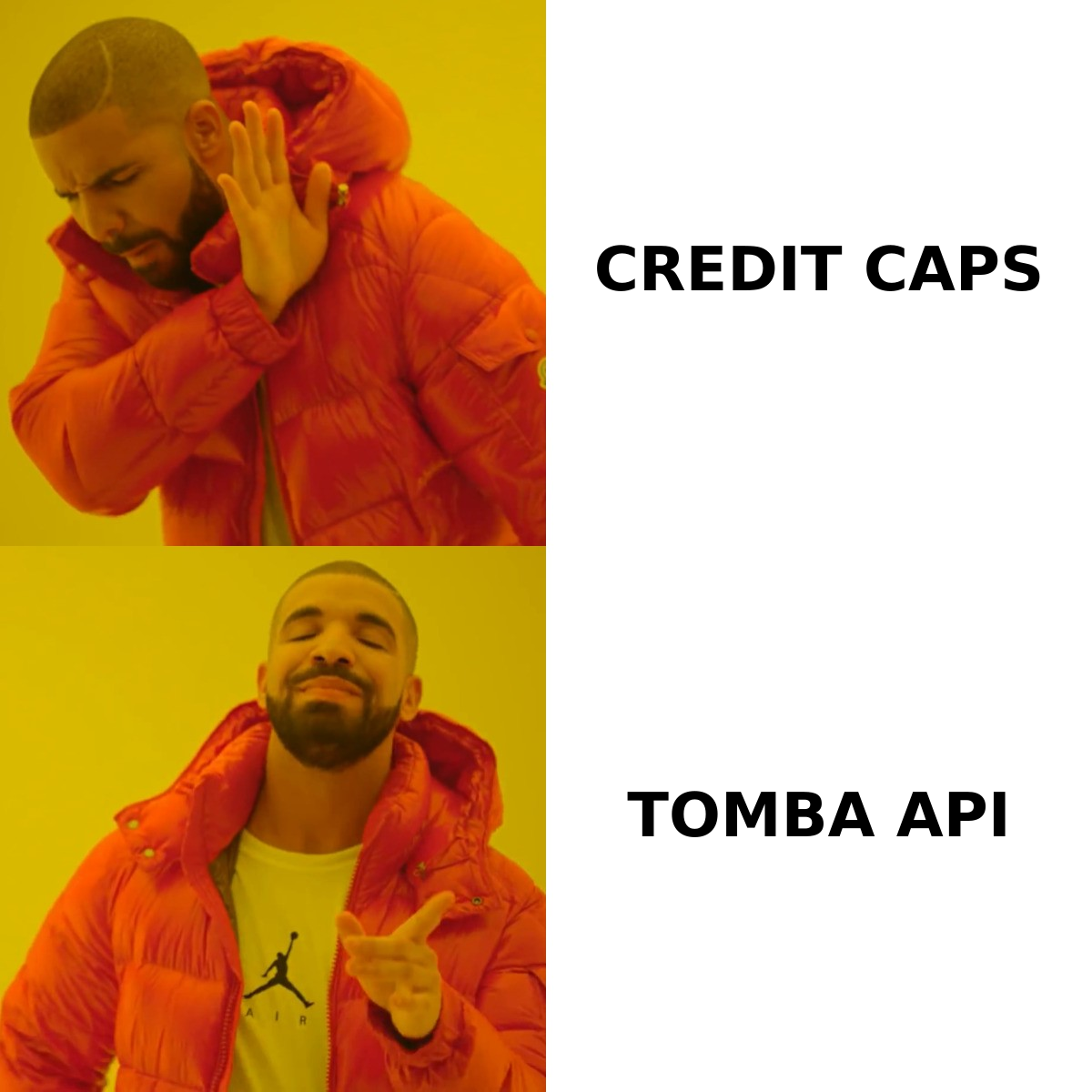
How do Generect and Minelead compare at a glance?#
Pricing on both platforms shifts, and both run custom quotes at the top end, so treat the numbers below as a shape rather than a contract — check each vendor's current page before you buy.
| Dimension | Generect | Minelead | Tomba |
|---|---|---|---|
| Primary job | Real-time lead list generation | Email finding by domain/name | Email finding + verification + enrichment |
| Data model | Live query against source data | Index + pattern inference | Index + pattern inference + SMTP validation |
| Free tier | Trial / demo-gated | Yes, limited monthly credits | Yes — 25 searches/mo |
| Entry paid plan | Roughly $99+/mo (quote-driven) | Roughly $49–$59/mo self-serve | $49/mo Starter |
| API access | Core to the product | Yes, simple REST | Yes, plus CLI, MCP, Sheets, Excel |
| Bulk processing | Yes, via API/exports | Yes, CSV upload | Yes — bulk email finder |
| Built-in verification | Limited | Basic syntax/MX checks | Full SMTP + catch-all verifier |
| Phone numbers | Partial, plan-dependent | No | Yes, phone finder |
| Best fit | Dev-led teams, agencies, ops | Solo founders, recruiters, SMBs | Teams that want one vendor end-to-end |
The row that matters most for cold outbound is "built-in verification." A finder that hands you an unverified address has handed you a coin flip, and coin flips are what get sending domains throttled.
What is Generect actually good at?#
Three things, clearly.
- Freshness. Because Generect resolves queries at request time rather than serving cached rows, job-change decay hits you less hard. In B2B data, roughly 25–30% of contact records rot every year through role changes, departures, and rebrands. Live resolution blunts that.
- Filter depth. You can express a genuine ICP — headcount band, industry, seniority, geography, technology signals — and get a list back, rather than searching one domain at a time. That is list building, not lookup.
- API-first delivery. The output is designed to land in your warehouse, your CRM, or your sequencer without a human downloading a CSV. If you have a RevOps engineer, this is leverage.
Where it gets uncomfortable: pricing is quote-shaped, the entry point is meaningfully higher than a self-serve email finder, and the UI is not the point of the product. If nobody on your team writes code, you will be paying for an engine you cannot start.
What is Minelead actually good at?#
Also three things.
- Zero friction. Sign up, paste a domain, get emails. There is no onboarding call and no sales-assisted plan gate for basic usage.
- A free tier that is not decorative. Plenty of tools give you five lookups and a demo request form. Minelead's free allowance is enough to test on your own target accounts, which is the only test that means anything.
- Pattern transparency. Domain search returns the company's email format (
first.last@,finitial+last@, etc.), which is useful even when the specific person is missing — you can construct and then verify.
Where it gets uncomfortable: coverage on smaller and non-English-market domains thins out fast, confidence scoring is coarser than enterprise tools, and verification is shallow. You will get syntactically valid addresses that bounce.
Which one finds more valid emails?#
Neither vendor publishes an independently audited hit rate, and you should be suspicious of any blog — including this one — that quotes a precise percentage as fact. What is verifiable is the mechanism, and mechanism predicts accuracy.

Here is how to read any accuracy claim in this category:
- Hit rate is how often the tool returns something. Vendors love this number because guessing inflates it.
- Valid rate is how often what it returns actually accepts mail. This is the only number tied to your bounce rate.
- Catch-all share is the percentage of results sitting on domains that accept everything. A catch-all address is neither confirmed nor refuted — and if a tool counts those as "valid," its headline number is fiction.
Generect's live-query model tends to help with recency — the person still being at the company. It does less for deliverability — whether the specific mailbox accepts mail. Minelead's pattern inference is the reverse: it can produce a plausibly formatted address for a person who left in 2024.
That gap is why serious outbound teams run a verification pass regardless of the finder. Run every list through an email verifier before it touches a sequencer, and treat catch-all results as a separate bucket with their own send policy — lower volume, warmer domain, no aggressive follow-up cadence.
Do the test yourself, and make it honest:
- Build one seed list of 100 accounts you know. Real ICP, mixed company sizes, mixed regions.
- Run the same list through both tools. Same day, same inputs, no cherry-picking.
- Verify both outputs with a third-party verifier. Never let the finder grade its own homework.
- Count valid, catch-all, invalid, and not-found separately. Four buckets, not two.
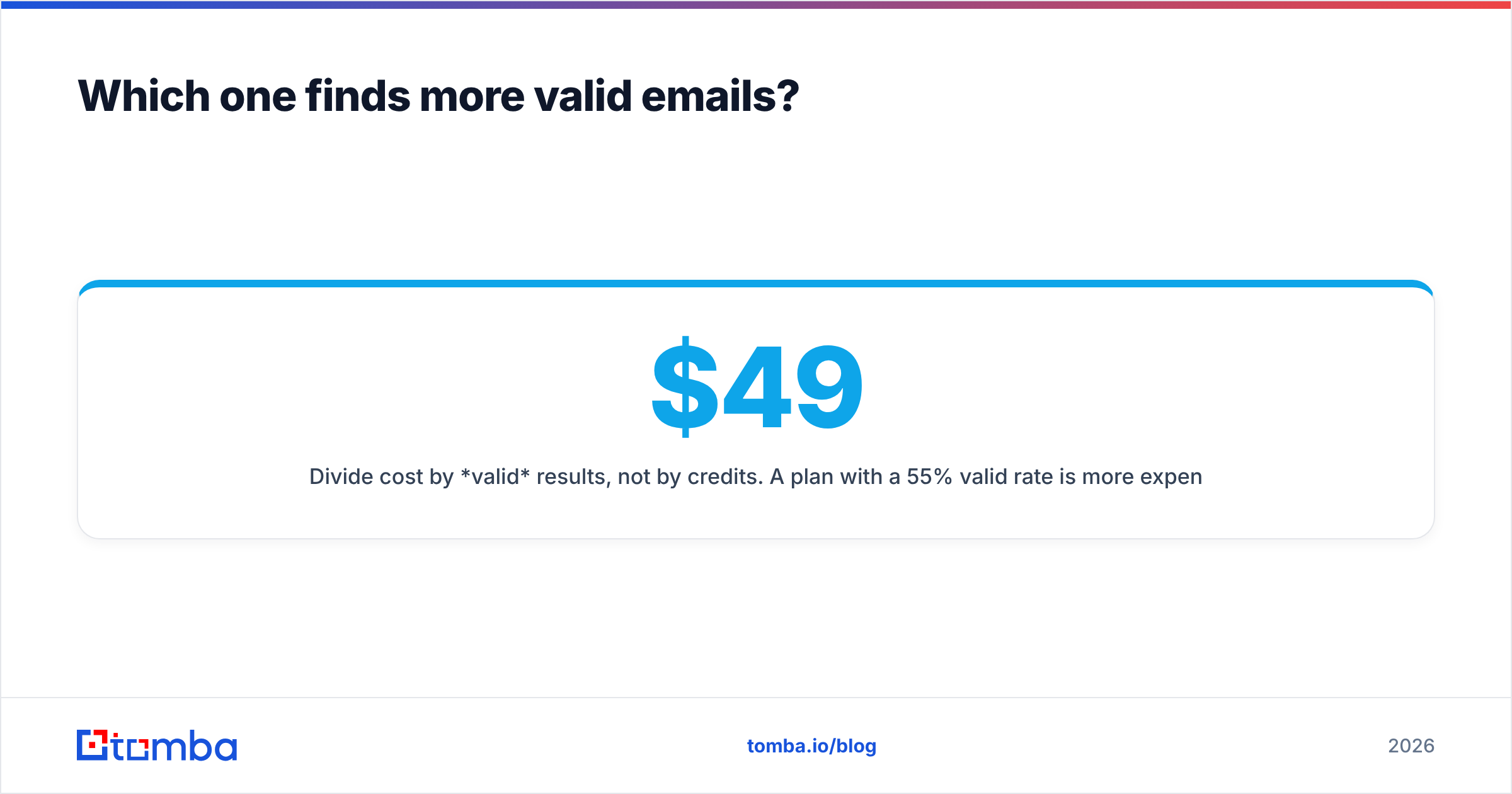
- Divide cost by valid results, not by credits. A $49 plan with a 55% valid rate is more expensive per usable contact than a $99 plan at 90%.
That last calculation flips most tool comparisons on their head, and it is the only one your CFO will care about.
How do pricing and credits really compare?#
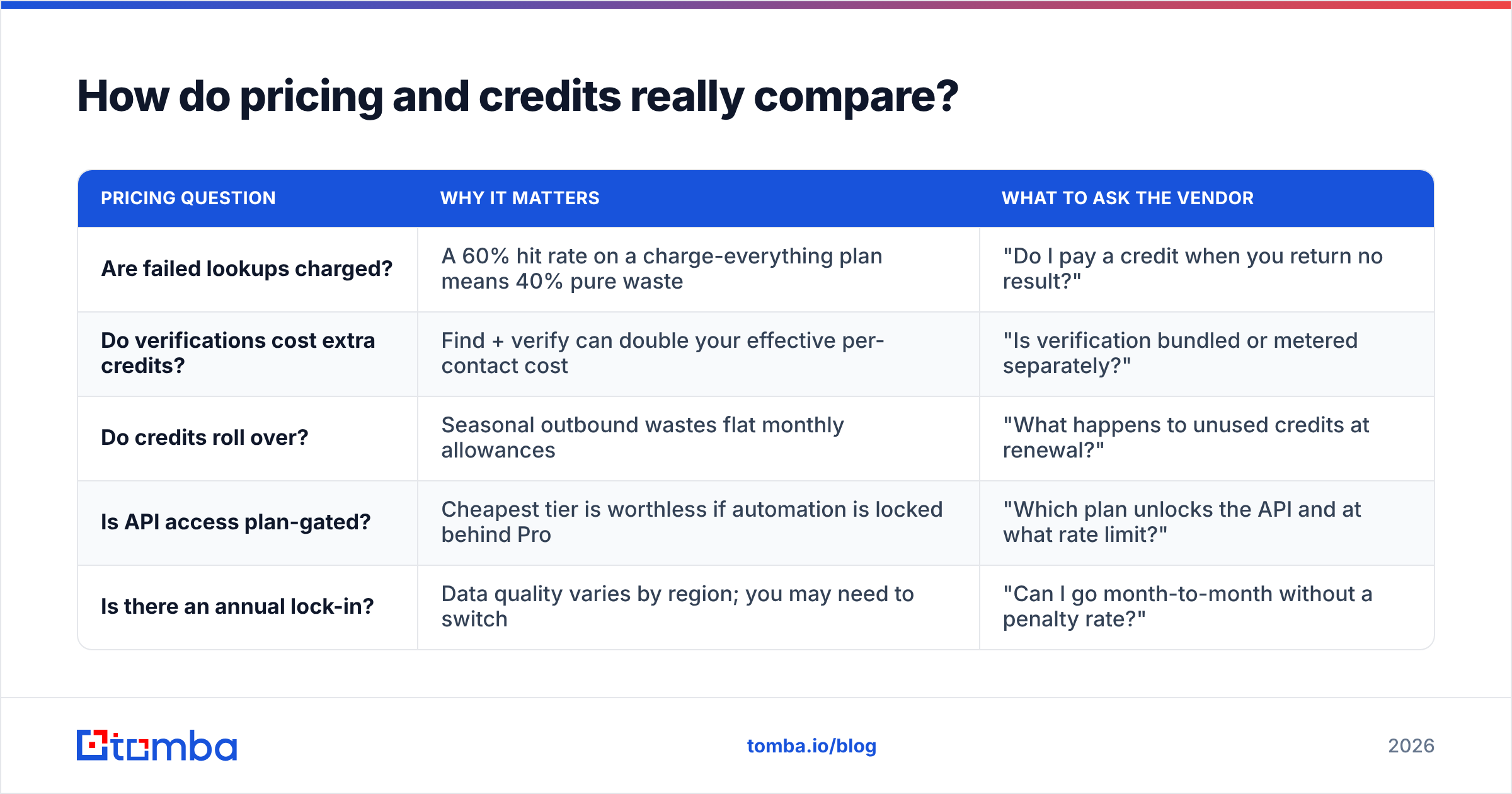
Credit systems are where contact-data vendors quietly diverge. Two plans with identical headline prices can differ by 3x in real cost depending on three policy details.

| Pricing question | Why it matters | What to ask the vendor |
|---|---|---|
| Are failed lookups charged? | A 60% hit rate on a charge-everything plan means 40% pure waste | "Do I pay a credit when you return no result?" |
| Do verifications cost extra credits? | Find + verify can double your effective per-contact cost | "Is verification bundled or metered separately?" |
| Do credits roll over? | Seasonal outbound wastes flat monthly allowances | "What happens to unused credits at renewal?" |
| Is API access plan-gated? | Cheapest tier is worthless if automation is locked behind Pro | "Which plan unlocks the API and at what rate limit?" |
| Is there an annual lock-in? | Data quality varies by region; you may need to switch | "Can I go month-to-month without a penalty rate?" |
For reference, Tomba pricing runs Free (25 searches/mo), Starter at $49/mo, Growth at $99/mo, Pro at $249/mo, and custom Enterprise — with find, verify, domain search, and enrichment sharing one credit pool rather than being sold as separate SKUs. Minelead sits in a similar self-serve band at the entry level. Generect generally starts higher and moves to quotes quickly, which is consistent with its API-and-volume positioning.
The comparison that actually decides it: take your monthly target of verified, sequence-ready contacts, divide the plan price by that number, and compare cents per usable contact across all three. Headline price is theater.

Which should you pick for your use case?#
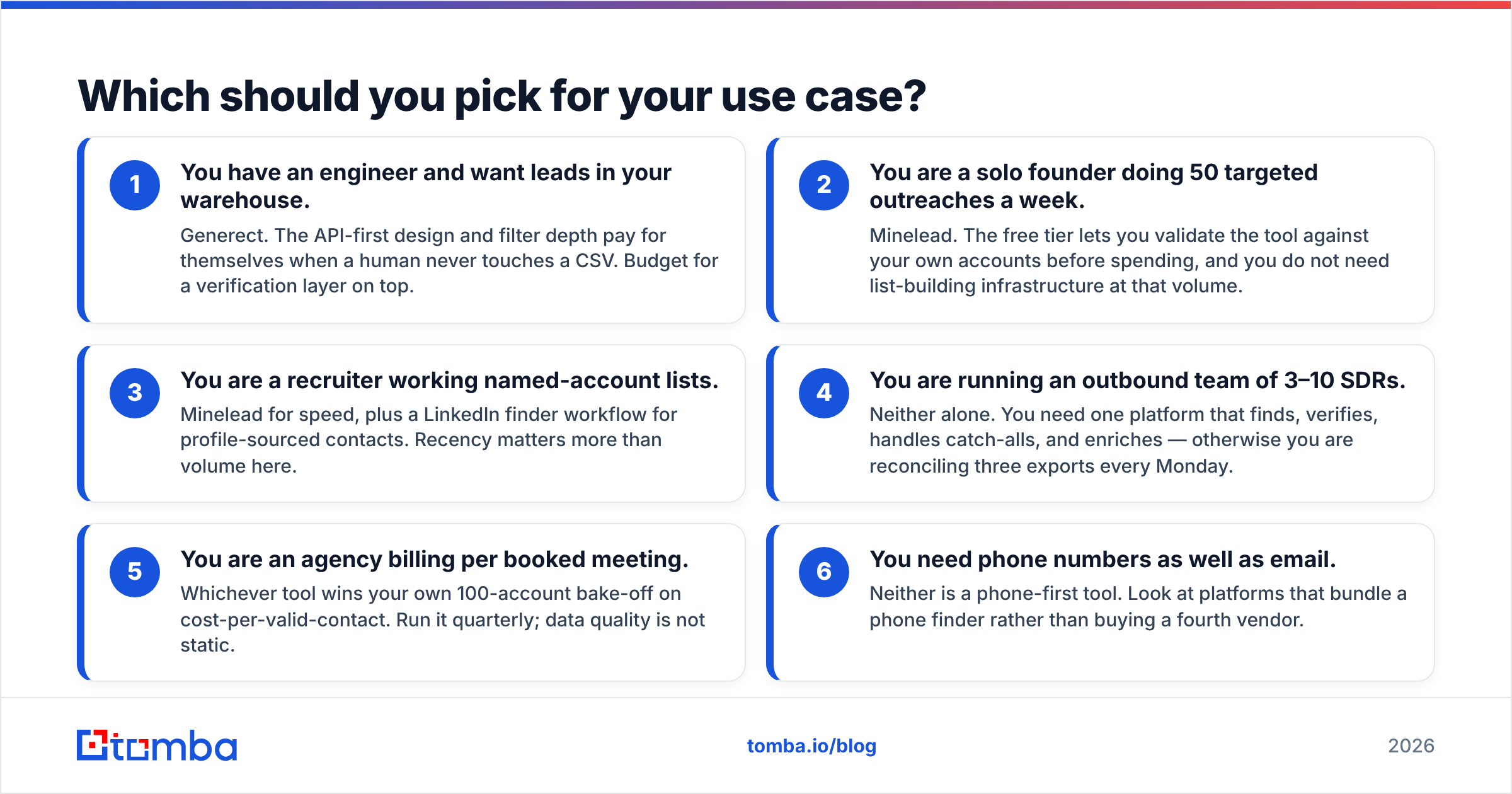
- You have an engineer and want leads in your warehouse. Generect. The API-first design and filter depth pay for themselves when a human never touches a CSV. Budget for a verification layer on top.
- You are a solo founder doing 50 targeted outreaches a week. Minelead. The free tier lets you validate the tool against your own accounts before spending, and you do not need list-building infrastructure at that volume.
- You are a recruiter working named-account lists. Minelead for speed, plus a LinkedIn finder workflow for profile-sourced contacts. Recency matters more than volume here.
- You are running an outbound team of 3–10 SDRs. Neither alone. You need one platform that finds, verifies, handles catch-alls, and enriches — otherwise you are reconciling three exports every Monday.
- You are an agency billing per booked meeting. Whichever tool wins your own 100-account bake-off on cost-per-valid-contact. Run it quarterly; data quality is not static.
- You need phone numbers as well as email. Neither is a phone-first tool. Look at platforms that bundle a phone finder rather than buying a fourth vendor.
What do reviewers say, and how much should you trust them?#
Both tools have review presence on G2 and similar directories, and the pattern is predictable: email finders get praised for speed and dinged for coverage gaps in specific verticals or regions. That is not a knock on either vendor — it reflects how contact data actually works. No provider has uniform coverage across US SaaS, European manufacturing, and Middle Eastern logistics simultaneously.
Read reviews for segment fit, not for star ratings. A 4.6 from a US-market SaaS team tells you nothing about whether the tool covers your DACH mid-market list. If a vendor publishes its data sources, read that page instead — sourcing methodology predicts coverage far better than aggregate sentiment does.
Where does Tomba fit in this comparison?#
Honestly: Tomba overlaps more with Minelead than with Generect on the finding side, and covers ground neither one does on the verification side.
If your problem is "I need lead lists generated programmatically at scale from ICP filters," Generect is a legitimate answer and Tomba is not a direct substitute for that specific job. If your problem is "I need accurate, deliverable email addresses for known people and companies, verified before they hit my sequencer," that is exactly the job a consolidated finder-plus-verifier is built for — with domain search for pattern discovery, SMTP verification and catch-all handling for deliverability, and one API key instead of three.
The consolidation argument is not just aesthetic. Every additional vendor in the pipeline is another credit system to forecast, another rate limit to handle, another export to deduplicate, and another line item to defend at renewal.
Ready to test it on your own list?#
Stop comparing feature grids and run the 100-account bake-off. Pull your real ICP list, run it through Tomba Email Finder on the free tier — 25 searches, no card — and count how many results come back verified rather than merely returned. Then run the same list through Generect or Minelead and compare cost per valid contact, not cost per credit. If Tomba does not win on your data, you will have learned something worth more than this article. If it does, Starter is $49/mo and the same credits cover finding, verifying, and enriching.
Related guides#
Ready to find emails that actually work?
Join 150,000+ professionals who stopped guessing and started sending. Free credits on signup — no credit card required.
Get the Tomba newsletter
Practical outbound tactics and product updates — once every two weeks.
About the author