Generect vs Prosperfleet Valgen: 2026 Data Tool Comparison
One vendor has a public product, docs and reviews. The other barely has a footprint. Here is an honest, evidence-first breakdown of Generect vs Prosperfleet Valgen — and what to do when a tool can't be verified.
Generect vs Prosperfleet Valgen is a lopsided matchup. One tool has a live product, public docs and real reviews. The other leaves almost no public trace. Here is what we could verify, and how to test any vendor yourself.
TL;DR
- Generect is easy to verify. It has a live site, a documented API, LinkedIn-style lead search, and public reviews you can read before you pay.
- Prosperfleet Valgen is not. We found no real docs, no pricing page, and no independent review trail. That is a buying risk, not a feature gap.
- Never buy contact data on trust. Run the same 100 rows through each vendor. Verify the output yourself. Compare cost per usable contact, not cost per credit.
- Generect wins by default if you sell LinkedIn-first and want ready-made lead lists with an API behind them.
- Need email discovery and verification only? A finder like Tomba Email Finder usually costs less per usable record.
What are Generect and Prosperfleet Valgen?#
Generect is a B2B lead platform built around LinkedIn-style search. You set an ICP: job title, seniority, company size, region, industry. It returns contact records with work emails and company fields. It sells real-time lookups instead of a stale cached database. An API exposes the same search. Your team can push leads straight into a CRM or a sequencer. You can read the current product claims on the official Generect site.
Prosperfleet Valgen is the hard half of this matchup. A search turns up no vendor docs. No pricing page. No G2 or Capterra profile with a real review count. No public API reference. It may be an early-stage product or a regional reseller. It could also be a white-label of another data provider, or just a name on an "alternatives" list.
That is not a knock on the tool. It does change how you test it. With no public footprint, Generect vs Prosperfleet Valgen is not a feature race. It is a known quantity against an unknown one. So we do both below. First an honest head-to-head, then a repeatable way to test any unverified vendor before you pay.
Generect vs Prosperfleet Valgen: how do they compare head to head?#
Here is the comparison as it stands today. Unknowns stay marked as unknown. "Not publicly verifiable" means we found no first-party source. It does not mean the feature is missing.
| Dimension | Generect | Prosperfleet Valgen | Tomba |
|---|---|---|---|
| Public product site | Yes, with feature pages | Not publicly verifiable | Yes |
| Public pricing | Listed / quote-based on site | Not publicly verifiable | Free tier, $49, $99, $249/mo |
| Free tier or trial | Trial available on request | Not publicly verifiable | Free — 25 searches/mo |
| Documented REST API | Yes | Not publicly verifiable | Yes, Tomba API |
| Core strength | LinkedIn-style lead search + lists | Unclear | Email discovery + verification |
| Bulk processing | Yes, list exports | Not publicly verifiable | Bulk finder and verifier |
| Independent reviews | Present on review sites | Minimal to none | Present on review sites |
| Native integrations | CRM + outbound tools | Not publicly verifiable | HubSpot, Salesforce, Pipedrive, Sheets, Zapier |
| Buyer risk level | Low — testable before purchase | High — untestable claims | Low — free tier proves output |
Read the table as a risk map, not a scoreboard. Every "not publicly verifiable" row is a question. Ask it on the sales call. Then confirm the answer in a live trial before you sign.
How should you evaluate a vendor you can't research?#
Use a fixed five-step protocol. It works for Prosperfleet Valgen. It works for any tool from an AI-written "top 20" list. It works for the next name a colleague sends you.
- Ask for first-party sources. Request the docs URL, the pricing page, and the DPA. A real vendor sends all three within an hour.
- Run a blind sample. Send 100 rows of first name, last name and company domain, with no emails. Run the same rows through a known baseline.
- Verify the output elsewhere. Never trust a vendor's own "valid" tag. Push the results through an independent email verifier and count each status.
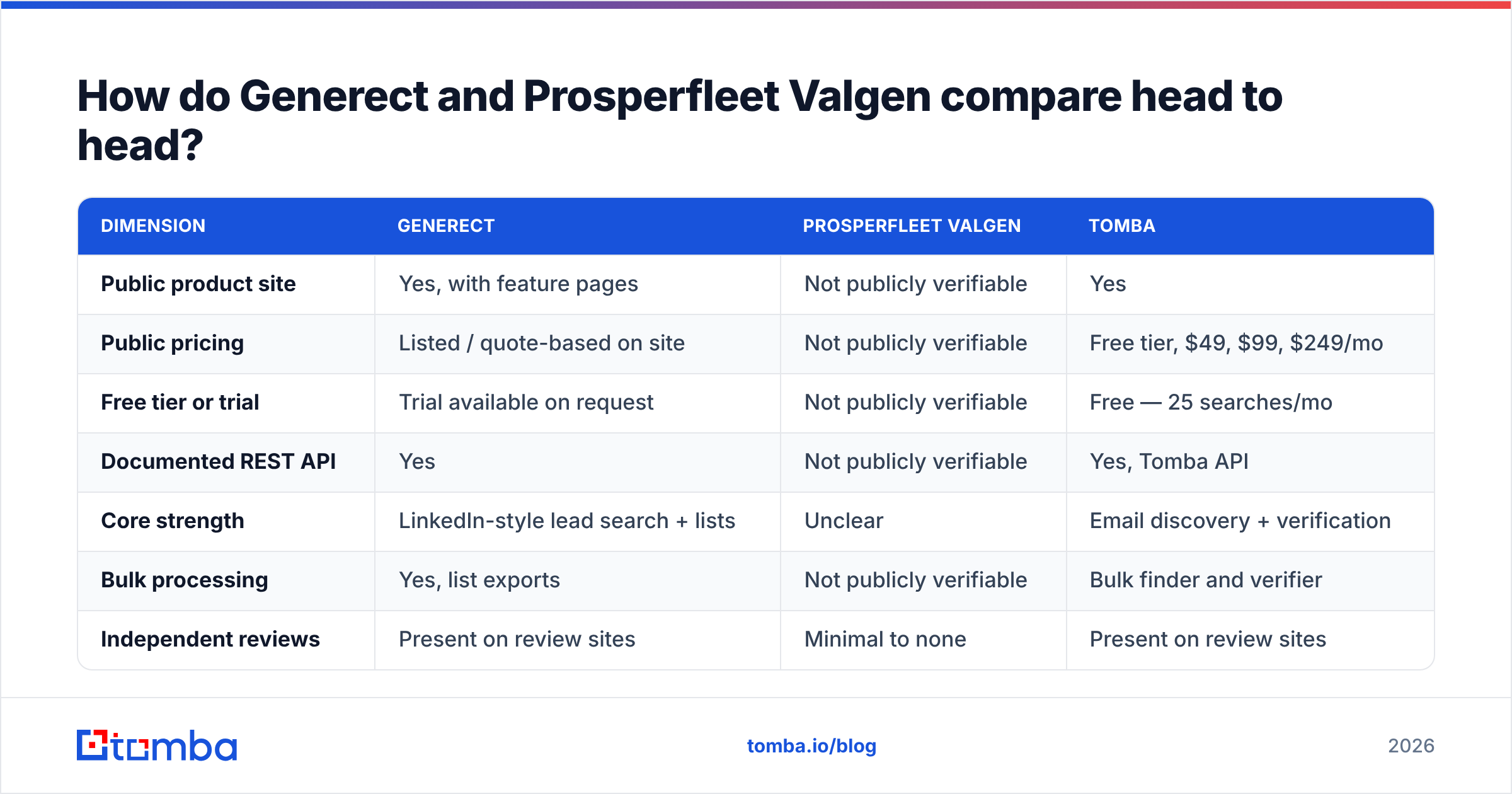
- Price it per usable contact. Divide the plan cost by verified deliverable records, not by credits. A $99 plan with 40% junk costs more than a clean $249 plan.
- Ask where the data comes from. How often does it refresh? Who handles GDPR deletions? Tomba publishes its data sources for that reason.
Run those five steps and the Generect vs Prosperfleet Valgen question answers itself within a week. You get your own numbers instead of vendor marketing.

Generect vs Prosperfleet Valgen: which one has better data accuracy?#
Vendors measure accuracy in three ways. They quote whichever number looks best:
- Match rate — how many of your rows got an email back. Easy to inflate by guessing patterns.
- Deliverability rate — how many of those emails pass an SMTP check. Harder to fake.
- Accuracy in production — how many landed without a bounce in a real send. That is the number your domain cares about.
Generect leans on real-time enrichment. Records get pulled at query time, not from a cache that went stale a year ago. That usually helps deliverability. It still does not replace your own testing.
Prosperfleet Valgen has no published accuracy benchmark. Treat any number quoted in a call as a guess. Your own 100-row test is the proof.

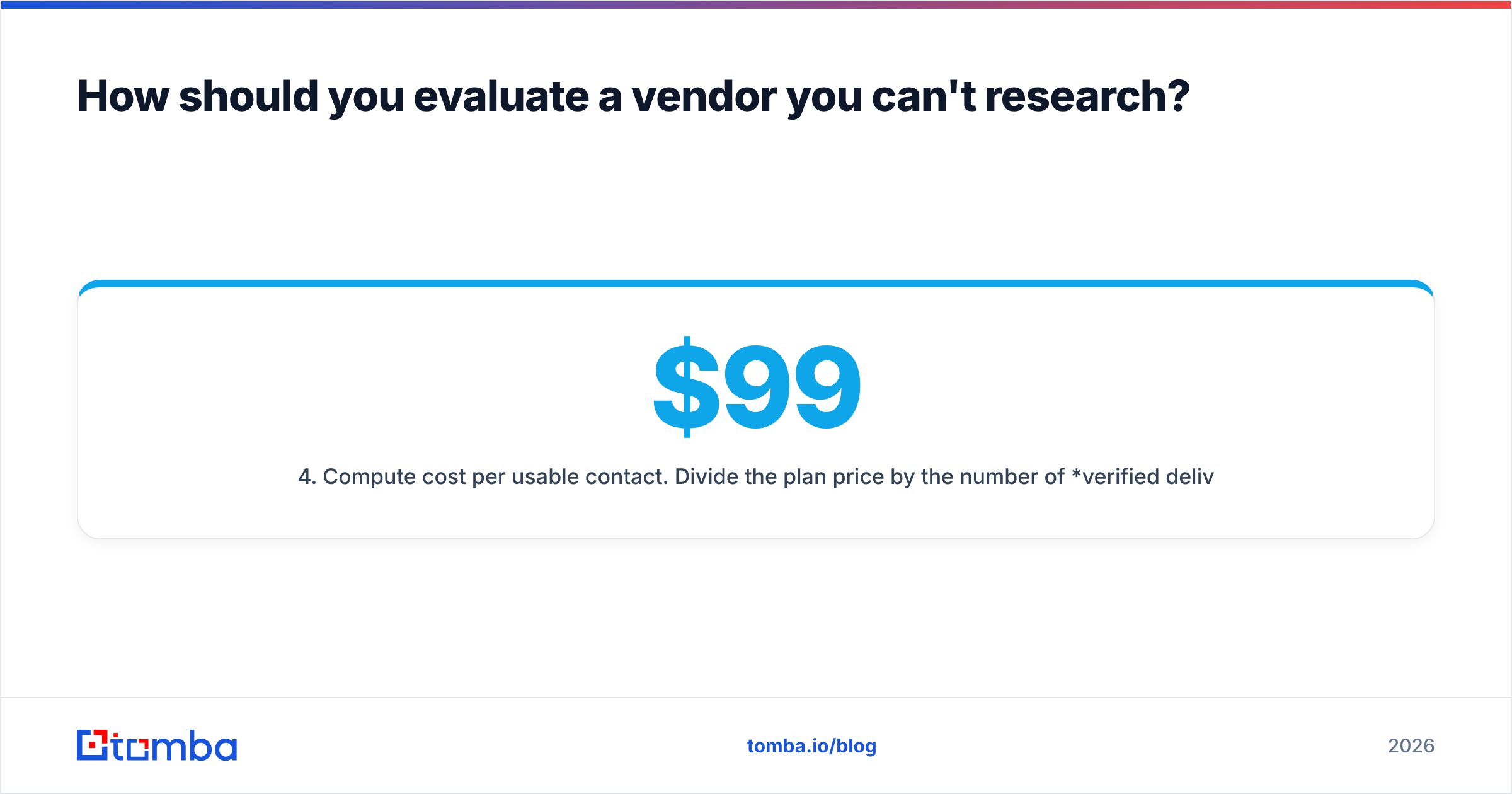
The pattern is the same across the category. A high match rate is not the same as high deliverability. The gap between them is where bounces come from.
Say a vendor returns an email for 95% of your rows. If only 60% pass verification, you have a bounce problem dressed up as a win. Bounces above roughly 3% start to hurt your sender reputation. That damage outlives the contract.
Suggested visual: your own verification dashboard, showing the deliverable, risky, catch-all and invalid split for each vendor sample.
How does pricing compare?#
Pricing is where Generect vs Prosperfleet Valgen splits hardest. One side lists numbers. The other lists nothing.
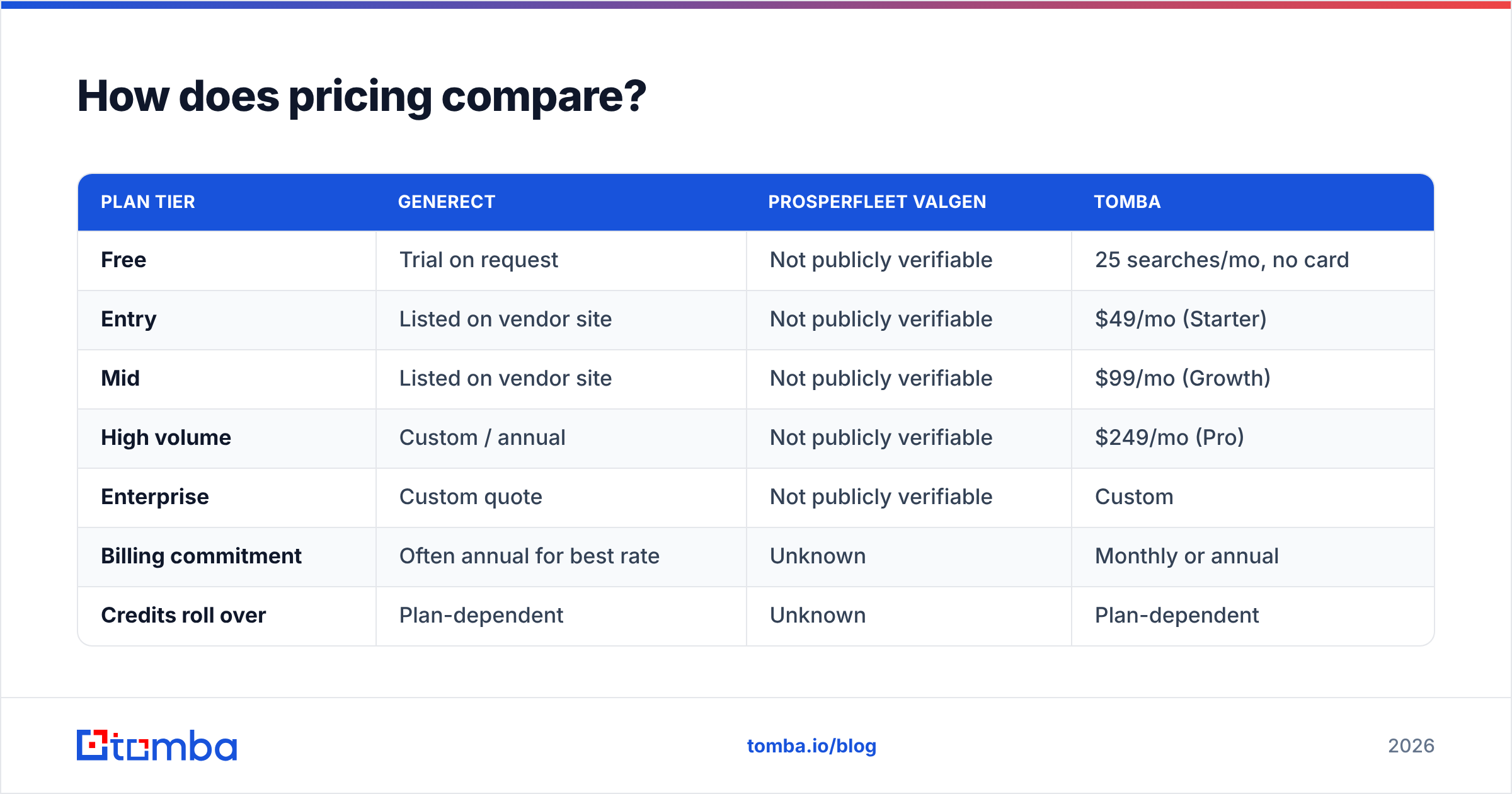
| Plan tier | Generect | Prosperfleet Valgen | Tomba |
|---|---|---|---|
| Free | Trial on request | Not publicly verifiable | 25 searches/mo, no card |
| Entry | Listed on vendor site | Not publicly verifiable | $49/mo (Starter) |
| Mid | Listed on vendor site | Not publicly verifiable | $99/mo (Growth) |
| High volume | Custom / annual | Not publicly verifiable | $249/mo (Pro) |
| Enterprise | Custom quote | Not publicly verifiable | Custom |
| Billing commitment | Often annual for best rate | Unknown | Monthly or annual |
| Credits roll over | Plan-dependent | Unknown | Plan-dependent |
Two pricing traps apply to any vendor you pick:
- Annual lock-in before a live test. If a good rate needs a twelve-month deal, ask for a 30-day exit or a pilot invoice. A confident vendor will agree.
- Credits burned on failed lookups. Ask a plain question. Do I pay when you return nothing, or when you return a catch-all address? The answer shifts real cost by 20–40%.
You can check the transparent side yourself on the Tomba pricing page. Published tiers, a free entry point, and no quote gate.
What about API access and automation?#
If you build anything beyond manual list pulls, the API is the product. On this point, Generect vs Prosperfleet Valgen is not a close call.
Generect exposes an API for lead retrieval. That is why engineering-led teams shortlist it. You can trigger a lookup from a workflow, drop results into your CRM, and skip the CSV round trip.
Prosperfleet Valgen has no public API reference to review. Ask for six things before you commit: the base URL, the auth method, rate limits, the response schema, sandbox keys, and the SLA. A vendor who cannot send a sandbox key in a day is not ready for production.
What a production-ready data API needs, in order:
- Documented, versioned endpoints — so a vendor change does not break your pipeline at 2am.
- Published rate limits — not "contact us" limits you discover during a batch job.
- A verification status on every record — deliverable, risky, catch-all or invalid, returned inline.
- Idempotent bulk endpoints — retry a failed batch without paying twice.
- Webhook callbacks for async jobs — polling a 50,000-row job wastes everyone's compute.
Some teams want that without a database subscription. They wire up the email finder API directly. At lower volume, the Google Sheets add-on does the same job with no code.
Where does Tomba fit in this comparison?#
Tomba solves a narrower problem than a lead database, on purpose. You bring the target list. It can come from LinkedIn, a conference roster, a funding round, or dormant CRM accounts. Tomba then finds and verifies the contact points.
That split matters for budget. A lead database charges you for discovery and contact data in one bundle. If your reps already build lists in Sales Navigator, you pay twice for the same discovery. A finder plus a verifier is usually cheaper per usable contact. The free tier lets you prove it before you spend.

Where Tomba tends to win:
- Verification is native, not a bolt-on. Catch-all verification is handled openly, not dumped in your list as "valid."
- Published pricing with a real free tier. 25 searches a month covers the 100-row test above across a few sessions.
- Domain-level discovery. Domain search returns the email pattern and the people at a company. That often beats filtering a database by title.
A database like Generect wins in one case. You do not know who to target yet, and you need ICP filters to build the list.

Generect vs Prosperfleet Valgen: which should you choose in 2026?#
Choose Generect if your outbound starts on LinkedIn. It fits when you want ICP-filtered lists rather than one-off lookups, and an API your engineers can call. It is a real product you can trial and read reviews about.
Choose Prosperfleet Valgen only after testing. If a rep pitched it to you, run the five-step protocol above. Live docs, a sandbox key, a clean sample and monthly billing earn it a seat at the table. If any of those four are missing, walk away.
Choose a dedicated finder if your problem is contact accuracy, not list building. Many teams over-buy here. They pay database prices for a job a finder and a verifier solve for less.
The honest verdict on Generect vs Prosperfleet Valgen: one option is testable today, and one is a question mark. In B2B data, testable beats promising. Bad data does not cost you the subscription fee. It costs you a burned domain and a quarter spent rebuilding sender reputation. Check review volume on G2's lead intelligence category, and keep the basics of lead generation in place. Know your ICP first. Buy data second.
Ready to test your list against real data?#
Stop judging vendors by their own accuracy claims. Take 100 rows from your target list. Run them through Tomba Email Finder. Count how many come back verified deliverable. The free tier gives you 25 searches a month with no card. Starter is $49/mo when you need volume. Every result carries a verification status, so you know what is safe to send. Whatever you decide about Generect vs Prosperfleet Valgen, decide it with your own numbers.
Related guides#
Ready to find emails that actually work?
Join 150,000+ professionals who stopped guessing and started sending. Free credits on signup — no credit card required.
Get the Tomba newsletter
Practical outbound tactics and product updates — once every two weeks.
About the author