Generect vs Pubrio (2026): Which B2B Data Tool Wins?
Generect and Pubrio both promise clean B2B contact data, but they solve different problems. Here is how they compare on match rate, verification, pricing and API access — plus when a dedicated email finder beats both.
TL;DR
- Generect is built around LinkedIn-sourced lead generation: you describe an audience, it returns matching people and companies with contact data, and it exposes that through an API that engineering teams can wire into their own systems.
- Pubrio leans into AI-assisted prospect search and enrichment — natural-language audience queries, buyer-intent style filters, and a workflow aimed at marketers who want a list without building one manually.
- Neither is primarily a verification engine. If your bounce rate is the metric you're judged on, you will still want a dedicated verifier in the chain.
- Pricing on both sits in the $40–$100/month range for entry seats, with credit-based limits that punish bulk work. Check each vendor's live pricing page before you budget — both change tiers frequently.
- If you mostly need accurate emails at a known domain rather than a whole prospecting suite, a focused email finder with a real API is cheaper and more predictable than either.
What are Generect and Pubrio, actually?#
Both tools sit in the same broad category — B2B contact data — but they were designed for different buyers, and that shows the moment you open them.
Generect positions itself as a lead-generation engine with LinkedIn as its primary spine. You define an audience the way you would inside Sales Navigator (title, headcount, geography, industry, technology), and Generect returns enriched records: person, company, work email, sometimes a phone. Its distinguishing feature is that the same capability is available as an API, so a RevOps or engineering team can generate lists programmatically instead of clicking through a UI. That matters if you're building an internal pipeline, a data warehouse sync, or an agency workflow that runs the same query for 40 clients.
Pubrio is aimed further up the funnel at the marketer or founder-led sales motion. The pitch is AI-assisted discovery: describe the kind of company you want in plain language, let the system translate that into filters, and get a list plus enrichment. It bundles company intelligence — funding, tech stack, hiring signals — alongside the contact record, so the list arrives with a reason to reach out attached.
The practical difference: Generect optimises for repeatable, programmatic list building. Pubrio optimises for discovery and context. You can force either to do the other job, but you'll feel the friction.
How do Generect and Pubrio compare feature by feature?#
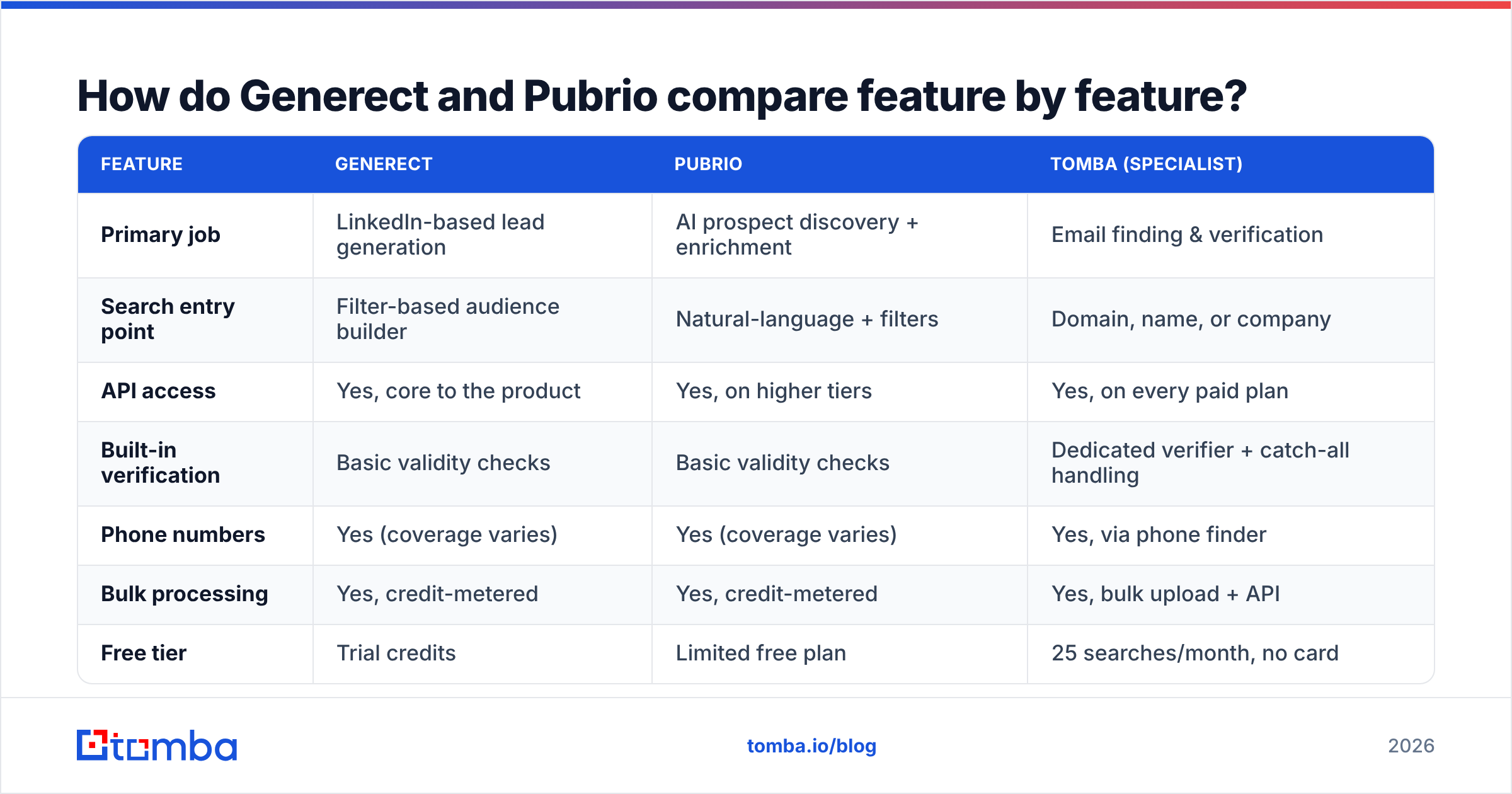
Here is the head-to-head on the attributes that actually change your day, with a dedicated email finder in the third column as a reference point for what a specialist tool does differently.
| Feature | Generect | Pubrio | Tomba (specialist) |
|---|---|---|---|
| Primary job | LinkedIn-based lead generation | AI prospect discovery + enrichment | Email finding & verification |
| Search entry point | Filter-based audience builder | Natural-language + filters | Domain, name, or company |
| API access | Yes, core to the product | Yes, on higher tiers | Yes, on every paid plan |
| Built-in verification | Basic validity checks | Basic validity checks | Dedicated verifier + catch-all handling |
| Phone numbers | Yes (coverage varies) | Yes (coverage varies) | Yes, via phone finder |
| Bulk processing | Yes, credit-metered | Yes, credit-metered | Yes, bulk upload + API |
| Free tier | Trial credits | Limited free plan | 25 searches/month, no card |
| Entry paid price | ~$49–$99/mo (check vendor) | ~$40–$99/mo (check vendor) | $49/mo Starter |
| Best for | Agencies, dev-led list ops | Marketers, founder-led sales | Teams that need clean emails at scale |
Two things to flag honestly. First, published pricing on both Generect and Pubrio moves — treat the numbers above as a range to verify on their own pages, not a quote. Second, "API access" means different things: Generect's API is the product's centre of gravity, while Pubrio's is more of an add-on for higher tiers. If you plan to automate, read the API docs before you buy the seat.

Which one has better data accuracy?#
This is where most comparison posts hand-wave, so let's be precise about what accuracy means.
There are three separate numbers, and vendors love to blur them:
- Coverage — of the 1,000 prospects you targeted, how many did the tool return any email for? A tool can look great here by guessing patterns.
- Match rate — of the emails returned, how many are the correct person's actual mailbox?
- Deliverability — of the correct addresses, how many actually accept mail today? People leave jobs. Mailboxes get deprovisioned. A record that was right in January is wrong by June.
Generect's LinkedIn-anchored approach tends to score well on coverage for tech, SaaS and services roles in North America and Western Europe, because those profiles are well-maintained. It gets thinner in manufacturing, logistics, public sector, and non-English-speaking mid-market — the same weakness every LinkedIn-derived dataset has.
Pubrio's enrichment blends multiple sources, which usually widens coverage but adds variance: you get more rows, and a higher share of those rows are stale or pattern-guessed. That trade is fine for a top-of-funnel awareness campaign and dangerous for a 200-account ABM list where every send is scrutinised.

The honest conclusion: neither tool eliminates the need for a verification step. If you're sending from a domain you care about, run every list through an email verifier before it touches your sequencer, regardless of which platform sourced it. The cost of verification is a rounding error next to the cost of a burned sending domain — and Google and Yahoo's bulk sender rules made that failure mode much more expensive than it was three years ago.
Pay particular attention to catch-all domains. Both tools will happily return an address at a catch-all server, and standard SMTP checks return "valid" for every mailbox on that server — including ones that don't exist. A catch-all verifier is the only thing that separates a real inbox from a black hole on those domains, and it's the single biggest hidden source of bounces in lists that "passed verification."
Is Generect better than Pubrio for outbound teams?#
It depends entirely on who owns the list-building process.
Choose Generect if:
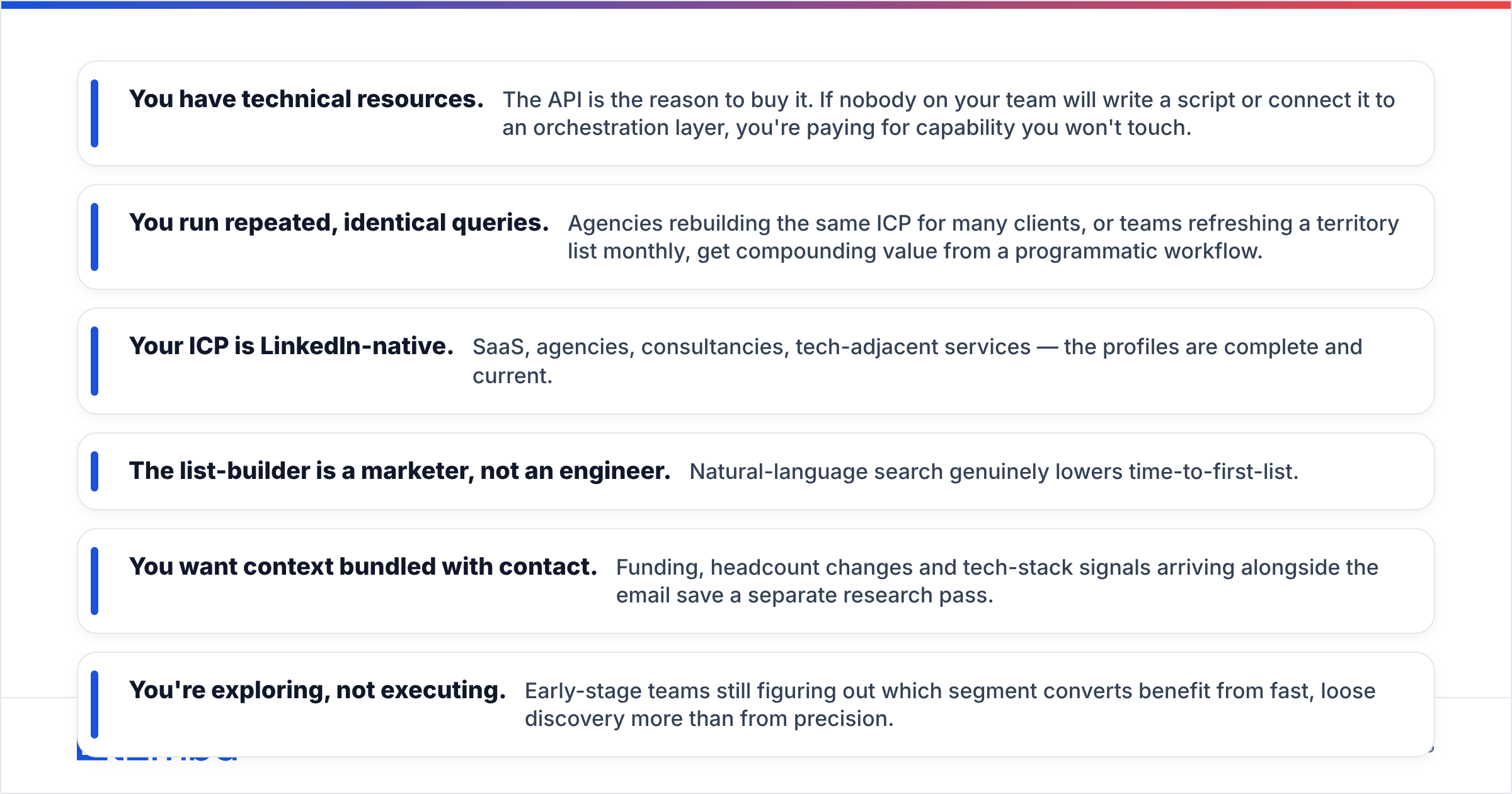
- You have technical resources. The API is the reason to buy it. If nobody on your team will write a script or connect it to an orchestration layer, you're paying for capability you won't touch.
- You run repeated, identical queries. Agencies rebuilding the same ICP for many clients, or teams refreshing a territory list monthly, get compounding value from a programmatic workflow.
- Your ICP is LinkedIn-native. SaaS, agencies, consultancies, tech-adjacent services — the profiles are complete and current.
Choose Pubrio if:
- The list-builder is a marketer, not an engineer. Natural-language search genuinely lowers time-to-first-list.
- You want context bundled with contact. Funding, headcount changes and tech-stack signals arriving alongside the email save a separate research pass.
- You're exploring, not executing. Early-stage teams still figuring out which segment converts benefit from fast, loose discovery more than from precision.
Choose neither — go specialist — if:
- You already know your accounts. If you have a target list of 500 domains from a conference, a partner, or your CRM, you don't need discovery. You need emails for those domains, which is a domain search problem, not a prospecting problem.
- Bounce rate is your gating metric. Suite tools treat verification as a checkbox. Specialists treat it as the product.
- You need predictable unit economics. Credit systems in bundled suites are opaque; a search that returns nothing still often costs you.
What do the pricing models actually cost you?#
The sticker price is the least interesting number. What matters is the effective cost per usable, verified contact.
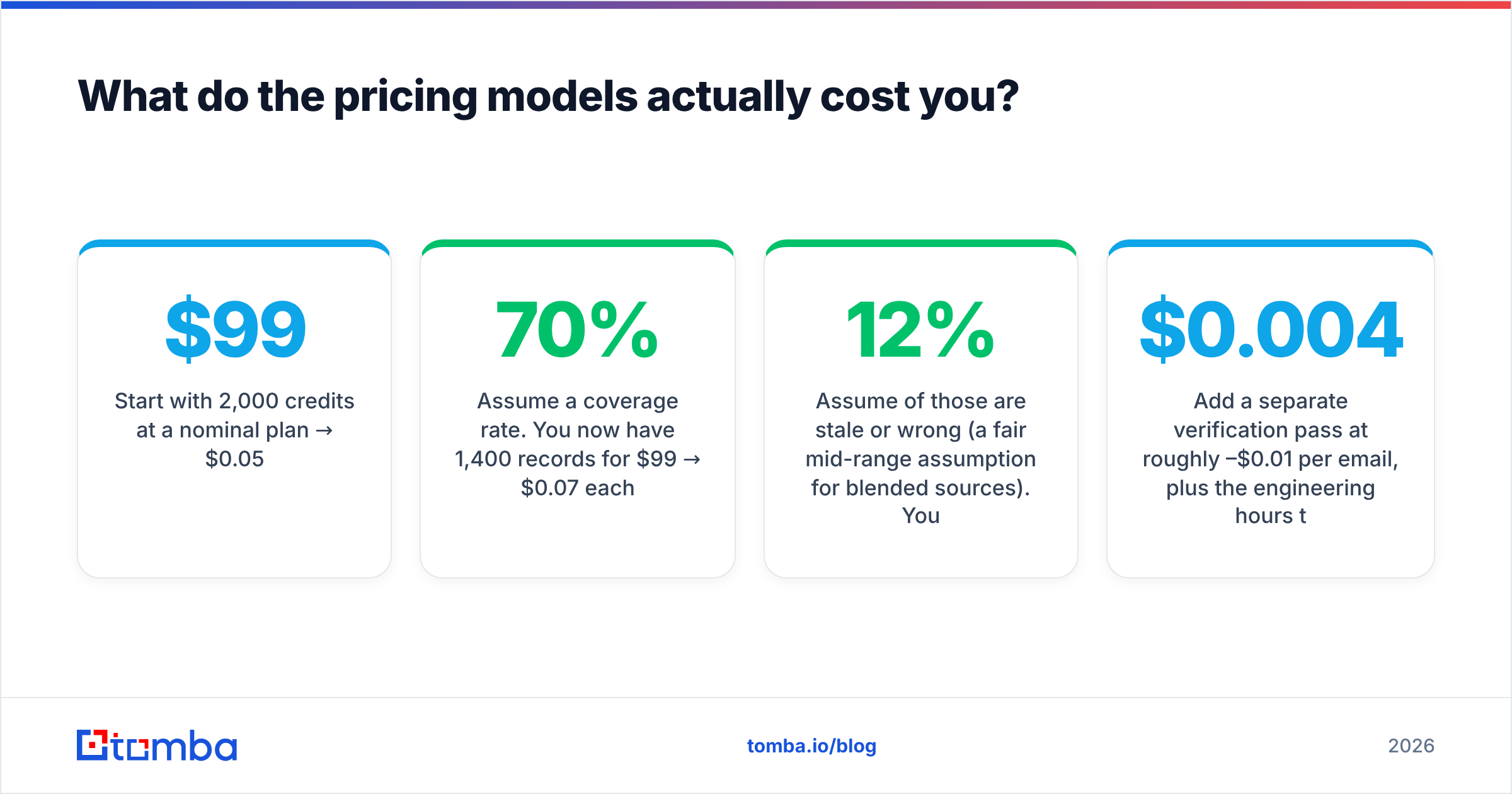
Run the arithmetic on a realistic scenario: you need 2,000 verified contacts a month.
- Start with 2,000 credits at a nominal $99/month plan → $0.05 per credit.
- Assume a 70% coverage rate. You now have 1,400 records for $99 → $0.07 each.
- Assume 12% of those are stale or wrong (a fair mid-range assumption for blended sources). You have ~1,230 usable → $0.08 each.
- Add a separate verification pass at roughly $0.004–$0.01 per email, plus the engineering hours to stitch it together.
That is the number to compare across vendors, and it's why "cheaper plan" and "cheaper data" are often opposites. A tool with a 92% match rate at $99 beats a tool with a 68% match rate at $49 on every metric except the invoice.

Three pricing traps to check before you sign, on either platform:
- Do failed lookups consume credits? Some vendors charge for a search that returns nothing. Over a year on a hard ICP, that's a meaningful line item.
- Do credits roll over? Most don't. If your outbound is seasonal, you're pre-paying for months you won't use.
- Is the API gated behind an upgrade? A $49 plan you can't automate against may cost more in labour than a $99 plan you can.
For reference, Tomba pricing runs a free tier at 25 searches/month, Starter at $49/mo, Growth at $99/mo and Pro at $249/mo, with API access included rather than reserved for enterprise tiers — a structure worth using as a benchmark when you evaluate what the suites gate.

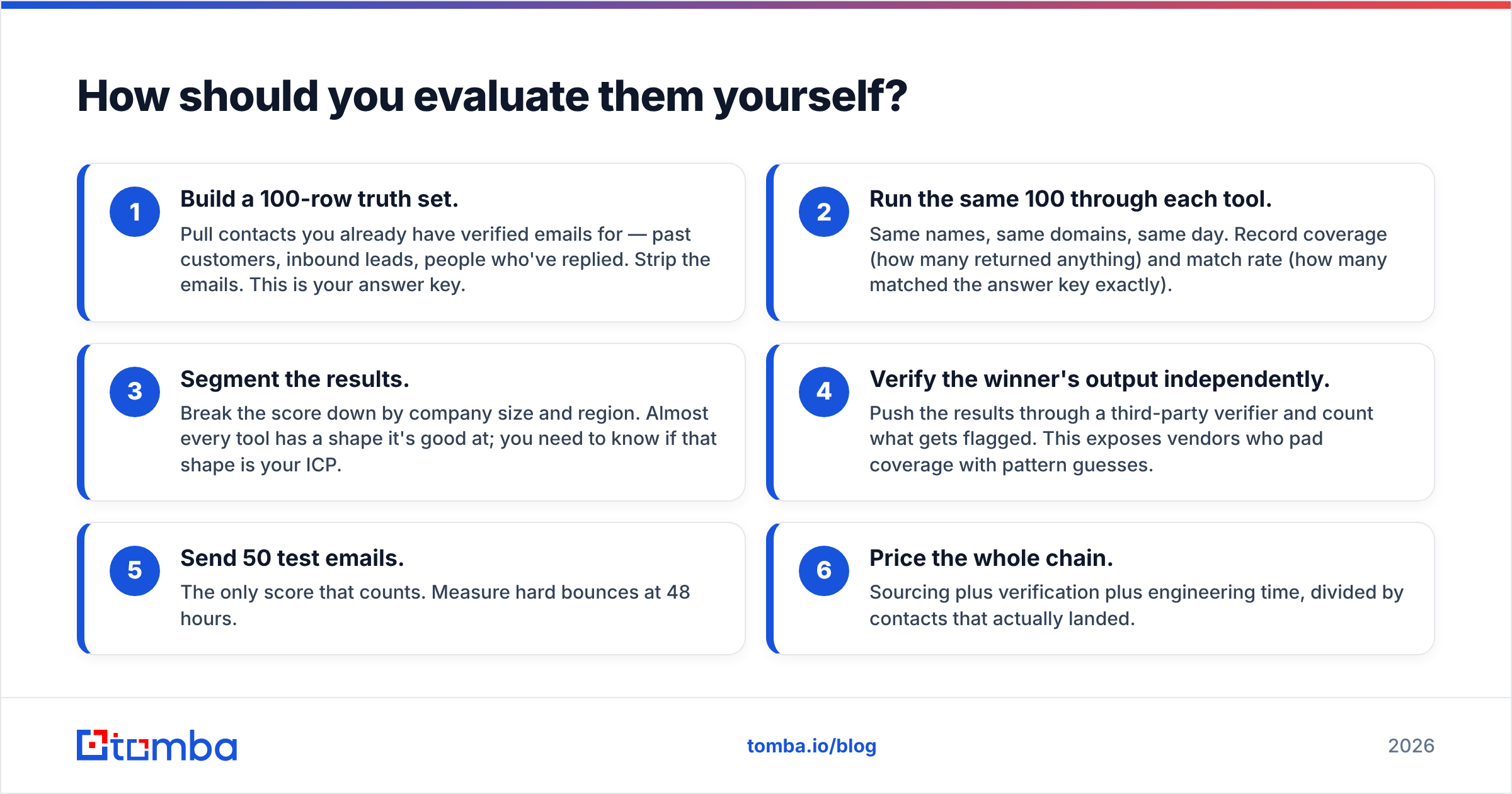
How should you evaluate them yourself?#
Don't take anyone's word — including this post's. Run a controlled bake-off. It takes an afternoon and it settles the argument permanently.
- Build a 100-row truth set. Pull contacts you already have verified emails for — past customers, inbound leads, people who've replied. Strip the emails. This is your answer key.
- Run the same 100 through each tool. Same names, same domains, same day. Record coverage (how many returned anything) and match rate (how many matched the answer key exactly).
- Segment the results. Break the score down by company size and region. Almost every tool has a shape it's good at; you need to know if that shape is your ICP.
- Verify the winner's output independently. Push the results through a third-party verifier and count what gets flagged. This exposes vendors who pad coverage with pattern guesses.
- Send 50 test emails. The only score that counts. Measure hard bounces at 48 hours.
- Price the whole chain. Sourcing plus verification plus engineering time, divided by contacts that actually landed.
Peer review helps as a sanity check too — the G2 category listings for lead intelligence show where each tool's reviewers cluster by company size, which is often more revealing than the feature grid.
What's the verdict on Generect vs Pubrio?#
Generect wins for programmatic, repeatable list generation. If you have someone who can call an API and your ICP lives on LinkedIn, it's the more controllable of the two, and control is what scales.
Pubrio wins for speed to first list. If the person building lists is a marketer and the goal is to test three segments this quarter, the AI-assisted search removes real friction, and the bundled company signals give your copy something to work with.
Both lose to a specialist when the job is narrow. The most common mistake we see is teams buying a full prospecting suite when the actual bottleneck was "we have 800 target domains and no emails for them." That's a $49 problem being solved with a $200 subscription plus onboarding.
A pragmatic stack for most teams in 2026 looks like this: one discovery tool for finding accounts you don't know about, one dedicated finder-and-verifier for turning known accounts into deliverable contacts, and a sequencer. Trying to make one platform do all three is how you end up with mediocre coverage, mystery bounces and a bill nobody can explain.
Whichever platform you land on, close the accuracy gap at the end of the chain rather than hoping the source data is clean. Start with the Tomba Email Finder — 25 free searches a month, no card, and API access on every paid plan — and run it against the same 100-row truth set you use to test Generect and Pubrio. Whichever tool wins your test deserves your budget; the point is that you'll actually know.
Related guides#
Ready to find emails that actually work?
Join 150,000+ professionals who stopped guessing and started sending. Free credits on signup — no credit card required.
Get the Tomba newsletter
Practical outbound tactics and product updates — once every two weeks.
About the author