Generect vs RampedUp 2026: Which B2B Data Tool Wins?
Generect sells fresh LinkedIn-sourced leads on demand. RampedUp sells CRM-native enrichment and data hygiene. We compare accuracy, pricing, and fit — plus when neither is the right buy.
TL;DR
- Generect is a lead-database and LinkedIn-scraping layer: you build a filtered list (or hit the API), it returns contacts pulled from live LinkedIn/company sources rather than a static warehouse.
- RampedUp is a CRM-first data platform: enrichment, cleansing, and buying-signal scoring that lives inside Salesforce and HubSpot, aimed at RevOps teams fixing dirty databases.
- They are not really the same product. Generect solves "I need net-new contacts now." RampedUp solves "our 400k CRM records are 40% junk."
- Neither is cheap for a small team. If your actual need is verified work emails at a known set of companies, a dedicated email finder starting at $49/mo covers it for a fraction of a seat-based data platform.
- Pick by pipeline stage: list-building → Generect, CRM hygiene + signals → RampedUp, precision email discovery + verification → a finder/verifier stack.
What Are Generect and RampedUp, Actually?#
Most "Generect vs RampedUp" searches start from a bad premise: that these two tools compete head-to-head. They overlap, but their centers of gravity are different, and buying the wrong one is how RevOps budgets get burned.
Generect (generect.com) positions itself as a lead-generation data provider with a heavy LinkedIn orientation. Instead of shipping you a snapshot of a database that was crawled six months ago, it pulls contacts against live sources when you run a search — company lists, people lists, and an API for programmatic pulls. The pitch is freshness: job changes and new hires show up faster than in warehouse-model providers.
RampedUp (rampedup.io) comes at data from the opposite direction. It is built for teams that already have a CRM full of records and a trust problem. Its core jobs are enrichment (fill the blanks on existing accounts and contacts), cleansing (flag stale titles, dead emails, departed contacts), and layering intent/hiring signals so reps know which accounts deserve attention this quarter. It installs into Salesforce and HubSpot and behaves like a native data layer.
Put plainly: Generect brings people in. RampedUp keeps the people you already have usable.

How Do Generect and RampedUp Compare Feature by Feature?#
Here is the practical breakdown. Pricing for both vendors is quote-driven at most tiers, so treat dollar figures as directional and confirm on their sites — this is the single most common place buyers get surprised.
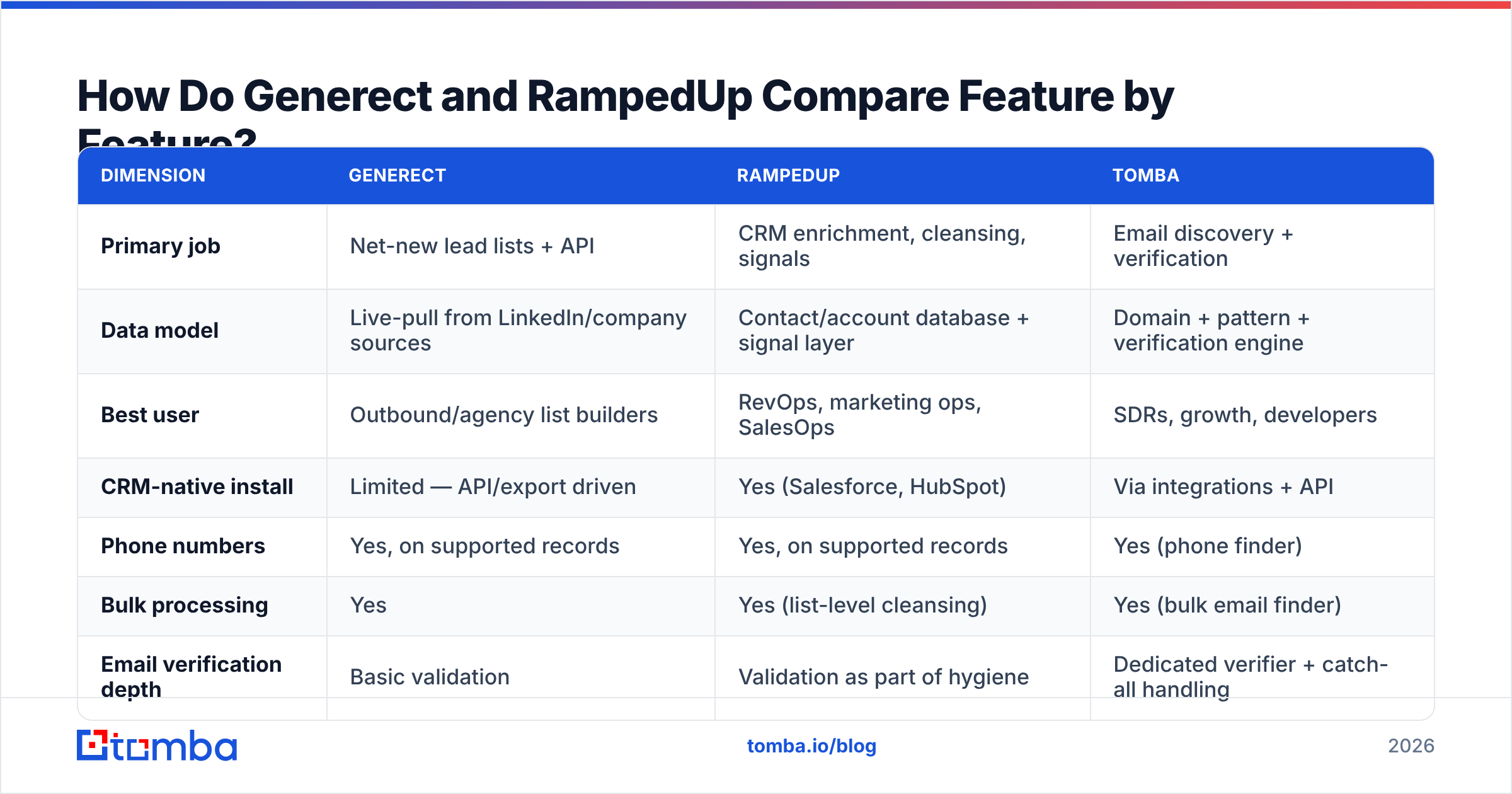
| Dimension | Generect | RampedUp | Tomba |
|---|---|---|---|
| Primary job | Net-new lead lists + API | CRM enrichment, cleansing, signals | Email discovery + verification |
| Data model | Live-pull from LinkedIn/company sources | Contact/account database + signal layer | Domain + pattern + verification engine |
| Best user | Outbound/agency list builders | RevOps, marketing ops, SalesOps | SDRs, growth, developers |
| CRM-native install | Limited — API/export driven | Yes (Salesforce, HubSpot) | Via integrations + API |
| Phone numbers | Yes, on supported records | Yes, on supported records | Yes (phone finder) |
| Bulk processing | Yes | Yes (list-level cleansing) | Yes (bulk email finder) |
| Email verification depth | Basic validation | Validation as part of hygiene | Dedicated verifier + catch-all handling |
| Entry pricing | Custom / tiered quote | Custom / seat + record based | Free 25/mo, then $49/mo |
| Free tier | Trial-based | Demo-based | Yes — 25 searches/mo |
| Developer API | Yes, core to the product | Available | Yes (Tomba API) |
Three things jump out of that table.
First, only one of the three has a published, self-serve entry price. Generect and RampedUp both route you through sales. That is normal for data platforms, and it is not a knock — but it means your evaluation timeline stretches from "an afternoon" to "two weeks and three calls."
Second, CRM-native matters more than people expect. If your reps live in Salesforce, a tool that enriches records in place beats a tool that hands you a CSV. RampedUp wins that dimension outright.
Third, verification depth is where both platforms are thinner than a specialist. Broad data platforms validate emails as a checkbox feature. If your bounce rate is the metric that keeps you up at night, a dedicated email verifier with real catch-all handling does a different quality of work.
Which One Has Better Data Accuracy?#
Accuracy claims in this category are close to unfalsifiable, so evaluate them structurally instead of taking marketing numbers at face value.
Generect's structural advantage is recency. A live-pull model means the record you get reflects the profile as it exists when you query. In a market where roughly a fifth of B2B contacts change roles annually — a figure repeatedly cited in Gartner and vendor research on data decay — recency is not a nice-to-have. It is the whole ballgame for job-change triggers and new-hire plays.
RampedUp's structural advantage is continuous correction. It is not trying to be right once at export time; it is trying to keep 200,000 records converging toward correct over months. Different problem, different math. A cleansing run that flags 18% of your contacts as departed is delivering value even if its own append data isn't the freshest on the market.
Where both get tested is deliverability. A "found" email is not a deliverable email. Both platforms return addresses that pass syntax and MX checks; neither is primarily a verification engine. If you are sending cold volume, run every list through a real verification pass before it touches your sending domain — your sender reputation is the asset you cannot buy back.
Run this test on any vendor, including Tomba:
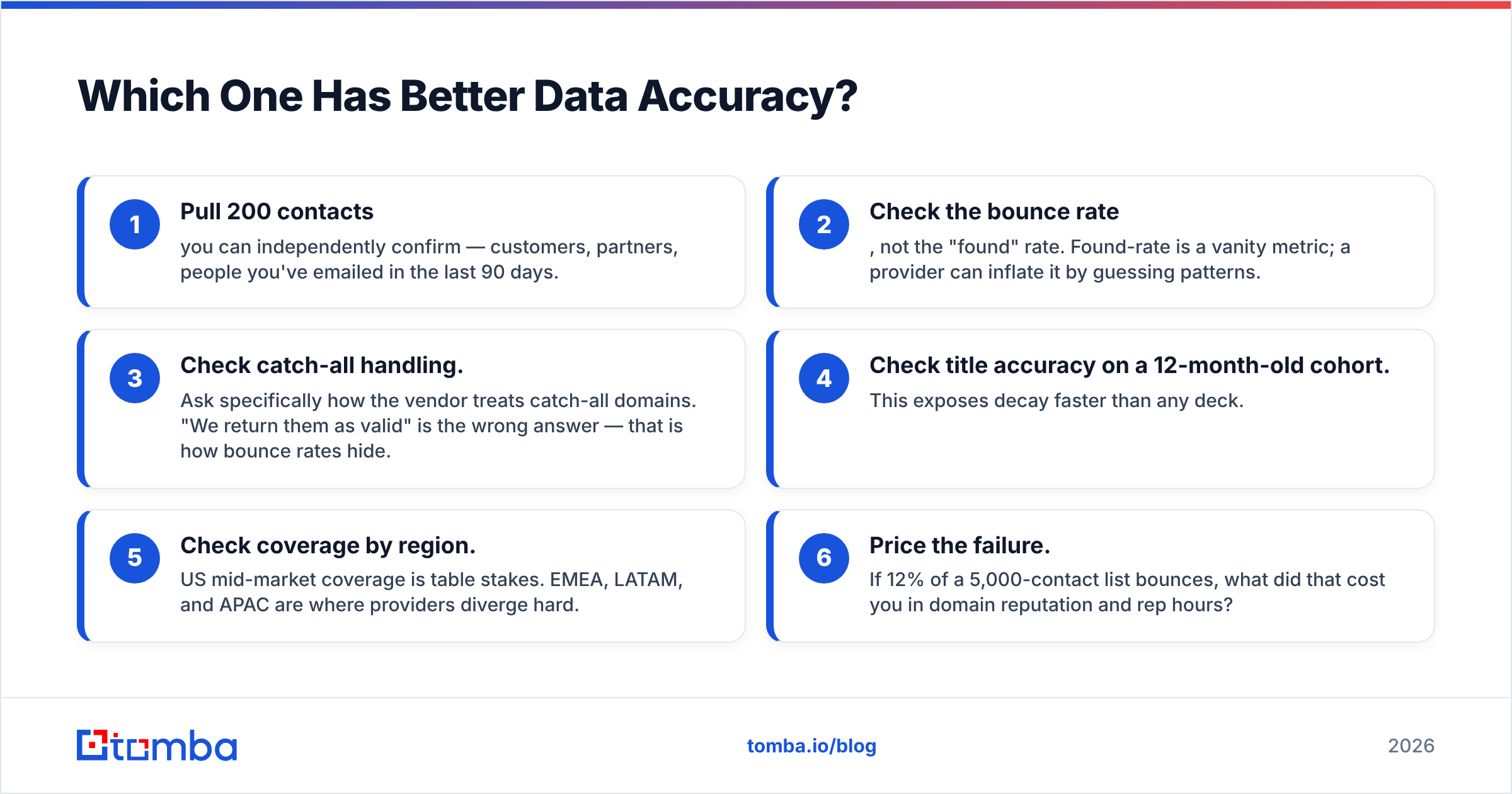
- Pull 200 contacts you can independently confirm — customers, partners, people you've emailed in the last 90 days.
- Check the bounce rate, not the "found" rate. Found-rate is a vanity metric; a provider can inflate it by guessing patterns.
- Check catch-all handling. Ask specifically how the vendor treats catch-all domains. "We return them as valid" is the wrong answer — that is how bounce rates hide.
- Check title accuracy on a 12-month-old cohort. This exposes decay faster than any deck.
- Check coverage by region. US mid-market coverage is table stakes. EMEA, LATAM, and APAC are where providers diverge hard.
- Price the failure. If 12% of a 5,000-contact list bounces, what did that cost you in domain reputation and rep hours?
Is Generect Better Than RampedUp for Outbound?#
For pure outbound list-building, Generect is the better fit — with a caveat.
Generect is built for the motion where you define an ICP filter, pull a few thousand matching contacts, and push them into a sequencer. The API makes it viable as infrastructure rather than a UI you visit. Agencies and lead-gen shops that rebuild lists weekly get real leverage from that.
RampedUp can support outbound, but you are paying for a platform whose best features — CRM-native cleansing, signal scoring, account prioritization — are wasted if you're just exporting lists. It is a RevOps tool that happens to have contact data, not a list-building tool that happens to sit in your CRM.
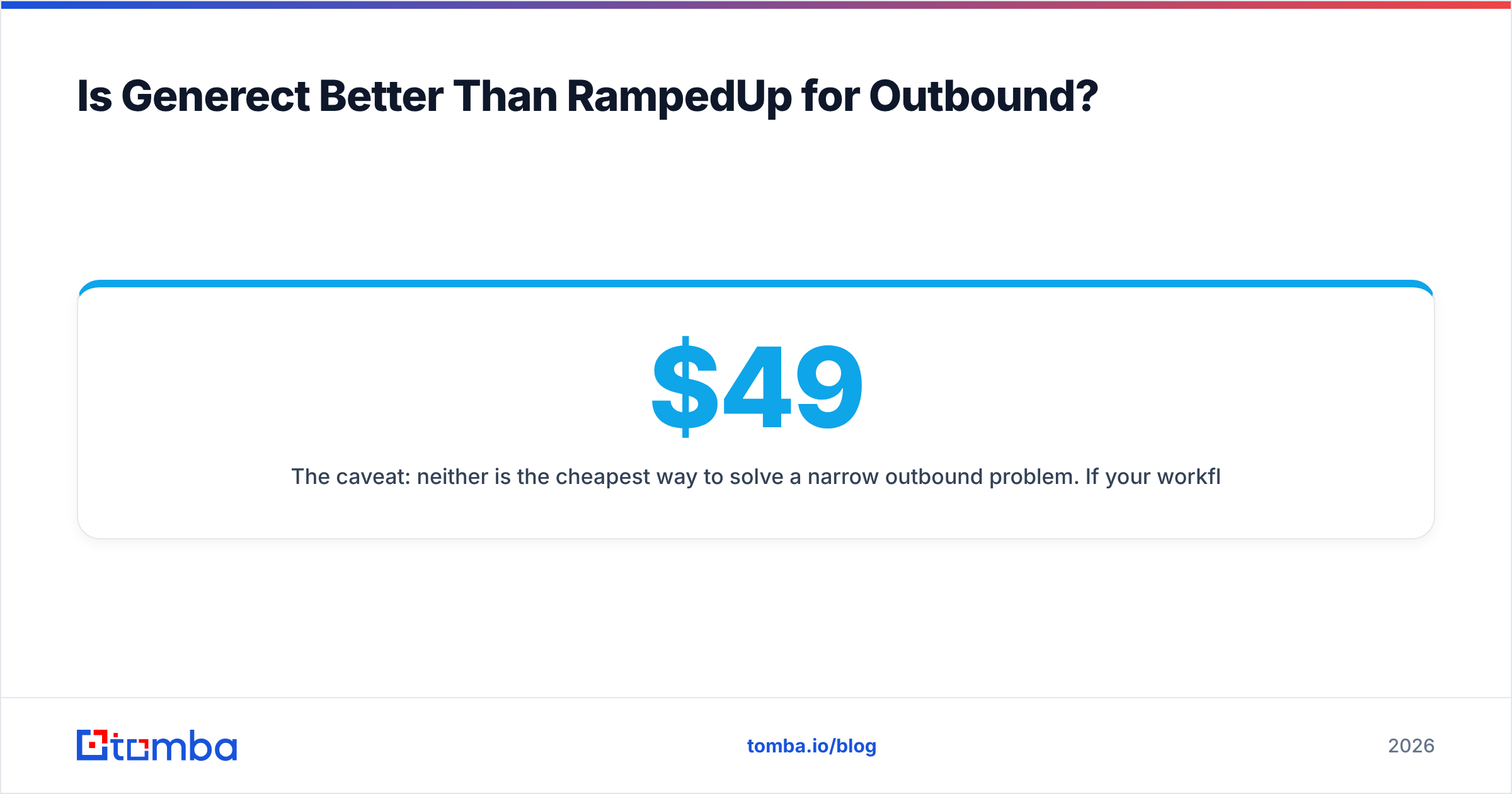
The caveat: neither is the cheapest way to solve a narrow outbound problem. If your workflow is "I have 800 target companies and I need the VP of Engineering at each one," you don't need a platform. You need domain search plus verification, and you need it to cost less than a headcount. That is a $49–$99/mo problem, not a $1,500/mo problem.

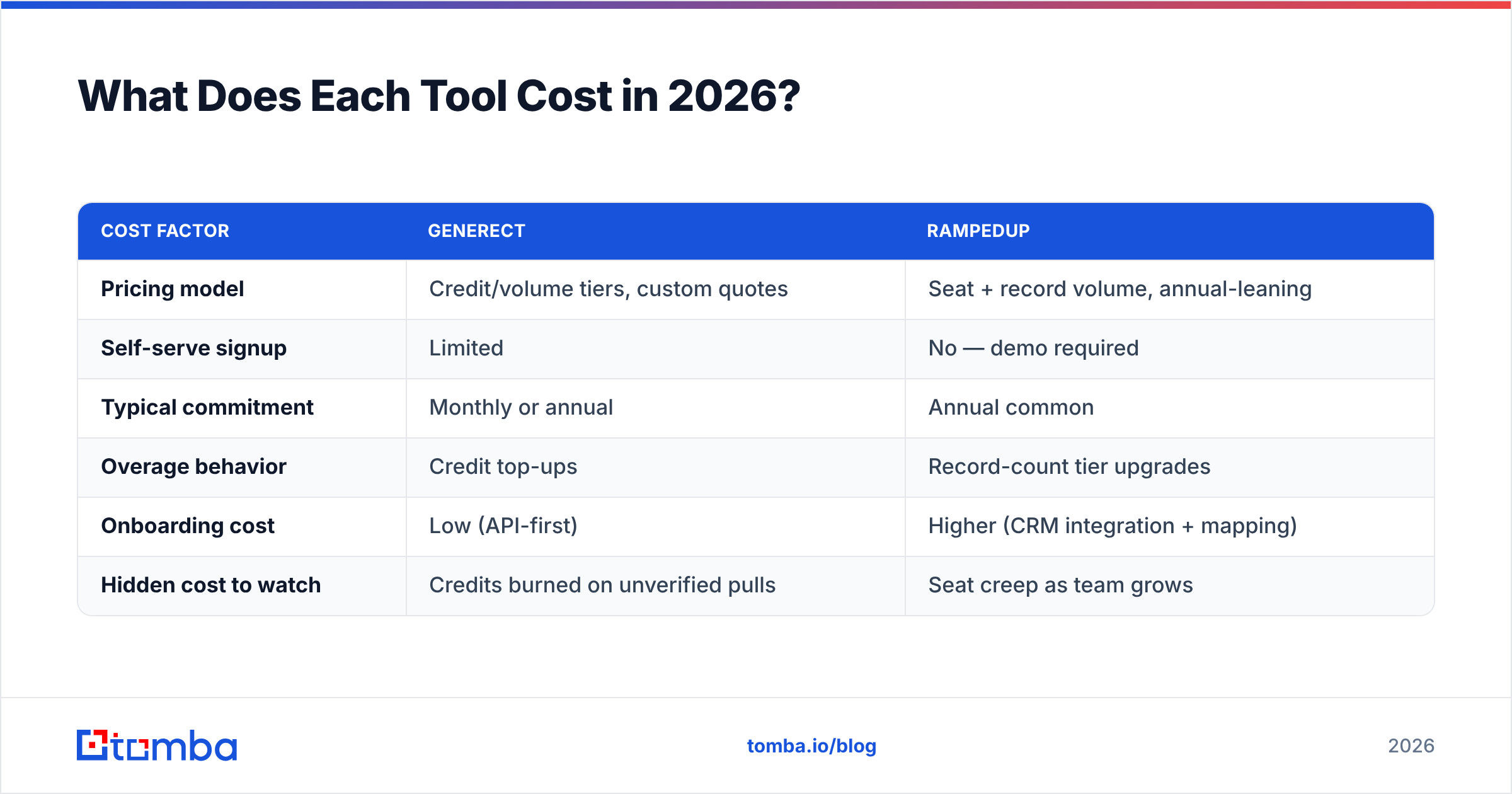
What Does Each Tool Cost in 2026?#
Both vendors gate pricing behind sales conversations, so what follows is the shape of the deal rather than a price list. Confirm current numbers directly with each vendor.
| Cost factor | Generect | RampedUp |
|---|---|---|
| Pricing model | Credit/volume tiers, custom quotes | Seat + record volume, annual-leaning |
| Self-serve signup | Limited | No — demo required |
| Typical commitment | Monthly or annual | Annual common |
| Overage behavior | Credit top-ups | Record-count tier upgrades |
| Onboarding cost | Low (API-first) | Higher (CRM integration + mapping) |
| Hidden cost to watch | Credits burned on unverified pulls | Seat creep as team grows |
The two hidden costs deserve attention because they are what actually blows budgets.
On Generect: credit burn on records you never use. Live-pull models charge on query, not on outcome. Pull 5,000 contacts, sequence 1,200, get replies from 40 — you paid for 5,000. Tighten filters before you scale volume.
On RampedUp: seat creep. Platform tools priced per seat get expensive at exactly the moment they're succeeding, because success means more people want access. Model the 18-month cost at your projected headcount, not today's.
For comparison, published Tomba pricing runs Free (25 searches/mo), Starter $49/mo, Growth $99/mo, Pro $249/mo, and Enterprise custom. That is a different budget class, and deliberately so — it is a focused tool, not a data platform. Whether that's a feature or a limitation depends entirely on the job you're hiring it for.
When Should You Choose Neither?#
Three scenarios where both tools are the wrong purchase:
1. Your list is small and specific. Under ~2,000 target contacts at known companies? A platform subscription is overkill. Use an email finder with domain search, run a verification pass, done. You'll spend under $100/mo and get comparable deliverability.
2. Your problem is deliverability, not data. If you're finding contacts fine but landing in spam, more data won't help. Fix authentication, warm your domains, and audit your email deliverability before buying another data source. A clean list into a burned domain still fails.
3. You need bulk verified B2B records at a known price. Vendors like BookYourData sell pay-as-you-go verified B2B contact data without a seat model — a legitimately different purchase shape that suits teams who want volume without a platform commitment. It's worth a look before you sign an annual data-platform contract.
There is also the DIY route that RevOps teams underrate: pull company lists however you like, then resolve contacts through an email finder API inside your own pipeline. You control the logic, you pay per resolution, and you're not renting a UI. Teams already running revenue operations tooling usually have the plumbing for this.
How Do You Run a Fair Evaluation?#
Compress the sales cycle with a structured bake-off. Both vendors will give you a trial or sample if you ask with a real use case attached.
- Define one ICP segment, not five. 500 contacts, one industry, one seniority band, one geography. Mixed tests produce mushy results.
- Request the same segment from every vendor on your shortlist — including a cheap specialist as your control. Without a control you can't tell "good data" from "expensive data."
- Measure four numbers only: match rate, bounce rate, title-accuracy rate on a manual 50-record sample, and cost per deliverable contact. The last one is the only number that matters at renewal.
- Test the integration path, not the demo. Ask to see the actual Salesforce field mapping or the actual API response payload. Demos hide the friction.
- Ask about data provenance and compliance. GDPR/CCPA posture, opt-out handling, and source disclosure. Reviews on G2 surface complaints here that vendor sites never will.
- Get overage terms in writing. What happens at 110% of contracted volume is a question you want answered before signing, not after.
Verdict: Which Should You Buy?#
Buy Generect if net-new contact discovery is a recurring, high-volume operation and you want API-first access to fresh LinkedIn-sourced data. Agencies, lead-gen shops, and outbound-heavy startups fit here.
Buy RampedUp if your CRM is the problem. Six-figure record counts, stale titles, no signal layer, reps who don't trust the data — that's a hygiene-and-enrichment purchase, and RampedUp is built for exactly it. Expect a real implementation, not a weekend setup.
Buy neither if what you actually need is verified work emails at a defined set of companies. That's a specialist job. Overpaying for platform features you won't touch is the most common data-stack mistake we see.
Most teams end up running a combination anyway: a hygiene layer for the CRM, and a fast, cheap resolution layer for net-new. The mistake is assuming one vendor should do both well.
Start with the narrow problem. If your immediate need is finding and verifying work emails at target companies — without a demo call, an annual contract, or a seat model — the Tomba Email Finder gives you 25 free searches a month to test it against your own known-good list. Run the bounce-rate test above on your data, compare it to whatever quote Generect or RampedUp sends back, and let cost-per-deliverable-contact decide. That's the only benchmark that survives a renewal conversation.
Related guides#
Ready to find emails that actually work?
Join 150,000+ professionals who stopped guessing and started sending. Free credits on signup — no credit card required.
Get the Tomba newsletter
Practical outbound tactics and product updates — once every two weeks.
About the author