Generect vs Reoon (2026): Which Email Data Tool Wins?
Generect sources B2B leads. Reoon verifies them. Comparing them head-to-head only makes sense once you know which half of your pipeline is leaking — here is the honest breakdown, plus what most teams actually buy.
TL;DR
- Generect and Reoon are not really competitors. Generect finds B2B contacts (LinkedIn-native lead and company search plus an API). Reoon cleans contacts you already have (bulk email verification with strong catch-all grading).
- If your problem is "I don't have enough prospects," Generect is the relevant tool. If your problem is "my bounce rate is 8% and my domain is cooking," Reoon is the relevant tool.
- Reoon is one of the cheapest per-verification options on the market and its credits are unusually flexible. Generect is priced like a data subscription, not a utility.
- Buying both means two vendors, two credit systems, two APIs, and no single source of truth on contact quality.
- Teams that want one pipeline — find, verify, enrich, export — usually consolidate on a platform that does all three. That is where Tomba sits, at $49/mo for the Starter plan with a free tier to test coverage first.
What are Generect and Reoon, actually?#
Start here, because the "vs" framing is misleading.
Generect is a B2B lead generation platform built around LinkedIn-shaped data. You search by company, headcount, geography, title, industry, or technology, and it returns contact records with professional emails and company firmographics. The pitch is real-time sourcing rather than a stale static dump: records are pulled and refreshed on request, and there is a Leads API for teams that want to feed a CRM or an outbound sequencer programmatically. Its natural buyer is an SDR team or an agency that needs to build lists continuously.
Reoon — specifically Reoon Email Verifier — is a validation utility. You give it a list; it tells you which addresses are safe to send to. It does SMTP-level checks, syntax and MX validation, disposable and role-account detection, and it is known in the cold email community for handling the hard cases: Yahoo, Hotmail/Outlook consumer domains, and catch-all servers that accept everything and reveal nothing. It does not source contacts. It has no search interface, no firmographics, no "find me VPs of Engineering in Berlin."
So the honest one-line answer to "Generect vs Reoon" is: they occupy different stages of the same pipeline. Sourcing feeds verification. Verification protects deliverability. Comparing them is like comparing a supplier to a quality-control lab.
That said, budget is finite and both charge credits, so the comparison people actually want is: where does my money produce more pipeline?

How do Generect and Reoon compare head-to-head?#
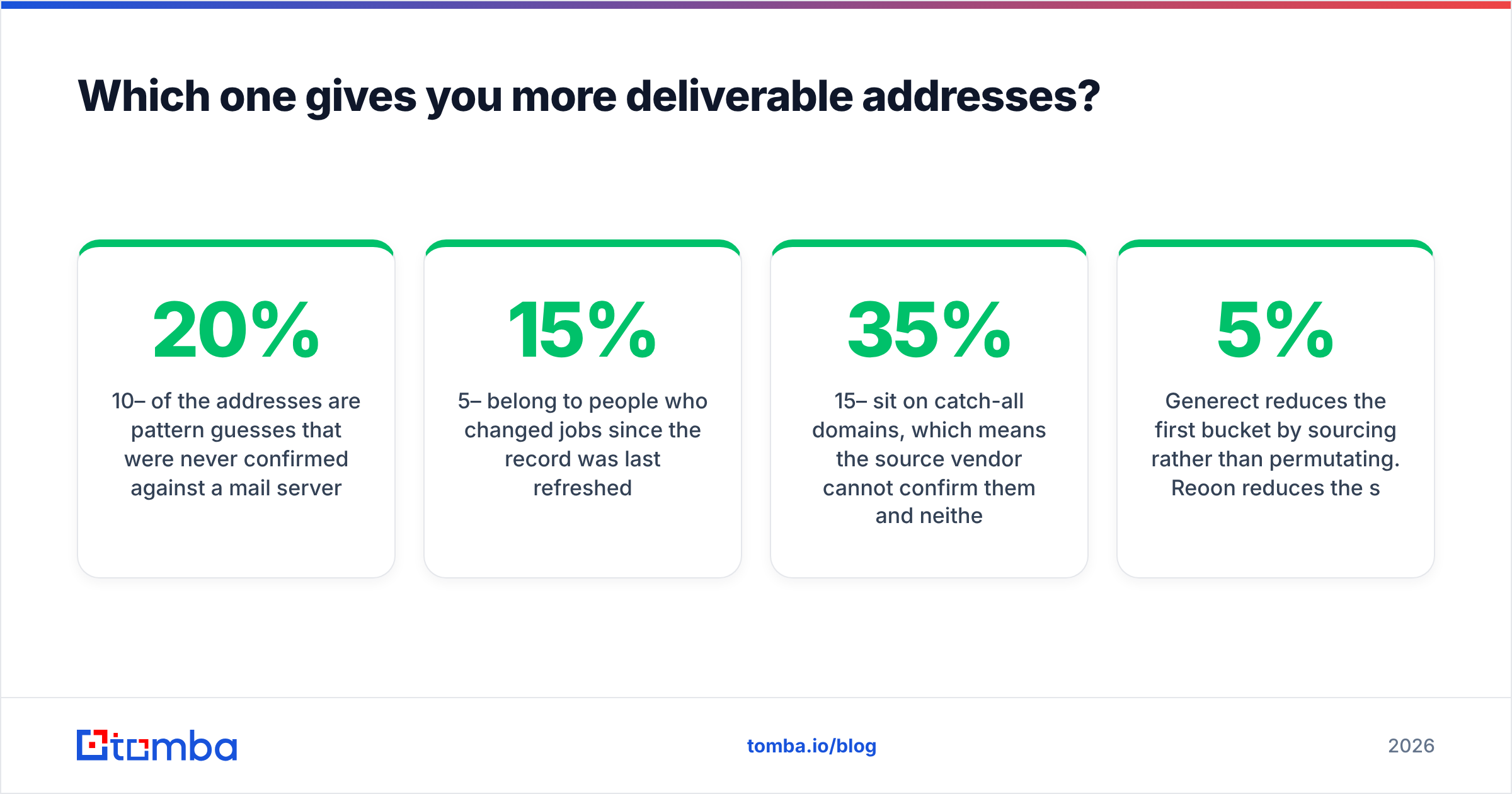
| Dimension | Generect | Reoon |
|---|---|---|
| Primary job | Find B2B contacts and companies | Verify existing email lists |
| Core output | Name, title, company, email, firmographics | Valid / invalid / risky / catch-all verdict |
| Search interface | Yes — filters by title, size, geo, industry | No — upload or API only |
| Catch-all handling | Returns the address; quality varies | Dedicated catch-all grading, its strongest feature |
| Bulk workflow | List building and export | Bulk upload, CSV in/out, high throughput |
| API | Leads API for programmatic sourcing | Verification API, single and bulk endpoints |
| Pricing model | Subscription/credit tiers, data-vendor pricing | Credit packs and plans, utility pricing (cheap per check) |
| Best for | SDR teams and agencies building lists weekly | Anyone with a list they didn't source themselves |
| Main weakness | You still need a verifier before sending | Useless if you have nothing to verify |

Two things fall out of that table.
First, the overlap is thin. Generect includes some validation on the emails it returns, as most data vendors do, but "the vendor says it's valid" is not the same as an independent SMTP check at send time. Data ages. A record sourced in January and mailed in April is a different risk profile than one verified the day you send.
Second, Reoon's advantage is narrow but deep. Catch-all domains are where most verifiers quietly give up and return "unknown," which leaves you guessing on 20–40% of enterprise lists. Reoon leans into that specific problem, and that is why it keeps showing up in cold email communities despite having almost no brand marketing. If you want to see how buyers rank the category, the G2 email verification category is a reasonable sanity check on positioning.
Pricing note before you budget: both vendors have changed tiers more than once, and Reoon in particular has run credit packs and lifetime-style offers that come and go. Check the live pricing page before you commit spend. Do not plan a quarter around a number you read in a blog post — including this one.
Which one gives you more deliverable addresses?#
Neither, by itself. That is the uncomfortable answer, and it is the whole point of this comparison.
Here is what actually happens on a typical 5,000-row list sourced from a LinkedIn-native provider:
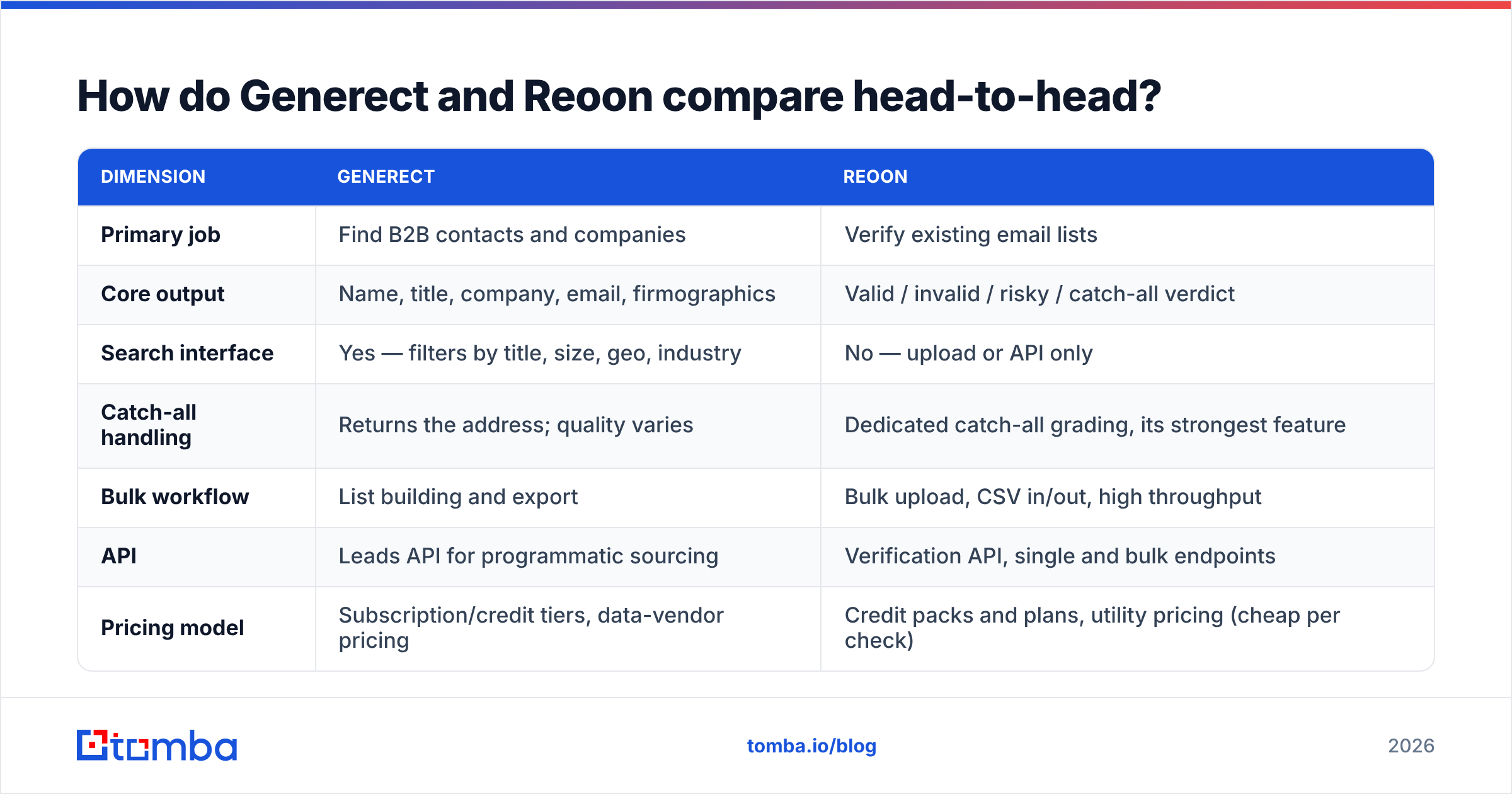
- 10–20% of the addresses are pattern guesses that were never confirmed against a mail server.
- 5–15% belong to people who changed jobs since the record was last refreshed.
- 15–35% sit on catch-all domains, which means the source vendor cannot confirm them and neither can most verifiers.
- Some slice is role accounts (info@, sales@, support@) that will tank your reply rate even when they are technically deliverable.
Generect reduces the first bucket by sourcing rather than permutating. Reoon reduces the second and third at send time. Neither addresses all four. If you run Generect output straight into a sequencer with no verification step, you will eventually see bounce rates north of 5%, and Google and Microsoft's 2024 bulk-sender rules made that expensive — Google's sender guidelines put a hard spam-complaint ceiling on senders and reward low bounce volume. Your sender reputation is the asset; the list is just inventory.

The practical benchmark to run yourself, before you sign anything:
- Take a control list of 200 contacts you already know are good — current customers, closed-won contacts, people who replied last quarter.
- Ask each vendor to source or verify them. For Generect, see how many of the 200 it can return with a matching email. For Reoon, see how many it correctly marks valid.
- Count the false confidents. A verifier that marks a dead address "valid" costs you more than one that says "unknown."
- Count the unknowns. This is where catch-all handling shows up. A high unknown rate means you are still guessing.
- Divide by price. Cost per usable contact is the only number that matters. Cost per credit is marketing.
Run that test with a free tier or a small credit pack. It takes an afternoon and it beats every comparison article, this one included.
When should you choose Generect?#
Pick Generect when list building is the constraint. Specifically:
- You need continuously refreshed contacts rather than a one-time database export.
- Your ICP is defined by LinkedIn-shaped attributes — headcount, seniority, department, geography.
- You have engineering resources and want to pull leads via API into your own system rather than clicking through a UI.
- You are an agency serving multiple ICPs and need breadth of search filters more than depth on any one account.
Pick something else when your ICP is regional SMB, when you need phone numbers as a first-class output, or when you already have a database and just need to clean it. Buying a sourcing subscription to solve a hygiene problem is the most common budget mistake in this category.
When should you choose Reoon?#
Pick Reoon when the list already exists and you are worried about what is in it. Typical triggers:
- You bought or inherited a list and have no idea how old it is.
- Your bounce rate crossed 4% and your sequencer started throttling.
- You are mailing enterprise domains where catch-all servers dominate.
- You want a cheap, high-throughput utility you can call from a script, not another SaaS seat.
Reoon is deliberately narrow. That narrowness is a feature: utilities that do one job well tend to be cheaper and more reliable than platforms that bolt the same job on as a checkbox. But it will not build you a pipeline. If you are evaluating Generect vs Reoon because you have $200 and one problem, name the problem first.

Do you actually need both tools?#
Most teams that run outbound at any volume end up needing both capabilities. The real question is whether they need both vendors. Here is the decision framework:
- Map where your list actually comes from. If 80% is scraped, exported, or bought, verification is your bottleneck and sourcing spend is premature. If you burn through lists in three weeks, sourcing is the bottleneck.
- Count your integration surface. Two vendors means two API keys, two credit balances, two rate limits, two support queues, and a glue script nobody wants to own when it breaks at 2am.
- Check for double-charging. You pay Generect for a record, then pay Reoon to check the same record. On a 50,000-contact year that is two full costs per contact, and the second one is only necessary because the first one was not confirmed.
- Decide who owns freshness. If sourcing and verification live in different systems, nothing tells you a contact went stale. Consolidated platforms can re-verify on export; two-vendor stacks usually cannot.
- Price the consolidation option honestly. A single platform that finds and verifies is not automatically cheaper — but it is usually cheaper than a sourcing subscription plus a verification balance plus the engineering time to stitch them.
Where does Tomba fit between them?#
Tomba covers both halves in one credit system, which is the specific gap this comparison exposes.
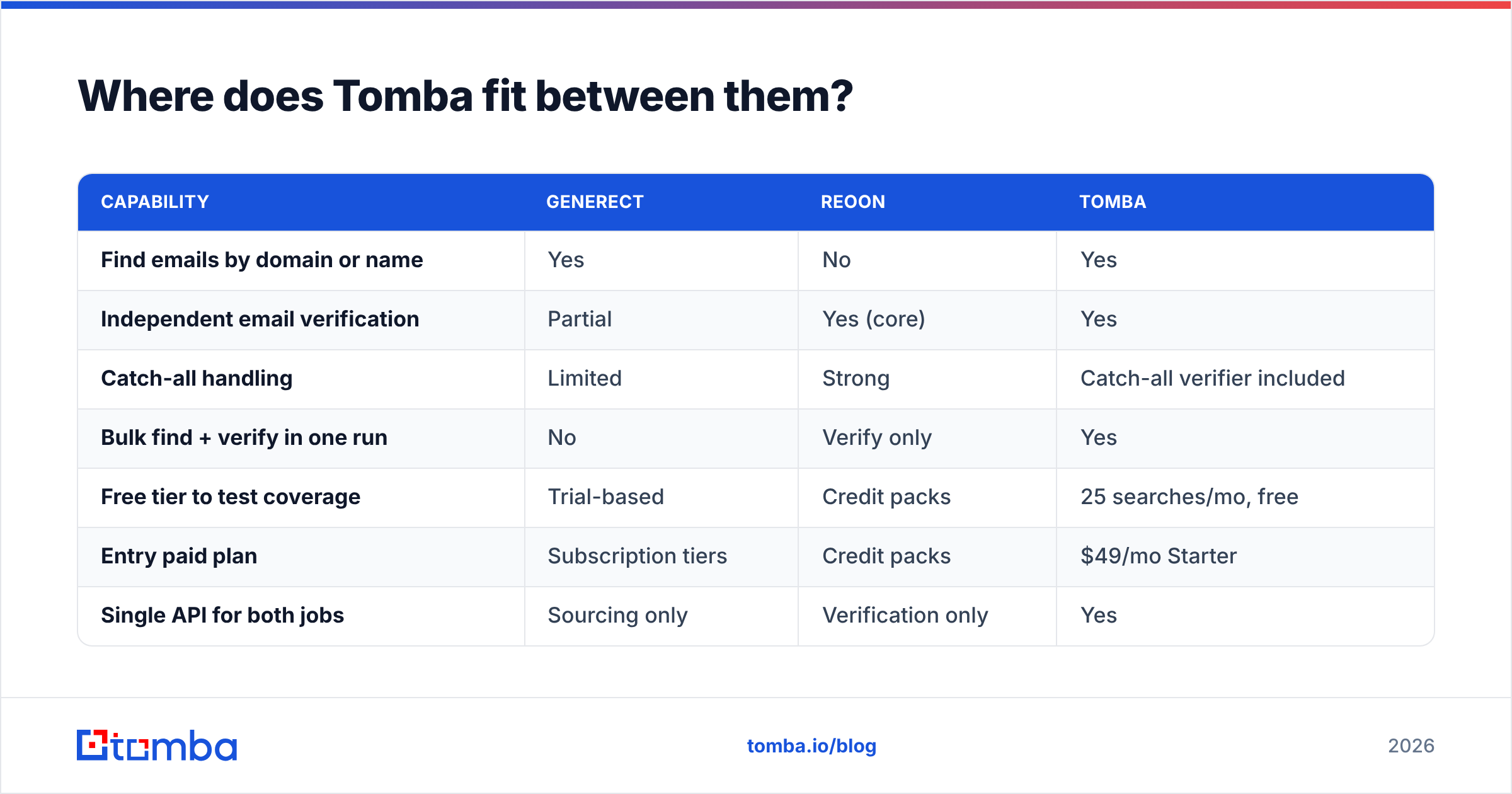
| Capability | Generect | Reoon | Tomba |
|---|---|---|---|
| Find emails by domain or name | Yes | No | Yes |
| Independent email verification | Partial | Yes (core) | Yes |
| Catch-all handling | Limited | Strong | Catch-all verifier included |
| Bulk find + verify in one run | No | Verify only | Yes |
| Free tier to test coverage | Trial-based | Credit packs | 25 searches/mo, free |
| Entry paid plan | Subscription tiers | Credit packs | $49/mo Starter |
| Single API for both jobs | Sourcing only | Verification only | Yes |
The honest caveats: Reoon will likely beat Tomba on raw cost per verification if all you ever do is verify, because that is a utility market and utilities compete on price alone. And Generect's LinkedIn-attribute search is more granular than a domain-first finder if your entire motion is "find me every Series B CTO in DACH." Neither of those is a small point.
What consolidation buys you is a shorter chain. You run a domain search or a bulk find, verification happens in the same run, and what lands in your CRM has already been graded — including on catch-all domains. One credit balance, one API, one export. For teams under ten reps, that operational simplicity usually outweighs the last few cents of per-check savings. For teams over fifty, the calculus flips toward specialized vendors and a data engineer to glue them.
What are the hidden costs of either choice?#
Three things nobody puts on the pricing page.
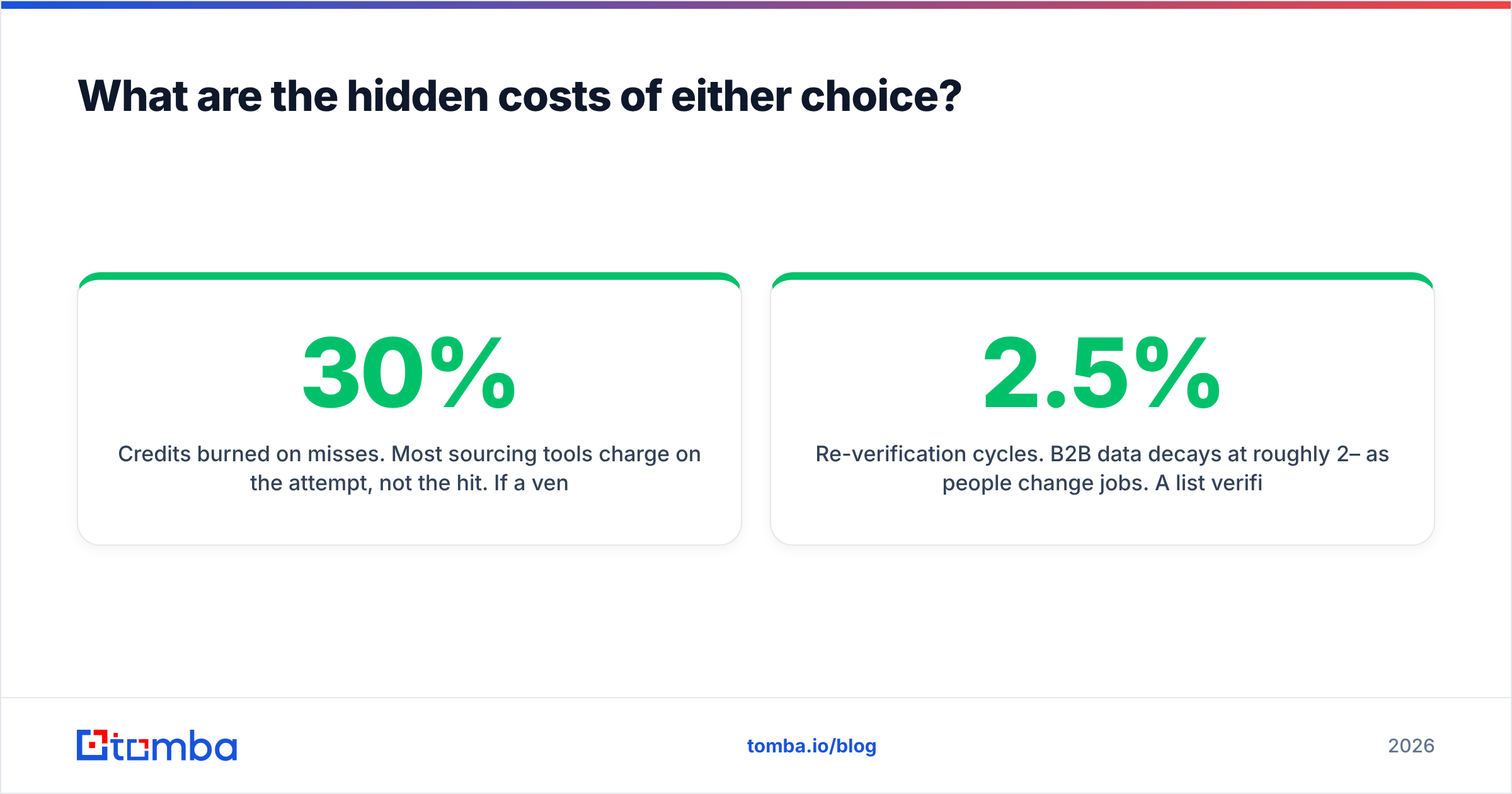
Credits burned on misses. Most sourcing tools charge on the attempt, not the hit. If a vendor returns nothing for 30% of your queries, your effective price is 43% higher than the sticker. Ask about the miss policy in writing.
Re-verification cycles. B2B data decays at roughly 2–2.5% per month as people change jobs. A list verified in January is meaningfully worse in June. If you are not budgeting for re-verification, you are budgeting for bounces.
The seat you forgot. Sourcing platforms often price per seat and per credit. Verification utilities usually do not. When you compare a $X/mo subscription against a credit pack, normalize to cost per usable contact per year, not cost per month.
Generect vs Reoon: what's the verdict?#
If you have to pick one and you already have a list: Reoon. It solves the more urgent problem — bounce risk — at the lower price, and its catch-all grading is genuinely better than what most all-in-one platforms ship.
If you have to pick one and you have no list: Generect. A verifier with nothing to verify is a rounding error in your stack.
If you are building a repeatable outbound motion rather than running a one-off campaign: neither single tool is the answer, and a two-vendor stack is a tax you will pay every month in glue code and reconciliation. Consolidate first, specialize later — when volume actually justifies it.
Want to test the consolidated path before committing to two subscriptions? Start with the Tomba Email Finder free tier — 25 searches a month, no card — and run your own 200-contact control list through it. Find and verify in the same pass, check the catch-all verdicts against contacts you know are live, then compare cost per usable contact against whatever quote is sitting in your inbox. If the numbers favor a specialist, buy the specialist. If they don't, you just removed a vendor from your stack. Full Tomba pricing starts at $49/mo for Starter and $99/mo for Growth when you outgrow the free tier.
Related guides#
Ready to find emails that actually work?
Join 150,000+ professionals who stopped guessing and started sending. Free credits on signup — no credit card required.
Get the Tomba newsletter
Practical outbound tactics and product updates — once every two weeks.
About the author