Generect vs Respona: Which B2B Outreach Tool Wins in 2026?
Generect sells B2B lead data through an API. Respona runs link-building and PR outreach campaigns. They get compared constantly and they solve different halves of the same problem. Here's which one you actually need.
TL;DR
- Generect is a data company. It sells B2B lead records — LinkedIn-sourced profiles, company firmographics, emails — mostly through an API and bulk exports. It does not send your emails.
- Respona is a campaign company. It finds contacts for content and link-building, then writes, personalises, and sends the sequences. Its database is a means to an end.
- They are not really competitors. Teams comparing "generect vs respona" are usually asking a different question: do I need better data, or better sending?
- Cost profile differs sharply. Generect prices around data volume and API access; Respona prices per user/campaign seat, with entry plans near $99/mo and agency tiers several times that. Always confirm on the vendor page before budgeting.
- Either way, verify before you send. Both pipelines break on the same thing: stale addresses. A dedicated email verifier costs less than the deliverability damage of a 12% bounce rate.
What are Generect and Respona, exactly?#
The fastest way to stop confusing these two is to look at where each one sits in your workflow.
Generect is a B2B lead-generation data provider. Its core assets are a LinkedIn-derived database of people and companies, real-time search that mirrors LinkedIn/Sales Navigator filters, and a Leads API that lets engineers pull records straight into an internal system. You hand it a filter set — job title, headcount, geography, tech, growth signals — and it hands back structured contact records. What happens next is your problem.
Respona is an outreach platform built for a specific job: digital PR, link building, podcast pitching, and content promotion. It starts from a search — a keyword, a competitor's backlink profile, a podcast topic — finds the pages and the humans behind them, pulls contact details, then runs AI-assisted personalisation and multi-step email sequences from your own mailbox. Reporting is oriented around replies and placements, not around record counts.
So one fills the top of your funnel with rows. The other turns rows into conversations with editors, bloggers, and site owners.
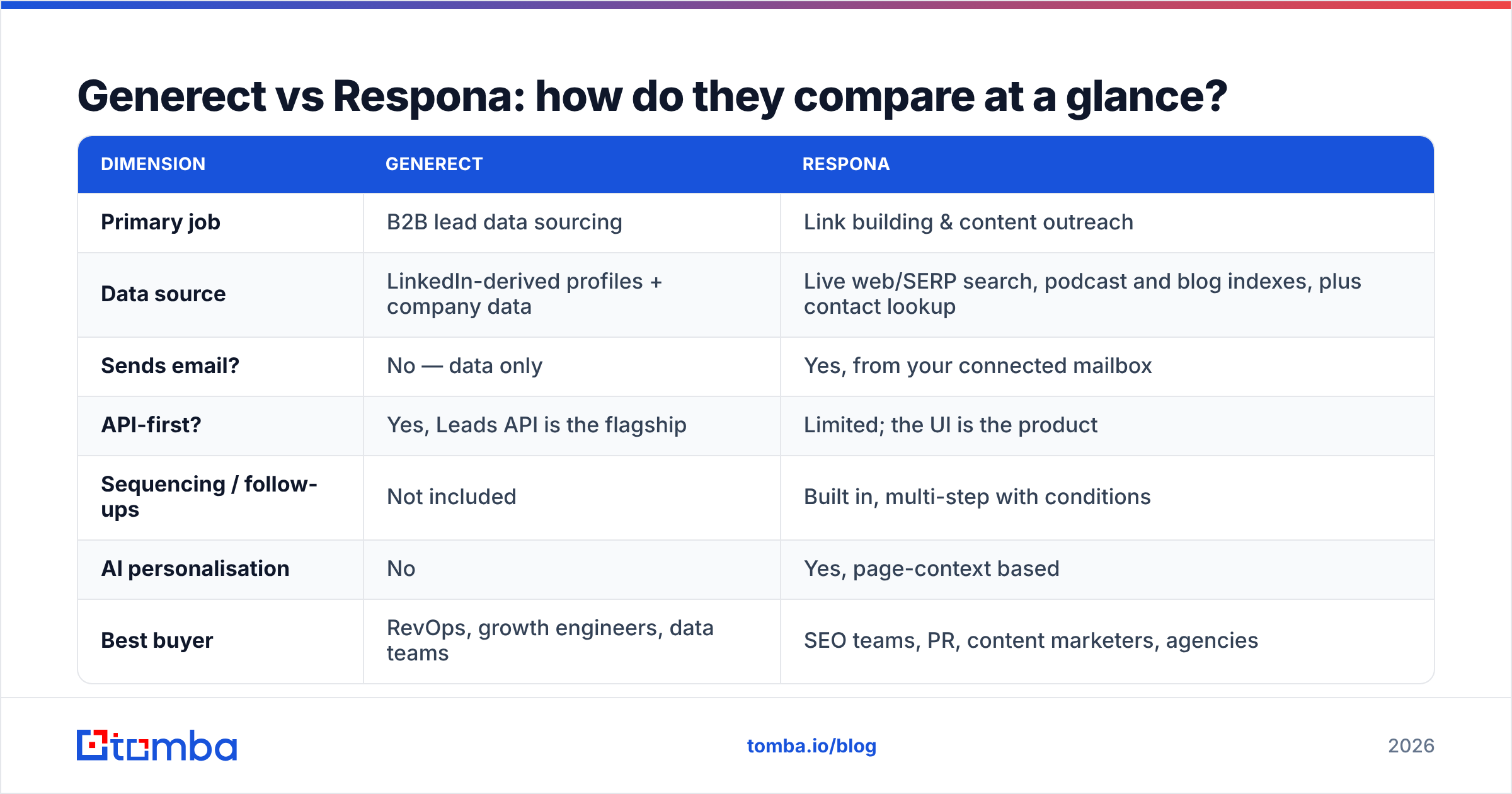
Generect vs Respona: how do they compare at a glance?#
| Dimension | Generect | Respona |
|---|---|---|
| Primary job | B2B lead data sourcing | Link building & content outreach |
| Data source | LinkedIn-derived profiles + company data | Live web/SERP search, podcast and blog indexes, plus contact lookup |
| Sends email? | No — data only | Yes, from your connected mailbox |
| API-first? | Yes, Leads API is the flagship | Limited; the UI is the product |
| Sequencing / follow-ups | Not included | Built in, multi-step with conditions |
| AI personalisation | No | Yes, page-context based |
| Best buyer | RevOps, growth engineers, data teams | SEO teams, PR, content marketers, agencies |
| Typical entry price | Volume/API-tiered, quote-driven | Around $99/mo entry, agency tiers far higher |
| Learning curve | Low for API users, needs a destination | Moderate — campaign builder has depth |
| Where it breaks | You still need sending infrastructure | Its contact data is narrower than a dedicated provider's |
Read that table twice and the "versus" framing collapses. A link-building agency will not replace Respona with Generect. A RevOps team building an internal enrichment service will not replace Generect with Respona.

Wait — that image is a joke about workflows, and the joke is the point:

What does Generect actually do well?#
Four things stand out when you use it in anger:
- API-first delivery. The Leads API is not an afterthought bolted onto a dashboard. If your plan is "enrich every inbound signup automatically" or "hydrate our internal ICP table nightly," Generect is architecturally aimed at you. Compare that with tools where the API is a paywalled tier-3 feature.
- LinkedIn-shaped filtering. Because the dataset mirrors LinkedIn structures, the filters feel familiar: seniority, function, headcount bands, industry, geography. Sales Navigator users transfer their mental model with no retraining.
- Real-time lookups over stale dumps. Static databases decay roughly 25–30% per year as people change jobs. Providers that re-query at request time — Generect included — reduce that rot, though nothing eliminates it.
- Volume economics. When you need 50,000 records rather than 500, per-record data pricing beats seat-based pricing every time. This is exactly where outreach platforms become the wrong tool financially.
What it does not do: warm up your domain, write your copy, manage reply detection, or stop you from emailing an address that bounced six months ago.
What does Respona actually do well?#
Respona's strength is that it collapses a five-tool workflow into one screen. The classic link-building stack — Ahrefs for prospects, a scraper for contacts, a verifier, a sequencer, a spreadsheet to track it — becomes a single campaign.
- Search-led prospecting. You start from intent ("guest post opportunities about email deliverability," "podcasts covering B2B SaaS") rather than from a company list. That's the correct entry point for PR work and the wrong one for account-based sales.
- Context-aware personalisation. It reads the target page and drafts an opener referencing the actual article. That single feature is why reply rates on PR outreach through Respona tend to beat generic sequences.
- Mailbox-native sending. Campaigns go through your Gmail or Outlook account with throttling and follow-up logic, which keeps volume in a range that doesn't torch sender reputation.
- Agency-friendly structure. Multiple workspaces, client separation, and placement reporting map to how link-building shops actually bill.
Its weakness is the mirror image of Generect's strength: when you need sales contacts — a VP of Engineering at 200 specific target accounts — Respona's contact discovery is thinner than a purpose-built B2B data provider, and there's no meaningful API to automate around.
Which one has better data coverage and accuracy?#
Different question than it looks. Generect and Respona are not indexing the same universe.
Generect indexes people and companies. Coverage is strongest where LinkedIn is strong: North America, Western Europe, tech and professional services, mid-market and enterprise. It thins out in regions with low LinkedIn penetration and in trades or SMB segments where nobody maintains a profile.
Respona indexes pages and publications, then finds the person attached. Coverage is strongest for editorial contacts — blog authors, editors, podcast hosts, journalists. Ask it for a Head of Procurement at a manufacturer and you're outside its design envelope. If author-level contact discovery is the whole job, a specialised author finder tends to resolve bylines more reliably than a general-purpose outreach suite.
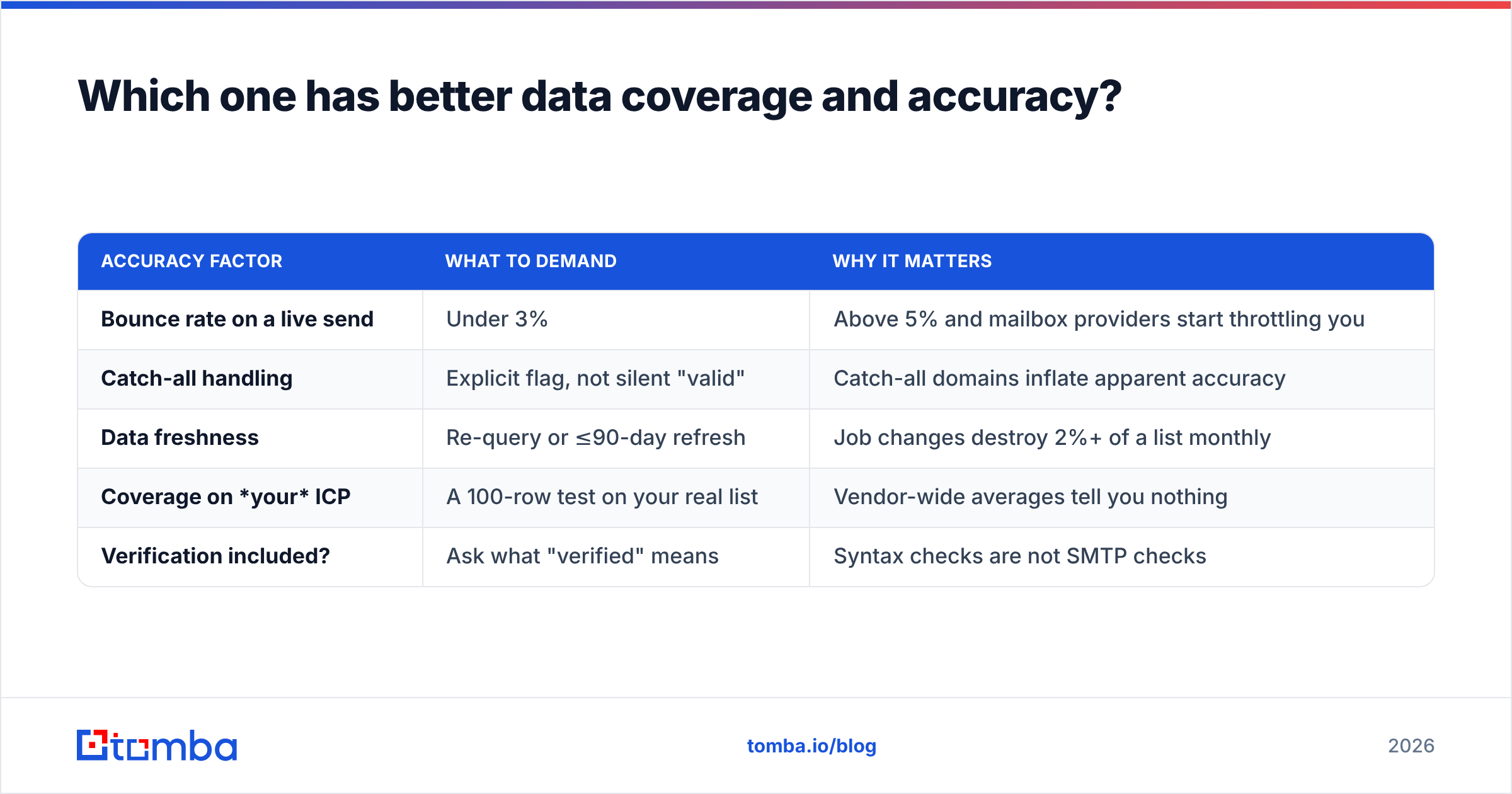
On accuracy, hold both to the same standard, because the metric that matters is not "records returned" — it's deliverable records returned.
| Accuracy factor | What to demand | Why it matters |
|---|---|---|
| Bounce rate on a live send | Under 3% | Above 5% and mailbox providers start throttling you |
| Catch-all handling | Explicit flag, not silent "valid" | Catch-all domains inflate apparent accuracy |
| Data freshness | Re-query or ≤90-day refresh | Job changes destroy 2%+ of a list monthly |
| Coverage on your ICP | A 100-row test on your real list | Vendor-wide averages tell you nothing |
| Verification included? | Ask what "verified" means | Syntax checks are not SMTP checks |
That third-to-last row is the one people skip. Run the same 100 target companies through any tool you're evaluating and count usable results. Marketing pages quote coverage across a global database; you only care about your slice.
Catch-all domains deserve their own paragraph. Roughly a fifth of business domains accept mail for any address, which means a naive verifier returns "valid" for addresses that will hard-bounce at the inbox layer. If your provider does not distinguish these, treat its accuracy number as unaudited. A dedicated catch-all verifier resolves the ambiguity instead of hiding it.
How do pricing and total cost compare?#
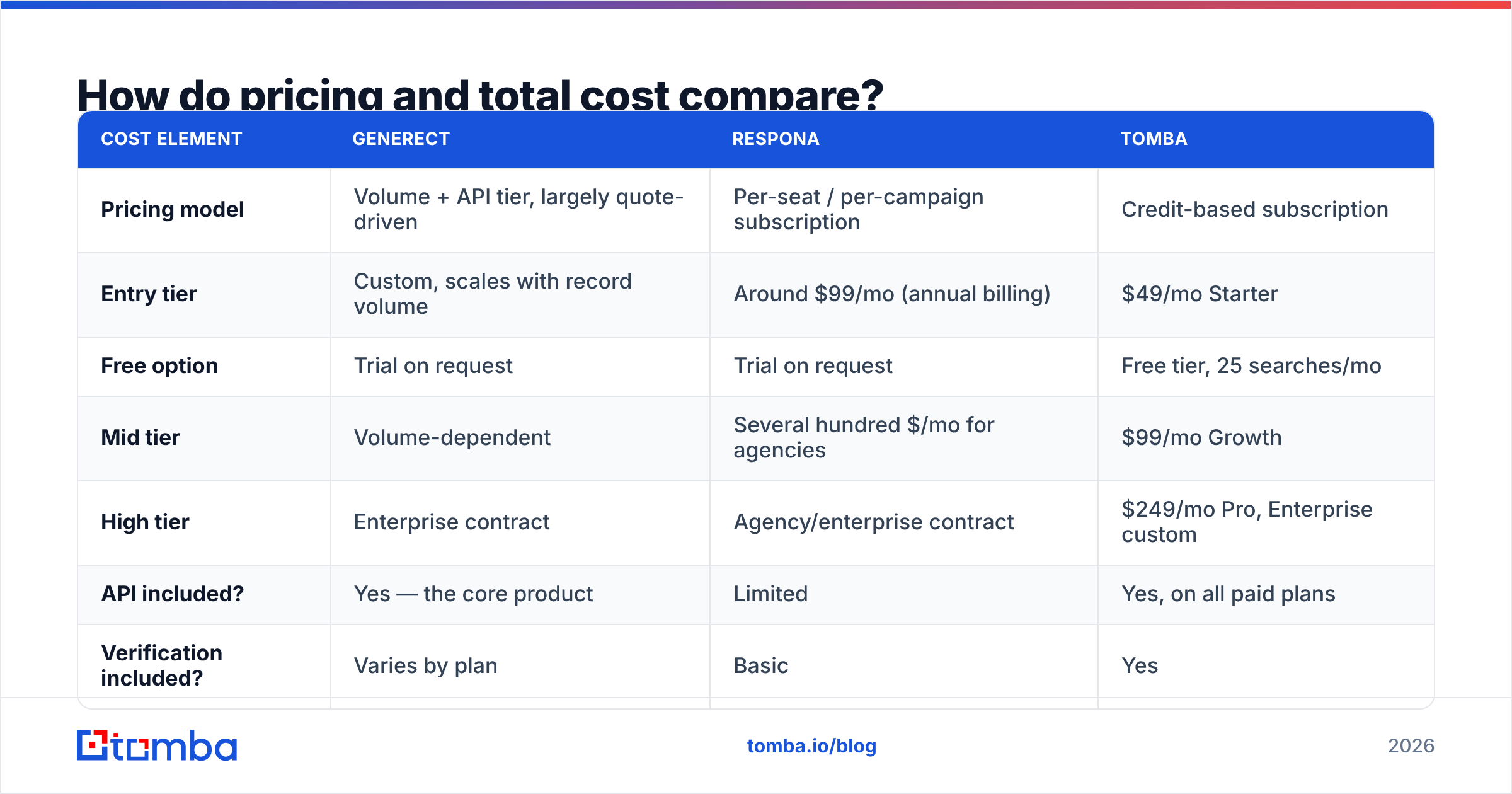
Prices move, so treat these as shapes rather than quotes and confirm on each vendor's page before you commit.
| Cost element | Generect | Respona | Tomba |
|---|---|---|---|
| Pricing model | Volume + API tier, largely quote-driven | Per-seat / per-campaign subscription | Credit-based subscription |
| Entry tier | Custom, scales with record volume | Around $99/mo (annual billing) | $49/mo Starter |
| Free option | Trial on request | Trial on request | Free tier, 25 searches/mo |
| Mid tier | Volume-dependent | Several hundred $/mo for agencies | $99/mo Growth |
| High tier | Enterprise contract | Agency/enterprise contract | $249/mo Pro, Enterprise custom |
| API included? | Yes — the core product | Limited | Yes, on all paid plans |
| Verification included? | Varies by plan | Basic | Yes |
| Sending included? | No | Yes | No |
Three cost traps worth naming:
- Seat pricing punishes scale. A five-person agency on a per-seat outreach tool pays five times for one workflow. A data API charges once for the volume.
- Data pricing punishes tiny volume. If you need 300 contacts a month, an enterprise data contract is absurd overhead. Transparent per-credit pricing, like the tiers on Tomba pricing, fits that shape far better.
- The invisible third line item. Neither Generect nor Respona removes the need for verification, warmup, and deliverability monitoring. Budget for it or pay for it later in blocked domains.

Which should you pick for your use case?#
Match the tool to the job, not to the review score.
- You're building an internal enrichment pipeline. Generect. API-first delivery is the entire reason it exists, and you'll write the sending layer yourself anyway.
- You run link building or digital PR. Respona. Nothing in Generect's product surface handles page-context personalisation or placement tracking, and rebuilding it is not worth your quarter.
- You do outbound sales to named accounts. Neither, alone. You want a contact-discovery layer plus a sequencer. Pair a bulk email finder with your existing sales engagement tool.
- You're a solo founder testing a market. Neither yet. Start with a free tier and 200 hand-picked accounts. Tooling spend before message-market fit is theatre.
- You need phone as well as email. Neither is built for it — layer in a dedicated phone finder rather than accepting whatever mobile numbers fall out of a general database.
- You need both data volume and campaign polish. Buy data from a provider with an email finder API and sending from a specialist. Split stacks are cheaper and more replaceable than one suite that half-does both.
For teams whose bottleneck is purely list acquisition in a specific vertical, curated database vendors such as BookYourData are a reasonable third path — they solve a narrower problem than either tool here and price accordingly.
What do reviewers say about Generect and Respona?#
Public review patterns on G2 are consistent with the split above. Respona's reviews cluster around campaign management, personalisation quality, and support responsiveness, with the recurring critique being price relative to smaller teams' volume. Generect's feedback centres on API reliability and data structure, with the recurring critique being that it's a component, not a solution — you need engineering time to get value.
Neither pattern is a flaw. They're descriptions of what each product is. The mistake is buying a component expecting a solution, or buying a solution expecting a component.
What's the honest verdict on Generect vs Respona?#
If forced to pick one for a general B2B team: neither is a complete answer.
Respona wins outright if your KPI is backlinks, mentions, or podcast placements. It is the better-designed product for that job and the comparison isn't close.
Generect wins outright if your KPI is records in a system and you have developers. It is the better-architected product for that job and, again, the comparison isn't close.
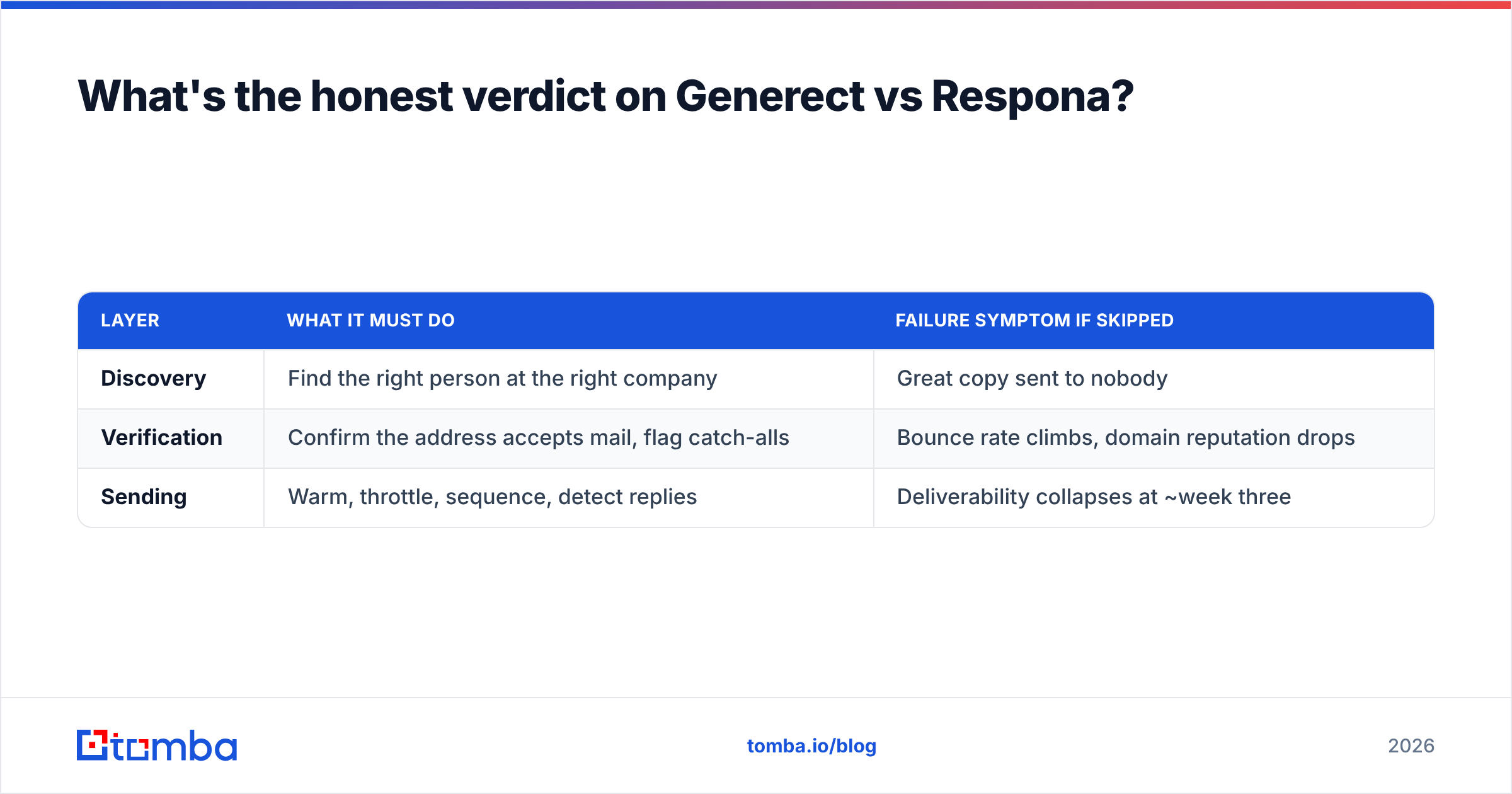
For everyone in the middle — the majority of B2B sales and growth teams — the useful move is to stop shopping for a suite and start assembling three cheap, replaceable layers:
| Layer | What it must do | Failure symptom if skipped |
|---|---|---|
| Discovery | Find the right person at the right company | Great copy sent to nobody |
| Verification | Confirm the address accepts mail, flag catch-alls | Bounce rate climbs, domain reputation drops |
| Sending | Warm, throttle, sequence, detect replies | Deliverability collapses at ~week three |
Generect covers layer one for high volume. Respona covers layers one and three for a narrow prospect type. Almost nobody sells all three honestly at one price, and the vendors that claim to usually compromise on verification — the least glamorous and most consequential layer.
Where does a dedicated email finder fit in this stack?#
Between the two. When you already know the accounts you want, you don't need a full database subscription or a campaign suite — you need addresses that resolve.
That's the gap Tomba Email Finder fills. Run a domain search to pull every discoverable address at a target company with role and confidence scoring, verify in the same pass, then push clean records into whatever sequencer you already pay for. Free tier gives you 25 searches a month to test coverage on your own ICP before spending anything; Starter is $49/mo and Growth $99/mo when the volume justifies it, with API, CLI, Sheets, and CRM integrations on every paid plan.
Test it the way you should test Generect and Respona: same 100 target accounts, same day, count deliverable results. The tool with the best marketing page rarely wins that comparison — and that's exactly why you should run it.
Related guides#
Ready to find emails that actually work?
Join 150,000+ professionals who stopped guessing and started sending. Free credits on signup — no credit card required.
Get the Tomba newsletter
Practical outbound tactics and product updates — once every two weeks.
About the author