Generect vs Revli (2026): Which B2B Lead Data Tool Wins
Generect sells LinkedIn-native lead data through an API. Revli sells lean, self-serve contact lookup. We compare coverage, accuracy, pricing models and export limits, then name the buyer each one actually fits.
TL;DR
- Generect is built around LinkedIn-shaped data: companies, people, and job-change signals delivered mostly through an API and bulk exports. It suits teams that want to pipe leads into their own systems.
- Revli is the leaner, self-serve option: look up a contact, get an email, move on. Less infrastructure, faster to start, smaller surface area.
- Neither is primarily a verification platform. Both hand you addresses; both expect you to verify before you send at volume.
- Pricing models differ more than prices do. Generect leans toward API/credit contracts, Revli toward simple subscription tiers. Compare cost-per-usable-contact, not cost-per-credit.
- If your bottleneck is finding and verifying work emails at a known price, a dedicated email finder with published tiers (Tomba: free 25 searches/mo, then $49/mo) usually beats either on unit economics.
Vendor pages change. Every price and limit below reflects what the vendors published at the time of writing — confirm on generect.com and revli.com before you sign anything.
What are Generect and Revli?#
Think of the B2B data market like grocery shopping. Some vendors sell you a pallet delivered to your loading dock; others sell you a single ingredient at the counter. Generect is closer to the pallet. Revli is closer to the counter.
Generect positions itself as a LinkedIn-native lead generation layer. Its pitch is that its data is derived from live professional-network activity rather than a static warehouse that decays quietly for eighteen months. The primary delivery mechanisms are an API, bulk list building, and integrations that push records into a CRM or sequencer. The buyer profile is a RevOps or growth engineer who wants a feed, not a UI.
Revli goes the other direction. It is a lighter contact-lookup product aimed at individual reps, founders, and small teams doing manual prospecting. You give it a person and a company, it returns a likely business email. There is far less machinery around it, which is a feature if you have five hours a week for prospecting and a liability if you need 40,000 records by Thursday.
That difference in shape matters more than any feature checklist. Choosing between them is mostly a question of whether you are buying data infrastructure or a lookup habit.

How do Generect and Revli compare head-to-head?#
Here is the honest side-by-side, with Tomba included as a third reference point because most buyers evaluating these two are also price-checking a pure email-finding tool.
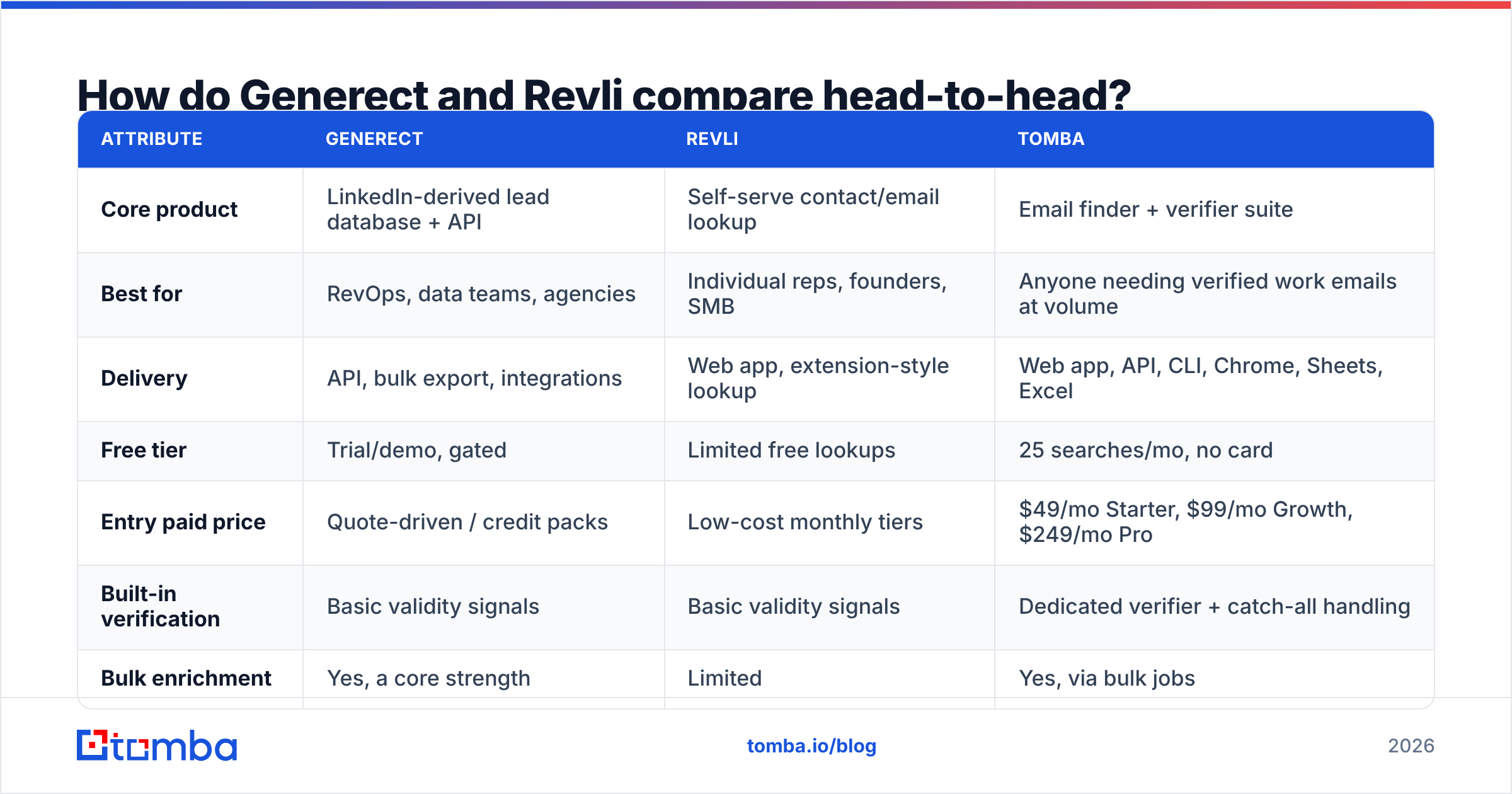
| Attribute | Generect | Revli | Tomba |
|---|---|---|---|
| Core product | LinkedIn-derived lead database + API | Self-serve contact/email lookup | Email finder + verifier suite |
| Best for | RevOps, data teams, agencies | Individual reps, founders, SMB | Anyone needing verified work emails at volume |
| Delivery | API, bulk export, integrations | Web app, extension-style lookup | Web app, API, CLI, Chrome, Sheets, Excel |
| Free tier | Trial/demo, gated | Limited free lookups | 25 searches/mo, no card |
| Entry paid price | Quote-driven / credit packs | Low-cost monthly tiers | $49/mo Starter, $99/mo Growth, $249/mo Pro |
| Built-in verification | Basic validity signals | Basic validity signals | Dedicated verifier + catch-all handling |
| Bulk enrichment | Yes, a core strength | Limited | Yes, via bulk jobs |
| API maturity | Strong, the main interface | Thin or absent on lower tiers | Documented REST API on all paid plans |
| Contract friction | Sales call common | Self-serve checkout | Self-serve checkout |

Two things jump out of that table.
First, Generect and Revli barely compete for the same buyer. They show up in the same search results because both promise "B2B leads," but a data engineer building an enrichment pipeline will find Revli underpowered, and a solo founder doing 30 lookups a week will find Generect's procurement process absurd for the job.
Second, neither one is optimised for the specific task of turning a name and a domain into a deliverable email. They both do it. Neither treats it as the main event, which is why a lot of teams end up running one of these alongside a dedicated finder or verifier.
Which one has better data accuracy?#
Accuracy is where vendor marketing gets slippery, so define your terms before you compare anything.
A vendor's "95% accuracy" claim usually means one of three different things:
- Match rate — of the contacts you asked about, what share returned any address at all. High match rates are easy to inflate by guessing patterns.
- Syntax/SMTP validity — of the returned addresses, what share pass a technical check. This ignores whether the person still works there.
- Real-world deliverability — what share actually land in an inbox without bouncing. This is the only number that affects your domain.
Generect's structural advantage is recency. Because its records track professional-network activity, it tends to catch job changes faster than databases refreshed on a quarterly cycle. That matters: roughly a fifth of B2B contact records go stale each year through role changes alone, and a stale record is the single most common source of hard bounces.
Revli's advantage is different: fewer moving parts, so fewer opportunities for a stale record to hide behind a confident-looking UI. But a smaller data footprint means lower match rates on non-obvious targets — mid-market European companies, technical ICs, anyone who is not a well-indexed VP of Sales at a US SaaS company.

The practical answer for both: do not trust either vendor's validity flag as your last line of defence. Run exports through a dedicated email verifier before they hit a sending tool. The cost of verification is trivial next to the cost of a burned sending domain, and a bounce rate above roughly 3% is where mailbox providers start throttling you regardless of how good your copy is.
How does the pricing actually compare?#
This is where most head-to-head posts get lazy and list sticker prices. The sticker price is not the number that matters. Here are the four cost mechanics you should model:
- Credit definition. Does a credit burn on a search or on a successful result? A $0.02 credit that burns on misses can cost more per usable contact than a $0.05 credit that only burns on hits. Ask directly and get it in writing.
- Seat structure. Some data vendors quote per-seat with a minimum. If your team is three people and the minimum is five, your real entry price is 66% above the quote.
- Rollover and expiry. Monthly credits that expire punish spiky prospecting. If you build lists in bursts, annual credit pools are worth a premium.
- Export rights. Can you export to CSV freely, keep the data after churning, and enrich your CRM? Some contracts restrict this and it only surfaces at renewal.
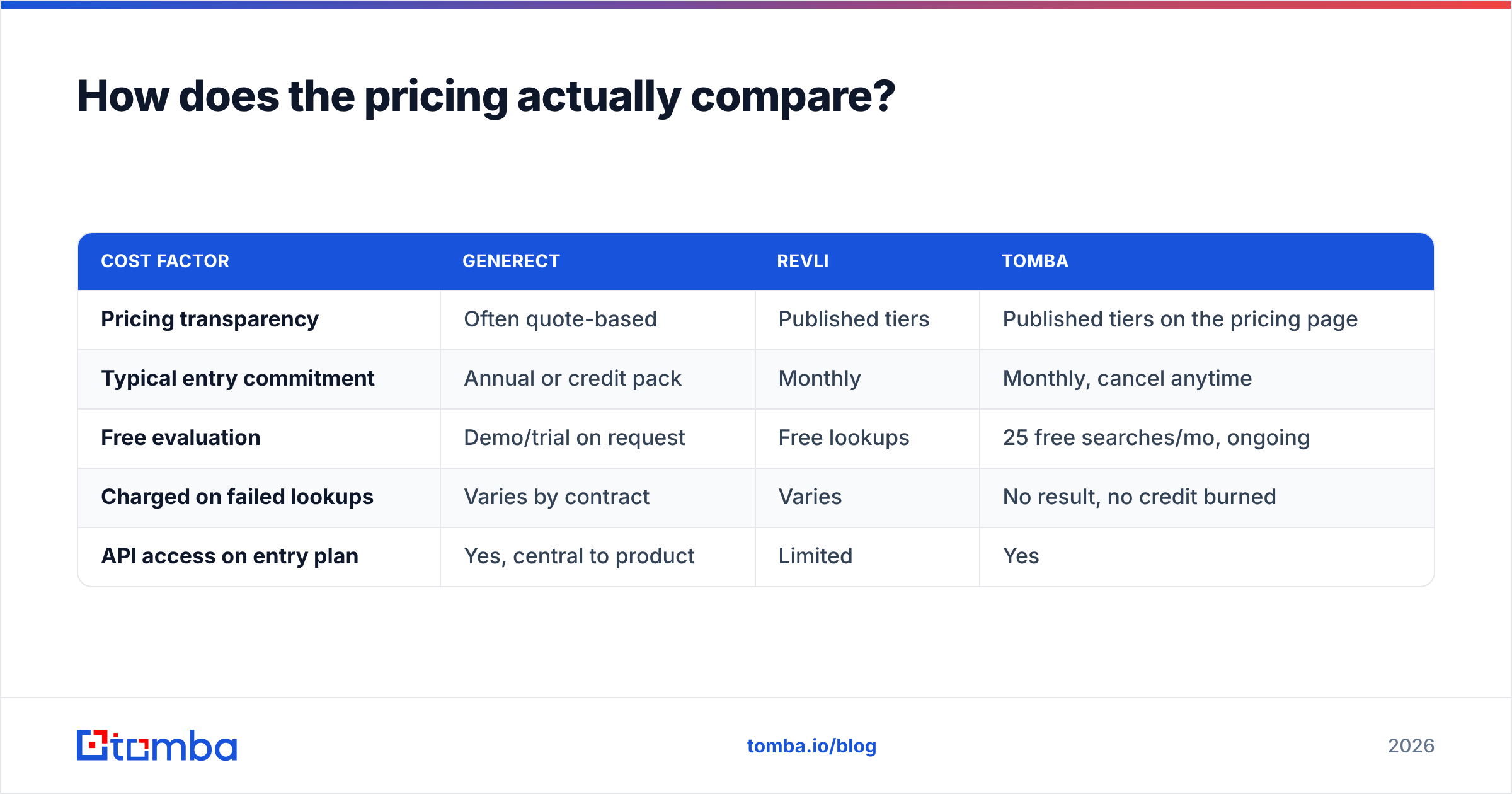
| Cost factor | Generect | Revli | Tomba |
|---|---|---|---|
| Pricing transparency | Often quote-based | Published tiers | Published tiers on the pricing page |
| Typical entry commitment | Annual or credit pack | Monthly | Monthly, cancel anytime |
| Free evaluation | Demo/trial on request | Free lookups | 25 free searches/mo, ongoing |
| Charged on failed lookups | Varies by contract | Varies | No result, no credit burned |
| API access on entry plan | Yes, central to product | Limited | Yes |
Generect's model makes sense if you are consuming tens of thousands of records and the API is the product. Revli's makes sense if you want a card-swipe purchase with no procurement. If you are somewhere in the middle — a 3-to-15-person outbound team — both models tend to feel wrong, and that is exactly the gap where mid-priced, self-serve finders compete hardest.

Which fits LinkedIn-first prospecting better?#
Generect, clearly — that is its origin story. If your motion is "build a filtered list of people who match a title, headcount and geography, then enrich," Generect is designed for exactly that path.
But be deliberate about two things.
Compliance and terms. Any product deriving data from a professional network operates in a contested legal space. The scraping question has been litigated repeatedly, most visibly in hiQ Labs v. LinkedIn, and the outcome was messier than either side's press release suggested (background here). If you sell into regulated industries or your legal team reviews vendors, ask for the data-sourcing statement in writing. Also confirm GDPR posture: lawful basis, DSAR handling, and suppression on request.
The extraction step is not the hard part. Getting a LinkedIn profile is easy. Getting the work email attached to it, verified, is where lists fall apart. If that is your specific bottleneck, a dedicated LinkedIn finder that resolves profiles to verified business addresses will do that one job better than a broad database's enrichment side-feature.
Revli, by contrast, is fine for one-off LinkedIn lookups but was never built to power a list-building motion at scale.
What about API access and automation?#
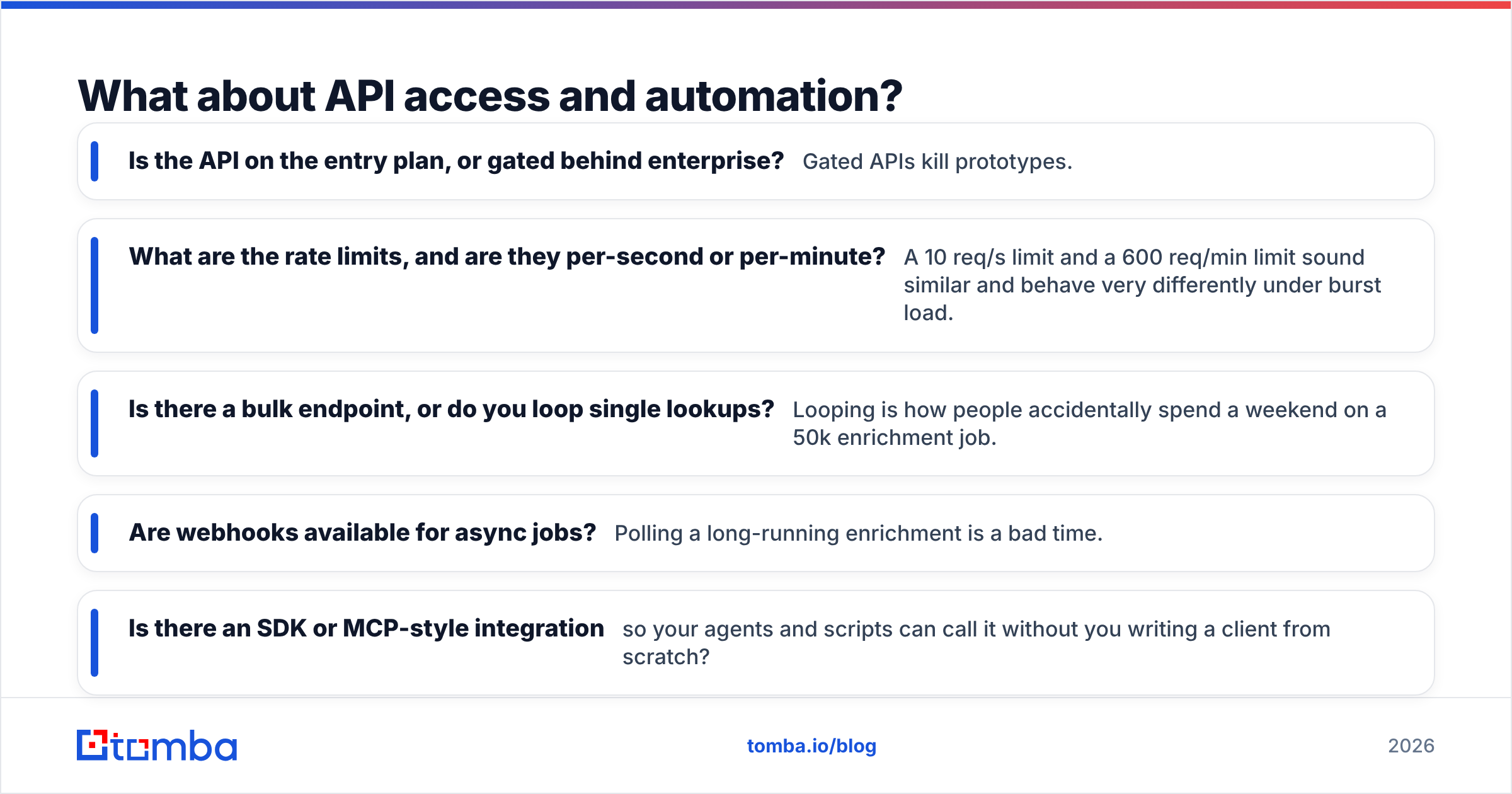
If you are automating, the questions are boring and decisive:
- Is the API on the entry plan, or gated behind enterprise? Gated APIs kill prototypes.
- What are the rate limits, and are they per-second or per-minute? A 10 req/s limit and a 600 req/min limit sound similar and behave very differently under burst load.
- Is there a bulk endpoint, or do you loop single lookups? Looping is how people accidentally spend a weekend on a 50k enrichment job.
- Are webhooks available for async jobs? Polling a long-running enrichment is a bad time.
- Is there an SDK or MCP-style integration so your agents and scripts can call it without you writing a client from scratch?
Generect scores well here — the API is the product, not an afterthought. Revli is thinner; treat API access as something to verify on your specific plan rather than assume. Tomba sits in between, with a documented email finder API available across paid tiers plus CLI and spreadsheet add-ons for people who would rather not write code at all.
Where do both tools fall short?#
Neutral criticism, applied evenly:
- Generect: procurement friction. Quote-based pricing means you cannot answer "what will this cost me next quarter" without a call. Onboarding is heavier. Overkill for small teams.
- Generect: the data-sourcing question will come up in security review, and you need a prepared answer.
- Revli: coverage ceilings. Smaller datasets mean weaker match rates outside well-indexed segments, and thin bulk workflows mean manual work at volume.
- Revli: limited depth beyond email. If you need phone numbers, firmographics, or intent signals, you will be stacking another tool on top.
- Both: verification is a checkbox feature, not a specialty. Neither handles catch-all domains with the rigour of a purpose-built verifier, and catch-alls are now a large share of corporate mail domains.
- Both: review coverage is thinner than the category leaders. Check current user reviews on G2 rather than relying on a single comparison post, including this one.
Which one should you actually choose?#
Pick by bottleneck, not by feature count.
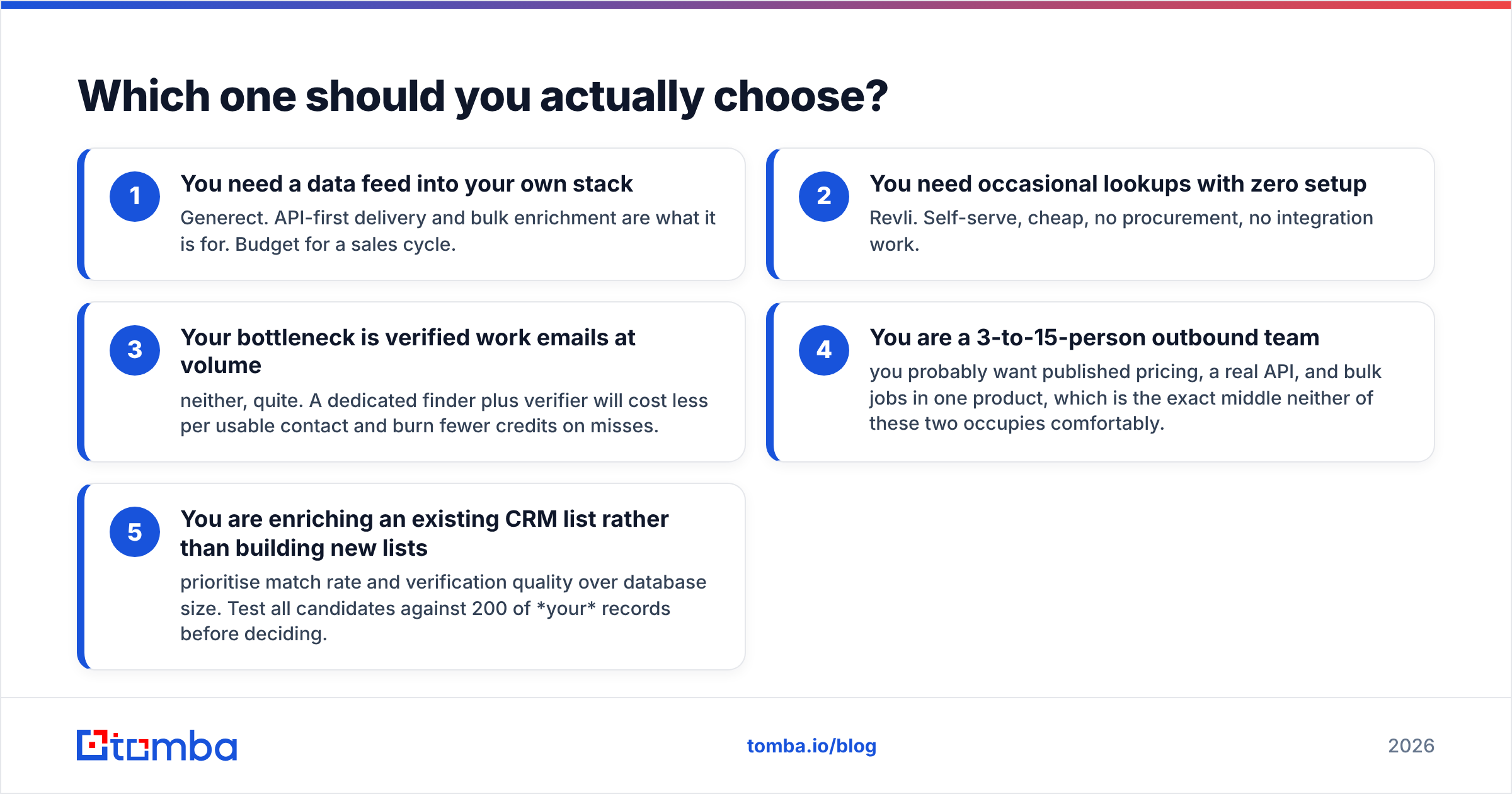
- You need a data feed into your own stack — Generect. API-first delivery and bulk enrichment are what it is for. Budget for a sales cycle.
- You need occasional lookups with zero setup — Revli. Self-serve, cheap, no procurement, no integration work.
- Your bottleneck is verified work emails at volume — neither, quite. A dedicated finder plus verifier will cost less per usable contact and burn fewer credits on misses.
- You are a 3-to-15-person outbound team — you probably want published pricing, a real API, and bulk jobs in one product, which is the exact middle neither of these two occupies comfortably.
- You are enriching an existing CRM list rather than building new lists — prioritise match rate and verification quality over database size. Test all candidates against 200 of your records before deciding.
That last point deserves emphasis. Run the same 200-row sample through every tool on your shortlist, then measure three numbers: match rate, verified-valid rate, and actual bounce rate after a small send. Vendor benchmarks are marketing. Your list is the only benchmark that predicts your results.
Ready to test the alternative?#
If your real problem is turning names and domains into verified, deliverable business emails without a sales call or a credit system you cannot model, start with the Tomba Email Finder. The free tier gives you 25 searches a month with no card, Starter is $49/mo, and every lookup runs through verification so you are not paying to discover bounces later. Run your 200-row sample, compare the numbers against whatever Generect or Revli quote you, and let the match rate decide.
Related guides#
Ready to find emails that actually work?
Join 150,000+ professionals who stopped guessing and started sending. Free credits on signup — no credit card required.
Get the Tomba newsletter
Practical outbound tactics and product updates — once every two weeks.
About the author