Generect vs RocketReach 2026: Data, Pricing, Accuracy
Generect sells API-first, LinkedIn-native lead data. RocketReach sells a giant static contact database with a browser extension. Here's which one actually fits your workflow — and where both get expensive.
TL;DR
- Generect is an API-first, LinkedIn-native data provider. It pulls leads and companies in near real time and is built for engineers who want to wire data into a pipeline, not click around a UI.
- RocketReach is a self-serve contact database with a huge static index, a Chrome extension, and a per-seat pricing model. It's built for individual reps and recruiters doing manual lookups.
- Accuracy is not the deciding factor — both land in a similar band on standard corporate domains. Coverage shape and cost per usable contact are what actually differ.
- Cost trap: RocketReach bills per seat with lookup caps; Generect quotes custom API pricing. Neither is cheap once you scale past one user or 5,000 contacts a month.
- If you want flat, API-first pricing with verification bundled in, an email finder like Tomba starts at $49/mo with the same endpoint powering the UI, the API, and bulk jobs.
What are Generect and RocketReach?#
They solve the same problem from opposite ends of the stack.
Generect positions itself as a lead-generation data engine. Its core pitch is real-time extraction from LinkedIn and company sources, exposed primarily through an API and a set of lead-list products. You describe an audience — job titles, headcount, geography, tech signals — and Generect returns structured lead records with work emails attached. The product assumes you have a developer or an ops person who can consume JSON.
RocketReach is a contact-lookup database. It advertises hundreds of millions of profiles and tens of millions of companies, searchable through a web app and a browser extension that overlays LinkedIn, company sites, and Crunchbase-style pages. You search a person, you get emails and phone numbers, you spend a lookup credit. It also has an API, but the API is a secondary surface bolted onto a UI-first product — pricing and rate limits reflect that.
The practical distinction: Generect is a supply-side data vendor; RocketReach is a demand-side lookup tool. One is for building lists at volume. The other is for finding one person right now.
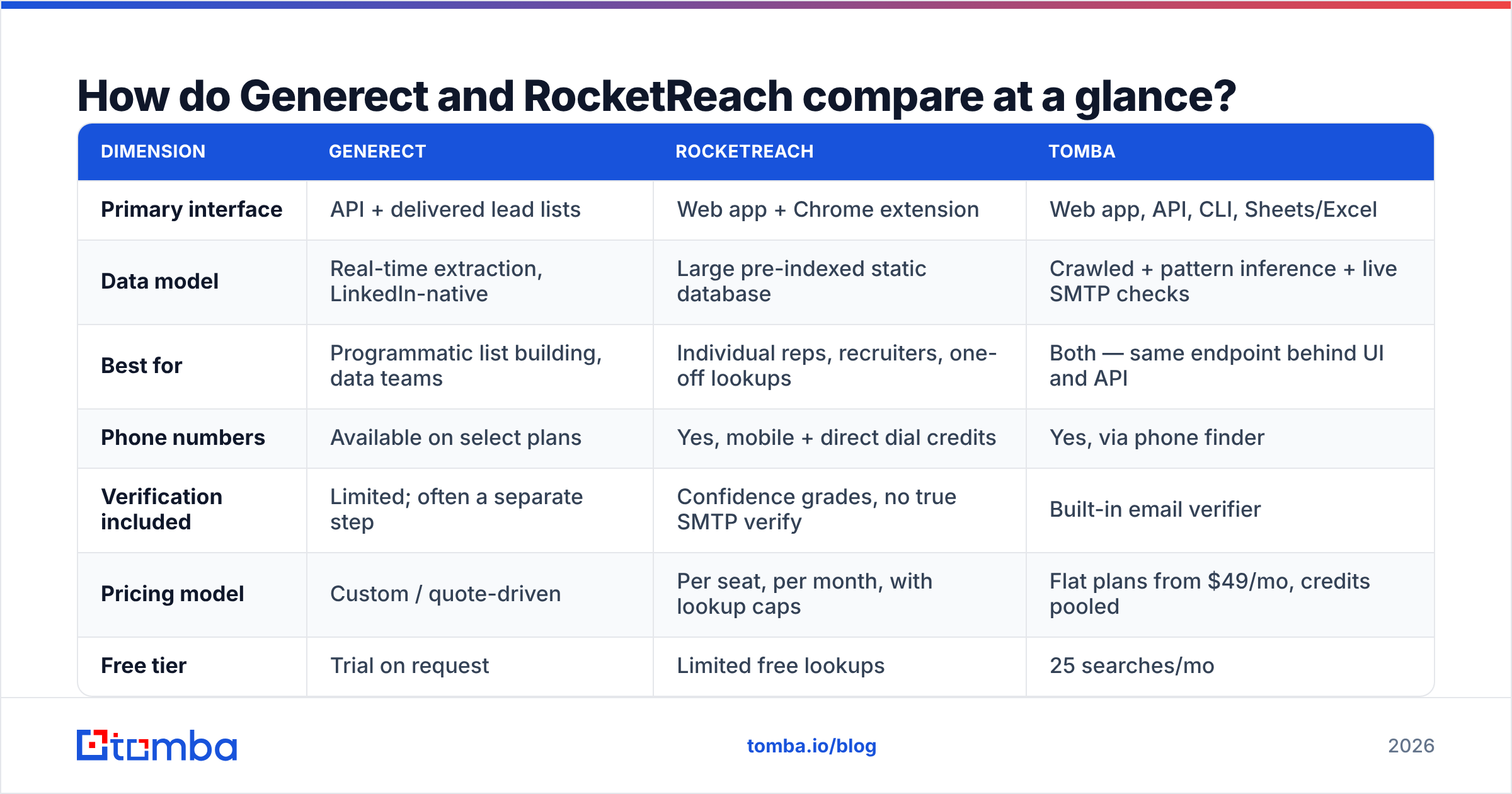
How do Generect and RocketReach compare at a glance?#
| Dimension | Generect | RocketReach | Tomba |
|---|---|---|---|
| Primary interface | API + delivered lead lists | Web app + Chrome extension | Web app, API, CLI, Sheets/Excel |
| Data model | Real-time extraction, LinkedIn-native | Large pre-indexed static database | Crawled + pattern inference + live SMTP checks |
| Best for | Programmatic list building, data teams | Individual reps, recruiters, one-off lookups | Both — same endpoint behind UI and API |
| Phone numbers | Available on select plans | Yes, mobile + direct dial credits | Yes, via phone finder |
| Verification included | Limited; often a separate step | Confidence grades, no true SMTP verify | Built-in email verifier |
| Pricing model | Custom / quote-driven | Per seat, per month, with lookup caps | Flat plans from $49/mo, credits pooled |
| Free tier | Trial on request | Limited free lookups | 25 searches/mo |
| Time to first contact | Hours (integration work) | Minutes | Minutes |
That table is the honest summary. Everything below is the detail that decides which column you should be in.
Which one has better data coverage?#
Different shapes of coverage, not different amounts.
Generect's strength is freshness on the profile side. Because it leans on live extraction rather than a snapshot rebuilt on a schedule, job-change decay hurts it less. If your ICP is "VP Engineering who started in the last 90 days at a Series B company," Generect's model is structurally better suited — the record was assembled recently, not cached eighteen months ago.
RocketReach's strength is breadth and long-tail hit rate. The index is enormous and it has been accumulating for years. When you search an obscure 30-person manufacturer in Ohio, RocketReach frequently returns something where a real-time extractor returns nothing, because someone else already looked that person up and the record persists. Recruiters love this. So does anyone doing account-based work where you need this specific person, not someone like this person.
Where both struggle is identical and predictable:
- Catch-all domains. Roughly a fifth of corporate domains accept every address at the SMTP layer, so neither tool can prove a hit is real without a separate catch-all verifier step.
- Non-English-speaking SMBs. Coverage thins sharply outside US/UK/EU enterprise.
- Recently rebranded or acquired companies. Domain migrations break both models until the source refreshes.
- Personal-email-only contacts. Founders using a Gmail address as their business email appear as gaps, not as hits.


Whose email accuracy holds up in a real campaign?#
Neither vendor's marketing number is the one you'll see.
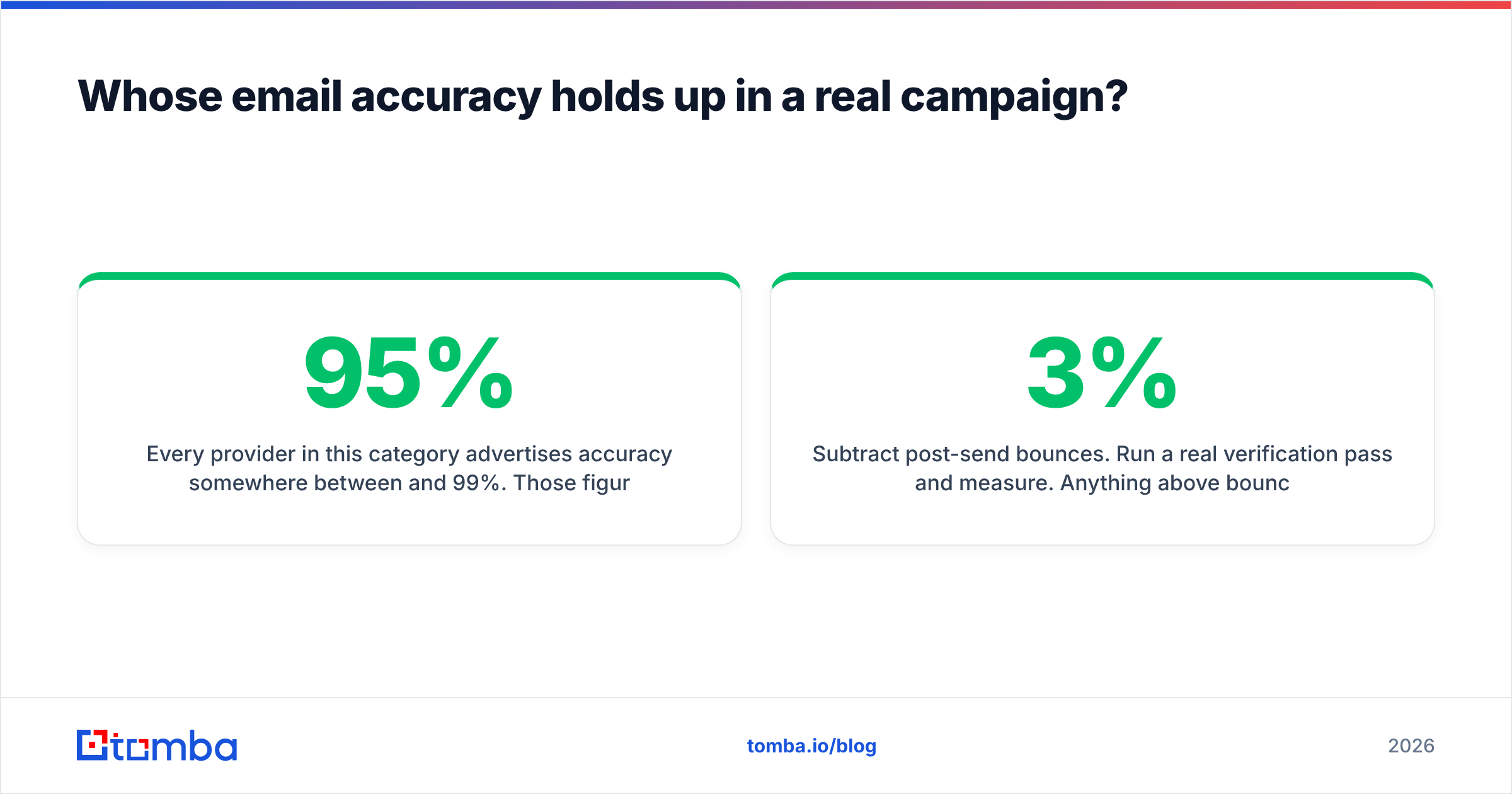
Every provider in this category advertises accuracy somewhere between 95% and 99%. Those figures come from internal test sets weighted toward large, well-indexed corporate domains — the easy half of the internet. Run either tool against a real prospecting list with SMBs, agencies, and non-US companies in it and the usable rate drops, often into the 70s or low 80s.
The number that matters is deliverable contacts per dollar, not the vendor's claimed accuracy. Compute it like this:
- Start with returned rows. How many of your 1,000 input records came back with an email at all? Call this the hit rate.
- Subtract unverifiable rows. Catch-all domains, role addresses (info@, sales@), and anything the tool flagged "guessed" or low-confidence.
- Subtract post-send bounces. Run a real verification pass and measure. Anything above 3% bounce is a deliverability problem, not a rounding error.
- Divide the plan cost by what survives. That's your true cost per usable contact — usually 2–4x the sticker price per credit.
This is where the biggest practical gap between the two shows up. RocketReach returns confidence grades but does not run a genuine SMTP verification on every result, so a chunk of what you get is inference presented with a badge. Generect's real-time model produces fresher records, but verification is generally something you're expected to handle downstream. In both cases you end up buying a verifier anyway — which is a real, recurring line item most comparison posts quietly skip.
If you'd rather not run two vendors, tools that bundle finding and verification in one credit pool remove that step entirely. Tomba's email verification API runs on the same call, so a result comes back already marked deliverable, risky, or catch-all.
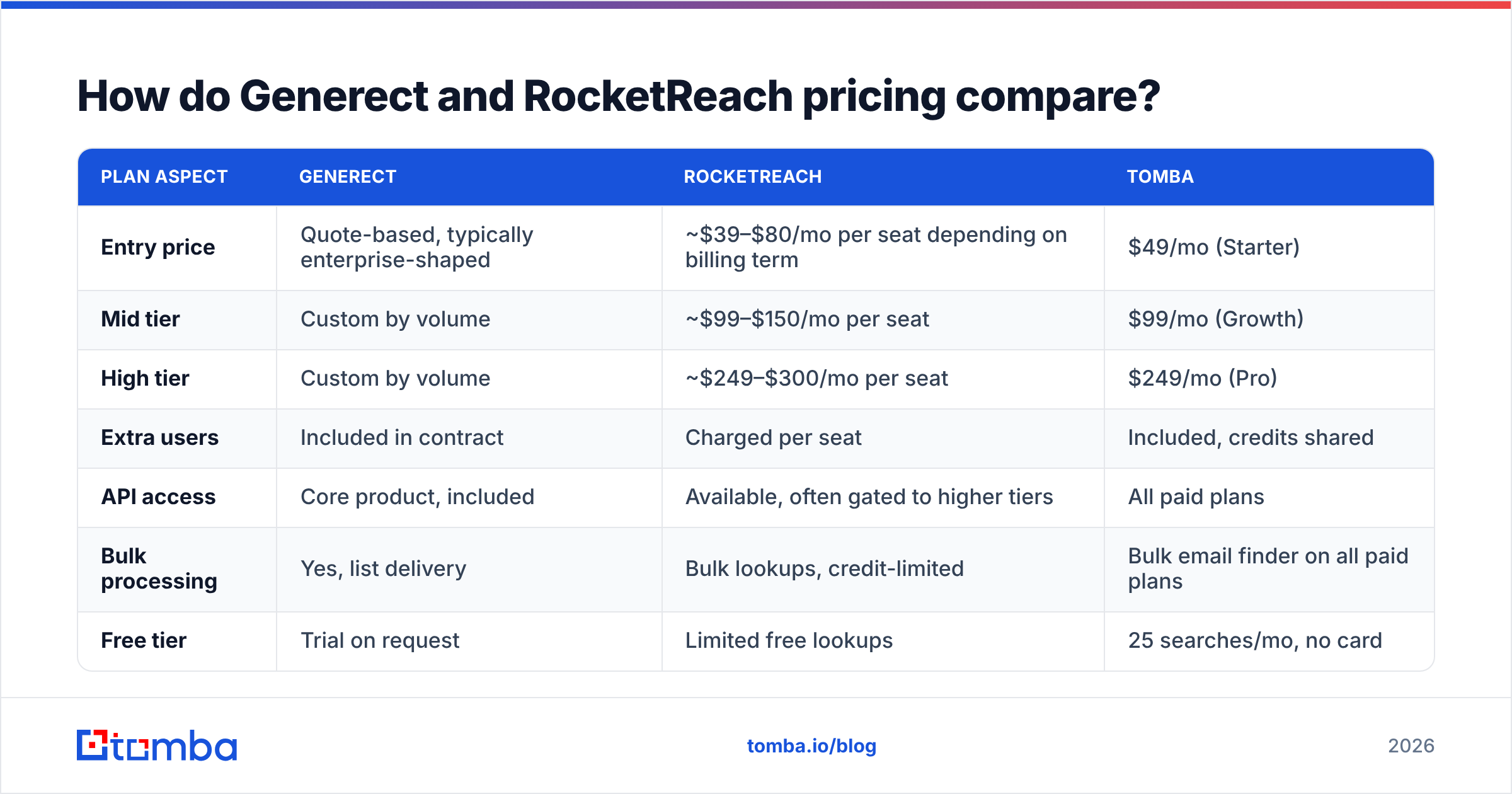
How do Generect and RocketReach pricing compare?#
| Plan aspect | Generect | RocketReach | Tomba |
|---|---|---|---|
| Entry price | Quote-based, typically enterprise-shaped | ~$39–$80/mo per seat depending on billing term | $49/mo (Starter) |
| Mid tier | Custom by volume | ~$99–$150/mo per seat | $99/mo (Growth) |
| High tier | Custom by volume | ~$249–$300/mo per seat | $249/mo (Pro) |
| Extra users | Included in contract | Charged per seat | Included, credits shared |
| API access | Core product, included | Available, often gated to higher tiers | All paid plans |
| Bulk processing | Yes, list delivery | Bulk lookups, credit-limited | Bulk email finder on all paid plans |
| Free tier | Trial on request | Limited free lookups | 25 searches/mo, no card |
Verify current numbers on each vendor's site before you buy — pricing in this category changes several times a year, and annual-vs-monthly billing swings RocketReach's effective rate by 30–50%.
Two structural things to notice:
RocketReach charges per seat. A five-person SDR team on the Pro tier is not $99/month, it's roughly $500/month, and each seat carries its own lookup ceiling that does not pool. If one rep burns their credits on day 12, they're stuck while a teammate's sit unused. That's the single most common source of surprise bills in this product category.
Generect charges by negotiation. Quote-based pricing is fine when you're buying 250,000 records a quarter and have procurement leverage. It's frustrating when you want to test 500 leads next Tuesday. Expect a sales call, a scoping conversation, and a minimum commitment before you see a number.
Flat, pooled-credit pricing — where the whole team draws from one bucket and the API costs the same as the UI — is a meaningfully different economic model. See Tomba pricing for that shape.

Which is better for API and automation?#
Generect, clearly — if you have engineering time.
Generect was designed API-first. The endpoints are the product, the documentation assumes you're building something, and the response schema is structured for ingestion into a warehouse or an enrichment pipeline. If your team runs a nightly job that hydrates new CRM records with contact data, Generect fits that mental model natively.
RocketReach's API exists but behaves like an add-on. Rate limits are tighter, access is typically tied to higher plan tiers, and the credit accounting is shared with your UI lookups — meaning a rep clicking around the Chrome extension can starve your production job. For a lot of teams that's an acceptable trade, because RocketReach's real value is the extension, not the endpoint.
The evaluation question is blunt: do you want a tool your reps use, or a tool your systems use? Generect answers the second. RocketReach answers the first. Buying the wrong one produces a subscription nobody logs into.
For teams that need both without buying twice, look for vendors where the API is not a separate SKU. A Chrome extension for reps and an API for engineers, drawing on the same credit pool, avoids the "we bought two tools that do the same thing" outcome that's endemic in this category.
Which should you pick for your use case?#
- Solo recruiter or founder doing manual sourcing — RocketReach. The extension workflow is genuinely good, the long-tail coverage is real, and per-seat pricing is irrelevant when you're one seat.
- Data or RevOps team building enrichment infrastructure — Generect. API-first design, fresher profile data, and contract pricing that gets rational at volume.
- Five-to-fifteen-person outbound team — neither is a comfortable fit. Per-seat costs punish RocketReach; quote-based minimums punish Generect. Flat-plan tools with shared credits are usually cheaper per usable contact at this size.
- Anyone sending cold email at volume — budget for verification regardless of which you pick, or your bounce rate will teach you the lesson expensively.
- Agencies serving multiple clients — prioritize pooled credits and bulk processing over UI polish. You'll be running lists, not clicking profiles.
What are the alternatives to Generect and RocketReach?#
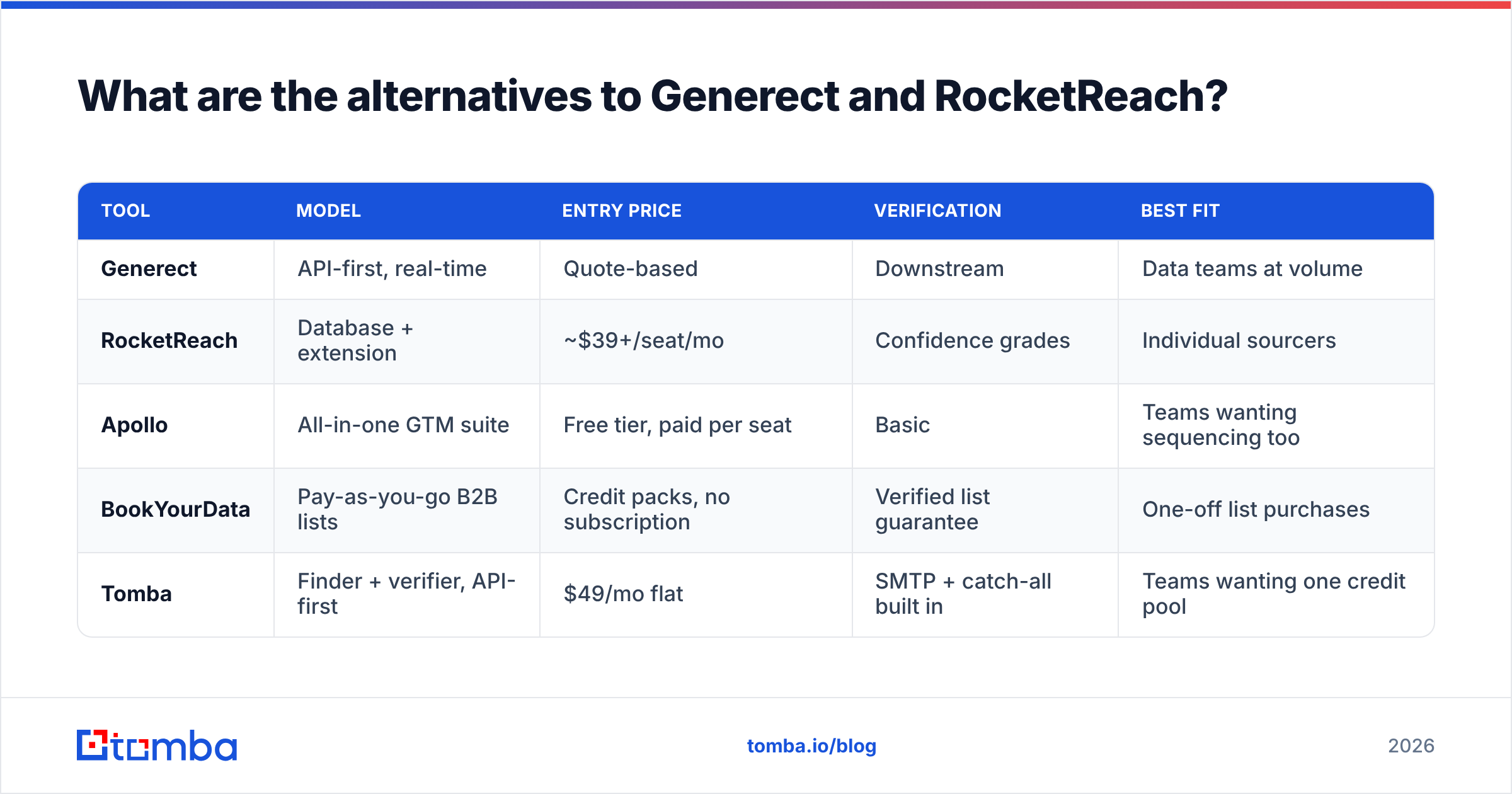
The lead-intelligence category on G2 lists dozens of vendors, and most of them are recombinations of the same three or four underlying data sources. The meaningful axes of difference are pricing model, verification depth, and whether the API is first-class.

| Tool | Model | Entry price | Verification | Best fit |
|---|---|---|---|---|
| Generect | API-first, real-time | Quote-based | Downstream | Data teams at volume |
| RocketReach | Database + extension | ~$39+/seat/mo | Confidence grades | Individual sourcers |
| Apollo | All-in-one GTM suite | Free tier, paid per seat | Basic | Teams wanting sequencing too |
| BookYourData | Pay-as-you-go B2B lists | Credit packs, no subscription | Verified list guarantee | One-off list purchases |
| Tomba | Finder + verifier, API-first | $49/mo flat | SMTP + catch-all built in | Teams wanting one credit pool |
BookYourData deserves a specific mention if your need is episodic rather than continuous — buying a clean, pre-verified list without committing to a monthly seat is a legitimately different purchase, and paying per list beats paying per seat when your prospecting is campaign-shaped rather than always-on.
If your need is continuous and API-shaped, the differentiator is whether finding and verifying happen in one call or two invoices.
What's the verdict on Generect vs RocketReach?#
Pick RocketReach if a human is doing the looking. Pick Generect if a machine is. That's the whole decision, and every other feature comparison is downstream of it.
Where both leave money on the table is the middle: teams with a handful of reps and an automation requirement, who don't want to pay per seat and don't want to sit through a procurement cycle to learn a price. That's a large share of B2B sales orgs, and it's exactly the gap flat-rate, API-included tooling fills.
Whichever way you go, validate before you commit. Take 200 real records from your ICP — not a vendor-supplied sample — run them through each tool's trial, verify the output independently, and compute cost per deliverable contact. The winner is rarely the one with the better accuracy claim on its homepage.
Want to run that test today? The Tomba Email Finder gives you 25 free searches a month with no card, returns verification status on every result, and exposes the exact same endpoint to your UI, your Chrome extension, your bulk jobs, and your API — on one pooled credit balance starting at $49/mo. Run your 200-record test against it alongside Generect and RocketReach and let the cost-per-usable-contact number decide.
Related guides#
Ready to find emails that actually work?
Join 150,000+ professionals who stopped guessing and started sending. Free credits on signup — no credit card required.
Get the Tomba newsletter
Practical outbound tactics and product updates — once every two weeks.
About the author