Generect vs Safetymails: Which B2B Email Tool Wins in 2026?
One builds lead lists from LinkedIn data, the other scrubs the lists you already have. Here's an honest Generect vs Safetymails breakdown — data coverage, verification depth, API quality and real cost per usable contact.
TL;DR
- Generect vs SafetyMails is not a head-to-head fight. Generect is a B2B lead sourcing tool. It pulls LinkedIn-derived company and people data through a search UI and an API. SafetyMails is an email verification service. It cleans lists, checks addresses in real time, and stops bounces. The real question is which problem you fix first.
- Pick Generect if your bottleneck is "I don't have enough targeted leads." You get firmographic and role filters, plus an API to pull records on a schedule.
- Pick SafetyMails if your bottleneck is "my bounce rate is wrecking my domain." Teams here already have lists from webforms, events, a CRM, or a scraper.
- The trap: buying both. Two vendors, two credit systems, two dashboards, and a manual CSV handoff in the middle. That handoff is where most teams lose hours every week.
- The consolidation play: one platform that finds and verifies on the same credit pool. Tomba starts free at 25 searches a month, then $49/mo on Starter. For teams under ~20 reps, that usually beats stitching two tools together.
Generect vs SafetyMails: what does each tool do?#
Generect (generect.com) sells real-time B2B lead generation. It does not hand you a static database dump. You filter live records by industry, headcount, geography, seniority, and job title. Then you export them or pull them through an API.
Its natural buyers are agencies, outbound teams, and data engineers. They want lead supply they can automate, not another seat-based prospecting UI.
SafetyMails (safetymails.com) sits at the other end of the pipeline. It validates email. You feed it a list, or you call its API from a signup form. It returns one verdict per address: valid, invalid, disposable, role-based, or unknown.
Its buyers are marketers guarding sender reputation, e-commerce teams cleaning old databases, and product teams that block junk signups at the door.
So the honest framing for Generect vs SafetyMails is not "which one is better." It is "which half of the pipeline are you failing at right now?"
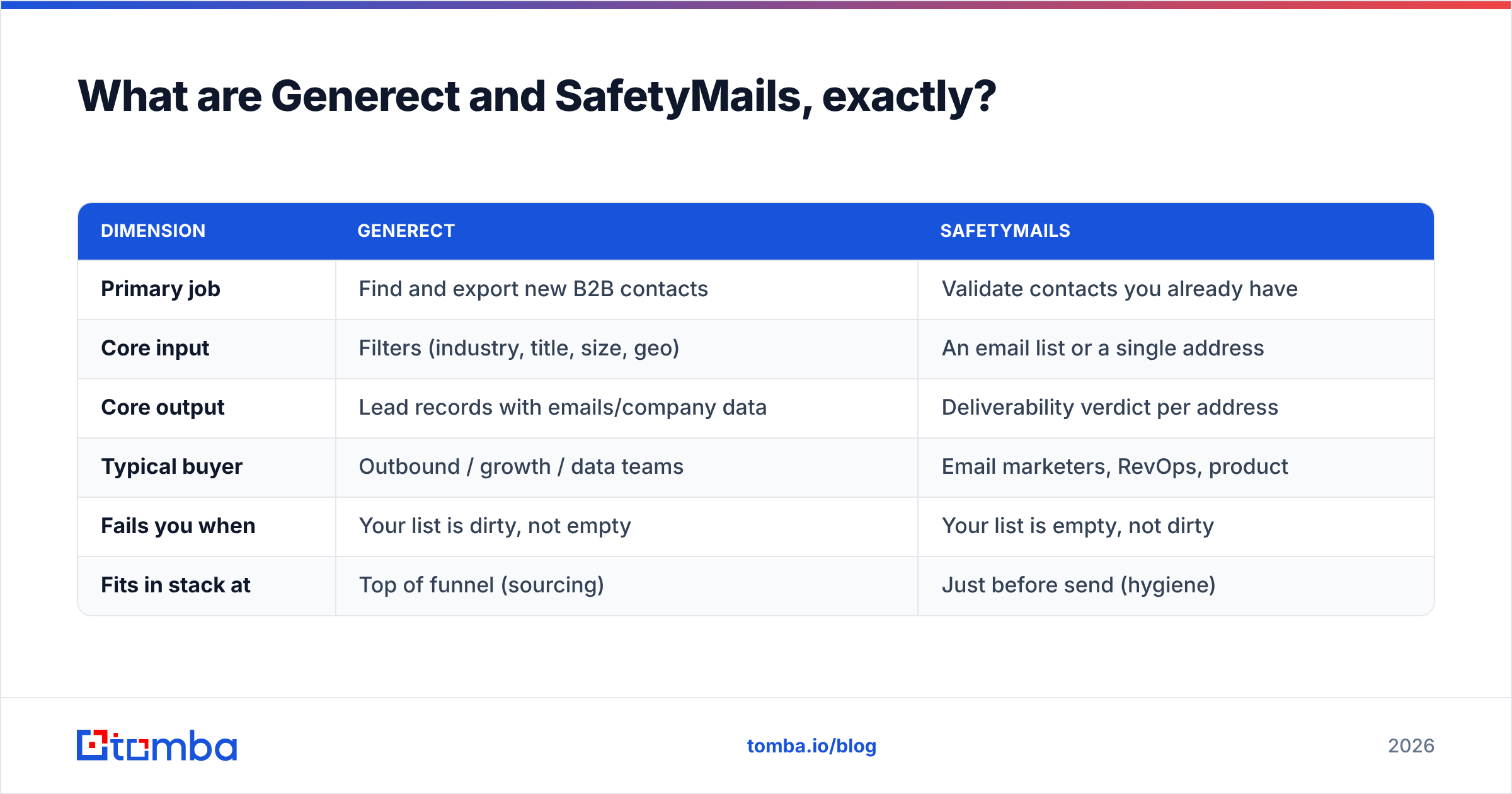
| Dimension | Generect | SafetyMails |
|---|---|---|
| Primary job | Find and export new B2B contacts | Validate contacts you already have |
| Core input | Filters (industry, title, size, geo) | An email list or a single address |
| Core output | Lead records with emails/company data | Deliverability verdict per address |
| Typical buyer | Outbound / growth / data teams | Email marketers, RevOps, product |
| Fails you when | Your list is dirty, not empty | Your list is empty, not dirty |
| Fits in stack at | Top of funnel (sourcing) | Just before send (hygiene) |

How accurate is the data in Generect vs SafetyMails?#
Here the comparison gets uncomfortable. The two tools report different kinds of accuracy, and buyers mix them up.
Generect's claim is about match rate and freshness. How often does a search return a real, currently employed person with a working email?
Its records lean on LinkedIn signals. Coverage is strongest where LinkedIn is strong: North America, Western Europe, tech, SaaS, agencies, and mid-market accounts. Coverage thins out for small firms in non-English markets, trades, local services, and roles with no professional profile. That is not a knock on Generect. It is a limit of every LinkedIn-derived dataset.
SafetyMails' claim is about verdict correctness. How often does "valid" reach an inbox? How often would "invalid" truly have bounced?
Verifiers are judged on two error types. False positives say valid, then bounce. False negatives say invalid, then would have delivered. The second one costs you quietly. Every over-aggressive rejection is a real prospect you deleted.
Both tools share one awkward gap: catch-all domains. Microsoft 365 and many corporate mail servers accept every address at the SMTP layer. A pure verifier returns "unknown" or "accept-all" and hands the call back to you.
Roughly 20–30% of B2B domains behave this way. So a verify-only workflow leaves a large gray bucket untouched. Tools that mix pattern intelligence with SMTP probing — see how a catch-all verifier handles those addresses — recover a real share of that bucket instead of dumping it.

Run your own test before you buy either one. Pull 100 contacts you know are good, such as past customers or closed-won accounts. Run them through the tool and measure the result.
For Generect, count how many of the 100 it finds from name plus domain. For SafetyMails, count how many it marks valid correctly. Vendor accuracy numbers come from vendor-chosen samples. Your ICP is the only benchmark that counts.
Which has the better API: Generect vs SafetyMails?#
Both tools sell an API. They solve different automation problems.
Generect's API is a supply endpoint. You call it with filters and get lead objects back. That is useful for an always-on list-building job, a CRM feed, or an internal prospecting tool. For a technical team, this is the main reason to pick Generect over a seat-based UI.
SafetyMails' API is a gatekeeper endpoint. The best use is a real-time check on your signup or lead-capture form. Block disposables and typos before they reach your database. Bulk list upload is the second use case, and most teams start there.
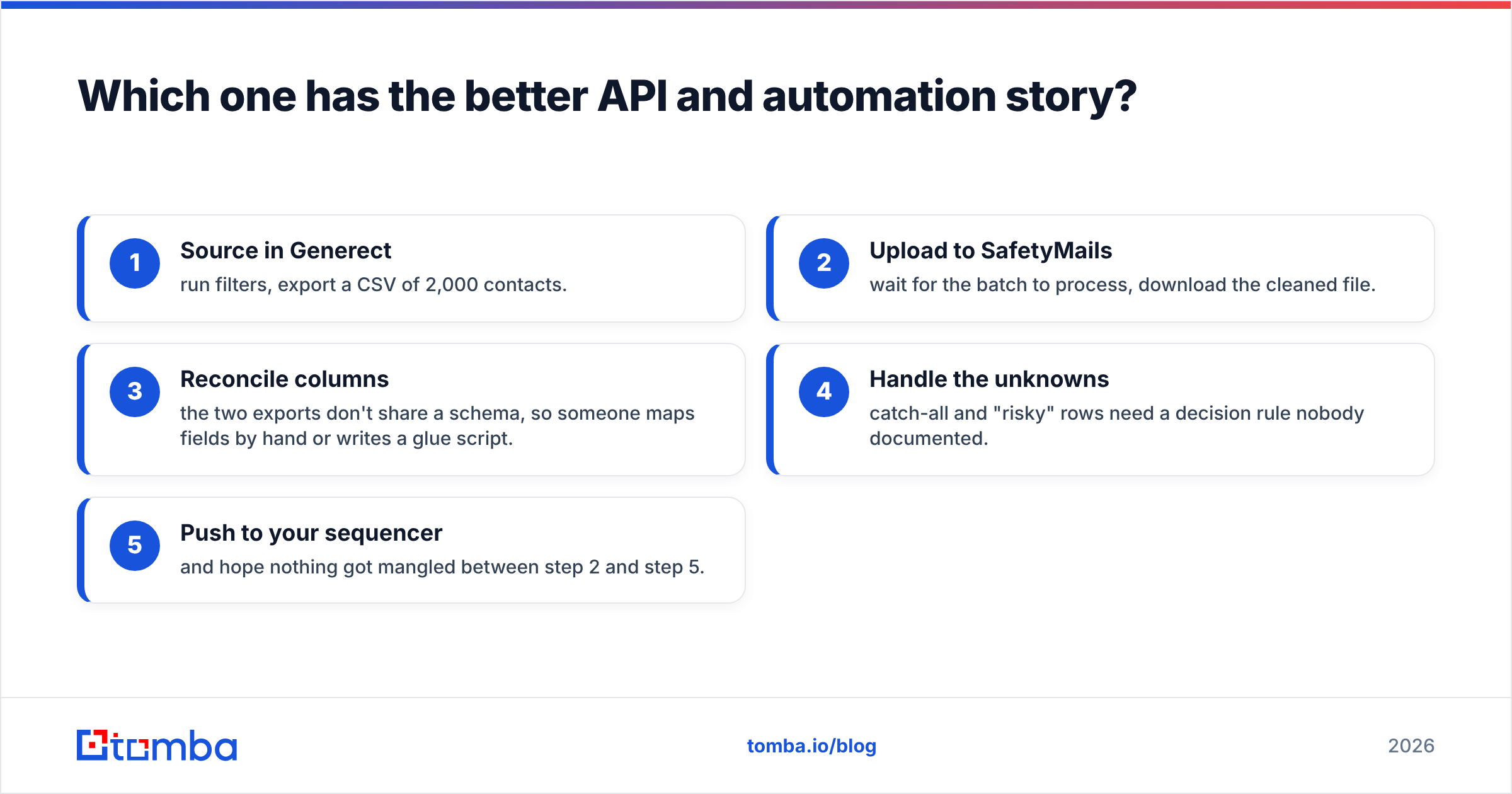
The gap shows up when you want both. A two-vendor pipeline usually looks like this:
- Source in Generect — run filters, export a CSV of 2,000 contacts.
- Upload to SafetyMails — wait for the batch, then download the clean file.
- Reconcile columns — the two exports share no schema, so someone maps fields by hand.
- Handle the unknowns — catch-all and risky rows need a rule nobody wrote down.
- Push to your sequencer — and hope nothing broke along the way.
Each step is small. Together they turn "we'll just use two tools" into a half-day job every week. That is the hidden tax in any Generect vs SafetyMails stack.
One provider with a bulk email finder and verification on the same credit pool folds steps 1–4 into a single call. A documented email finder API turns the chore into a cron job.
Generect vs SafetyMails pricing: what does a usable contact cost?#
Ignore sticker price. The number that matters is cost per contact you can safely email. It folds in match rate, verification pass rate, and the credits you burn on misses.
Both vendors price by credits, and both change their plans. Check generect.com and safetymails.com before you commit. Read current buyer reviews on G2 too, rather than trusting live numbers in any comparison post, including this one. What stays stable is the shape of each model.
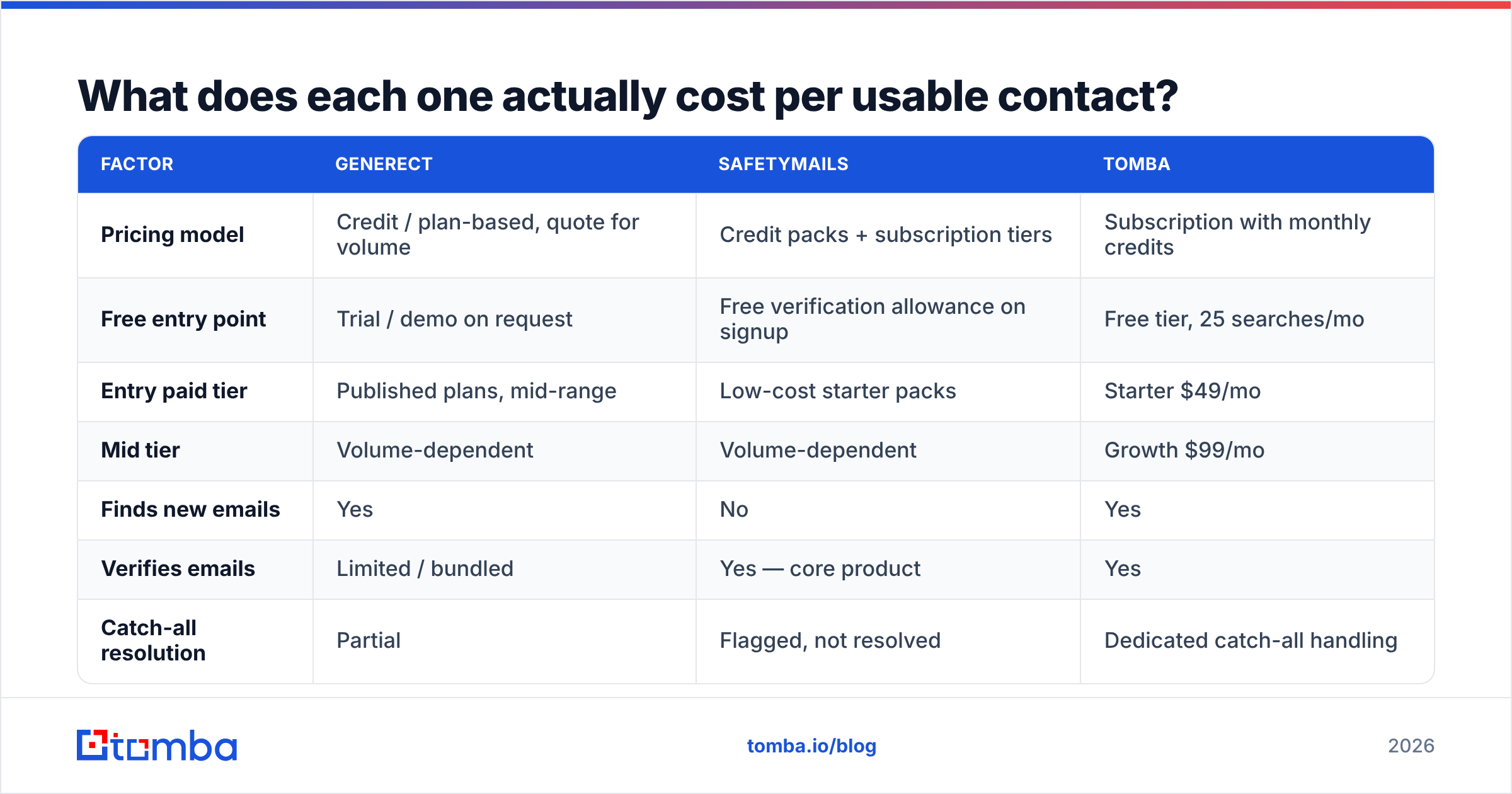
| Factor | Generect | SafetyMails | Tomba |
|---|---|---|---|
| Pricing model | Credit / plan-based, quote for volume | Credit packs + subscription tiers | Subscription with monthly credits |
| Free entry point | Trial / demo on request | Free verification allowance on signup | Free tier, 25 searches/mo |
| Entry paid tier | Published plans, mid-range | Low-cost starter packs | Starter $49/mo |
| Mid tier | Volume-dependent | Volume-dependent | Growth $99/mo |
| Finds new emails | Yes | No | Yes |
| Verifies emails | Limited / bundled | Yes — core product | Yes |
| Catch-all resolution | Partial | Flagged, not resolved | Dedicated catch-all handling |
| Credits expire monthly | Plan-dependent | Packs typically persist | Monthly on subscription |
| Vendors to manage | 1 of 2 needed | 1 of 2 needed | 1 |

Run the Generect vs SafetyMails math on your own volume. Say you need 3,000 verified contacts a month, and your sourcing tool hits a 65% match rate. You pay for about 4,600 lookups plus 3,000 verifications, across two invoices.
On a consolidated plan that is one line item. Tomba pricing at $99/mo on Growth usually lands below a mid-tier sourcing plan plus a verification pack. The gap grows with volume, because you stop paying twice for the same contact.

Is Generect better than SafetyMails for cold outreach?#
For pure cold outreach, Generect is the more relevant tool. But it only covers the first half of the job.
Cold outreach needs four things: the right accounts, the right people inside them, a reachable email, and proof the email won't bounce. Generect covers the first three. SafetyMails covers the fourth.
Ship a campaign with Generect alone and you will hit some stale addresses. Above roughly 3% hard bounces, your sender reputation starts to slide. Google and Microsoft bulk-sender rules made that line far less forgiving than it was three years ago.
Ship with SafetyMails alone and you get a spotless list of whoever you already had. That works for reactivation campaigns. It fails for new-market expansion.
So Generect vs SafetyMails for outreach resolves like this: Generect if you have no list, SafetyMails if you have a bad one, and both if you want a repeatable outbound motion. The third case is why consolidated platforms exist. A domain search that returns every findable address at a company, each one already scored by an email verifier, removes the handoff.
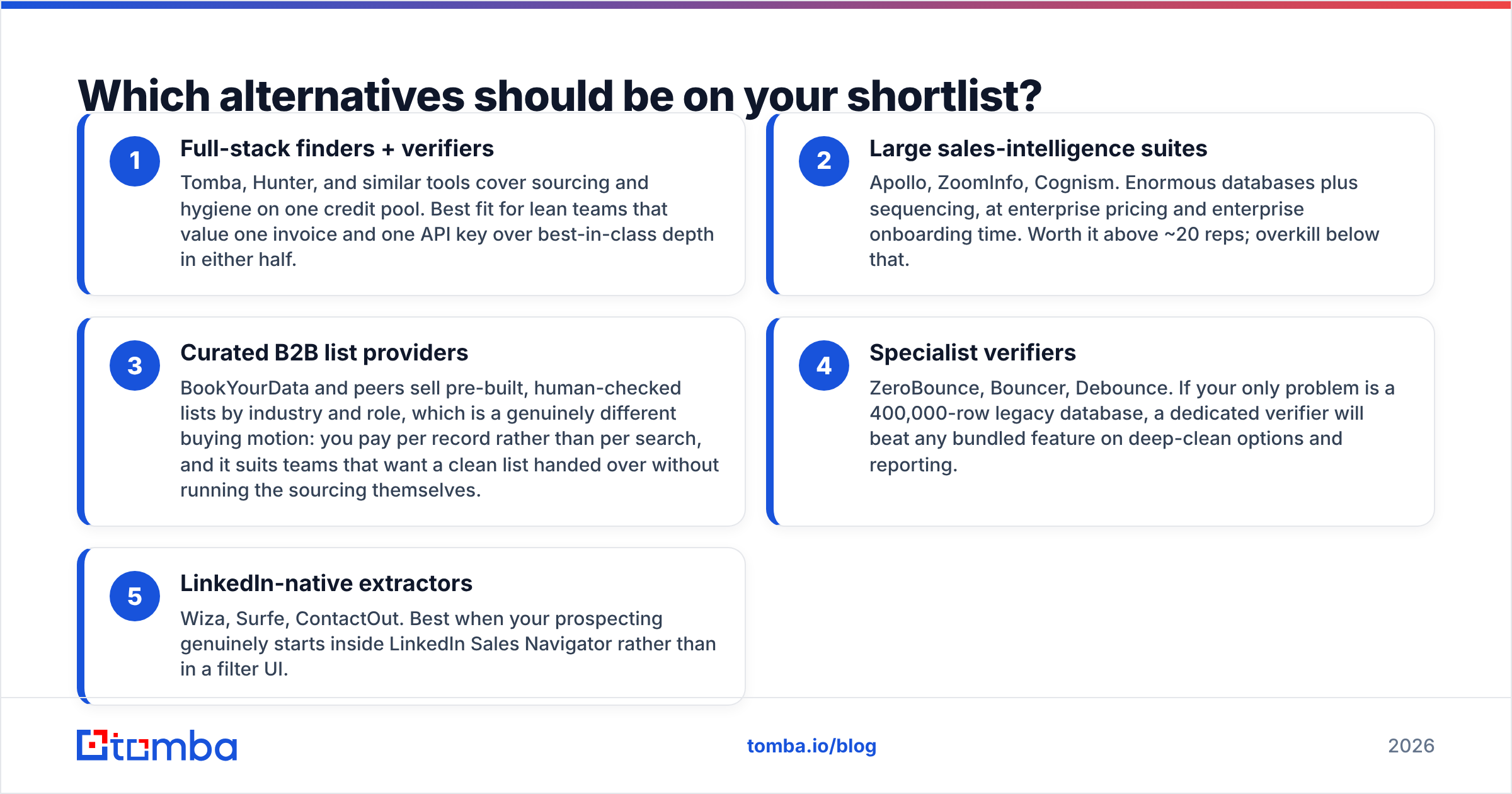
Which alternatives should be on your shortlist?#
Generect vs SafetyMails is not the whole market. Buying either one without checking the nearby categories is how teams end up with three overlapping subscriptions.
- Full-stack finders and verifiers — Tomba, Hunter, and peers cover sourcing and hygiene on one credit pool. Best for lean teams that want one invoice and one API key.
- Sales-intelligence suites — Apollo, ZoomInfo, Cognism. Huge databases plus sequencing, at enterprise prices and enterprise onboarding time. Worth it above ~20 reps. Overkill below that.
- Curated B2B list providers — BookYourData and peers sell pre-built, human-checked lists by industry and role. You pay per record, not per search. It suits teams that want a clean list handed over.
- Specialist verifiers — ZeroBounce, Bouncer, Debounce. If your only problem is a 400,000-row legacy database, a dedicated verifier beats any bundled feature on deep-clean options and reporting.
- LinkedIn-native extractors — Wiza, Surfe, ContactOut. Best when your prospecting starts inside LinkedIn Sales Navigator rather than in a filter UI.
Pick by the sentence that sounds most like you. "I can't find enough people" points to groups 1, 2, 3, or 5. "I find plenty, they just bounce" points to group 4 — or to fixing hygiene in the tool you already pay for.
The verdict on Generect vs SafetyMails#
Generect wins if you are a technical or agency team. You need programmatic access to fresh, filterable B2B lead data, and you already trust your verification step. The API-first design and LinkedIn freshness are the real draws.
SafetyMails wins if your problem is deliverability. Think rising bounces, a spam-folder trend, or a legacy list you are afraid to mail. You need real-time form checks and batch cleaning, without paying for a database you won't use.
Neither wins outright in the most common case. A small or mid-size outbound team needs both halves and does not want to run a CSV bridge between two vendors. There, the two-tool stack is the expensive answer, not the safe one. You pay twice per contact, and you own the reconciliation work forever.
Test before you sign anything. Pull 100 known-good contacts from your CRM. Run the same 100 through every tool on your shortlist. Score match rate, verification accuracy, and total round-trip time. Ten minutes of testing beats ten reviews.
If what you want is a list you can email today, start where the pipeline is shortest. The Tomba Email Finder finds addresses by domain, name, or company and verifies them in the same call. You get 25 free searches a month to test it on your own ICP, then $49/mo on Starter — with no second vendor to reconcile.
Related guides#
Ready to find emails that actually work?
Join 150,000+ professionals who stopped guessing and started sending. Free credits on signup — no credit card required.
Get the Tomba newsletter
Practical outbound tactics and product updates — once every two weeks.
About the author