Generect vs Salutary Data: B2B Contact Data Compared 2026
Generect sells API-first, freshly-scraped B2B leads. Salutary Data sells human-verified US contact files with cell phones. Here is which one actually fits your outbound motion in 2026 — and when neither does.
TL;DR
- Generect is an API-first B2B lead engine built around live LinkedIn-derived company and people data. You query it, you get fresh records back. Strongest for engineering-led teams that want to build their own list pipeline.
- Salutary Data is a compiled, human-verified US contact database sold mostly as licensed files or record-level pulls. Strongest for teams that want a clean, phone-heavy list handed to them.
- The real split is freshness vs verification: Generect optimizes for "this record exists right now," Salutary optimizes for "a human confirmed this record is correct."
- Pricing models are not comparable head-to-head. Generect leans usage/subscription; Salutary leans record-based licensing with contract minimums that can shock a small team.
- If you mostly need verified work emails on demand, a dedicated email finder with per-lookup pricing is usually cheaper than either — that is the third option covered at the end.
What are Generect and Salutary Data?#
Both companies sell B2B contact data. That is where the similarity ends.
Generect positions itself as a lead-generation data platform with an API at the center. Instead of maintaining a static warehouse of records that ages quietly in the background, its pitch is real-time retrieval: you pass filters (industry, headcount, title, geography, technology signals) and it returns company and people records assembled at query time from public professional profiles. It also ships integrations and an export layer, but the API is the product's spine.
Salutary Data is a compiled B2B contact database vendor focused on the US market. Its differentiator is verification discipline — records go through a mix of automated and human checks, with a heavy emphasis on direct dials and mobile numbers. It sells through licensed data files, custom-built lists, and record-level access rather than a self-serve credit meter you top up on a Tuesday afternoon.
So you are comparing two philosophies:
- Generect = a faucet. Turn it on, get records shaped by your filters, right now.
- Salutary Data = a reservoir. Someone already filled it, cleaned it, and will sell you a measured amount.
Neither is objectively better. They fail in different directions, which is the useful part.
How do Generect and Salutary Data differ on data sourcing?#
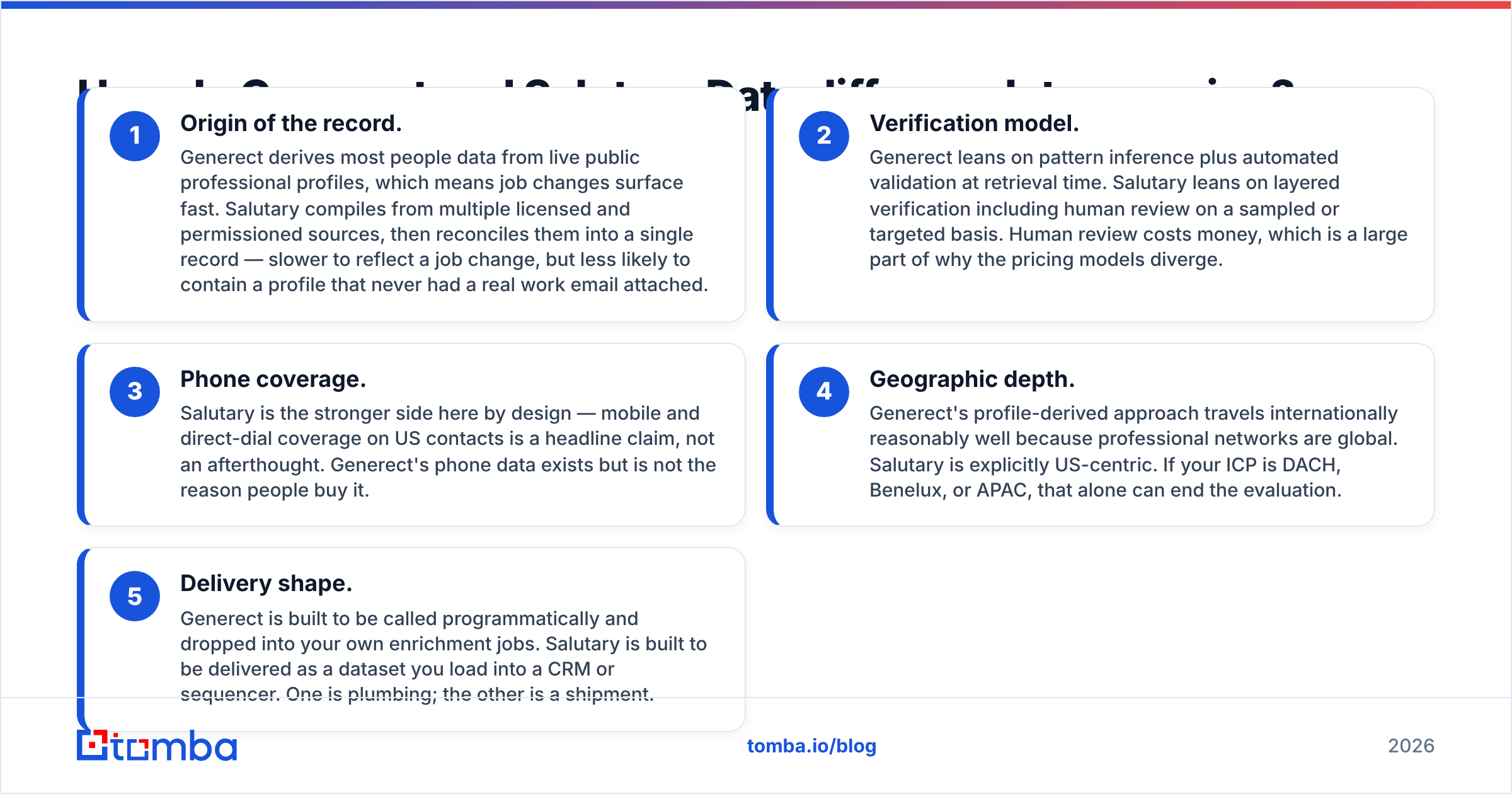
This is the section that actually predicts your bounce rate and your connect rate. Five differences matter:
- Origin of the record. Generect derives most people data from live public professional profiles, which means job changes surface fast. Salutary compiles from multiple licensed and permissioned sources, then reconciles them into a single record — slower to reflect a job change, but less likely to contain a profile that never had a real work email attached.
- Verification model. Generect leans on pattern inference plus automated validation at retrieval time. Salutary leans on layered verification including human review on a sampled or targeted basis. Human review costs money, which is a large part of why the pricing models diverge.
- Phone coverage. Salutary is the stronger side here by design — mobile and direct-dial coverage on US contacts is a headline claim, not an afterthought. Generect's phone data exists but is not the reason people buy it.
- Geographic depth. Generect's profile-derived approach travels internationally reasonably well because professional networks are global. Salutary is explicitly US-centric. If your ICP is DACH, Benelux, or APAC, that alone can end the evaluation.
- Delivery shape. Generect is built to be called programmatically and dropped into your own enrichment jobs. Salutary is built to be delivered as a dataset you load into a CRM or sequencer. One is plumbing; the other is a shipment.

A practical way to read that list: if your team has an engineer who will happily write a cron job, Generect's shape rewards you. If your team's technical ceiling is "import CSV," Salutary's shape rewards you.
Which provider has better accuracy?#
Accuracy claims from data vendors are marketing numbers until you test them on your own ICP. Every provider quotes 95%+ on something. The question is on what slice, measured how, and at what point in time.

Here is what tends to hold up when teams run their own tests:
- On recently-changed roles, Generect wins. Profile-derived data reflects a title change in days, not quarters. Compiled databases lag because reconciliation takes time.
- On stable, mid-market US contacts, Salutary wins. A record that has been in the same seat for three years and has been human-checked is about as reliable as B2B data gets.
- On catch-all domains, both struggle. No provider fully solves catch-all servers, because the server itself refuses to tell you the truth. This is where a dedicated catch-all verifier earns its keep regardless of which vendor you buy from.
- On deliverability, neither guarantees it. "Valid" means the mailbox accepts mail. It does not mean your message lands in the primary tab.
The only honest accuracy test is the one you run. Take 250 accounts you actually care about, pull them from each vendor, run the outputs through an independent email verifier, and compare (a) match rate, (b) verified-valid rate, and (c) real bounce rate after send. Vendor-reported accuracy and your observed accuracy will not be the same number, and only one of them costs you domain reputation.
How do Generect and Salutary Data compare feature by feature?#

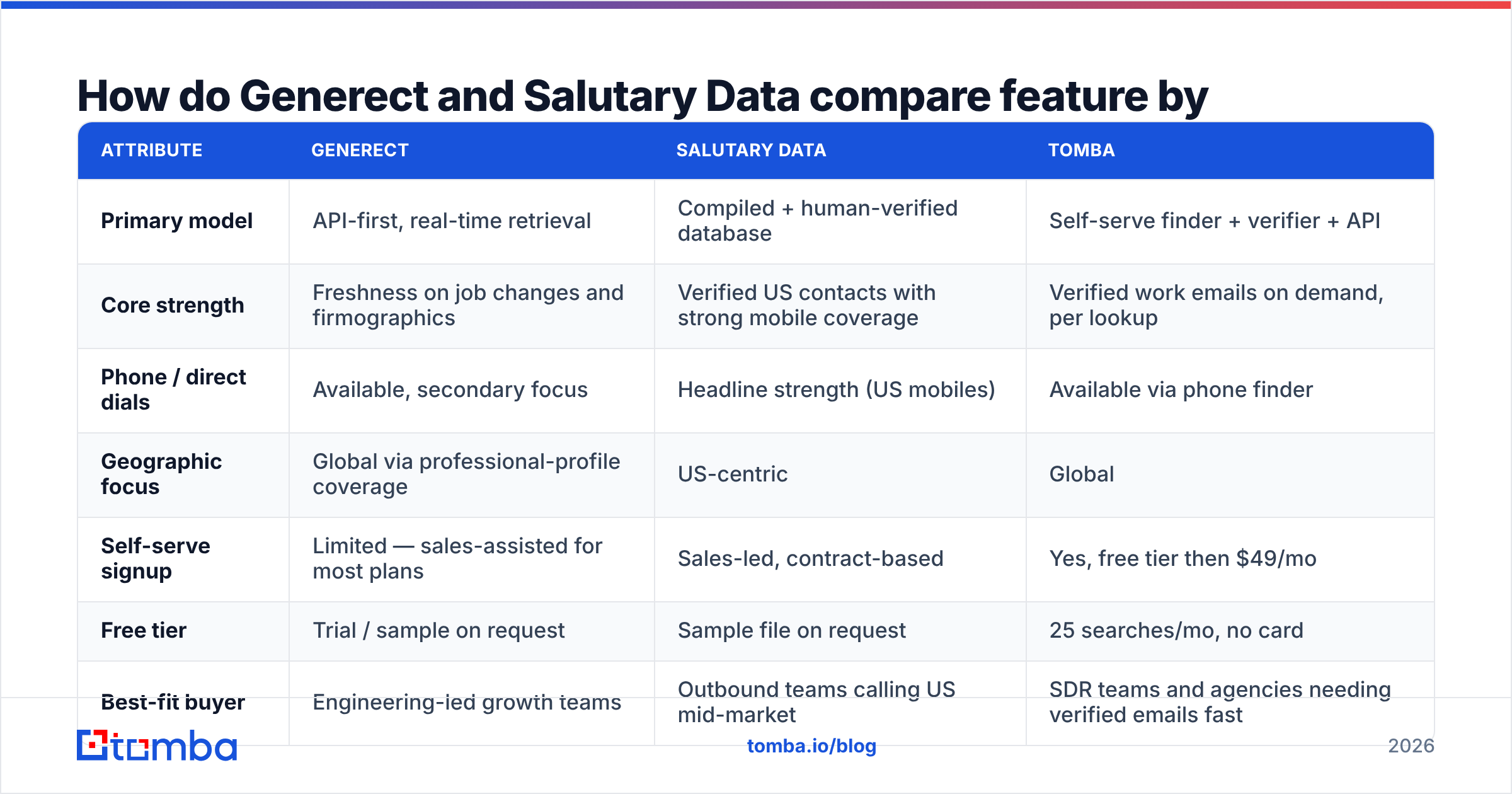
| Attribute | Generect | Salutary Data | Tomba |
|---|---|---|---|
| Primary model | API-first, real-time retrieval | Compiled + human-verified database | Self-serve finder + verifier + API |
| Core strength | Freshness on job changes and firmographics | Verified US contacts with strong mobile coverage | Verified work emails on demand, per lookup |
| Phone / direct dials | Available, secondary focus | Headline strength (US mobiles) | Available via phone finder |
| Geographic focus | Global via professional-profile coverage | US-centric | Global |
| Self-serve signup | Limited — sales-assisted for most plans | Sales-led, contract-based | Yes, free tier then $49/mo |
| Free tier | Trial / sample on request | Sample file on request | 25 searches/mo, no card |
| Best-fit buyer | Engineering-led growth teams | Outbound teams calling US mid-market | SDR teams and agencies needing verified emails fast |
| Biggest friction | You build the workflow yourself | Contract minimums and US-only scope | Not a full firmographic warehouse |
Two things stand out in that table.
First, neither Generect nor Salutary is a "sign up and start sending" product. Both expect a conversation, a scoping call, and in Salutary's case a commercial agreement. That is fine for a funded team with a quarterly data budget. It is a wall for a three-person agency that needs 4,000 verified emails by Thursday.
Second, their strengths barely overlap. Teams that seriously evaluate both usually discover they were solving two different problems and had bundled them into one RFP.
What does each one actually cost?#
Be skeptical of any article that quotes hard numbers for these two — both price through sales, and both adjust by volume, geography, and contract length. What you can compare reliably is the shape of the cost.
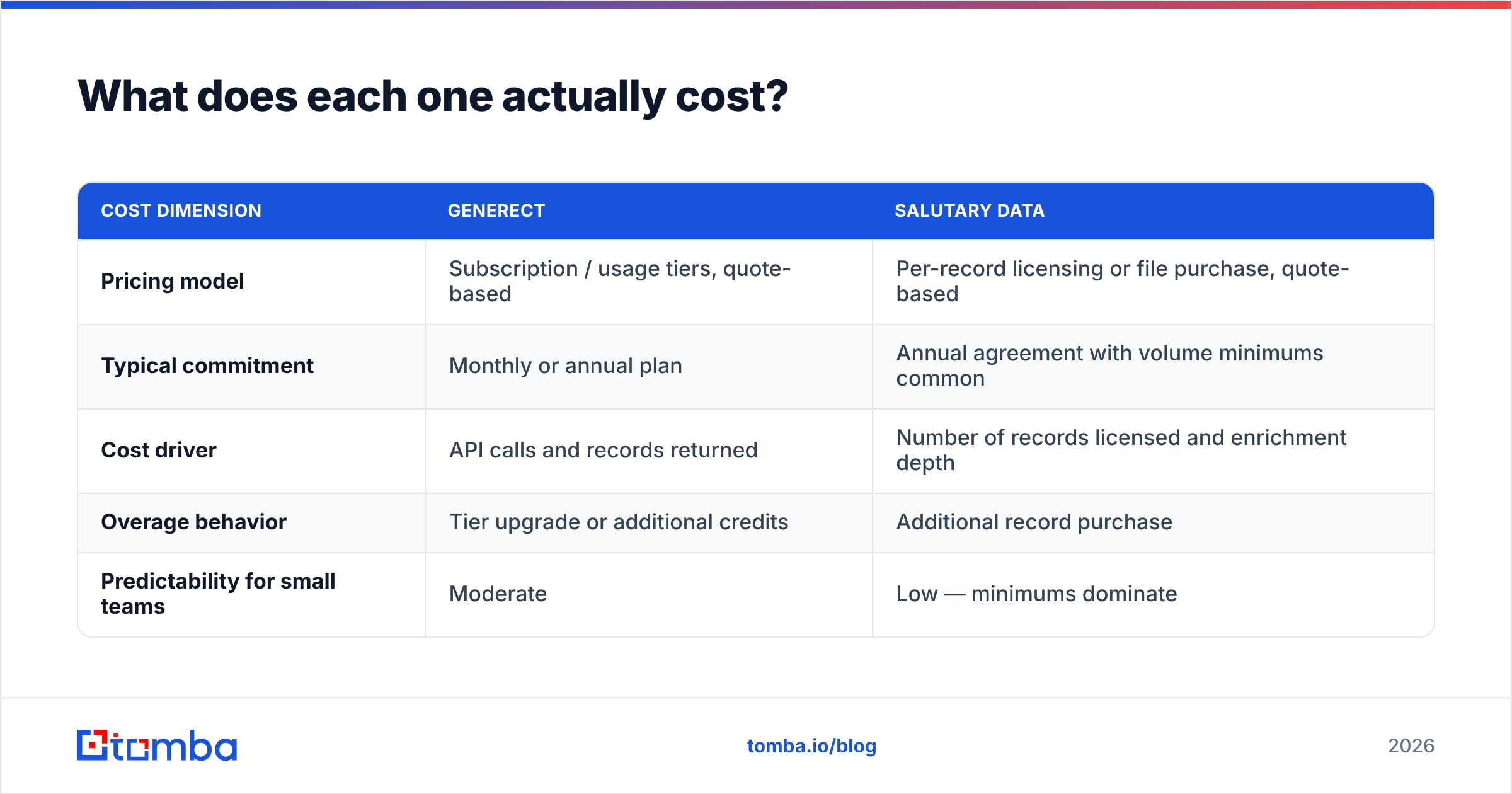
| Cost dimension | Generect | Salutary Data |
|---|---|---|
| Pricing model | Subscription / usage tiers, quote-based | Per-record licensing or file purchase, quote-based |
| Typical commitment | Monthly or annual plan | Annual agreement with volume minimums common |
| Cost driver | API calls and records returned | Number of records licensed and enrichment depth |
| Overage behavior | Tier upgrade or additional credits | Additional record purchase |
| Predictability for small teams | Moderate | Low — minimums dominate |

The trap in both models is the same: you pay for records, not for records you can use. If you license 50,000 US contacts and your ICP only covers 6,000 of them, your effective cost per usable contact just went up 8x. Before signing anything, ask both vendors for a match-rate test against your own account list, not a random sample of their database. A vendor confident in its coverage will run that test. A vendor that deflects is telling you something.
For reference on the transparent end of the market, Tomba pricing publishes tiers openly — free at 25 searches/mo, Starter at $49/mo, Growth at $99/mo, Pro at $249/mo, Enterprise custom. That is not a claim that Tomba replaces a compiled database with human-verified mobiles; it is a claim that you can know your cost before a sales call, which matters when you are sizing a pilot.
Who should choose Generect?#
Pick Generect if three or more of these describe you:
- You have engineering capacity and want data as an API dependency, not a file drop.
- Your ICP spans multiple countries, not just the US.
- Job-change and hiring signals drive your triggers — you care more about when than about perfectly cleaned.
- You already run your own verification and deduplication layer, so raw freshness beats pre-cleaning.
- You want to enrich records continuously rather than buy a snapshot once a quarter.
Where Generect will frustrate you: if you need phone-first outbound into US mid-market, or if nobody on your team wants to own a pipeline. Profile-derived data also inherits the gaps of professional networks — under-represented industries stay under-represented no matter how fresh the query is.
Who should choose Salutary Data?#
Pick Salutary Data if:
- Your motion is call-first and connect rate is the metric your VP watches.
- Your territory is the United States, full stop.
- You need a defensible provenance story for compliance review — compiled, permissioned, documented.
- You'd rather buy a clean dataset once than maintain a live enrichment job.
- You have budget approval for an annual data line item.
Where Salutary will frustrate you: international expansion, tiny pilots, and any workflow that needs a record right now for a lead who just filled out a form. Compiled databases answer "who exists in this segment," not "who is this specific person who landed on my pricing page eleven seconds ago." For that last case you want website visitor reveal or a real-time lookup, not a licensed file.
Worth noting for context: buyers comparing these two often also shortlist BookYourData, which sits closer to Salutary in philosophy — verified, purchasable B2B contact lists with clear coverage claims and a pay-as-you-go option that avoids the annual-minimum problem. If contract shape is your blocker rather than data quality, that is a reasonable third quote to collect. Independent reviews on G2 are useful here mainly for reading the one-star reviews of every vendor on the list, which is where the real limitations get documented.
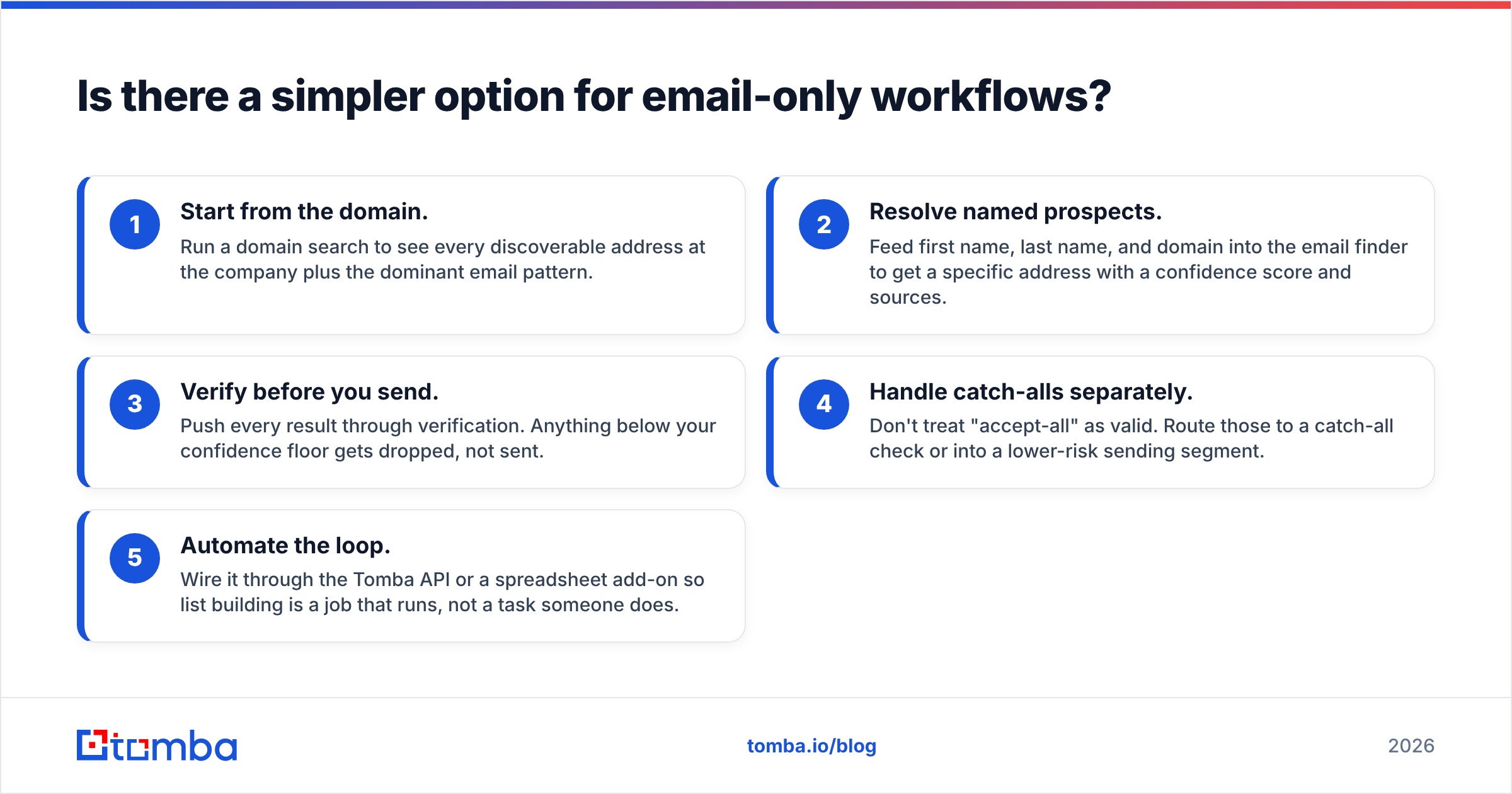
Is there a simpler option for email-only workflows?#
Yes, and it is worth being direct about it: a large share of teams evaluating Generect vs Salutary Data do not need either one.
If your actual requirement is "I have a list of companies and job titles and I need verified work email addresses," you are shopping in the wrong aisle. You are not buying a database — you are buying lookups. That is a per-record utility, and utilities should be cheap, self-serve, and instant.
That workflow looks like:
- Start from the domain. Run a domain search to see every discoverable address at the company plus the dominant email pattern.
- Resolve named prospects. Feed first name, last name, and domain into the email finder to get a specific address with a confidence score and sources.
- Verify before you send. Push every result through verification. Anything below your confidence floor gets dropped, not sent.
- Handle catch-alls separately. Don't treat "accept-all" as valid. Route those to a catch-all check or into a lower-risk sending segment.
- Automate the loop. Wire it through the Tomba API or a spreadsheet add-on so list building is a job that runs, not a task someone does.
Run that at $49/mo and compare the cost per usable, verified, non-bouncing contact against a five-figure annual data license. For many SMB and agency teams the math is not close. For a 200-rep enterprise calling US CFOs, it flips — and Salutary's phone coverage or Generect's API depth becomes worth the contract.
What is the verdict on Generect vs Salutary Data?#
Generect if you build, Salutary if you buy. Generect rewards teams with engineering capacity, global ICPs, and a preference for fresh-over-polished. Salutary rewards US-focused, phone-heavy outbound teams that want verified records delivered rather than assembled. Both are legitimate, both price through sales, and both will look expensive if you license more records than your ICP contains.
Run the same 250-account test against both. Measure match rate, verified-valid rate, and post-send bounce rate — not the deck. Whichever vendor survives your own data, buy that one.
And if the test reveals what it often reveals — that you needed verified emails rather than a database — start with the Tomba Email Finder. Free tier gets you 25 searches to test accuracy on your own accounts before you spend anything, Starter is $49/mo, and every result comes with a confidence score and sources so you can audit it instead of trusting it. Test it against your Generect and Salutary samples on the same 250 accounts and let the bounce rate pick the winner.
Related guides#
Ready to find emails that actually work?
Join 150,000+ professionals who stopped guessing and started sending. Free credits on signup — no credit card required.
Get the Tomba newsletter
Practical outbound tactics and product updates — once every two weeks.
About the author