Generect vs SMARTe: B2B Contact Data Compared for 2026
Generect sells fresh LinkedIn-sourced B2B search; SMARTe sells mobile-heavy contact data with a compliance story. Here is where each one actually wins, where both leak budget, and how to test them in a week.
Generect vs SMARTe comes down to one question: do you need fresher search data, or deeper mobile coverage? Here is the short answer first.
TL;DR
- Generect builds records close to query time from live, LinkedIn-shaped search. Pick it when your ICP shifts often and job-change freshness matters.
- SMARTe sells a large pre-built database with strong mobile numbers and a clear GDPR/CCPA posture. Pick it when your team dials as much as it emails.
- Neither publishes full self-serve pricing. Both route real volume through sales, so your cost depends on the deal you cut.
- Both will hand you emails that bounce. Verification is a separate job.
- The cheaper setup: use one database for discovery, then run every export through a verifier such as Tomba before it touches your sending domain.
What is the Generect vs SMARTe comparison actually about?#
Both tools sit on the same shelf: B2B contact data. But they solve different problems, and that difference is the whole decision.
Think of it like buying produce. Generect is the farmers' market. Smaller inventory, picked recently, and you can see where it came from. SMARTe is the wholesale supplier. Huge inventory, indexed, with paperwork for every crate. Neither is better on its own. It depends on whether you value freshness or breadth, and on how many questions your legal team asks.
Here is what each one optimizes for:
- Generect — real-time search over company and people data. The filters mirror LinkedIn Sales Navigator, and there is an API for scripted pulls. The claim is recency: records get built near the moment you query, not served from an old snapshot.
- SMARTe — a global contact database. It leans on direct dials and mobile numbers, ships a LinkedIn browser extension, and documents consent handling for EMEA and APAC.
- Both — sell "contacts." Both export CSVs, push to CRM, and enrich lists you already own.
- Neither — is a sending tool. You still need sequencing, warmup, and deliverability downstream.
- Neither — gives you a bounce-free list. Every provider here ships some dead mailboxes.
That last point is the one that costs money. We come back to it below.
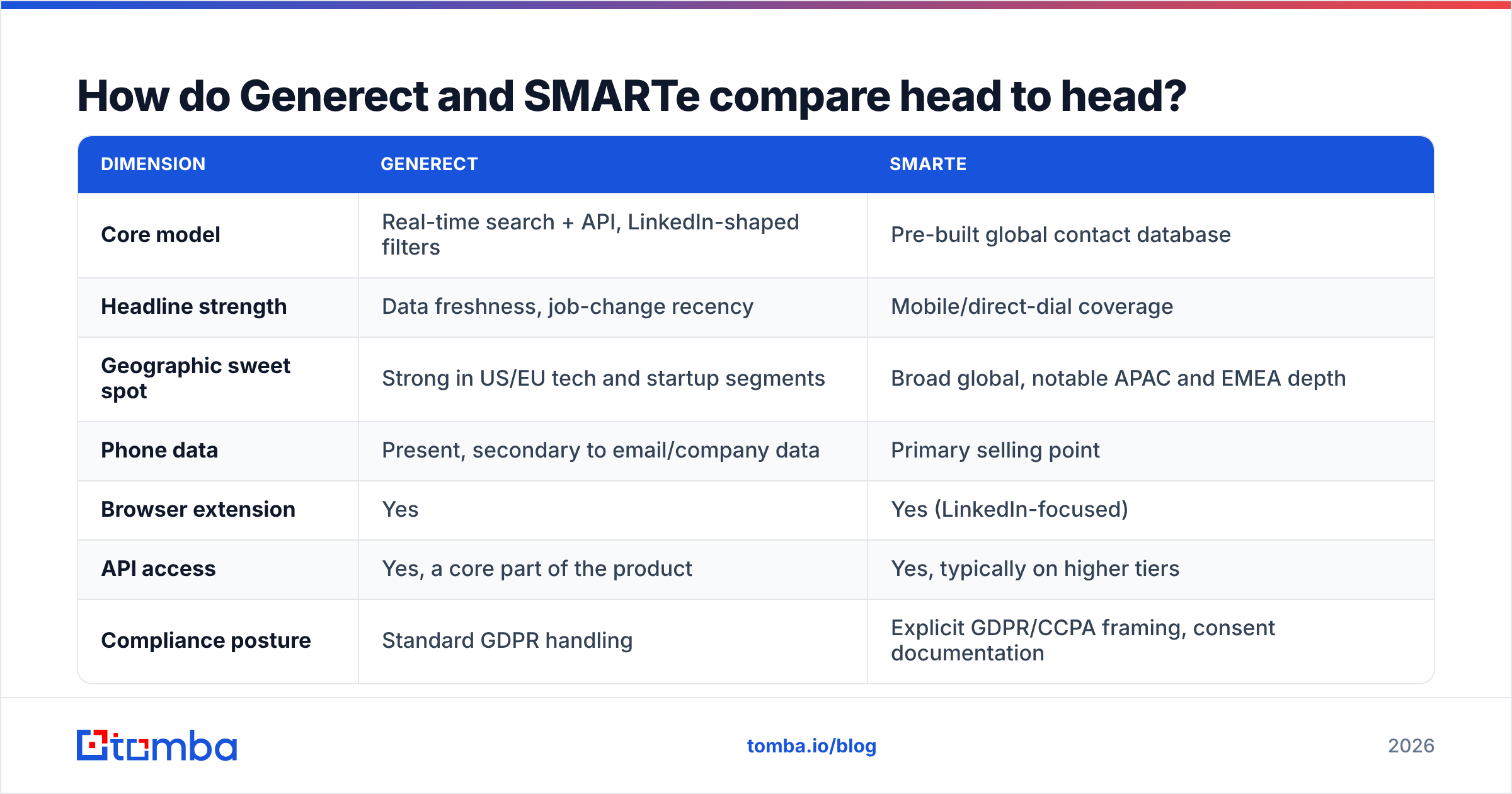
Generect vs SMARTe: how do they compare head to head?#
| Dimension | Generect | SMARTe |
|---|---|---|
| Core model | Real-time search + API, LinkedIn-shaped filters | Pre-built global contact database |
| Headline strength | Data freshness, job-change recency | Mobile/direct-dial coverage |
| Geographic sweet spot | Strong in US/EU tech and startup segments | Broad global, notable APAC and EMEA depth |
| Phone data | Present, secondary to email/company data | Primary selling point |
| Browser extension | Yes | Yes (LinkedIn-focused) |
| API access | Yes, a core part of the product | Yes, typically on higher tiers |
| Compliance posture | Standard GDPR handling | Explicit GDPR/CCPA framing, consent documentation |
| Self-serve signup | Limited, demo-first for most tiers | Demo-first, sales-led |
| Published pricing | Not fully public | Not fully public |
| Best fit | RevOps teams building programmatic list pulls | SDR teams running multi-channel call + email |
Two things fall out of that table.
First, Generect is the more developer-shaped product. If your motion is "define an ICP query, pull 2,000 records a week, push to HubSpot, sequence," the API-first design fits.
Second, SMARTe is the more SDR-shaped product. If your reps live inside LinkedIn and want a mobile number in two clicks, the extension beats an API you have to wire up.
Generect vs SMARTe: which one has better data accuracy?#
Accuracy is where vendor marketing gets loudest. Every provider quotes a number in the 90s. Those numbers use different samples and different definitions of "valid."
Here is what actually varies:

Coverage rate — out of 1,000 target contacts, how many does the tool return at all? This is usually the real constraint. A 98%-accurate tool that finds 40% of your ICP loses to a 92%-accurate tool that finds 80%.
Bounce rate on send — the only number that matters commercially. Vendors rarely quote it, because it depends on your list, your domain, and how long the data sat.
Catch-all handling — many corporate domains accept all mail at the SMTP layer. No verifier can confirm a single mailbox by handshake alone. Some vendors label these records "valid," some label them "risky." Run a catch-all verifier instead of trusting the label.
Decay — B2B contact data rots at roughly 25–30% a year as people change jobs. A record pulled in January and sent in June is a different asset.
Generect's freshness pitch targets decay. That is a real edge if your sales cycle is long and lists sit in a CRM for months. SMARTe's breadth pitch targets coverage. Neither claim replaces your own bounce test.
Do this before you sign anything. Ask both vendors for a 200-record sample against your ICP, not a sample they pick. Run it through an independent email verifier. Compare coverage rate and hard-bounce rate side by side. The vendor whose numbers survive wins.
Generect vs SMARTe: how do they handle phone numbers?#
This is the clearest split between the two.
SMARTe built its identity on mobile numbers. If your team cold-calls, or runs a "call after the email opens" play, direct dials are the product. SMARTe's positioning, its own site, and its G2 reviews all point at that use case.
Generect includes phone data but does not lead with it. Expect company numbers and some direct lines, with less consistency at the mobile level.
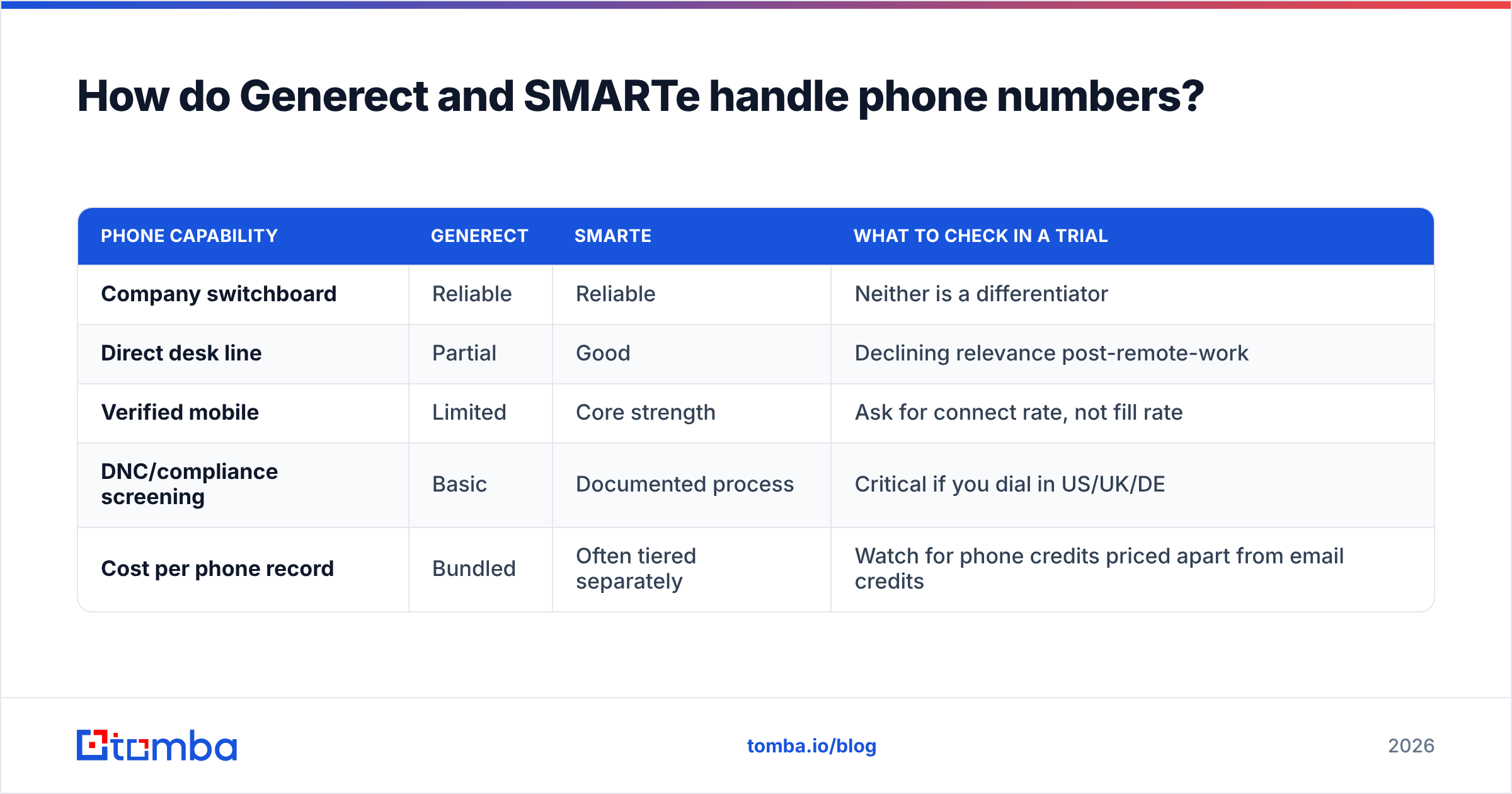
| Phone capability | Generect | SMARTe | What to check in a trial |
|---|---|---|---|
| Company switchboard | Reliable | Reliable | Neither is a differentiator |
| Direct desk line | Partial | Good | Declining relevance post-remote-work |
| Verified mobile | Limited | Core strength | Ask for connect rate, not fill rate |
| DNC/compliance screening | Basic | Documented process | Critical if you dial in US/UK/DE |
| Cost per phone record | Bundled | Often tiered separately | Watch for phone credits priced apart from email credits |
If you dial, this table probably decides it. If you do not dial, SMARTe's main edge is one you will never use. Weight the rest of the comparison accordingly. Some teams need dialable numbers without buying a second platform, so they bolt a phone finder onto a cheaper email-first stack.
Generect vs SMARTe pricing: what does each cost in 2026?#
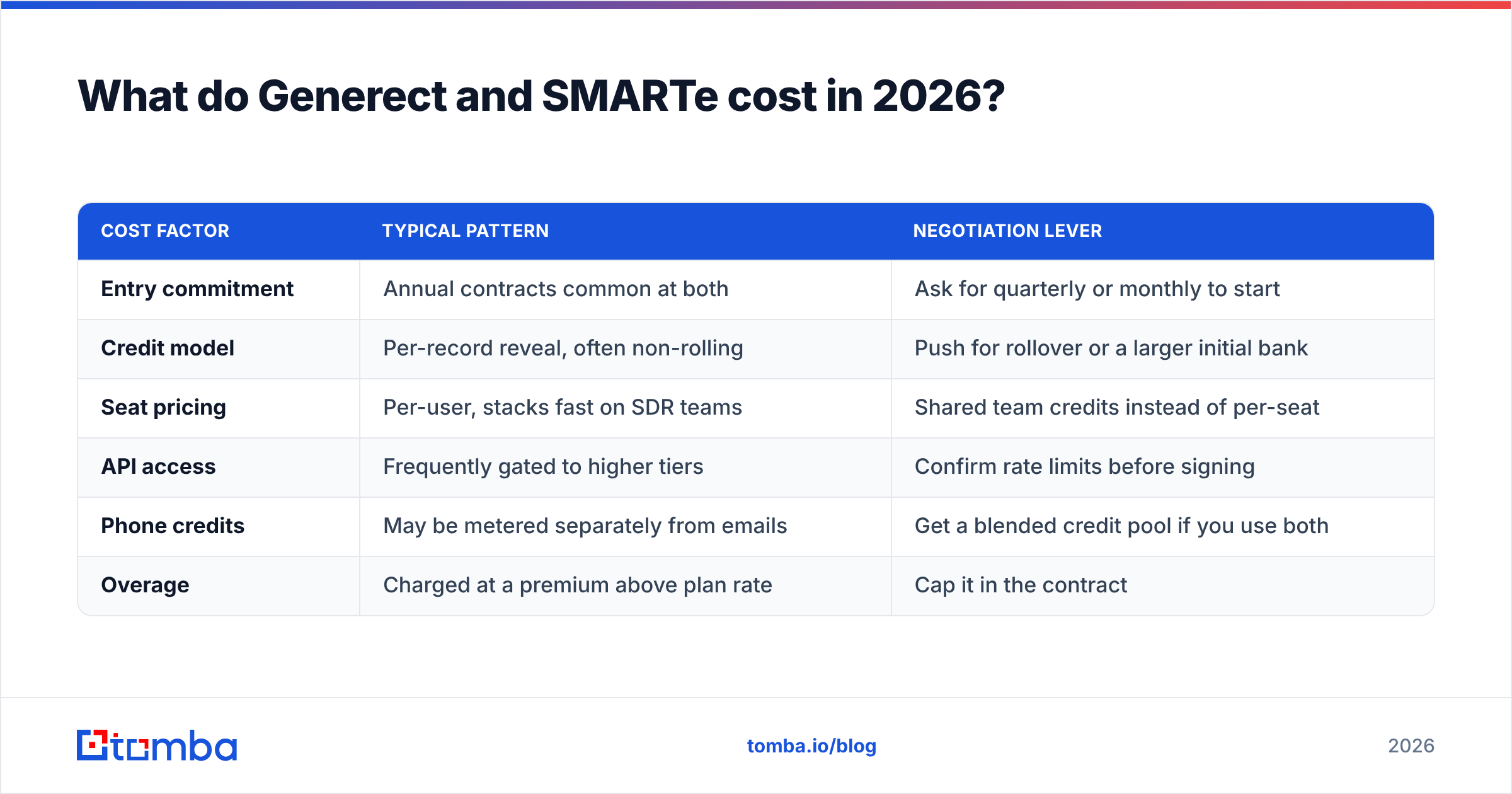
Both are sales-led. The price you get depends on seats, credit volume, contract length, and how close it is to the end of their quarter.
Here is what you can plan around:
| Cost factor | Typical pattern | Negotiation lever |
|---|---|---|
| Entry commitment | Annual contracts common at both | Ask for quarterly or monthly to start |
| Credit model | Per-record reveal, often non-rolling | Push for rollover or a larger initial bank |
| Seat pricing | Per-user, stacks fast on SDR teams | Shared team credits instead of per-seat |
| API access | Frequently gated to higher tiers | Confirm rate limits before signing |
| Phone credits | May be metered separately from emails | Get a blended credit pool if you use both |
| Overage | Charged at a premium above plan rate | Cap it in the contract |
Compare that to the self-serve end of the market, where prices are public and you can start without a call. Tomba's plans run a free tier at 25 searches a month, Starter at $49/mo, Growth at $99/mo, and Pro at $249/mo. Enterprise is on request. It is not a like-for-like swap, since Tomba finds and verifies rather than warehousing mobile data. But it sets a useful floor. If a quote is 10x that and you only need emails, you are paying for features you will not touch.
Rule of thumb: if fewer than 30% of your touches are calls, you are overpaying for a mobile-first database.
Generect vs SMARTe: which is better for GDPR compliance?#
SMARTe puts compliance up front. It publishes detail on consent handling, data subject requests, and regional processing. If you sell into the EU and your legal team reviews DPAs, that shortens the buying cycle.
Generect works under the same GDPR rules but markets less around them. That is not weaker. It means you do more of the diligence yourself.
Put three questions to either vendor in writing:
What is the lawful basis for processing the data you are selling me? Can you evidence it per region?
How do you handle a deletion request that lands after I exported the record to my CRM?
Where is data stored and processed? Do any subprocessors sit outside the EEA?
Crisp answers signal a mature operation. If all you get is a PDF that says "we are GDPR compliant," push harder. Wikipedia's GDPR overview is a fine primer before the call.

Generect vs SMARTe alternatives: when should you pick neither?#
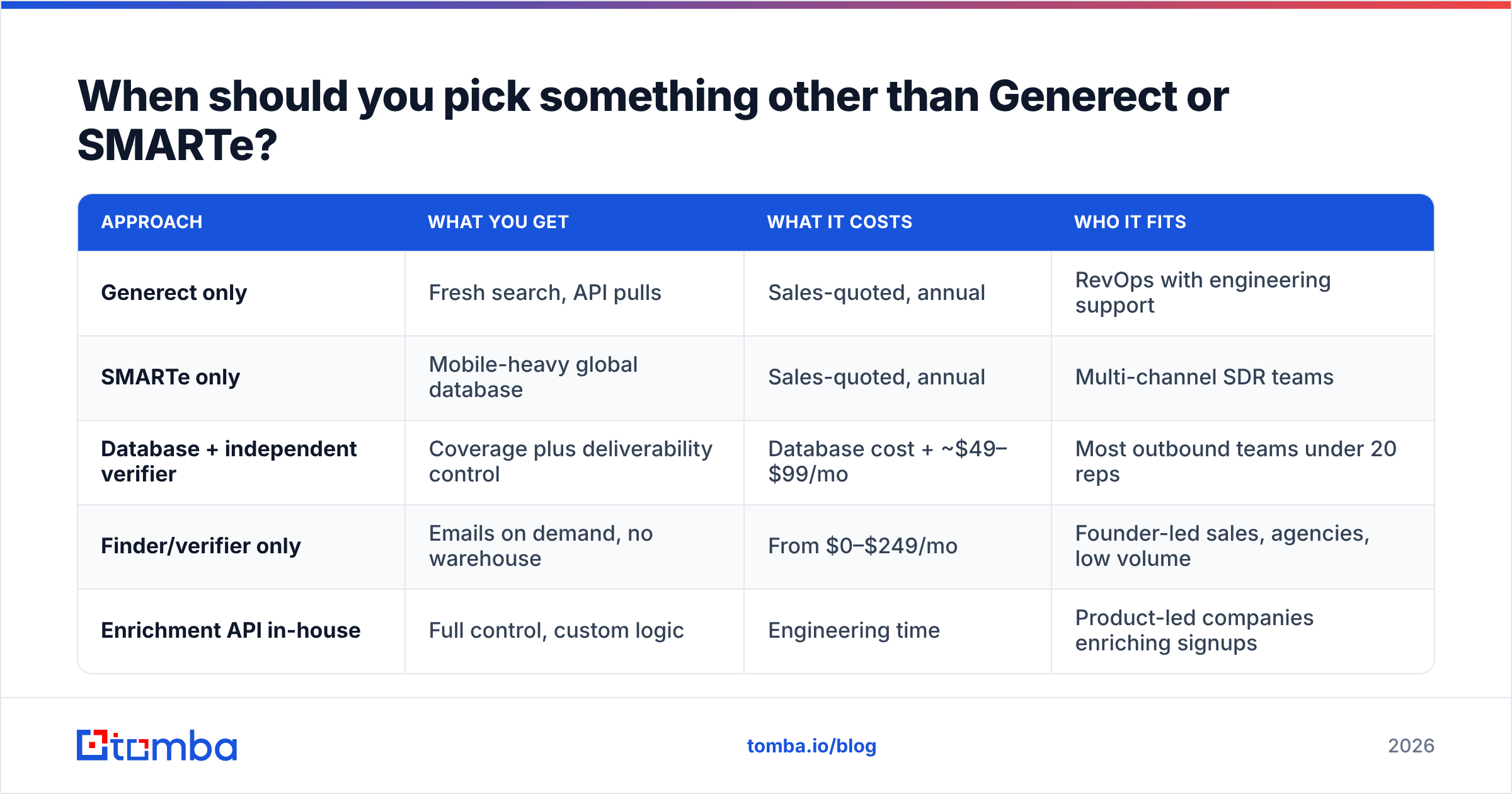
Many teams land on a third pattern after a year of paying for a big database: split discovery from verification.
The logic is simple. Databases are good at telling you who exists. They are weak at telling you whether a mailbox is alive today. That needs an SMTP check at send time, not a lookup against a snapshot. A dedicated finder and verifier fixes the expensive half for a fraction of the database cost.

| Approach | What you get | What it costs | Who it fits |
|---|---|---|---|
| Generect only | Fresh search, API pulls | Sales-quoted, annual | RevOps with engineering support |
| SMARTe only | Mobile-heavy global database | Sales-quoted, annual | Multi-channel SDR teams |
| Database + independent verifier | Coverage plus deliverability control | Database cost + ~$49–$99/mo | Most outbound teams under 20 reps |
| Finder/verifier only | Emails on demand, no warehouse | From $0–$249/mo | Founder-led sales, agencies, low volume |
| Enrichment API in-house | Full control, custom logic | Engineering time | Product-led companies enriching signups |
For the last two rows, the workflow is short. Pull a company list. Run domain search to map who works there. Resolve addresses with the finder. Verify in bulk. Hand the clean file to your sequencer. Teams on that pattern usually see hard bounces fall under 2%. That is the line that keeps sender reputation and inbox placement intact.
Generect vs SMARTe: so which should you choose?#
Choose Generect if your motion is scripted, your ICP changes each quarter, and someone can wire an API into your CRM. The freshness edge compounds when you pull lists all the time.
Choose SMARTe if your reps dial. Mobile coverage is hard to replicate, the compliance docs are above average for this market, and the LinkedIn extension fits how SDRs work.
Choose neither if you only need emails, your volume is under a few thousand records a month, and you would rather pay a listed price than sit through a demo. That is a common situation, and a sales-led contract is the wrong tool for it.
Whatever you pick, verify separately. Both platforms will send you records that bounce. That is not a knock on either vendor. It is the physics of a market where 25–30% of contacts change jobs every year. Teams that keep their domains healthy own verification themselves.
Run the 200-record bake-off. Compare coverage first, bounce rate second, price third. Then negotiate.
Ready to test the verification layer before you sign a contract? Start with the Tomba Email Finder. The free tier gives you 25 searches a month with no card, which is enough to bounce-test a sample from any vendor's export. If the numbers hold up, plans start at $49/mo with the same API your engineers would use to automate the pipeline.
Related guides#
Ready to find emails that actually work?
Join 150,000+ professionals who stopped guessing and started sending. Free credits on signup — no credit card required.
Get the Tomba newsletter
Practical outbound tactics and product updates — once every two weeks.
About the author