Generect vs SourceScrub: Which B2B Data Tool Wins in 2026
Generect finds people. SourceScrub finds companies nobody has heard of yet. Here is an honest breakdown of coverage, pricing models, workflows, and which one actually fits your motion in 2026.
TL;DR
- These tools are not substitutes. Generect is a contact-data and lead-generation platform built around LinkedIn-style search and API delivery. SourceScrub is a private-company intelligence platform built for deal sourcing in private equity, growth equity, and M&A.
- Pick Generect if your job is filling a sales list with named people you can email or call this quarter.
- Pick SourceScrub if your job is discovering bootstrapped, never-funded companies before a competing fund finds them — conference exhibitor lists, "top 50" source lists, and firmographic signals are its core value.
- Pricing models diverge hard. Generect sells self-serve and API-metered access. SourceScrub is quote-only, seat-based, annual-contract enterprise software. Budget accordingly.
- Neither one is a cheap email layer. If you only need verified work emails at scale, a dedicated email finder at $49/mo beats paying deal-sourcing prices for contact data.
If you landed here typing "Generect vs SourceScrub," there's a decent chance someone on your team put both on the same shortlist. That shortlist is probably wrong — not because either tool is bad, but because they answer different questions. This post separates them properly, then tells you what to do if you actually need both jobs done.
What is Generect?#
Generect is a B2B lead-generation and contact-data provider. Its pitch is real-time lead search: you define a target audience the way you would inside a LinkedIn Sales Navigator filter — job title, seniority, headcount, industry, geography — and Generect returns matching people with contact details attached, either through the web app or through an API.
The core use cases look like this:
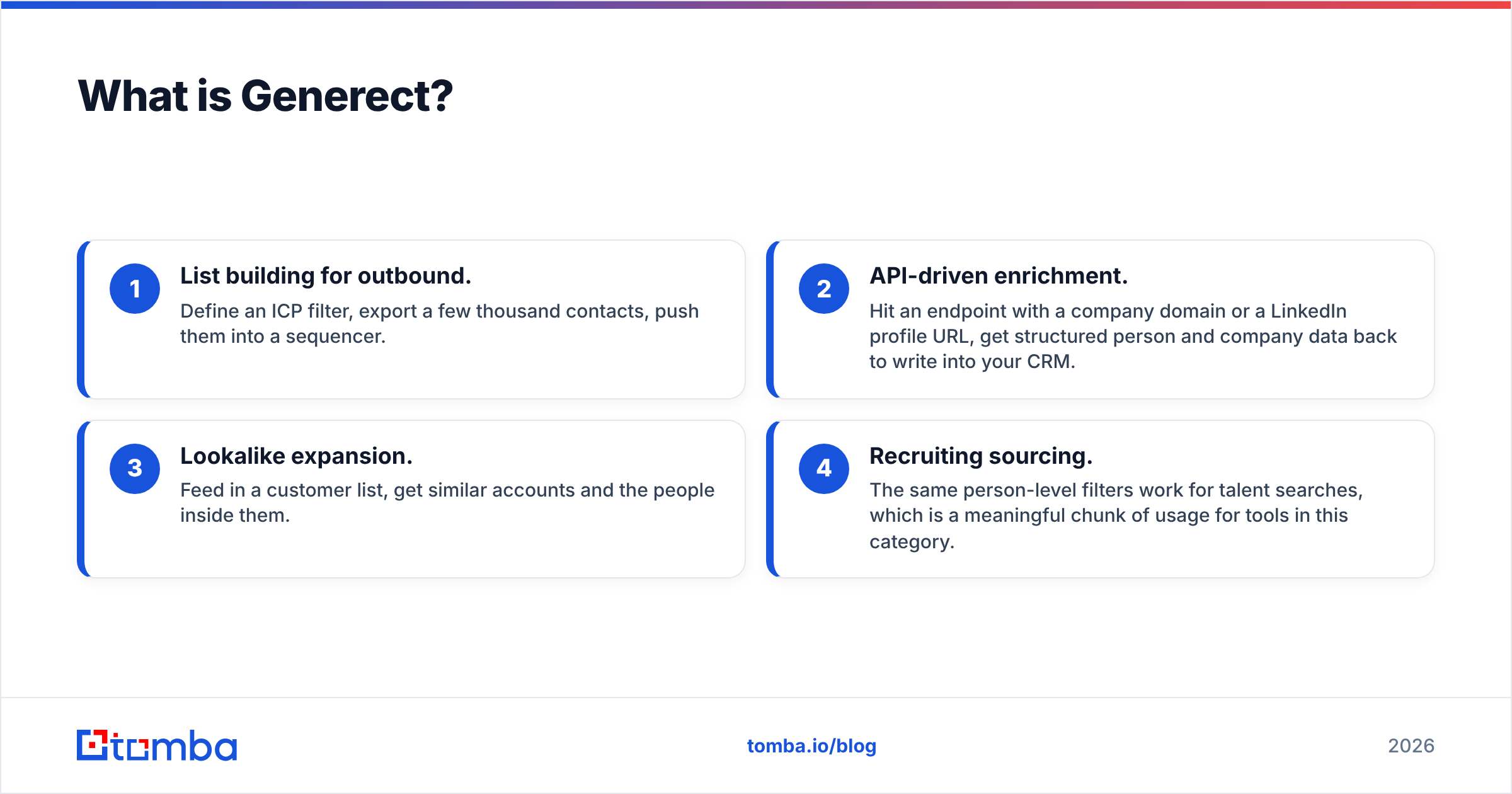
- List building for outbound. Define an ICP filter, export a few thousand contacts, push them into a sequencer.
- API-driven enrichment. Hit an endpoint with a company domain or a LinkedIn profile URL, get structured person and company data back to write into your CRM.
- Lookalike expansion. Feed in a customer list, get similar accounts and the people inside them.
- Recruiting sourcing. The same person-level filters work for talent searches, which is a meaningful chunk of usage for tools in this category.
The important structural point: Generect is optimized for people you can contact now. Its data model centers on the individual record — name, title, company, email, sometimes phone. Company data exists mostly as context for the person.
What is SourceScrub?#
SourceScrub is a private-company intelligence platform. Its customers are investment banks, private equity and growth equity firms, corporate development teams, and, increasingly, enterprise GTM teams that want to find companies before the market does.
SourceScrub's differentiator is not contact volume — it's source lists. The platform continuously ingests and structures things like conference exhibitor rosters, industry award lists, "fastest-growing companies" rankings, trade association directories, and buyer's guides. Those lists are where bootstrapped, never-raised, quietly profitable companies actually show up. They don't appear in funding databases because they never raised a round.
On top of that, SourceScrub layers firmographics (headcount, estimated revenue, growth signals, website traffic trends), executive contacts, and workflow tooling — saved searches, alerts on hiring or list appearances, and CRM sync into Salesforce, DealCloud, or Affinity.
The mental model: SourceScrub answers "which companies should I be talking to that nobody has mapped yet?" Generect answers "who do I email at the companies I already picked?"

How do Generect and SourceScrub actually differ?#
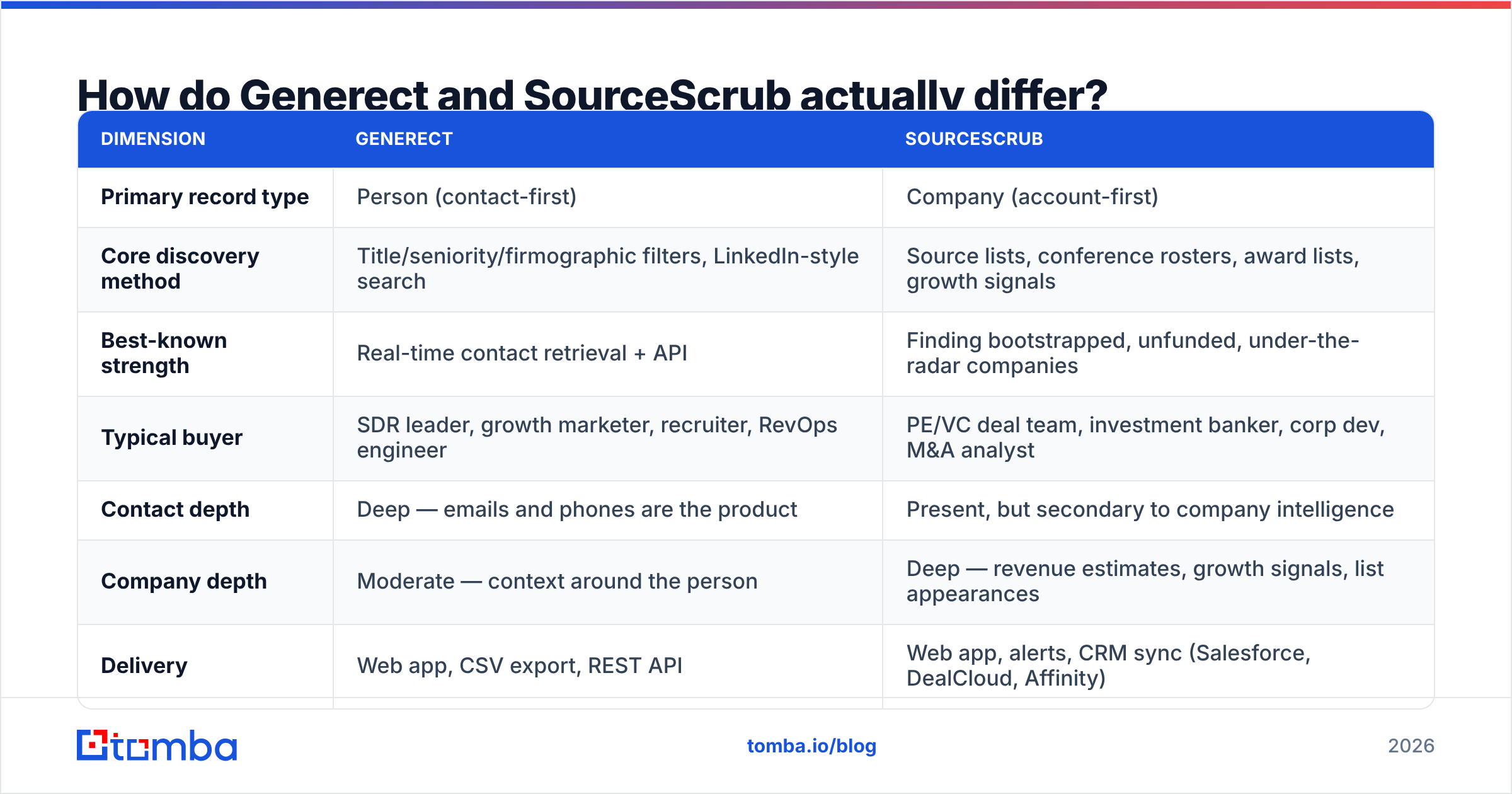
Here is the side-by-side that matters. Read it as "different jobs," not "better vs worse."
| Dimension | Generect | SourceScrub |
|---|---|---|
| Primary record type | Person (contact-first) | Company (account-first) |
| Core discovery method | Title/seniority/firmographic filters, LinkedIn-style search | Source lists, conference rosters, award lists, growth signals |
| Best-known strength | Real-time contact retrieval + API | Finding bootstrapped, unfunded, under-the-radar companies |
| Typical buyer | SDR leader, growth marketer, recruiter, RevOps engineer | PE/VC deal team, investment banker, corp dev, M&A analyst |
| Contact depth | Deep — emails and phones are the product | Present, but secondary to company intelligence |
| Company depth | Moderate — context around the person | Deep — revenue estimates, growth signals, list appearances |
| Delivery | Web app, CSV export, REST API | Web app, alerts, CRM sync (Salesforce, DealCloud, Affinity) |
| Pricing model | Self-serve tiers + metered API credits | Quote-only, seat-based, annual contract |
| Time to first value | Same day | Onboarding + implementation cycle |
| Where it breaks down | Thin on non-obvious company discovery | Expensive and slow if you only wanted emails |
The row that decides most evaluations is the second one. Discovery method is the whole ballgame. If your target list already exists — you know the 800 accounts, you just need people inside them — SourceScrub's source-list engine is capability you're paying for and not using. If your problem is that you don't know which companies exist in a fragmented vertical, no amount of contact filtering will surface them, because you can't filter for a company you've never heard of.
Which one has better data coverage?#
Wrong question, but it's the one everyone asks, so let's answer it honestly on both axes.
Contact coverage goes to Generect. Person-level records, email discovery, and phone data are its core product, and its API is built for programmatic pulls at volume. Vendors in this category typically land somewhere in the 90%+ range on deliverability for verified business emails, though every provider's self-reported number should be treated as a ceiling, not a floor. Coverage also skews heavily toward markets with dense LinkedIn adoption — North America and Western Europe are strong, APAC and LATAM thin out fast.
Company coverage of hard-to-find businesses goes to SourceScrub, decisively. If a 40-person industrial services company in Ohio has never raised capital, never issued a press release, and exists on the internet as a website and a booth at one trade show, most databases have no reason to know about it. SourceScrub's ingestion of that trade show's exhibitor list is exactly how it shows up.
Company coverage of known, mid-to-large businesses is roughly a wash. Both platforms will have Salesforce, Shopify, and every Series B in your feed. Nobody wins there.
A practical note on verification: neither platform removes your obligation to check the data before you send. Provider-side "verified" flags decay — people change jobs, domains get retired, catch-all servers accept everything and then bounce silently. Running a final pass through an email verifier before a campaign is cheap insurance regardless of which vendor sourced the record.
How do Generect and SourceScrub compare on pricing?#
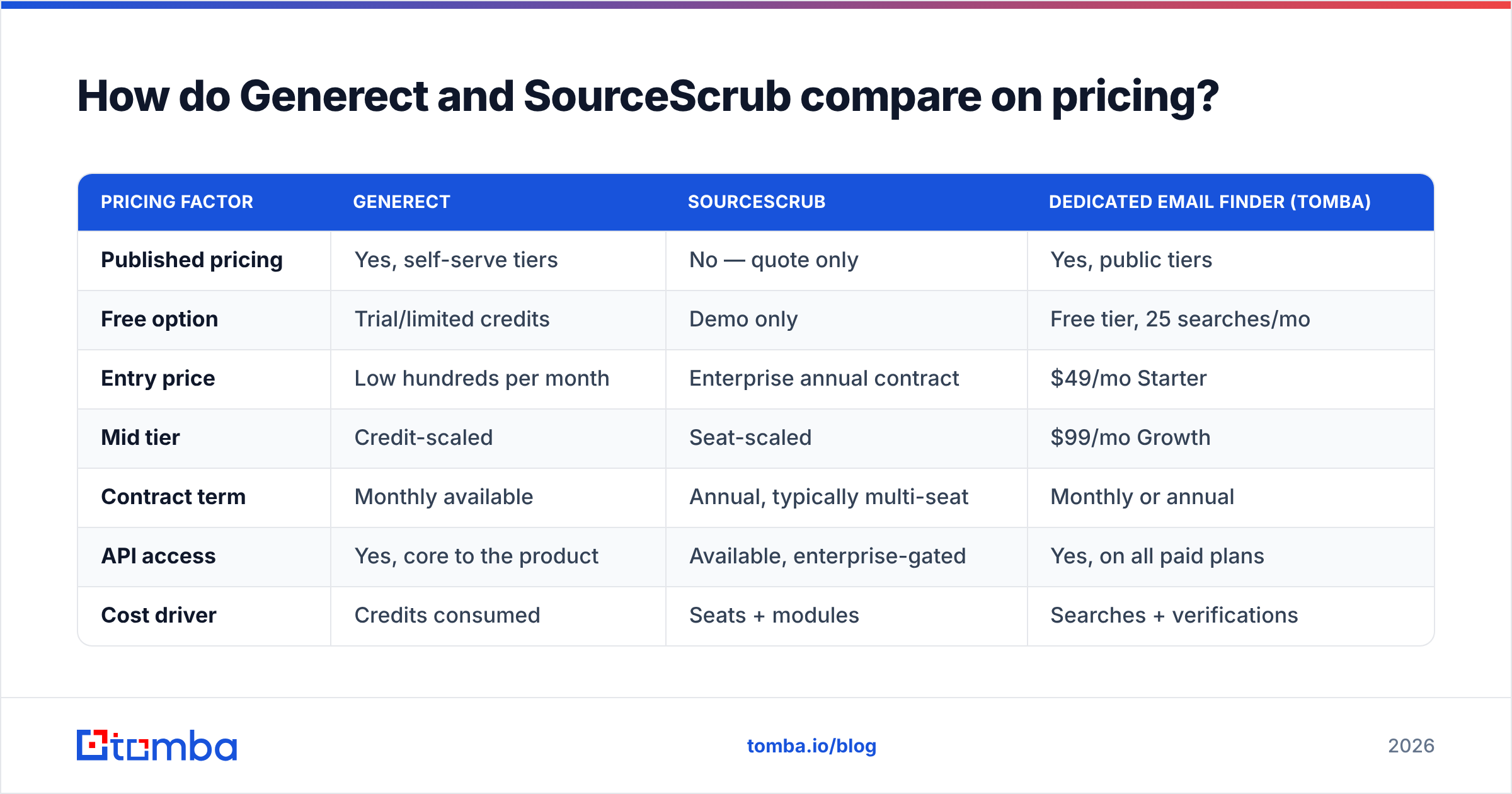
This is where the two tools stop looking like alternatives entirely.
| Pricing factor | Generect | SourceScrub | Dedicated email finder (Tomba) |
|---|---|---|---|
| Published pricing | Yes, self-serve tiers | No — quote only | Yes, public tiers |
| Free option | Trial/limited credits | Demo only | Free tier, 25 searches/mo |
| Entry price | Low hundreds per month | Enterprise annual contract | $49/mo Starter |
| Mid tier | Credit-scaled | Seat-scaled | $99/mo Growth |
| Contract term | Monthly available | Annual, typically multi-seat | Monthly or annual |
| API access | Yes, core to the product | Available, enterprise-gated | Yes, on all paid plans |
| Cost driver | Credits consumed | Seats + modules | Searches + verifications |
SourceScrub does not publish pricing, and in practice deal-sourcing platforms in this tier land in the five-figure annual range once you add seats. That is entirely reasonable if a single sourced deal justifies the year. It is entirely unreasonable if what you actually needed was 5,000 verified emails for a Q3 outbound push.

That gap is the most common budgeting mistake in this comparison. Teams evaluate a deal-sourcing platform, get sticker shock, then either overpay for capability they won't use or abandon the project entirely. The third option — buy the narrow tool for the narrow job — rarely gets considered until later.
Who should choose Generect?#
Choose Generect if most of these are true:
- Your ICP is definable by filters. You can describe your buyer as "VP+ of Engineering, 200–2,000 headcount, SaaS, US/UK" and that description is genuinely accurate.
- You need contact data, not company discovery. The accounts are known; the people are not.
- You want an API in your stack. Enrichment on form-fill, CRM hygiene jobs, and lead-routing logic all need programmatic access, not CSV exports.
- You're running recruiting alongside sales. Person-level search serves both motions from one contract.
- You want to start this week. Self-serve pricing and no implementation cycle matter when you're testing a channel.
Where Generect will frustrate you: fragmented verticals with long tails of small private companies. If your TAM is "regional HVAC distributors" or "specialty chemical manufacturers under $50M," filter-based search returns whatever happens to be in the index, and you will never know what it missed.
Who should choose SourceScrub?#
Choose SourceScrub if most of these are true:
- Your value is in discovery, not outreach volume. You need to find 30 companies nobody else has found, not email 30,000 people.
- You work in private markets. PE, growth equity, banking, corp dev — the workflow (saved searches, list alerts, DealCloud/Affinity sync) was designed for you.
- Bootstrapped companies are your target. Funding-database-driven tools structurally cannot see them. Source lists can.
- Signals matter more than contacts. Hiring velocity, web traffic direction, and repeated conference appearances are your buy signals.
- One outcome pays for the platform. In deal sourcing it usually does. In outbound sales, it usually doesn't.
Where SourceScrub will frustrate you: as a bulk contact engine. You'll get executive contacts, but the economics of using an enterprise deal-sourcing seat to build a cold-email list are bad, and the export limits and workflow aren't built for it.
Can you just use both — and what fills the gap?#
Yes, and in serious private-markets GTM teams that's the actual answer: SourceScrub (or a peer) for account discovery, then a separate contact layer for reach.
That contact layer is where the split gets interesting, because it doesn't have to be a full lead-gen platform. Once you know the company, finding the right person's email is a solved, cheap problem:
- Domain-first discovery. Run domain search against each sourced company to pull every discoverable address and the org's email pattern in one call.
- Pattern inference. Once you know a company uses
first.last@, you can construct and verify addresses for anyone on the org chart. - Catch-all handling. Roughly a fifth of B2B domains accept everything at the SMTP layer. A catch-all verifier separates real mailboxes from black holes instead of letting you burn sender reputation finding out.
- Bulk enrichment. Feed the sourced account list in, get contacts out, via the Tomba API or a spreadsheet add-in.
Financially this is the stack that makes sense: pay enterprise prices for the thing only enterprise software does (discovering invisible companies), and pay commodity prices for the commodity (finding an email at a known domain). Paying discovery prices for commodity data is how software budgets quietly balloon.
If you want third-party sanity checks on either vendor before you commit, G2's category listings are the least-filtered source available — filter reviews to your company size, because the experience of a 12-person fund and a 400-seat sales org are not comparable.
Which one wins in 2026?#
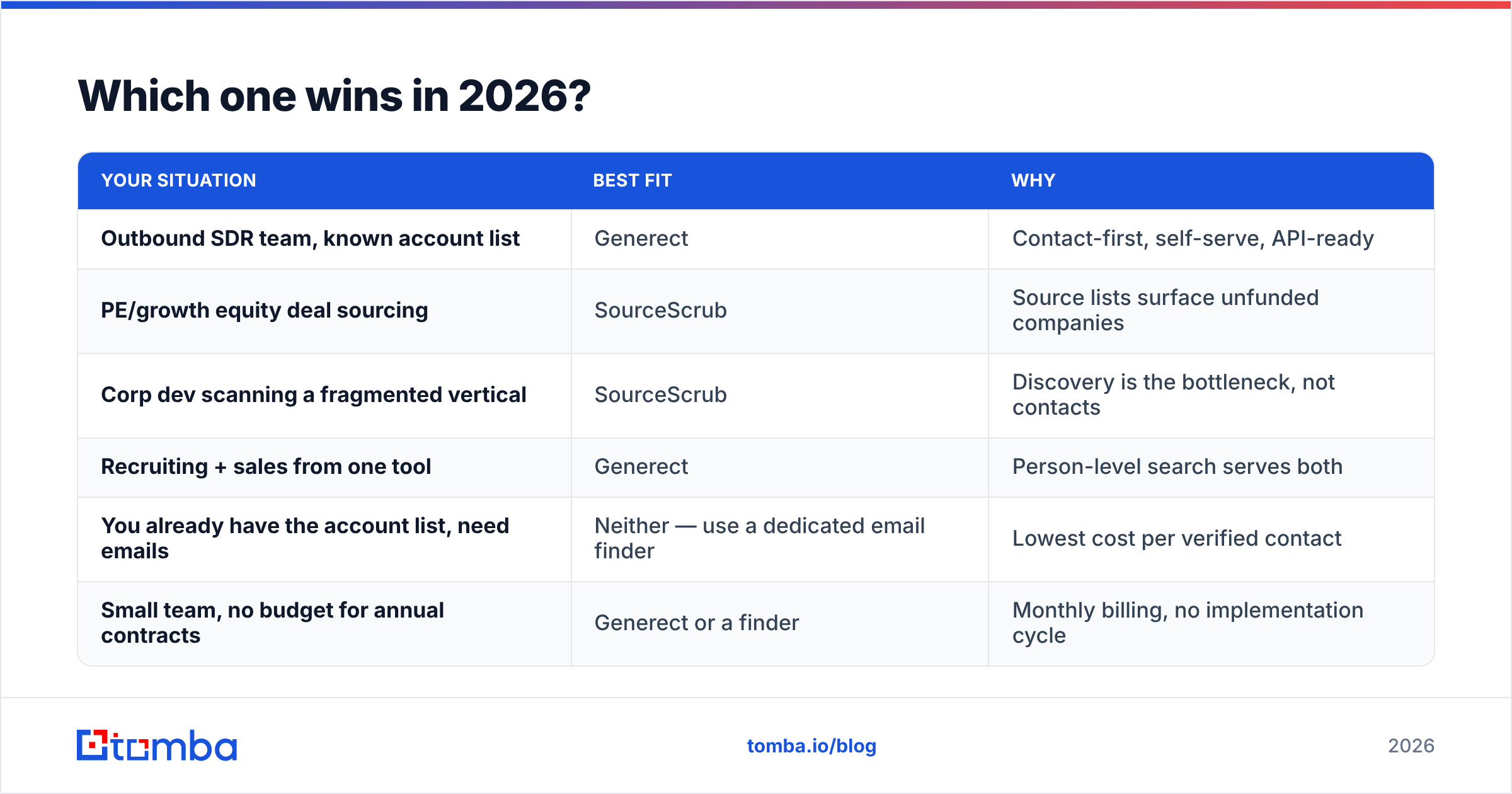
| Your situation | Best fit | Why |
|---|---|---|
| Outbound SDR team, known account list | Generect | Contact-first, self-serve, API-ready |
| PE/growth equity deal sourcing | SourceScrub | Source lists surface unfunded companies |
| Corp dev scanning a fragmented vertical | SourceScrub | Discovery is the bottleneck, not contacts |
| Recruiting + sales from one tool | Generect | Person-level search serves both |
| You already have the account list, need emails | Neither — use a dedicated email finder | Lowest cost per verified contact |
| Small team, no budget for annual contracts | Generect or a finder | Monthly billing, no implementation cycle |
The verdict: there is no head-to-head winner because there is no head-to-head. SourceScrub wins deal sourcing and isn't seriously challenged there by a contact-data tool. Generect wins contact acquisition and API-driven enrichment, and SourceScrub isn't trying to win that. The only genuinely wrong answer is buying either one for the job the other does.
The second-most common wrong answer is buying either one when what you needed was a $49 email finder. Before you sign anything, write down the actual bottleneck in one sentence. If that sentence contains "we don't know which companies to target," you need discovery. If it contains "we can't reach the people at companies we've already identified," you need contacts — and you should compare Tomba pricing against whatever quote you're holding before deciding.
Ready to fill in the contacts?#
Whichever platform you use to build your account list, the last mile is the same: turning a company name into a verified, deliverable address at the right person. That's exactly what the Tomba Email Finder does — search by domain, name, or company, get verified work emails back, and start free with 25 searches a month before you commit to $49/mo. Pair it with your discovery tool of choice and stop paying enterprise rates for data you can source in one API call.
Related guides#
// get started
Find, verify and enrich your first contacts today
Start on the free plan with 25 searches a month, then scale when your team is ready.
Free plan · No credit card required · GDPR & CCPA
// about the author