Generect vs Techsalerator: B2B Data Comparison for 2026
One sells live LinkedIn-sourced leads by the seat, the other licenses raw data files by the record. Here is how Generect and Techsalerator actually differ on coverage, pricing model, and refresh rate — plus when neither is the right buy.
Generect vs Techsalerator is a common shortlist, but the two tools barely overlap. One sells fresh LinkedIn-sourced leads by the seat. The other licenses raw data files by the record. Here is how to tell which one fits your motion.
TL;DR
- Generect is a LinkedIn-native lead tool. You build a search, and it returns people and companies with contact data. Pricing is a subscription with monthly credits.
- Techsalerator is a data licensing house. You describe an audience, and they quote a file or an API feed. Expect a minimum spend.
- The real split is flow vs. inventory. Generect suits teams that prospect every week. Techsalerator suits teams that need one large, filtered dataset.
- Neither fits well if you already have a name and a domain and just need a verified email. That is a lookup job, not a list-buying job.
- Budget check: self-serve tools cost $49–$249 per month. Bulk licensing starts in the four figures. Price per usable record, not per record delivered.
What are Generect and Techsalerator?#
Generect is built on LinkedIn data. You define an ICP — titles, headcount, geography, tech stack — and it returns matching people with work emails and company details. The pitch is speed and freshness. People update their own profiles, so job-change decay is slower than in a static database.
Techsalerator plays a different game. It is a data provider in the classic sense. It sells hundreds of country-level and vertical datasets: B2B firmographics, consumer records, mobile identifiers, POI data, and financial data. You tell them the audience and the geography. They scope it, quote it, and deliver. There is no self-serve dashboard for exporting 200 leads on a Tuesday afternoon.
So Generect vs Techsalerator is not two versions of the same product. It is two answers to two different questions:
- Generect answers: "Who should my SDRs email this month?"
- Techsalerator answers: "Can I license 400,000 records for a campaign, a model, or a new market?"
Get that distinction right before the demo call. It saves a quarter of wasted budget.
Generect vs Techsalerator: how do they differ?#
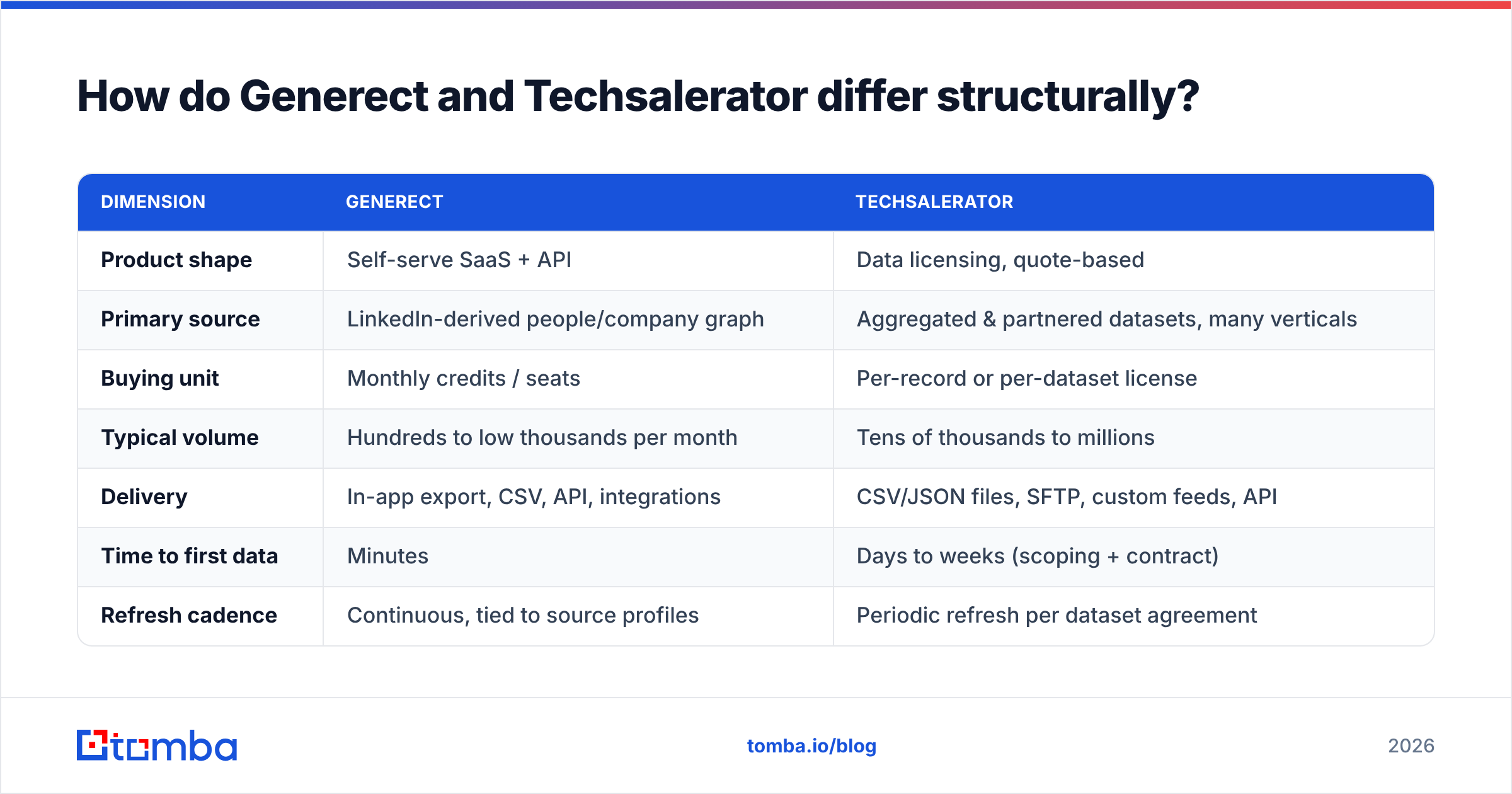
| Dimension | Generect | Techsalerator |
|---|---|---|
| Product shape | Self-serve SaaS + API | Data licensing, quote-based |
| Primary source | LinkedIn-derived people/company graph | Aggregated & partnered datasets, many verticals |
| Buying unit | Monthly credits / seats | Per-record or per-dataset license |
| Typical volume | Hundreds to low thousands per month | Tens of thousands to millions |
| Delivery | In-app export, CSV, API, integrations | CSV/JSON files, SFTP, custom feeds, API |
| Time to first data | Minutes | Days to weeks (scoping + contract) |
| Refresh cadence | Continuous, tied to source profiles | Periodic refresh per dataset agreement |
| Geographic strength | Strong where LinkedIn penetration is high | Broad global coverage, incl. non-LinkedIn markets |
| Best for | SDR teams, agencies, founders prospecting | Data teams, market research, ABM at scale |
Read that table as a fork in the road. If your motion is "10 reps, 50 fresh accounts each per week," a licensing contract is friction you do not need. Building a scoring model or mapping a market in Southeast Asia? A self-serve credit plan will run out first.
Generect vs Techsalerator: which has better data accuracy?#
Accuracy is the wrong single number to argue about. Split it into four things you can measure. Vendors quote whichever one flatters them.
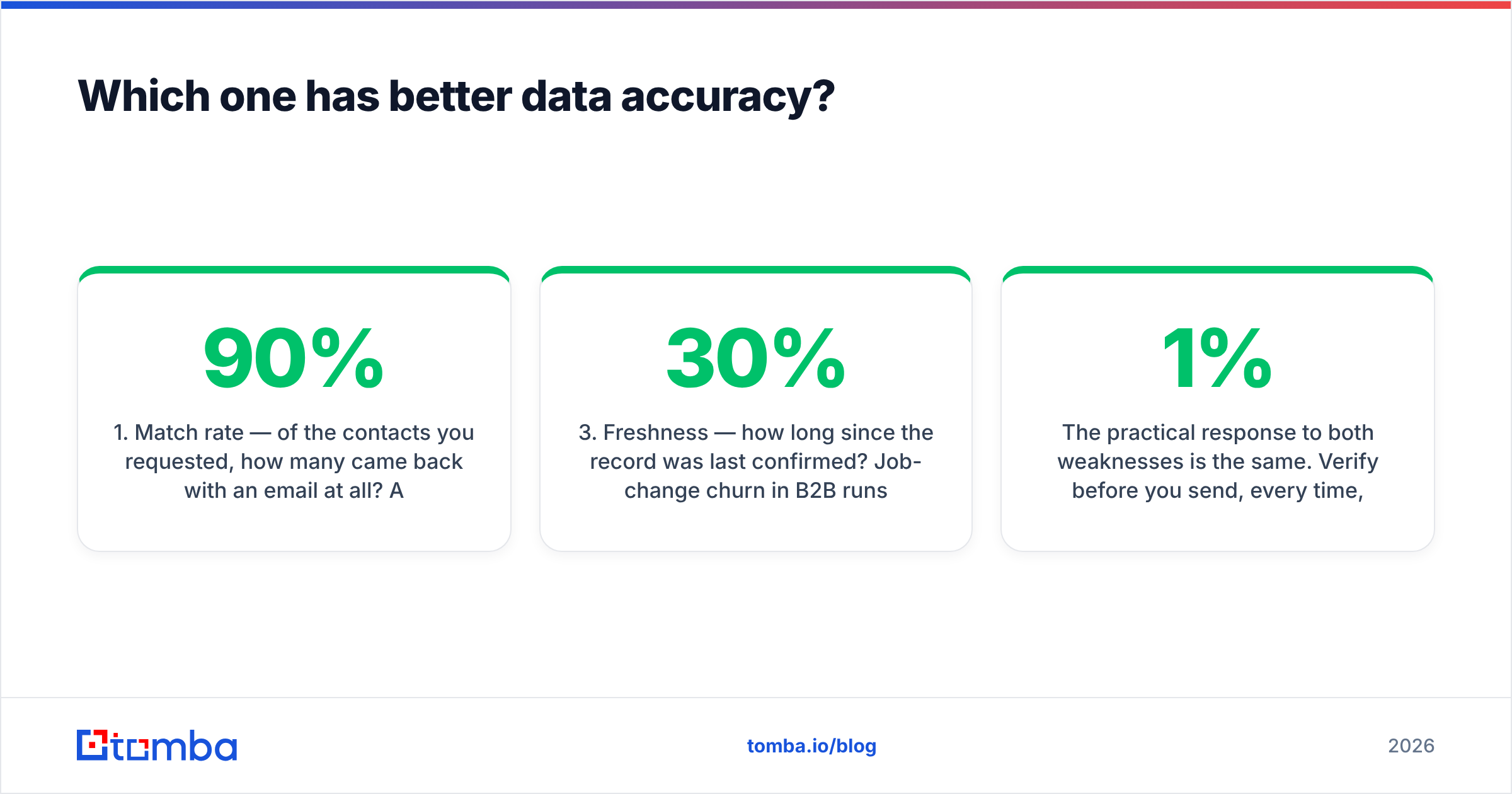
- Match rate — of the contacts you asked for, how many came back with an email? A 90% match rate with 60% deliverability is worse than 60/95.
- Deliverability — how many of those emails survive SMTP checks without bouncing? This is the number your domain reputation cares about.
- Freshness — when was the record last confirmed? Job changes hit 20–30% of B2B contacts each year. A two-year-old file is a third wrong before you send.
- Field completeness — an email with no title or company size is both a bounce risk and a dead end for personalization.
Generect's edge is freshness on the people side. Profiles that people maintain themselves decay slower than stored snapshots. Its weakness is the one every LinkedIn-derived source has: coverage drops where professionals do not keep profiles. Think regional manufacturing, trades, much of Japan, and a lot of LATAM SMB.
Techsalerator's edge is breadth. Need Vietnamese logistics firms or Nordic healthcare buyers? A licensing house that aggregates registry data and partner feeds usually wins there. Its weakness is that a delivered file is a snapshot. It was right on the extraction date, and nobody re-checks it later unless the contract says so.
The fix for both weaknesses is the same. Verify before you send, every time. Run any purchased file through an email verifier before it reaches your sequencer.
That one step separates a 1% bounce rate from a burned sending domain. Ask both vendors for a 100–500 record sample. Verify it yourself, then compare the post-verification usable count. That is the only accuracy number that matters.
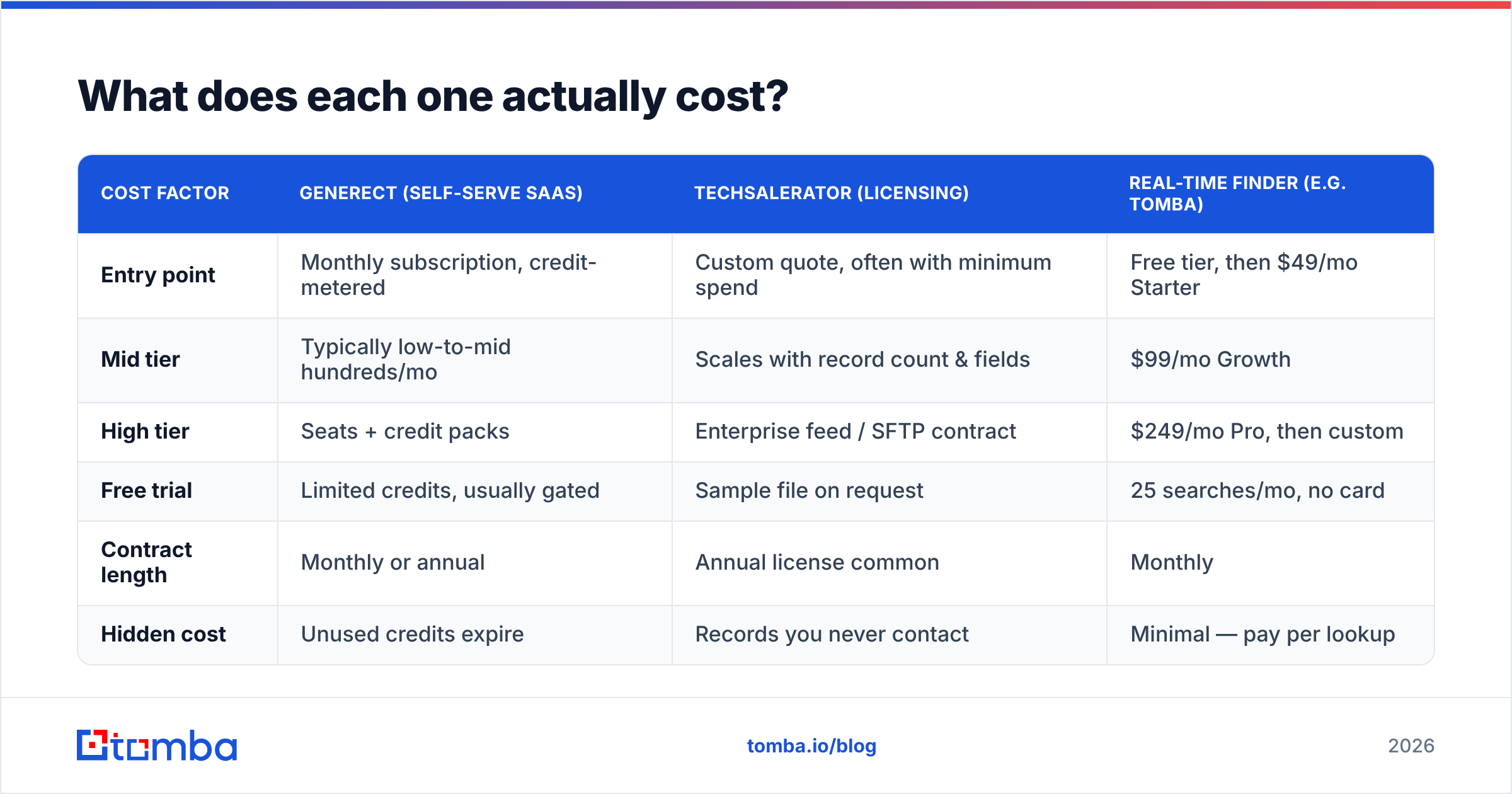
What does each one actually cost?#
Neither vendor makes this easy. Here is how to model it, rather than quote numbers that go stale.
| Cost factor | Generect (self-serve SaaS) | Techsalerator (licensing) | Real-time finder (e.g. Tomba) |
|---|---|---|---|
| Entry point | Monthly subscription, credit-metered | Custom quote, often with minimum spend | Free tier, then $49/mo Starter |
| Mid tier | Typically low-to-mid hundreds/mo | Scales with record count & fields | $99/mo Growth |
| High tier | Seats + credit packs | Enterprise feed / SFTP contract | $249/mo Pro, then custom |
| Free trial | Limited credits, usually gated | Sample file on request | 25 searches/mo, no card |
| Contract length | Monthly or annual | Annual license common | Monthly |
| Hidden cost | Unused credits expire | Records you never contact | Minimal — pay per lookup |
Two budgeting rules save people from bad deals here:
- Price per usable record, not per delivered record. If a 50,000-record file costs $6,000 and 38% fails verification, your real cost is about $0.19 per contactable person — not $0.12. Run that math before you sign, using the sample.
- Match the commitment to the decay curve. Buy 12 months of data upfront and roughly 25% goes stale in that window. Smaller, more frequent pulls almost always win.
For a floor price on the self-serve end, Tomba pricing runs Free (25 searches/month), Starter at $49/mo, Growth at $99/mo, and Pro at $249/mo. Weigh that against any four-figure licensing minimum.
Who should choose Generect?#
Pick Generect if most of these are true:
- Your ICP is LinkedIn-visible. SaaS, agencies, professional services, and tech roles in North America and Western Europe.
- You prospect continuously. Weekly list building beats quarterly file drops.
- You want self-serve control. No procurement cycle, no scoping call, no waiting on a delivery team.
- Your volume is modest. Under a few thousand contacts a month, a subscription beats licensing minimums.
- Titles matter more than firmographic depth. You target people, not company models.
The failure mode: a team buys the subscription, then finds its target vertical barely exists in the source graph. Construction subcontractors, independent pharmacies, and regional freight are common blind spots. Test your exact ICP during the trial. A generic "VP of Marketing, United States" search proves nothing.
Who should choose Techsalerator?#
Pick Techsalerator if most of these are true:
- You need volume in one shot. Building a CRM from scratch, seeding an ABM platform, or feeding a propensity model.
- Your market is off the beaten path. Emerging markets, non-English regions, or verticals with few social profiles.
- You need non-standard fields. Financials, POI, mobile identifiers, or industry attributes that prospecting tools do not carry.
- You have a data function. Someone must ingest, dedupe, and validate a raw file. Without that person, a big file is a liability.
- Compliance review is part of your process. Licensing contracts document provenance and usage terms, which helps under GDPR or CCPA scrutiny.
The failure mode: a five-person startup signs a licensing deal, gets 200,000 records, cleans none of them, and emails the lot. Bounce rates spike and the domain gets throttled. The file takes the blame for an operations gap.
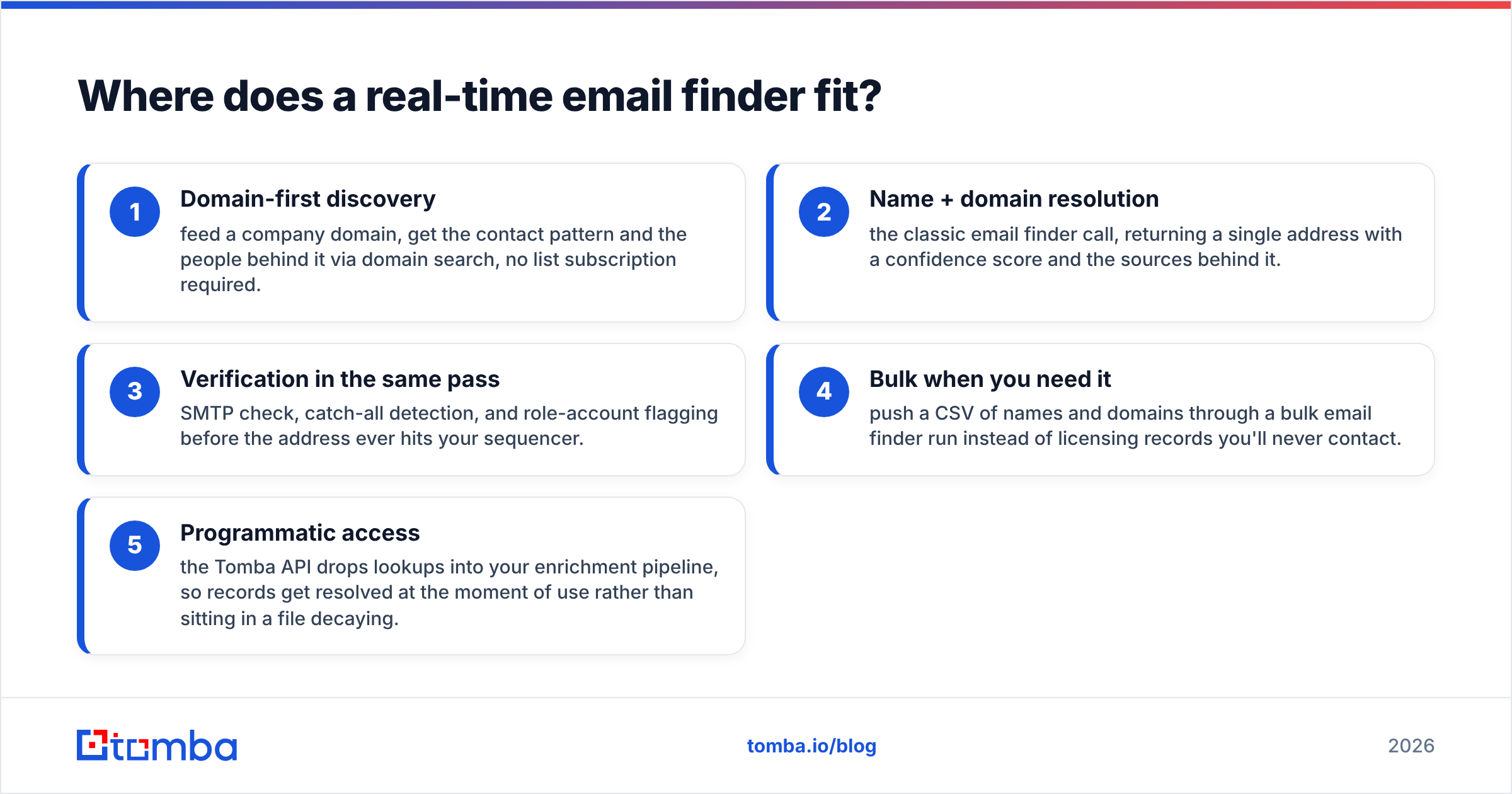
Where does a real-time email finder fit?#
Here is the case neither vendor covers well. You already know who you want. The account list came from a conference, an intent tool, your CRM, or a scraped speaker page. You do not need discovery. You need a verified address for firstname lastname @ knowndomain.com, right now.
That is a lookup problem. Lookup tools solve it for a fraction of either price:
- Domain-first discovery — feed a company domain and get the contact pattern and the people behind it via domain search. No list subscription needed.
- Name + domain resolution — the classic email finder call. It returns one address with a confidence score and its sources.
- Verification in the same pass — SMTP check, catch-all detection, and role-account flags before the address hits your sequencer.
- Bulk when you need it — push a CSV of names and domains through a bulk email finder run instead of licensing records you will never contact.
- Programmatic access — the Tomba API resolves records at the moment of use, so nothing sits in a file and decays.
Many teams end up running a hybrid. They license from a provider or a peer like BookYourData for large one-off pulls, then use a real-time finder for daily work. The two costs do not overlap, and the finder keeps the file honest as it ages.

What should you ask on the demo call?#
Use the same script for both vendors. The answers separate them faster than any feature page.
- "Can I have a 300-record sample matching my exact ICP filters?" Not a generic sample. Yours. A "no" tells you plenty.
- "What is your measured bounce rate on that sample?" Some vendors credit back bounced records. Get it in writing.
- "When was each record last verified, and is that date a field?" A
last_verified_atcolumn is the most useful field in any B2B dataset. - "What happens to unused credits, and does the contract auto-renew?" These are the two most common billing surprises here.
- "Where does the data come from, and what is the legal basis?" Check the answer against public sources. Review sites like G2 show patterns in how vendors handle compliance complaints.
Run the sample through your own verification stack before the second call. Bring the numbers to the table. It turns a feature debate into a unit-economics debate, and that is where you have leverage.
Generect vs Techsalerator: which one wins?#
There is no universal winner. Any post that declares one is selling something.
Choose Generect if you prospect continuously into LinkedIn-visible markets and want to skip procurement. Freshness and self-serve speed are the real wins.
Choose Techsalerator if you need volume, unusual geographies, or fields no prospecting tool carries — and you have the data operations capacity to use a licensed file.
Choose neither if your real bottleneck is turning known names and domains into verified, deliverable addresses. That is the most common case, and the cheapest to fix. Before signing a four-figure data contract, spend a week testing whether a real-time lookup layer plus contact enrichment covers 80% of the job.
Start with the Tomba Email Finder. The free tier gives you 25 searches a month with no card. Run your ICP through a real workflow and measure your true match and deliverability rates first. If it holds up, Starter at $49/mo covers most one- to three-rep teams. If it does not, you walk into the Generect vs Techsalerator sales call with your own benchmark numbers instead of theirs.
Related guides#
Ready to find emails that actually work?
Join 150,000+ professionals who stopped guessing and started sending. Free credits on signup — no credit card required.
Get the Tomba newsletter
Practical outbound tactics and product updates — once every two weeks.
About the author