Generect vs The Org: B2B Contact Data Compared (2026)
Generect sells API-first B2B contact data. The Org publishes free company org charts. They solve different halves of the same prospecting problem — here's which one you actually need, and when you need both.
Generect vs The Org is not a fair fight, because the two tools do different jobs. Generect sells B2B contact data through an API. The Org maps company org charts for free. This guide shows which one you need, and when you need both.
TL;DR
- Generect is a paid, API-first B2B data provider. You send a query. It returns company and people records with work emails and phone numbers. It is built for engineers and RevOps teams that pipe data into a CRM or sequencer.
- The Org is a free, public directory of company org charts. It shows who reports to whom — names, titles, and structure. It is not a contact-data vendor, so it will not hand you a verified work email.
- They are not really competitors. Comparing Generect vs The Org is like comparing a pipe to a map. The map shows you who matters. The pipe gives you a way to reach them.
- Need volume and automation? Then you need a contact-data source. Need account mapping for big deals? Then org-chart data is worth more than another 10,000 emails.
- The cheapest combo for most small teams: use The Org (free) to find the right title. Then run that name through a dedicated email finder and verifier before you send.
Why are people comparing Generect vs The Org?#
Both names show up when you search for "B2B people data." The results rarely explain that Generect vs The Org is a contrast, not a contest. The two tools sit at opposite ends of the same workflow.
Prospecting has two problems. The first is targeting. Out of 4,000 employees at a target account, which seven people shape this purchase? The second is reachability. You know it is Priya in Revenue Operations. So what is her email address, and does it bounce?
Generect solves problem two, with some targeting filters on top. The Org solves problem one, and stops there on purpose. Teams that buy one and expect the other end up unhappy. Then they blame the vendor.
So the honest way to frame Generect vs The Org is not "which tool is better." It is "which half of my data problem is still open, and what is the cheapest way to close it without hurting deliverability."

What does Generect actually do?#
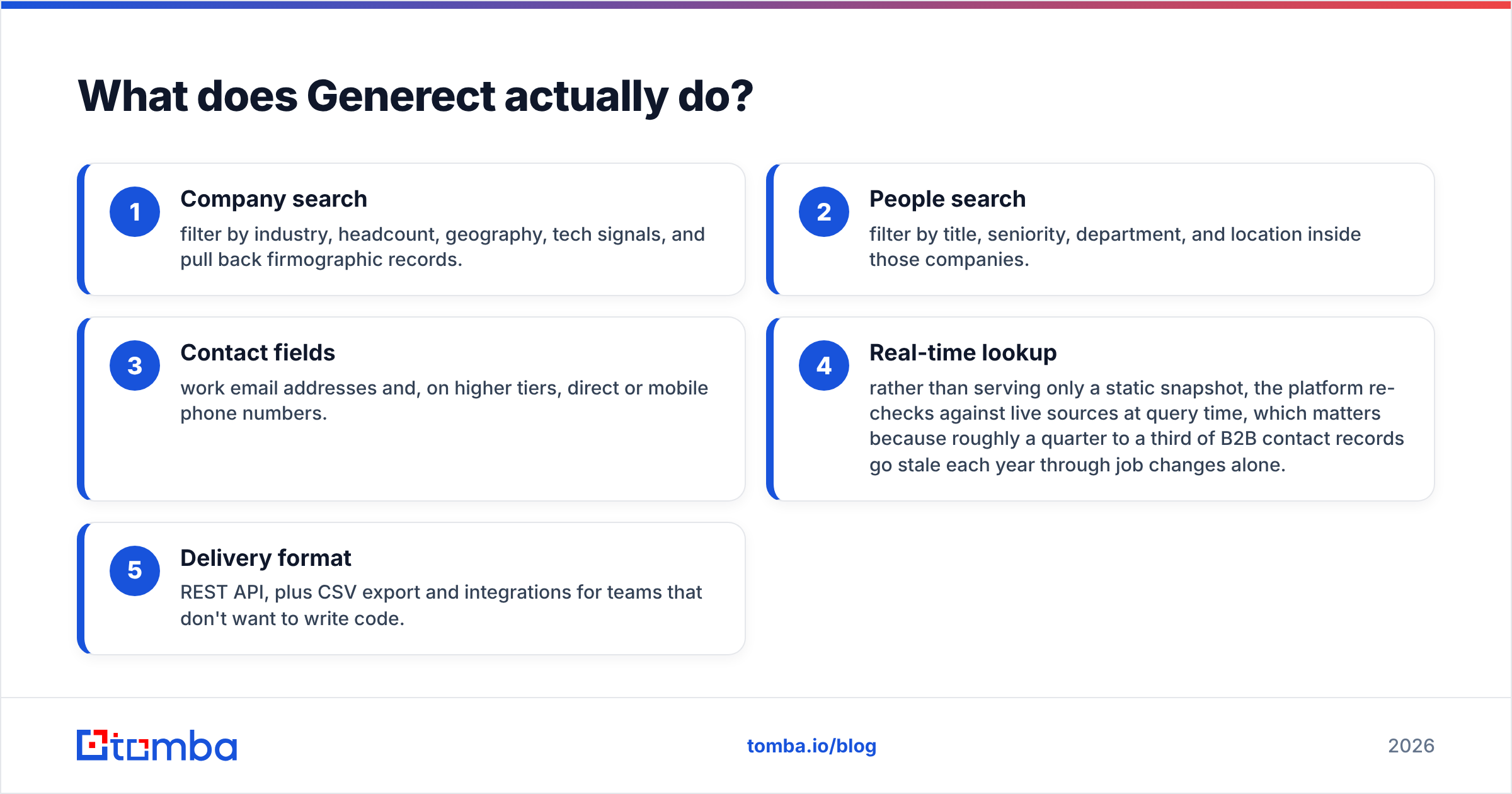
Generect is a B2B lead data platform. Its main selling point is API-first delivery. You do not build lists by hand in a UI. Your systems query it in code instead, and get back structured records for companies and people.
What you usually get from a provider in this class:
- Company search — filter by industry, headcount, geography, and tech signals, then pull back company records.
- People search — filter by title, seniority, department, and location inside those companies.
- Contact fields — work email addresses, plus direct or mobile phone numbers on higher tiers.
- Real-time lookup — the platform checks live sources at query time. That matters. Roughly a quarter to a third of B2B contact records go stale each year from job changes alone.
- Delivery format — REST API, plus CSV export and integrations for teams that do not want to write code.
The case for a tool like this is simple. It takes the human out of list building. If your ICP is clear and your sequencer is hungry, fresh contacts on demand beat a prettier dashboard.
The caveats are the same ones every API-first data vendor carries. Pricing is usually quote-based, not a public self-serve card. So you face a sales cycle and an annual commitment before you know the coverage fits your market.
Coverage also varies by region. Most providers are strongest in North America and Western Europe. They are much thinner in APAC, LATAM, and non-English markets. Ask for a coverage sample against your target list before you sign, not a generic demo file.
What does The Org actually do?#
The Org is a free, public directory of org charts. Companies claim their profile and add their leaders and team structure. The result is a tree you can browse: CEO on top, function leaders below, teams under them.
For account-based selling, that data is genuinely useful. Most contact databases do not carry it. A record that says "Director of Marketing Operations" gives you a title. An org chart shows that this director reports to a VP of Demand Gen, who reports to a CMO who joined four months ago. That is the gap between a generic pitch and a message that lands.
What The Org gives you:
- Reporting structure for companies that have claimed and updated their profile.
- Named people with titles, often including new hires and leadership changes.
- Company overview data — sector, size, location, and sometimes funding context.
- Free access for browsing. Paid tiers aim at employers and recruiters, not outbound sales.
What it does not give you:
- Verified work email addresses.
- Phone numbers.
- Bulk export of thousands of contacts into your CRM.
- Guaranteed freshness. Coverage depends on whether the company claims and updates its page. Big tech and funded startups are well covered. A 60-person manufacturer in Ohio is probably not.
Treat The Org like a company About page or a well-kept LinkedIn profile. It is great research input. It is useless as a sending list.
How do Generect and The Org compare head-to-head?#
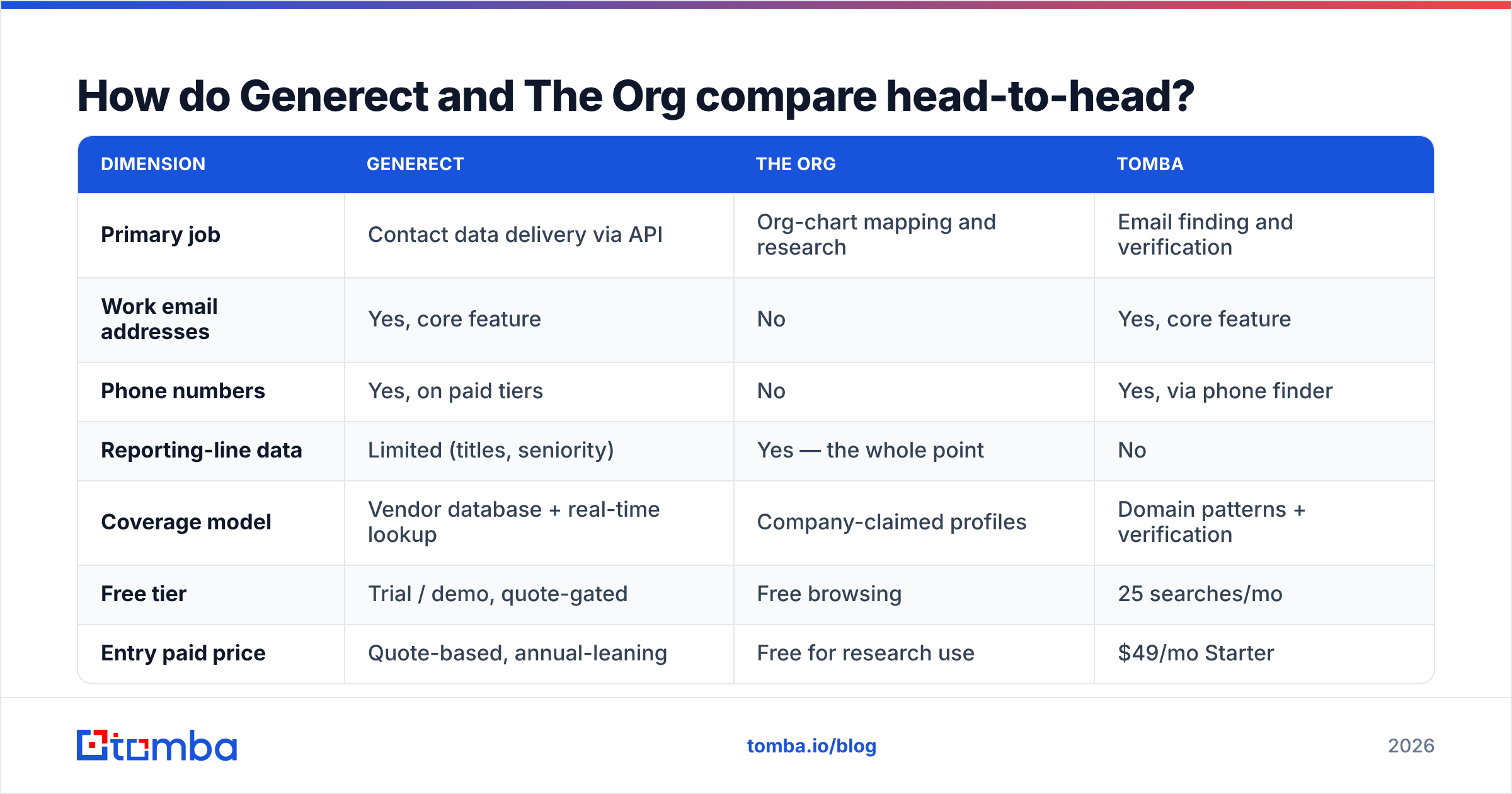
Here is Generect vs The Org side by side, with Tomba as a third reference point.
| Dimension | Generect | The Org | Tomba |
|---|---|---|---|
| Primary job | Contact data delivery via API | Org-chart mapping and research | Email finding and verification |
| Work email addresses | Yes, core feature | No | Yes, core feature |
| Phone numbers | Yes, on paid tiers | No | Yes, via phone finder |
| Reporting-line data | Limited (titles, seniority) | Yes — the whole point | No |
| Coverage model | Vendor database + real-time lookup | Company-claimed profiles | Domain patterns + verification |
| Free tier | Trial / demo, quote-gated | Free browsing | 25 searches/mo |
| Entry paid price | Quote-based, annual-leaning | Free for research use | $49/mo Starter |
| API access | Yes, API-first design | Limited / partner-level | Yes, on all paid plans |
| Bulk export | Yes | No | Yes, bulk finder and verifier |
| Best for | Automated outbound at volume | Enterprise account mapping | Targeted, verified sending |
The table makes the point. Only one column says yes in the reporting-line row. Only two say yes in the work-email row. These products overlap on almost nothing.
Which one gives you contactable, low-bounce emails?#
Generect, of the two. The Org is not in that business at all. But "gives you emails" and "gives you emails that land" are two different claims. This is where most B2B data buying goes wrong.
Every contact database carries three kinds of records, even the good ones:
- Verified — the address was checked against the receiving mail server recently.
- Pattern-guessed — the provider knows the company uses
first.last@domain.comand builds the address. Often right. Sometimes badly wrong. - Stale — correct 18 months ago. It bounces now, because the person changed jobs.
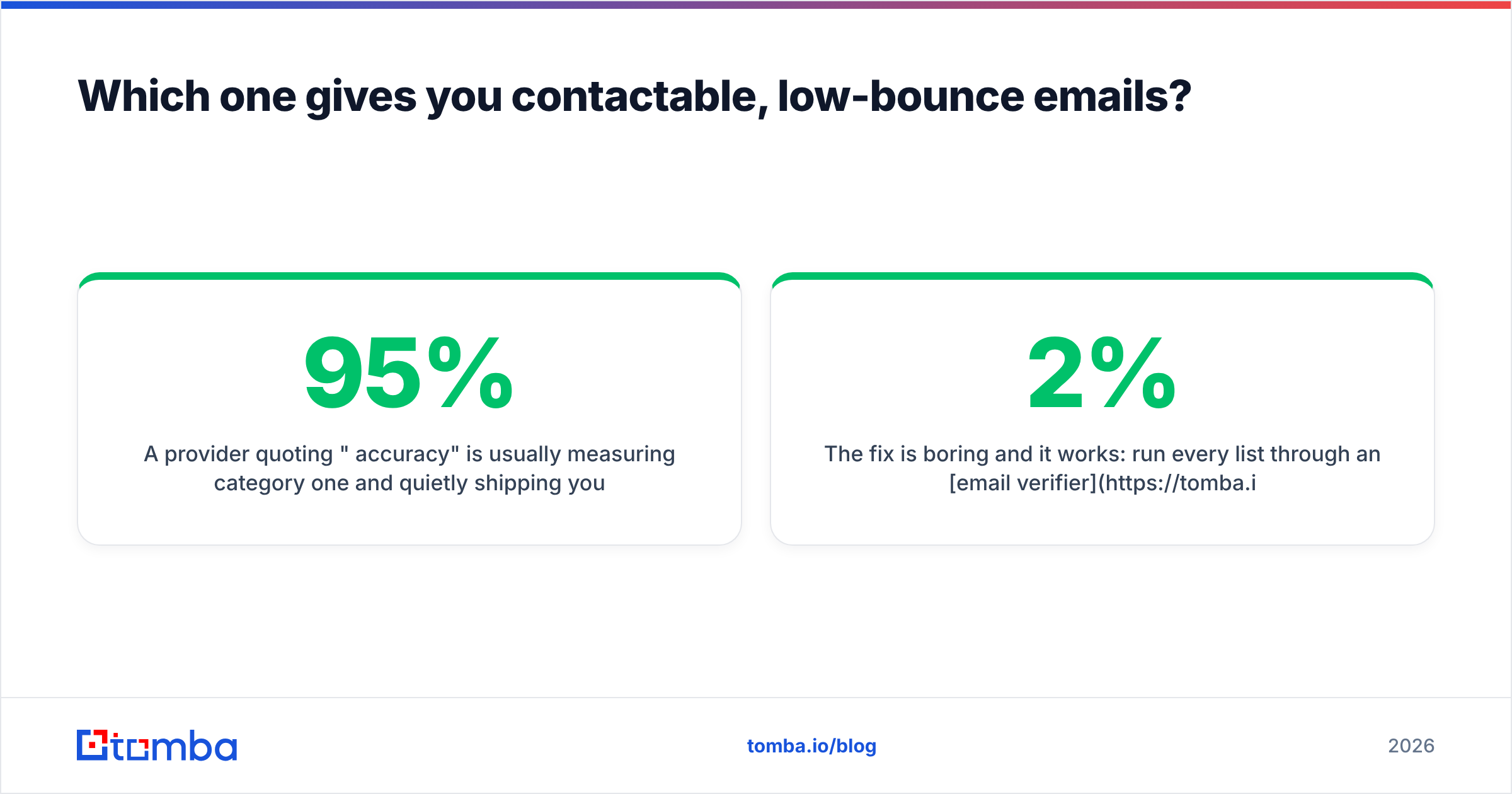
A vendor that quotes "95% accuracy" usually measures the first group. It still ships you some of the other two. Send to a raw export with no check of your own, and your bounce rate climbs. Your sender reputation drops. Inbox placement then falls for every later campaign, including the ones with clean data.
The fix is boring, and it works. Run every list through an email verifier from a different vendor than the one that sold you the list. A second opinion costs cents per record. It protects a domain you spent a year warming up. Keep hard bounces under 2%. Drift above 5% and you are doing real damage.
Some domains are catch-all. The mail server accepts every address and tells you nothing. For those, use a catch-all verifier that reads other signals instead of a simple SMTP handshake. Many enterprise domains are catch-all, so "unverifiable" is not an edge case.
What should you actually pay for this?#
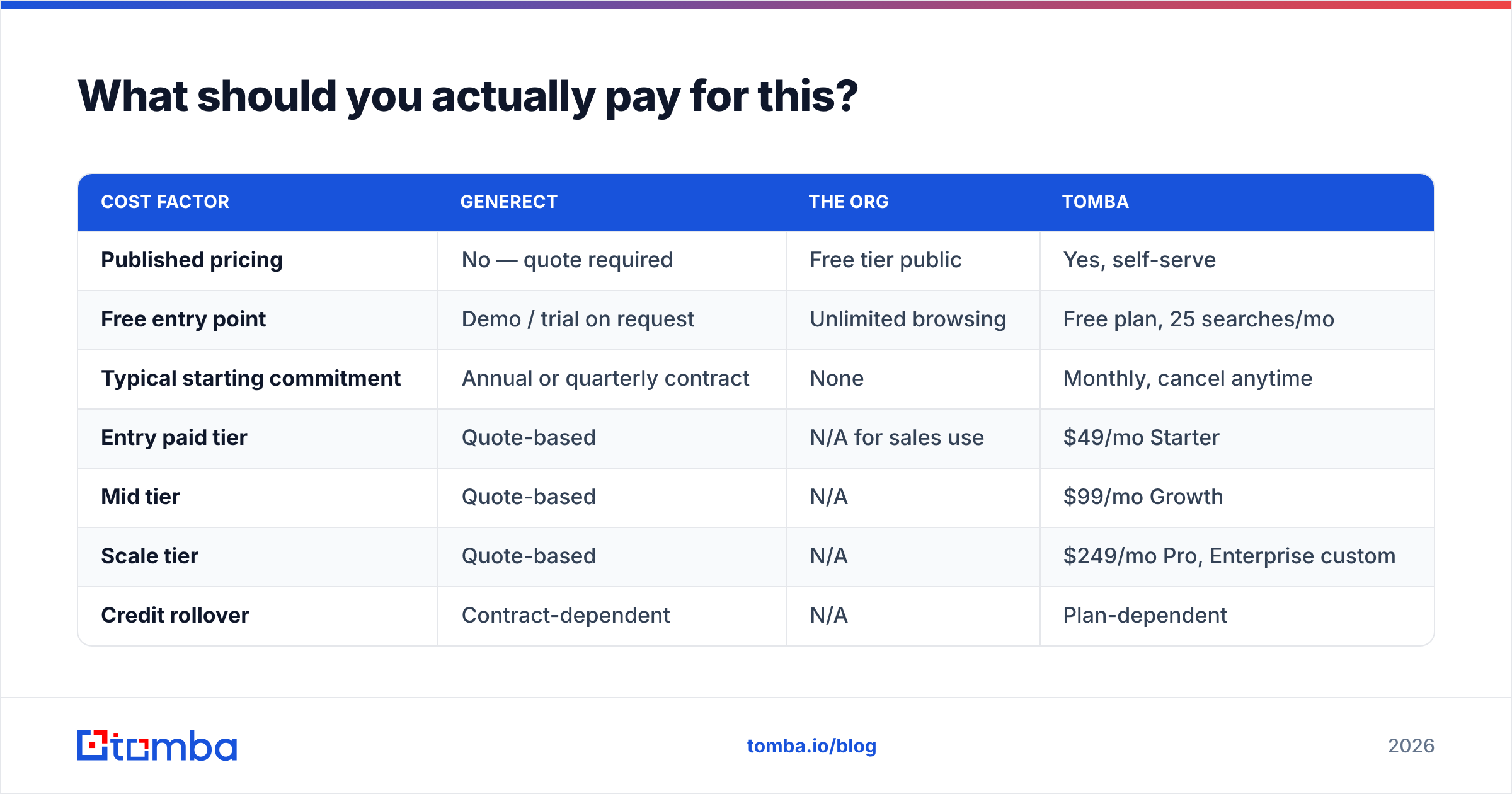
Generect vs The Org also split on price transparency. Pricing views differ more than features do.
| Cost factor | Generect | The Org | Tomba |
|---|---|---|---|
| Published pricing | No — quote required | Free tier public | Yes, self-serve |
| Free entry point | Demo / trial on request | Unlimited browsing | Free plan, 25 searches/mo |
| Typical starting commitment | Annual or quarterly contract | None | Monthly, cancel anytime |
| Entry paid tier | Quote-based | N/A for sales use | $49/mo Starter |
| Mid tier | Quote-based | N/A | $99/mo Growth |
| Scale tier | Quote-based | N/A | $249/mo Pro, Enterprise custom |
| Credit rollover | Contract-dependent | N/A | Plan-dependent |
Quote-based pricing is not bad by default. At 200,000 records a year, it often beats any self-serve card per record. It is bad when you are a five-person team testing a new segment. You commit before you know the coverage works for your niche.
So here is the practical rule: do not sign an annual data contract until you have tested coverage on 200 real accounts from your own target list. Any vendor confident in its data will let you run that test. If it will not, that is useful information too.
Want a self-serve baseline to compare quotes against? Check current Tomba pricing. Knowing the per-record cost of a monthly plan makes an enterprise quote much easier to negotiate.
Which should you choose for your use case?#
Your Generect vs The Org answer depends on the motion you run:
- You run high-volume outbound (2,000+ sends a month) and have engineers. Go with an API-first contact provider like Generect, or an email finder API if you would rather start self-serve. Add your own verification before send. The Org will not scale here.
- You sell six-figure deals into 50 named accounts. The Org is worth more to you than a bigger database. Map the buying committee. Then find contact details for the few people who matter. Volume tooling is overkill.
- You are a founder prospecting under $200 a month. Use The Org free for research. Then use a self-serve finder for the addresses. Skip quote-gated vendors until you have repeatable results.
- You are a recruiter or talent partner. Org charts are your main asset. Team structure shows who is hireable and who is blocked. Pair The Org with a LinkedIn finder for reachability.
- You are enriching a CRM, not building new lists. Neither tool fits well. What you want is data enrichment that fills gaps on records you already own, matched by domain or email.
Can you use both together?#
Yes. For account-based teams, running Generect vs The Org as a pair is the strongest setup. The workflow:
- Build the account list from your ICP — funding stage, headcount, tech stack, and any other signal that predicts a deal for you.
- Map the buying committee on The Org. For each account, name the economic buyer, the champion, and the blocker. Five minutes per account, at no cost.
- Resolve contact details for those named people with a finder. Do not pull a department-wide export. You want 6 right people, not 60 rough ones.
- Verify before sending. Every address, every time, in a separate step.
- Enrich and log to CRM so the reporting-line intel from step two lives in the record, not in a browser tab.
That order gives you smaller lists and far better reply rates. The message can point to a real structure. "Saw you moved under the new CRO in March" beats anything a template writes. Buyers on G2 rate data tools on coverage and accuracy, not feature count. This workflow aims at exactly that.
What's the verdict on Generect vs The Org?#
The verdict depends on your bottleneck. They win different arguments.
Generect wins if your bottleneck is throughput. You know your ICP, your sequencer is hungry, and you need thousands of fresh records delivered in code. Get a real coverage sample for your own market before you commit. And never treat a vendor's accuracy claim as a substitute for your own check.
The Org wins if your bottleneck is intelligence. Fewer accounts, bigger deals, and messages that must show you understand how the company is wired. It costs nothing, so it adds to any stack.
Neither wins if you just wanted a simple way to turn a name and a company domain into a verified email. No sales call. No annual contract. That is a third category, and it is where most teams' real gap sits.
If that sounds like you, start with the Tomba Email Finder. The free plan gives you 25 searches a month, so you can test coverage on your own target accounts before you spend a cent.
Starter runs $49/mo when you are ready to scale. Verification and catch-all handling live in the same platform, so you are not stitching a finder, a verifier, and a CSV cleaner together to send one campaign. Map the org chart wherever you like. Get the addresses from something you can test today.
Related guides#
Ready to find emails that actually work?
Join 150,000+ professionals who stopped guessing and started sending. Free credits on signup — no credit card required.
Get the Tomba newsletter
Practical outbound tactics and product updates — once every two weeks.
About the author