Generect vs Truemail 2026: Which B2B Data Tool Wins?
Generect sells lead data. Truemail sells verification. They get compared constantly, but they solve different halves of the same problem — here is how each one actually performs, what they cost, and which belongs in your stack.
TL;DR
- They are not the same category. Generect is a lead-data and LinkedIn-sourced contact API. Truemail is primarily an email verification service with a lighter finder attached. Comparing them one-to-one only makes sense if you are trying to solve "get valid emails" end to end.
- Generect wins on discovery. If you need to build a list from scratch — job titles, company filters, LinkedIn URLs in, contacts out — Generect is the more natural fit.
- Truemail wins on cleaning. If you already have a list and your bounce rate is embarrassing, Truemail's verification pipeline is cheaper per record and simpler to operate.
- Neither is a complete stack alone. Most teams end up paying twice: once to find, once to verify. That is the real cost comparison nobody puts in the table.
- Budget reality: verification is a commodity priced in fractions of a cent. Discovery is not. Spend your money accordingly.
What is Generect and who is it for?#
Generect positions itself as a B2B lead-generation data provider with an API-first delivery model. The pitch: give it a set of filters — industry, headcount, seniority, geography, or a raw LinkedIn URL — and it returns structured contact records, including work emails and company firmographics. It leans heavily on LinkedIn-derived data, which is why it shows up in conversations about scraping alternatives and lead-list builders rather than in conversations about email hygiene.
The typical buyer is an agency or an outbound team that builds lists programmatically. You are not logging into a dashboard to search one person at a time; you are hitting an endpoint from a script, an n8n workflow, or a Clay table, and pushing results into a sequencer.
That model has two consequences. First, output volume can be very high, very fast. Second, you own the quality problem. A discovery API that returns 4,000 rows has no incentive to tell you that 700 of them are stale, role-based, or belong to people who left the company eight months ago.
What is Truemail and what does it actually do?#
Truemail comes at the same problem from the opposite end. Its core product is email verification: you upload a list or call the API, and it returns a status for each address — valid, invalid, risky, catch-all, disposable, role-based. It also offers an email-finder feature and bulk processing, but verification is the centre of gravity and the reason people buy it.
Verification is a multi-step technical process, not a single check. A serious verifier runs syntax validation, domain and MX record lookups, disposable-domain matching, role-account detection, and an SMTP-level handshake that asks the receiving server whether the mailbox exists without actually delivering a message. Truemail does all of that, and its pricing is structured the way commodity verification usually is — pay-as-you-go credit packs plus subscription tiers, with per-email costs dropping sharply at volume.
The gap in Truemail's story is upstream. If you have no list, verification gives you nothing to verify.

How do Generect and Truemail compare head-to-head?#
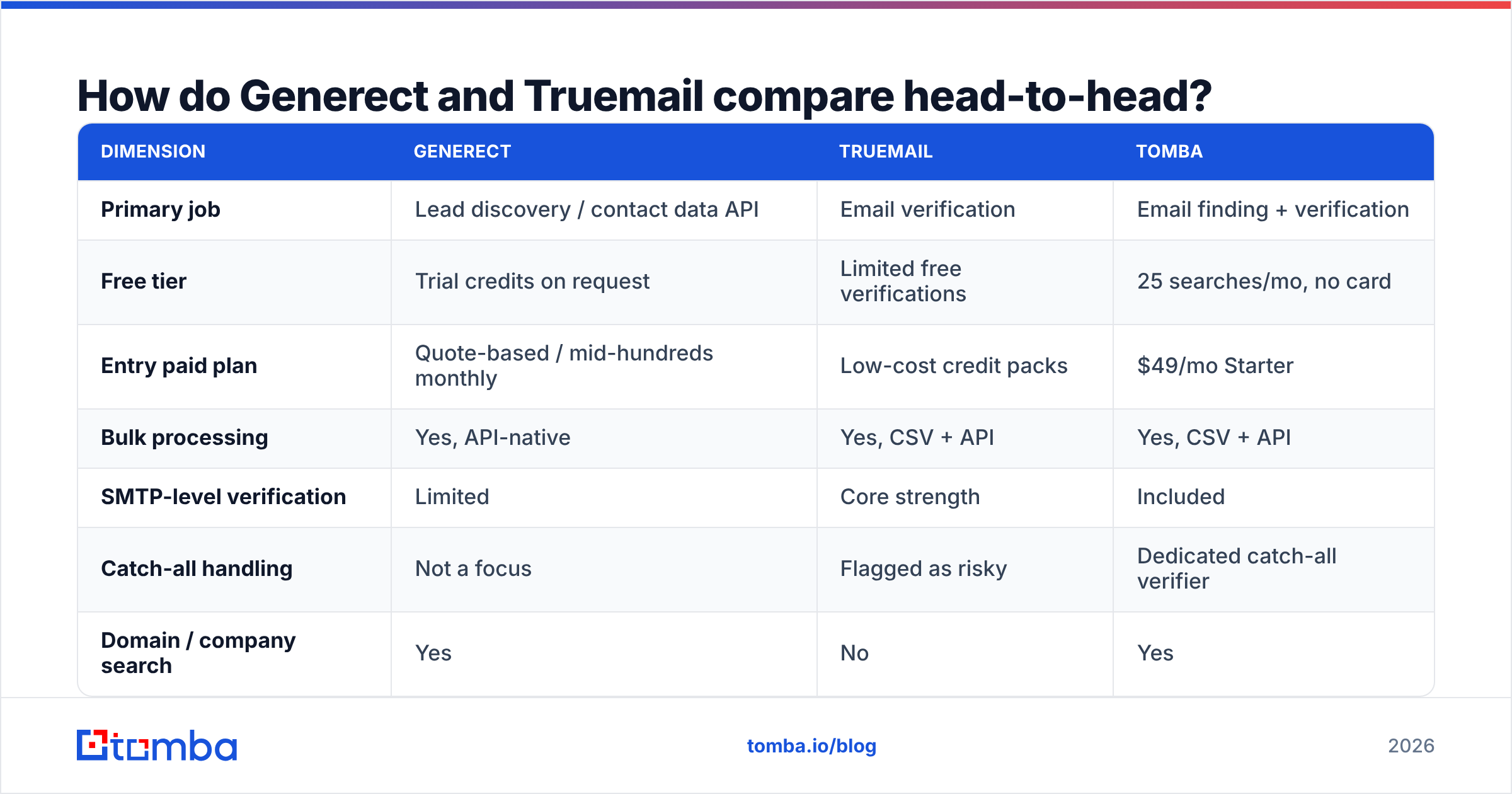
Here is the honest side-by-side. Treat any pricing figure as directional — both vendors adjust plans, and you should confirm on their own pricing pages before you commit a budget.
| Dimension | Generect | Truemail | Tomba |
|---|---|---|---|
| Primary job | Lead discovery / contact data API | Email verification | Email finding + verification |
| Free tier | Trial credits on request | Limited free verifications | 25 searches/mo, no card |
| Entry paid plan | Quote-based / mid-hundreds monthly | Low-cost credit packs | $49/mo Starter |
| Bulk processing | Yes, API-native | Yes, CSV + API | Yes, CSV + API |
| SMTP-level verification | Limited | Core strength | Included |
| Catch-all handling | Not a focus | Flagged as risky | Dedicated catch-all verifier |
| Domain / company search | Yes | No | Yes |
| LinkedIn-based lookup | Core strength | No | Yes |
| Phone numbers | Partial | No | Yes |
| Native CRM integrations | Via API / automation platforms | Limited | HubSpot, Salesforce, Pipedrive, Zapier |
| Best for | Building lists from filters | Cleaning lists you already have | Doing both in one credit pool |
Two things jump out. Generect and Truemail overlap on maybe 20% of their surface area — mostly the "we also have an email finder" claim that both make. And neither covers the full find-then-verify loop as cleanly as a combined tool does.

Which one gives you more valid emails?#
Wrong question, and it is the question most comparison posts answer badly. "Valid emails delivered" is a function of two multiplied numbers:
- Match rate — of the contacts you asked for, how many came back with any email at all?
- Accuracy rate — of the emails that came back, how many actually accept mail?
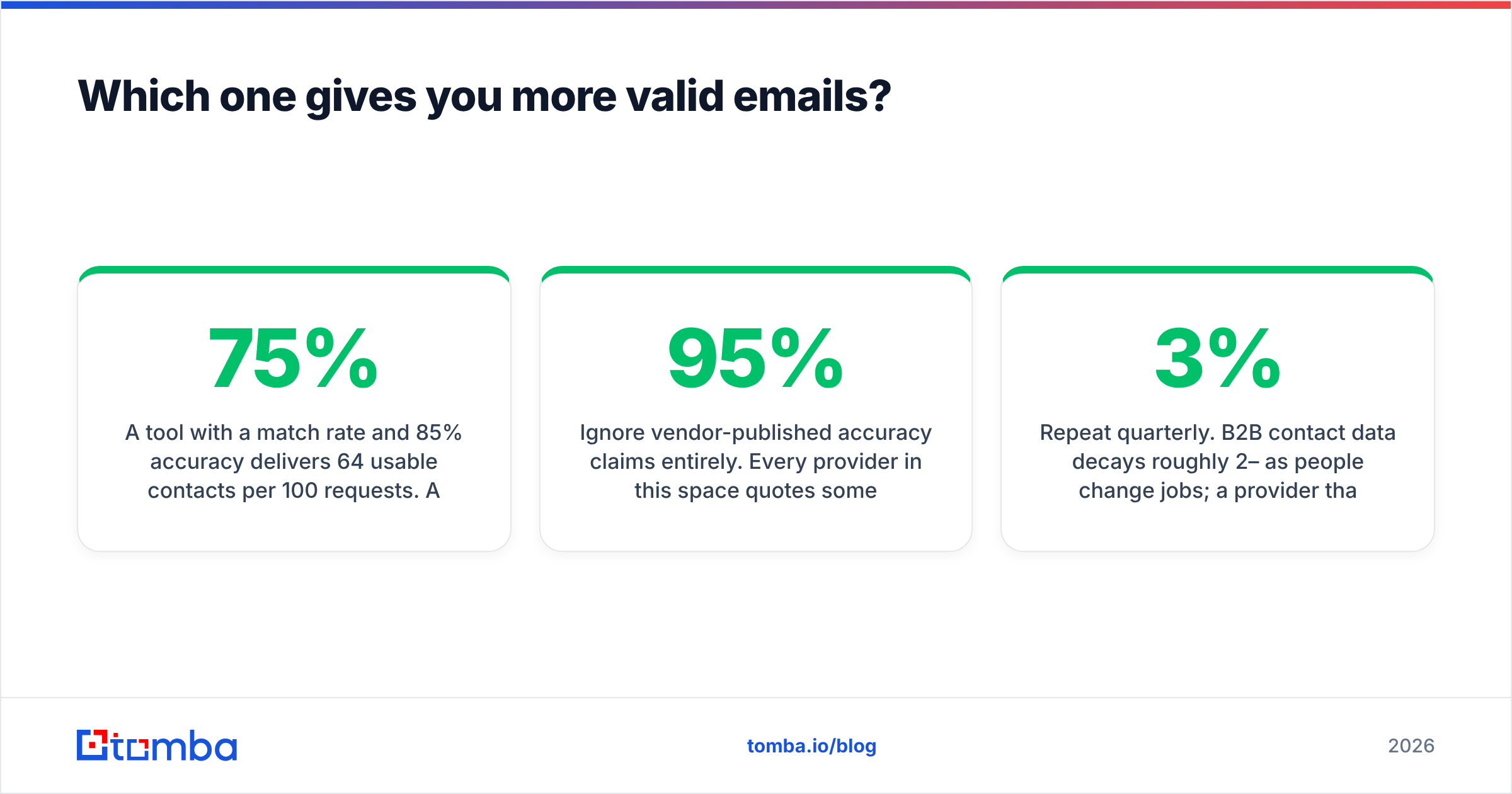
A tool with a 75% match rate and 85% accuracy delivers 64 usable contacts per 100 requests. A tool with a 55% match rate and 97% accuracy delivers 53. The first one looks worse on the accuracy chart and is better for your pipeline.
Generect optimises for the first number. Truemail optimises for the second. That is not a flaw in either — it is their product design showing through.

Ignore vendor-published accuracy claims entirely. Every provider in this space quotes something between 95% and 99%, measured on their own sample, using their own definition of "valid." Run your own test instead:
- Build one control list of 200 contacts you can independently confirm — customers, past leads, people whose addresses appear on their company site.
- Run the same list through both tools on trial credits. Do not use different lists; the comparison collapses immediately if you do.
- Count three buckets, not one: found and correct, found and wrong, not found. The middle bucket is the expensive one — a wrong address costs you a bounce, a wrong address at scale costs you your domain.
- Send a real 100-address campaign through your ESP and measure the actual hard-bounce rate. That number is the only one that matters.
- Repeat quarterly. B2B contact data decays roughly 2–3% per month as people change jobs; a provider that tested well last year is not automatically fine today.
If you want a shortcut on the second half, our email verifier runs the same SMTP-level checks and will happily grade a list you sourced from anywhere else, including Generect.
What does each one really cost per usable contact?#
The sticker price on a verification plan is almost never the number that matters. Work in cost-per-usable-contact instead.
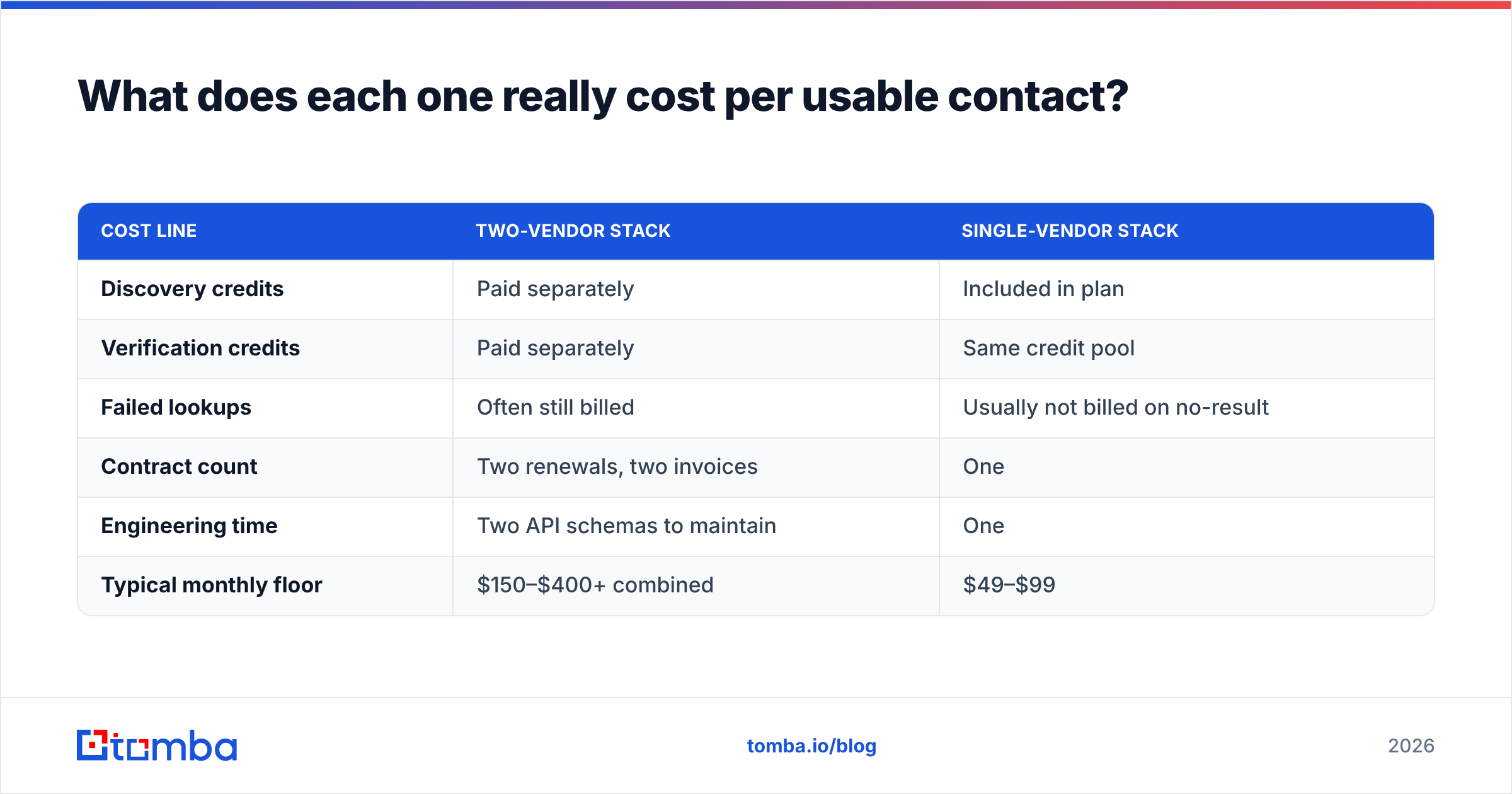
Say you need 5,000 verified prospects this quarter. With a discovery-only tool at a 70% match rate, you need to request roughly 7,150 records. Then you push those 5,000 found addresses through a verifier, which typically fails another 10–15% as invalid, risky, or catch-all. You are now at about 4,300 mailable contacts — and you paid for 7,150 discovery credits plus 5,000 verification credits to get there.
| Cost line | Two-vendor stack | Single-vendor stack |
|---|---|---|
| Discovery credits | Paid separately | Included in plan |
| Verification credits | Paid separately | Same credit pool |
| Failed lookups | Often still billed | Usually not billed on no-result |
| Contract count | Two renewals, two invoices | One |
| Engineering time | Two API schemas to maintain | One |
| Typical monthly floor | $150–$400+ combined | $49–$99 |
This is the strongest practical argument against running Generect and Truemail side by side: you are paying two vendors, reconciling two credit systems, and writing glue code to move records between them. For a data team with real engineering capacity and volume above six figures of records, that is fine and often optimal. For a five-person sales team, it is overhead disguised as sophistication.
For reference, Tomba pricing runs a free tier at 25 searches per month, Starter at $49/mo, Growth at $99/mo, and Pro at $249/mo, with finding and verification drawing from the same pool — which removes the reconciliation problem entirely.
Which should you choose for your use case?#
Pick by job to be done, not by feature count.
- You are building lists from filters at scale — Generect. Its filter-to-API model is built for exactly this, and no verifier will substitute for it. Budget separately for cleaning the output.
- You have a 30,000-row CSV of unknown quality — Truemail. This is a pure hygiene job, verification is a commodity, and paying commodity prices for it is correct.
- You need both, on a small team, this month — a combined tool. The email finder and verifier sharing one credit pool removes a whole class of operational friction.
- You need verified contacts by industry with instant download — look at a purpose-built database provider. BookYourData is a solid option here; it sells pre-verified, filterable B2B contacts with a bounce guarantee, which is a genuinely different model from either Generect's API or Truemail's verification pipeline, and it suits teams that want a list today rather than an integration project.
- Your bottleneck is catch-all domains — this deserves its own tool. Roughly a fifth of B2B domains accept everything at the gateway, which makes standard SMTP checks useless. A dedicated catch-all verifier is the only thing that moves that number.
- You are enriching inside a CRM or spreadsheet — check native integrations before anything else. An API you have to wrap yourself costs more in engineering hours than the subscription costs in dollars.

How do the APIs and integrations differ?#
Generect is API-first by design. That is a genuine advantage if your workflow already lives in code or in an automation platform. The tradeoff is that the burden of orchestration sits with you: retries, rate limits, deduplication, credit accounting, and quality gating are all yours to build.
Truemail's API is narrower by nature — submit addresses, get statuses back — which makes it easy to bolt onto anything. Bulk CSV upload covers the non-technical path, which matters when the person cleaning the list is an SDR manager, not an engineer.
If you are evaluating on developer experience specifically, read the actual docs before you buy, and check three things: whether failed lookups consume credits, whether bulk jobs are async with webhooks or polling-only, and how rate limits behave under burst. Those three answers determine how much code you write. The Tomba API documents all three up front, and there is a CLI and an MCP server if you would rather not write an HTTP client at all.
Independent user reviews are worth a scan too — G2 carries verified reviews for most tools in this category, and the one-star reviews are consistently more informative than the five-star ones. Look specifically for complaints about credit burn on no-result lookups and about support responsiveness during billing disputes.
What do most teams get wrong about this comparison?#
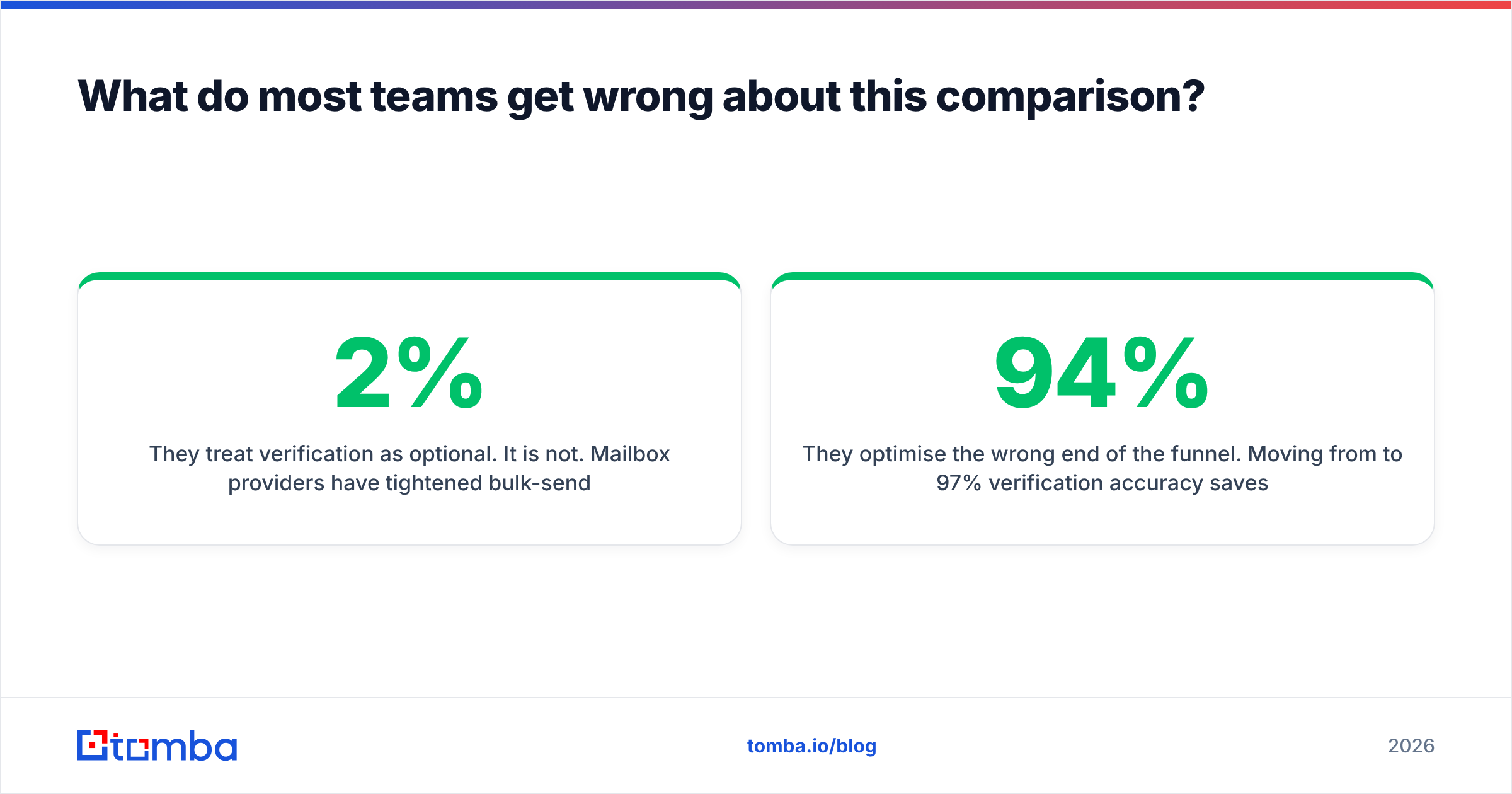
They treat verification as optional. It is not. Mailbox providers have tightened bulk-sender requirements considerably, and a hard-bounce rate above roughly 2% starts damaging your sending domain in ways that take months to repair. Verification is not a quality upgrade; it is the cost of being allowed to send.
They test on a biased sample. Everyone tests with contacts from companies they already know — usually large, well-indexed, US-based tech firms. Every provider looks excellent on that sample. Test on the segment you actually sell to, including the awkward ones: 20-person manufacturers, non-English domains, companies with no LinkedIn presence.
They optimise the wrong end of the funnel. Moving from 94% to 97% verification accuracy saves you three bounces per hundred. Moving from a 55% to a 75% match rate gives you twenty more prospects per hundred. The second lever is four to six times larger and gets a fraction of the attention.
They buy annually before testing. Both vendors offer trials. Use them, on the same list, in the same week. A two-hour test beats any comparison table on the internet, including this one.
The verdict#
Generect if you are building lists. Truemail if you are cleaning them. If you are doing both — which describes most outbound teams — running two vendors is a legitimate architecture but a slow, expensive default.
Start with the Tomba Email Finder. Find, verify, and enrich from one credit pool, test it free on 25 searches without a card, and only add a specialist vendor when you have measured a specific gap it fills. Bring your control list. Let the bounce rate decide.
Related guides#
Ready to find emails that actually work?
Join 150,000+ professionals who stopped guessing and started sending. Free credits on signup — no credit card required.
Get the Tomba newsletter
Practical outbound tactics and product updates — once every two weeks.
About the author