Generect vs Trueverify: Which B2B Data Tool Wins in 2026?
Generect sells you contacts. Trueverify tells you which ones are real. Here is an honest breakdown of where each tool actually earns its keep in 2026 — and where a single provider covers both jobs cheaper.
Generect vs Trueverify is a fair question built on a shaky premise. One tool finds contacts. The other checks whether those contacts are real. Here is what each one does, what each one costs, and when you truly need both.
TL;DR
- Generect and Trueverify are not really competitors. Generect is a lead-sourcing platform built on LinkedIn-derived company and people data. Trueverify sits in the email-validation lane. Comparing them head to head only helps if you are deciding which problem to solve first.
- If your list is empty, sourcing beats validation. If your bounce rate is above 4%, validation beats sourcing. Do them in that order and you stop wasting credits.
- Running both means two contracts, two credit pools, and two APIs. It also means two places where a record can go stale between the find and the send.
- A consolidated provider — Tomba, Findymail, Prospeo, or similar — covers find plus verify on one credit balance. That is why most teams under 20 reps end up there.
- Nobody publishes a stable price list forever. Treat every number below as directional. Confirm it on the vendor's own page before you sign.
What are Generect and Trueverify, exactly?#
Generect is a B2B lead-generation and data platform. Its pitch is real-time sourcing. Instead of serving you a static database dump that decayed six months ago, it pulls fresh company and people records and exposes them through a UI and an API. The data leans heavily on LinkedIn and Sales Navigator. You feed it a filter — industry, headcount, geography, job title, or a Sales Navigator search URL — and it returns structured contact records. You can read their positioning on generect.com.
Trueverify sits at the other end of the pipeline. It is an email validation service. You hand it a list of addresses. It runs syntax checks, DNS and MX lookups, disposable-domain detection, role-account flagging, and SMTP probing. Then it returns a verdict for each address: valid, invalid, risky, unknown, or catch-all. It does not find new contacts. It tells you whether the ones you have will bounce.
That gap matters more than any feature scorecard, because the two tools fail in different ways. Generect fails when it returns a clean-looking record for a person who left the company in March. Trueverify fails when it marks a real, deliverable address as "risky" because the receiving server refuses to confirm anything. That is the classic catch-all problem.
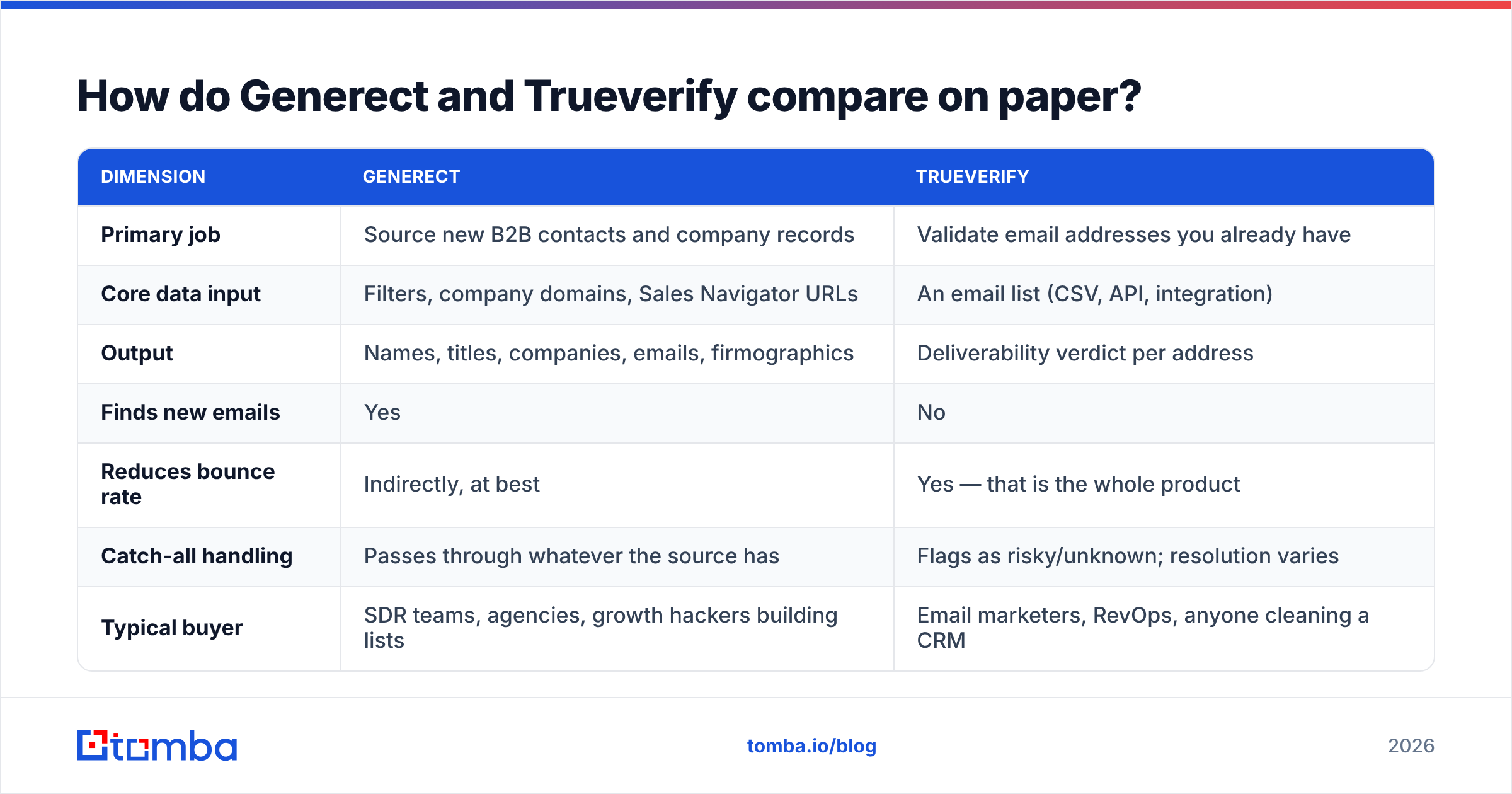
Generect vs Trueverify: how do they compare on paper?#
Here is the honest structural comparison. Note the empty cells. They are the point.
| Dimension | Generect | Trueverify |
|---|---|---|
| Primary job | Source new B2B contacts and company records | Validate email addresses you already have |
| Core data input | Filters, company domains, Sales Navigator URLs | An email list (CSV, API, integration) |
| Output | Names, titles, companies, emails, firmographics | Deliverability verdict per address |
| Finds new emails | Yes | No |
| Reduces bounce rate | Indirectly, at best | Yes — that is the whole product |
| Catch-all handling | Passes through whatever the source has | Flags as risky/unknown; resolution varies |
| Typical buyer | SDR teams, agencies, growth hackers building lists | Email marketers, RevOps, anyone cleaning a CRM |
| Pricing model | Credit / subscription tiers, quote-driven at volume | Per-verification credits, volume discounts |
| API | Yes — a central part of the offering | Yes — bulk and real-time endpoints |
| Replaces the other? | No | No |
If you were hoping for a winner in row eleven, there isn't one. What you have is a two-stage pipeline. The real question is how many vendors you want to pay to run it.
Which one actually finds more valid emails?#
Wrong question. But it is the one people search for, so let's answer it properly.
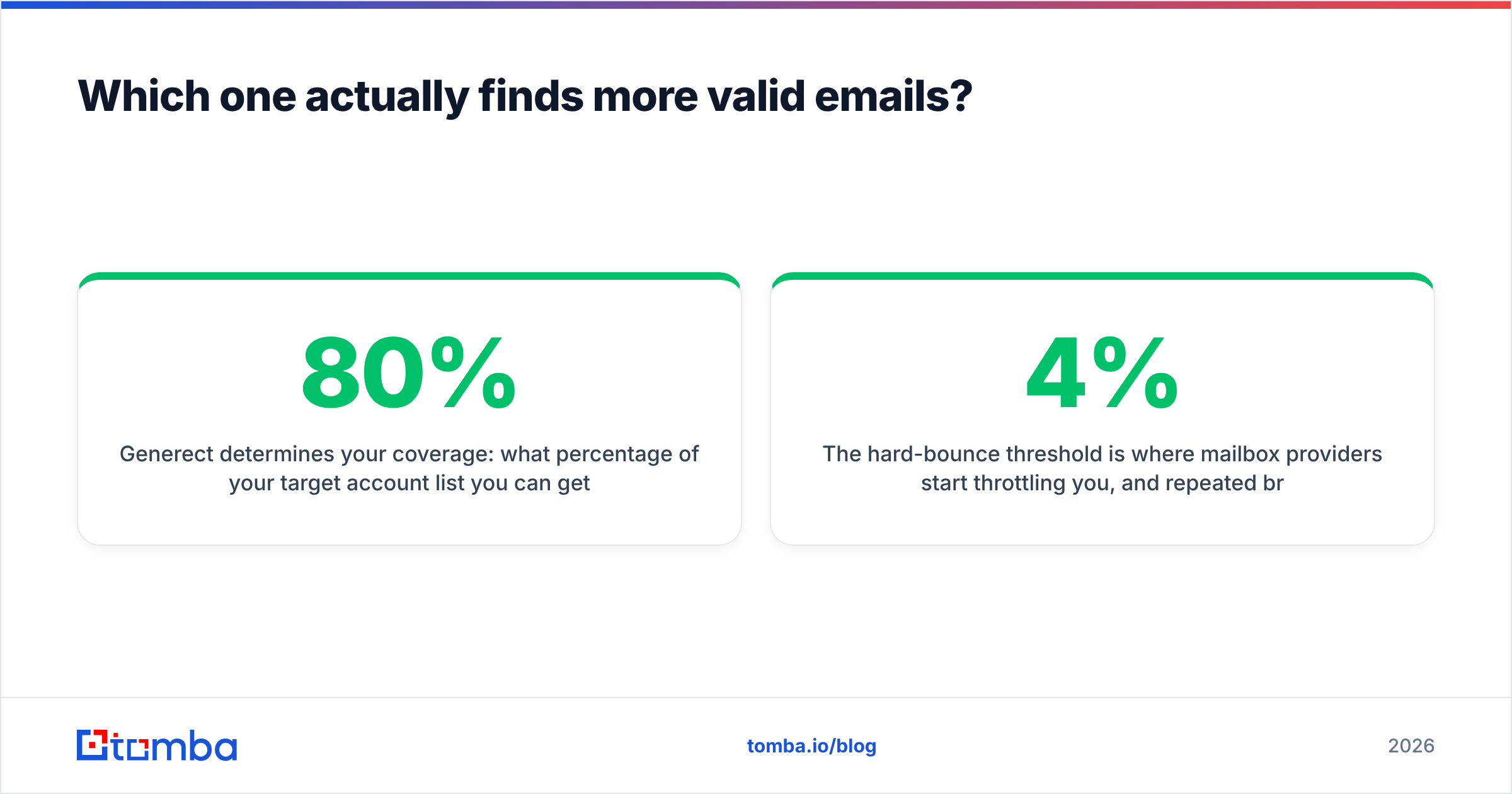
Generect sets your coverage: the share of your target accounts you can get a contact for at all. Trueverify sets your precision: the share of addresses you send to that accept mail. A tool that finds an address for 80% of your list at 70% deliverability lands 56 real inboxes per 100 targets. A tool that finds 60% at 95% lands 57. Same outcome, very different invoices.

Two numbers to demand from any vendor here, in writing:
- Match rate on your ICP, not theirs. Vendor benchmarks are almost always run on tech companies in the US and EU, where LinkedIn density is highest. If you sell to German mid-market manufacturers or Japanese logistics firms, the published match rate is fiction. Run a 200-row sample of your own accounts first.
- Bounce rate after their verification. Not "accuracy" — bounce rate. Accuracy is a marketing word with no agreed meaning. Bounce rate is a number your ESP reports back to you, and you cannot argue with it.
The 4% hard-bounce line is where mailbox providers start to throttle you. Repeated breaches damage your sender reputation for weeks. Google's own Postmaster Tools will show you the damage in near real time. This is why a sourcing-only stack breaks: raw database emails often bounce at 8–15% with no verification pass. A bounce message storm on a fresh domain can end a sending program in two weeks.
What does each cost once you add it up?#
The Generect vs Trueverify cost question is not two prices side by side. It is one pipeline billed twice. Both vendors run credit-based models with tiered plans and custom quotes above a certain volume, and both have changed their published pricing more than once. Rather than quote numbers that will be wrong by the time you read this, budget for the three costs people keep missing:
- Double-spend on the same contact. You pay Generect a credit to find the address, then pay Trueverify a credit to check it. On a 50,000-contact quarter that is 100,000 billable events for 50,000 usable rows.
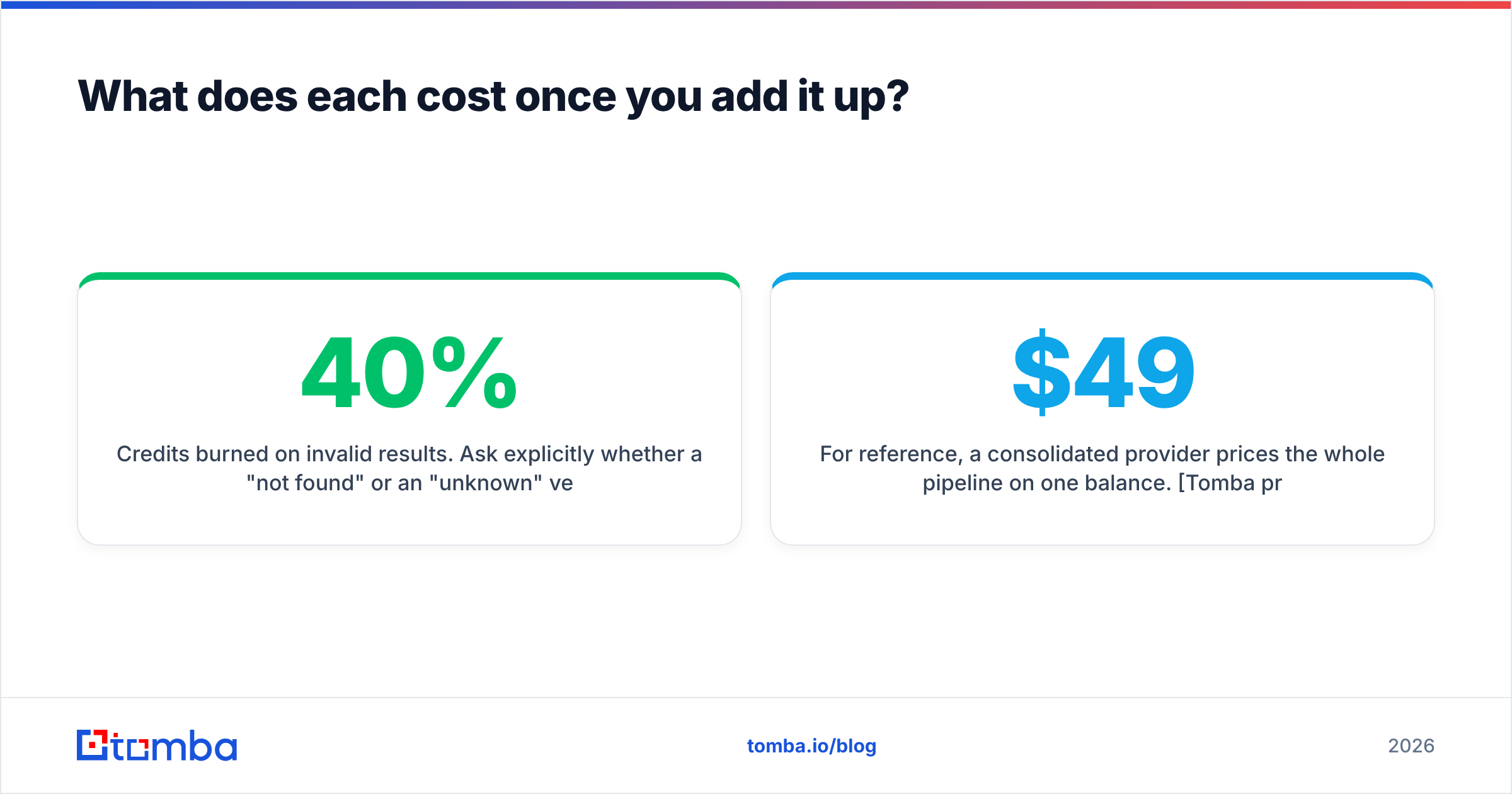
- Credits burned on invalid results. Ask whether a "not found" or "unknown" verdict eats a credit. Some vendors refund, some don't. On a low-match-rate ICP, that one clause can swing your cost per usable contact by 40%.
- Minimum commitments and rollover. Monthly credits that expire punish seasonal outbound. Annual plans that look cheap per credit stop being cheap when Q3 is quiet.
For reference, a consolidated provider prices the whole pipeline on one balance. Tomba pricing runs a free tier at 25 searches per month, Starter at $49/mo, Growth at $99/mo, Pro at $249/mo, and custom Enterprise. Finding and verification draw from the same pool, so there is no second contract. Peer reviews for all three categories are worth a skim on G2 before you sign anything annual.
Do you need a lead database, a verifier, or both?#
Here is the decision framework, in the order that saves the most money.
- You have accounts but no contacts. Sourcing is the bottleneck. A platform like Generect earns its budget here. No amount of verification creates an address that does not exist yet.
- You have a big, old CRM. Validation is the bottleneck. B2B contact data decays at roughly 2–3% per month through job changes alone, so a two-year-old list is largely fiction. An email verifier pass is the cheapest deliverability win you have.
- You have a domain but no names. This is a domain search job. Enumerate who works at the company, then verify the pattern. Neither a pure database nor a pure verifier does this well alone.
The next three cases are where teams usually overspend.
- Your list is 30%+ catch-all domains. Standard SMTP verification returns "unknown" and you are left guessing. You need a dedicated catch-all verifier that resolves those addresses instead of shrugging at them. Otherwise you either bin good leads or send blind.
- You need this inside a product or workflow. API quality beats every other factor. Check rate limits, webhook support for async bulk jobs, and whether the email verification API returns a confidence score or just a binary flag. Binary flags are useless for tiering a send list.
- You are under ten reps. Consolidate. Two invoices, two support queues, two schema mappings, and two failure modes at 2am are not worth the marginal quality gain at your volume.
How do Generect and Trueverify stack up against an all-in-one?#
This is the comparison most readers are really running, whether or not they typed it into the search bar.
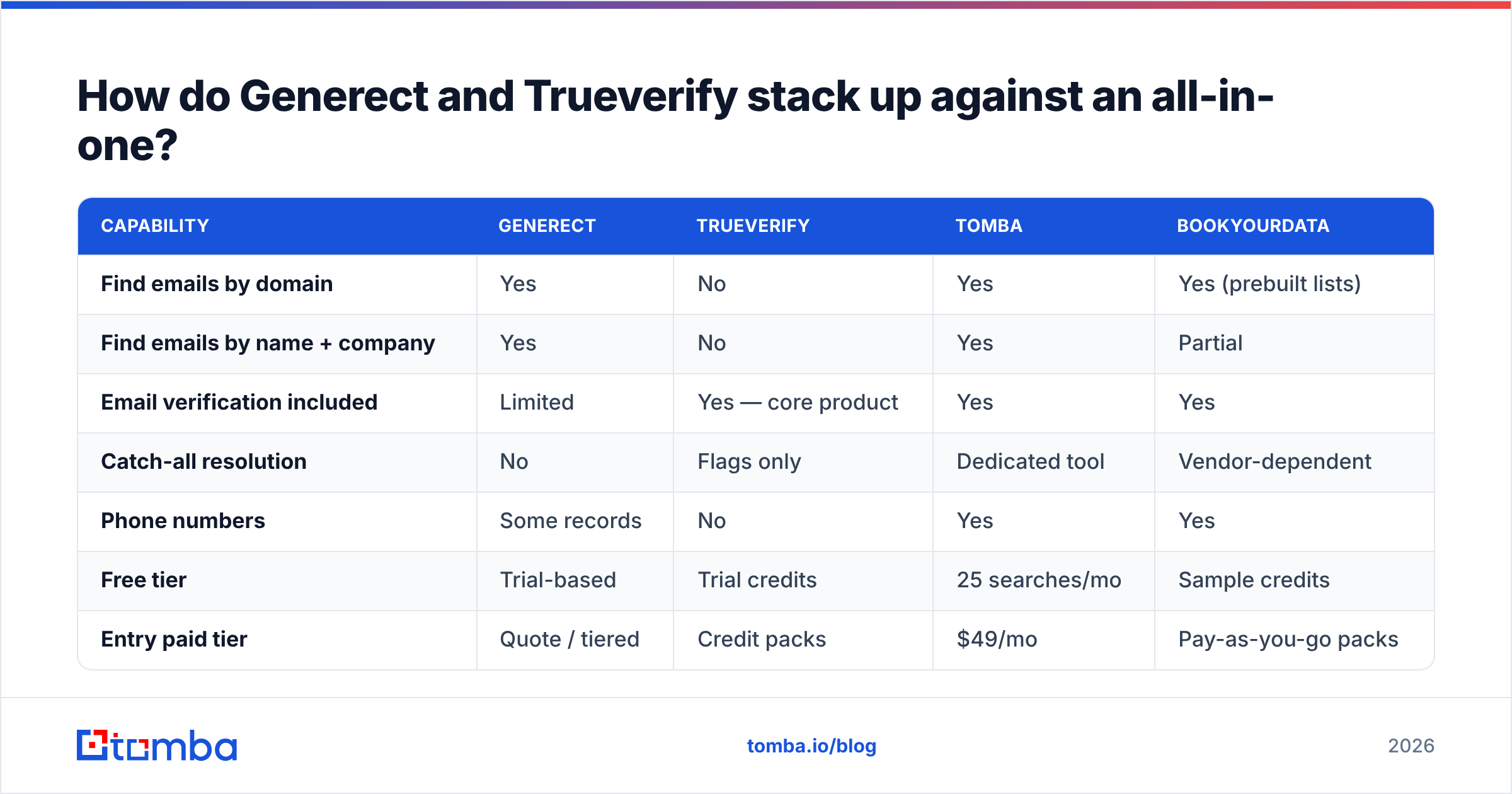
| Capability | Generect | Trueverify | Tomba | BookYourData |
|---|---|---|---|---|
| Find emails by domain | Yes | No | Yes | Yes (prebuilt lists) |
| Find emails by name + company | Yes | No | Yes | Partial |
| Email verification included | Limited | Yes — core product | Yes | Yes |
| Catch-all resolution | No | Flags only | Dedicated tool | Vendor-dependent |
| Phone numbers | Some records | No | Yes | Yes |
| Free tier | Trial-based | Trial credits | 25 searches/mo | Sample credits |
| Entry paid tier | Quote / tiered | Credit packs | $49/mo | Pay-as-you-go packs |
| API access | Yes | Yes | Yes, all plans | Yes |
| Spreadsheet add-ons | Limited | Limited | Sheets, Excel, Airtable | CSV export |
| Best fit | LinkedIn-led sourcing at scale | High-volume list hygiene | Find + verify on one balance | Buying prebuilt, guaranteed lists |

BookYourData deserves a note of its own here, not a grudging table row. It solves a different problem: buying a pre-built, accuracy-guaranteed list instead of assembling one. For teams that want a defined dataset delivered rather than a search tool to operate, that model is often the faster path. It is a reasonable answer to a question Generect and Trueverify are not asking.
What does a working 2026 stack look like?#
The pattern holds up across the teams I have seen run this well. Start with the order of operations:
- Define the account list first, in the CRM. Not in the data tool. If your source of truth is a vendor's UI, you will re-buy the same records every quarter.
- Source contacts in bulk, then verify in bulk, then load. Never load unverified records into your CRM "to clean later." Later never comes, and the junk contaminates every segment you build after it.
Then keep the list honest over time:
- Tier your send list by confidence score. Send to
validright away. Routecatch-allthrough a dedicated resolver. Parkunknownfor a LinkedIn touch instead of an email. This alone usually drops hard bounces below 2%. - Re-verify anything older than 90 days before it re-enters a sequence. Decay is the silent killer. A contact that verified clean in January is a coin flip by May.
- Instrument the whole thing. Track cost per replied contact, not cost per credit. A source that costs triple but replies at 4x is the cheap one.

Common questions#
Is Generect a replacement for Trueverify? No. Generect's verification, where it exists, is a convenience layer on sourcing, not a dedicated hygiene product. If your main pain is bounce rate on an existing list, a sourcing platform does not fix it.
Is Trueverify a replacement for Generect? Also no. A verifier cannot invent contacts. If your list is empty, verification has nothing to chew on.
Can I just use one tool for both? Yes, and for most teams under 20 reps that is the right call. Consolidated providers have closed most of the quality gap that justified a split stack three years ago, and single-balance billing removes the double-spend problem.
How do I test this fairly? Take 200 accounts from your real ICP, not a demo list. Run them through each candidate. Send a small, warmed batch. Compare hard-bounce rate and reply rate, not vendor-reported "accuracy." Two hundred rows and one week of sending will tell you more than every review site combined.
What about GDPR and CCPA? Ask each vendor for their lawful-basis documentation and their opt-out handling before you send a single email into the EU. LinkedIn-derived data carries obligations that "we scraped it publicly" does not discharge.
The practical takeaway#
Generect vs Trueverify is the wrong fight. They are complements dressed up as competitors. If your outbound program is large enough that best-in-class sourcing and best-in-class validation each pay for themselves, run both and accept the integration tax. That is a real scenario, and at eight-figure pipeline targets it is often correct.
For everyone else, stop paying two vendors to hand records to each other. Start with one provider that finds and verifies on the same credit balance. Measure your real bounce and reply rates for a quarter. Split the stack only when you can point at a number that says splitting it would help.
Want to run that test cheaply? The Tomba Email Finder covers domain search, name-based lookup, and verification on a single balance. The free tier gives you 25 searches a month and Starter is $49/mo — enough to benchmark 200 of your own accounts before you renew anything.
Related guides#
Ready to find emails that actually work?
Join 150,000+ professionals who stopped guessing and started sending. Free credits on signup — no credit card required.
Get the Tomba newsletter
Practical outbound tactics and product updates — once every two weeks.
About the author