Generect vs VCBacked: B2B Lead Data Compared for 2026
Generect sells LinkedIn-sourced lead lists and an API. VCBacked sells access to funded startups. They solve different problems — here is which one fits your outbound motion, and where both leave gaps.
Generect vs VCBacked is not a fair fight, because the two tools do not do the same job. One builds lists from LinkedIn. The other tracks who just raised money. Here is how they differ, and which one fits your outbound.
TL;DR
- Generect pulls leads from LinkedIn. You define an audience, and it returns contact records plus an API to pull them into your stack.
- VCBacked tracks funding. It lists venture-backed companies, their rounds, their investors, and the people who decide.
- They are not swaps for each other. Generect answers "who matches this persona?" VCBacked answers "who just raised money?"
- Both hand you emails. Both let those emails go stale. Send without your own check and you will eat bounces either way.
- Cheapest sane stack: one signal source plus a finder and verifier. Tomba's Free tier gives you 25 searches a month to test that pairing.
What are Generect and VCBacked?#
Two different bets on where B2B contact data should come from.
Generect treats LinkedIn as the source of truth. You point it at a search: job titles, headcount, location, tech stack, or a Sales Navigator URL you already built. It returns lead records with names, roles, company data, and contact details. The API is the standout part. Instead of exporting CSVs by hand, teams wire the Leads API into their CRM or sequencer. That appeals to agencies and RevOps teams who rebuild a list every week and do not want to click export.
VCBacked starts from a signal, not a persona. Its database tracks companies that raised venture capital: round size, stage, date, and lead investor. It then attaches decision-makers to those companies. The pitch is timing. A company that closed a Series A eight weeks ago has budget and a plan to spend it. If your ICP is "funded startups between 20 and 200 people," you get a pre-filtered list instead of building filters yourself.
That gap matters more than any feature checklist. A persona tool gives you volume. A signal tool gives you relevance. Teams that mix up the two send generic emails to a well-timed list, or great emails to the wrong titles.
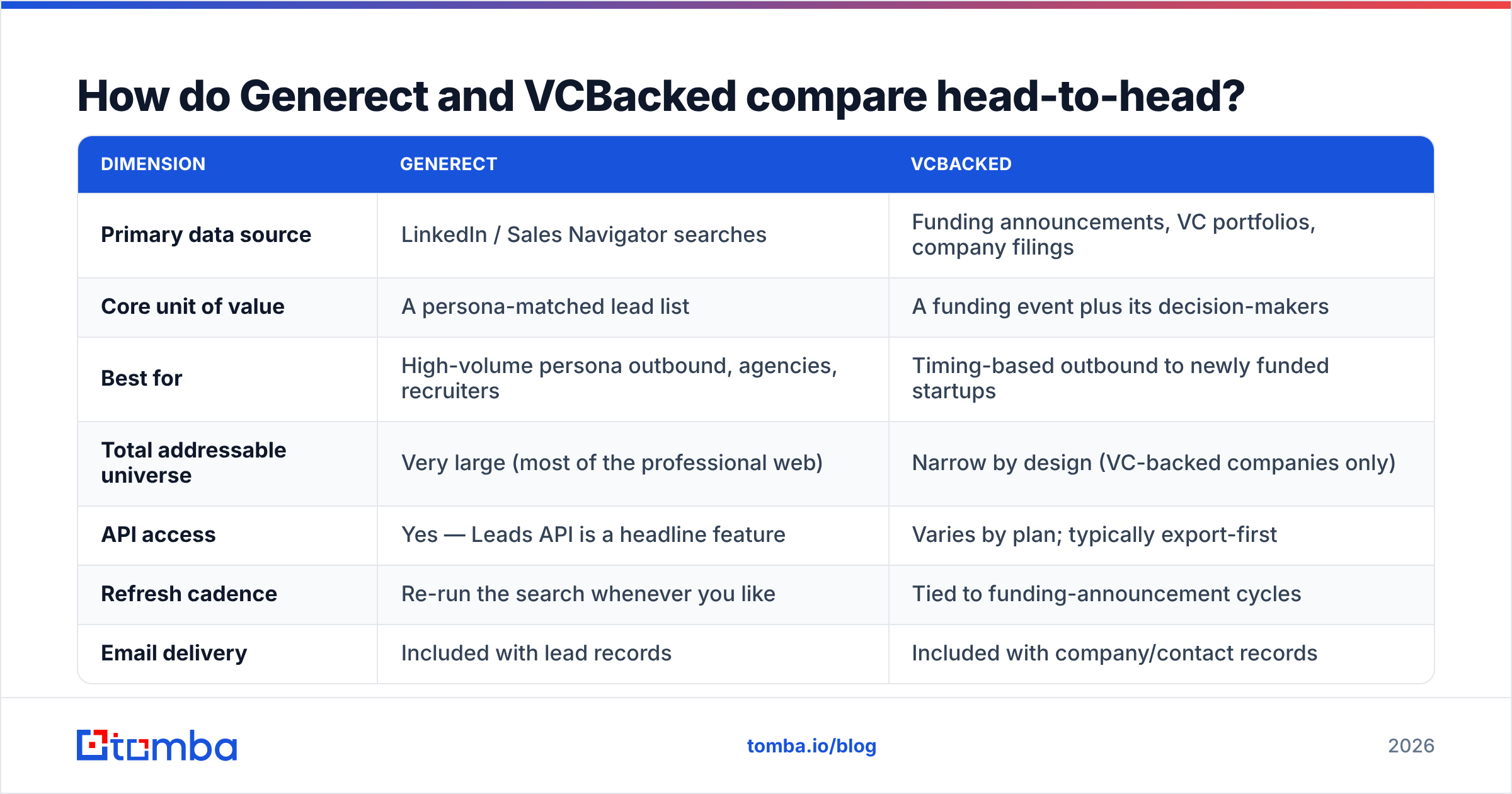
Generect vs VCBacked: how do they compare head-to-head?#
| Dimension | Generect | VCBacked |
|---|---|---|
| Primary data source | LinkedIn / Sales Navigator searches | Funding announcements, VC portfolios, company filings |
| Core unit of value | A persona-matched lead list | A funding event plus its decision-makers |
| Best for | High-volume persona outbound, agencies, recruiters | Timing-based outbound to newly funded startups |
| Total addressable universe | Very large (most of the professional web) | Narrow by design (VC-backed companies only) |
| API access | Yes — Leads API is a headline feature | Varies by plan; typically export-first |
| Refresh cadence | Re-run the search whenever you like | Tied to funding-announcement cycles |
| Email delivery | Included with lead records | Included with company/contact records |
| Built-in verification | Basic; most teams add a second layer | Basic; most teams add a second layer |
| Weakest point | Signal-blind — no "why now" | Coverage ceiling — bootstrapped and PE-backed firms are invisible |
| Typical buyer | SDR team, lead-gen agency | Founder-led sales, seed-stage vendors selling to startups |
Read that table as a fork, not a scoreboard. Sell developer tools to Series A startups? VCBacked's narrow list is a feature, and you skip the filtering work. Sell to hospital buyers? VCBacked has almost nothing for you, and Generect is the only real option of the two.

What data does each one actually give you?#
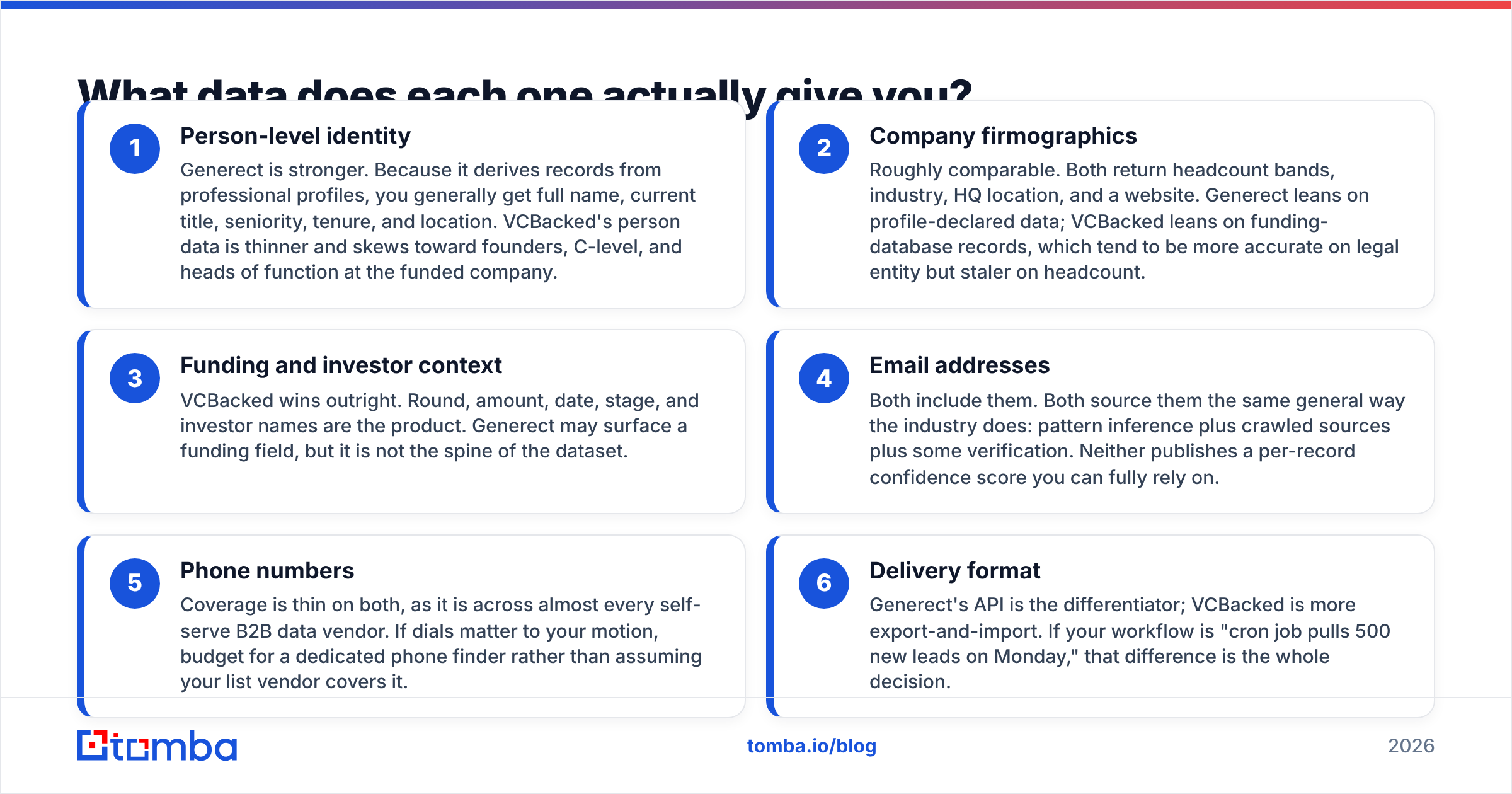
Here is what lands in your CRM, field by field. Start with the people and the companies.
- Person-level identity — Generect is stronger. It builds records from professional profiles, so you get full name, title, seniority, tenure, and location. VCBacked's people data is thinner. It skews to founders, C-level, and heads of function.
- Company firmographics — Close to even. Both return headcount bands, industry, HQ, and a website. Generect leans on profile data. VCBacked leans on funding records, which are sharper on legal entity but staler on headcount.
- Funding and investor context — VCBacked wins outright. Round, amount, date, stage, and investor names are the product. Generect may show a funding field, but it is not the spine of the data.
Then the contact details, and how they reach you.
- Email addresses — Both include them. Both build them the way the industry does: pattern guessing, crawled sources, and some checking. Neither gives you a per-record score you can lean on.
- Phone numbers — Thin on both, as it is with almost every self-serve B2B vendor. If dials matter to your motion, budget for a dedicated phone finder.
- Delivery format — Generect's API is the difference. VCBacked is export-and-import. If your workflow is "a cron job pulls 500 leads on Monday," that is the whole decision.
Which one has better email accuracy?#
Neither vendor publishes an audited accuracy number. Treat any figure you see in a comparison post as marketing, not measurement. That includes the numbers people quote about Generect or VCBacked. What you can reason about is how the data ages.
Generect's records sit on top of profiles that people update when they change jobs. Role data stays fresh enough. The email is a separate object, though. When someone moves from Acme to Globex, the profile updates within weeks. The old first.last@acme.com address stays in the export until the vendor re-runs its checks. That lag is where bounces come from.
VCBacked has the opposite problem. Funding events are fixed in time. A Series B closed in March 2026 is still true in 2027. But the team at a fast-growing startup churns hard. The VP of Sales you pulled from a six-month-old round may already be gone. At a 40-person company, no directory catches the change.
The fix for both: never send straight from the export. Run the list through a dedicated email verifier first. On typical B2B lists like these, one pass strips out 8–20% as invalid, role-based, or dead. That gap is the difference between a healthy sender score and a domain that lands in spam by week three.
Two details catch people out:
- Catch-all domains pass a naive SMTP check and still bounce. Startups on Google Workspace often run a wildcard, so they turn up a lot in VC-backed data. Use a catch-all verifier instead of trusting a green check mark.
- Role addresses (
info@,hello@,founders@) show up often in early-stage records, because that is what the company published. They deliver fine. They convert badly. Filter them out before they pad your "valid" count.
How does pricing compare?#
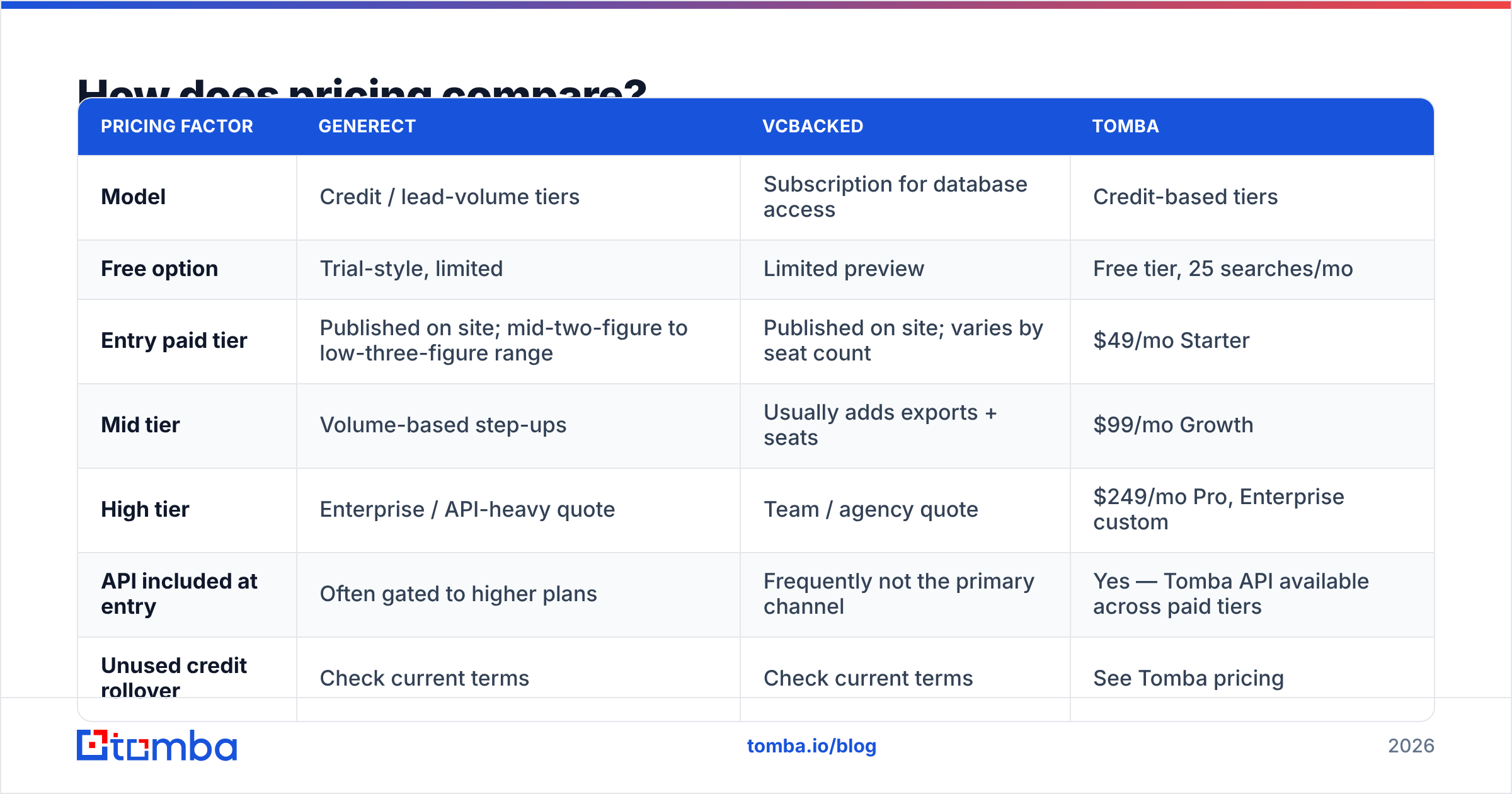
Generect vs VCBacked pricing is a moving target. Both vendors change prices and hide parts behind a demo, so check their own sites before you budget. The structure is more stable than the dollar figures:
| Pricing factor | Generect | VCBacked | Tomba |
|---|---|---|---|
| Model | Credit / lead-volume tiers | Subscription for database access | Credit-based tiers |
| Free option | Trial-style, limited | Limited preview | Free tier, 25 searches/mo |
| Entry paid tier | Published on site; mid-two-figure to low-three-figure range | Published on site; varies by seat count | $49/mo Starter |
| Mid tier | Volume-based step-ups | Usually adds exports + seats | $99/mo Growth |
| High tier | Enterprise / API-heavy quote | Team / agency quote | $249/mo Pro, Enterprise custom |
| API included at entry | Often gated to higher plans | Frequently not the primary channel | Yes — Tomba API available across paid tiers |
| Unused credit rollover | Check current terms | Check current terms | See Tomba pricing |
The cost question people get wrong is not "which sticker price is lower." It is how many of the credits you buy turn into a delivered email. A $99 plan with 60% deliverable contacts costs more per usable lead than a $149 plan at 90%. Run a 200-record test on each vendor. Verify the output yourself. Then divide plan cost by the verified count. That is the only number worth comparing.
Is VCBacked better for funding-triggered outbound?#
Yes. That is the whole point of the product, and it is a good reason to buy it.
Funding rounds are one of the few triggers in B2B that track with real budget. Venture capital rounds come with growth targets attached. The 90 days after an announcement are when new vendors get a look. Say your product maps to a post-raise need: hiring, sales tools, infrastructure, compliance, finance ops. A funded-company list plus a timely first line will beat a generic persona blast.
Generect can get close if you rebuild your search often and add funding data from elsewhere. But then you are doing by hand what VCBacked does by design.
The catch: the pool is small, and everyone fishes in it. A startup that raised a visible Series A gets hundreds of cold emails that month. Timing alone no longer sets you apart when rivals hold the same list. What still works is being specific. Name what they said they would do with the money. Name the roles they just opened. Name the market they called out. That means enrichment, not just extraction. Pair the funding signal with contact enrichment so your first line says more than "congrats on the raise."
Where do both tools fall short?#
The Generect vs VCBacked debate hides three gaps that show up in almost every rollout:
- No standalone verification layer. Both ship "verified" emails. Neither lets you inspect or tune that standard. If your bounce limit is 2% and theirs is closer to 8%, you find out after the damage.
- No coverage outside VC and LinkedIn. Manufacturing, local services, government contractors, family-owned mid-market: none of it shows up. Those buyers are not on LinkedIn and were never funded. A domain-first approach works better there.
- Little re-enrichment. Buying data is a one-off. Keeping data correct is a habit. Neither product exists to keep your CRM right for the next 18 months. With 50,000 stale rows, you need a bulk pipeline, not another list.
That last gap is why most teams bolt on a third tool. A bulk email finder run each quarter against your CRM export tends to recover more pipeline than buying 10,000 net-new leads.
Generect vs VCBacked: which should you choose in 2026?#
Pick by motion, not by feature count:
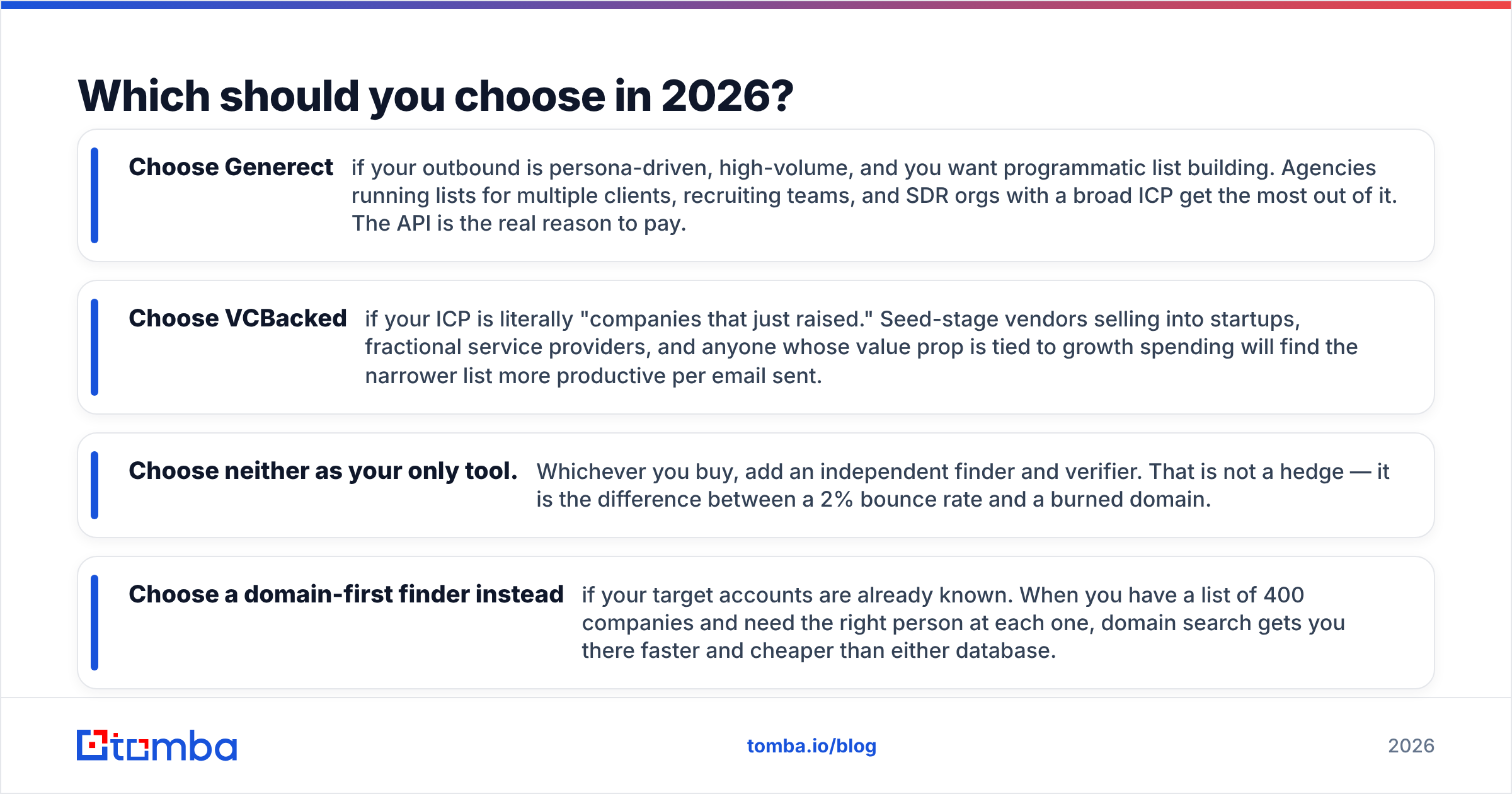
- Choose Generect if your outbound is persona-led, high-volume, and you want list building by API. Agencies, recruiters, and SDR teams with a broad ICP get the most from it. The API is the real reason to pay.
- Choose VCBacked if your ICP is literally "companies that just raised." Seed-stage vendors, fractional service providers, and anyone tied to growth spending will send fewer, better emails.
- Choose neither as your only tool. Whichever you buy, add your own finder and verifier. That is the gap between a 2% bounce rate and a burned domain.
- Choose a domain-first finder if you already know the accounts. With a list of 400 companies and one person to find at each, domain search is faster and cheaper than either database.
Want an outside read before you commit? Check recent user reviews on G2 rather than the case studies on vendor sites. Review volume and recency tell you more about momentum than any comparison table, this one included.
Ready to close the accuracy gap?#
Whichever database you pick, the last mile is the same. You have a name and a company. You need an address that delivers. That is what Tomba is built for. Feed it the companies from your VCBacked export or the profiles from your Generect pull. Get back verified addresses, with catch-all detection, bulk processing, and an API that drops into the pipeline you already built.
Start free with 25 searches a month, or move to Starter at $49/mo when the volume calls for it. Run the Tomba Email Finder against 100 records from your current list and compare the verified count. That one test tells you more than another week of vendor demos.
Related guides#
Ready to find emails that actually work?
Join 150,000+ professionals who stopped guessing and started sending. Free credits on signup — no credit card required.
Get the Tomba newsletter
Practical outbound tactics and product updates — once every two weeks.
About the author