Generect vs Verifiedemail: Which B2B Data Tool Wins in 2026?
Generect sells lead data and LinkedIn-sourced contacts. Verifiedemail sells validation. They solve different halves of the same problem — here is which one you actually need, and what it costs to run both.
TL;DR
- Generect and Verifiedemail are not really competitors. Generect is a lead-data and search-API company; Verifiedemail is an email-validation service. Comparing them head-to-head only makes sense if you are trying to decide which gap in your stack to fill first.
- If you have no contact list, Generect (or any finder) is the higher-priority buy. Validation on an empty list produces nothing.
- If you already own a list — from a scrape, a CRM export, a webinar, or a purchased file — Verifiedemail-style validation is the higher-ROI buy, because bad addresses damage your sending domain long after the campaign ends.
- Neither one covers both jobs to a professional standard. Most teams end up paying two vendors, two overheads, and two APIs.
- A consolidated platform (Tomba, Hunter, Dropcontact and similar) does finding and verification behind one key, which is usually cheaper than two point tools once you cross roughly 5,000 contacts a month.
What are Generect and Verifiedemail?#
Generect is a B2B lead-generation data provider. Its pitch is structured search over company and people data — filter by industry, headcount, geography, job title, tech stack — and return contact records with work emails and, on some plans, phone numbers. It leans heavily on LinkedIn-derived signals and sells an API alongside the web app, which is what attracts agencies and dev-heavy growth teams. You can see the current positioning on generect.com.
Verifiedemail sits at the other end of the funnel. It takes an address you already have and tells you whether a message sent to it will land: syntax check, domain and MX record lookup, disposable-domain detection, role-account flagging, and an SMTP-level mailbox probe where the receiving server allows it. It does not source contacts. It grades them.
That distinction matters more than any feature table. A finder answers who and what is their address. A verifier answers will this address accept mail. Buying the wrong one first is the single most common reason a first cold-email campaign lands at a 12% bounce rate.
How do Generect and Verifiedemail actually differ?#
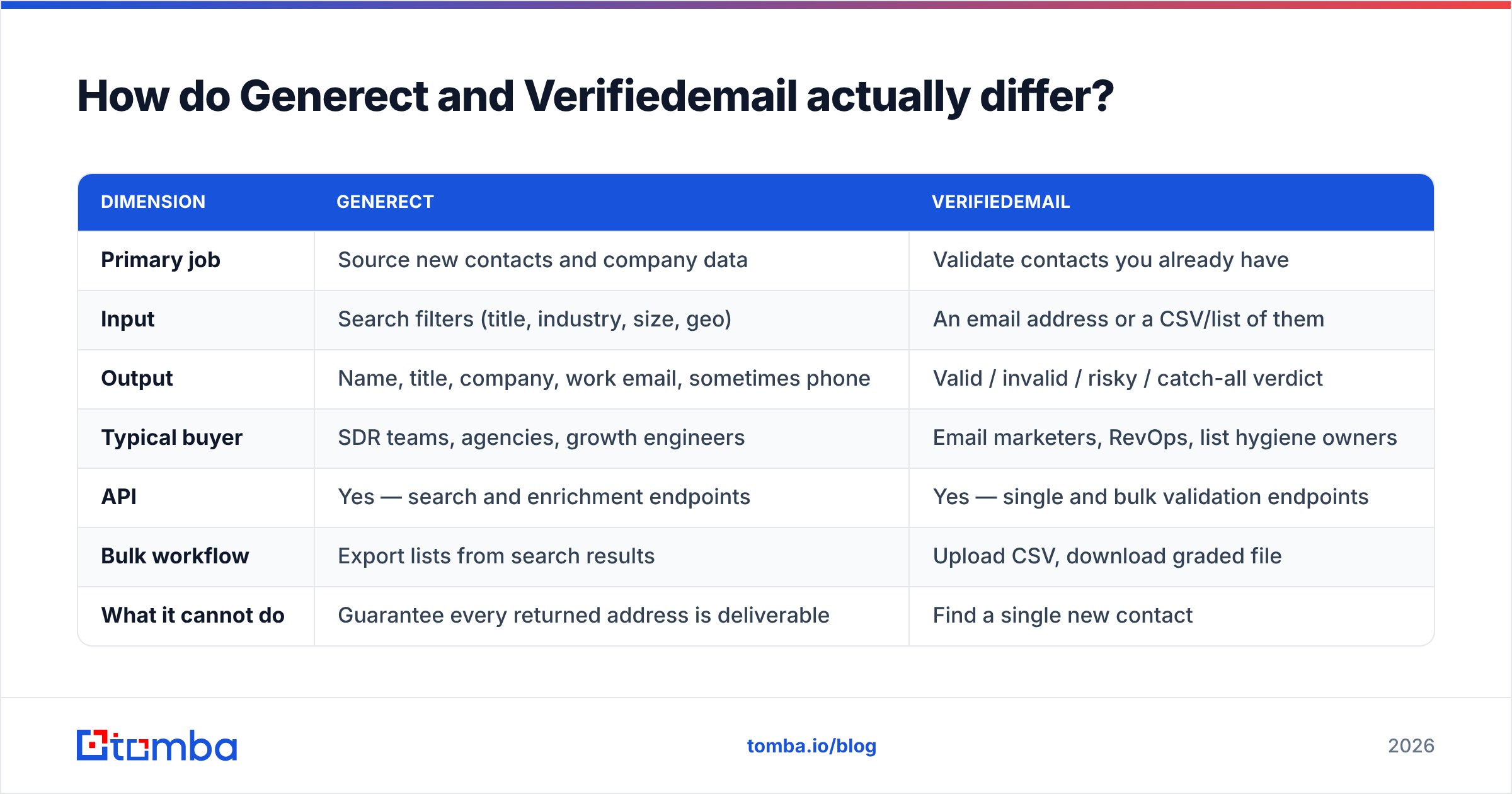
| Dimension | Generect | Verifiedemail |
|---|---|---|
| Primary job | Source new contacts and company data | Validate contacts you already have |
| Input | Search filters (title, industry, size, geo) | An email address or a CSV/list of them |
| Output | Name, title, company, work email, sometimes phone | Valid / invalid / risky / catch-all verdict |
| Typical buyer | SDR teams, agencies, growth engineers | Email marketers, RevOps, list hygiene owners |
| API | Yes — search and enrichment endpoints | Yes — single and bulk validation endpoints |
| Bulk workflow | Export lists from search results | Upload CSV, download graded file |
| What it cannot do | Guarantee every returned address is deliverable | Find a single new contact |
| Where money is wasted | Paying for records you never email | Verifying a list you sourced badly |
Read that last row twice. Both tools have a characteristic failure mode, and both failure modes are about sequencing rather than quality. Generect budget evaporates when you pull 40,000 records and email 3,000 of them. Verifiedemail budget evaporates when you validate a scraped list where 60% of the addresses were pattern guesses that were never going to resolve.
Which one finds more valid emails?#
This is where the comparison breaks down, and it is worth being blunt: Verifiedemail does not find emails at all, so "which finds more" is only a fair question if you are comparing Generect against other finders.

What you should evaluate instead is net usable contacts per dollar across the whole chain. Break it into four measurable numbers:
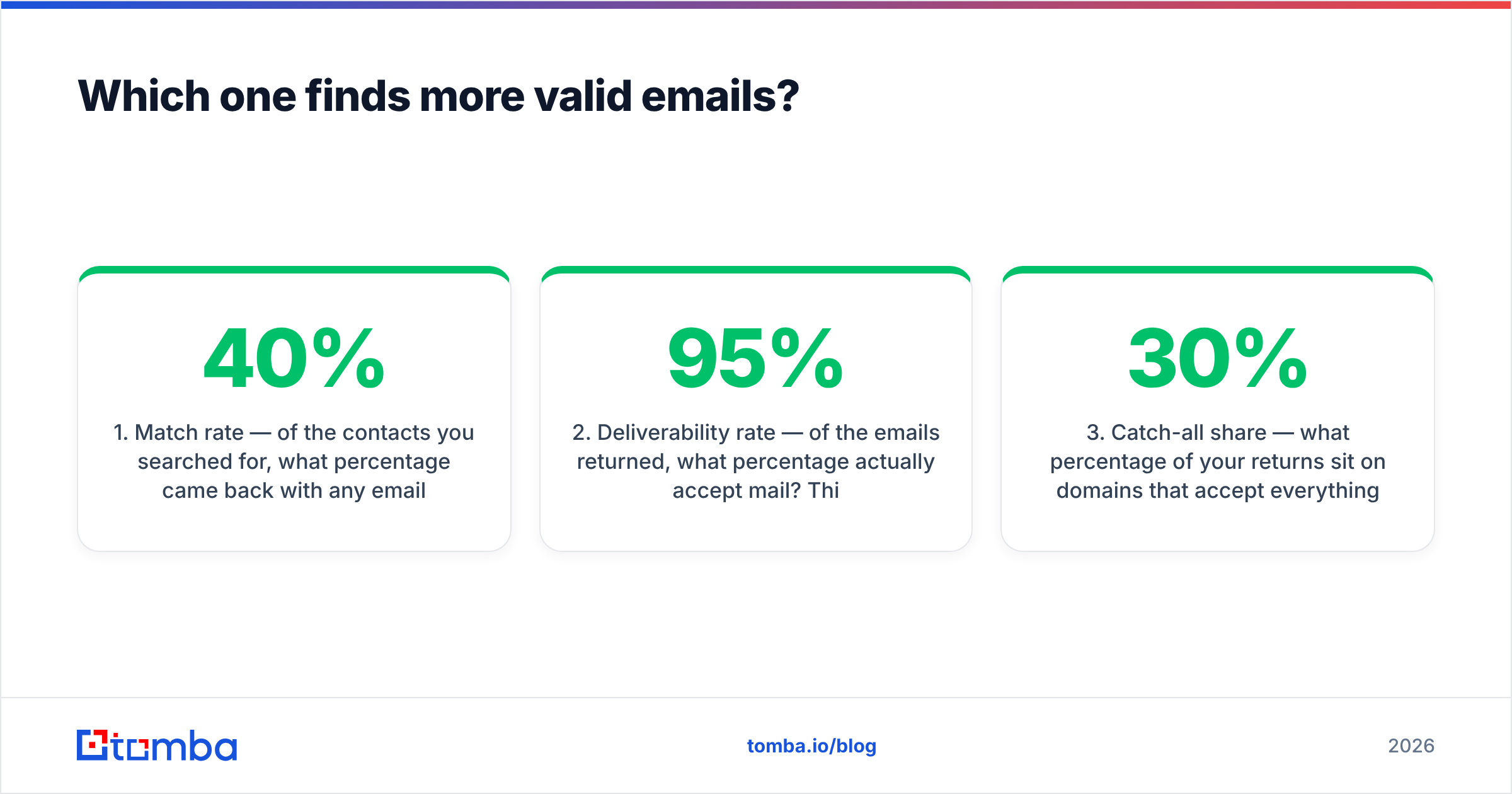
- Match rate — of the contacts you searched for, what percentage came back with any email at all? Data providers in the B2B space typically land between 40% and 75% depending on how niche your ICP is. European mid-market with GDPR-suppressed records lands lower than US SaaS.
- Deliverability rate — of the emails returned, what percentage actually accept mail? This is the number vendors quote loosely and rarely define. A "95% accuracy" claim usually means "95% of what we returned, not 95% of what you asked for."
- Catch-all share — what percentage of your returns sit on domains that accept everything and confirm nothing? On enterprise domains this can be 20–30% of a list, and it is the single biggest blind spot in cheap verification.
- Cost per landed email — total spend divided by messages that reached an inbox. This is the only figure worth putting in a board deck.
Run those four on a 500-contact sample before you sign an annual deal with either vendor. Any provider that refuses a trial sample is telling you something.

What does the catch-all problem do to this comparison?#
Catch-all domains are where the Generect-vs-Verifiedemail framing gets genuinely interesting, because it is the one place both tools are weak in the same way.
A catch-all (or accept-all) server is configured to accept mail addressed to any local part at that domain. Probe it with an SMTP handshake and you get a 250 OK for ceo@company.com and an equally cheerful 250 OK for asdkjh@company.com. Standard verification returns "risky" or "unknown" and stops there. Standard finders return the address with a confidence score that is really a pattern-frequency guess.
If catch-alls are 25% of your list, that quarter is a coin flip under both tools. The workarounds that actually move the needle:
- Pattern corroboration — confirm the same first.last format appears in multiple independent sources for that domain, not just one.
- Historical delivery data — has this exact address received mail successfully before, anywhere in the provider's network?
- Dedicated catch-all logic — some vendors run a separate pipeline for these. Tomba's catch-all verifier is one, and it is worth testing against your own known-good sample rather than trusting the marketing number.
- Send-side risk control — route catch-all contacts to a secondary sending domain so a bad batch cannot take your primary reputation with it.
Whatever you buy, ask the vendor directly what happens to a catch-all address. If the answer is "we mark it risky," you are paying for a shrug.
How do pricing and credits compare?#
Both vendors publish tiered credit pricing, and both change it. Treat the shape below as a model for how to compare rather than as a quote — check the live pricing pages before you buy.

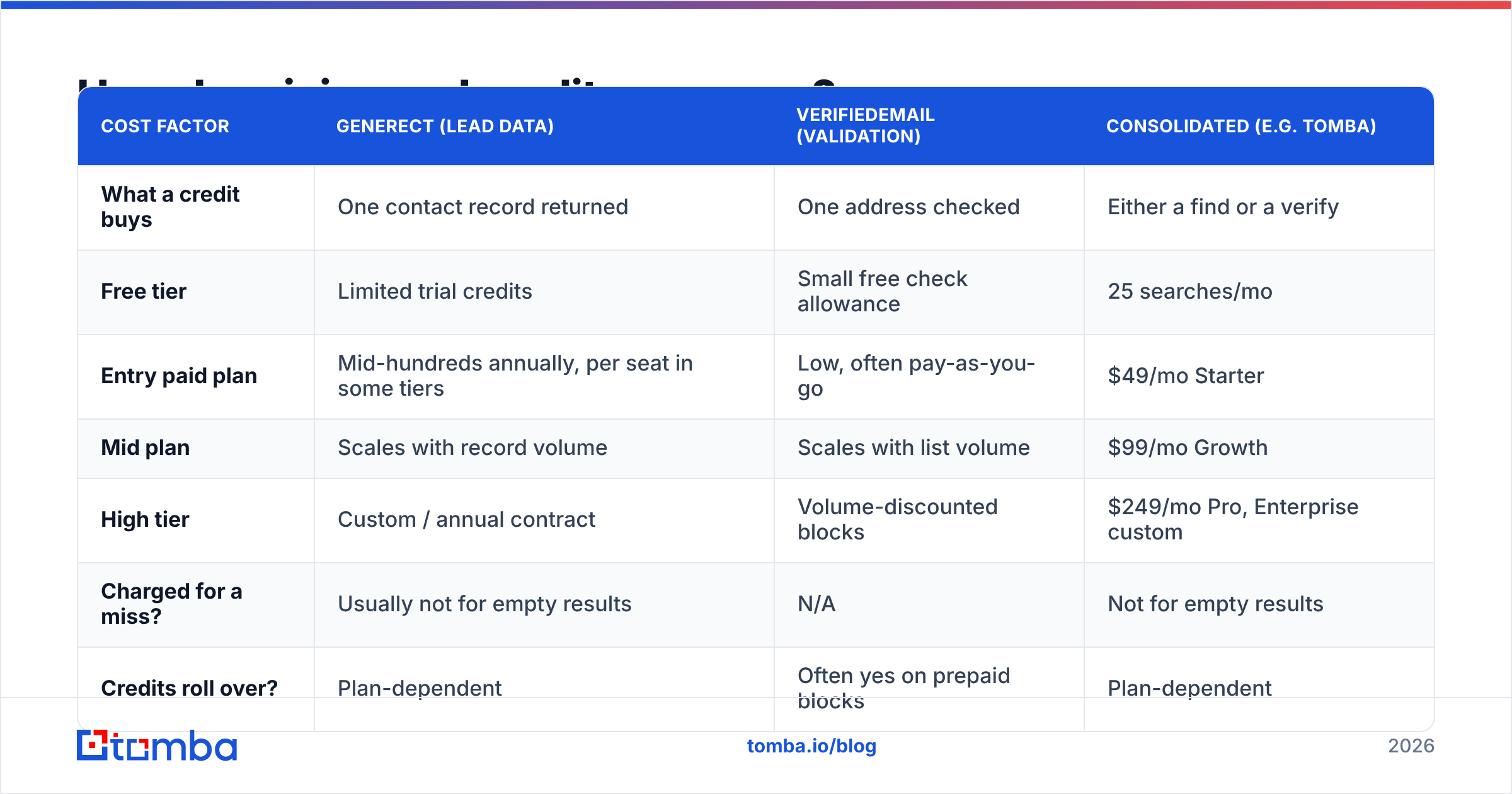
| Cost factor | Generect (lead data) | Verifiedemail (validation) | Consolidated (e.g. Tomba) |
|---|---|---|---|
| What a credit buys | One contact record returned | One address checked | Either a find or a verify |
| Free tier | Limited trial credits | Small free check allowance | 25 searches/mo |
| Entry paid plan | Mid-hundreds annually, per seat in some tiers | Low, often pay-as-you-go | $49/mo Starter |
| Mid plan | Scales with record volume | Scales with list volume | $99/mo Growth |
| High tier | Custom / annual contract | Volume-discounted blocks | $249/mo Pro, Enterprise custom |
| Charged for a miss? | Usually not for empty results | N/A | Not for empty results |
| Credits roll over? | Plan-dependent | Often yes on prepaid blocks | Plan-dependent |
| API included | Yes, tier-gated | Yes | Yes on all paid tiers |
The line that decides most procurement arguments is the second-to-last one: do you get charged when the tool finds nothing? A provider that bills for empty lookups can double your effective cost per contact on a hard ICP, and it never shows up in the headline price. Ask in writing.
The other hidden cost is duplication. Run a finder and a verifier separately and you will pay twice for the same contact — once to discover it, once to grade it — plus the engineering time to glue two APIs together and reconcile two different verdict vocabularies. That is why the consolidated column exists. You can compare the full breakdown on Tomba pricing, but the principle applies to any all-in-one: at low volume two point tools are fine, and somewhere north of a few thousand contacts a month the integration overhead starts costing more than the licences.
Is Generect better than Verifiedemail for outbound teams?#
For an outbound team starting from zero, yes — but only because of sequencing, not superiority.
You cannot verify your way to a pipeline. If your SDRs have no list, buying validation is like buying a smoke detector for a house you have not built. Get the contacts first, then grade them.
Generect fits when:
- Your ICP is definable by firmographic filters and you want to pull it in bulk.
- You need company-level context (headcount, funding, tech) alongside the person.
- You have an engineer who will wire the search API into your CRM rather than exporting CSVs by hand.
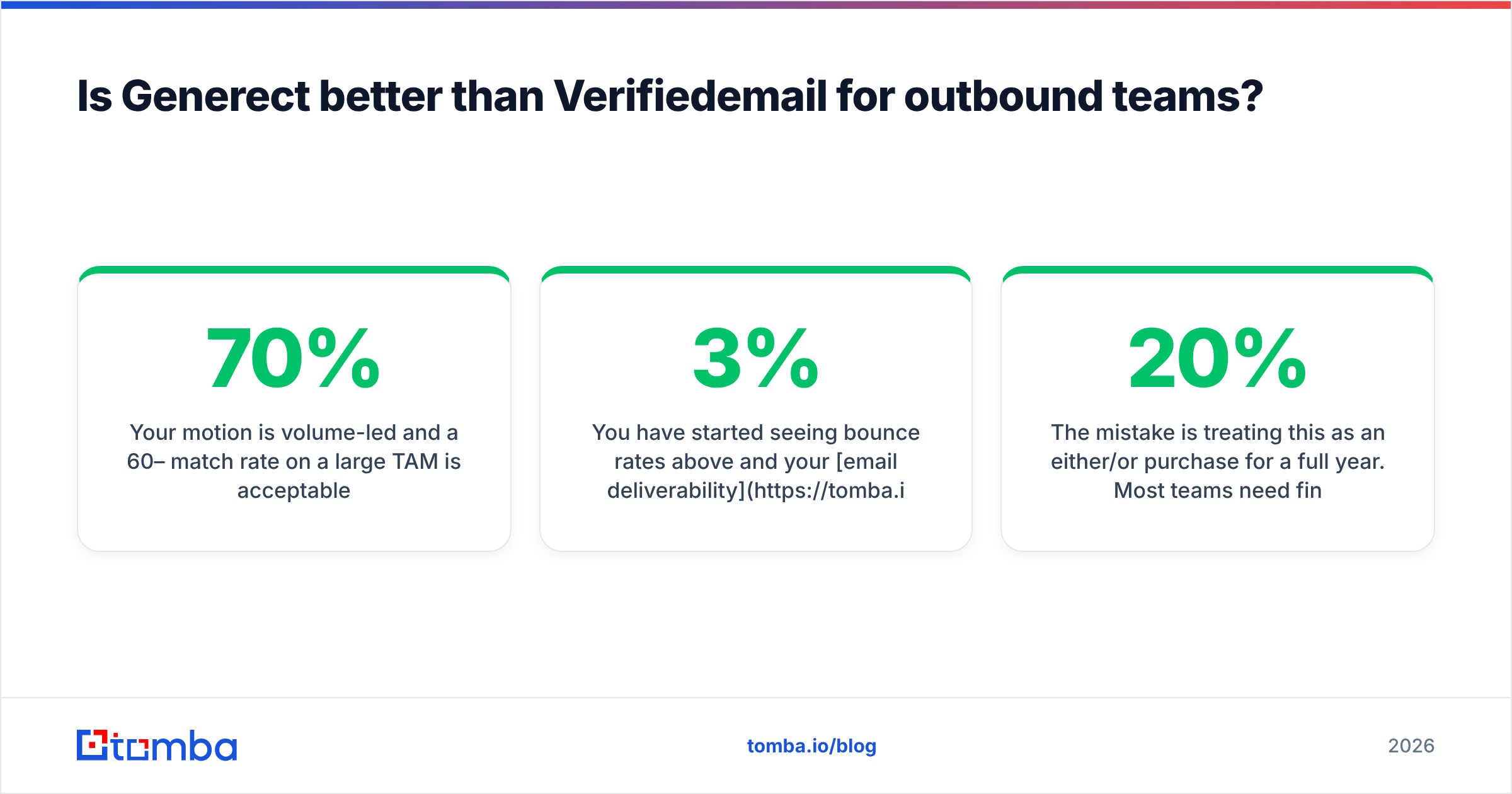
- Your motion is volume-led and a 60–70% match rate on a large TAM is acceptable.
Verifiedemail fits when:
- You already have 10,000+ addresses of uncertain age — an old CRM, a conference list, an inherited database.
- You have started seeing bounce rates above 3% and your email deliverability is trending the wrong way.
- You are migrating ESPs and the new provider is going to audit your list quality on import.
- You need a defensible pre-send hygiene step for compliance or for a picky email platform.
The mistake is treating this as an either/or purchase for a full year. Most teams need find-heavy spend in quarter one and verify-heavy spend from quarter two onward, once the list exists and starts decaying. B2B contact data decays fast — analyst estimates from firms like Gartner and the broader martech industry generally put annual B2B data decay somewhere between 20% and 30%, driven mostly by job changes. Whatever you validated in January is measurably worse by July.
What does a combined stack look like in practice?#
Here is the sequence that actually survives contact with a real quarter:
- Define the ICP tightly before you search. Every extra filter you skip costs you credits on records you will never email. Ten thousand loosely-matched contacts is worse than eight hundred tight ones.
- Source with a finder. Pull by domain rather than by person where you can — domain search style queries give you the whole org's email pattern in one call, which is cheaper than resolving people one at a time.
- Verify everything before it enters the sequencer. Not "the risky ones" — everything. Fresh finds bounce too.
- Split the verdicts three ways. Valid goes to your primary sending domain. Catch-all and risky go to a secondary domain or a lower-volume manual track. Invalid gets suppressed permanently, not re-verified next month.
- Re-verify on a rolling 90-day cycle. Do not re-verify the whole database at once; that is a large bill for little marginal gain. Re-verify the slice you are about to email.
- Track cost per landed email, not cost per credit. It is the only number that tells you whether the finder or the verifier is your bottleneck.
That workflow is vendor-agnostic. You can build it from Generect plus Verifiedemail, or from a single platform that exposes both an email finder and an email verifier behind one key. The second path removes a reconciliation step, and reconciliation steps are where automation quietly rots.

What should you check before signing either contract?#
Six questions, in the order that has saved the most money:
- What is your definition of accuracy? Percentage of returned addresses that are deliverable, or percentage of requested contacts that were matched? The gap between those two numbers is often 30 points.
- Do you charge for no-result lookups? Get it in writing.
- What is your catch-all handling? "Marked as risky" is not handling.
- Where does the data come from, and under what legal basis? For EU contacts this is not optional. Ask for the GDPR position and the opt-out mechanism.
- Can I run a 500-record blind sample against my own known-good list? A vendor confident in its data says yes.
- What is the rate limit, and does it drop on the plan I am actually buying? API docs frequently quote the enterprise limit.
Cross-check the answers against public reviews on G2 rather than the vendor's own testimonial page. Pay particular attention to the two-star reviews — one-star reviews are usually billing disputes, and two-star reviews are usually product truth.
The verdict#
Generect and Verifiedemail are not rivals; they are two stages of one pipeline, and picking between them is really picking which stage is currently broken. No list? Buy the finder. Bad list? Buy the verifier. Both problems at once — which is where most teams actually are — and paying two vendors starts looking like an accounting decision rather than a technical one.
If you would rather run one pipeline than stitch two, start with the Tomba Email Finder. It finds addresses by domain, name, or company, grades them with built-in verification and dedicated catch-all logic before they ever reach your sequencer, and runs on the same API key end to end. The free tier gives you 25 searches a month — enough to run the 500-contact sample test described above against your own ICP, and to see the four numbers that matter before you commit a budget to anyone.
Related guides#
Ready to find emails that actually work?
Join 150,000+ professionals who stopped guessing and started sending. Free credits on signup — no credit card required.
Get the Tomba newsletter
Practical outbound tactics and product updates — once every two weeks.
About the author