Generect vs Vitamail: Which B2B Email Data Tool Wins?
Generect sells a live B2B data engine. Vitamail sells fast email lookup. They solve different halves of the same problem — here is which one belongs in your stack, and when neither is the right answer.
TL;DR
- Generect is a live B2B data engine: you describe an audience (title, company size, geography, LinkedIn signals) and it returns freshly-pulled contact records. It is a list-building tool first, an email finder second.
- Vitamail is a lightweight email finder and verifier: you feed it a name and a domain, it returns a deliverable address. It is a lookup tool first, a database second.
- If you already know who you want and only need how to reach them, a finder/verifier wins on cost per contact. If you don't know who you want yet, a data engine wins.
- Neither publishes stable, self-serve pricing at the tier granularity most teams need — budget for a sales call with Generect and a low-volume trial with Vitamail before you commit.
- If you want both halves (discovery and verification) with a documented API and public pricing, Tomba's $49/mo Starter tier is the cheapest honest entry point of the three.
What problem are you actually trying to solve?#
Start here, because "Generect vs Vitamail" is a comparison between two different job descriptions that happen to overlap on one field: the email address.
Think of it like hiring for a restaurant. Generect is the sourcing manager who goes to the market, decides what's fresh today, and comes back with crates of produce. Vitamail is the line cook who takes an ingredient you already picked and confirms it's not spoiled before it hits the plate. You can technically ask either one to do the other's job. You won't like the result.
Concretely:
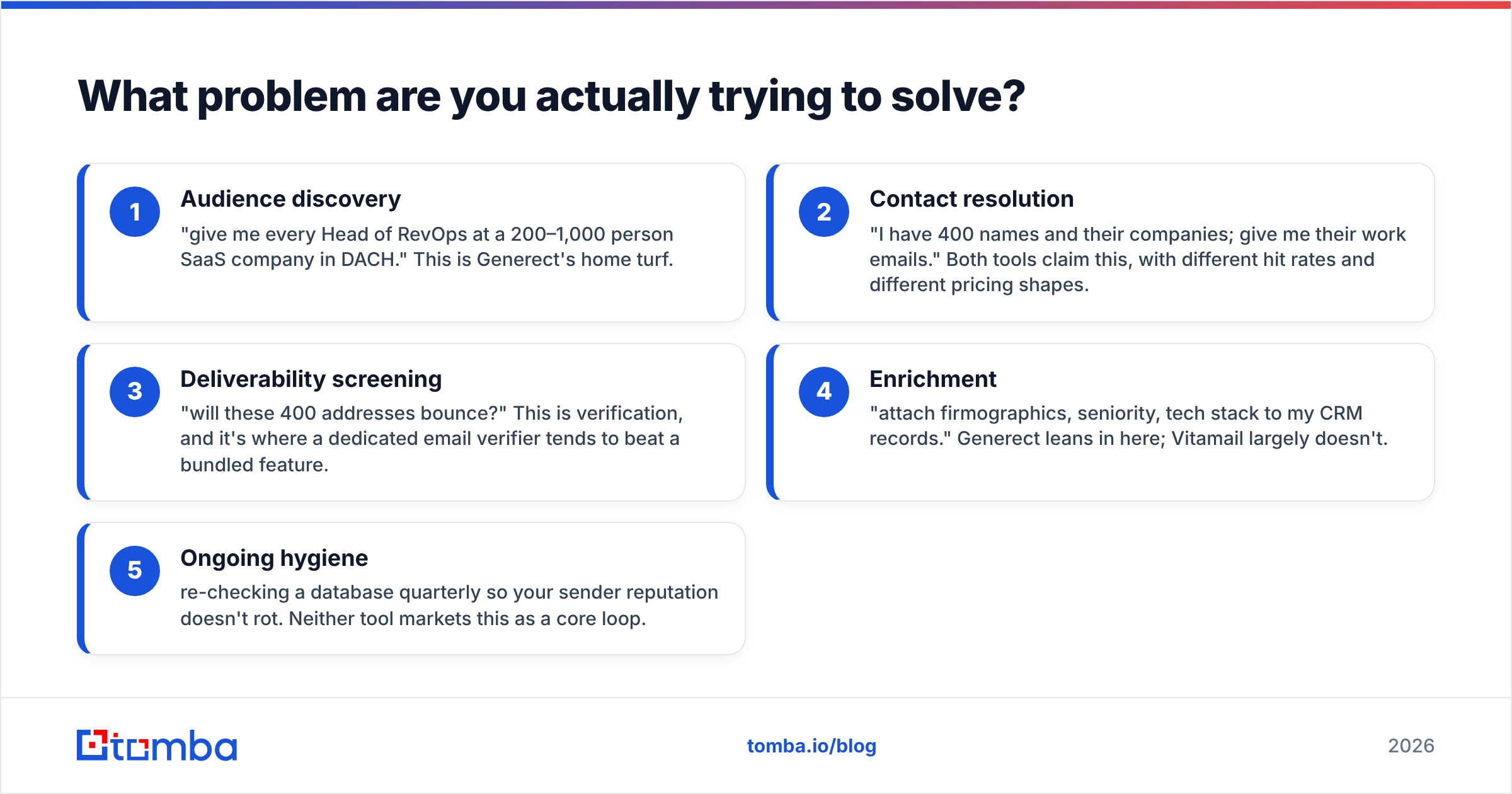
- Audience discovery — "give me every Head of RevOps at a 200–1,000 person SaaS company in DACH." This is Generect's home turf.
- Contact resolution — "I have 400 names and their companies; give me their work emails." Both tools claim this, with different hit rates and different pricing shapes.
- Deliverability screening — "will these 400 addresses bounce?" This is verification, and it's where a dedicated email verifier tends to beat a bundled feature.
- Enrichment — "attach firmographics, seniority, tech stack to my CRM records." Generect leans in here; Vitamail largely doesn't.
- Ongoing hygiene — re-checking a database quarterly so your sender reputation doesn't rot. Neither tool markets this as a core loop.
Most teams evaluating Generect vs Vitamail are really deciding whether they have a discovery problem or a resolution problem. Answer that first and the rest of this post gets much shorter.
What is Generect?#
Generect (generect.com) positions itself as a real-time B2B lead generation and data API. Instead of serving records from a static warehouse that was refreshed some unknown number of months ago, the pitch is that queries trigger a live pull, so the job titles and company affiliations you get back reflect the present rather than last year's snapshot.
That architecture matters more than it sounds. The single biggest source of bad B2B data isn't bad matching logic — it's staleness. Roughly a third of a typical B2B contact database degrades annually through job changes, restructures, and domain migrations. A live-pull model attacks the problem at the source instead of patching it downstream.
The trade-offs are predictable:
- Latency. Live queries are slower than a warehouse SELECT. Fine for batch list builds, less fine for a real-time form-fill enrichment call.
- Pricing opacity. Generect's commercial motion skews toward custom quotes and API contracts rather than a public self-serve card. Expect a call.
- Coverage shape. Strong where professional-network signals are dense (tech, SaaS, agencies, mid-market North America and Western Europe). Thinner in industries where decision-makers don't maintain public profiles — construction, local services, much of APAC SMB.
What is Vitamail?#
Vitamail is the simpler product: an email finder plus verification layer aimed at people who need addresses now, without a procurement cycle. You provide identity inputs — full name and company domain, typically — and it returns a best-guess address with a confidence signal, having run pattern inference and an SMTP-level check.
This is a well-understood category with well-understood physics. Every finder in it does roughly the same four things: infer the company's email pattern, generate candidates, validate them against the receiving mail server, and score confidence. Differences between vendors come down to pattern-corpus size, how aggressively they guess when confidence is low, and how they handle catch-all domains.
That last one is the honest dividing line in this whole category. A catch-all domain accepts every address at the SMTP layer, so a naive verifier marks garbage as valid. If a tool reports 95%+ "valid" rates, ask what it does with catch-alls before you believe the number.

How do Generect and Vitamail compare head-to-head?#
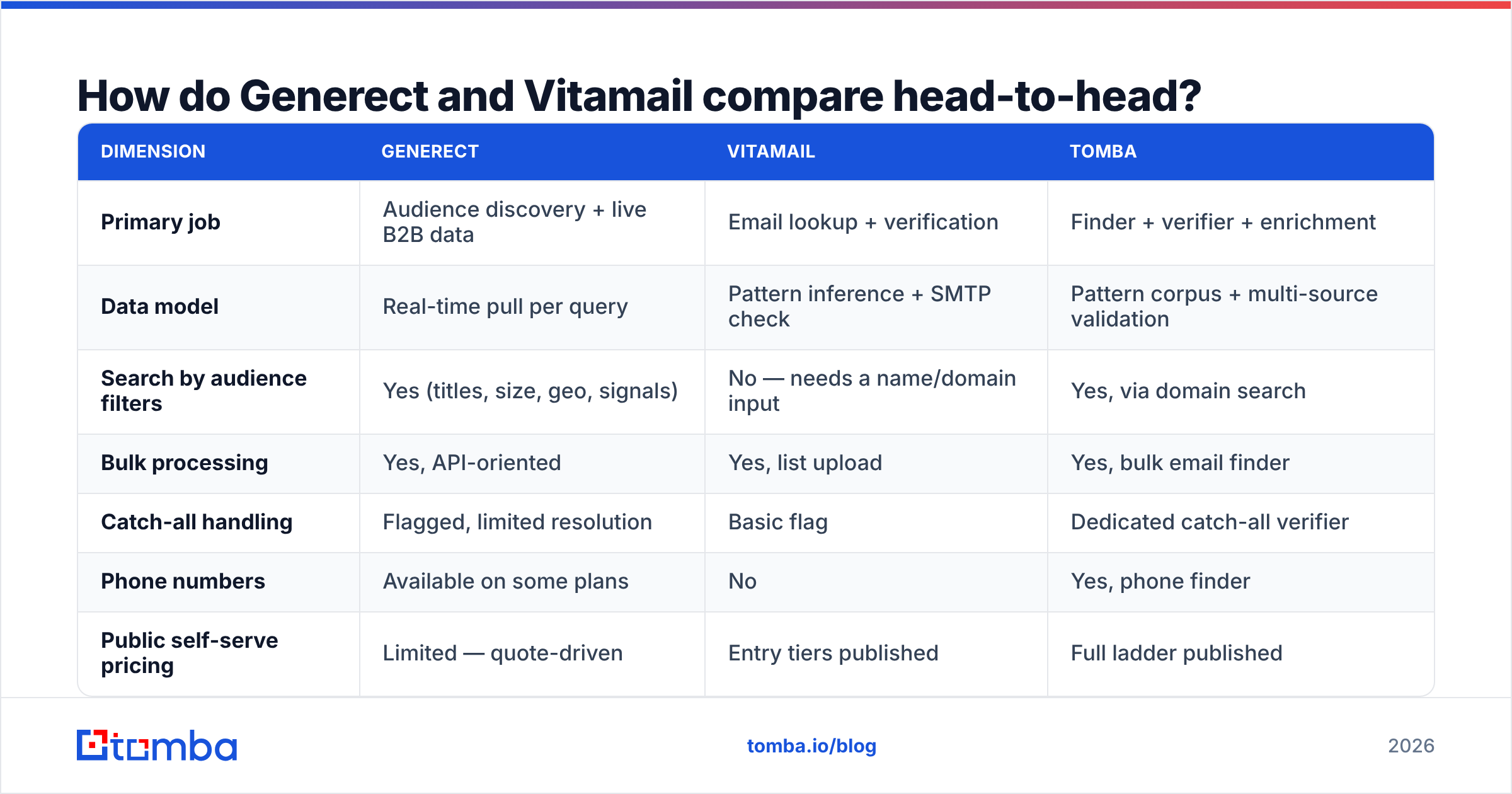
| Dimension | Generect | Vitamail | Tomba |
|---|---|---|---|
| Primary job | Audience discovery + live B2B data | Email lookup + verification | Finder + verifier + enrichment |
| Data model | Real-time pull per query | Pattern inference + SMTP check | Pattern corpus + multi-source validation |
| Search by audience filters | Yes (titles, size, geo, signals) | No — needs a name/domain input | Yes, via domain search |
| Bulk processing | Yes, API-oriented | Yes, list upload | Yes, bulk email finder |
| Catch-all handling | Flagged, limited resolution | Basic flag | Dedicated catch-all verifier |
| Phone numbers | Available on some plans | No | Yes, phone finder |
| Public self-serve pricing | Limited — quote-driven | Entry tiers published | Full ladder published |
| Free tier | Trial/demo, gated | Small free allowance | 25 searches/mo, no card |
| Entry paid price | Custom quote | Low double digits/mo | $49/mo Starter |
| Best for | Building an ICP list from scratch | Resolving a list you already have | Both, on one credit pool |

Which one is more accurate?#
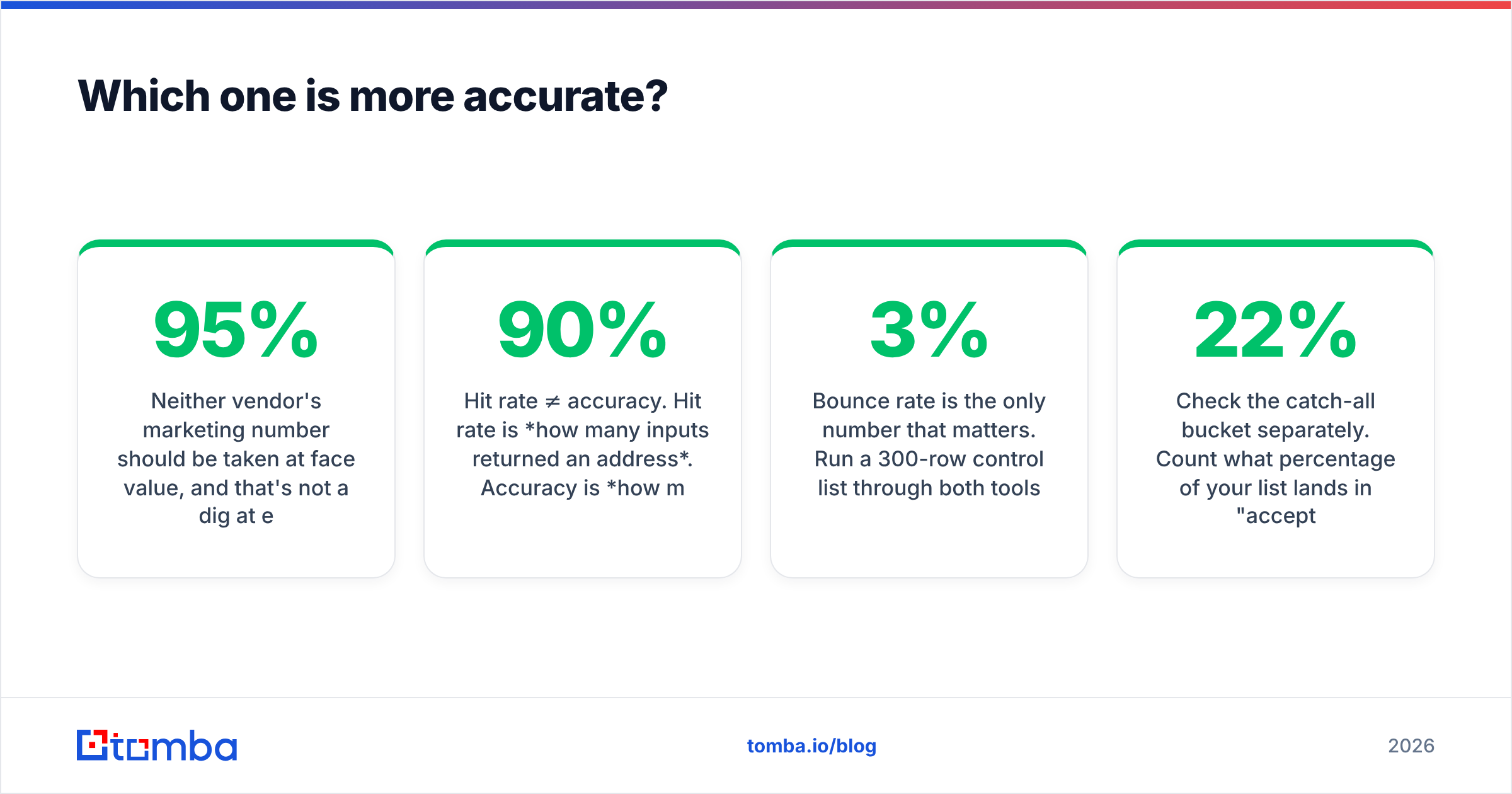
Neither vendor's marketing number should be taken at face value, and that's not a dig at either — it's how the category works. "95% accuracy" can mean five different things depending on the denominator.
Here's how to read the claims:
- Hit rate ≠ accuracy. Hit rate is how many inputs returned an address. Accuracy is how many of those addresses actually deliver. A tool can push hit rate to 90% by guessing aggressively and quietly destroy your bounce rate.
- Bounce rate is the only number that matters. Run a 300-row control list through both tools, send to it from a warmed, non-production domain, and measure hard bounces. Anything above 3% is a deliverability problem, not a data problem.
- Segment the test. Test one slice where you expect strength (mid-market SaaS, English-speaking) and one where you expect weakness (sub-50-employee firms outside the US). Vendors that look identical on the first slice diverge hard on the second.
- Check the catch-all bucket separately. Count what percentage of your list lands in "accept-all / unknown" and how each tool labels it. If Generect and Vitamail both return 22% unknown on your ICP, that's 22% of your spend producing a coin flip.
In practice, Generect tends to win on coverage of people you didn't know existed — because it's finding the person and the address in one motion. Vitamail tends to win on cost per resolved address when you already have the name. Those aren't competing accuracy claims; they're different denominators.
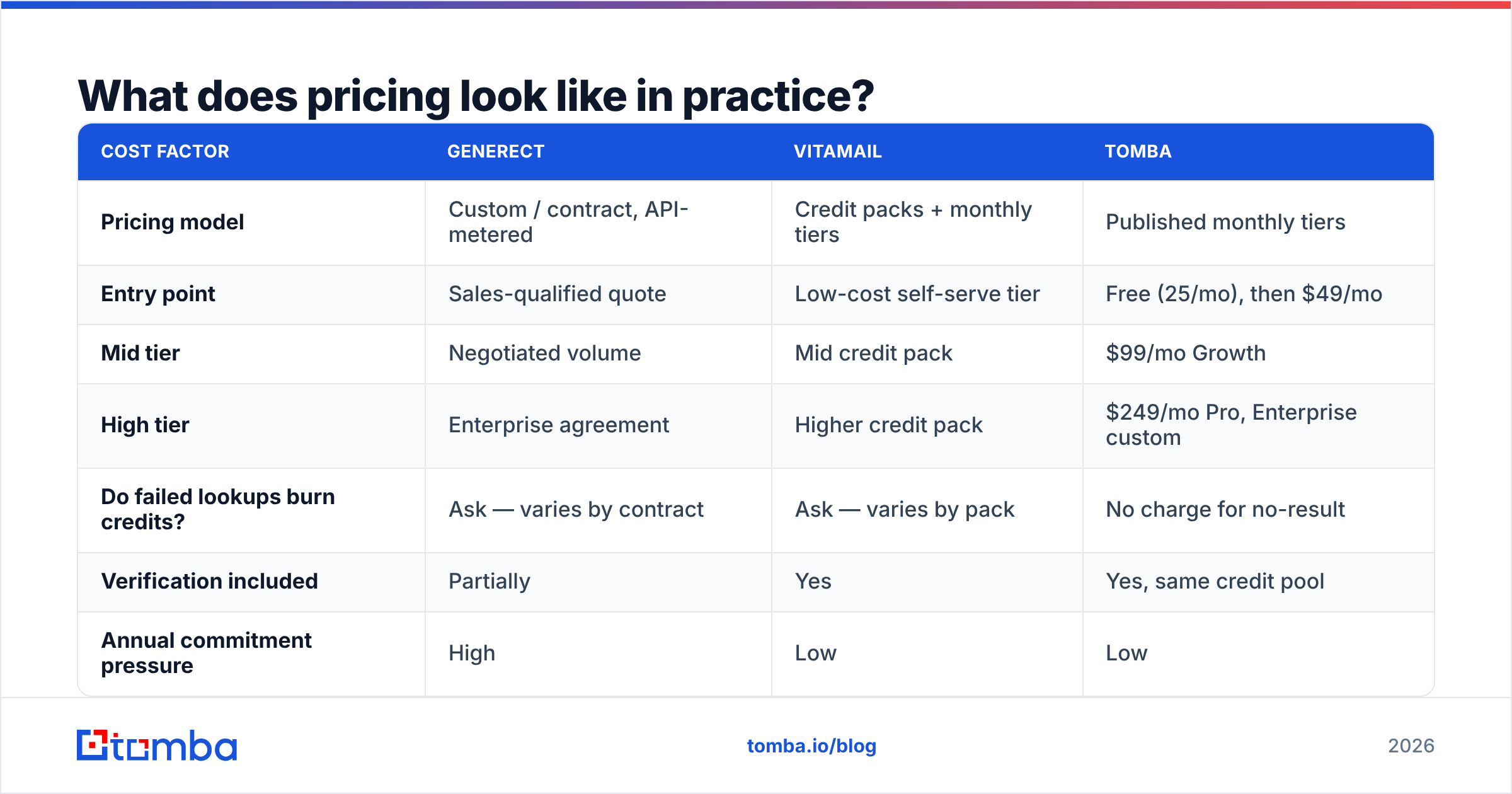
What does pricing look like in practice?#
Both vendors adjust packaging regularly, so treat the shapes below as structural rather than as quotes — confirm current numbers on each vendor's own pricing page before you budget.
| Cost factor | Generect | Vitamail | Tomba |
|---|---|---|---|
| Pricing model | Custom / contract, API-metered | Credit packs + monthly tiers | Published monthly tiers |
| Entry point | Sales-qualified quote | Low-cost self-serve tier | Free (25/mo), then $49/mo |
| Mid tier | Negotiated volume | Mid credit pack | $99/mo Growth |
| High tier | Enterprise agreement | Higher credit pack | $249/mo Pro, Enterprise custom |
| Do failed lookups burn credits? | Ask — varies by contract | Ask — varies by pack | No charge for no-result |
| Verification included | Partially | Yes | Yes, same credit pool |
| Annual commitment pressure | High | Low | Low |
Two questions decide the real cost, and almost nobody asks them during a demo:
Do you pay for misses? If a tool charges a credit whether or not it returns a deliverable address, your effective price on a hard ICP can be double the sticker. Are verification and discovery separately metered? Some stacks charge you once to find and again to verify the same contact. On a 10,000-contact quarter, that's the difference between one line item and two.
You can sanity-check any quote against published Tomba pricing as a baseline, since it's one of the few in this category with the full ladder visible without a call.

Which should you pick for your workflow?#
Pick Generect if: you're entering a new market, your ICP definition is still moving, and you need volume discovery with firmographic context. You have engineering time to integrate an API and budget approval for a contract. Your outbound motion is list-first — build the audience, then write to it.
Pick Vitamail if: your pipeline starts somewhere else. You scrape conference attendee lists, export LinkedIn Sales Navigator searches, or get inbound names from webinars, and you need those names turned into addresses cheaply and fast. You don't need firmographics; you need a mailbox.
Pick neither if: you need both motions on one credit pool with a documented API and no procurement cycle. That's the gap in this matchup, and it's the gap Tomba was built into.

How do you run a fair 60-minute bake-off?#
Skip the demo theater. Do this instead:
- Build a 200-row ground-truth list. Pull contacts you already have confirmed addresses for — customers, partners, past replies. Strip the emails. Keep them in a separate column.
- Run all candidates on identical inputs. Same names, same domains, same day. Any variance in input invalidates the comparison.
- Score three columns per tool: returned an address (yes/no), matched your known-good address (yes/no), and confidence label. Now you have real hit rate and real precision, not vendor marketing.
- Send a live control batch. Take 100 addresses each tool returned that you couldn't ground-truth, send a plain one-line email from a secondary domain, and log hard bounces after 48 hours.
- Divide total cost by confirmed-deliverable addresses. That is your true CPL input. It is almost never the number on the pricing page.
- Test the API, not just the UI. If your team will hit this programmatically, a clean, rate-limit-honest email finder API is worth more over 12 months than a two-point accuracy edge.
Independent review aggregators like G2's sales intelligence category are useful for spotting support and billing complaints that never appear in a demo — but they are worthless for accuracy, because reviewers test different ICPs. Your own bake-off is the only accuracy evidence that applies to you.
Does any of this matter if your deliverability is broken?#
Partly. Clean data is necessary, not sufficient. If your SPF record, DKIM signing, and DMARC alignment aren't configured, a perfect list still lands in spam. And bounce rate is only one of several signals mailbox providers weigh when deciding where your mail goes — the underlying SMTP handshake tells you whether an address exists, not whether a human will ever see your message.
The practical order of operations: authenticate the domain, warm the sender, then optimize data quality. Teams that reverse those steps spend money on premium data and burn it on a cold domain.
The verdict#
Generect wins when discovery is the bottleneck. Vitamail wins when resolution is the bottleneck and budget is tight. Both are defensible picks for the job they were designed for, and both get frustrating the moment your workflow shifts toward the other half.
The uncomfortable answer most evaluations reach is that you need both capabilities within a quarter of starting, and running two vendors means two contracts, two credit pools, and two sets of accuracy claims to reconcile.
If that's where you're heading, start with the Tomba Email Finder. Free tier gives you 25 searches a month with no card, which is enough to run the 200-row ground-truth test above before you spend anything. Discovery, verification, catch-all handling, and enrichment sit on one credit pool with published pricing from $49/mo — so the number you compare in your bake-off is the number you actually pay.
Related guides#
Ready to find emails that actually work?
Join 150,000+ professionals who stopped guessing and started sending. Free credits on signup — no credit card required.
Get the Tomba newsletter
Practical outbound tactics and product updates — once every two weeks.
About the author