Generect vs Vulcan7 (2026): Which Lead Data Tool Wins?
Generect and Vulcan7 both sell "leads," but they serve completely different sellers. Here's an honest breakdown of data coverage, pricing, workflow fit, and when a cheaper email-finder stack beats both.
Generect vs Vulcan7 looks like a fair fight. It is not. One tool sells B2B contact data. The other sells homeowner leads to real estate agents. Pick by who you sell to, and the choice makes itself.
TL;DR
- Generect vs Vulcan7 is not a real head-to-head. Generect is a B2B lead-data tool. It searches companies and people, mostly from LinkedIn. Vulcan7 is a real estate tool. It sells expired listings, FSBOs, and a power dialer.
- Sell to businesses? Vulcan7 data is useless to you. It tracks homeowners and property records, not job titles and company domains.
- Chase expired listings at 8am? Generect hands you B2B contacts you cannot use. Vulcan7 wins that lane outright.
- Prices do not line up either. Vulcan7 charges per seat each month, plus a setup fee. Generect charges for lead credits and API calls.
- Most B2B teams need neither. A good email finder plus verification runs $49/mo. That covers most of what an SDR does each day.
What is Generect, and what problem does it solve?#
Generect is a B2B lead tool. It pulls company and contact records, mostly from LinkedIn. You get lists you can search and export, or an API you can call. The pitch is fresh data. Most databases go stale each quarter. Generect checks live profiles instead.
Four kinds of buyers pick it up:
- Outbound SDR teams. They filter by headcount, industry, region, and job level. Then they push the list into a sequencer.
- Recruiters and staffing firms. They work from LinkedIn and need contact details on each candidate.
- Developers. They want a lead API they can call from a script, not a UI they have to click through.
- Lead-gen agencies. Cost per lead and clean exports matter more than a pretty dashboard.
Read the vendor pitch at generect.com. User reviews are thin next to the big names. Check G2 before you sign a yearly deal.
What is Vulcan7, and who actually uses it?#
Vulcan7 is a real estate tool. It is not a B2B tool at all. It sends agents a daily list of homeowner leads: expired listings, for sale by owner, for rent by owner, pre-foreclosure, and whole neighborhoods. Each lead comes with checked phone numbers. A power dialer calls several lines at once.
The workflow is narrow and fast:
- The overnight sweep. Listings that expired or changed status yesterday show up this morning.
- Phone matching. Vulcan7 bets on phone accuracy. An agent's funnel starts with a live call.
- The dialer. Three lines at once, with voicemail drops and call recording. Two hours of dialing shrinks to forty minutes.
- Scripts. Coaching content is bundled in. Most agents do not lack leads. They lack words when someone picks up.
- CRM sync. Push call results into whatever CRM the brokerage uses.
Details live at vulcan7.com. Listing agents usually weigh it against REDX or Espresso Agent, not a B2B data vendor.

Generect vs Vulcan7: how do they compare head-to-head?#
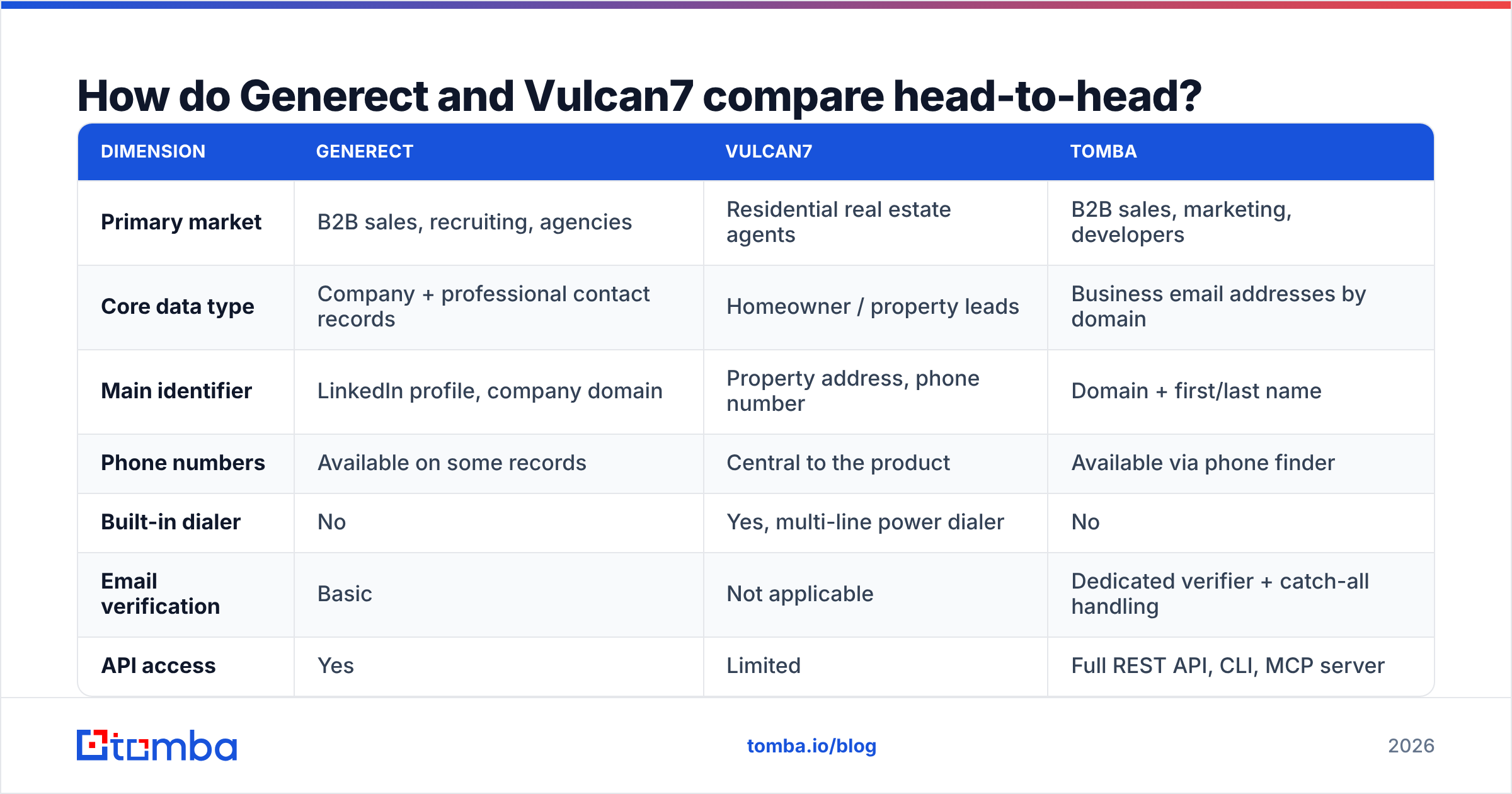
This is where the versus framing falls apart. Line up the specs and the overlap is near zero.
| Dimension | Generect | Vulcan7 | Tomba |
|---|---|---|---|
| Primary market | B2B sales, recruiting, agencies | Residential real estate agents | B2B sales, marketing, developers |
| Core data type | Company + professional contact records | Homeowner / property leads | Business email addresses by domain |
| Main identifier | LinkedIn profile, company domain | Property address, phone number | Domain + first/last name |
| Phone numbers | On some records | Central to the product | Via phone finder |
| Built-in dialer | No | Yes, multi-line power dialer | No |
| Email verification | Basic | Not applicable | Verifier + catch-all handling |
| API access | Yes | Limited | Full REST API, CLI, MCP server |
| Entry price | Credit-based, mid-range | Per-seat monthly + setup fee | Free tier (25 searches), then $49/mo |
| Best for | Net-new B2B list building | Daily expired/FSBO calling | Precise email discovery at scale |
| Worst for | Anyone selling to homeowners | Anyone selling to businesses | Teams that need a dialer |
So you are not really picking a tool. You are naming your market. The market then picks the tool for you.
Which platform has better data quality?#
Neither. They measure different things. Any vendor quoting one accuracy number across both is selling you a number, not a method.
Generect's test looks like this. Ask for VP-level marketing contacts at 200-person SaaS firms in Germany. How many records have a live email and a current job title? Titles decay fast. About a quarter of B2B records go stale each year from job changes alone. Fresh data beats a big pile.
Vulcan7's test is different. Dial a homeowner and see who picks up. That is a phone match problem. It leans on telecom data and do-not-call scrubbing, not company data.
B2B buyers can run this test:
- Pull 100 records in your exact ICP. Not a generic sample.
- Verify them yourself with an email verifier. Do not trust the source's own valid flag.
- Count bounces, catch-alls, and role accounts apart. A 95% valid rate is not 95% if half of it is catch-all.
- Check 20 job titles by hand on LinkedIn. Three or more wrong means the data is older than claimed.
- Run the same 100 again in 60 days. Decay rate matters more than day-one accuracy.
Do that once. You will stop arguing about vendor accuracy claims.
What do Generect and Vulcan7 actually cost?#
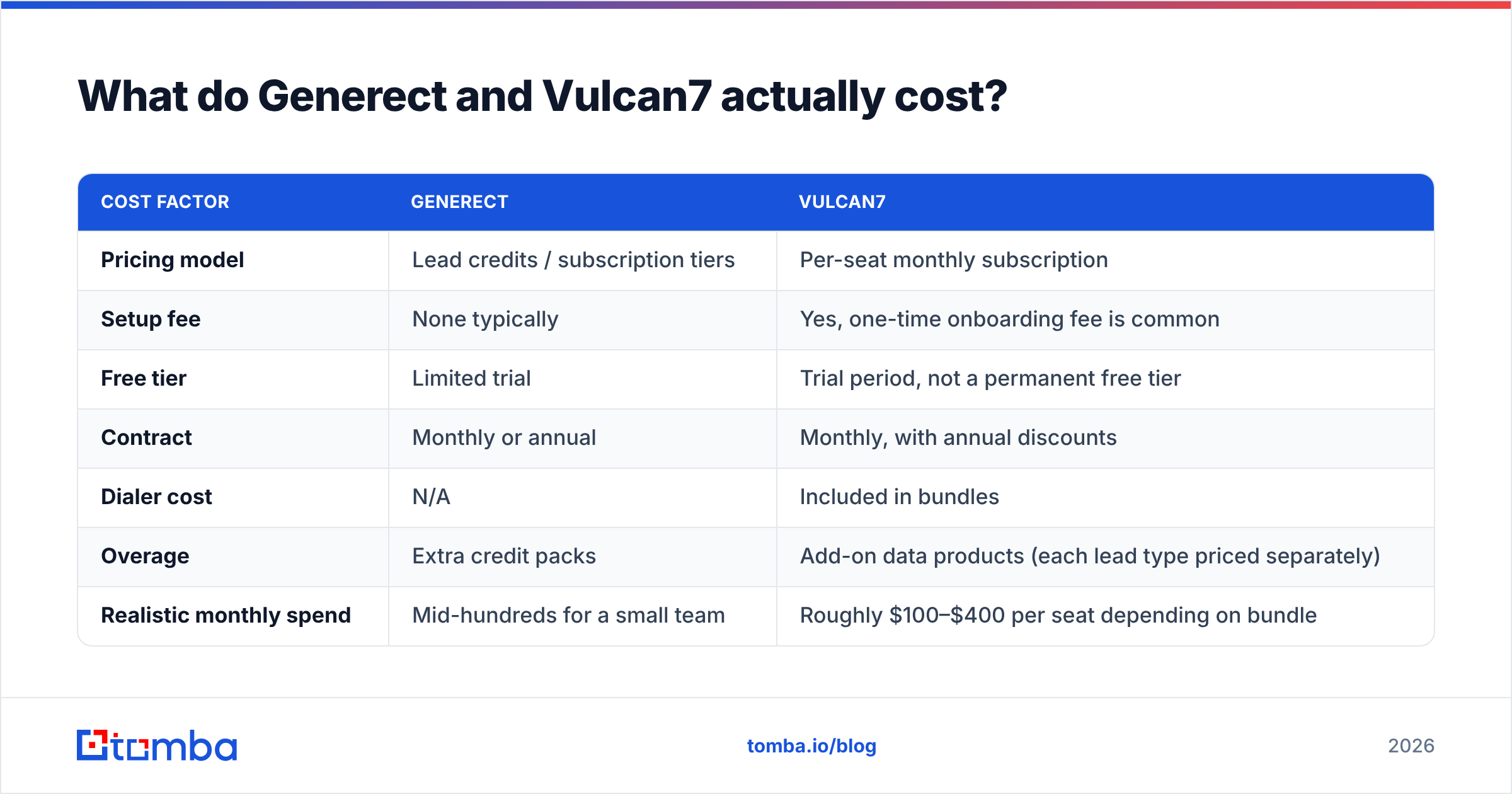
Both vendors shift prices often. Treat these as shapes, not quotes. Check the pricing pages before you buy.
| Cost factor | Generect | Vulcan7 |
|---|---|---|
| Pricing model | Lead credits / tiers | Per-seat monthly plan |
| Setup fee | Usually none | Yes, a one-time fee is common |
| Free tier | Limited trial | Trial only, not a free tier |
| Contract | Monthly or annual | Monthly, cheaper if annual |
| Dialer cost | N/A | Included in bundles |
| Overage | Extra credit packs | Each lead type priced on its own |
| Real monthly spend | Mid-hundreds for a small team | Roughly $100–$400 per seat |
Two things bite buyers here. First, Vulcan7 sells lead types one at a time. Expireds, FSBOs, and neighborhood search can each be a line item. The starting price and the real bill drift apart fast.
Second, credit tools like Generect can charge for lookups that return nothing usable. Ask if failed searches are refunded. Get the answer in writing.
Tomba pricing is flat on purpose. A free tier with 25 searches a month, Starter at $49/mo, Growth at $99/mo, Pro at $249/mo, plus custom enterprise terms. No setup fee. No per-lead-type bundles.
When should you pick Generect over Vulcan7?#
Pick Generect if all of these are true:
- You sell to businesses. Your ICP runs on headcount, industry, tech stack, or funding stage.
- You reach people by email or LinkedIn, not by phone.
- You need bulk lists. Hundreds or thousands of records per campaign, not 40 hand-picked accounts.
- You want an API so RevOps can enrich CRM records as they land.
Pick Vulcan7 if:
- You are a licensed agent, or you run a brokerage team.
- Your day starts with a call block. Speed to dial is the one metric that counts.
- You need homeowner phone numbers with DNC scrubbing done for you.
- You would pay for a dialer anyway, so the bundle saves money.
Anything else means forcing a tool into the wrong job.
What if neither one fits your workflow?#
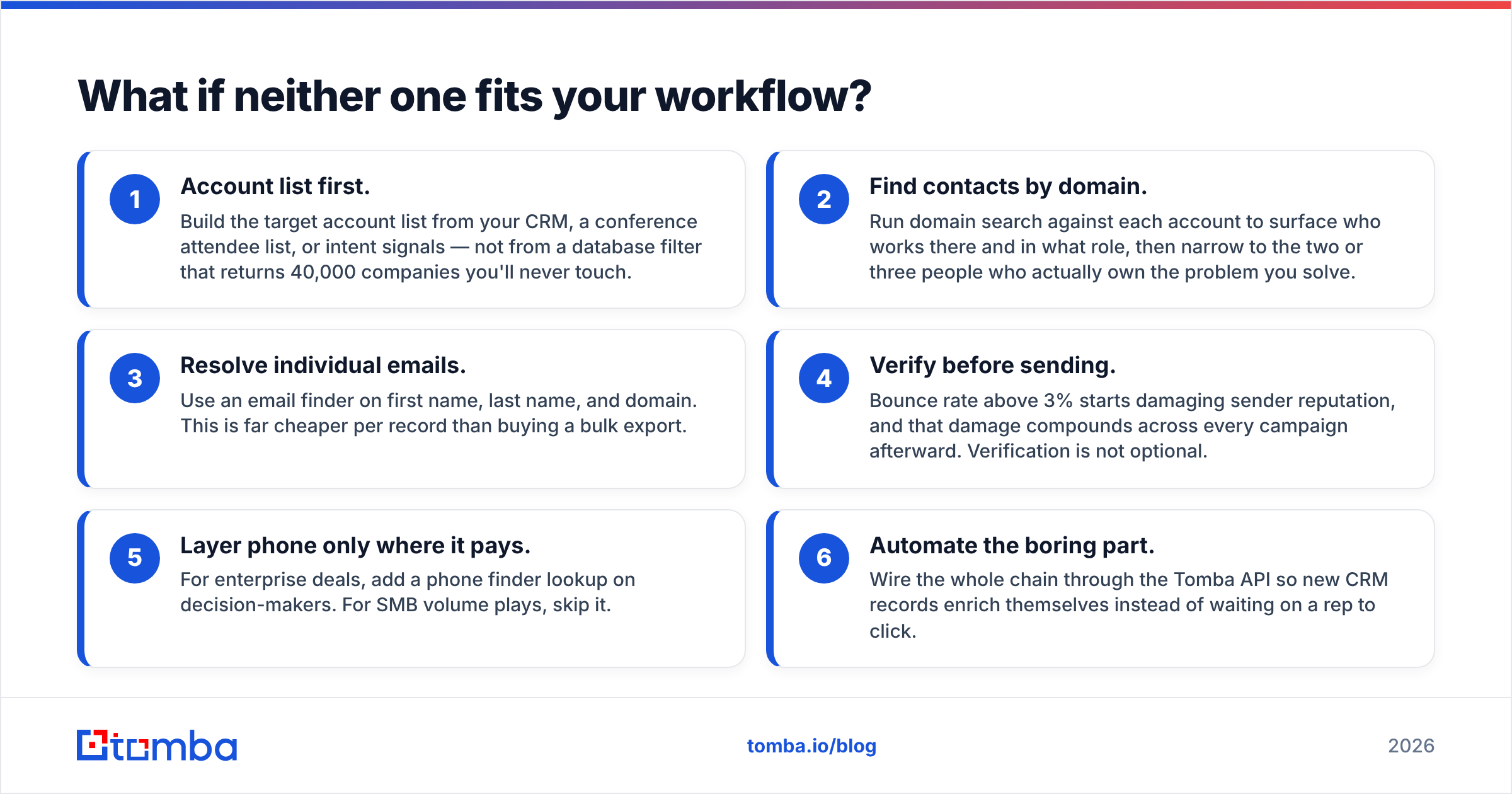
Most B2B teams searching "Generect vs Vulcan7" are in the wrong comparison. The real question is simpler. How do you get accurate business emails for a named list of accounts? And how do you skip paying for a database you will barely touch?
That is a smaller problem. Smaller tools solve it for less.

A lean B2B stack in 2026 looks like this:
- Build the account list first. Use your CRM, an event list, or intent signals. Skip the filter that returns 40,000 companies you will never touch.
- Find people by domain. Run domain search on each account. Then narrow to the two or three people who own your problem.
- Get the emails. Use an email finder on first name, last name, and domain. Per record, that costs far less than a bulk export.
- Verify before you send. A bounce rate over 3% hurts sender reputation. That damage builds with every send after it.
- Add phone only where it pays. Big deals, yes. High-volume SMB plays, no. Use a phone finder on decision-makers.
- Automate the dull part. Wire the chain through the Tomba API. New CRM records then enrich themselves.
Need large pre-built B2B lists with promised delivery rates? BookYourData is strong in that lane. Price it next to a finder-based stack. The two solve different problems, and plenty of teams run both.
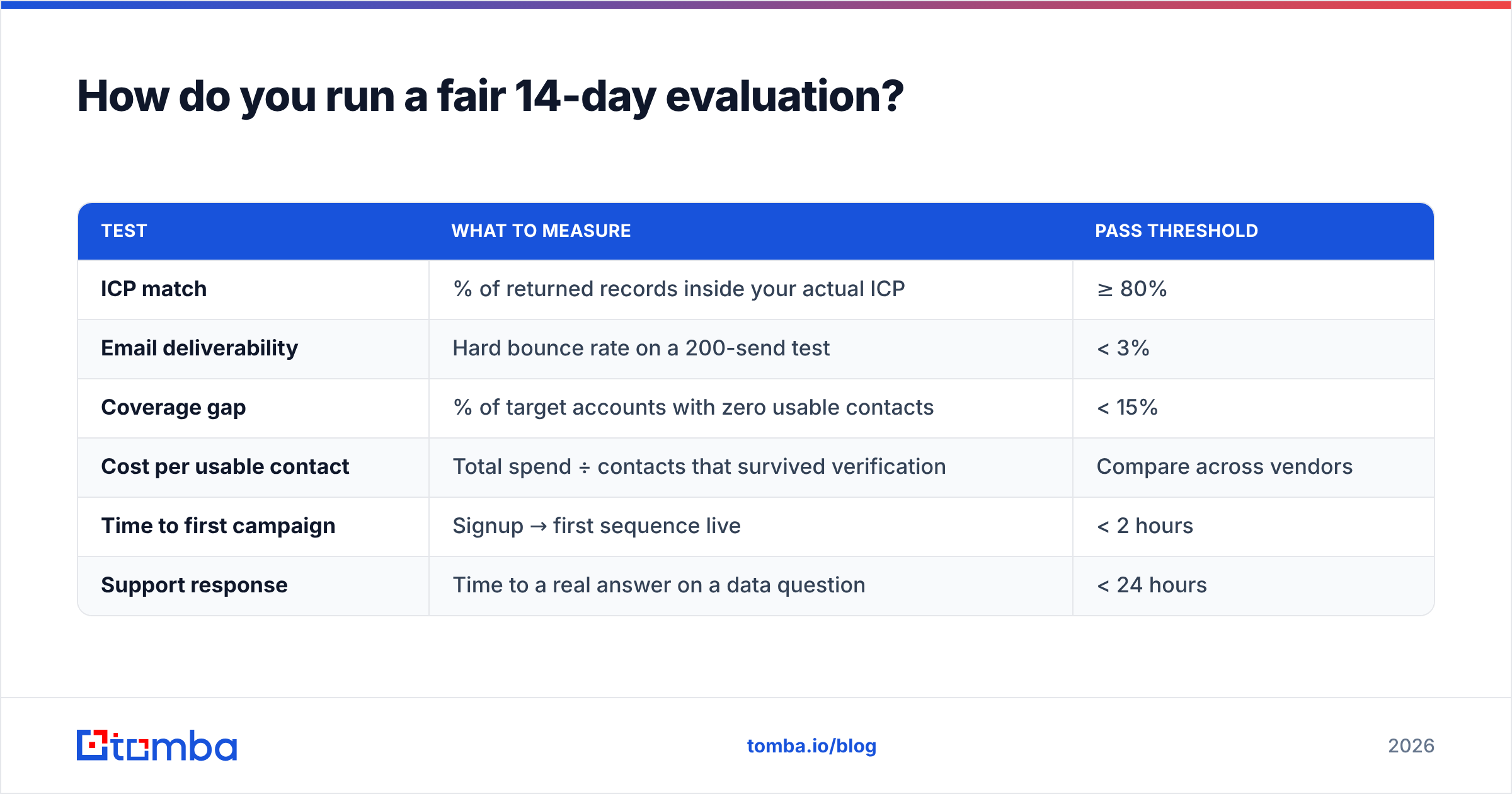
How do you run a fair 14-day evaluation?#
Trust no one here, this post included. Run the same test on every tool.
| Test | What to measure | Pass threshold |
|---|---|---|
| ICP match | % of records inside your real ICP | ≥ 80% |
| Email deliverability | Hard bounce rate on a 200-send test | < 3% |
| Coverage gap | % of accounts with zero usable contacts | < 15% |
| Cost per usable contact | Spend ÷ contacts that pass verification | Compare vendors |
| Time to first campaign | Signup → first sequence live | < 2 hours |
| Support response | Time to a real answer on data | < 24 hours |
Cost per usable contact is the number that counts. A cheap tool with a 40% verify failure rate costs more than the one that looked pricey.
The verdict on Generect vs Vulcan7#
Both tools do their job well, in separate worlds. Vulcan7 wins if you list houses. Generect is a fair pick if you need broad B2B lists with an API. Neither answers this one: "I need good business emails for 300 named accounts, without a five-figure contract."
If that sounds like you, start with the Tomba Email Finder. The free tier gives you 25 searches. Test the data against your own ICP before you spend. Starter is $49/mo. Verification, domain search, and catch-all handling come built in, not as extra line items. Run the 14-day test above. Compare cost per usable contact. Let the numbers pick your stack.
Related guides#
Ready to find emails that actually work?
Join 150,000+ professionals who stopped guessing and started sending. Free credits on signup — no credit card required.
Get the Tomba newsletter
Practical outbound tactics and product updates — once every two weeks.
About the author