Genoo Pricing Reviews Pros and Cons: A 2026 Buyer's Guide
Genoo bundles email, landing pages, lead scoring and WordPress sync into one mid-market platform. Here is what it actually costs, what reviewers praise, where it frustrates teams, and when a leaner stack wins.

This guide breaks down Genoo pricing reviews pros and cons in plain language. You get the real cost range, what users praise, what they complain about, and when a leaner stack wins.
TL;DR
- Genoo is a mid-market marketing automation platform — email, landing pages, forms, lead scoring, lead nurturing, and a WordPress sync module — sold as one bundle rather than as modular add-ons.
- Genoo does not publish a public price ladder. Buyer directories put the practical entry point in the low-hundreds-per-month range. The real number depends on contact volume and onboarding. Get a written quote before you budget.
- The strongest reviews praise hands-on support, the WordPress/WebSync integration, and the fact that lead nurturing is not gated behind an enterprise tier.
- The most common complaints: a dated interface, a smaller integration ecosystem than HubSpot or ActiveCampaign, and no meaningful free tier to test with real data.
- Genoo does not source contact data. Whatever platform you pick, you still need a verified email layer feeding it — that is where a dedicated email finder belongs in the stack.
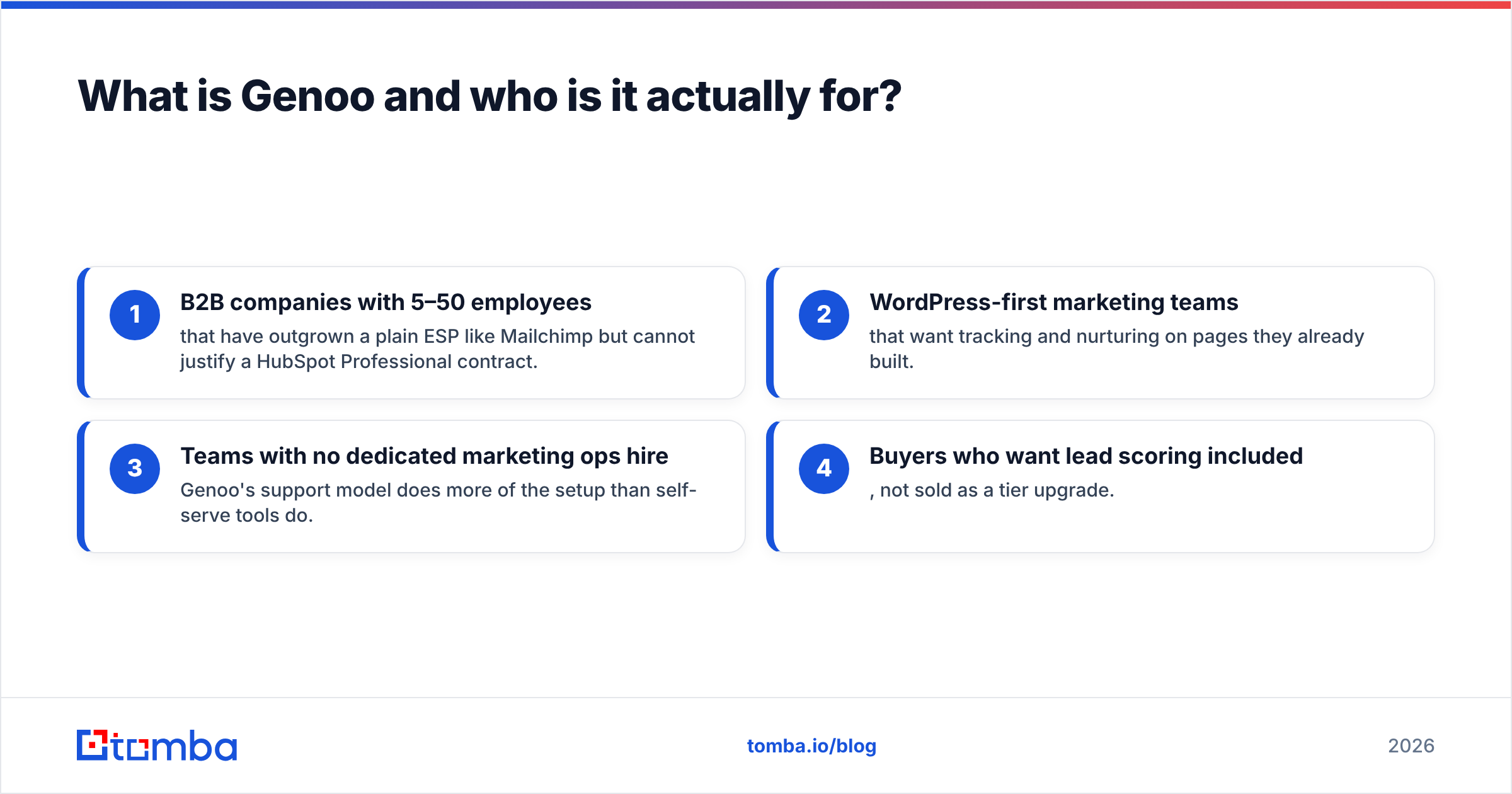
What is Genoo and who is it actually for?#
Genoo is a marketing automation platform for small and mid-sized B2B companies that want lead nurturing without an enterprise contract. Think of it like a compact kitchen in a small restaurant. Every appliance you need is bolted into one wall. Nothing is best in class on its own, but you can still cook the full menu without hiring three chefs.
The product covers the standard automation checklist — email campaigns, landing pages, embedded forms, lead scoring, behavioral tracking, and a light CRM-style lead database. Its most distinctive piece is WebSync, a WordPress module that pulls your existing site pages into the tracking and nurturing layer instead of forcing you to rebuild landing pages inside the vendor's editor. If your marketing site already lives on WordPress, that is a genuine time saver.
Who it fits:
- B2B companies with 5–50 employees that have outgrown a plain ESP like Mailchimp but cannot justify a HubSpot Professional contract.
- WordPress-first marketing teams that want tracking and nurturing on pages they already built.
- Teams with no dedicated marketing ops hire — Genoo's support model does more of the setup than self-serve tools do.
- Buyers who want lead scoring included, not sold as a tier upgrade.
Who it does not fit: product-led SaaS companies needing deep product-event triggers, ecommerce teams needing revenue attribution per SKU, and any team whose stack decision hinges on a long integration marketplace.
How much does Genoo cost in 2026?#
Here is the honest answer: Genoo runs a quote-led pricing model, not a self-serve checkout. There is no public four-tier grid you can screenshot. Any blog that quotes an exact dollar figure with confidence is guessing. Buyer directories such as Capterra and G2 report a starting point in the low hundreds of dollars per month for the core platform. From there it scales with contact volume and add-on modules.
That structure has three practical consequences for your budget:
- Your quote is a negotiation, not a menu. Annual prepay, contact-count commitments, and multi-year terms all move the number.
- Onboarding is often a separate line item. Ask explicitly whether implementation, template setup, and data import are included or billed once.
- Contact-count creep is the real cost driver. Every marketing automation platform prices on database size. A list that grows 40% because nobody pruned it grows your invoice by roughly the same amount.
Check the official Genoo site for the current packaging before you commit — quote-led vendors change bundles more often than they change published prices.

What is actually included at each level?#
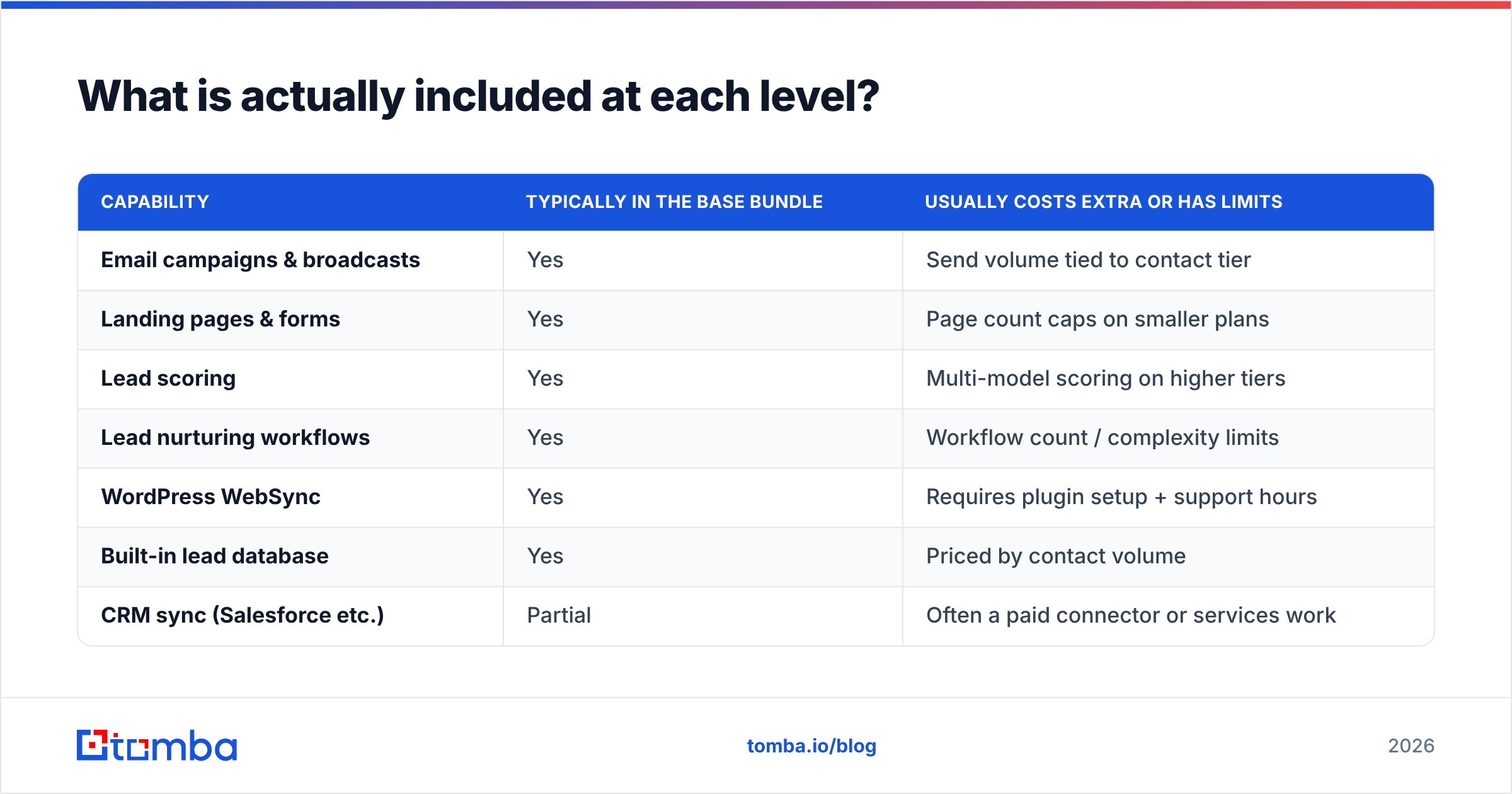
Rather than tiers, think in modules. This is what you are buying and what tends to sit outside the base bundle:
| Capability | Typically in the base bundle | Usually costs extra or has limits |
|---|---|---|
| Email campaigns & broadcasts | Yes | Send volume tied to contact tier |
| Landing pages & forms | Yes | Page count caps on smaller plans |
| Lead scoring | Yes | Multi-model scoring on higher tiers |
| Lead nurturing workflows | Yes | Workflow count / complexity limits |
| WordPress WebSync | Yes | Requires plugin setup + support hours |
| Built-in lead database | Yes | Priced by contact volume |
| CRM sync (Salesforce etc.) | Partial | Often a paid connector or services work |
| Onboarding & template build | Sometimes | Frequently a one-time services fee |
| Contact data / email discovery | No | Third-party tool required |
That last row is the one buyers forget. No marketing automation platform — Genoo, HubSpot, ActiveCampaign, or otherwise — creates net-new contacts for you. It nurtures the ones you already have. Sourcing and validating those contacts is a separate budget line, which is why teams pair automation with a domain search and email verifier layer.
Genoo pricing reviews pros and cons: what buyers report#
Aggregated review sentiment on Genoo is quieter than the giants — fewer reviews, but a noticeably steadier tone. The pattern across public reviews looks like this.
What reviewers consistently praise:
- Support that behaves like a partner. The most repeated theme is that you get a human who knows your account, not a ticket queue. For a team without a marketing ops specialist, that is worth real money.
- Everything in one login. No stitching an ESP to a landing page builder to a scoring tool.
- WordPress integration. Tracking and nurturing your existing pages instead of duplicating them.
- Lead nurturing included by default. Cheaper platforms often paywall true multi-step nurturing.
What reviewers consistently criticize:
- The interface feels dated. Functional, but it does not compete visually with tools rebuilt in the last three years.
- Smaller integration ecosystem. If your stack has ten SaaS tools that must talk to each other, expect Zapier-style middleware or custom work.
- Reporting depth. Adequate for campaign-level metrics, thin for multi-touch attribution.
- Learning curve on workflows. Powerful, but not the drag-and-drop simplicity newer entrants advertise.
- No real free tier. You evaluate through a demo, not by loading your own list and seeing what happens.
Treat "no free tier" as the most consequential item. You cannot test how a platform handles your data quality until you load your data. And if 12% of your list bounces, the platform is not the problem.
How does Genoo compare to the alternatives?#
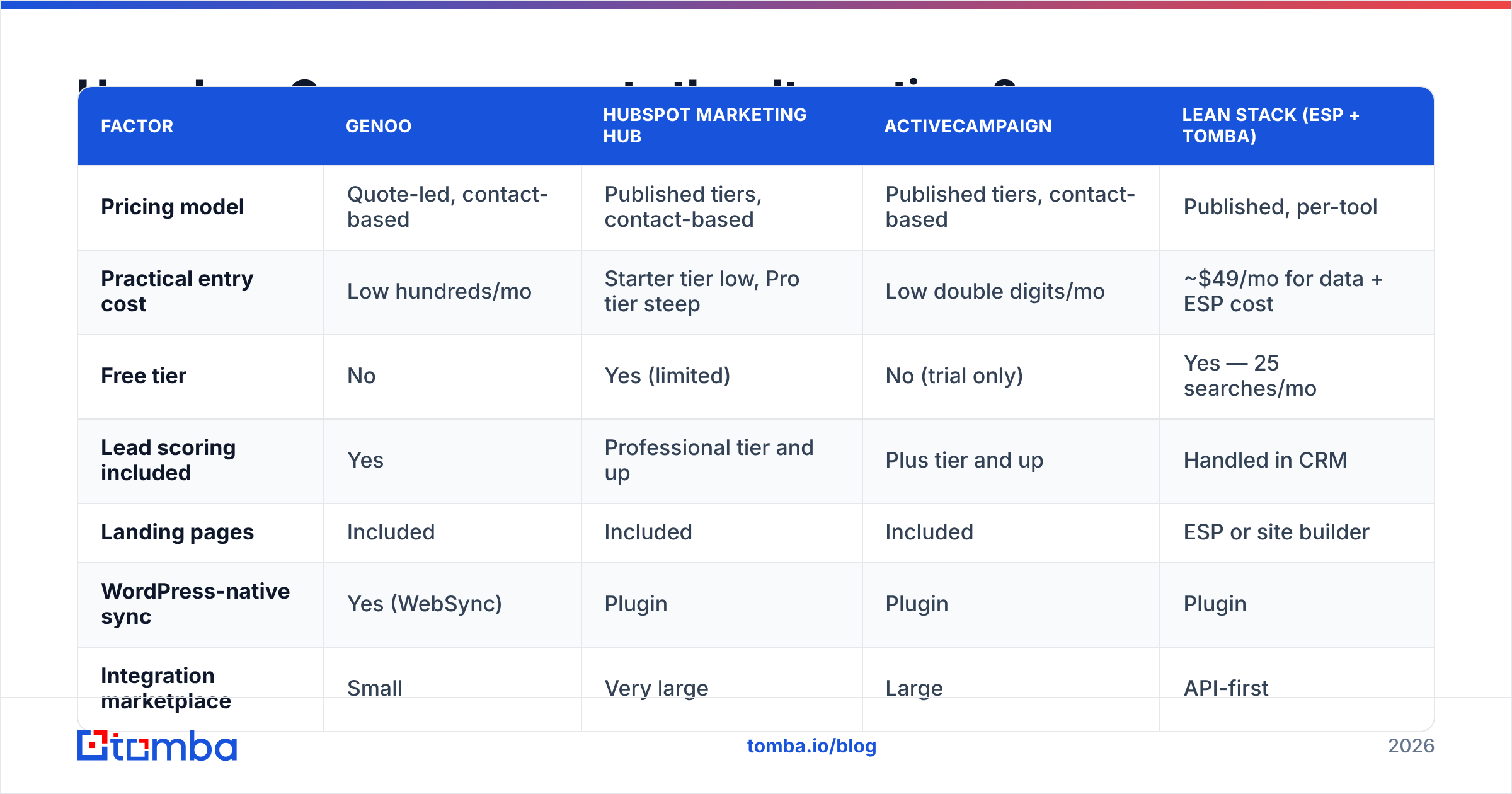
Here is a like-for-like frame across the categories most buyers shortlist against. Prices below are the publicly listed entry points at time of writing; always confirm directly.
| Factor | Genoo | HubSpot Marketing Hub | ActiveCampaign | Lean stack (ESP + Tomba) |
|---|---|---|---|---|
| Pricing model | Quote-led, contact-based | Published tiers, contact-based | Published tiers, contact-based | Published, per-tool |
| Practical entry cost | Low hundreds/mo | Starter tier low, Pro tier steep | Low double digits/mo | ~$49/mo for data + ESP cost |
| Free tier | No | Yes (limited) | No (trial only) | Yes — 25 searches/mo |
| Lead scoring included | Yes | Professional tier and up | Plus tier and up | Handled in CRM |
| Landing pages | Included | Included | Included | ESP or site builder |
| WordPress-native sync | Yes (WebSync) | Plugin | Plugin | Plugin |
| Integration marketplace | Small | Very large | Large | API-first |
| Sources new contact data | No | Limited | No | Yes — core function |
| Best for | WP-first SMB B2B | Scaling teams with budget | Email-heavy SMBs | Outbound-led teams |
| Weakest at | UI, reporting depth | Cost at scale | Advanced B2B scoring | No native nurturing UI |
The comparison exposes the real decision. You are not choosing between "good" and "bad" platforms. You are choosing between paying one vendor to bundle six mediocre-to-good tools versus assembling three excellent ones and accepting the integration tax.
What are the hidden costs nobody quotes you?#
Four line items reliably appear after the contract is signed:
- Onboarding and template services. Budget a one-time fee unless it is explicitly written into the order form as included.
- Contact-count inflation. Import a bloated 40,000-row list and you pay for 40,000 rows forever — including the 8,000 that no longer work. Deduplicate first with a tool like a bulk email finder workflow and a verification pass.
- Integration glue. Middleware subscriptions or developer hours to connect what the marketplace does not cover.
- Deliverability remediation. Sending nurture sequences to unverified contacts damages sender reputation, and repairing it costs weeks of throttled sending. No platform protects you from your own list hygiene.

That fourth point deserves emphasis. Buyers routinely blame the platform for a 12% bounce rate and a 1% reply rate. The platform did not write those addresses. A clean list on an average platform beats a dirty list on a great one, every time. So the sequence matters: source, verify, then automate.
Is Genoo worth it in 2026?#
Verdict: yes for a narrow, well-defined buyer — no for everyone else. Weigh the Genoo pricing reviews pros and cons against the size and skill of your team.
Buy Genoo if you are a WordPress-centric B2B company with 5–50 employees and no marketing ops hire. It fits best when you need lead scoring and nurturing that your ESP cannot give you. The bundled model and hands-on support cut the headcount you would otherwise hire. When your team is small, one vendor beats four contracts.
Skip Genoo if any of these are true:
- You need a large integration ecosystem. HubSpot's marketplace is the reason most buyers tolerate its pricing — see the HubSpot Marketing Hub tiers for the trade-off.
- You want to self-serve evaluate. No free tier means you commit before you see your own data flow through it.
- Your bottleneck is contacts, not nurturing. If you have 400 good contacts and need 4,000, an automation platform will not fix that. A prospecting and enrichment layer will.
- Modern UI matters to adoption. If your team will not log in, the feature list is irrelevant.
What should the leaner alternative stack look like?#
If the honest answer to "what's blocking pipeline?" is not enough qualified contacts, invert the spend. Put the money into data first and keep automation cheap:
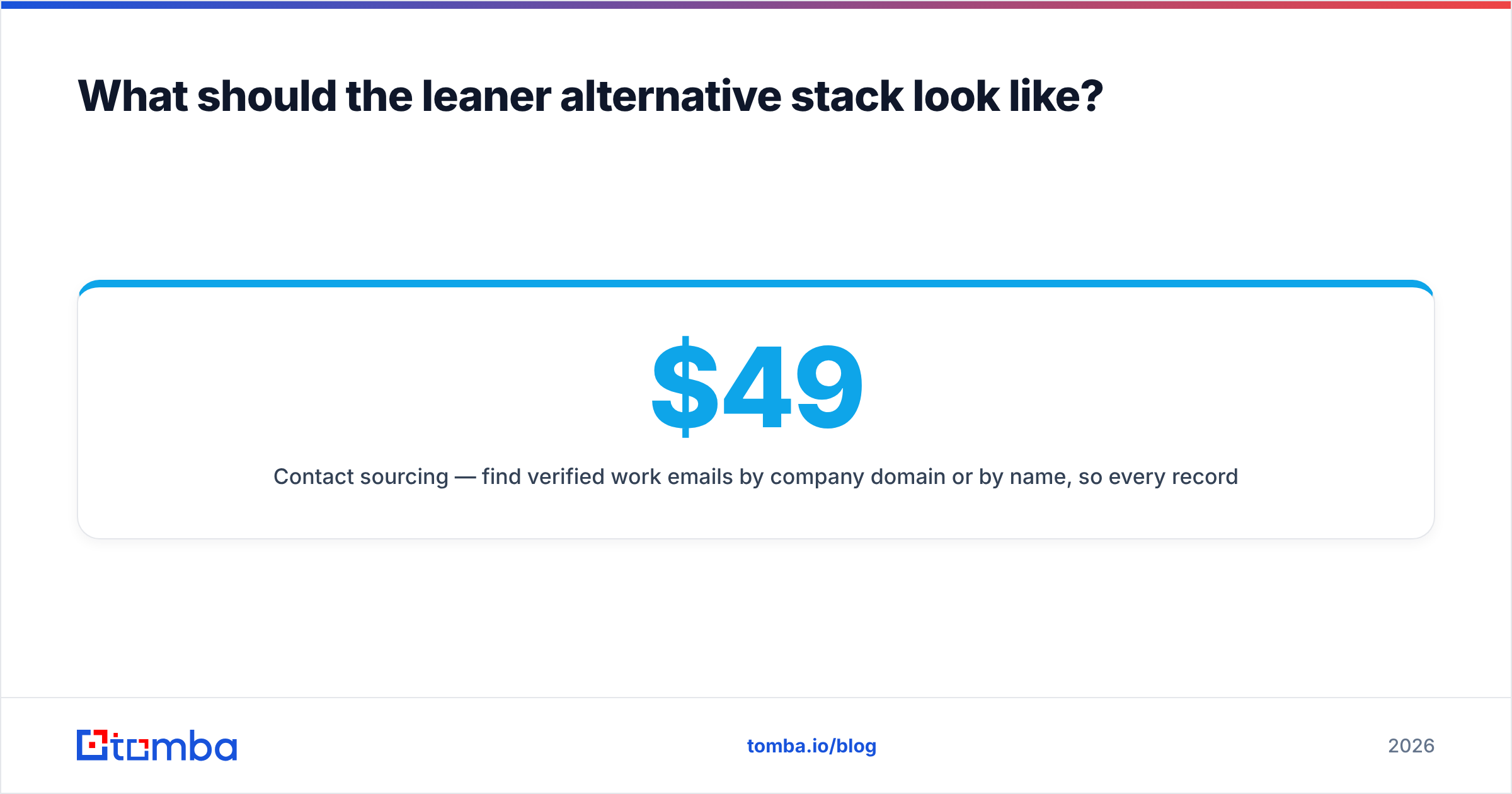
- Contact sourcing — find verified work emails by company domain or by name, so every record entering your CRM is real. See Tomba pricing: free tier at 25 searches/month, Starter $49/mo, Growth $99/mo, Pro $249/mo.
- Verification gate — run every list through validation before import, including a catch-all verifier pass for domains that accept everything.
- Enrichment — attach role, company size, and tech signals with data enrichment so scoring has something to score.
- Sending and nurturing — a mid-tier ESP or sequencer, connected via API.
- Sync — push clean records straight into your CRM through your existing integrations.
That stack usually lands well under a bundled automation contract, and each layer is easy to swap. The trade-off is real. You own the wiring, and you lose the single-vendor support line that Genoo reviewers rate so highly. If your team has zero technical capacity, the bundle is worth the premium. If one person is comfortable with an API key, the lean stack wins on cost and on data quality.
What questions should you ask before signing?#
Bring these to the demo, in writing:
- What is the exact contact-count band for this quote, and what happens at the next band?
- Is onboarding included, and what is the scope in hours or deliverables?
- Which CRM connectors are native versus services-built?
- What is the contract term and the renewal uplift cap?
- Can I load a sample of my real list during evaluation?
Any vendor that answers all five clearly is worth shortlisting. Any vendor that answers vaguely on question one will surprise you at renewal.
Start with the data layer, not the platform#
Whichever automation platform you land on — Genoo, HubSpot, ActiveCampaign, or a lean assembled stack — its output ceiling is set by the contacts you feed it. Nurture sequences pointed at guessed addresses produce bounces, not pipeline.
Fix that layer first. Tomba Email Finder finds verified professional email addresses by domain, name, or company, with a free tier of 25 searches per month to test against your own target accounts before you spend anything. Load clean, verified, enriched records into whatever platform you choose — then let the automation do the job you are actually paying it for.
Related guides#
Ready to find emails that actually work?
Join 150,000+ professionals who stopped guessing and started sending. Free credits on signup — no credit card required.
Get the Tomba newsletter
Practical outbound tactics and product updates — once every two weeks.
About the author