Gentle Follow Up Email: Templates and Timing That Work in 2026
Most follow-ups fail because they nag instead of adding value. Here are the timing rules, templates, and structure behind gentle follow up emails that actually get replies.
TL;DR
- A gentle follow up email works when it carries new value — a resource, a reframe, a concrete question — not when it only repeats "just checking in."
- The highest-response cadence for most B2B threads is day 3, day 7, day 14, then a breakup at day 21-30. Same-day and next-day bumps read as pressure.
- Keep it under 90 words, keep the original thread, and make the ask smaller than the one they ignored.
- Silence is usually a routing problem, not a rejection — bad email addresses, spam placement, and wrong-contact sends account for a large share of "no reply."
- Verify the address before you blame the copy. A polite email to a dead inbox is still a bounce.
What is a gentle follow up email?#
A gentle follow up email is a short, low-pressure message sent after an unanswered email that gives the recipient a new reason to respond without implying they did something wrong.
The word "gentle" is doing real work there. It is not a softener you bolt onto a demand. It describes a structural choice: you remove the obligation, reduce the size of the ask, and hand the recipient an easy exit. Think of it like knocking on a neighbour's door versus leaning on the bell. Same intent, wildly different response.
Here is the difference in practice:
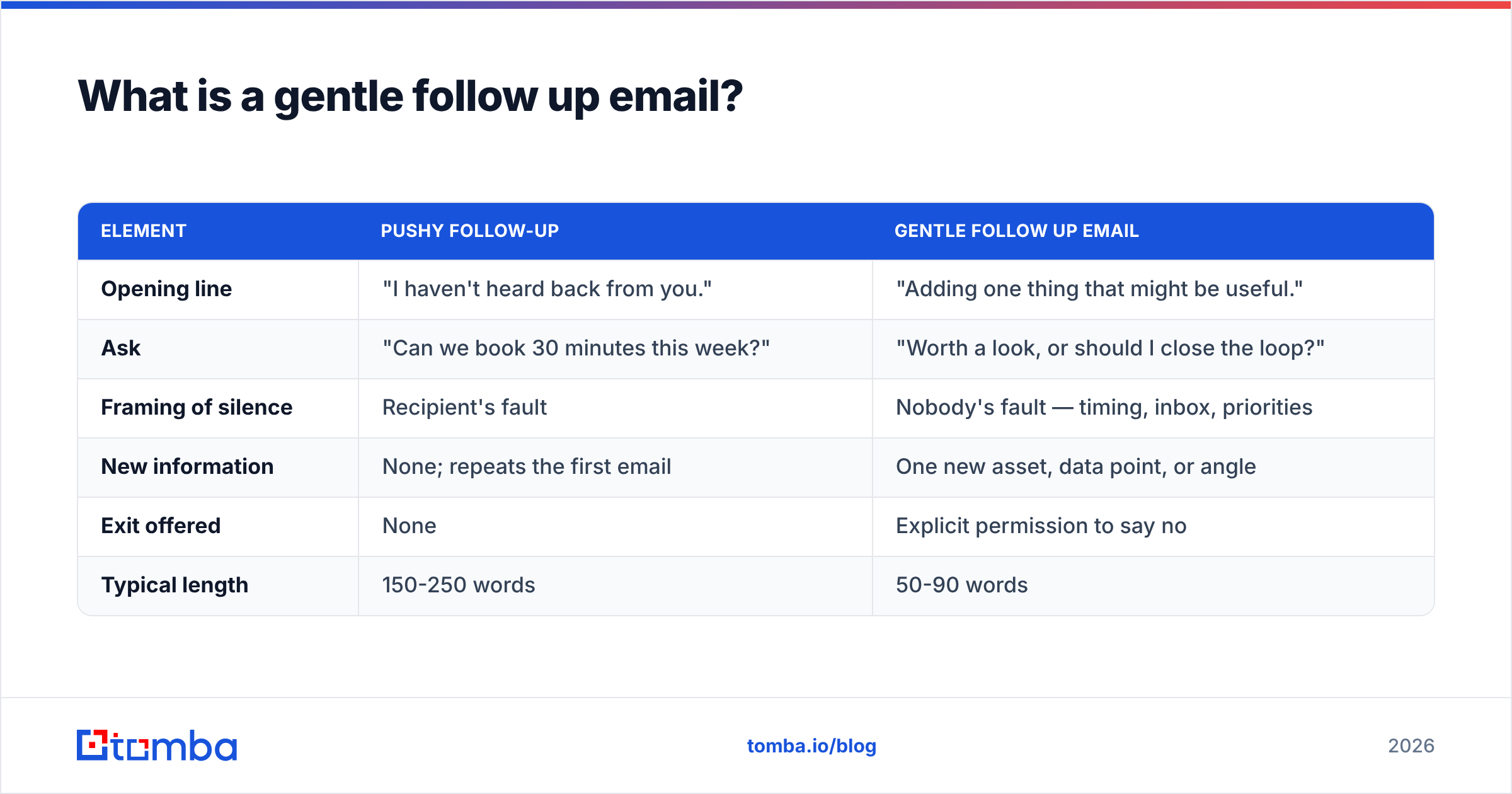
| Element | Pushy follow-up | Gentle follow up email |
|---|---|---|
| Opening line | "I haven't heard back from you." | "Adding one thing that might be useful." |
| Ask | "Can we book 30 minutes this week?" | "Worth a look, or should I close the loop?" |
| Framing of silence | Recipient's fault | Nobody's fault — timing, inbox, priorities |
| New information | None; repeats the first email | One new asset, data point, or angle |
| Exit offered | None | Explicit permission to say no |
| Typical length | 150-250 words | 50-90 words |
The pushy version assumes attention was owed. The gentle version assumes attention has to be earned again, every single time.
Why do most follow-up emails get ignored?#
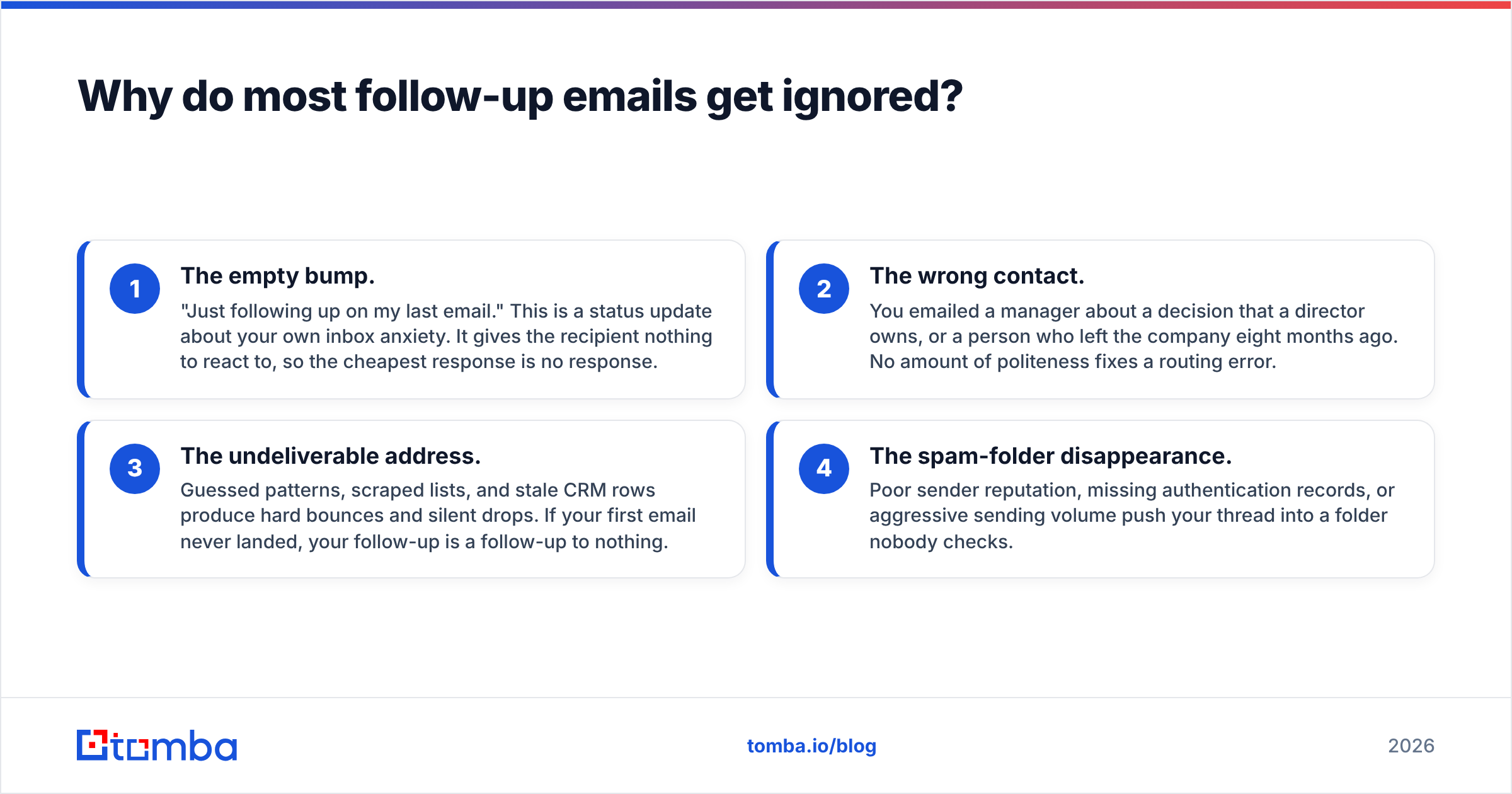
Because they add volume without adding value. Four failure modes cover the overwhelming majority of dead threads.
- The empty bump. "Just following up on my last email." This is a status update about your own inbox anxiety. It gives the recipient nothing to react to, so the cheapest response is no response.
- The wrong contact. You emailed a manager about a decision that a director owns, or a person who left the company eight months ago. No amount of politeness fixes a routing error.
- The undeliverable address. Guessed patterns, scraped lists, and stale CRM rows produce hard bounces and silent drops. If your first email never landed, your follow-up is a follow-up to nothing.
- The spam-folder disappearance. Poor sender reputation, missing authentication records, or aggressive sending volume push your thread into a folder nobody checks.
Only the first one is a copywriting problem. The other three are data and infrastructure problems that copy cannot solve — which is why teams who rewrite their templates for the fifth time and see no lift are usually fixing the wrong layer.
Before you touch your templates, run one diagnostic: pull 100 addresses from your last campaign and check them with an email verifier. If more than 5% come back invalid or risky, your reply-rate problem is a list problem.
How long should you wait before following up?#
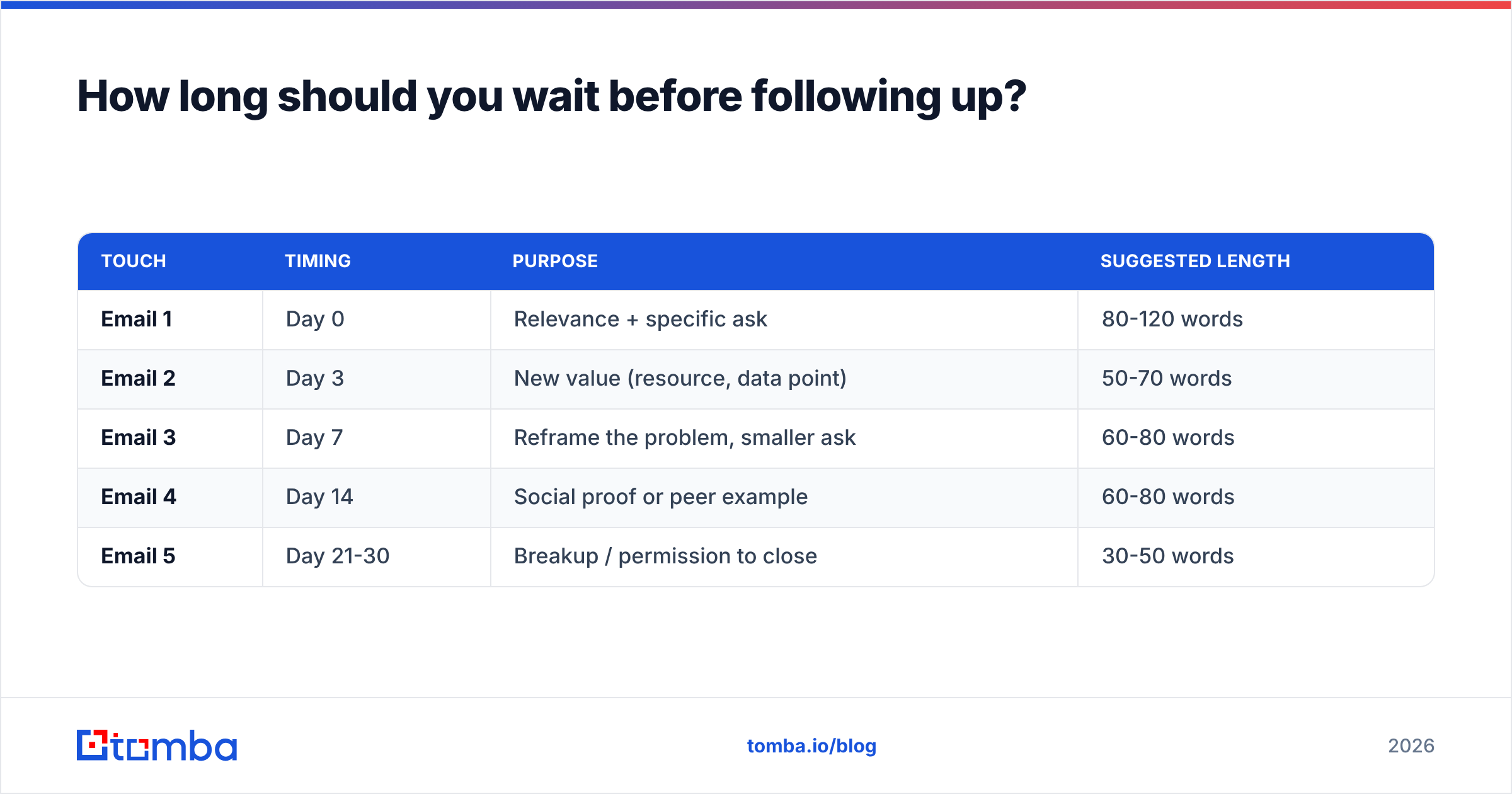
Wait three business days after the first email, then widen the gaps. Sending sooner reads as urgency you have not earned; sending later loses the thread's context entirely.
A cadence that respects the recipient's calendar:
| Touch | Timing | Purpose | Suggested length |
|---|---|---|---|
| Email 1 | Day 0 | Relevance + specific ask | 80-120 words |
| Email 2 | Day 3 | New value (resource, data point) | 50-70 words |
| Email 3 | Day 7 | Reframe the problem, smaller ask | 60-80 words |
| Email 4 | Day 14 | Social proof or peer example | 60-80 words |
| Email 5 | Day 21-30 | Breakup / permission to close | 30-50 words |
Three adjustments worth making:
- Match the buying cycle. Enterprise procurement moves in quarters. If your prospect said "revisit in Q3," a day-3 nudge in Q1 is noise. Set the reminder for the date they gave you and reference it explicitly.
- Respect inbound signals. If someone opened your proposal four times yesterday, day 3 is too slow. Website visitor data and engagement signals should compress the cadence, not extend it.
- Stop at five. Beyond five touches, incremental reply rate collapses while spam complaints climb. Reply rates in outbound benchmarks tracked by vendors on G2 consistently show diminishing returns past the fourth or fifth message.
What does a gentle follow up email actually look like?#
Six templates you can adapt. Each one follows the same skeleton: one line of context, one new thing, one small ask, one exit.
1. The added-value follow-up (day 3)
Subject: Re: [original subject]
Hi [Name] — came across [specific resource] after I wrote and thought of your [specific initiative]. Sharing in case it's useful regardless of whether we talk.
Still happy to walk through how [peer company] handled [problem] if that's relevant. If not, no problem at all.
[Your name]
2. The reframe (day 7)
Hi [Name] — I think I led with the wrong thing last time. The part most [role] teams care about isn't [feature], it's [outcome]. Is that closer to what's on your plate this quarter?
3. The one-question follow-up
Hi [Name] — one question and I'll leave it there: is [problem] something your team is actively working on in 2026, or has it been deprioritized? Either answer helps me stop guessing.
4. The peer example (day 14)
Hi [Name] — [Similar company] was dealing with the same [problem] and cut [metric] by [number] in [timeframe]. Two-paragraph write-up here if you want it: [link]. Happy to send and disappear.
5. The referral redirect
Hi [Name] — this may not be your area, and that's fine. If someone else on the [department] team owns [problem], I'd rather bother them than you. Who should I ask?
6. The breakup (day 21-30)
Hi [Name] — closing the loop on this one so I stop landing in your inbox. If [problem] moves up the list later this year, my door's open. Thanks for your time either way.
Notice what none of them do: apologise for existing, use the phrase "just checking in," or ask for 30 minutes on the first bump. The ask always shrinks as the sequence progresses. You start by asking for a meeting and end by asking for a yes/no.
What should you never write in a follow-up?#
Some phrases actively lower your reply rate because they signal either guilt or entitlement.
- "Sorry to bother you again." You have now framed your own message as a nuisance. The recipient agrees and deletes it.
- "Per my last email." Reads as an accusation, even when you do not mean it that way.
- "I'm sure you're busy, but..." Everything after "but" is the demand you just pretended to soften.
- "Bumping this to the top of your inbox." Announcing that you are manipulating their attention rarely helps.
- "Following up on my follow-up." Two failed messages, zero new information.
- Guilt-trip closes like "I'd hate for you to miss out." Manufactured scarcity in a cold thread reads as a scam.
Replace all of them with one honest sentence: what changed since you last wrote, and what you want them to do now.
Should you follow up in the same thread or start fresh?#
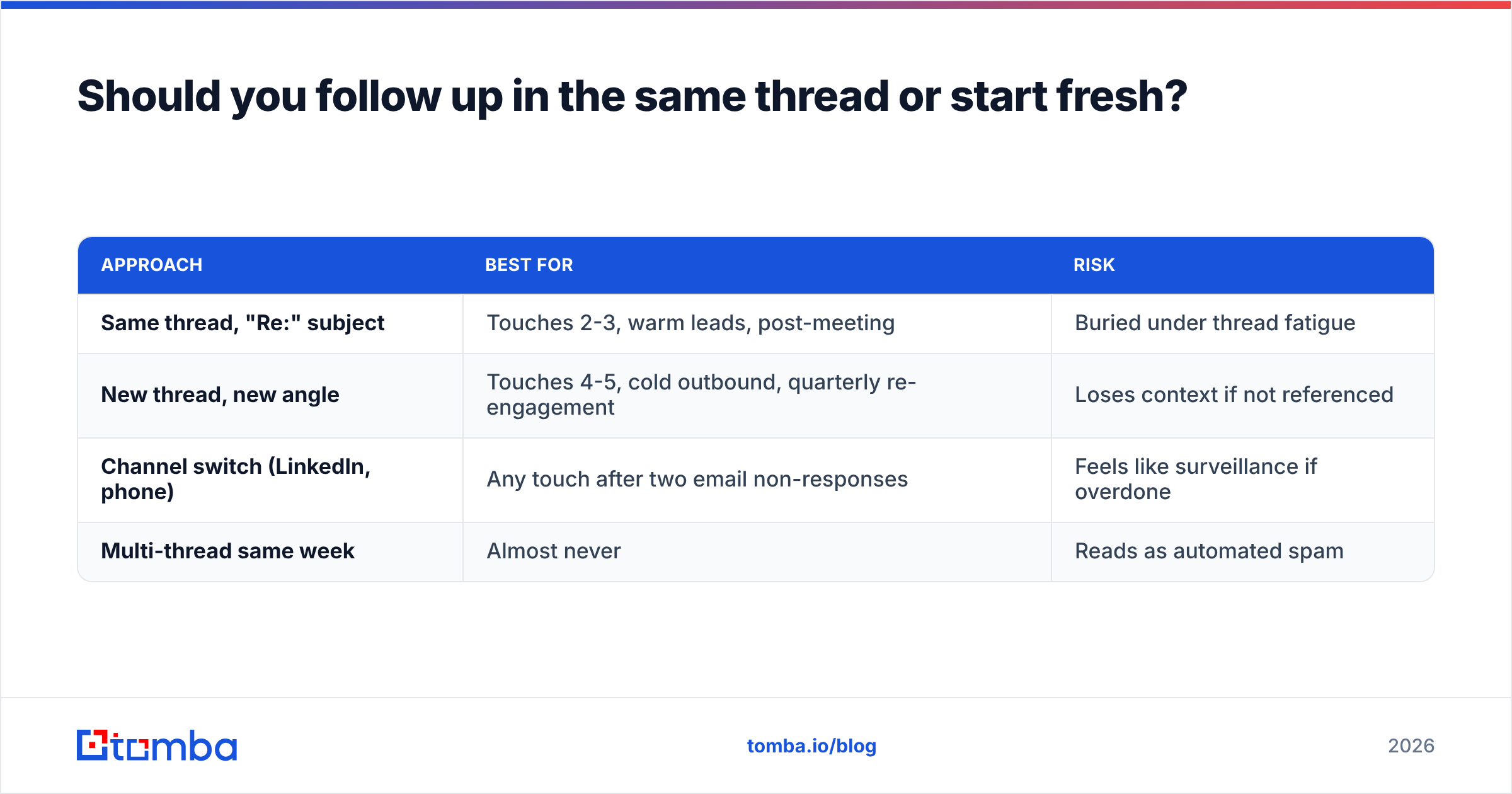
Reply in the same thread for the first three touches, then consider a fresh thread with a new subject line for touch four onward.
Same-thread replies preserve context, show the recipient the full history without effort, and cost nothing. They also stack: by touch three, a single thread with four messages looks persistent rather than scattered.
The argument for a new thread later in the sequence is deliverability and framing. A thread the recipient has ignored three times may have been mentally categorised as noise. A fresh subject line about a genuinely different angle gets evaluated on its own merits. Just do not restart with the same pitch under a new headline — recipients notice.
| Approach | Best for | Risk |
|---|---|---|
| Same thread, "Re:" subject | Touches 2-3, warm leads, post-meeting | Buried under thread fatigue |
| New thread, new angle | Touches 4-5, cold outbound, quarterly re-engagement | Loses context if not referenced |
| Channel switch (LinkedIn, phone) | Any touch after two email non-responses | Feels like surveillance if overdone |
| Multi-thread same week | Almost never | Reads as automated spam |
If you switch channels, do it deliberately. A short LinkedIn note referencing your email — "sent you a note about [topic], happy to move it here if easier" — respects the recipient's preference instead of ignoring it. For phone follow-ups, pull direct numbers with a phone finder rather than dialing a switchboard and hoping.
How do you make sure the follow-up actually arrives?#
Fix the plumbing before the prose. A gentle follow up email that lands in spam has a 0% reply rate no matter how well it is written.
Run this checklist before your next sequence:
- Verify every address. Hard bounces damage email deliverability for your whole domain, not just the one send. Validate before the first email, not after the third bounce.
- Check authentication. SPF, DKIM, and DMARC records need to exist and pass. Google and Yahoo both tightened bulk-sender requirements, and their published sender guidelines are the authoritative reference.
- Confirm you have the right person. Titles change. Use a domain search to see the current contact map for a company before you commit five touches to someone who moved teams.
- Watch catch-all domains. Catch-all servers accept everything, which means a "valid" result may still mean nobody reads it. Treat those addresses as lower confidence and prioritise verified ones.
- Cap daily volume per mailbox. Sudden spikes look like spam behaviour. Ramp gradually and split across mailboxes.
- Personalise beyond the first name. Merge-tag-only personalisation is now trivially detectable by both humans and filters.
Vendors that publish deliverability guidance — including HubSpot's sales email research — consistently land on the same finding: list quality moves reply rate more than subject-line optimisation ever does.
How do you track follow-ups without a heavy CRM?#
You need three fields and a rule, not a new platform.
- Next touch date — the single most important field. If it is blank, the lead is effectively dead.
- Touch count — enforces your stop rule so nobody hits touch nine.
- Last new value sent — prevents you from repeating the same resource twice.
- Outcome tag — replied, bounced, wrong contact, or not now with a revisit date.
A spreadsheet handles this fine under 200 leads. Past that, push it into your CRM with automated reminders. What matters is not the tool; it is that a follow-up fires because a date arrived, not because you happened to remember.
For teams running this at scale, enrichment matters more than reminder logic. If your rows are missing job titles, company size, or direct contact details, every follow-up you write will be generic by necessity. Running the list through data enrichment first is what makes "gentle and specific" possible instead of "gentle and vague."
When should you stop following up entirely?#
Stop after the breakup email, and stop immediately if you get any of these signals:
- An explicit no, in any form. "Not interested" means the sequence ends today, not after one more value-add.
- An out-of-office indicating a role change or departure. Update the record and find the replacement.
- A hard bounce. Remove the address; do not retry.
- An unsubscribe click or spam complaint. Legally and practically, this is a full stop.
- Three touches with zero opens on a verified address. Something is wrong at the delivery layer — diagnose before you send more.
Stopping cleanly is also a follow-up strategy. Plenty of replies come months after a breakup email, precisely because the sender left on good terms. The breakup email is the only message in a sequence that reliably generates responses from people who ignored everything else — usually some version of "sorry, bad timing, circle back in Q4." That is a real outcome.
Putting it together#
The gentle follow up email is not a softer version of nagging. It is a different transaction: each message spends your credibility to buy a small amount of the recipient's attention, and it only works if each one returns something. New resource, better question, sharper framing, or a clean exit.
Get the sequence right — day 3, 7, 14, breakup — keep each message under 90 words, shrink the ask as you go, and stop when they tell you to. Then handle the part copywriting cannot: make sure the message reaches a real, current, monitored inbox.
That last part is where most sequences quietly fail. If your follow-ups are landing on guessed or stale addresses, no template rewrite will save them. Start with Tomba Email Finder to get verified, current addresses for the people who actually own the decision, then run your cadence against a list you trust. The free tier covers 25 searches a month, and paid plans start at $49/mo on the Starter tier — see Tomba pricing for the full breakdown. Fix the delivery layer first, and your gentle follow-ups finally get the chance to be judged on their merits.
Related guides#
Ready to find emails that actually work?
Join 150,000+ professionals who stopped guessing and started sending. Free credits on signup — no credit card required.
Get the Tomba newsletter
Practical outbound tactics and product updates — once every two weeks.
About the author