Gentle Nudge Email: 12 Templates and When to Send Them
A gentle nudge email only works when it gives the reader a new reason to reply. Here are 12 templates, the timing rules behind them, and the mistakes that quietly kill your response rate.
TL;DR
- A gentle nudge email is a short, low-pressure follow-up that gives the reader a new reason to reply — not a reminder that you already emailed them.
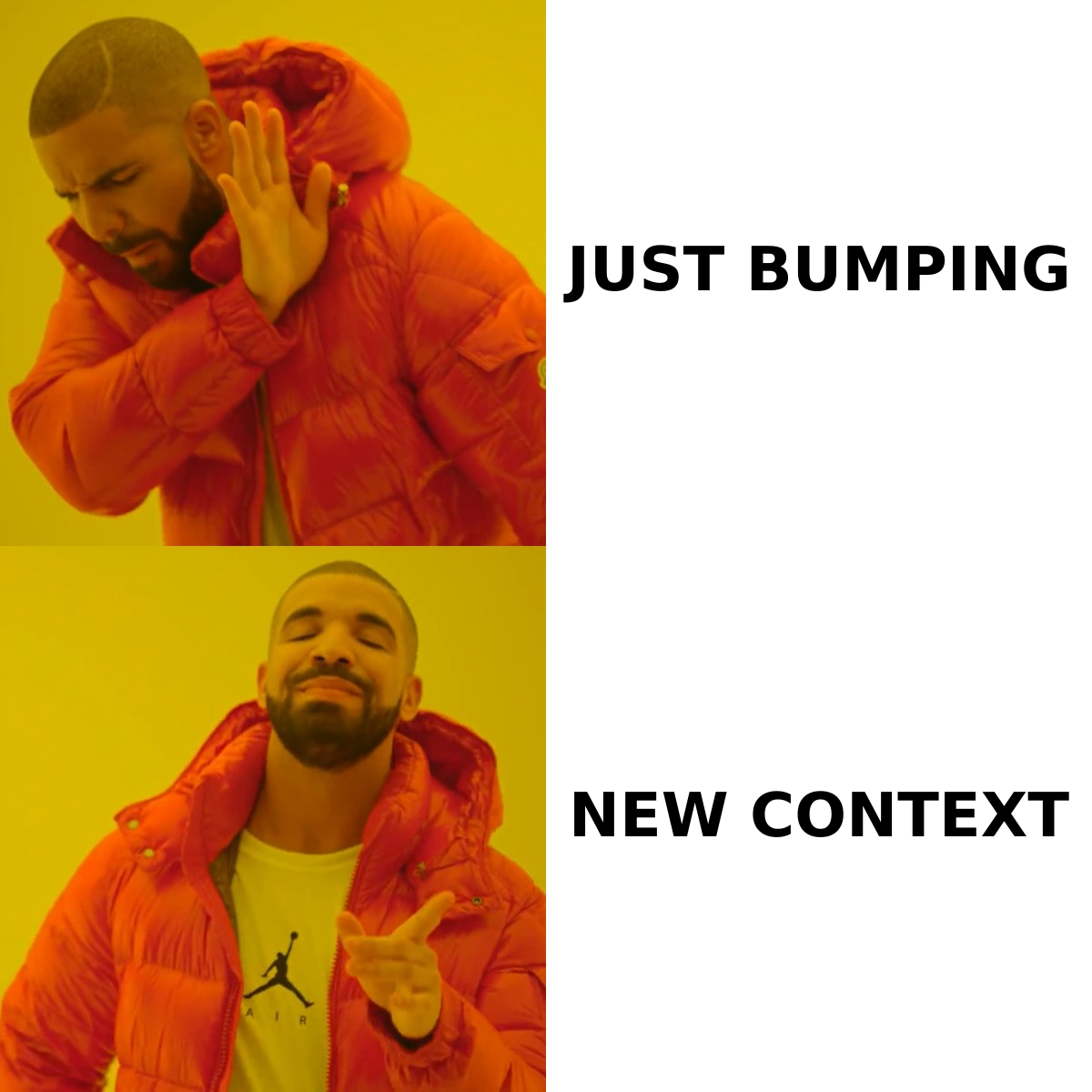
- "Just bumping this up" and "circling back" are the two lowest-performing openers in B2B follow-up. They add zero information and signal that the sender has nothing new to say.
- The best nudge cadence for cold outbound is day 3, day 7, day 14, then a breakup. For warm threads (post-demo, post-proposal), tighter is fine: 2, 5, 10.
- Every nudge should carry one of four payloads: new information, a lowered ask, a deadline, or a clean exit. If it carries none of those, don't send it.
- Nudges only work if the address is real. Chasing a bounced or role-based inbox for three weeks is a deliverability problem disguised as a persistence problem.
What is a gentle nudge email?#
A gentle nudge email is a follow-up written to remove friction rather than apply pressure. It assumes the silence is logistical — the person was busy, the thread got buried, the decision moved down the queue — instead of assuming rejection.
Think of it like knocking on a neighbour's door. A nudge is one knock, a step back, and a note left in the mailbox. A pushy follow-up is standing there ringing the bell six times because you know they're home. Same goal, radically different outcome.
Technically, the difference shows up in three places:
- Framing — the nudge takes responsibility ("I probably buried the ask in a wall of text") instead of assigning blame ("I haven't heard back from you").
- Ask size — it shrinks the request. If the first email asked for a 30-minute call, the nudge asks for a yes/no or a forwarding name.
- Exit ramp — it explicitly gives permission to say no, which paradoxically raises reply rates because "no" becomes a cheap, socially acceptable answer.
That third point is the one most reps skip. A reader who feels trapped between "yes" and "ignore" will pick ignore every single time.
Why do most follow-ups get ignored?#
Because they contain no new information. If your second email is a restatement of the first, you've asked the reader to re-evaluate a decision they already made, using the exact same inputs. Nothing changed, so their answer doesn't change either.
There's a psychological angle too. Open loops nag at people — the Zeigarnik effect describes how unfinished tasks stay mentally active. A good nudge closes the loop for the reader by making the reply a two-second action. A bad nudge just widens the loop and adds guilt, and guilt makes people archive.
The other silent killer is volume math. If you're sending 400 nudges a week and 12% of the addresses are stale, you're generating bounces that damage your sender reputation — which then depresses inbox placement for the 88% that were fine. Persistence into bad data doesn't just waste time; it actively degrades the channel.
When should you send a gentle nudge email?#
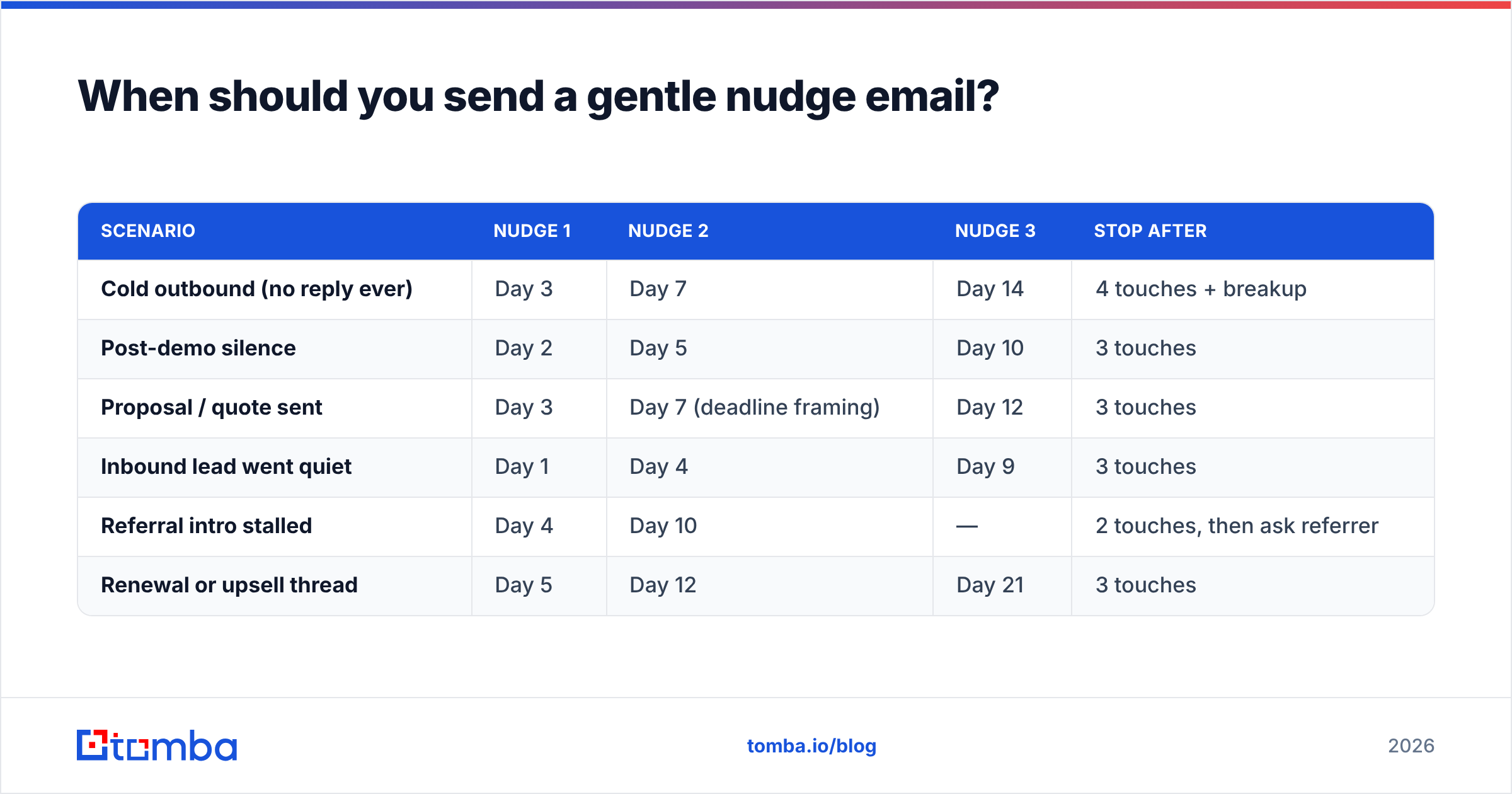
Timing depends entirely on thread temperature. A cold prospect who has never replied needs breathing room. A prospect who sat through your demo and asked for pricing needs speed, because their internal context decays fast.
| Scenario | Nudge 1 | Nudge 2 | Nudge 3 | Stop after |
|---|---|---|---|---|
| Cold outbound (no reply ever) | Day 3 | Day 7 | Day 14 | 4 touches + breakup |
| Post-demo silence | Day 2 | Day 5 | Day 10 | 3 touches |
| Proposal / quote sent | Day 3 | Day 7 (deadline framing) | Day 12 | 3 touches |
| Inbound lead went quiet | Day 1 | Day 4 | Day 9 | 3 touches |
| Referral intro stalled | Day 4 | Day 10 | — | 2 touches, then ask referrer |
| Renewal or upsell thread | Day 5 | Day 12 | Day 21 | 3 touches |
Two rules override the table. First, never nudge inside 24 hours of the original send unless the deal is actively closing — it reads as anxious. Second, if a prospect gave you a date ("check back after the board meeting on the 14th"), that date replaces every cadence rule you have. Following the instruction you were given is itself the strongest nudge.
What goes into a nudge that actually gets a reply?#
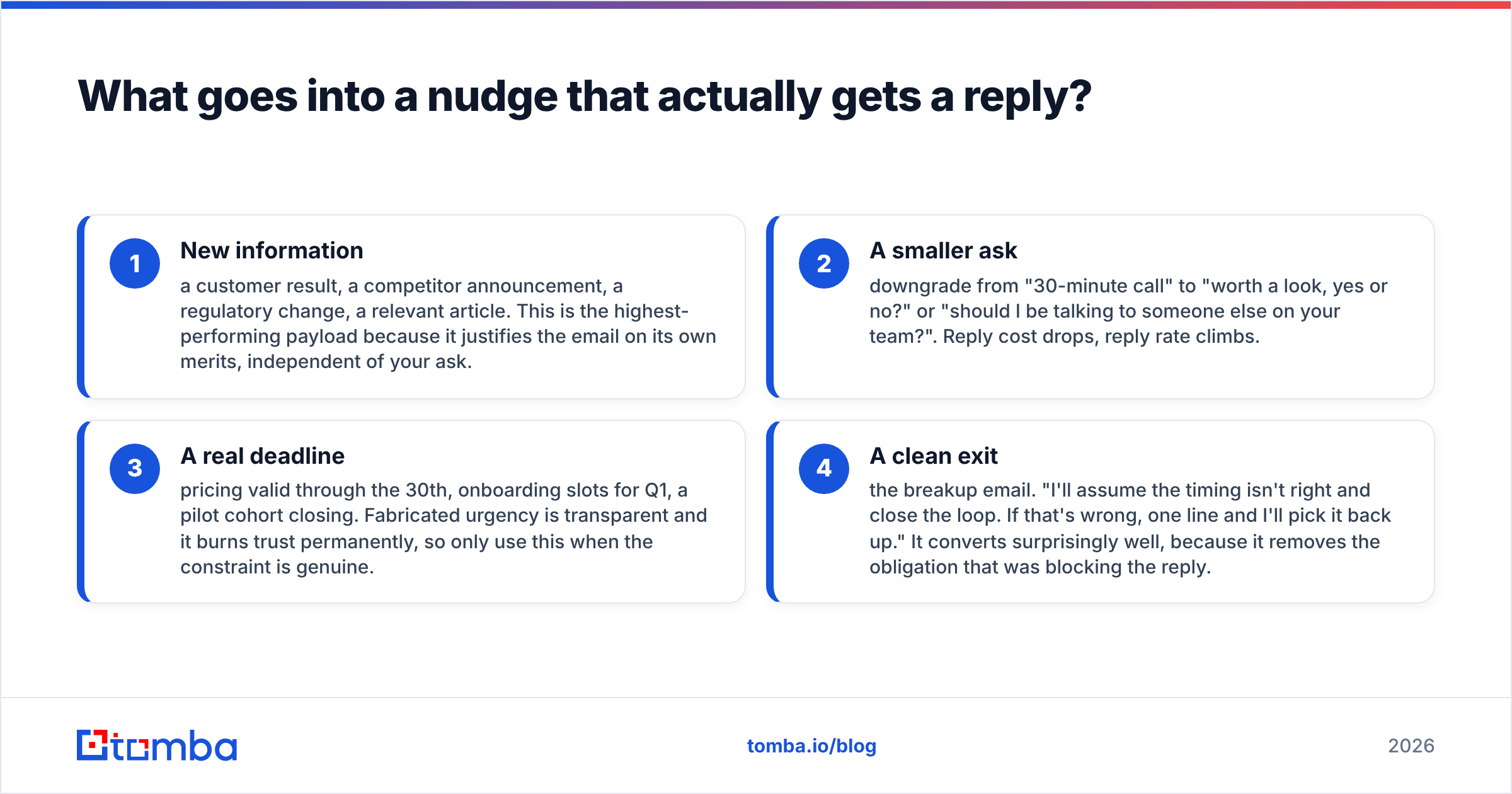
Four ingredients. A nudge that carries at least one of them earns its send; a nudge that carries none is spam you wrote to feel productive.
- New information — a customer result, a competitor announcement, a regulatory change, a relevant article. This is the highest-performing payload because it justifies the email on its own merits, independent of your ask.
- A smaller ask — downgrade from "30-minute call" to "worth a look, yes or no?" or "should I be talking to someone else on your team?". Reply cost drops, reply rate climbs.
- A real deadline — pricing valid through the 30th, onboarding slots for Q1, a pilot cohort closing. Fabricated urgency is transparent and it burns trust permanently, so only use this when the constraint is genuine.
- A clean exit — the breakup email. "I'll assume the timing isn't right and close the loop. If that's wrong, one line and I'll pick it back up." It converts surprisingly well, because it removes the obligation that was blocking the reply.
Keep the whole thing under 75 words. Keep the original thread attached so the reader has context without scrolling their archive. And keep the subject line stable — subject line testing matters on the first touch, but changing it mid-thread breaks Gmail's conversation grouping and makes you look like a different sender.
What are the best gentle nudge email templates?#
These are written for B2B, second person, short. Swap the brackets and cut anything that doesn't survive a read-aloud test.
1. The new-information nudge
Subject: Re: [original subject]
Saw [Company] just [announcement]. That usually pushes [problem] up the list. The 20% throughput number I mentioned came from a team about your size — happy to send the breakdown, no call needed.
2. The smaller ask
Skipping the call ask. Is this a "not now" or a "not us"? Either answer helps me stop cluttering your inbox.
3. The wrong-person check
Quick one: if [topic] isn't yours, who owns it these days? Happy to take it off your plate.
4. The self-blame open
I buried the ask in too much detail last week. Short version: [one sentence]. Worth 15 minutes?
5. The resource nudge
No ask here. We published a teardown of how [peer company] handled [problem] — [link]. Ignore if it's not relevant.
6. The deadline nudge
The pilot pricing we discussed holds through [date]. After that it moves to standard. Not trying to rush you, just don't want you to hear about it after the fact.
7. The post-demo nudge
You mentioned [specific objection] on the call. I pulled the numbers on it — [one-line answer]. Does that clear it, or is there a bigger blocker?
8. The proposal nudge
Is the proposal stuck on price, scope, or timing? Tell me which one and I'll fix it or get out of your way.
9. The referral revival
[Referrer] thought this was worth 15 minutes. If they were wrong, I'd rather know than keep guessing.
10. The one-line nudge
Still worth a conversation?
11. The seasonal reset
Q4 was probably not the moment. Reopening this now that budgets have reset — same offer, better timing?
12. The breakup
I'll close this out and stop following up. If [problem] comes back around in Q2, reply to this thread and I'll pick it up from here.
Template 10 looks too simple to work. It works because it is the cheapest possible reply prompt in the thread. If you want more starting points, the cold email templates library covers first-touch structures that these nudges are designed to sit behind.
Is a gentle nudge better than a direct follow-up?#
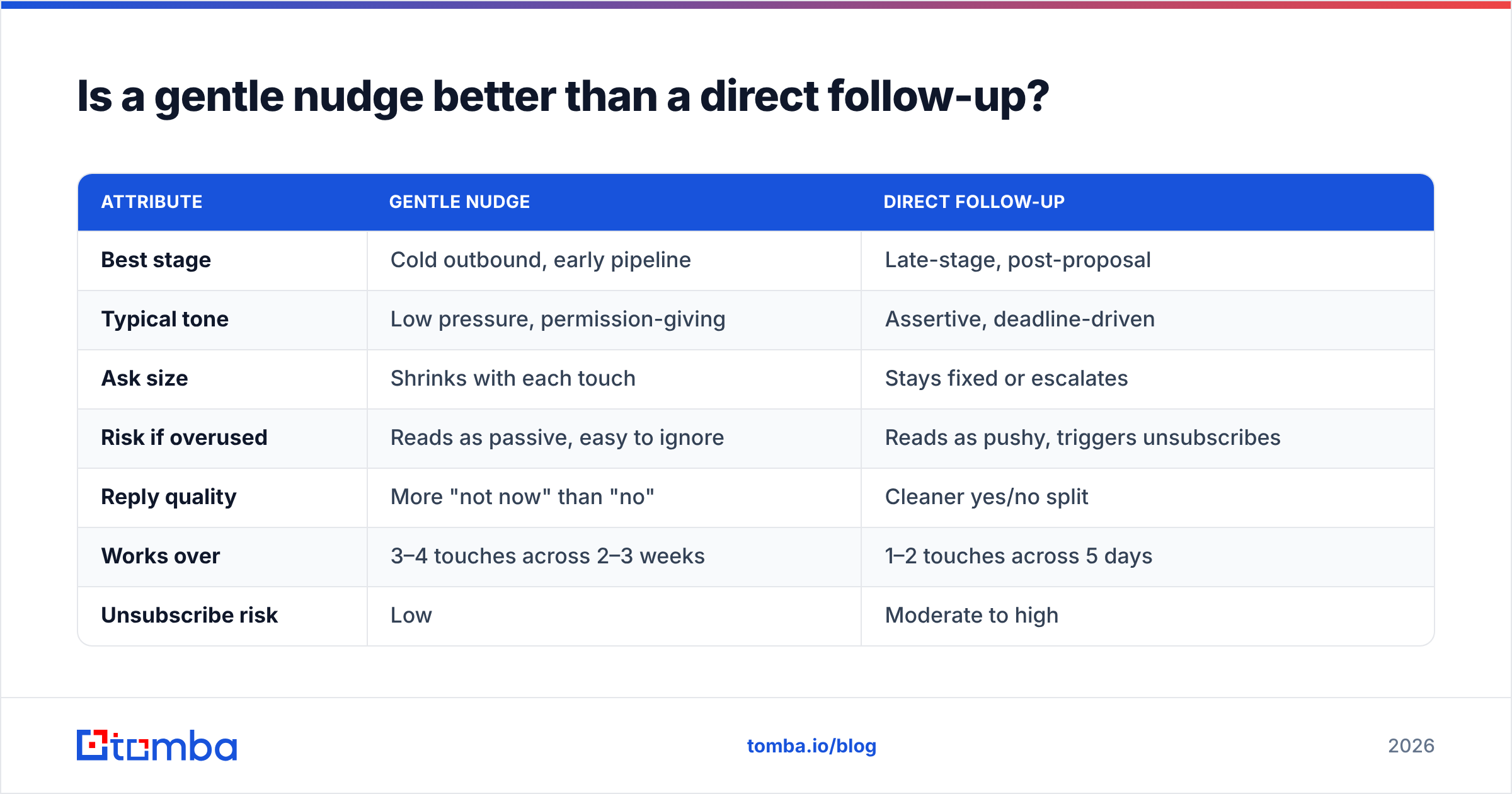
Not universally. The gentle approach wins on cold and mid-funnel threads; direct wins late in a deal where both sides have already invested time and vagueness starts to read as weakness.
| Attribute | Gentle nudge | Direct follow-up |
|---|---|---|
| Best stage | Cold outbound, early pipeline | Late-stage, post-proposal |
| Typical tone | Low pressure, permission-giving | Assertive, deadline-driven |
| Ask size | Shrinks with each touch | Stays fixed or escalates |
| Risk if overused | Reads as passive, easy to ignore | Reads as pushy, triggers unsubscribes |
| Reply quality | More "not now" than "no" | Cleaner yes/no split |
| Works over | 3–4 touches across 2–3 weeks | 1–2 touches across 5 days |
| Unsubscribe risk | Low | Moderate to high |
The practical answer: open gentle, close direct. Touches one through three stay soft and additive. The final touch — the breakup — is direct, because at that point clarity is the gift. Sales teams that measure this properly track it against response rate per touch rather than per sequence, which is the only way to see where a cadence stops earning its send.
For a broader view of how follow-up cadence fits into pipeline hygiene, HubSpot's sales resources cover the CRM side of the same problem, and reviewing sequencing tools on G2 will show you which platforms actually enforce cadence limits versus which just let reps spam.
How many nudges are too many?#
Four total touches after the initial email is the practical ceiling for cold outbound. Past that, you're not persistent — you're a filtering problem for the recipient's inbox rules.
Watch three signals instead of counting blindly:
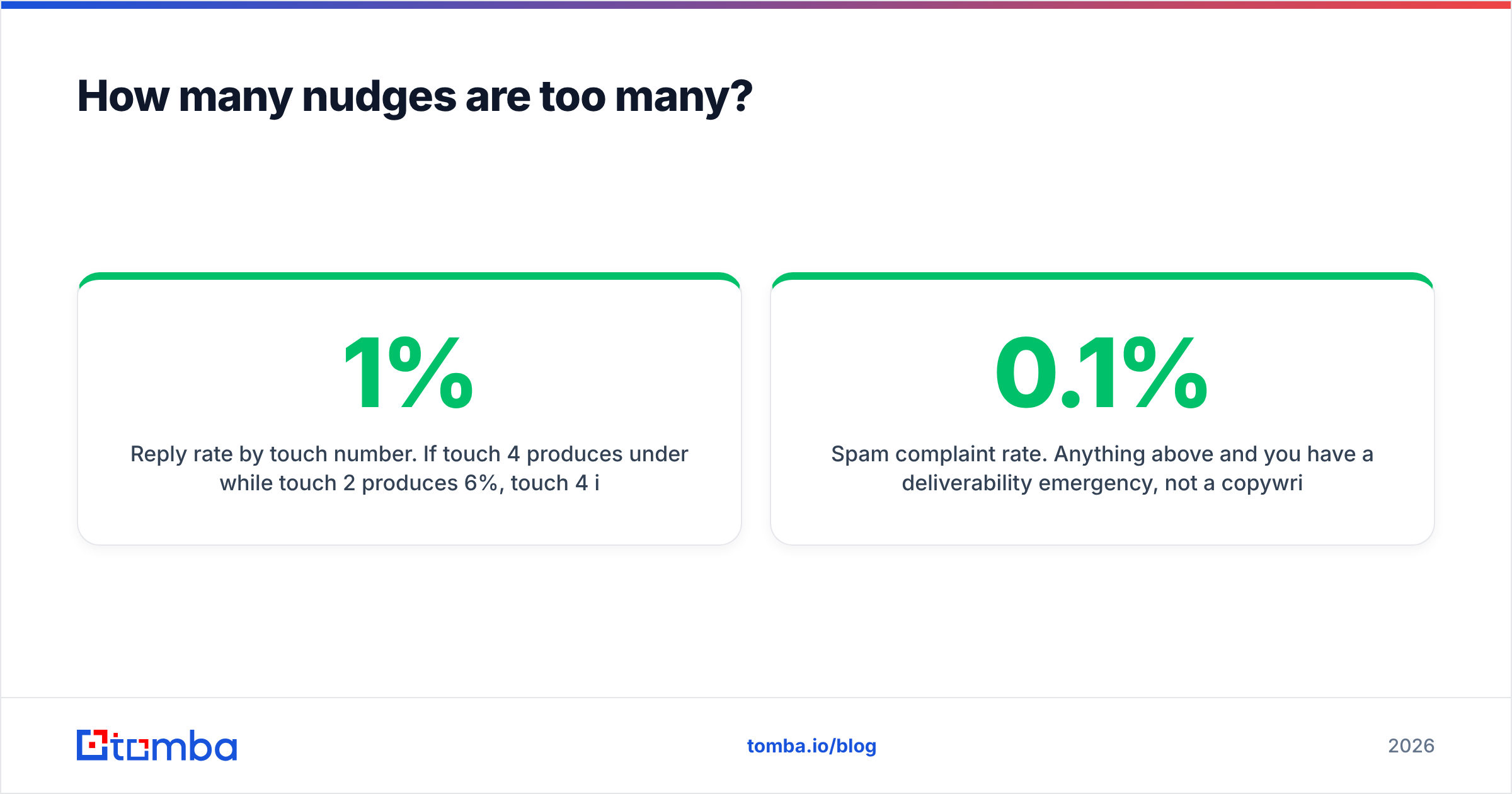
- Reply rate by touch number. If touch 4 produces under 1% while touch 2 produces 6%, touch 4 is costing you more in unsubscribes than it earns.
- Negative reply ratio. A rising share of "please stop" replies means your cadence is outrunning your relevance.
- Spam complaint rate. Anything above 0.1% and you have a deliverability emergency, not a copywriting one. Check your domain against a blacklist checker before you assume the copy is at fault.
What mistakes kill a gentle nudge email?#
- "Just checking in." Three words that tell the reader you had nothing to say but sent an email anyway.
- Guilt framing. "I've reached out three times" makes your persistence the reader's problem.
- Changing the subject line mid-thread. Breaks threading, looks like a new cold email, resets any familiarity you built.
- Attachments on a nudge. They slow delivery, trip filters, and imply a bigger ask than a nudge should carry.
- Nudging a dead address. If the original email soft-bounced or landed in a catch-all domain, no amount of clever copy helps. Run the list through an email verifier before the sequence starts, not after it fails.
- Same-day nudging. Anything under 24 hours reads as panic unless a deadline is genuinely hours away.
- Nudging everyone identically. If your day-7 email is byte-identical across 500 recipients, spam filters cluster it. Vary the opening line at minimum.
How do you scale nudges without sounding robotic?#
Separate the parts that must be personal from the parts that can be templated. The ask, the exit ramp, and the structure are template work. The first sentence — the reason this email exists today — is not.
A workable split: one manually written opening line per prospect, drawn from a trigger you can pull programmatically (funding round, new hire in the department, published article, tech-stack change). Everything after that sentence comes from your template library. That gives you personalization density where the reader actually notices it, at roughly 20 seconds of human time per email.
Data quality is the other half. A nudge sequence multiplies whatever list you feed it — four touches into a 90%-accurate list produces four times the bounces of a single send. Verify before the sequence, not during it, and re-verify anything older than 90 days. B2B contact data decays at roughly 2–3% per month as people change roles, which means a list you built in January is meaningfully wrong by summer. Providers differ here; tools like Tomba and peers such as BookYourData each take a different approach to freshness, and it's worth testing both against a sample of your own accounts rather than trusting anyone's published accuracy number.
Frequently asked questions#
How long should a gentle nudge email be? Under 75 words, ideally under 50. If it doesn't fit on a phone screen without scrolling, it's a second cold email, not a nudge.
Should I reply to the same thread or start a new one? Reply to the thread for touches 1–3. Consider a fresh thread only for a seasonal reset weeks or months later, where the original context is genuinely stale.
What's the best day to send one? Tuesday through Thursday, mid-morning in the recipient's timezone, holds up as the general pattern. But it matters far less than whether the email carries new information.
Does adding "sorry to bother you" help? No. It pre-apologizes for the email's existence and invites the reader to agree that it was a bother.
Nudges compound only when the underlying addresses are correct. Before you build a four-touch cadence, make sure every contact in it is a live, verified, individual inbox — not a guessed permutation or a role account that nobody reads. The Tomba Email Finder finds verified professional addresses by name and domain, with a free tier at 25 searches a month and paid plans starting at $49/mo, so you can pressure-test your list before you spend three weeks following up into the void.
Related guides#
Ready to find emails that actually work?
Join 150,000+ professionals who stopped guessing and started sending. Free credits on signup — no credit card required.
Get the Tomba newsletter
Practical outbound tactics and product updates — once every two weeks.
About the author