How to Get Email Addresses for Free in 2026: 9 Methods
Free email lookup works — until it doesn't. Here are nine methods that actually return valid B2B addresses in 2026, the accuracy you can expect from each, and the point where free stops paying for itself.
TL;DR
- You can get email addresses for free at real volume, but only in the 20–100 contacts/month range — every legitimate free tier caps out there.
- The highest-accuracy free path is a vendor free tier (Tomba's 25 searches/mo, Hunter's 25, Snov.io's 50) because those results are verified before delivery.
- The highest-volume free path is pattern permutation plus SMTP verification — free forever, roughly 55–70% hit rate, and slow.
- Never send to an unverified guessed address. One 8% bounce run can cost you a domain that took three months to warm.
- Free stops making sense at about 150 contacts/month; past that, a $49/mo plan is cheaper than the hours you burn stitching free tools together.
What does "get email addresses for free" actually mean?#
Three very different things get bundled under that phrase, and mixing them up is why most people end up with a bounced list.
- Free tier of a paid tool. You get a real, verified result — just a small number of them. Tomba gives 25 searches/month, Hunter gives 25, Snov.io gives 50 credits. Accuracy matches the paid product because it's the same engine.
- Free public data. Scraping "contact" pages, WHOIS records, GitHub commit logs, conference speaker lists, press releases. Unlimited, zero cost, highly variable quality.
- Free guessing. Generating
first.last@domain.comstyle permutations and testing them. Unlimited, free, and completely dependent on whether you verify afterward.
Method 1 is the only one that hands you a validated address. Methods 2 and 3 hand you a candidate, and a candidate without verification is a bounce waiting to happen.

Which free methods actually work in 2026?#
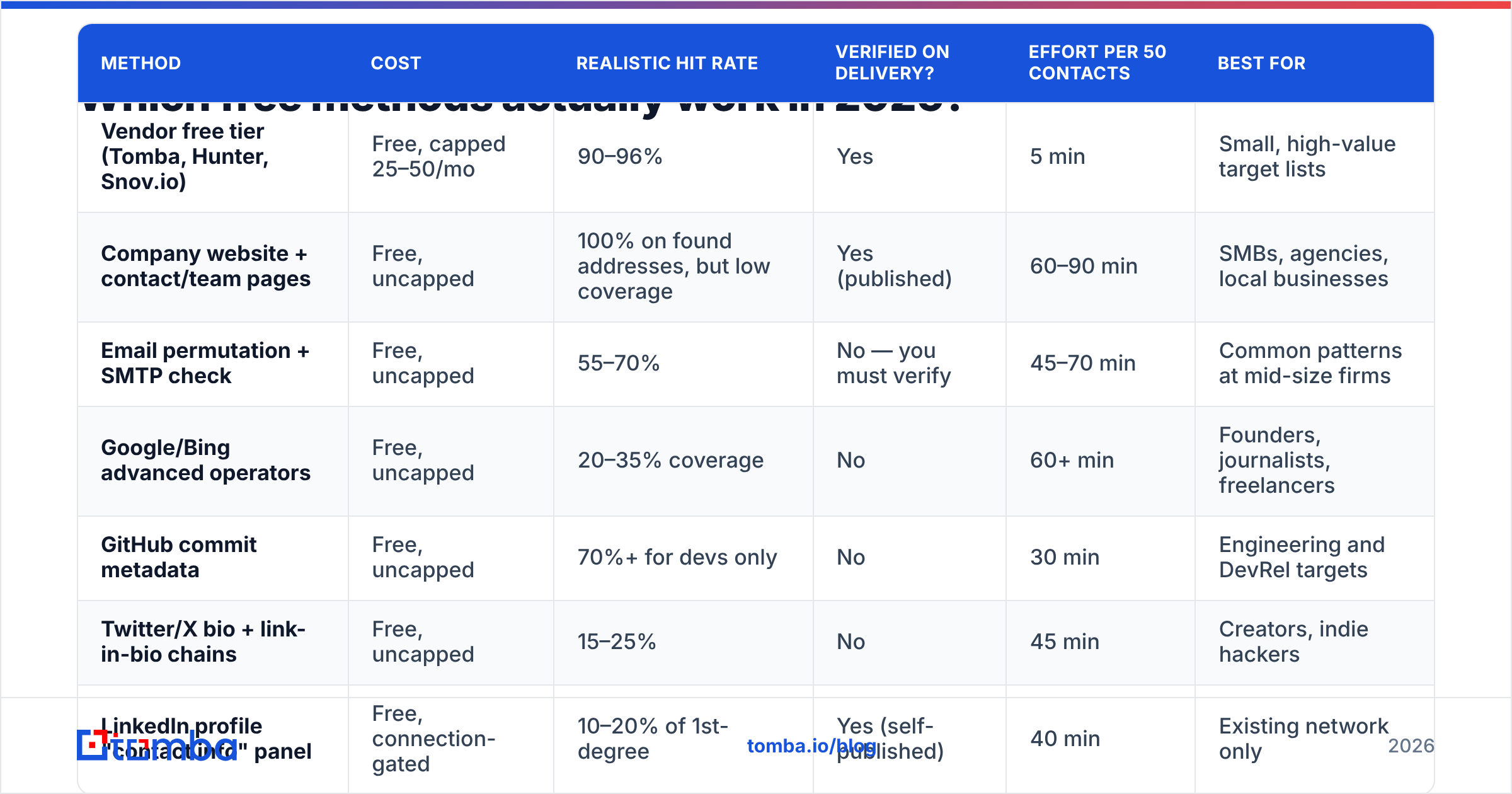
Here's the honest ranking based on what returns usable B2B addresses today. "Hit rate" is the share of attempts that produce a deliverable address; "effort" is minutes per 50 contacts.
| Method | Cost | Realistic hit rate | Verified on delivery? | Effort per 50 contacts | Best for |
|---|---|---|---|---|---|
| Vendor free tier (Tomba, Hunter, Snov.io) | Free, capped 25–50/mo | 90–96% | Yes | 5 min | Small, high-value target lists |
| Company website + contact/team pages | Free, uncapped | 100% on found addresses, but low coverage | Yes (published) | 60–90 min | SMBs, agencies, local businesses |
| Email permutation + SMTP check | Free, uncapped | 55–70% | No — you must verify | 45–70 min | Common patterns at mid-size firms |
| Google/Bing advanced operators | Free, uncapped | 20–35% coverage | No | 60+ min | Founders, journalists, freelancers |
| GitHub commit metadata | Free, uncapped | 70%+ for devs only | No | 30 min | Engineering and DevRel targets |
| Twitter/X bio + link-in-bio chains | Free, uncapped | 15–25% | No | 45 min | Creators, indie hackers |
| LinkedIn profile "contact info" panel | Free, connection-gated | 10–20% of 1st-degree | Yes (self-published) | 40 min | Existing network only |
| WHOIS / domain registrant records | Free, mostly redacted post-GDPR | 5–15% | No | 30 min | Older domains, non-EU registrars |
| Press releases, PR newswires, SEC filings | Free, uncapped | 30–40% | Yes (published) | 50 min | Enterprise, IR, and PR contacts |
Three of those nine deserve a closer look because they carry almost all the value.
How do you stack free tiers without breaking anything?#
The stacking strategy is legitimate and it works: sign up for several vendor free tiers with your real work email, use each one's monthly allowance, and rotate. You're not abusing anything — free tiers exist as product trials, and using them as intended is fine.
A realistic monthly free stack in 2026:
- Tomba — 25 searches/month. The email finder returns a confidence score with every result, and the free tier includes domain search, so one search can surface a whole company's published pattern rather than a single person.
- Hunter — 25 searches/month. Long-standing index, strong on US mid-market. Its confidence percentage is directionally reliable.
- Snov.io — 50 credits/month. Credits split across finding and verifying, so budget them.
- Apollo.io — limited free plan. Good for firmographic filtering; email reveal is credit-gated and the data skews stale on smaller companies.
- RocketReach / ContactOut — a handful of free lookups. Useful as a tie-breaker when two other tools disagree.
- BookYourData — pay-as-you-go with a small free sample. Worth a look if you want a pre-built list rather than one-by-one lookups; their sample data is clean and the per-record model avoids subscription lock-in.
That stack lands you roughly 100–130 verified addresses a month at zero cost. It's genuinely useful for founder-led sales, a first ICP test, or a 100-account ABM pilot. It is not a demand-gen engine.
The catch nobody mentions: free tiers usually exclude the bulk endpoints. You get single lookups through a UI, not CSV upload. So your time becomes the real cost — at roughly 12 seconds per manual lookup, 130 contacts is about 30 minutes of clicking, plus the research time to find the names in the first place.

Does email permutation still work?#
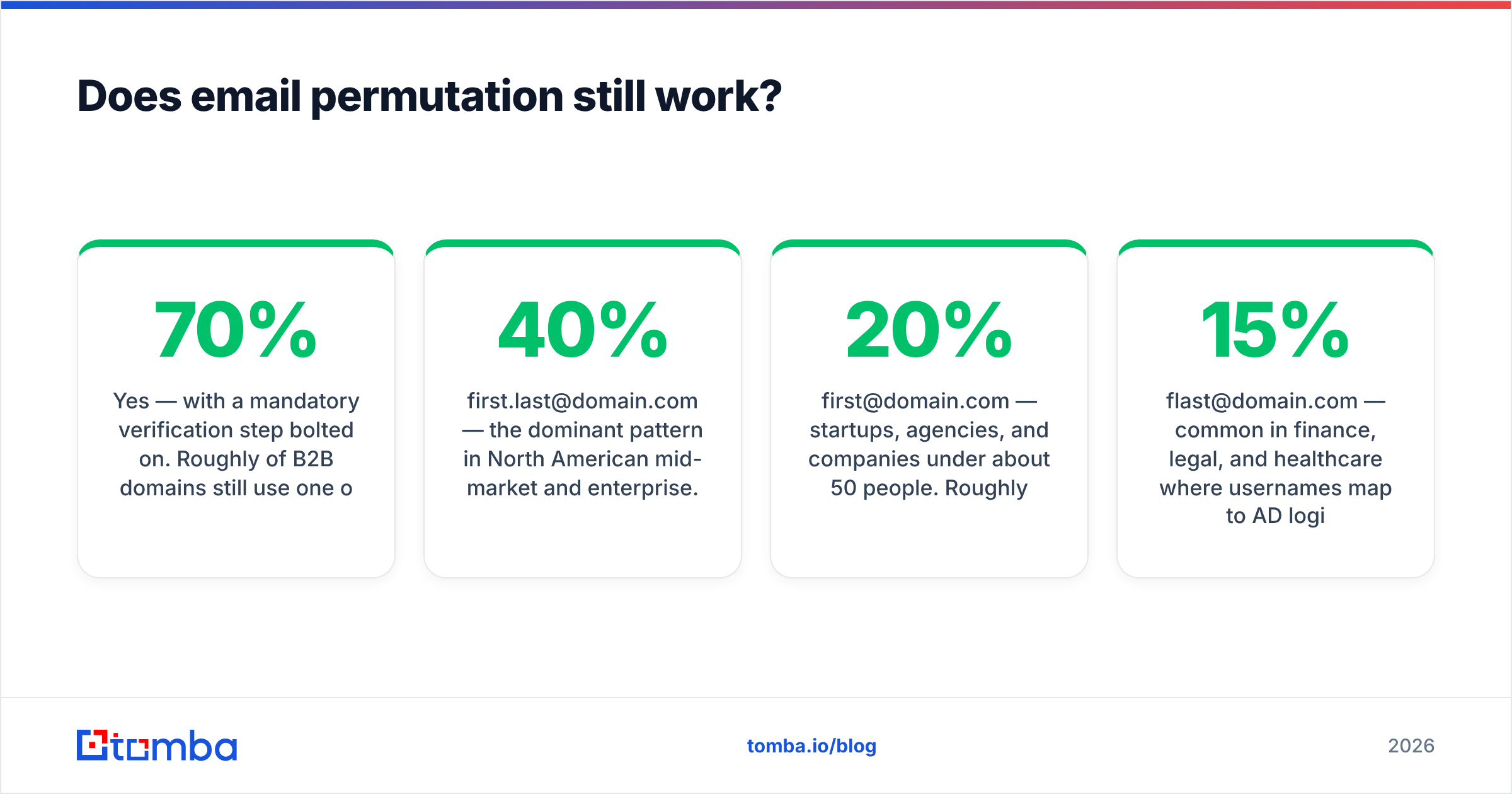
Yes — with a mandatory verification step bolted on. Roughly 70% of B2B domains still use one of six patterns:
first.last@domain.com— the dominant pattern in North American mid-market and enterprise. Roughly 40% of domains.first@domain.com— startups, agencies, and companies under about 50 people. Roughly 20%.flast@domain.com— common in finance, legal, and healthcare where usernames map to AD logins. Roughly 15%.firstl@domain.com— less common, often at European firms. Roughly 8%.first_last@domain.com— rarer, seen in older enterprise tenants. Roughly 5%.- Everything else — initials, employee IDs,
f.last, non-Latin transliterations. The remaining 12%, and the reason blind permutation caps out around 65%.
The workflow: identify the pattern once per company (find any one published address at that domain — a support address, a press contact, a job posting), then apply that pattern to every target at the company. A free email permutator generates the candidates; a company email pattern checker tells you which one the domain actually uses.
Then verify. This is not optional. Run every candidate through a free email checker or a proper email verifier before it touches a sending tool. An unverified permutation list typically runs 30–45% invalid, and Google's bulk sender rules — in force since 2024 and tightened since — put the spam-complaint threshold at 0.3% with bounce rates expected under 2%. See Google's own bulk sender guidelines for the current requirements.
One more trap: catch-all domains. A catch-all accepts every address at the domain, so SMTP verification returns "valid" for asdfgh@company.com. Roughly a quarter of B2B domains are catch-all. Standard verification can't resolve them — you need a catch-all verifier that uses secondary signals, or you accept the risk and segment those addresses into a separate, low-volume send.
What can you find on public web sources for free?#
More than most people try, and it costs nothing but time.
Search operators still work. site:company.com "@company.com" surfaces published addresses. "@company.com" "VP of Marketing" sometimes catches a press release or a PDF. filetype:pdf "@company.com" finds addresses buried in whitepapers, annual reports, and conference programs — a genuinely underused source.
GitHub is the single best free source for engineering contacts. Commit metadata contains the author's email unless they've enabled the privacy setting. git log --format='%ae' | sort -u on a cloned public repo dumps every contributor address. Around 70% of active contributors still leak a real address this way, and a meaningful share are work addresses.
Job postings reveal patterns. Companies frequently list careers@ or a recruiter's direct address, which tells you the domain's format instantly.
Press releases and newswires — PR Newswire, Business Wire, and company IR pages publish media-contact emails with names and titles attached. That's a verified address, a real name, and a role in one line.
Conference sites and speaker bios are gold for enterprise targets. Speaker submission portals often expose contact fields, and program PDFs are frequently indexed.
What no longer works well: WHOIS (mostly redacted since GDPR), LinkedIn scraping at scale (aggressive detection and account bans), and buying "free" lists from forums (universally recycled, universally toxic).

When is free no longer worth it?#
Run the math on your own time. At a fully-loaded cost of $40/hour, spending 90 minutes a week stitching free tools together costs $240/month. A paid plan that returns the same volume in four minutes costs $49.
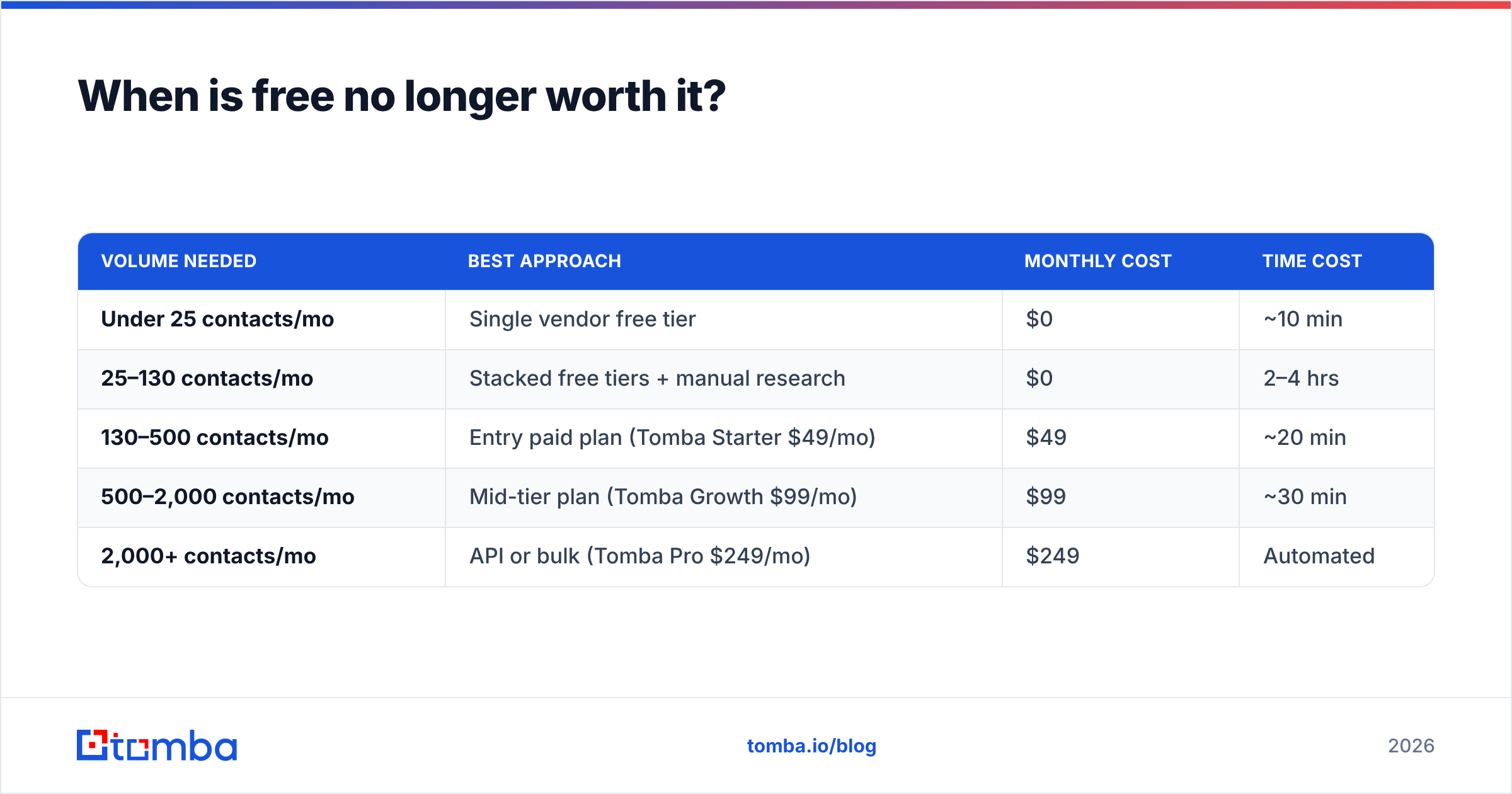
Here's the crossover in practice:
| Volume needed | Best approach | Monthly cost | Time cost |
|---|---|---|---|
| Under 25 contacts/mo | Single vendor free tier | $0 | ~10 min |
| 25–130 contacts/mo | Stacked free tiers + manual research | $0 | 2–4 hrs |
| 130–500 contacts/mo | Entry paid plan (Tomba Starter $49/mo) | $49 | ~20 min |
| 500–2,000 contacts/mo | Mid-tier plan (Tomba Growth $99/mo) | $99 | ~30 min |
| 2,000+ contacts/mo | API or bulk (Tomba Pro $249/mo) | $249 | Automated |
Note what changes at the crossover: not just cost, but bulk access and API access. Free tiers are single-lookup by design. The moment you want to upload a CSV of 400 names and get 400 verified addresses back, you need bulk email finder access — and no free tier offers it, at any vendor.

The second thing that changes is risk. Free-method lists carry higher invalid rates, and invalid rates drive bounces, and bounces drive sender reputation damage. A domain that lands in Microsoft's filtered bucket takes weeks to recover. The $49 you saved is not worth a quarter of degraded email deliverability.
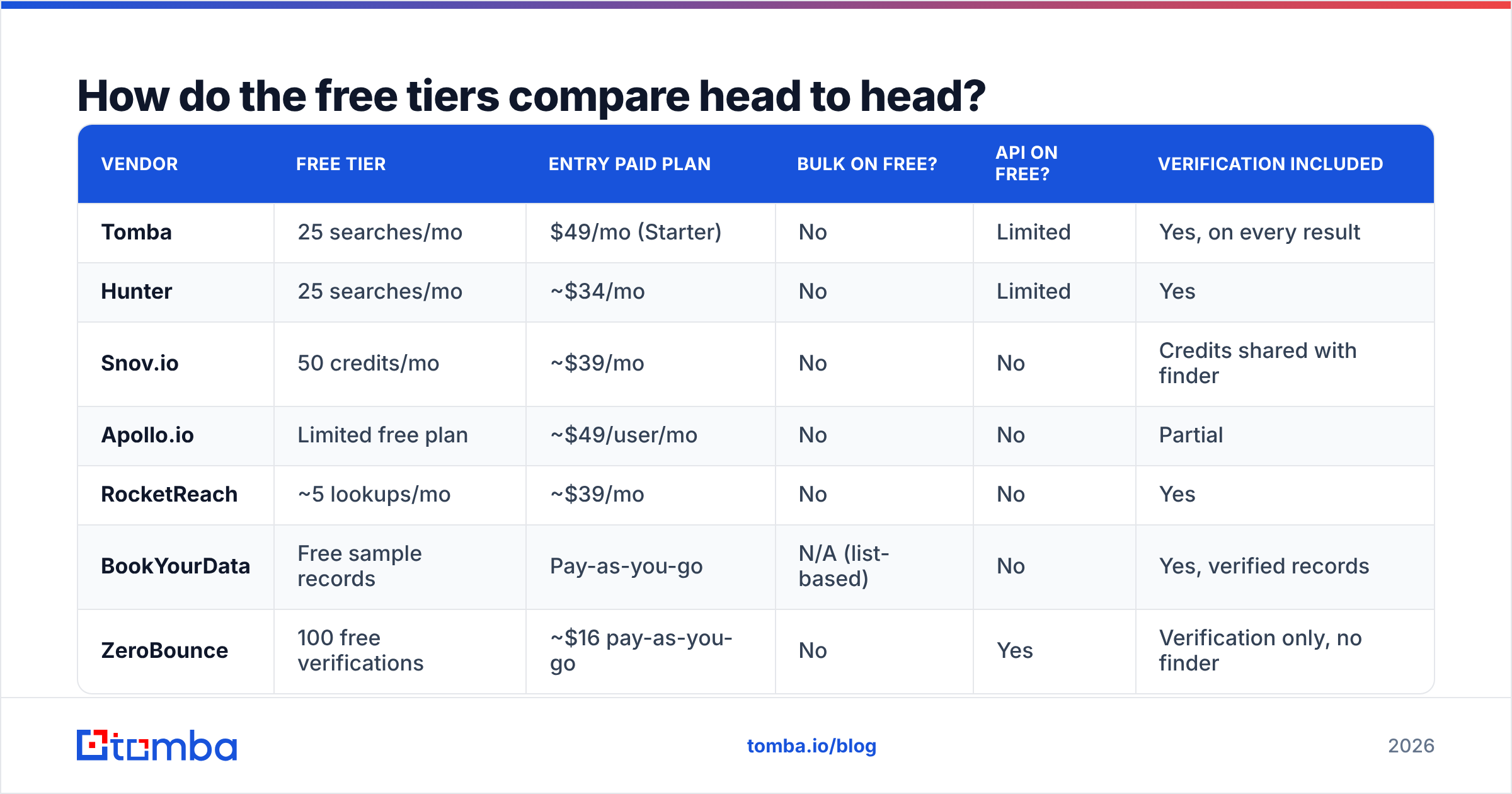
How do the free tiers compare head to head?#
Prices and limits as published by each vendor in 2026. Verify before you commit — free tiers change often.
| Vendor | Free tier | Entry paid plan | Bulk on free? | API on free? | Verification included |
|---|---|---|---|---|---|
| Tomba | 25 searches/mo | $49/mo (Starter) | No | Limited | Yes, on every result |
| Hunter | 25 searches/mo | ~$34/mo | No | Limited | Yes |
| Snov.io | 50 credits/mo | ~$39/mo | No | No | Credits shared with finder |
| Apollo.io | Limited free plan | ~$49/user/mo | No | No | Partial |
| RocketReach | ~5 lookups/mo | ~$39/mo | No | No | Yes |
| BookYourData | Free sample records | Pay-as-you-go | N/A (list-based) | No | Yes, verified records |
| ZeroBounce | 100 free verifications | ~$16 pay-as-you-go | No | Yes | Verification only, no finder |
Two things stand out. First, ZeroBounce's 100 free verifications are the best free verification allowance available — pair them with permutation candidates and you've built a decent free pipeline. Second, BookYourData's per-record model is the cleanest fit if you'd rather buy a defined list than run monthly lookups; there's no subscription to forget about, and the records ship pre-verified.
For a broader view of how these engines score against each other on match rate and bounce rate, G2's email-finder category aggregates verified user reviews with segment filters, which is more useful than any single vendor's own benchmark page — including ours.
What's the safest free workflow, step by step?#
Here's the sequence that produces the cleanest list without spending anything:
- Build the target list first. Names, titles, company domains. LinkedIn Sales Navigator's free trial, Crunchbase's free tier, or plain search. Emails come last, not first.
- Establish the domain pattern. One published address per company tells you the format. Check the contact page, a job posting, or a press release.
- Burn free-tier credits on the hard ones. Use your 25 Tomba searches on the executives and edge-case domains where guessing fails — not on the easy
first@startup.comtargets you could permutate in seconds. - Permutate the rest. Apply the confirmed pattern to remaining names.
- Verify everything. Free verification allowances first, then discard anything that isn't a confirmed valid. Treat catch-all results as a separate segment.
- Send in small batches. Cap the first send at 30–50 per domain per day and watch the bounce rate. If it clears 2%, stop and re-verify.
- Log what bounced. Bounced addresses tell you which pattern assumption was wrong, which sharpens step 2 for the next batch.
Skipping step 5 is the single most common failure mode, and it's the one with consequences that outlast the campaign. Tools like a spam checker and an SPF checker round out the pre-send checklist — both free, both worth two minutes each.
Is it legal to collect emails this way?#
Mostly yes for B2B, with real conditions. Under GDPR, legitimate interest can cover B2B outreach to a business address if the message is relevant to the recipient's professional role, you disclose your source on request, and you honor opt-outs immediately. CAN-SPAM in the US is more permissive: you need accurate headers, a valid physical address, and a working unsubscribe. CASL in Canada is stricter and generally requires consent.
What's clearly out of bounds regardless of jurisdiction: harvesting addresses from sites whose terms forbid it, buying scraped lists, and ignoring unsubscribe requests. The ICO's guidance on direct marketing is the clearest free reference if you're selling into the UK or EU.
Practical rule: if you couldn't comfortably tell the recipient exactly how you got their address, don't send.
Start free, then scale when it pays#
Free methods are a legitimate starting point, not a permanent strategy. Use the 25-search free tier to validate that your ICP responds at all. Permutate and verify your way through the next hundred. Track the hours. The moment you're spending more than two hours a month on lookups, the free path has quietly become the expensive one.
When that happens, Tomba's Email Finder is the fastest way off it — 25 free searches to test the match rate against your own target list, verification built into every result rather than bolted on afterward, and bulk plus API access from the $49/mo Starter plan upward. Compare the tiers on Tomba pricing and run your hardest twenty domains through the free tier first. If the hit rate doesn't beat what you're getting manually, you've lost nothing but ten minutes.
Related guides#
Ready to find emails that actually work?
Join 150,000+ professionals who stopped guessing and started sending. Free credits on signup — no credit card required.
Get the Tomba newsletter
Practical outbound tactics and product updates — once every two weeks.
About the author