How to Get Leads Online in 2026: The Complete Playbook
Most online lead gen advice is a list of channels with no math attached. This guide breaks down what each channel actually costs per qualified lead, when it works, and how to build a system that compounds.
TL;DR
- "Get leads online" is not one tactic — it's roughly nine distinct channels with cost-per-qualified-lead ranging from under $5 to over $400. Picking the wrong one is the most expensive mistake in B2B marketing.
- Inbound channels (SEO, content, community) compound but take 6–12 months. Outbound channels (cold email, ads, LinkedIn) produce pipeline in weeks but stop the day you stop paying.
- The highest-ROI setup for most B2B teams under $10M ARR is a small inbound engine plus a tightly targeted outbound motion built on verified contact data.
- Lead quality beats lead volume every time. A 200-contact list with 97% deliverability outperforms a 5,000-contact scraped list that torches your sending domain.
- Whatever channel you pick, the bottleneck is almost always the same: accurate contact data. Fix that before you buy another ad.
What does "get leads online" actually mean in 2026?#
It means turning anonymous internet attention into a named human with a verified email address, a job title, and a reason to talk to you. Everything else — the funnels, the lead magnets, the retargeting pixels — is machinery in service of that one conversion.
The reason most teams struggle is that they treat "online lead generation" as a single skill. It isn't. Running Google Ads for a $40k ACV product and building a programmatic SEO engine for a self-serve tool are unrelated disciplines that happen to share a KPI. When someone says "our lead gen isn't working," the useful question is: which of the nine channels are you running, and what's the cost per qualified lead on each?
A qualified lead — not a raw form fill. This distinction is where most reporting falls apart. A landing page that converts at 8% looks fantastic until you discover 60% of those emails are personal Gmail addresses from students, or bounce outright.
Which online lead generation channels are worth your budget?#
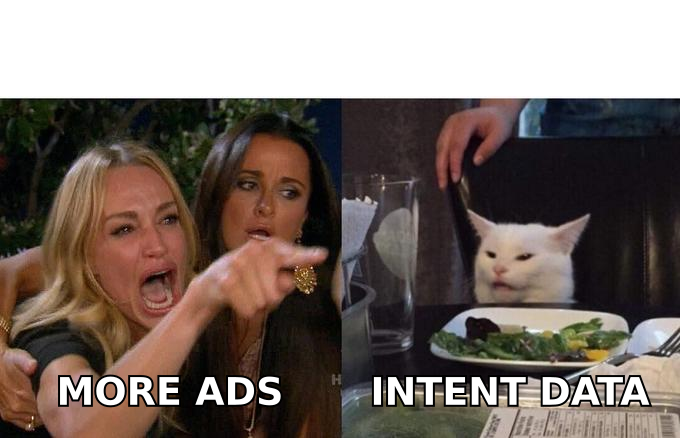
Here's the honest breakdown. Costs are typical mid-market B2B ranges in 2026 — your numbers will vary by vertical, but the relative ordering holds up remarkably well across industries.
| Channel | Typical cost per qualified lead | Time to first lead | Scales? | Best for |
|---|---|---|---|---|
| Organic SEO / content | $15–$60 (amortized) | 4–9 months | Yes, slowly | Products with search demand |
| Cold email outbound | $8–$35 | 1–3 weeks | Yes, linearly | Defined ICP, $5k+ ACV |
| LinkedIn organic / social selling | $20–$70 | 2–4 months | Poorly (founder-bound) | Founder-led sales |
| Google Search Ads | $80–$400 | Days | Yes, expensively | High-intent, high-ACV |
| LinkedIn Ads | $150–$450 | Days | Yes, expensively | Enterprise ABM |
| Webinars / virtual events | $40–$120 | 4–8 weeks | Moderate | Complex, education-heavy sales |
| Review sites (G2, Capterra) | $60–$250 | 2–6 weeks | Capped by category | Established categories |
| Partner / affiliate | $10–$50 (rev-share) | 2–5 months | Yes | Ecosystem-adjacent products |
| Website visitor identification | $5–$40 | Days | Capped by traffic | Sites with existing traffic |
Two things jump out. First, paid channels are 5–15x more expensive per lead than the top-performing owned channels. Second, the cheap channels take months. That tension is the entire strategic problem of online lead generation, and nobody has solved it — you either pay in money or in time.
The practical answer for most teams: run one fast channel to keep pipeline alive while one slow channel compounds underneath it. Cold email plus SEO is the most common working pair. Ads plus content is the well-funded version of the same idea.
How do you build an online lead engine that compounds?#
Think of it like a restaurant. Ads are ordering takeout for your guests — fast, reliable, and the margin is terrible. SEO and content are planting a kitchen garden — nothing to eat for a season, then free produce forever. Outbound is going door to door inviting neighbors — cheap, effective, and entirely dependent on having the right addresses.
Here's the build order that works for teams starting close to zero:
- Define one ICP segment narrowly enough to name 200 companies. "SaaS companies" is not a segment. "Series A-to-B vertical SaaS companies in North America with 20–80 employees and an in-house SDR team" is. If you can't list 200 accounts by name, your targeting is too vague and every downstream channel will underperform.
- Build the contact layer before the campaign layer. Get verified decision-maker emails and phone numbers for those accounts. This is the step teams skip, and it's why their outreach bounces at 12% and their ad audiences are junk. Use a domain search to pull every public email pattern at a target company, then verify emails before anything sends.
- Ship one fast channel. Cold email or paid search, depending on whether your buyers are actively searching. Target 30–50 qualified conversations in the first 90 days — enough signal to know if the ICP is right.
- Start the slow channel in parallel, week one. Publish the 10 bottom-funnel pages your buyers search for before purchase: comparison pages, alternatives pages, pricing explainers, integration pages. These outrank thought-leadership fluff and convert 3–5x better.
- Instrument everything to closed-won, not to MQL. Channel-level cost per customer is the only number that should change your budget. Cost per lead is a diagnostic, not a decision input.
- Kill or double down at 90 days. Channels rarely improve gradually. They either show a signal early or they don't fit your motion.
Notice that step 2 sits before every campaign. That's deliberate. Marketing qualified lead counts mean nothing if the underlying records are wrong.
Why does contact data quality decide your cost per lead?#
Because bad data multiplies through every downstream metric. Walk the math.
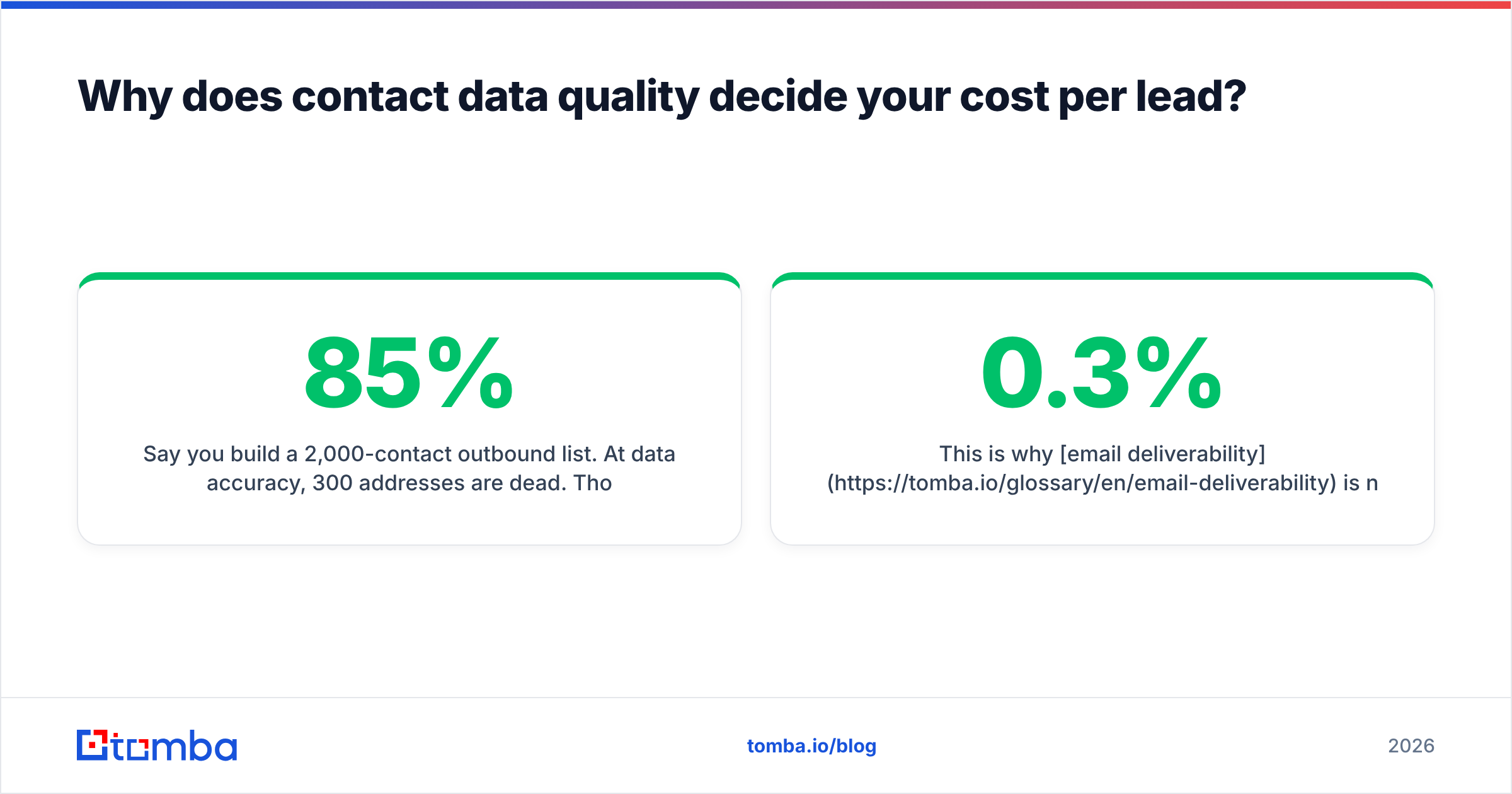
Say you build a 2,000-contact outbound list. At 85% data accuracy, 300 addresses are dead. Those 300 bounces push your bounce rate to 15% — well past the 2–3% threshold where mailbox providers start throttling you. Your sending domain reputation drops. Now the 1,700 good addresses see inbox placement fall from 90% to maybe 55%. You didn't lose 15% of your list. You lost roughly half your total reach, plus a domain that takes six weeks to rehabilitate.
The same rot shows up in paid. Upload a customer-match audience full of stale emails and your lookalike modeling degrades, which raises CPMs on an audience that was already the expensive part of your budget.
This is why email deliverability is not a separate topic from lead generation — it's the constraint that caps every channel that touches email. Google and Yahoo's bulk sender requirements, in force since 2024 and tightened since, made spam complaint rates above 0.3% a hard fail rather than a soft warning. Google's official sender guidelines remain the definitive reference; read them before you scale any sending volume.
Is inbound or outbound better for getting leads online?#
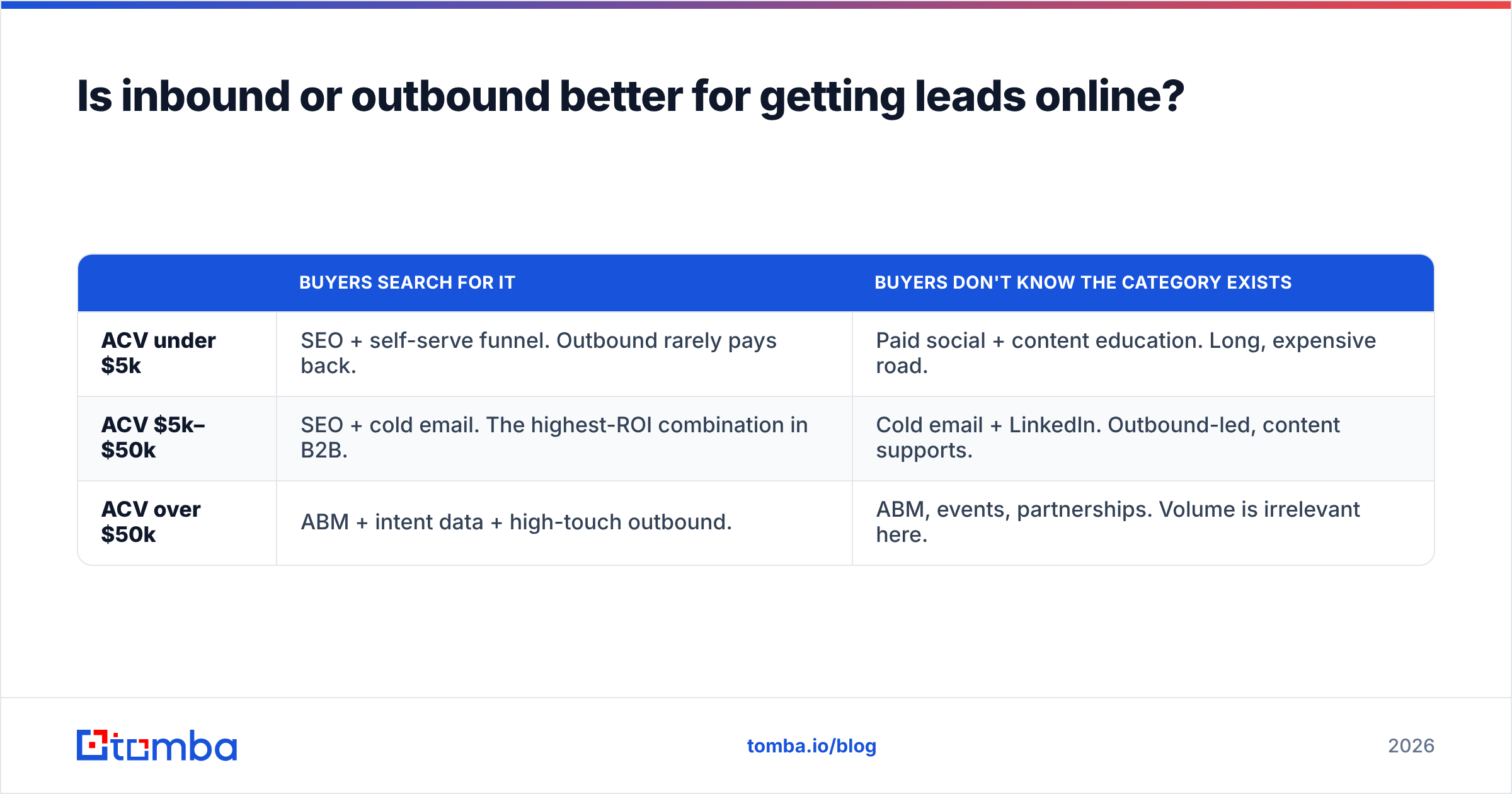
Neither. The correct choice is determined by two variables: whether your buyers search for your category, and what your average contract value is.
| Buyers search for it | Buyers don't know the category exists | |
|---|---|---|
| ACV under $5k | SEO + self-serve funnel. Outbound rarely pays back. | Paid social + content education. Long, expensive road. |
| ACV $5k–$50k | SEO + cold email. The highest-ROI combination in B2B. | Cold email + LinkedIn. Outbound-led, content supports. |
| ACV over $50k | ABM + intent data + high-touch outbound. | ABM, events, partnerships. Volume is irrelevant here. |
The single most common error is running an ACV-under-$5k playbook (volume, automation, self-serve) on an over-$50k product, or the reverse. A $200k enterprise deal doesn't come from a 500-person email blast. A $99/month tool can't sustain a six-touch SDR sequence.
For the large middle band — $5k to $50k ACV, which is where most B2B software lives — the combination that consistently wins is targeted outbound funded by a growing content base. Content warms the account; outbound creates the timing. Neither works nearly as well alone.
Worth noting that outbound in 2026 looks nothing like 2019. Volume-based spray is dead, killed by both mailbox provider enforcement and buyer fatigue. What works now is 30–80 highly researched contacts per week with genuine personalization, sent from a warmed domain with a verified list. That's a data problem more than a copywriting problem, which is why the tooling stack matters.
What tools do you actually need to get leads online?#
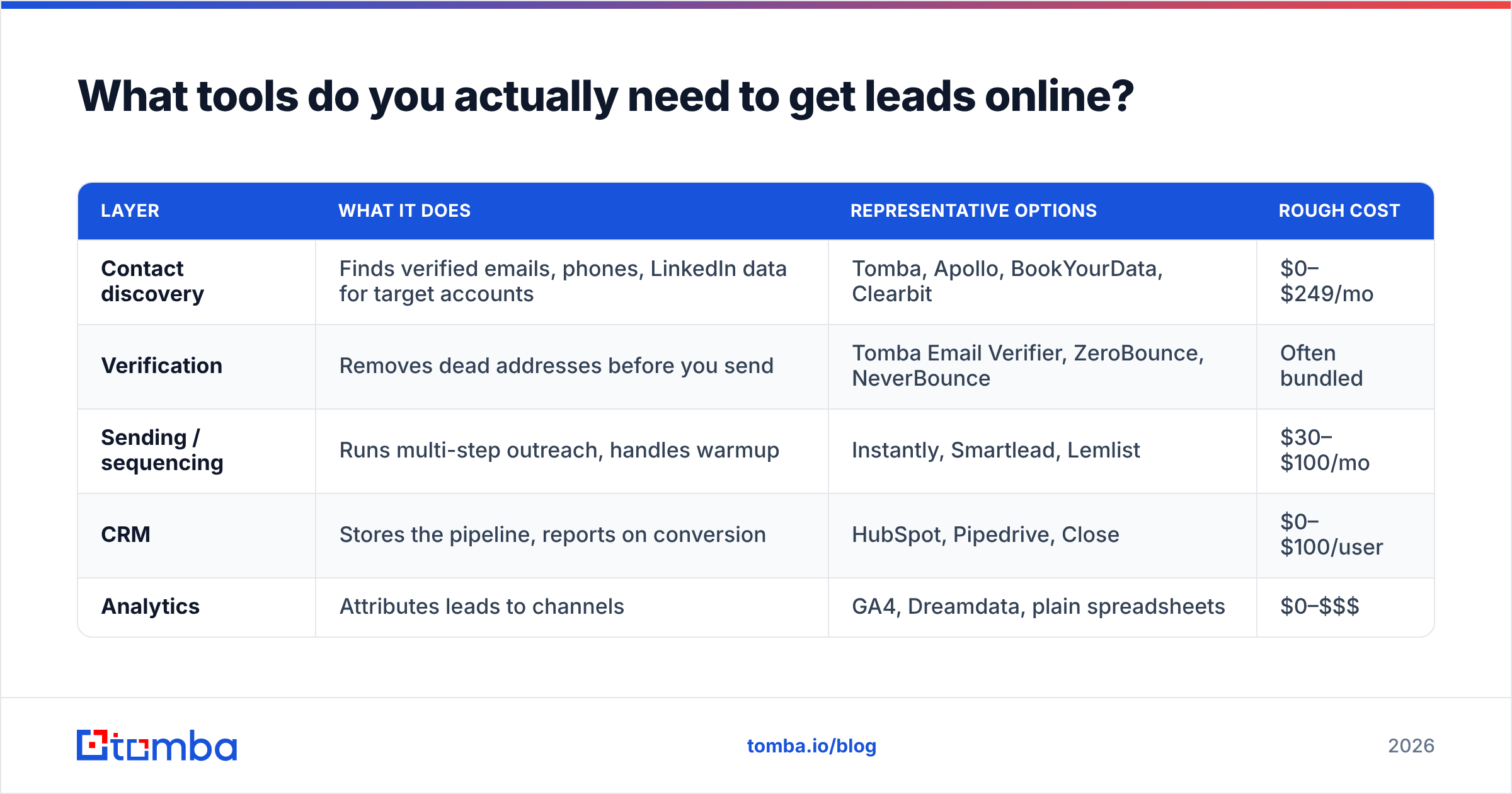
Fewer than the average stack diagram suggests. Here's the minimum viable set, and what each layer does.
| Layer | What it does | Representative options | Rough cost |
|---|---|---|---|
| Contact discovery | Finds verified emails, phones, LinkedIn data for target accounts | Tomba, Apollo, BookYourData, Clearbit | $0–$249/mo |
| Verification | Removes dead addresses before you send | Tomba Email Verifier, ZeroBounce, NeverBounce | Often bundled |
| Sending / sequencing | Runs multi-step outreach, handles warmup | Instantly, Smartlead, Lemlist | $30–$100/mo |
| CRM | Stores the pipeline, reports on conversion | HubSpot, Pipedrive, Close | $0–$100/user |
| Analytics | Attributes leads to channels | GA4, Dreamdata, plain spreadsheets | $0–$$$ |
On the discovery layer specifically: prices vary more than capability does, and the differentiator is accuracy on your accounts, not on a vendor benchmark. Test any provider against 50 contacts you can independently confirm before committing to an annual plan.
Tomba pricing runs a free tier at 25 searches per month, Starter at $49/mo, Growth at $99/mo, and Pro at $249/mo — useful reference points because the mid-market tier is where most teams land once they're sending consistently. BookYourData takes a different approach with pay-as-you-go credits and a strong North American B2B database, which suits teams that buy lists in bursts rather than searching continuously. Apollo bundles discovery and sequencing in one seat, at the cost of flexibility if you already like your sending tool.
If you'd rather validate the category before spending anything, G2's lead intelligence grid is a reasonable neutral starting point for reading how real teams rate accuracy and support.
For enrichment at scale — filling in job titles, company size, and tech stack across an existing list — most teams eventually move to an API rather than a UI. A contact enrichment endpoint that runs on record creation in your CRM removes the manual research step entirely.
How do you measure whether your online lead generation is working?#
Track four numbers per channel, monthly, in one table. Anything more granular is procrastination.
- Qualified leads — leads that match your ICP definition and had a real conversation. Not form fills.
- Cost per qualified lead — all-in, including tooling and a fair share of salary.
- Qualified-lead-to-opportunity rate — the fastest signal that your targeting is drifting. When this drops, the problem is upstream of your messaging.
- Pipeline created — dollar value, not count. This is the number that survives a budget review.
A healthy B2B setup lands somewhere near: 20–40% of qualified leads become opportunities, 20–30% of opportunities close, and total blended cost per customer sits under one-third of first-year contract value. If your win rate on qualified leads is under 10%, the leads aren't qualified — regardless of what your CRM stage says.
One more diagnostic worth running quarterly: pull a random sample of 50 leads from each channel and manually check whether they match your ICP. Automated qualification drifts. Human spot-checks catch it before you've spent another quarter's budget on the wrong audience.
What should you do in your first 30 days?#
Week 1: define the ICP segment and build a named list of 200 target accounts. No tooling required beyond a spreadsheet and LinkedIn.
Week 2: find and verify decision-maker contacts at those accounts. Expect 2–4 relevant contacts per company. Verify every address; discard anything that isn't a confirmed deliverable result. Catch-all domains need a separate check — a catch-all verifier tells you whether the mailbox actually exists rather than whether the domain accepts everything.
Week 3: write three sequences — one per persona — and warm your sending domain. Do not send from your primary domain. Buy a lookalike domain, warm it for at least two weeks, and cap daily volume at 30–40 per mailbox.
Week 4: launch, then publish your first two bottom-funnel content pages while the sequence runs. By day 30 you should have replies to read and a content engine started. That's the whole playbook — everything after is iteration.
The teams that fail at this rarely fail at strategy. They fail at step two, send to a list they never verified, burn a domain, and conclude that "outbound doesn't work." It works fine. Bad data doesn't.
Start with the data layer. Before you commit budget to ads, sequences, or a new content hire, make sure the contacts you're reaching are real. The Tomba Email Finder pulls verified professional email addresses by domain, name, or company — free tier included at 25 searches a month, so you can test accuracy against your own target accounts before paying for anything. Build the list right, and every channel downstream gets cheaper.
Related guides#
Ready to find emails that actually work?
Join 150,000+ professionals who stopped guessing and started sending. Free credits on signup — no credit card required.
Get the Tomba newsletter
Practical outbound tactics and product updates — once every two weeks.
About the author