GetEmail.io vs Apollo.io: Which Email Finder Wins in 2026?
GetEmail.io is a lightweight AI email finder. Apollo.io is a full sales platform with a database attached. We compare accuracy, credits, pricing and API access to show which one earns a seat in your stack.
GetEmail.io vs Apollo.io is a choice between a tool and a platform. One finds an address. The other runs your whole outbound motion. Here is the short version first.
TL;DR
- GetEmail.io is a single-purpose email finder. Give it a name and a company domain. It predicts and checks the business email, in a browser extension or an API call.
- Apollo.io is a full go-to-market platform. Contact database, filters, sequences, dialer, CRM sync. Email finding is one feature, and you pay per seat for all of it.
- The price shapes differ, not just the numbers. GetEmail.io sells credit buckets on one account. Apollo.io bills per user per month, so a five-person team pays five times over.
- Neither tool is verification-first. If bounce rate matters more than feature count, you will bolt on a verifier either way.
- Team size decides it. Solo founders and recruiters lean GetEmail.io. Staffed outbound teams lean Apollo.io. API-heavy or high-volume work suits a flat-rate finder like Tomba at $49/mo.
What are GetEmail.io and Apollo.io?#
They solve overlapping problems from opposite ends of the stack.
GetEmail.io is a lightweight lookup tool. You give it a first name, last name and a company domain. Its algorithm predicts the most likely email pattern, then checks it. There is a Chrome extension for LinkedIn, a Google Sheets add-on, Salesforce and HubSpot connectors, and an API. That is the whole product surface, and the focus is the point.
Apollo.io is a database plus an engagement layer. The database holds hundreds of millions of contacts and companies. On top of it sit filters (title, headcount, tech stack, intent signals), sequences, a dialer, meeting scheduling, and two-way CRM sync. Email finding is a byproduct of pulling a record out of the database.
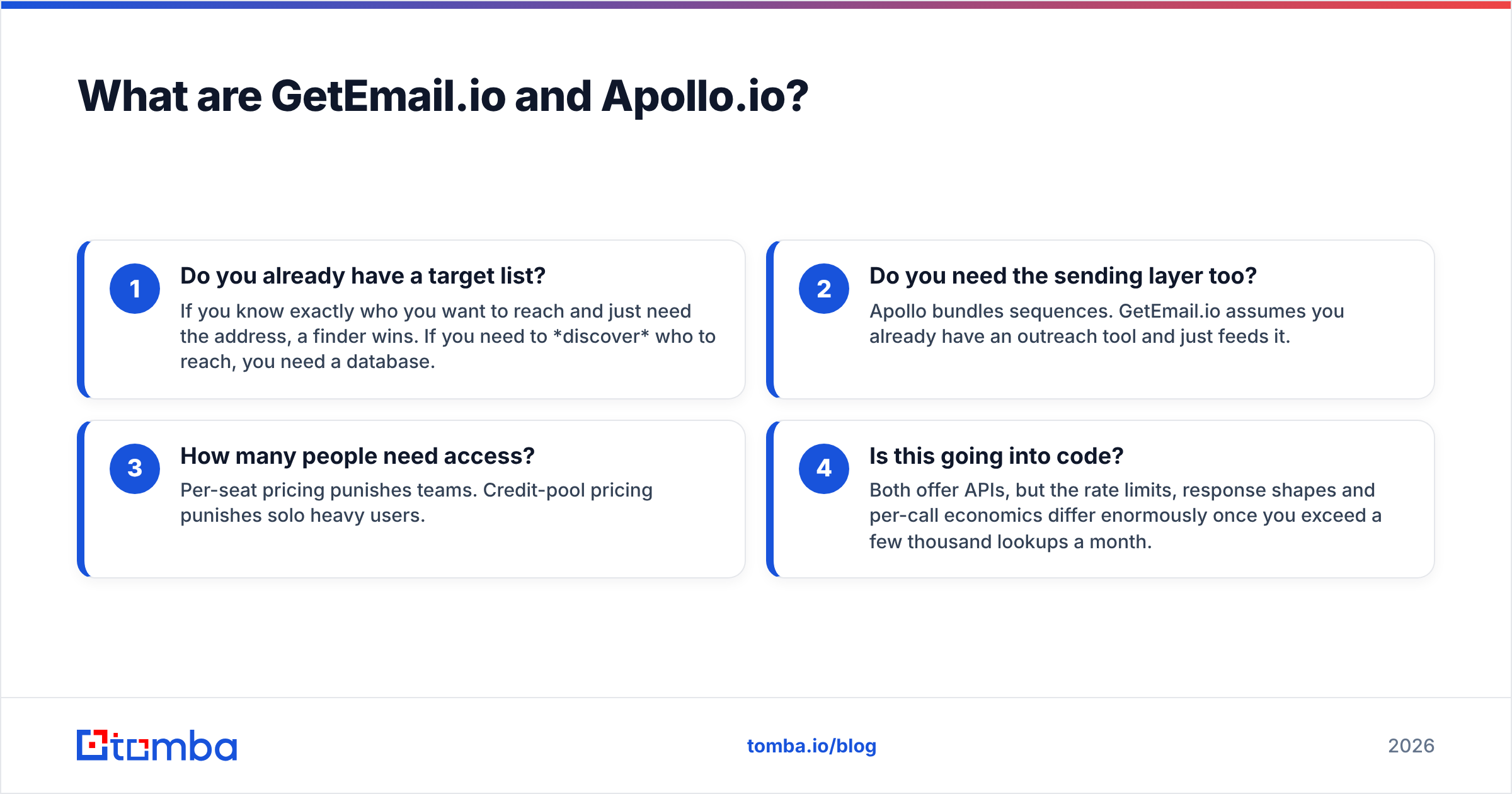
The practical difference comes down to four decisions:
- Do you already have a target list? If you know who you want to reach and just need the address, a finder wins. If you need to discover who to reach, you need a database.
- Do you need the sending layer too? Apollo bundles sequences. GetEmail.io assumes you already have an outreach tool and just feeds it.
- How many people need access? Per-seat pricing punishes teams. Credit-pool pricing punishes solo heavy users.
- Is this going into code? Both offer APIs. But rate limits, response shapes and per-call costs differ a lot once you pass a few thousand lookups a month.
Answer those four and the rest of this GetEmail.io vs Apollo.io comparison mostly resolves itself.

GetEmail.io vs Apollo.io: how do the features compare?#
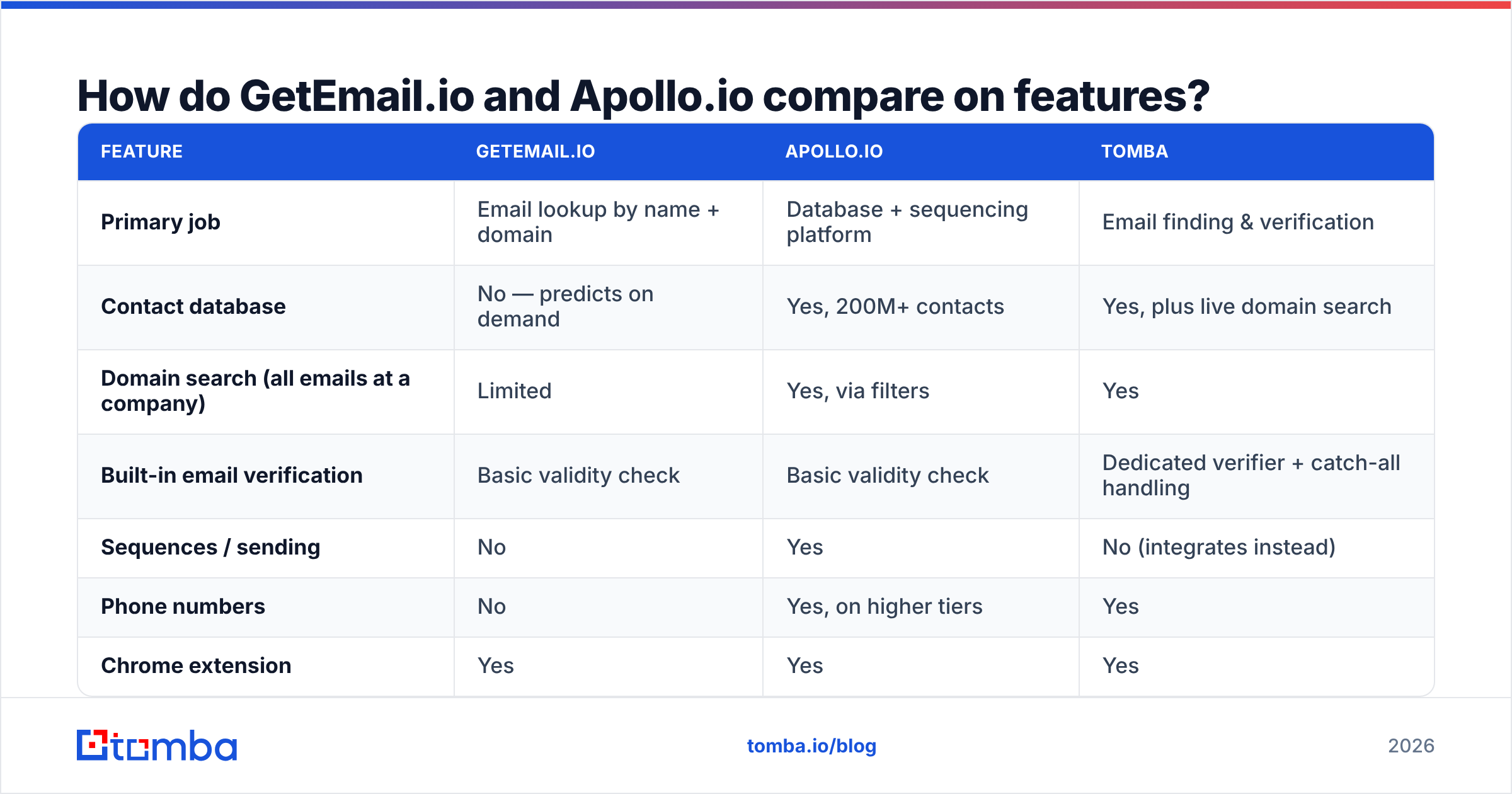
| Feature | GetEmail.io | Apollo.io | Tomba |
|---|---|---|---|
| Primary job | Email lookup by name + domain | Database + sequencing platform | Email finding & verification |
| Contact database | No — predicts on demand | Yes, 200M+ contacts | Yes, plus live domain search |
| Domain search (all emails at a company) | Limited | Yes, via filters | Yes |
| Built-in email verification | Basic validity check | Basic validity check | Dedicated verifier + catch-all handling |
| Sequences / sending | No | Yes | No (integrates instead) |
| Phone numbers | No | Yes, on higher tiers | Yes |
| Chrome extension | Yes | Yes | Yes |
| API access | Yes | Yes, tier-gated | Yes, on every paid plan |
| Pricing model | Credit tiers, single account | Per user, per month | Credit tiers, single account |
| Free tier | ~10 credits/mo | Free plan with limited credits | 25 searches/mo |
Two things stand out. Apollo's edge is breadth. If your team already pays for a database, a sequencer and a dialer separately, folding them into one $79-ish seat is a real budget story. GetEmail.io's edge is restraint. It does not force you into a workflow. It answers one question and gets out of the way.
Neither is a verification-first product. Both return a confidence signal. But confidence is not the same as an SMTP check against a live mail server, and that gap is where bounces come from. If you send at volume, plan on a separate email verifier step either way.
Which one finds more valid emails?#
Accuracy is where marketing pages get vague and buyers get burned. The honest answer: it depends on the segment you prospect. Test both on your list before you commit.
Three structural factors predict accuracy better than any vendor claim:
- Pattern coverage. GetEmail.io leans on algorithmic prediction. It infers
first.last@,flast@,first@and similar patterns, then scores them. That works well at firms with 50+ staff and a steady format. It degrades on small companies, agencies and anywhere the format is odd. - Database freshness. Apollo's records come from a contributory network plus public sources. Coverage is huge, but stale records are a known complaint in Apollo.io reviews on G2. People change jobs, and an 18-month-old entry is a bounce waiting to happen.
- Catch-all handling. About a fifth of business domains accept every address at the SMTP layer, so standard checks return "unknown." Does the tool tell you that, or quietly mark the address valid? That one choice drives most real-world bounce rates.

The takeaway from benchmark data like this is not "vendor X wins forever." Headline accuracy numbers hide a lot of variance. The spread between tools widens sharply on hard segments: small companies, non-US domains, and catch-all servers. Run a 100-contact sample through both, send to it, and count the bounces. That number beats every comparison table on the internet, including this one.
To isolate the catch-all problem, a catch-all verifier returns a usable verdict on domains that generic checkers call "unknown." That is where most surprise bounces start.
How does pricing really compare?#
This is where GetEmail.io vs Apollo.io stops looking like a close comparison.
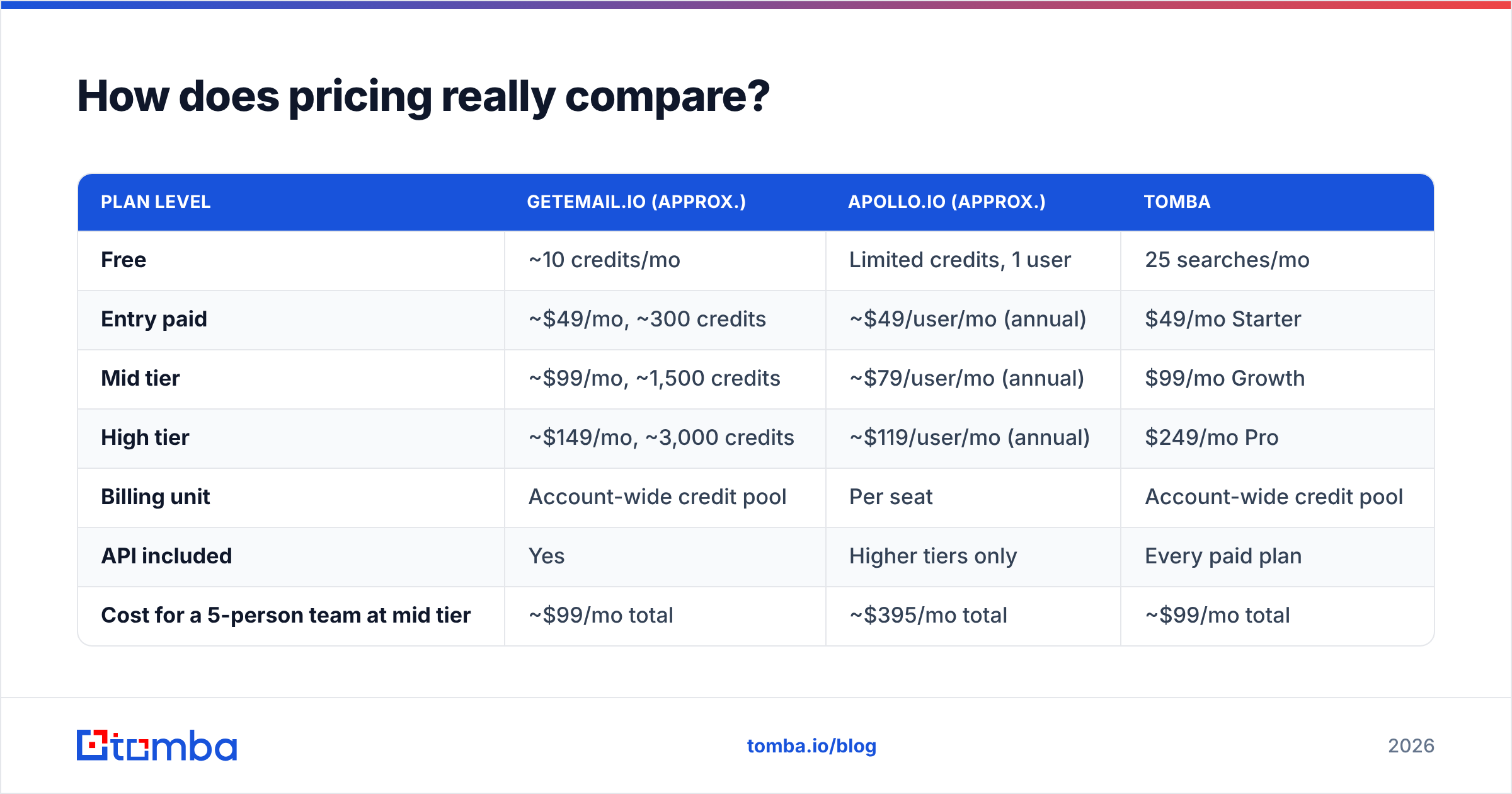
| Plan level | GetEmail.io (approx.) | Apollo.io (approx.) | Tomba |
|---|---|---|---|
| Free | ~10 credits/mo | Limited credits, 1 user | 25 searches/mo |
| Entry paid | ~$49/mo, ~300 credits | ~$49/user/mo (annual) | $49/mo Starter |
| Mid tier | ~$99/mo, ~1,500 credits | ~$79/user/mo (annual) | $99/mo Growth |
| High tier | ~$149/mo, ~3,000 credits | ~$119/user/mo (annual) | $249/mo Pro |
| Billing unit | Account-wide credit pool | Per seat | Account-wide credit pool |
| API included | Yes | Higher tiers only | Every paid plan |
| Cost for a 5-person team at mid tier | ~$99/mo total | ~$395/mo total | ~$99/mo total |
Prices move, so check each vendor's page before you sign. But the shape is stable, and the shape should drive your decision.
Per-seat pricing makes sense when every seat gets its own value. A rep using sequences, a dialer and a shared CRM view really does consume a seat. It stops making sense when four of your five people just need an address twice a week. Then you are paying platform prices for a lookup.
The reverse trap is real too. A solo operator burning 5,000 lookups a month can outgrow credit tiers fast, and one flat platform seat may cost less. Do the math with your real monthly volume, not with the plan names.

One more line item people forget: credits burned on failures. Ask each vendor whether a "not found" result consumes a credit. The answer shifts effective cost by 20-40% on hard segments. Tomba's pricing does not charge for searches that return nothing. When your ICP is small businesses, that matters more than the headline price.

Is Apollo.io better than GetEmail.io for outbound teams?#
For a staffed outbound team with an SDR pod, probably yes — with caveats.
Apollo's value is consolidation. One login covers list-building, enrichment, sequencing and call logging. Your RevOps person maintains one integration instead of four. When a rep asks "who else at this account should I touch?", Apollo answers on the same screen. GetEmail.io cannot answer that at all. It needs you to know the name first.
The caveats are real though:
- Seat math scales badly. Ten reps on the mid tier runs close to $800 a month before add-ons. Your CFO will revisit that line.
- Deliverability risk from a shared sender. Sending through the same platform as everyone else in your category does not automatically hurt you. But your email deliverability then rests on infrastructure choices you do not control.
- Data recency. A big database is only an asset if it is current. Budget time to re-verify before every campaign, not once a quarter.
- Feature gravity. Bundled platforms nudge you toward the bundled sequencer, even when a specialist tool would convert better. That cost is soft, but it is not zero.
For a solo founder, recruiter, agency owner or anyone doing 100-500 targeted lookups a month, GetEmail.io's simplicity is a genuine feature. There is no onboarding, no seat management, no unused modules. You paste a name, you get an address.
What about API access and workflow automation?#
Wiring email discovery into a product, a scraper or an internal tool narrows the comparison to three questions. Is the API on your plan? What does it cost per call at volume? How good are the docs?
GetEmail.io exposes a plain REST endpoint on paid plans. Name plus domain in, email plus confidence score out. It is easy to integrate and easy to reason about. Bulk is where it gets thin. Push tens of thousands of lookups through per-call endpoints and you own the queueing, retries and rate limits yourself.
Apollo's API is powerful but tier-gated. The terms on bulk export and data reuse are stricter than most developers expect. Read the contract before you build around it. "We have an API" and "we may store and reuse this data in our own product" are different statements.
For pipeline work, look for three things most platforms do not bundle. A real bulk email finder endpoint that batches for you. An email finder API on the entry plan, not the enterprise plan. Native connectors — Google Sheets, Zapier, HubSpot — so non-technical teammates can run lookups without a terminal.
GetEmail.io vs Apollo.io: which should you choose in 2026?#
Pick by the constraint that binds hardest for you.
- Choose Apollo.io if you have a funded outbound team and no existing database, and you want list-building, sequencing and dialing in one contract. Accept the per-seat cost as the price of consolidation. Build a re-verification step into every campaign.
- Choose GetEmail.io if you are one to three people, you already know your targets, and you already have a sending tool. You want a cheap, focused lookup that stays out of your way.
- Choose a dedicated finder-plus-verifier if your bottleneck is data quality rather than feature count. That is the case when bounces, catch-all domains and wasted credits are what cost you money each month.
- Run all three on a test list first. A 100-row sample costs an afternoon and settles the argument with data instead of opinions.
That third path is where Tomba fits. It is not trying to be a sequencer or a CRM. It is an email finder with verification, catch-all detection, domain search, phone lookup and enrichment next to it. Pricing runs on a shared credit pool ($49/mo Starter, $99/mo Growth, $249/mo Pro, free tier at 25 searches) rather than per seat, and API access is included on every paid plan instead of reserved for enterprise contracts.
Ready to test the data layer instead of the feature list?#
The fastest way to end a vendor debate is to run the same 100 contacts through each tool and count the bounces. Start with the Tomba Email Finder. The free tier gives you 25 searches with no card, enough to benchmark against whatever GetEmail.io or Apollo.io returns for the same names. If the accuracy holds up on your ICP, the flat $49/mo Starter plan gives your whole team the same credit pool, plus the verifier, domain search and API you would otherwise pay platform prices for.
Related guides#
Ready to find emails that actually work?
Join 150,000+ professionals who stopped guessing and started sending. Free credits on signup — no credit card required.
Get the Tomba newsletter
Practical outbound tactics and product updates — once every two weeks.
About the author