GetEmail.io vs ZoomInfo: Which B2B Data Tool Wins in 2026?
GetEmail.io is a lightweight AI email finder. ZoomInfo is an enterprise data platform with an enterprise contract to match. Here is how they actually compare on coverage, accuracy, and total cost of ownership.
GetEmail.io vs ZoomInfo comes down to one question: do you need a few email addresses, or a whole data platform? One costs about $49 a month. The other starts in the five figures. Here is what each tool does well, what it really costs, and where a middle option beats both.
TL;DR
- GetEmail.io is a narrow, AI-driven email finder. Paste a name and a company domain, and it returns a best-guess address. It is cheap, fast, and does almost nothing else.
- ZoomInfo is a full go-to-market data platform. You get contact records, firmographics, technographics, intent signals, dialers, and workflow automation. It is sold on annual contracts that usually start in the five figures.
- They are not really competitors. They are two different budget lines. The real question is whether you need addresses or an entire data layer.
- Neither tool leads the market on raw email accuracy. Providers that pair pattern matching with verification usually beat both. Verification is the step most teams skip.
- Want ZoomInfo-grade contact discovery without the contract? A mid-market email finder with a real verification stack and per-request API pricing is the honest third option.
What is GetEmail.io and what is ZoomInfo?#
Think of it like buying transport. GetEmail.io is a bicycle: cheap, immediate, and it gets one person to one address. ZoomInfo is a fleet-leasing contract: trucks, drivers, routing software, fuel cards, and a procurement process to match.
GetEmail.io launched as an AI email-guessing engine. You give it a first name, last name, and a company domain. Its model then predicts the most likely mailbox from known company patterns and machine-learned scoring. It ships a Chrome extension, a LinkedIn lookup, a Gmail sidebar, a small API, and bulk CSV upload. That is the whole product. There is no firmographic filtering, no intent data, no dialer, and no CRM-grade record management.
ZoomInfo sits at the other extreme. It runs its own contact and company database, built from public sources, contributory networks, its former Community Edition email-scraping program, and licensed third-party feeds. On top of that database it adds buying-intent signals, website visitor identification (WebSights), a sales engagement product, conversation intelligence (Chorus), and a Copilot AI layer that recommends accounts to work. Pricing is quote-only, annual, and seat-based, with caps on export credits.
So the practical question is not "which is better." It is this: what job are you hiring the tool to do?
Here are the five jobs these tools get hired for, and who actually wins each one.
- Find one specific person's email, right now. GetEmail.io wins on speed and cost. A browser extension and a name is all you need. ZoomInfo is overkill for a one-off lookup.
- Build a filtered list of 5,000 VPs of Engineering at Series B SaaS companies in DACH. ZoomInfo wins outright. GetEmail.io has no search-by-attribute capability. It needs you to already know who you are looking for.
- Enrich an existing CRM of 40,000 stale records. ZoomInfo has the depth, but the credit math gets ugly fast. A per-request enrichment API is usually cheaper for pure field-fill.
The last two jobs are where most buyers get the decision wrong.
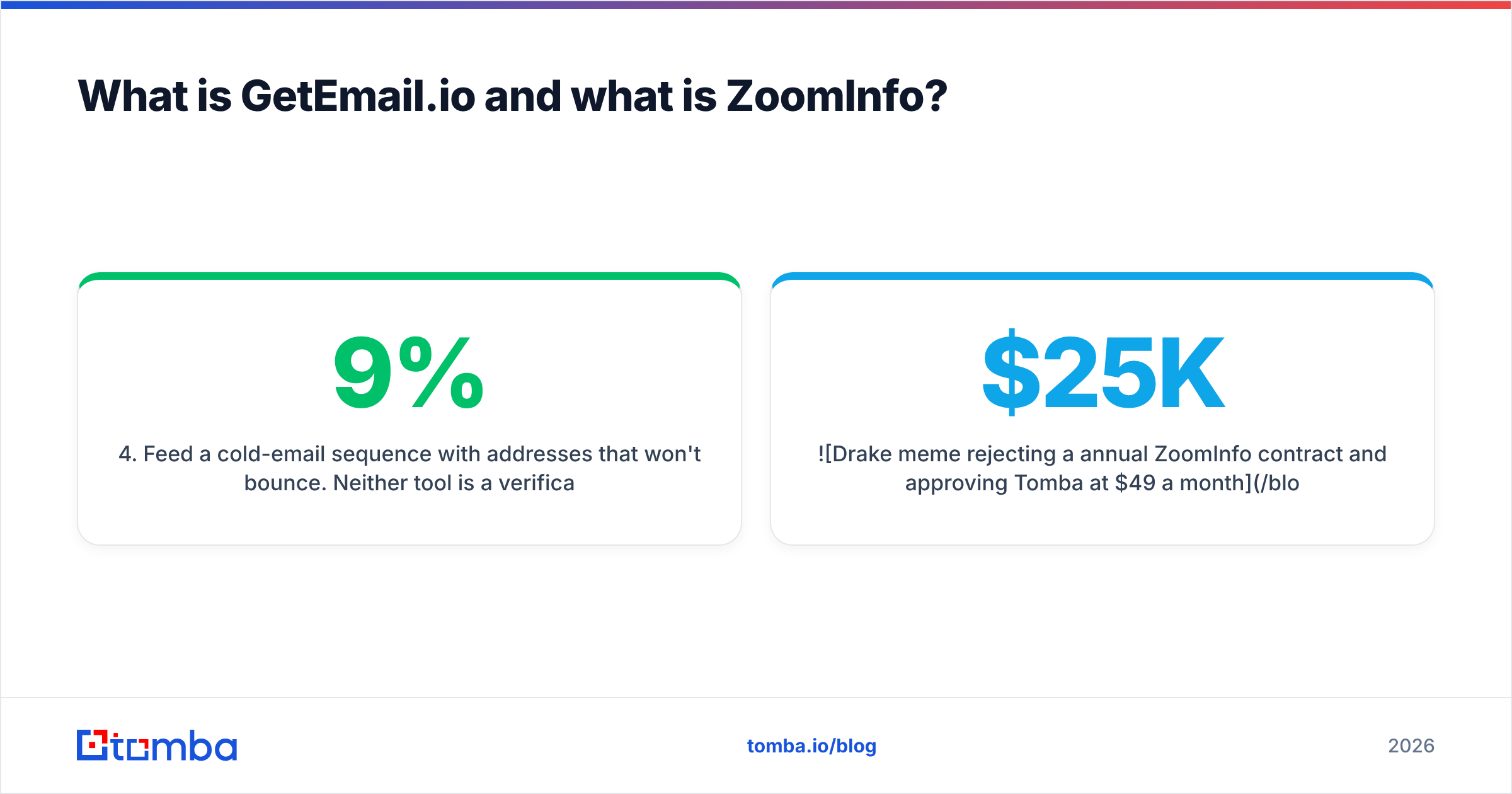
- Feed a cold-email sequence with addresses that will not bounce. Neither tool is a verification specialist. Both need a downstream email verifier before you send, unless you enjoy explaining a 9% bounce rate to your deliverability lead.
- Run programmatic lookups inside your own product or workflow. GetEmail.io's API is simple, but it is rate-limited and thin on metadata. ZoomInfo's API exists, yet it sits behind enterprise licensing and extra fees.

GetEmail.io vs ZoomInfo: how do they compare head-to-head?#
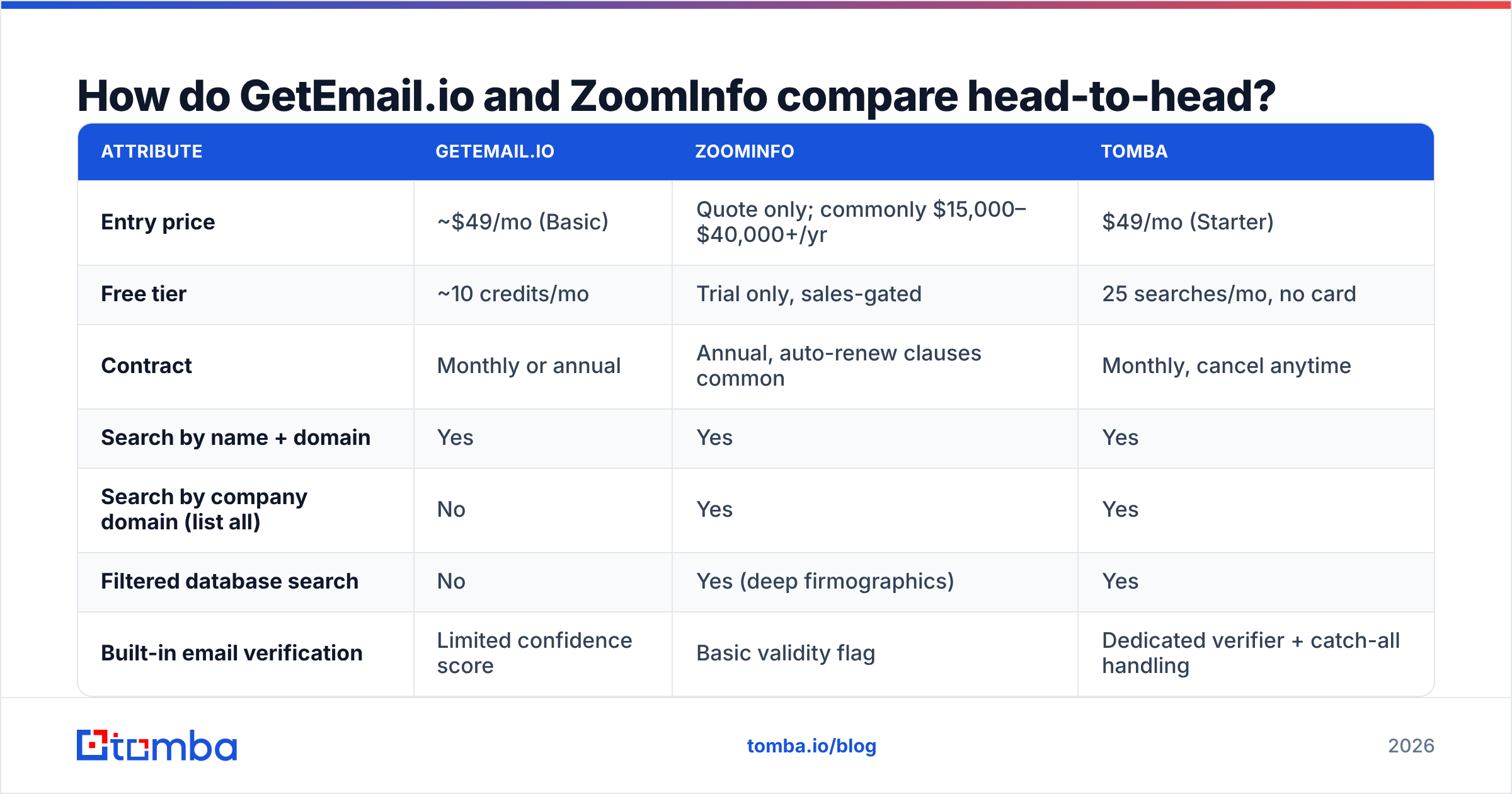
Pricing below reflects publicly listed rates at the time of writing. GetEmail.io publishes its tiers openly. ZoomInfo publishes no pricing at all, so the figures are the ranges buyers consistently report on G2 and in procurement discussions. Always confirm with the vendor.
| Attribute | GetEmail.io | ZoomInfo | Tomba |
|---|---|---|---|
| Entry price | ~$49/mo (Basic) | Quote only; commonly $15,000–$40,000+/yr | $49/mo (Starter) |
| Free tier | ~10 credits/mo | Trial only, sales-gated | 25 searches/mo, no card |
| Contract | Monthly or annual | Annual, auto-renew clauses common | Monthly, cancel anytime |
| Search by name + domain | Yes | Yes | Yes |
| Search by company domain (list all) | No | Yes | Yes |
| Filtered database search | No | Yes (deep firmographics) | Yes |
| Built-in email verification | Limited confidence score | Basic validity flag | Dedicated verifier + catch-all handling |
| Phone numbers | No | Yes, incl. direct dials | Yes |
| Intent data | No | Yes (add-on) | No |
| API | Yes, basic | Enterprise-gated, extra cost | Yes, included on all paid plans |
| Chrome extension | Yes | Yes | Yes |
| Time to first result | Minutes | Weeks (demo → contract → onboarding) | Minutes |
| Best for | Solo reps, one-off lookups | Enterprise GTM teams with budget | SMB and mid-market outbound, developers |

The table exposes the real dividing line. These two tools overlap on exactly one row: name plus domain lookup. They diverge on everything else. If that one row is your entire use case, paying ZoomInfo prices is indefensible. If you need rows 6 through 10, GetEmail.io cannot help you at any price.
GetEmail.io vs ZoomInfo: which one has better data accuracy?#
Neither has a decisive edge, and both marketing pages oversell their case.
GetEmail.io is a pattern predictor. It works out the company's mailbox convention (first.last@, flast@, first@) and scores the candidates. That works well at companies with one consistent pattern and a large public footprint. It breaks down at companies with mixed conventions, acquired subsidiaries on legacy domains, or heavy aliasing. Its confidence score tells you how sure the model is. It does not tell you whether the mailbox accepts mail.
ZoomInfo relies on a stored database. Accuracy therefore depends on how fresh each record is, not on how good the prediction is. Records are strong for enterprise contacts that ZoomInfo's research team actively maintains. For long-tail SMB, non-US regions, and high-churn roles, staleness is the recurring complaint in user reviews. B2B contact data decays by roughly 25–30% a year in most published estimates. A database refreshed once a quarter will always trail reality.

Most comparison posts miss one point: prediction accuracy and deliverability are different metrics. A tool can return the correct address format and still hand you a mailbox that was shut down eight months ago. A stale database record can look perfect and be completely dead.
So the only number worth optimizing is your hard bounce rate after send, not the vendor's claimed accuracy percentage. You need three things to control it:
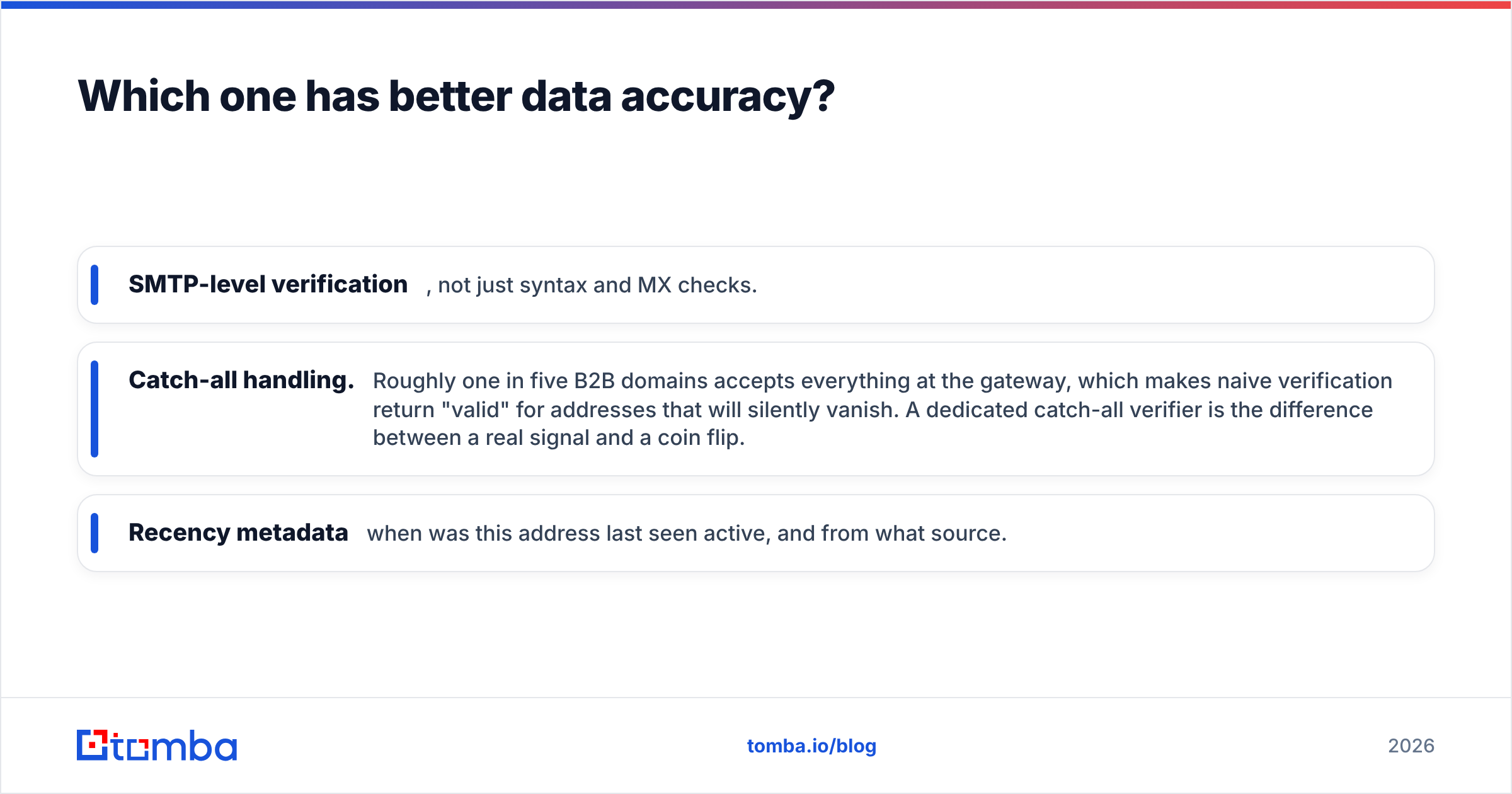
- SMTP-level verification, not just syntax and MX checks.
- Catch-all handling. About one in five B2B domains accepts every address at the gateway. Naive verification then returns "valid" for addresses that quietly vanish. A dedicated catch-all verifier turns that coin flip into a real signal.
- Recency metadata. When was this address last seen active, and from what source?
GetEmail.io covers the first in part. ZoomInfo covers the third in part. Neither covers all three cleanly. That is why most serious outbound stacks put a verification layer between the finder and the sender.
What does ZoomInfo actually cost once you add everything up?#
This is where head-to-head comparisons usually go soft, so let's be concrete about the cost drivers.
ZoomInfo's list price is only the entry fee. Total cost of ownership usually includes:
- Seat licenses. Priced per user. Most teams under-buy at signature, then true up mid-contract at a worse rate.
- Credit packs. Exports are metered. Credits reset once a year on most contracts. Run out in month seven and you buy more with zero leverage.
- Module add-ons. Intent, WebSights, Engage, and Chorus are separate SKUs. The "ZoomInfo does everything" pitch holds only if you buy everything.
- Annual commitment with auto-renewal. Buyers regularly report renewal notice windows measured in months. Read that clause before you sign, not in month eleven.
- Implementation and admin time. CRM field mapping, dedupe rules, and governance are real work. None of it shows up on the invoice.
GetEmail.io's cost model is refreshingly boring by comparison. Pick a credit tier, pay monthly, cancel when you want. The trade-off is that credits are spent on guesses. In many credit models, a failed guess on an obscure domain still burns budget. Check the vendor's current terms on what counts as a billable request. This varies, and it changes.

Is there a better middle option between the two?#
Yes, and here is the honest part of the analysis. Most teams weighing GetEmail.io vs ZoomInfo actually want something in between. Many of them do not know the category exists.
The middle tier includes Tomba, Hunter, Findymail, and Dropcontact. These tools pair domain-level discovery with verification and a developer-ready API at SMB pricing. You get much more than a name-plus-domain guesser, and far less contractual weight than an enterprise platform.
Here is what that middle tier buys you that neither of the other two delivers well:
- Domain search — give it
stripe.comand get back the mailboxes, roles, and detected pattern for that company. You do not need a name first. GetEmail.io cannot do this. ZoomInfo can, but only inside a contract. - Verification in the same pipeline — find and verify in one request, instead of stitching two vendors together and reconciling formats.
- Transparent per-request pricing — Tomba pricing runs Free (25 searches/mo), Starter $49/mo, Growth $99/mo, Pro $249/mo, and Enterprise custom. The API is included on every paid plan rather than sold as an upsell.
- Bulk and API parity — the same accuracy logic whether you upload a CSV or call the email finder API from your own service.
BookYourData is also worth a look if you want pre-built, pay-as-you-go lists instead of on-demand lookups. It solves a different shape of the same problem, and it is genuinely strong at bulk list delivery without a subscription.
Which should you choose in 2026?#
Match the tool to the constraint, not to the feature list.
Choose GetEmail.io if: you are a solo founder, recruiter, or single AE doing a few hundred lookups a month. You already know exactly who you are targeting. You work mostly with well-known companies that have predictable email patterns. And you have no budget for a platform.
Choose ZoomInfo if: you run a multi-team GTM org with a data-ops function to own the instance. You need intent and technographic filtering. Your budget process can absorb a five-figure annual line item. ZoomInfo is a genuinely powerful platform. It is simply priced for companies where a 2% lift in pipeline efficiency beats the cost of the contract.
Choose a mid-market finder if: you send outbound at volume and treat bounce rate as a first-class metric. You want an API without a procurement cycle. You need domain-level discovery but cannot justify enterprise spend. That describes most Series A to Series C sales teams and almost every agency.
Choose more than one if: your ICP spans enterprise and long tail. Many teams run a platform for named accounts and a per-request finder for everything else. Both feeds then land in the same data enrichment pipeline before they hit the CRM.
What should you test before committing?#
Run the same 100-contact sample through every candidate. Do not use the vendor's demo list.
- Pull 100 real contacts from your own ICP. Include at least 30 from companies under 200 employees and 20 from outside your home region.
- Run each tool on the identical list. Record found rate, verified-deliverable rate, and cost per verified contact.
- Send a small warmed test batch and measure the real hard bounce rate. This is the only number that matters.
- Check API response times and rate limits at your real concurrency, not the maximum stated in the docs.
- Read the cancellation and auto-renewal clause before the discount conversation, not after.
Cost per verified contact reorders most vendor rankings. A tool with a 20% lower list price and a 15% higher bounce rate is not cheaper. It is more expensive, plus a deliverability problem.
Ready to test the middle path?#
Is your answer to "do I need intent data and a dialer?" no, but "do I need more than a name-and-domain guesser?" yes? Then start with a free tier and run the 100-contact test above. The Tomba Email Finder gives you 25 searches a month with no card. Domain search and verification sit in the same workflow, and the API is on every paid plan from $49/mo. Run it against your real ICP list, compare cost per verified contact, and let the bounce rate pick the winner.
Related guides#
Ready to find emails that actually work?
Join 150,000+ professionals who stopped guessing and started sending. Free credits on signup — no credit card required.
Get the Tomba newsletter
Practical outbound tactics and product updates — once every two weeks.
About the author