GetProspect Pricing in 2026: Plans, Credits, and Real Costs
GetProspect's plans look cheap per month until you divide by usable emails. Here's the credit math, the hidden limits, and how the per-verified-email cost compares to Tomba, Hunter, and Apollo in 2026.
TL;DR
- GetProspect's published list price starts free (about 50 valid emails/month) and climbs through roughly $49, $99, $199, and $399/month tiers — but the number that matters is cost per verified, deliverable email, not cost per credit.
- The free plan is genuinely usable for testing; the Starter tier is where most solo sellers land, and it caps out fast if you prospect daily.
- Seats, verification credits, and export limits are the three places where the sticker price and the invoice stop matching.
- At mid-volume (5,000–20,000 lookups/month), GetProspect sits mid-pack: cheaper than Apollo's paid data tiers, roughly level with Hunter, and more expensive per usable email than Tomba's $49 Starter once you factor in bounce rates.
- Buy GetProspect for its LinkedIn extension workflow. Buy something else if you need API-first enrichment, catch-all resolution, or phone data in the same bill.
Prices below are the vendor's published list rates at the time of writing. Vendors reprice quietly — always confirm on the live GetProspect pricing page before you commit to an annual contract.
What is GetProspect and who actually pays for it?#
GetProspect is a B2B email-finder and lead database with a LinkedIn Chrome extension bolted to the front. You browse LinkedIn (or Sales Navigator), click the extension, and it pushes matched contacts — name, title, company, email — into a list you can filter, enrich, and export.
Think of it like a parking meter for contact data. You feed it credits, it gives you time on the lot. The confusion starts when you realize some spots cost double, some are already taken, and the meter still charges you for pulling in and finding nothing.
The typical buyer is a founder, SDR, or two-person agency doing 500–5,000 lookups a month, working primarily out of LinkedIn rather than out of a CRM or a script. That profile matters, because GetProspect's pricing is built around list building in a browser, not around API calls or bulk CSV enrichment.

How much does GetProspect cost in 2026?#
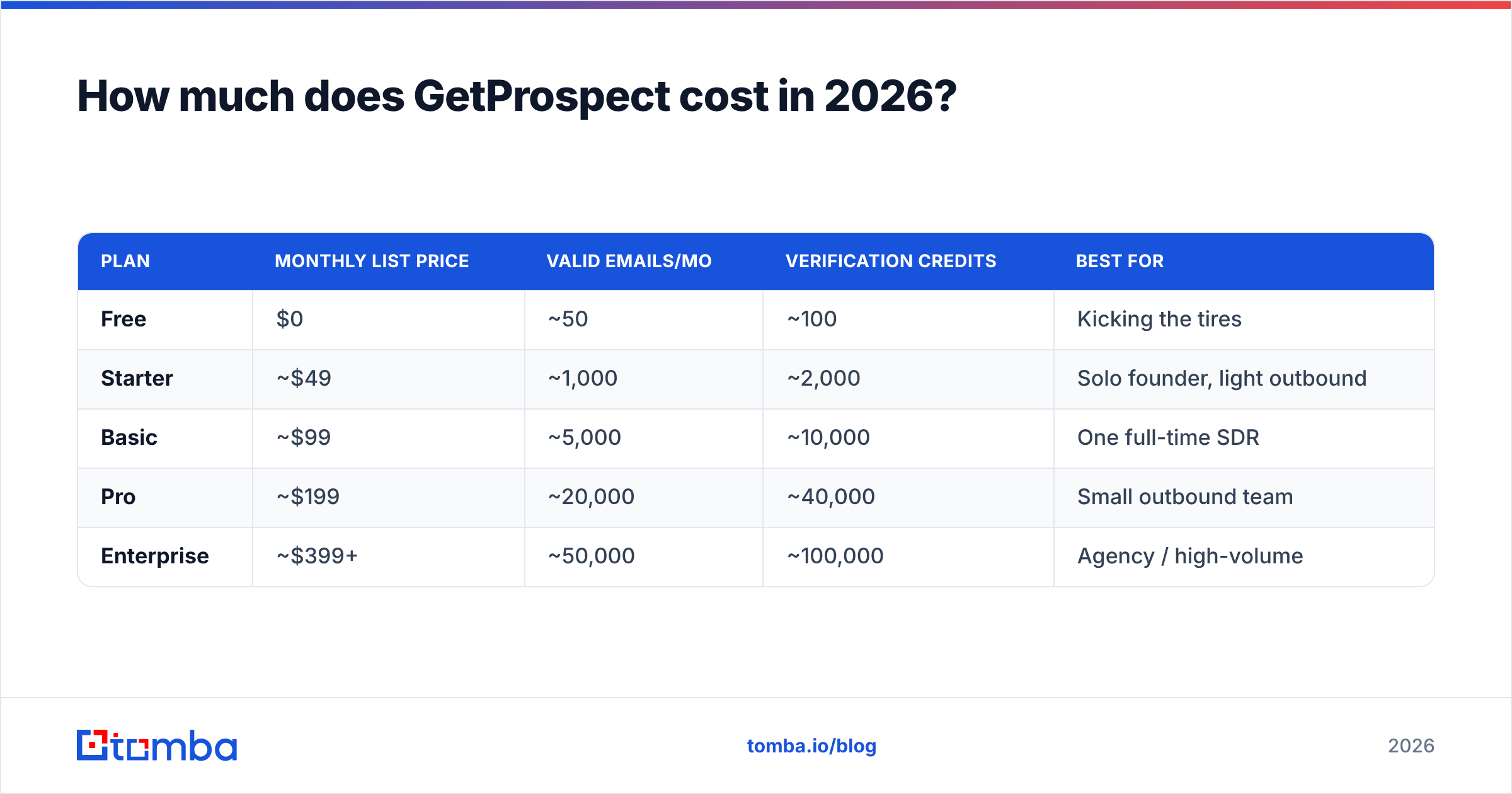
Here's the shape of the tiers. GetProspect meters on valid emails found, not on searches attempted — which is more generous than it first sounds, since failed lookups aren't supposed to bill you.
| Plan | Monthly list price | Valid emails/mo | Verification credits | Best for |
|---|---|---|---|---|
| Free | $0 | ~50 | ~100 | Kicking the tires |
| Starter | ~$49 | ~1,000 | ~2,000 | Solo founder, light outbound |
| Basic | ~$99 | ~5,000 | ~10,000 | One full-time SDR |
| Pro | ~$199 | ~20,000 | ~40,000 | Small outbound team |
| Enterprise | ~$399+ | ~50,000 | ~100,000 | Agency / high-volume |
Annual billing typically knocks 20–30% off, which is the single biggest lever on the invoice — and the single biggest commitment risk if your motion changes in month three.
Three structural notes that the pricing page does not put in bold:
- Credits do not roll over. Unused monthly allowance evaporates. If your outbound is spiky — heavy in Q1, quiet in August — you are pre-paying for a peak you only hit twice a year.
- Verification is a separate meter. Finding an email and confirming it's deliverable draw from different pools. A workflow that verifies everything twice (once on find, once before send) burns the second pool faster than the first.
- Seats are priced per user on higher tiers. A three-person team on Basic is not $99. Model the seat count before you compare against a flat-rate competitor.
What does "valid email" actually mean on your invoice?#
This is the whole ballgame. Every email-finder vendor publishes an accuracy number, and every one of those numbers is measured on a dataset the vendor chose. What you care about is: of 1,000 emails this tool hands me, how many land in an inbox?

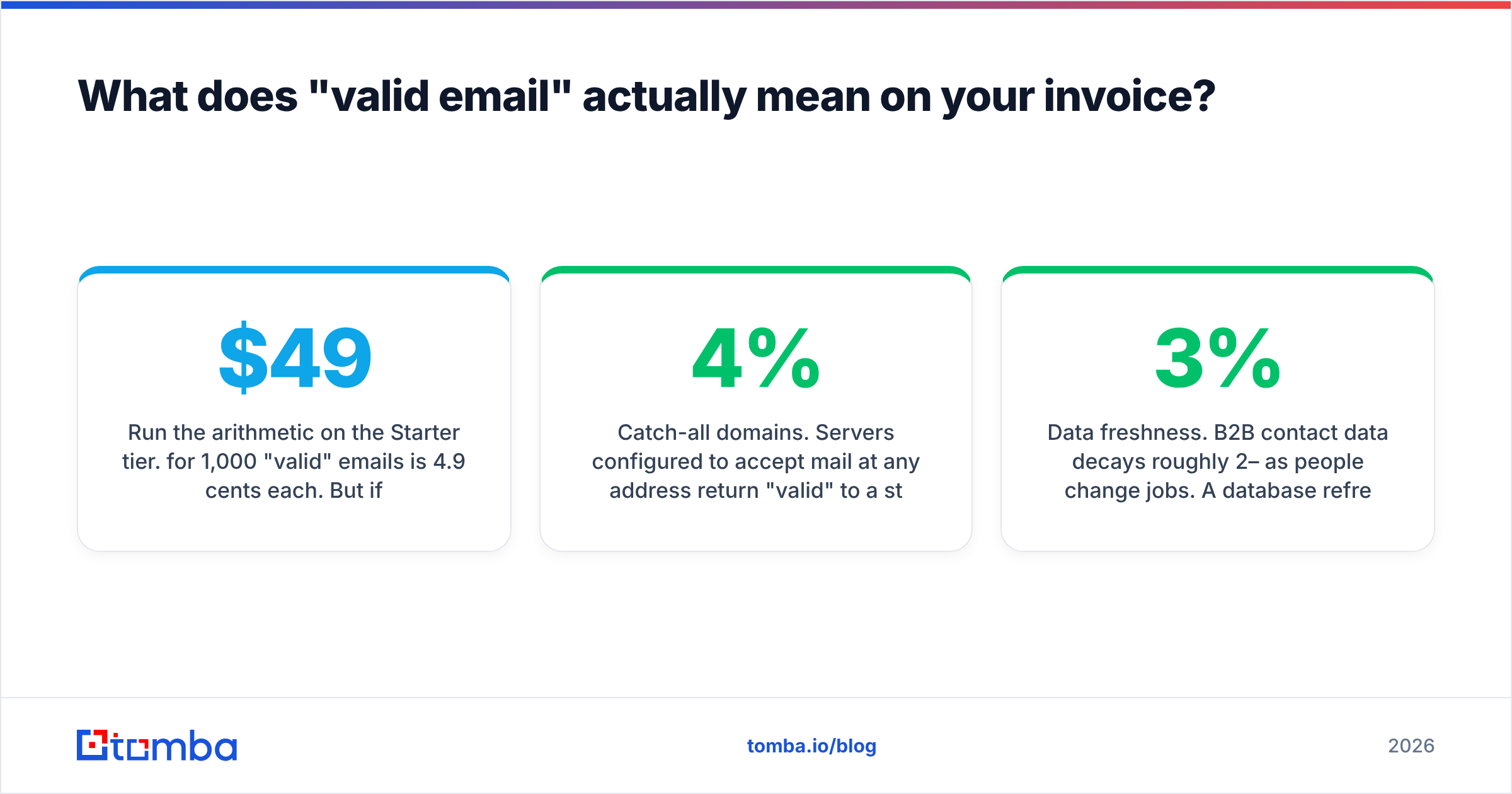
Run the arithmetic on the Starter tier. $49 for 1,000 "valid" emails is 4.9 cents each. But if 12% of them bounce or hit a catch-all you can't resolve, you actually bought 880 usable addresses — 5.6 cents each. At 20% waste it's 6.1 cents. That spread is bigger than the price gap between most vendors' tiers.
Two things move that waste number more than anything else:
- Catch-all domains. Servers configured to accept mail at any address return "valid" to a standard SMTP probe whether or not the mailbox exists. Tools that don't do deeper catch-all resolution quietly inflate their hit rate. If a meaningful share of your ICP is enterprise (where catch-all configs are common), a dedicated catch-all verifier is not optional — it's the difference between a 4% and a 14% bounce rate.
- Data freshness. B2B contact data decays roughly 2–3% per month as people change jobs. A database refreshed quarterly is, on average, six weeks stale. Ask any vendor when their records were last re-verified, not how many records they hold.
Before you sign anything, run the same 100-contact test list through every tool on your shortlist, send to all of them from a throwaway domain, and count hard bounces. It takes an afternoon and it will contradict at least one vendor's marketing page.
Is GetProspect worth it compared to the alternatives?#
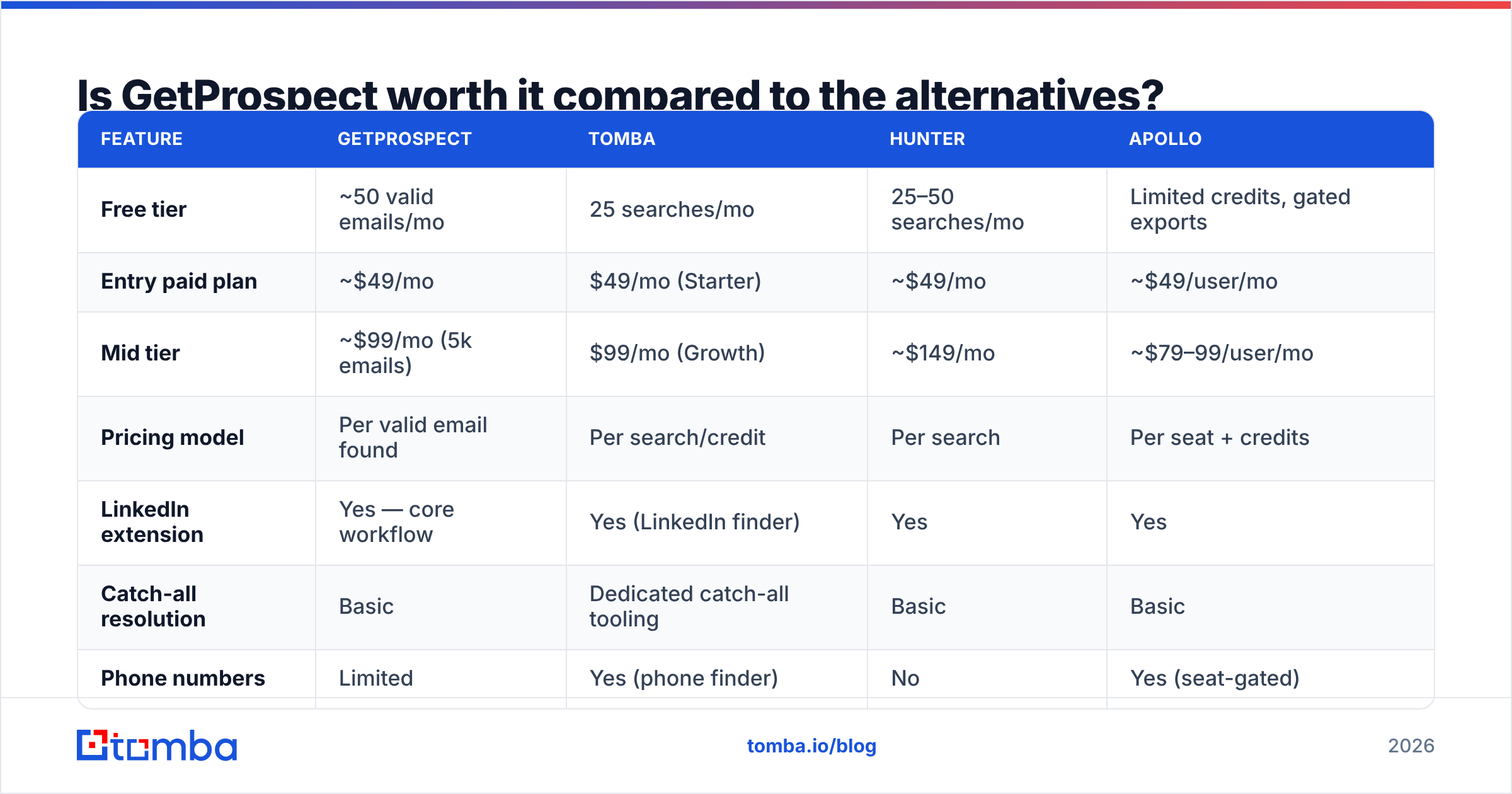
Here's the head-to-head at the tier most buyers actually land on — roughly 5,000 lookups a month.

| Feature | GetProspect | Tomba | Hunter | Apollo |
|---|---|---|---|---|
| Free tier | ~50 valid emails/mo | 25 searches/mo | 25–50 searches/mo | Limited credits, gated exports |
| Entry paid plan | ~$49/mo | $49/mo (Starter) | ~$49/mo | ~$49/user/mo |
| Mid tier | ~$99/mo (5k emails) | $99/mo (Growth) | ~$149/mo | ~$79–99/user/mo |
| Pricing model | Per valid email found | Per search/credit | Per search | Per seat + credits |
| LinkedIn extension | Yes — core workflow | Yes (LinkedIn finder) | Yes | Yes |
| Catch-all resolution | Basic | Dedicated catch-all tooling | Basic | Basic |
| Phone numbers | Limited | Yes (phone finder) | No | Yes (seat-gated) |
| API access | Yes, higher tiers | Yes, all paid tiers | Yes | Yes |
| Bulk CSV enrichment | Yes | Yes | Yes | Yes |
| Credit rollover | No | No | No | Varies |
Read that table as three separate buying decisions, not one:
- If your workflow lives in LinkedIn, GetProspect and Tomba's LinkedIn extension are the two to trial. GetProspect's list-building UI is genuinely well-built for click-and-collect prospecting.
- If your workflow lives in a script, a CRM, or a spreadsheet, per-seat models punish you. Look at API-first pricing where you pay for volume rather than for people who have login rights. Tomba's email finder API and Hunter's both fit here; Apollo's seat model does not.
- If you need phones and emails in one bill, Apollo and Tomba cover both. GetProspect and Hunter will send you shopping for a second vendor, and two $49 subscriptions is not cheaper than one $99 one.

Where does GetProspect pricing get expensive?#
The list price is honest. The invoice surprises come from four places, and they're the same four places on almost every tool in this category:
- Seat creep. You buy for one SDR. Six months later, marketing wants access for a webinar list and the founder wants it for fundraising research. On per-seat tiers, headcount is a pricing multiplier disguised as an admin setting.
- Double-dipping on verification. If you find with GetProspect and verify with a separate service, you're paying twice for confidence in the same address. Either trust the finder's verification or don't — running both permanently is a tax on indecision.
- Overage vs. upgrade. Blowing through Starter three weeks into the month usually means upgrading mid-cycle at full freight. Model your realistic monthly volume with 30% headroom rather than buying for your median month.
- Annual lock-in on an unproven motion. The 20–30% annual discount is real money, but only if outbound is a permanent function at your company. If you're still testing whether cold email works for your ICP, pay monthly for the first quarter. The discount you "lose" is cheaper than twelve months of a tool you abandon in March.
One more, less obvious: export friction has a price. If a plan restricts CSV exports or throttles bulk operations, your team pays in labor — copy-pasting, re-running lists, reconciling duplicates. Ten hours a month of that is worth more than the plan difference you were arguing about.
How should you actually pick a tier?#
Work backwards from send volume, not from the pricing page. Here's the sequence:
- Count your real monthly sends. Not your ambition — your last 90 days. If you sent 1,400 cold emails last quarter, your monthly need is ~470, not 5,000.
- Add a discovery multiplier. You'll look up more contacts than you email — bad fits, duplicates, people who left. Assume 1.4× your send target.
- Add a verification pass. Budget one verification per found email, minimum. If you're sending from a young domain, budget two — a bounce on a cold domain does disproportionate damage to sender reputation.
- Divide price by usable emails. Not credits. Not "valid" per the vendor. Usable, post-bounce-test.
- Check the seat math last. Multiply by everyone who will realistically need a login within twelve months.
- Trial two tools on the same 100 contacts. Same list, same week, same send infrastructure. Anything else is a vibes-based purchase.
Do that and the decision usually makes itself. A solo founder sending 400 emails a month does not need a $199 plan and should not sign an annual contract. A three-SDR team sending 6,000 a month should not be on a per-seat plan with a credit cap.
What are the strongest GetProspect alternatives?#
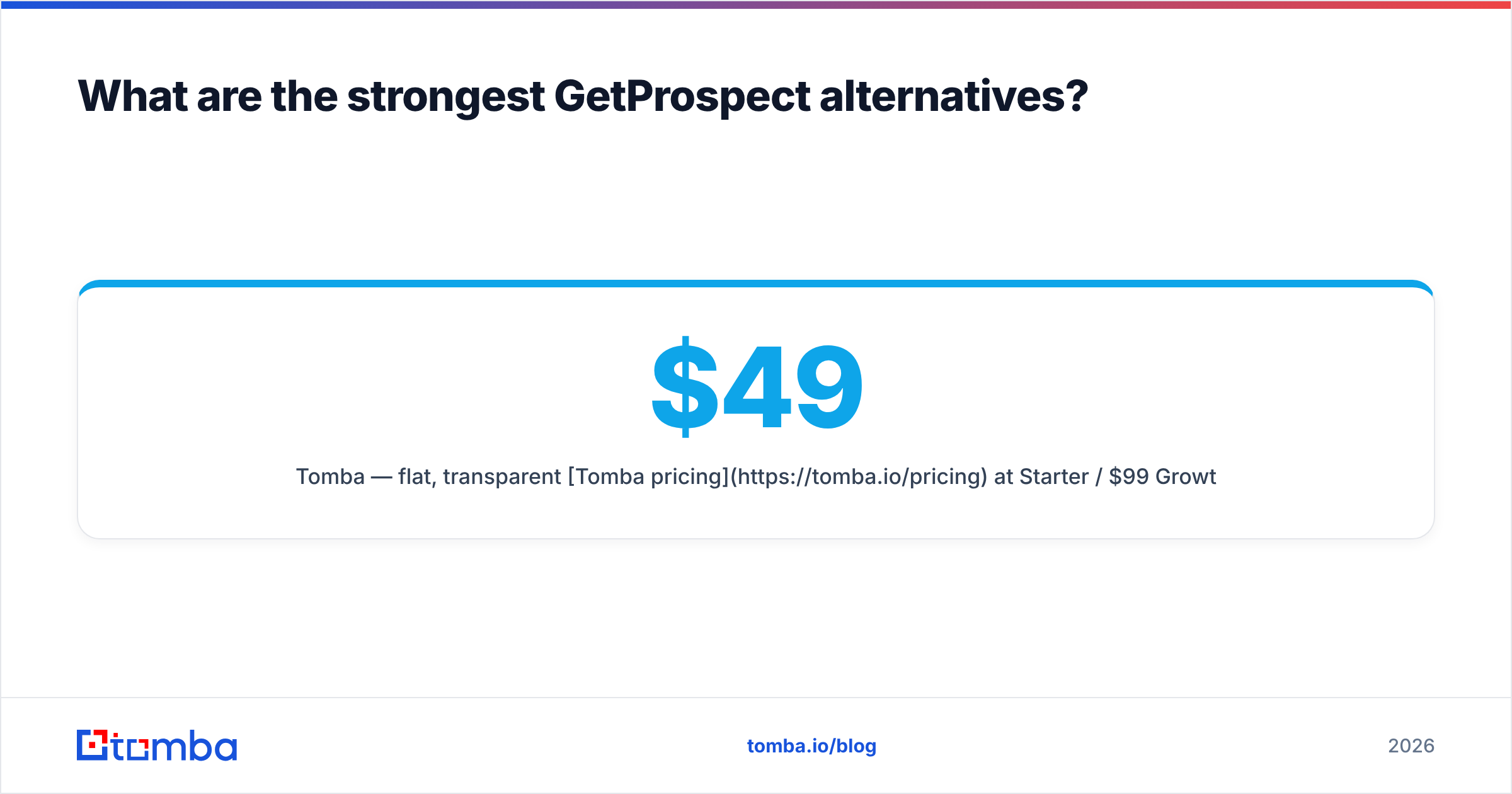
- Tomba — flat, transparent Tomba pricing at $49 Starter / $99 Growth / $249 Pro with a 25-search free tier, plus domain search, catch-all verification, phone lookup, and enrichment on the same bill. Strongest fit if you want one vendor and API access without a seat tax.
- Hunter — the most established brand in domain-based email finding. Clean UI, reliable domain search, no phone data. Good if email is genuinely all you need.
- Apollo — a full sales engagement platform, not just a finder. Powerful if you'll use the sequencer and dialer; expensive and heavy if you only wanted addresses. See the Apollo alternative breakdown if that's your comparison set.
- BookYourData — pay-as-you-go list purchasing with a strong accuracy guarantee. A genuinely different model: buy a list outright rather than rent a search quota. Worth a look if your prospecting is campaign-based rather than continuous.
- Free tools first — before paying anyone, run a few targets through a free email checker and a company email pattern lookup. If your ICP has predictable formats, your paid volume needs may be lower than you assumed.
For third-party sentiment rather than vendor claims, G2's email-finder category and Capterra both carry enough recent reviews to spot patterns in support quality and billing complaints — which is exactly the stuff no pricing page discloses.
The verdict on GetProspect pricing#
GetProspect is fairly priced for what it is: a LinkedIn-first list builder with a clean UI and a metering model (pay for valid emails, not attempts) that's more buyer-friendly than most. The free tier is real, the Starter tier is a reasonable place for a solo seller to begin, and the accuracy is competitive.
Where it loses is breadth. If you need catch-all resolution, phone numbers, and API-driven enrichment, you're either buying a second tool or upgrading past the point where the price advantage exists. And like every vendor in the category, the sticker price flatters the real per-usable-email cost by whatever your bounce rate turns out to be.
Run the 100-contact bounce test. It's the only benchmark that's about your ICP.
Ready to compare against a flat, no-seat-tax option? Start with the Tomba Email Finder — 25 free searches a month, no card, and the same email finder, verifier, domain search, and catch-all tooling on every paid plan from $49. Run your test list through both and let the bounce report pick the winner.
Related guides#
Ready to find emails that actually work?
Join 150,000+ professionals who stopped guessing and started sending. Free credits on signup — no credit card required.
Get the Tomba newsletter
Practical outbound tactics and product updates — once every two weeks.
About the author