GetProspect vs Mystrika 2026: Which Tool Actually Wins?
GetProspect finds the contacts. Mystrika sends the emails. Comparing them head-to-head only works if you know which half of the outbound stack you are actually missing — here is the honest breakdown.
TL;DR
- GetProspect and Mystrika are not really competitors. GetProspect is a B2B contact database and email finder; Mystrika is a cold email sending, warmup, and inbox-rotation platform. Most teams that compare them end up buying both.
- If your problem is "I don't have enough good contacts," GetProspect (or a dedicated finder like Tomba) is the answer. If your problem is "my emails land in spam or I can't manage replies at volume," Mystrika is the answer.
- Mystrika's pricing has historically been aggressive for what it includes — unlimited-style sending seats, warmup pool, and a unified inbox — which makes it popular with agencies running many domains.
- GetProspect's differentiator is the LinkedIn-driven workflow: browse a profile or a search page, pull contacts, push them to your CRM. Its data volume is solid; verification depth is where teams usually bolt on a second tool.
- The stack that actually works in 2026: a high-accuracy finder + a real-time verifier + a sender with warmup and rotation. Buying one tool and expecting it to do all three is how you burn a domain.
What are GetProspect and Mystrika, actually?#
Start here, because the naming of this comparison is misleading.
GetProspect is a lead-generation platform built around a B2B contact database and a Chrome extension that works on LinkedIn. You search by job title, company size, industry, or technology, and it returns contact records — name, company, role, and a work email address. It also does bulk enrichment from a CSV of names and domains, and pushes results into HubSpot, Pipedrive, and similar systems. Its job ends the moment a contact lands in your list.
Mystrika is a cold email execution platform. You connect mailboxes (Google Workspace, Outlook, SMTP), warm them up inside a shared warmup network, rotate sends across multiple domains, write sequences, and manage every reply in one unified inbox. It also does A/Z testing across many variants and has AI-assisted copy generation. Its job starts the moment you already have a list.
So the honest framing of getprospect vs mystrika is not "which is better." It is "which half of the outbound problem are you solving this quarter?"
Wait — that renders wrong. Here it is properly:

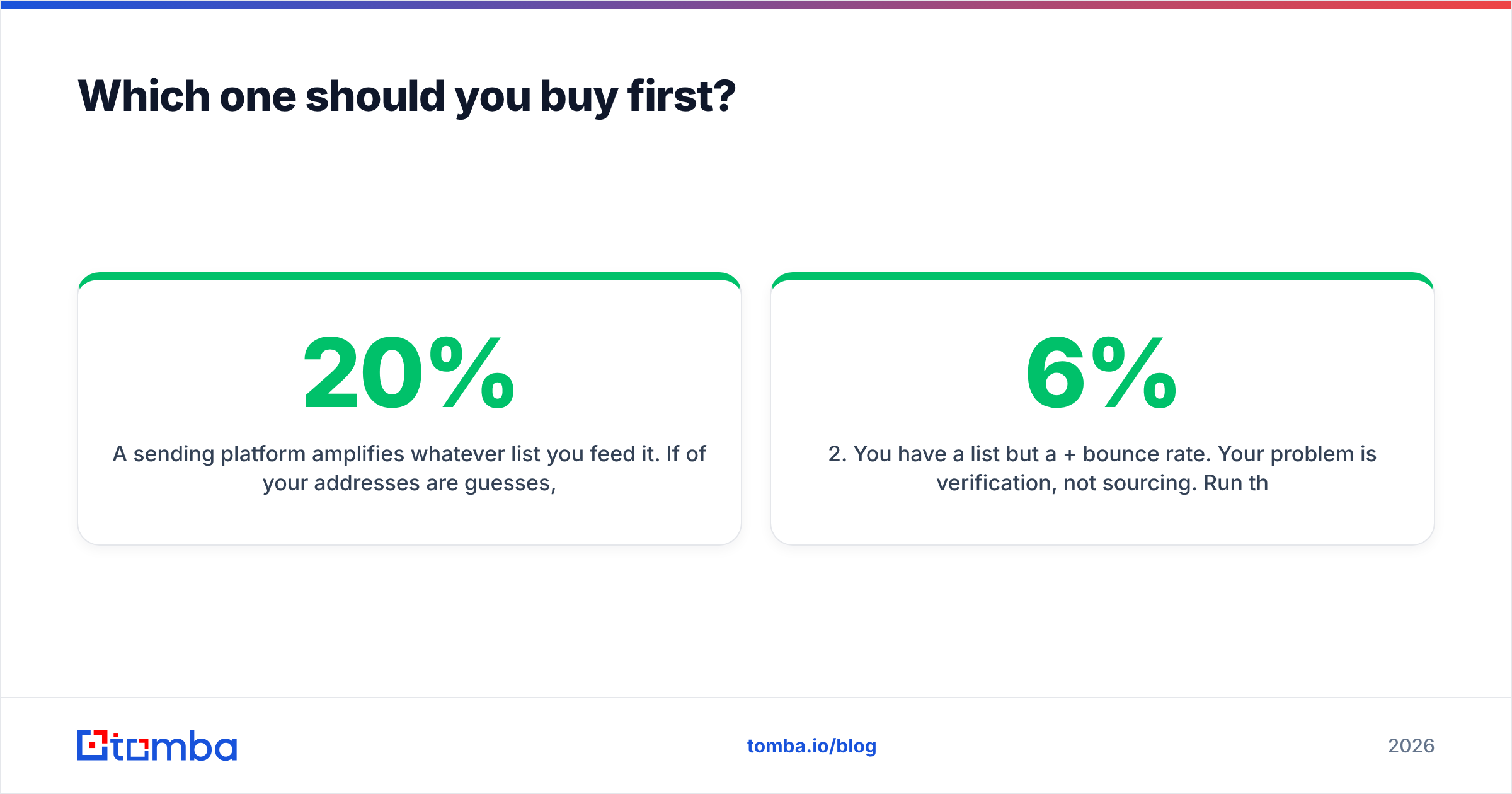
How do GetProspect and Mystrika compare feature by feature?#
| Capability | GetProspect | Mystrika | Tomba |
|---|---|---|---|
| Primary job | Find and enrich B2B contacts | Send, warm up, and manage cold email | Find and verify B2B emails |
| Contact database | Yes — searchable, filter by role/industry/size | No | Yes, plus domain-level discovery |
| LinkedIn extension | Yes, core workflow | No | Yes (LinkedIn finder) |
| Email verification | Basic, bundled | Basic list cleaning | Dedicated email verifier + catch-all handling |
| Mailbox warmup | No | Yes — shared warmup pool | No |
| Sequences / sending | No | Yes — multi-step, multi-inbox rotation | No |
| Unified inbox | No | Yes | No |
| Public API | Yes | Limited | Yes — full email finder API |
| Entry paid price | ~$49/mo (published tiers vary) | ~$29/mo (frequently discounted) | $49/mo Starter |
| Free tier | Limited monthly credits | Trial / limited plan | 25 searches/mo |
| Best for | Building lists from LinkedIn | Agencies running many domains | Accuracy-first list building and API workflows |
Pricing on both platforms changes often — Mystrika in particular has run lifetime and promotional pricing at various points. Check the vendor pages before you budget. The structural differences in the table are what actually stay stable.
Which one should you buy first?#
Conclusion first: buy the finder before the sender.
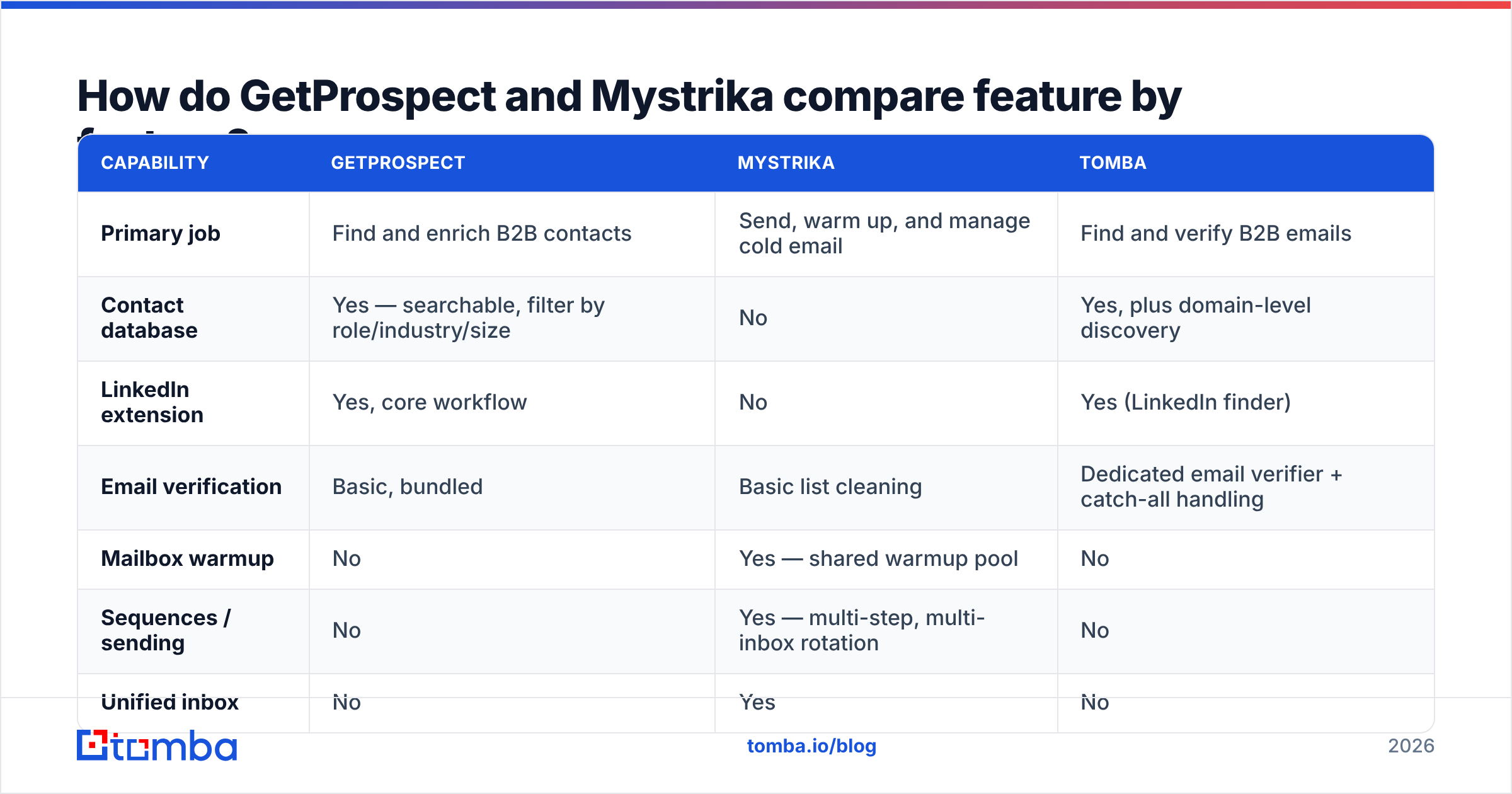
A sending platform amplifies whatever list you feed it. If 20% of your addresses are guesses, Mystrika will faithfully deliver 20% of your volume into hard bounces, and your domain reputation absorbs the damage. Warmup does not rescue a bad list. It just makes the crash slower and more expensive.
Here is the decision path most teams should follow:
- You have zero contacts and no repeatable sourcing motion. Start with a finder. GetProspect if your ICP lives on LinkedIn and you want to prospect visually. A dedicated email finder if you work from domain lists, want an API, or need catch-all resolution.
- You have a list but a 6%+ bounce rate. Your problem is verification, not sourcing. Run the list through a real verifier before you touch a sending tool.
- You have a clean list and one sending domain that is throttling. Now Mystrika earns its keep — inbox rotation and warmup are exactly what you are missing.
- You run an agency with 10+ clients and 40+ mailboxes. Mystrika's per-workspace economics get very attractive at that scale, and the unified inbox stops your SDRs from tab-juggling.
- You need contacts inside a product or workflow, not a UI. Neither of these is API-first in the way a developer wants. That is a different tool category.
Is GetProspect's data accurate enough for cold outbound?#
GetProspect's data is respectable for a mid-market database, and the LinkedIn extension gives you fresh signal — you are looking at a live profile, so the role and company are current even if the email is inferred.
The gap is verification depth. Most database-style finders return a confidence score and stop there. That is fine for warm outreach at low volume. At 3,000 sends a month across a handful of domains, "probably valid" is not a standard you can operate on, and Google and Microsoft both now weigh bounce and complaint rates heavily in filtering decisions. Their guidance on bulk sender requirements is worth reading directly rather than through a vendor blog.
Three things separate a usable list from a dangerous one:
- Catch-all handling. Roughly a fifth of B2B domains accept everything at the SMTP layer, which means a naive verifier marks every address "valid." A catch-all verifier uses pattern confidence and secondary signals instead of trusting the SMTP handshake.
- Role-account filtering. info@, sales@, and support@ inflate your list size and depress your reply rate. Strip them before import.
- Recency. A contact record built 14 months ago has roughly a one-in-four chance of being stale, given normal B2B job mobility. Re-verify at send time, not at import time.
If you use GetProspect for sourcing, budget for a verification pass before anything enters Mystrika. That single step usually moves bounce rate from high single digits to under 2%.
What does Mystrika do that GetProspect can't touch?#
Four things, and they are the reason people put up with running two subscriptions.
Warmup at scale. Mystrika's warmup pool sends and replies to seed conversations across accounts, building the engagement signal that mailbox providers use to decide whether you look like a human or a blast. If you are spinning up new domains — and in 2026 you should be sending from secondary domains, never your primary — warmup is non-optional. You can estimate ramp time with a warmup calculator before you commit to a launch date.
Inbox rotation. Instead of one mailbox pushing 200 sends a day (a reputation death sentence), you spread 200 across ten mailboxes at 20 each. Mystrika handles the distribution automatically. GetProspect has no concept of this because it does not send.
Unified inbox. Every reply from every domain in one queue, with tagging and lead status. Once you cross ~5 mailboxes, this stops being convenience and becomes the difference between replying in 20 minutes and replying in two days.
A/Z testing. Not A/B — Mystrika lets you run many variants simultaneously and reports per-variant reply rates. For teams still hunting for message-market fit, that is faster learning than sequential testing.
None of these features has an equivalent in GetProspect. That is not a criticism of GetProspect; it is a category boundary.

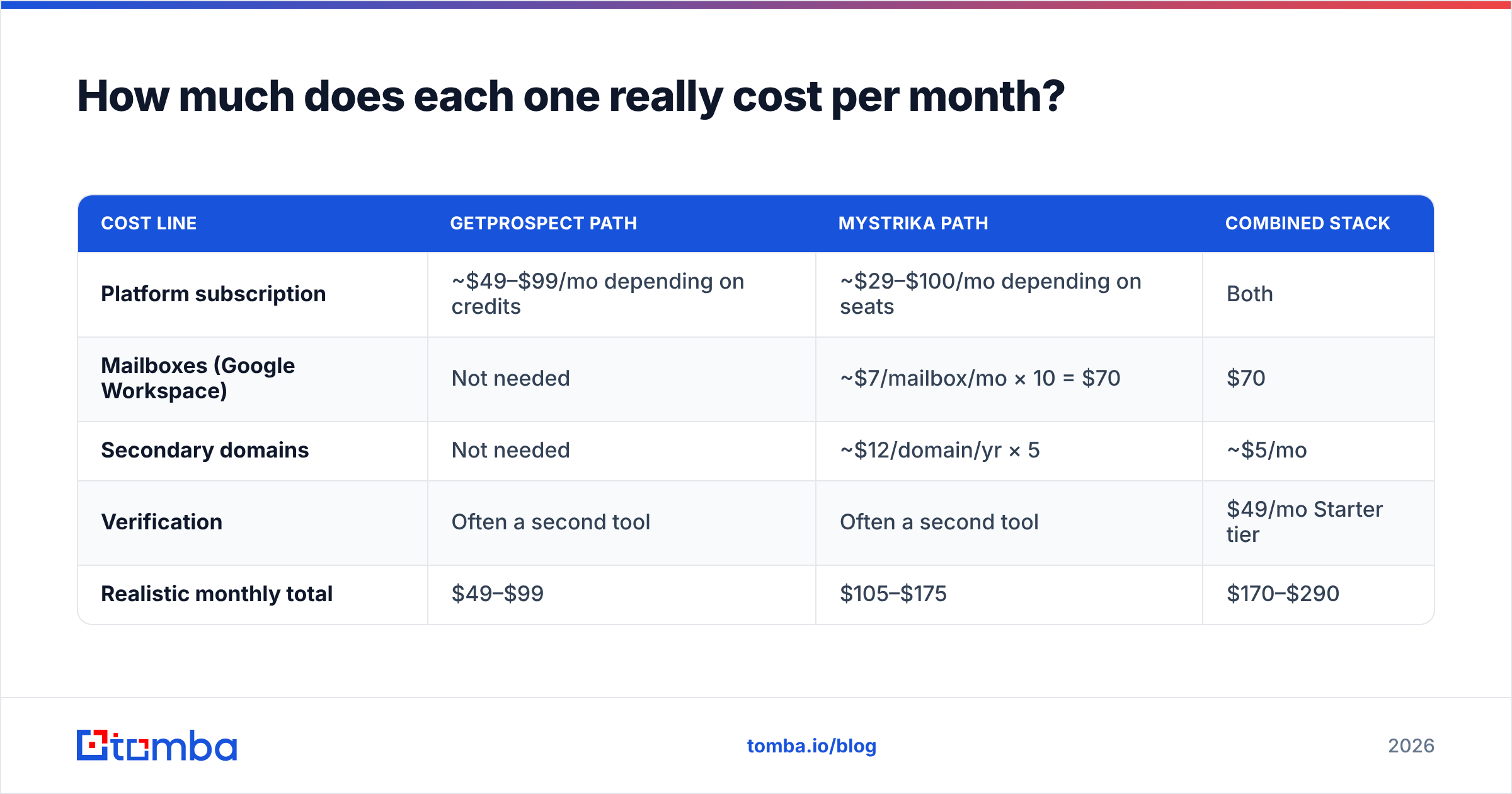
How much does each one really cost per month?#
The sticker price is the smaller half of the story. Model total cost.
| Cost line | GetProspect path | Mystrika path | Combined stack |
|---|---|---|---|
| Platform subscription | ~$49–$99/mo depending on credits | ~$29–$100/mo depending on seats | Both |
| Mailboxes (Google Workspace) | Not needed | ~$7/mailbox/mo × 10 = $70 | $70 |
| Secondary domains | Not needed | ~$12/domain/yr × 5 | ~$5/mo |
| Verification | Often a second tool | Often a second tool | $49/mo Starter tier |
| Realistic monthly total | $49–$99 | $105–$175 | $170–$290 |
Two takeaways. First, the mailbox and domain infrastructure behind a sending tool frequently costs more than the sending tool itself — plan for it. Second, verification is the line item everyone forgets and everyone eventually pays for, either in subscription dollars or in a burned domain.
For reference, Tomba pricing runs Free (25 searches/mo), Starter at $49/mo, Growth at $99/mo, and Pro at $249/mo, with finding and verifying in the same credit pool — which removes the two-vendor split for the sourcing half of the stack. Independent user reviews on G2 are a useful sanity check on any of these vendors before you commit annually.
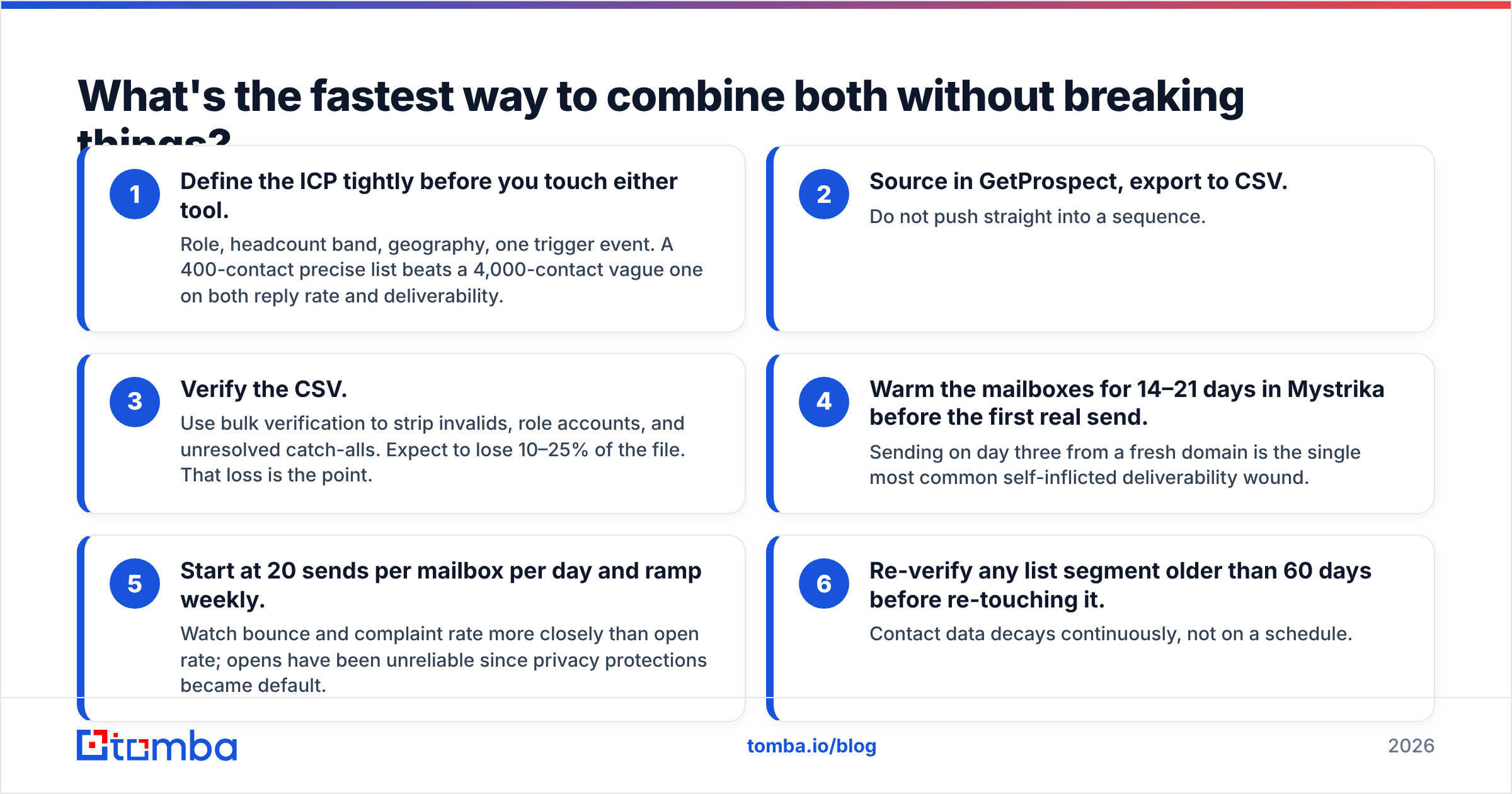
What's the fastest way to combine both without breaking things?#
If you decide to run GetProspect and Mystrika together, sequence it like this:
- Define the ICP tightly before you touch either tool. Role, headcount band, geography, one trigger event. A 400-contact precise list beats a 4,000-contact vague one on both reply rate and deliverability.
- Source in GetProspect, export to CSV. Do not push straight into a sequence.
- Verify the CSV. Use bulk verification to strip invalids, role accounts, and unresolved catch-alls. Expect to lose 10–25% of the file. That loss is the point.
- Warm the mailboxes for 14–21 days in Mystrika before the first real send. Sending on day three from a fresh domain is the single most common self-inflicted deliverability wound.
- Start at 20 sends per mailbox per day and ramp weekly. Watch bounce and complaint rate more closely than open rate; opens have been unreliable since privacy protections became default.
- Re-verify any list segment older than 60 days before re-touching it. Contact data decays continuously, not on a schedule.
That workflow assumes a source, a verifier, and a sender as three distinct responsibilities. Any tool that claims to do all three well is usually excellent at one of them and adequate at the others.
Is there a scenario where you only need one?#
Yes, two of them.
Only GetProspect: you sell high-ACV deals to a small named-account list, you send from your own mailbox at low volume, and every email is hand-written. You do not need warmup infrastructure for 15 emails a week. Source, verify, send from Gmail, move on.
Only Mystrika: you already have a data source you trust — an existing CRM, a partner list, an event export, a scraped-and-verified in-house database. You have the contacts. What you lack is throughput and deliverability. Mystrika alone is a complete answer here.
Everyone else is running two tools whether they planned to or not. The question is just whether you chose the second one deliberately or bought it after a bad month.
Which tool wins the GetProspect vs Mystrika comparison?#
Neither, because they compete on different axes — and that is the useful answer, not a dodge.
Judge GetProspect against other finders and databases: coverage in your niche, verification rigor, API access, cost per valid contact. Judge Mystrika against other senders: warmup network quality, rotation logic, inbox usability, per-seat economics at your mailbox count. Comparing a database's price to a sender's price tells you nothing.
What genuinely decides outbound performance in 2026 is upstream of both: data quality. A sender with perfect warmup delivers garbage efficiently. A database with great coverage and weak verification hands you a list that quietly poisons a domain you spent three weeks warming. Fix accuracy first, throughput second.
If the sourcing half is where you are weakest, start with the Tomba Email Finder — find contacts by domain, name, or company, verify them in the same workflow, and export a list your sending platform can safely run at volume. The free tier gives you 25 searches a month to test coverage against your own ICP before you pay anyone, and Starter is $49/mo when you are ready to scale. Feed a clean list into whichever sender you choose, and both halves of your stack start earning their subscription.
Related guides#
Ready to find emails that actually work?
Join 150,000+ professionals who stopped guessing and started sending. Free credits on signup — no credit card required.
Get the Tomba newsletter
Practical outbound tactics and product updates — once every two weeks.
About the author