GetProspect vs Skyp (2026): Email Data vs AI Outbound Compared
GetProspect sells verified contact data. Skyp sells AI-run outbound campaigns. They get compared constantly, but they solve different halves of the same problem — here is which one you actually need in 2026.
TL;DR
- They are not the same category. GetProspect is a B2B contact database and email finder. Skyp is an AI microcampaign platform that writes and sends sequences for you. Comparing them head-to-head only makes sense if you are deciding where your budget goes first.
- Price gap is enormous. GetProspect's paid tiers run roughly $34–$99/mo. Skyp's published plans start at $99/mo per user and climb to $1,250 and $5,000/mo for Growth and Scale.
- Volume ceilings differ by an order of magnitude. GetProspect's Agency tier delivers up to 20,000 verified emails a month. Skyp's entry Pro plan caps sending at about 20 emails/day, 500/month.
- If you buy Skyp without a data source, you have an empty engine. Skyp imports contacts from CRMs and lead databases — it does not replace one.
- The cheapest working stack is usually data + your existing sender. A dedicated finder plus a verifier plus the sequencer you already pay for beats a $1,250/mo all-in-one for most teams under 20 reps.
What are GetProspect and Skyp?#
GetProspect is a LinkedIn-first email finder wrapped around a B2B contact database. You install the Chrome extension, run a Sales Navigator search, and it pulls names, companies, verified work emails, and some phone numbers into lists. It also ships a bulk finder, a Google Sheets add-on, an API, and a lightweight built-in CRM. Its selling point is a credit model that only bills you when a valid email is returned.
Skyp sits at the other end of the funnel. It is an AI microcampaign tool: you set a goal, define a tone, import contacts, and a chain of AI agents handles strategy, personalization, copywriting, and a quality-review pass before anything sends. It tracks opens, replies, and conversions. Per its Capterra listing, plans begin at $99/mo per user.
So the honest framing for getprospect vs skyp is not "which tool is better." It is: do you have a contact problem or a copy-and-execution problem?
How do GetProspect and Skyp actually differ?#
Five differences decide this for almost everyone:
- Primary job. GetProspect answers "who do I email and what is their address?" Skyp answers "what do I say and when do I send it?" Neither does the other's job well.
- Where the leads come from. GetProspect generates leads from LinkedIn and its own database. Skyp ingests leads — from your CRM, a CSV, or a database you already pay for. Skyp is downstream of a data vendor by design.
- Pricing philosophy. GetProspect prices per verified record. Skyp prices per seat, with steep tiers that assume a managed, high-touch motion rather than volume outbound.
- Volume model. A finder scales linearly: more credits, more contacts. Skyp's entry plan deliberately throttles to roughly 20 sends/day on one domain — a deliverability-safe design, but a hard ceiling if you need 3,000 touches a month.
- Who owns the copy. With Skyp, AI agents draft and review. With GetProspect, you write your own emails in whatever sequencer you already use — Instantly, Smartlead, Reply, HubSpot, or your inbox.
What do GetProspect and Skyp cost in 2026?#
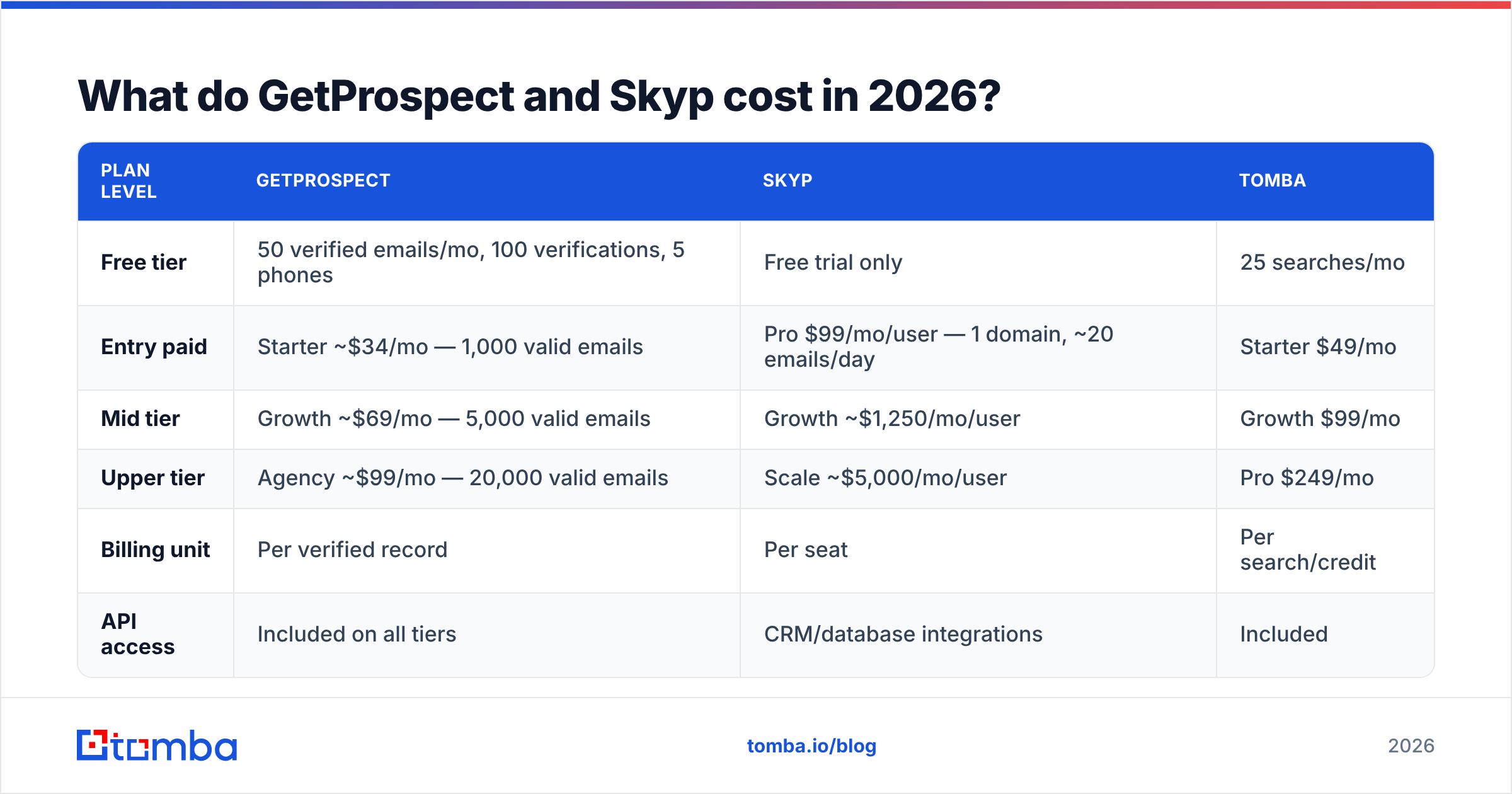
List pricing changes and annual billing usually undercuts monthly, so treat this as a shape-of-the-market snapshot and confirm on each vendor's page before you buy.
| Plan level | GetProspect | Skyp | Tomba |
|---|---|---|---|
| Free tier | 50 verified emails/mo, 100 verifications, 5 phones | Free trial only | 25 searches/mo |
| Entry paid | Starter ~$34/mo — 1,000 valid emails | Pro $99/mo/user — 1 domain, ~20 emails/day | Starter $49/mo |
| Mid tier | Growth ~$69/mo — 5,000 valid emails | Growth ~$1,250/mo/user | Growth $99/mo |
| Upper tier | Agency ~$99/mo — 20,000 valid emails | Scale ~$5,000/mo/user | Pro $249/mo |
| Billing unit | Per verified record | Per seat | Per search/credit |
| API access | Included on all tiers | CRM/database integrations | Included |
The number that jumps out: at Skyp's Growth tier you could fund roughly a year of GetProspect's Agency plan and still have budget left for a sending tool. That is not a knock on Skyp — a fully AI-run campaign function is priced against agency retainers and SDR salaries, not against data tools. But it means the two products are competing for very different lines on your budget.
Which one has better data?#
Only one of them is a data vendor, so the more useful question is: how good is GetProspect's data, and what would you plug into Skyp instead?
GetProspect's credit model — charging only when a verified email is found — is genuinely reader-friendly. It removes the worst failure mode of credit-based tools, where you burn 400 credits on a list and get 190 addresses. But two caveats matter:
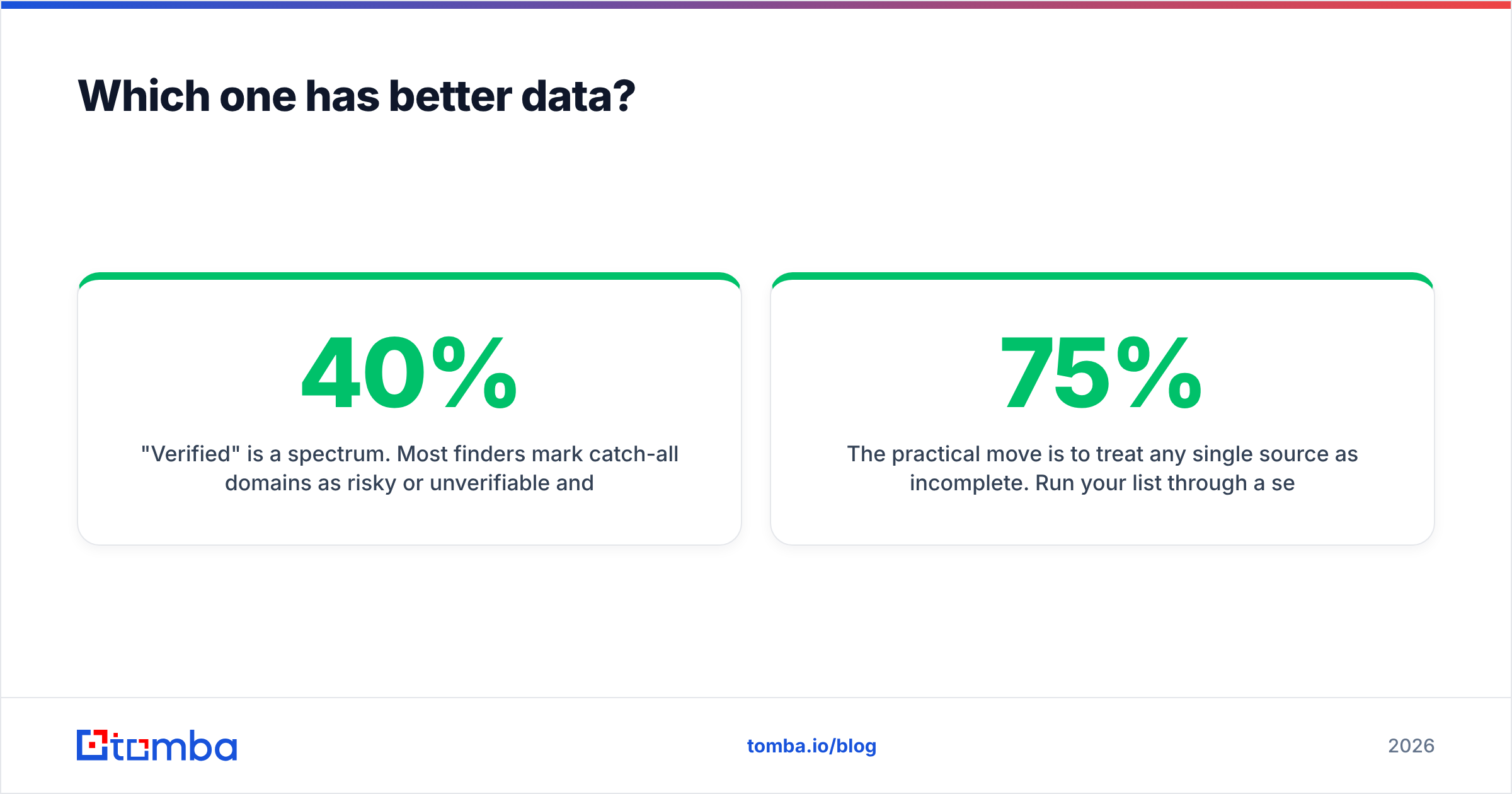
- "Verified" is a spectrum. Most finders mark catch-all domains as risky or unverifiable and hand them back with a shrug. On enterprise lists, catch-alls can be 20–40% of your target accounts. If your ICP is mid-market and up, run a dedicated catch-all verifier before you write those addresses off — a large share of them are deliverable.
- Coverage is regional. Every provider's hit rate collapses somewhere. US and Western Europe tech coverage is strong across the board; APAC, LATAM, and non-tech verticals like construction or logistics vary wildly. Test your actual ICP on the free tier before committing.
The practical move is to treat any single source as incomplete. Run your list through a second email verifier before a send, and use a bulk email finder to fill the gaps your primary vendor missed. Two sources of 75% coverage overlap into something closer to 90%.
Which one wins for cold email execution?#
Skyp, clearly — that is its whole product. But "wins" needs qualifiers.
What Skyp does well: the six-step guided workflow is a genuine advantage for founders and small teams who have never run outbound and would otherwise ship a mediocre three-email sequence. Multiple AI agents splitting strategy, personalization, drafting, and QA is a smarter architecture than one prompt doing everything. The built-in throttling at 20/day on a single domain is deliberately conservative, which is the right instinct — most first-time senders torch their domain in week two.
Where it constrains you: one domain and 500 sends/month at the entry tier means Skyp's Pro plan is a pilot, not a program. If your model needs 5,000 touches a month to hit quota, you are either jumping to a tier priced in four figures or running Skyp alongside a volume sender anyway.
What you still own regardless: email deliverability infrastructure. No AI copywriter fixes a missing DMARC record, an unwarmed domain, or a list with 8% invalid addresses. Google and Yahoo's bulk-sender requirements put the burden on the sender, not the software. If your bounce rate is above 3%, the copy is not your problem — the list is.

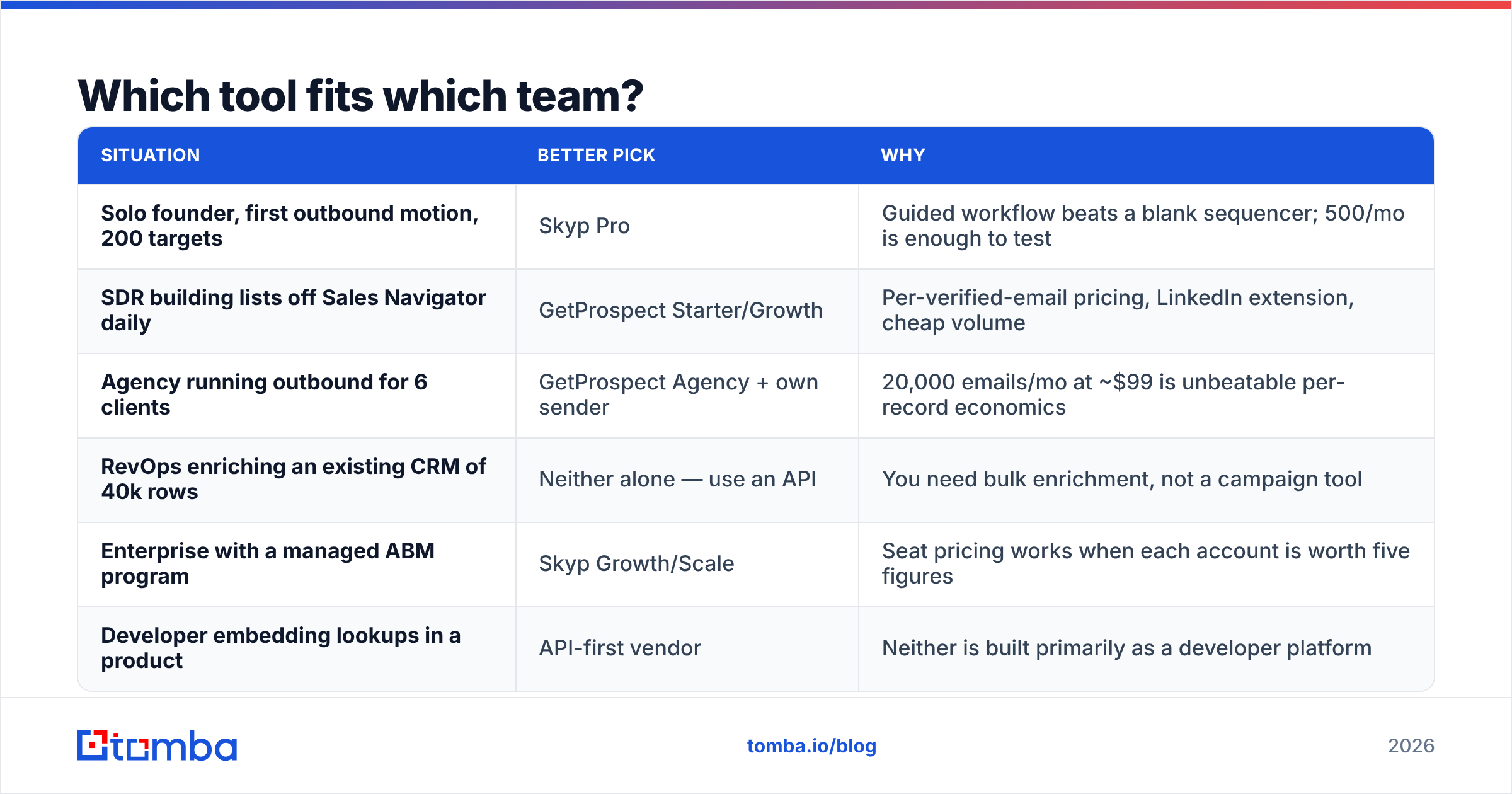
Which tool fits which team?#
| Situation | Better pick | Why |
|---|---|---|
| Solo founder, first outbound motion, 200 targets | Skyp Pro | Guided workflow beats a blank sequencer; 500/mo is enough to test |
| SDR building lists off Sales Navigator daily | GetProspect Starter/Growth | Per-verified-email pricing, LinkedIn extension, cheap volume |
| Agency running outbound for 6 clients | GetProspect Agency + own sender | 20,000 emails/mo at ~$99 is unbeatable per-record economics |
| RevOps enriching an existing CRM of 40k rows | Neither alone — use an API | You need bulk enrichment, not a campaign tool |
| Enterprise with a managed ABM program | Skyp Growth/Scale | Seat pricing works when each account is worth five figures |
| Developer embedding lookups in a product | API-first vendor | Neither is built primarily as a developer platform |
Note the pattern: the two tools rarely compete for the same buyer. When they do, it is usually a small team asking "should I spend my one tool budget on finding people or on talking to them?" The answer is almost always finding people first — because a good list with a mediocre email outperforms a perfect email sent to bounces, and because you can send from Gmail for free while you validate the motion.
What are the hidden costs on each side?#
GetProspect. Credits reset monthly and typically do not roll over — plan for your realistic average, not your best month. Phone credits are separate and much scarcer than email credits across the whole category. And the built-in CRM is convenient but shallow; you will still sync to a real CRM, which means integration setup time. If you need B2B phone numbers at scale, budget for a dedicated source.
Skyp. Per-seat pricing compounds fast — three reps on Pro is $297/mo before you have bought a single contact record. The domain limit at the entry tier means buying and warming secondary domains separately if you scale. And AI-generated personalization still needs a human reviewing samples; the QA agent catches structural problems, not the "I noticed you went to State University" moments that make prospects wince.
Both. Neither vendor absorbs the cost of bad data upstream. If your list came from a scraper or a three-year-old export, you are paying for sends to addresses that no longer exist. Run a free email checker on a sample before you commit a full campaign.
Can you use both — and where does a dedicated finder fit?#
Yes, and it is the most common real-world configuration: a data layer feeding a sending layer.
The data layer's job is to produce a clean, current, deduplicated list with verified addresses and enough firmographic context for personalization. The sending layer's job is sequencing, timing, reply detection, and deliverability hygiene. Skyp is a sending layer with AI on top. GetProspect is a data layer with a light CRM on top.
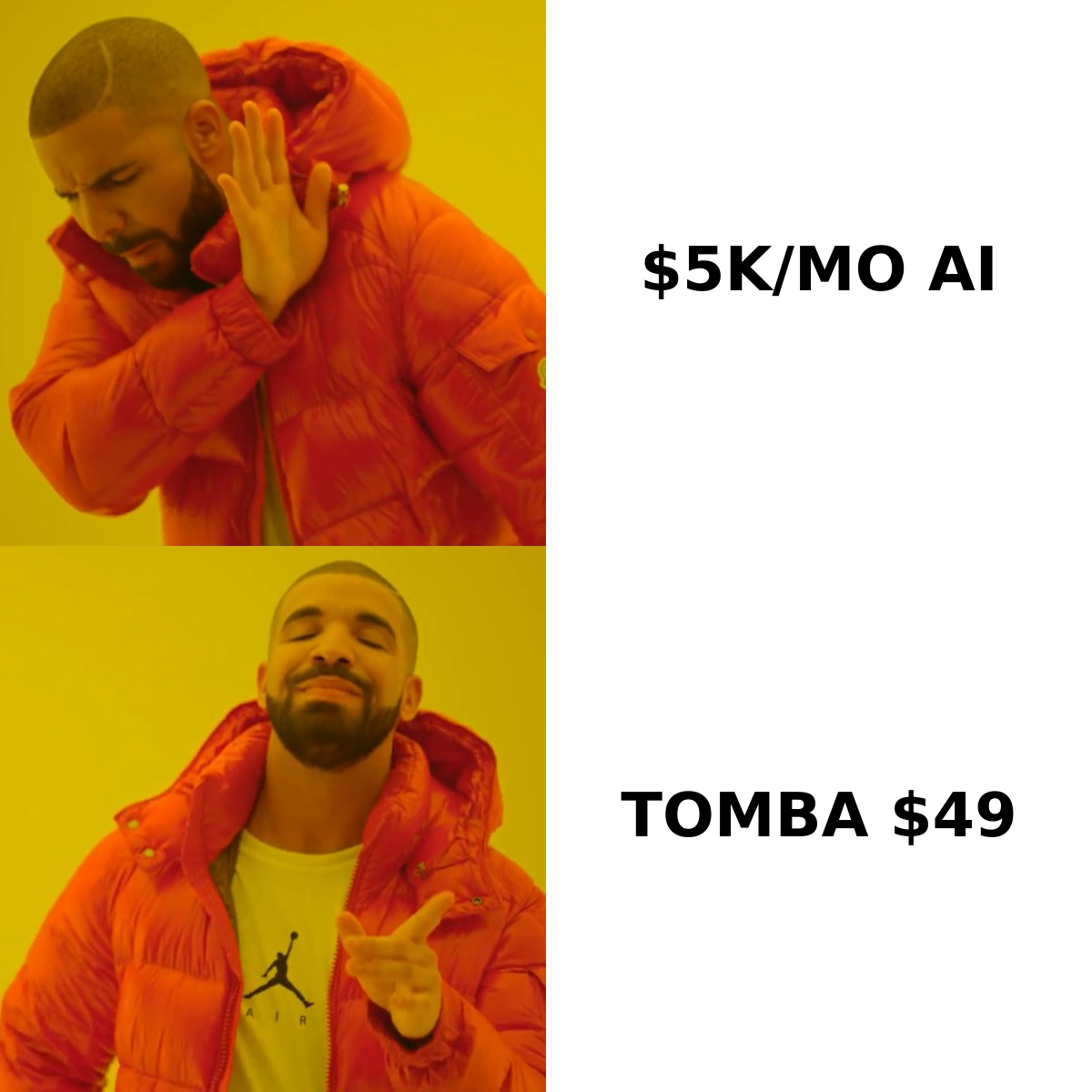
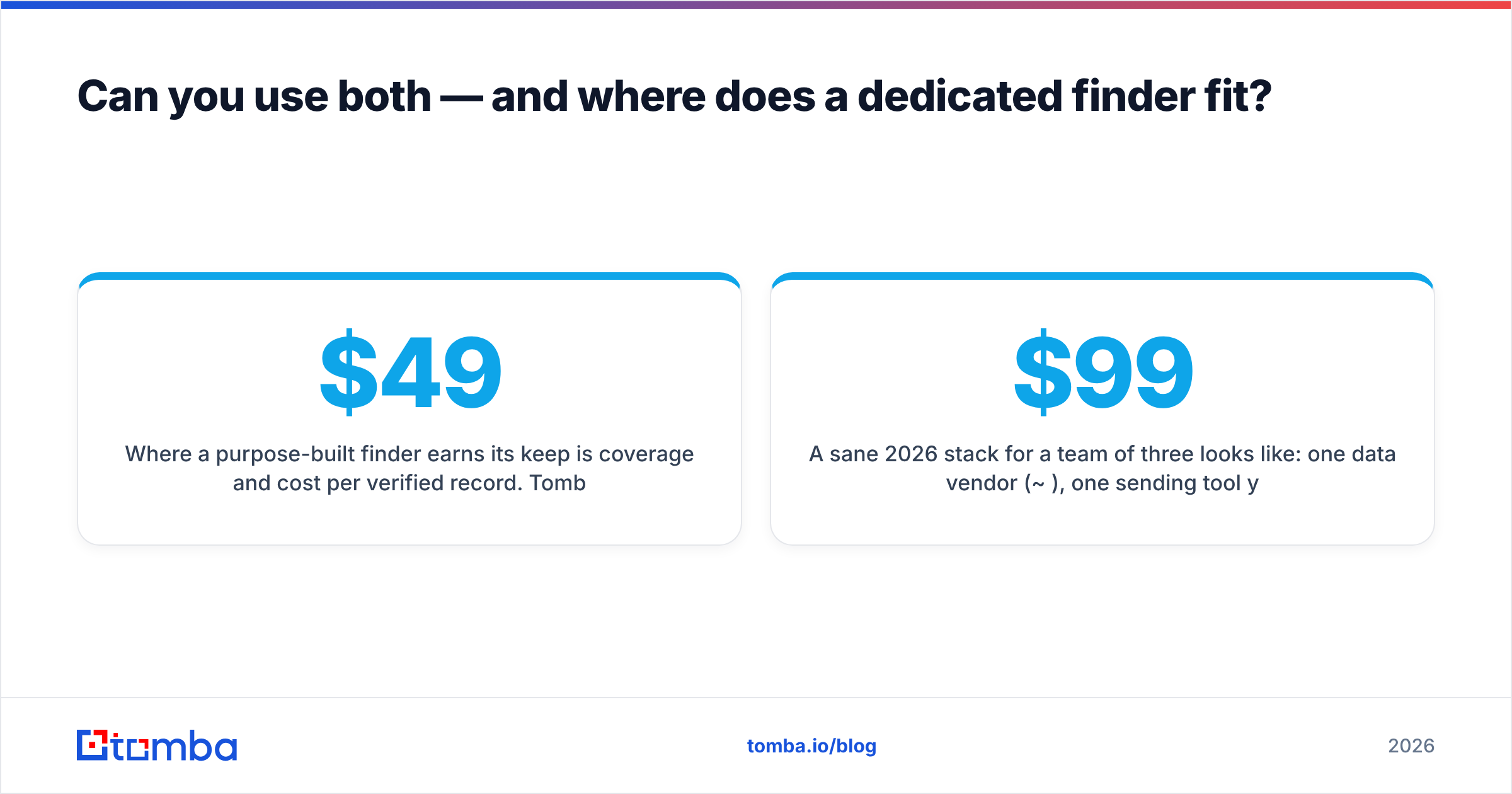
Where a purpose-built finder earns its keep is coverage and cost per verified record. Tomba's email finder sits in the data layer with a free tier of 25 searches, Starter at $49/mo, Growth at $99/mo, and Pro at $249/mo, plus domain search, catch-all verification, enrichment, and an API on the same credit pool. Full Tomba pricing is public. The pitch is not "replace your sequencer" — it is "stop paying campaign-tool prices for contact records."
A sane 2026 stack for a team of three looks like: one data vendor (~$99/mo), one sending tool you already own, verified lists before every send, and a warmed sending domain. Total under $200/mo. Compare that to a single Growth seat on a seat-priced AI platform and the trade-off is stark — you are buying an outsourced SDR function, and you should evaluate it against hiring, not against software.
The verdict#
GetProspect wins on cost-per-contact and is the right first purchase for anyone doing LinkedIn-based prospecting. Its per-verified-email billing is the fairest credit model in the category, and every feature being available on every tier — including free — is unusually honest packaging.
Skyp wins when your bottleneck is execution, not data, and when a five-figure annual spend is justified by deal size. Its guided AI workflow genuinely lowers the floor for teams who would otherwise send bad campaigns. Just do not buy it expecting a contact database — it needs one feeding it.
If you are choosing today with limited budget: buy data first, send from what you already have, and revisit AI campaign tooling once you know your reply rate on a clean list.
Ready to fix the data layer? Start with the Tomba Email Finder — 25 free searches a month, no card required. Run your real ICP through it, check the hit rate against whatever you use now, and see how many contacts your current list is missing before you spend another dollar on sending.
Related guides#
Ready to find emails that actually work?
Join 150,000+ professionals who stopped guessing and started sending. Free credits on signup — no credit card required.
Get the Tomba newsletter
Practical outbound tactics and product updates — once every two weeks.
About the author