GetProspect vs Truemail: Which Email Tool Wins in 2026?
GetProspect finds emails at scale. Truemail cleans lists cheaply. They solve different halves of the same problem — here is the honest breakdown of accuracy, pricing, API depth, and which one actually belongs in your 2026 stack.

TL;DR
- They are not the same category. GetProspect is a prospecting database and email finder with a LinkedIn extension. Truemail is primarily an email verification engine with a lighter finder attached.
- If you need net-new contacts, GetProspect wins on raw discovery — filters, company data, list building, CRM push.
- If you need a dirty list cleaned cheaply, Truemail wins on cost-per-verification and pay-as-you-go flexibility.
- Buying both is common — and expensive. Most teams end up paying two subscriptions to close one loop: find, then verify.
- A single API that does discovery + verification (Tomba, Hunter, Findymail-class tools) usually beats the two-tool stack on total cost and engineering time.
What are GetProspect and Truemail, actually?#
Short version: GetProspect is where you go to get emails. Truemail is where you go to trust them.
GetProspect started as a LinkedIn email extractor and grew into a contact database with filters (job title, industry, headcount, location, technologies) plus a Chrome extension that pulls contacts off LinkedIn search results and Sales Navigator lists. You build a list inside their UI, enrich it, export it, or sync to a CRM. Verification exists, but it is a supporting act.
Truemail went the other direction. Its core is bulk verification: syntax checks, MX record lookups, SMTP handshakes, disposable-domain detection, role-account flagging, and catch-all handling. It sells credits, has a real-time API for signup forms, and prices aggressively per verification. It also ships an email finder, but nobody switches to Truemail for the finder.
That asymmetry is the whole comparison. Asking "GetProspect vs Truemail" is closer to "hammer vs level" than "hammer vs hammer." The useful question is which half of your workflow is currently broken.
How do the two products differ in scope?#
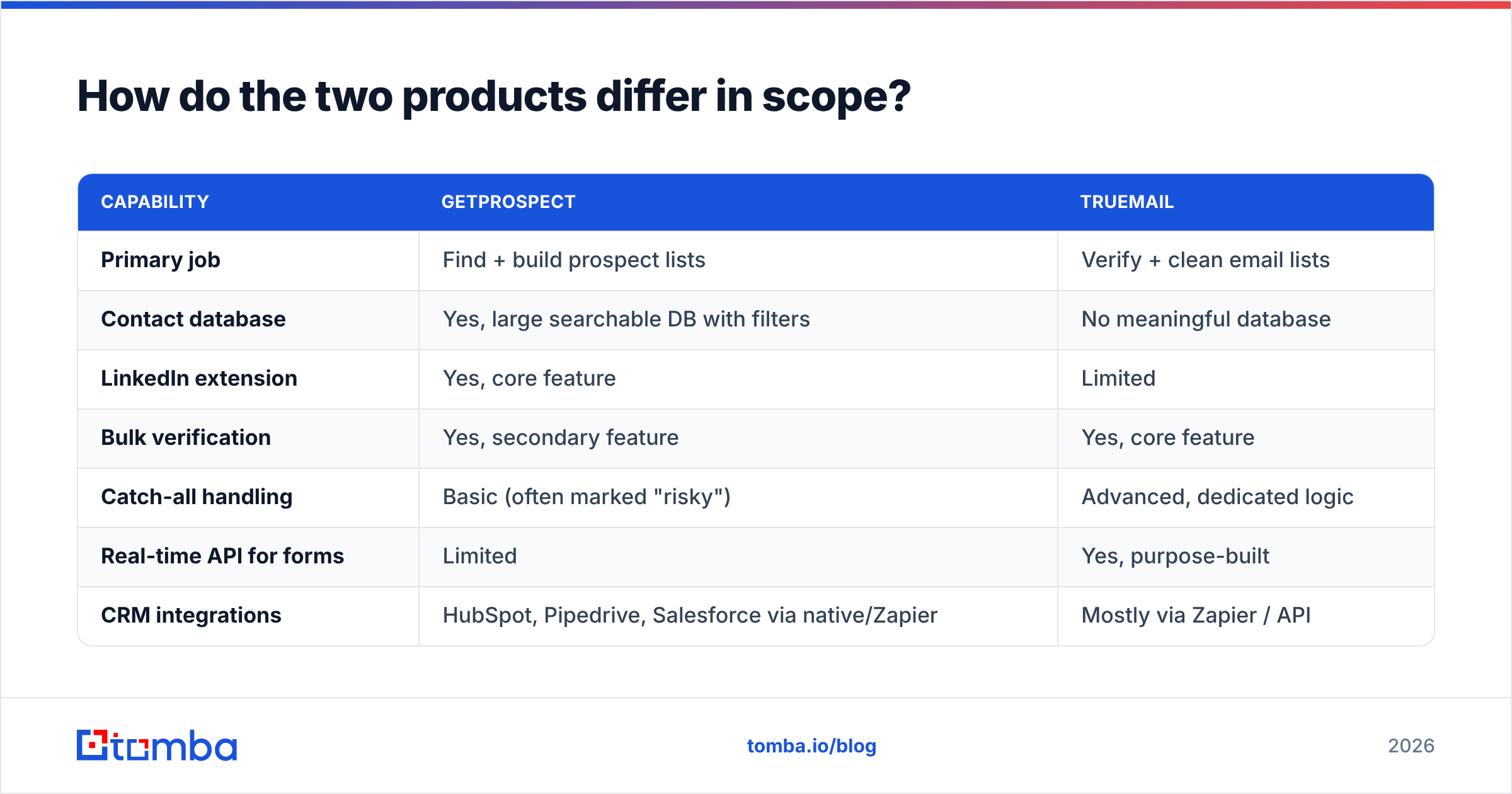
Here is the scope split before we get into numbers:
| Capability | GetProspect | Truemail |
|---|---|---|
| Primary job | Find + build prospect lists | Verify + clean email lists |
| Contact database | Yes, large searchable DB with filters | No meaningful database |
| LinkedIn extension | Yes, core feature | Limited |
| Bulk verification | Yes, secondary feature | Yes, core feature |
| Catch-all handling | Basic (often marked "risky") | Advanced, dedicated logic |
| Real-time API for forms | Limited | Yes, purpose-built |
| CRM integrations | HubSpot, Pipedrive, Salesforce via native/Zapier | Mostly via Zapier / API |
| Best for | SDRs and founders building outbound lists | RevOps and email teams protecting deliverability |
Notice that the overlap is only one row. If you are choosing between them because you assumed they compete head-on, you may be about to solve the wrong problem.
Which tool finds more emails?#
GetProspect, and it is not close — but the win comes with a caveat about what "found" means.
GetProspect returns a hit rate that varies wildly by segment. On mid-market North American SaaS with clean LinkedIn profiles, expect strong coverage. On EU SMBs, agencies, or industries with low LinkedIn adoption (construction, manufacturing, local services), coverage drops hard. That is not a GetProspect-specific flaw — every LinkedIn-derived database inherits the same bias. It is a flaw you should budget for.
The bigger issue is what happens after the find. Many database-first tools return a pattern-guessed address (first.last@domain.com) with a confidence label rather than a verified one. That address may be syntactically perfect and completely fictional. If you export straight to your sequencer, your bounce rate tells the story two days later.

Truemail's finder exists, but it is domain-and-name based rather than database-backed. You supply a first name, last name, and domain; it generates and tests permutations. That works fine when you already know who you want to reach. It does not work when your input is "give me 400 heads of ops at Series B fintechs" — there is no list to filter.
Practical read:
- Discovery from scratch — GetProspect. Filters and a database are the product.
- Enrichment of a known list — either, though a dedicated email finder with a documented API is usually faster to wire in.
- One-off lookups — Truemail is cheaper per call; GetProspect burns a plan credit.
- Coverage outside North America — test both on 100 of your real accounts before committing. Vendor-published hit rates are measured on vendor-chosen samples.

Which tool verifies better?#
Truemail, clearly. Verification is its entire reason to exist, and depth shows up in the edge cases.
The edge case that matters most is the catch-all domain. A catch-all server accepts mail for any address at that domain, so a standard SMTP handshake returns "valid" for asdkjh@company.com just as happily as for the CEO. Roughly a fifth to a third of B2B domains are configured this way, concentrated in exactly the enterprise accounts you most want to reach.
Most verifiers punt and label these "risky" or "unknown," which leaves you with a pile of contacts and no decision rule. Truemail applies additional heuristics to split that pile. So do purpose-built tools like a catch-all verifier. GetProspect's verification is adequate for obvious junk — malformed syntax, dead domains, known disposables — and vague beyond that.
The other Truemail advantage is the real-time API. If you want to block fake signups at the form, you need sub-second responses and high uptime, not a batch job. That is a different engineering requirement than list cleaning, and Truemail is built for it.
Where Truemail is weaker: it is a single-purpose tool. You still need something upstream producing addresses. And single-purpose tools multiply — a finder, a verifier, an enrichment provider, a phone provider, four dashboards, four invoices, four API keys.
How do the pricing models compare?#
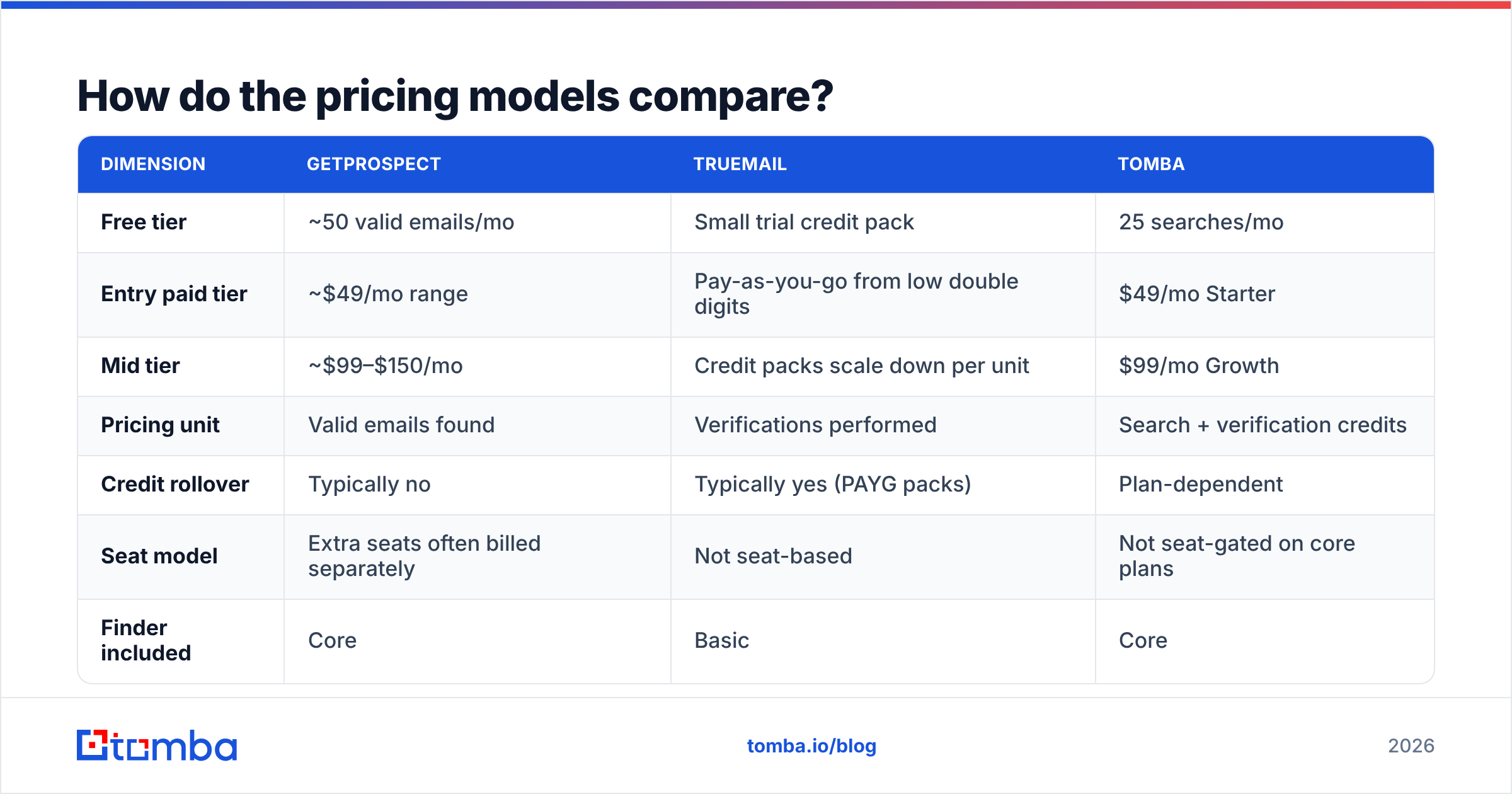
This is where the comparison gets genuinely interesting, because the two vendors price on different units. GetProspect sells valid emails per month on a subscription. Truemail sells verification credits, often as pay-as-you-go with no expiry pressure.
Approximate 2026 positioning (always confirm on the vendor's own pricing page — these change quarterly):
| Dimension | GetProspect | Truemail | Tomba |
|---|---|---|---|
| Free tier | ~50 valid emails/mo | Small trial credit pack | 25 searches/mo |
| Entry paid tier | ~$49/mo range | Pay-as-you-go from low double digits | $49/mo Starter |
| Mid tier | ~$99–$150/mo | Credit packs scale down per unit | $99/mo Growth |
| Pricing unit | Valid emails found | Verifications performed | Search + verification credits |
| Credit rollover | Typically no | Typically yes (PAYG packs) | Plan-dependent |
| Seat model | Extra seats often billed separately | Not seat-based | Not seat-gated on core plans |
| Finder included | Core | Basic | Core |
| Verifier included | Basic | Core | Core |
Two traps hide in that table.
Trap one: the "valid emails" unit. When a plan meters valid emails found, a low-coverage industry quietly costs you more searches to hit the same list size. Your effective cost per usable contact is not the number on the pricing page.
Trap two: the two-subscription tax. Teams that run GetProspect for discovery and Truemail for cleaning are paying roughly $49–$150/mo plus credit packs, plus the internal cost of moving CSVs between them. That workflow is fine at 200 contacts a month. At 5,000 it becomes a part-time job for someone on your team.

If you want an outside read on how buyers actually score these categories, G2's lead intelligence grid separates "data quality" from "ease of setup" — and the two rarely rank the same vendor first.
What about API depth and integrations?#
If your team writes code, the API is the product and the dashboard is a demo.
GetProspect's API covers search and enrichment reasonably well, and native CRM connectors (HubSpot, Pipedrive) reduce glue code for revenue teams that live in the CRM. Rate limits are plan-tiered. Docs are serviceable rather than excellent.
Truemail's API is narrow but solid: single verification, bulk verification, status polling. Exactly what a verification API should be. Nothing more.
What neither gives you is one credential covering find, verify, catch-all resolution, enrichment, and phone lookup. That matters more than it sounds. Every additional vendor means another key in your secrets manager, another rate limit to back off from, another status page to watch, another renewal conversation.
That is the practical argument for a consolidated provider. A single email finder API that also handles verification, data enrichment, and bulk lead generation removes the CSV shuttle entirely — you find and verify in one call chain, and only pay for contacts that survive both steps.

Also worth checking before you commit: how each vendor documents its sourcing. Public, auditable data sources matter more every year as GDPR and CCPA enforcement tightens. HubSpot's guide to GDPR-compliant prospecting is a decent baseline for what your legal team will ask about.
Who should choose GetProspect?#
Pick GetProspect if most of these are true:
- You build lists from LinkedIn. The extension is genuinely good at pulling contacts from Sales Navigator searches.
- Your ICP is North American or Western European mid-market. That is where the database is densest.
- Non-technical users own the workflow. SDRs can operate the UI without help.
- You already have a verifier. Or your bounce tolerance is high because volume is low.
- CRM sync matters more than API flexibility. Native HubSpot/Pipedrive push saves real hours.
Skip it if you are engineering-led, if your ICP sits outside LinkedIn-heavy industries, or if per-contact cost is the metric your CFO tracks.
Who should choose Truemail?#
Pick Truemail if most of these are true:
- You inherited a list. Bought data, an old CRM export, a webinar registration dump — Truemail is the cheapest path to knowing what is alive.
- You are protecting sender reputation. Bounce rate above 3% is where mailbox providers start throttling you, and cleaning is the fastest fix.
- You need form-time validation. The real-time API is built for it.
- Your volume is spiky. Pay-as-you-go credits beat a subscription you use twice a quarter.
- You already have a discovery source. Truemail assumes addresses arrive from somewhere else.
Skip it if your actual problem is "we do not have enough contacts." Verification cannot create data that does not exist.
Is there an option that does both without two invoices?#
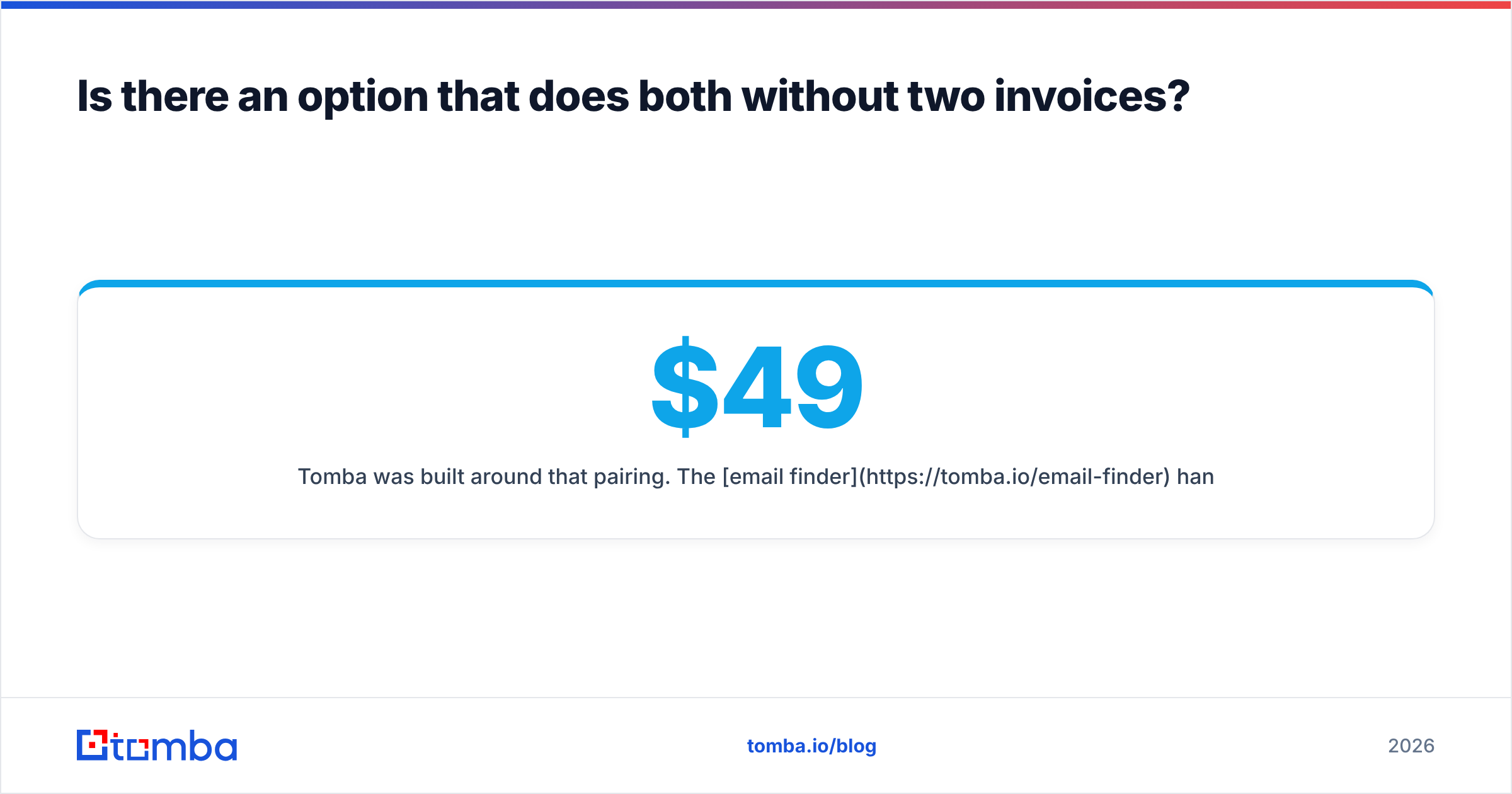
Yes — and this is the honest reason the GetProspect vs Truemail framing breaks down. Both vendors are strong at one half of a two-step job that almost nobody does in isolation.
Tomba was built around that pairing. The email finder handles discovery by domain, name, or company; email verification runs on the same credits; domain search pulls every published address at a company; catch-all resolution and phone finder sit in the same account. Tomba pricing runs Free (25 searches/mo), Starter $49/mo, Growth $99/mo, Pro $249/mo, Enterprise custom — one line item instead of two.
The fair caveat: Tomba's database is not the biggest on the market, and if your entire workflow is "scroll Sales Navigator and click a button," GetProspect's extension is more polished. Consolidation is worth real money, but it is not worth pretending a trade-off does not exist.
Test all three on the same 100 accounts from your actual pipeline. Measure three numbers: hit rate, bounce rate after sending, and dollars per contact that replied. Vendor benchmarks are marketing. Your list is evidence.
Frequently asked questions#
Can GetProspect replace a dedicated verifier? For obvious junk, yes. For catch-all domains and borderline addresses, no — those are exactly the addresses that damage your reputation, and they need dedicated logic.
Is Truemail's email finder good enough to skip a prospecting tool? Only if you already know the names and domains. It generates and tests permutations; it does not give you a searchable database to filter.
Which is cheaper? Per verification, Truemail. Per found contact, it depends entirely on your ICP's coverage. Run 500 real records through both trials before you sign anything.
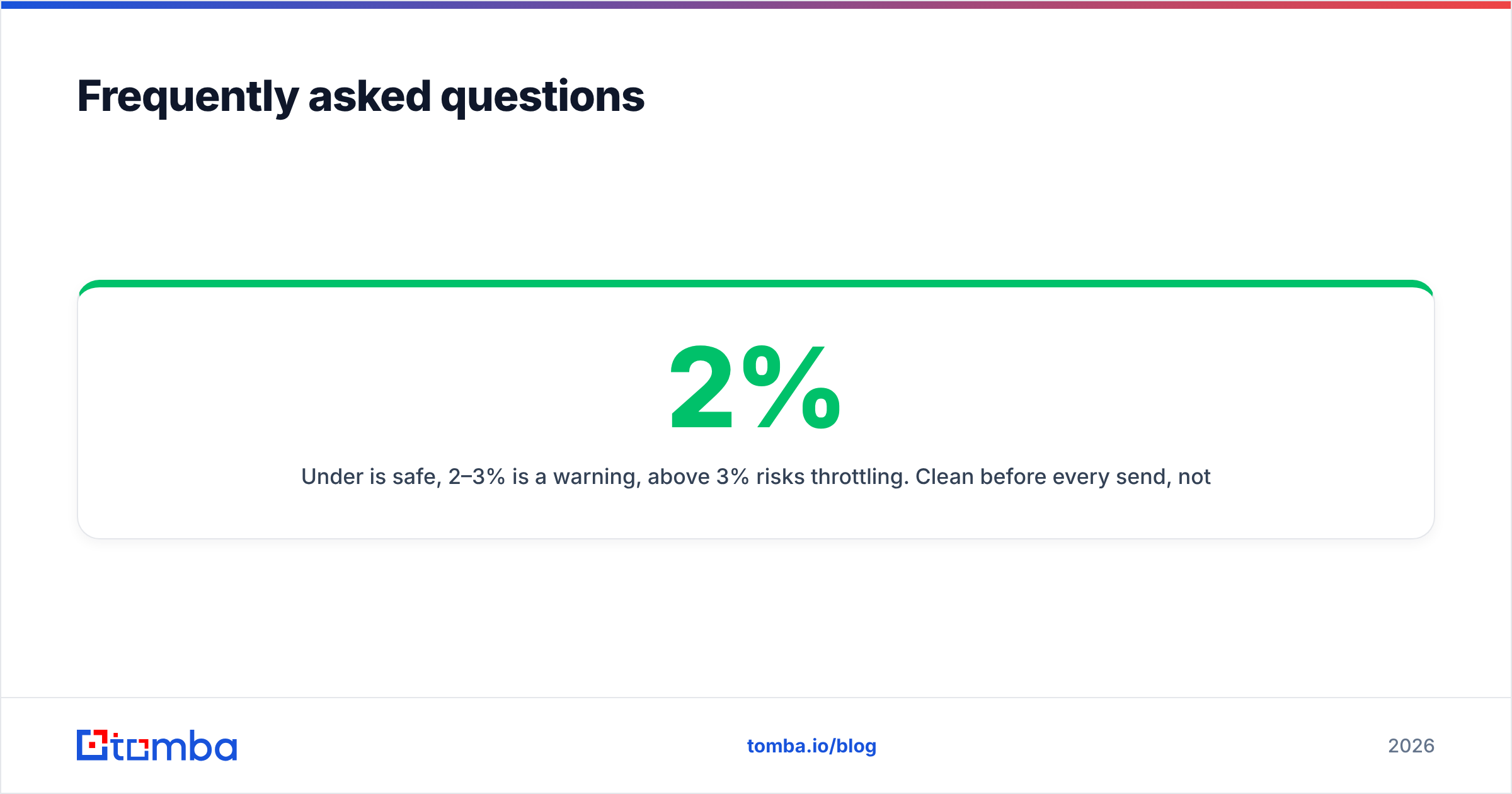
What bounce rate should I target? Under 2% is safe, 2–3% is a warning, above 3% risks throttling. Clean before every send, not once a quarter — B2B data decays roughly 2–2.5% per month.
Do I need both tools? If you keep the two-vendor stack, budget for the CSV shuttle between them. If that friction annoys you, consolidate.
Ready to stop paying two subscriptions for one workflow? Start with the Tomba Email Finder — find professional email addresses by domain, name, or company, verify them on the same credits, and push clean contacts straight into your sequencer. The free tier gives you 25 searches a month with no card, which is enough to benchmark it against your current GetProspect or Truemail export before you change anything.
Related guides#
Ready to find emails that actually work?
Join 150,000+ professionals who stopped guessing and started sending. Free credits on signup — no credit card required.
Get the Tomba newsletter
Practical outbound tactics and product updates — once every two weeks.
About the author