GetProspect vs VCBacked Email Finders: 2026 Comparison
GetProspect is lean and cheap. VC-backed platforms are huge and expensive. We break down accuracy, credits, contracts, and hidden costs so you know which model actually fits your outbound in 2026.
GetProspect vs VCBacked platforms is a pricing question, not a data question. GetProspect sells credits. Funded vendors sell seats, then meter the data on top. Here is what each model really costs, and which one fits your team.
TL;DR
- GetProspect is a lean, self-serve email finder. It works from LinkedIn and starts cheap. VC-backed platforms (Apollo, ZoomInfo, Clearbit, Seamless.AI) sell a whole GTM stack, with sales calls, seats, and annual contracts attached.
- The real difference is not accuracy. It is cost structure. Lean tools charge per credit. Funded platforms charge per seat, then meter the data on top.
- Most of these vendors buy or license the same data. Paying 6x more rarely buys 6x more contacts. It buys intent signals, org charts, and a CSM.
- Run under ~20,000 lookups a month and skip intent data? A credit-based finder like GetProspect or Tomba will cost you 60–90% less than a funded platform.
- Verify before you send, whatever the vendor. No provider ships a list clean enough to skip email verification.
What is GetProspect, and who actually uses it?#
GetProspect is a B2B contact-data tool built around a Chrome extension and a LinkedIn workflow. You search LinkedIn or its own database. The extension resolves work emails. You export to CSV or push into a CRM. It has a free tier, credit-based paid plans, and an API. Their plan list changes more often than most, so check the product pages for current numbers.
The typical GetProspect buyer is a founder, a solo SDR, an agency, or a 2–5 person outbound team. They want three things: emails that land, a price that skips procurement, and an export button. They do not want a demo call.
That profile matters. It is exactly the buyer VC-backed platforms are not built for.
What does 'VC-backed' actually change for you as a buyer?#
'VC-backed' is not an insult. It is a business model. And the model has predictable effects on your invoice and your workflow.
A funded data platform has to grow fast enough to justify its last valuation. That pushes it toward bigger contracts, land-and-expand pricing, and a product wide enough to replace three other tools. In practice:
- Seat-based pricing becomes the floor. You pay per user before you pay for a single record. Add a second SDR, add another $80–$150/month.
- Annual contracts replace month-to-month. The discounts are real. So is the lock-in when your headcount drops in Q3.
- Credits get tiered and expiring. Export credits, mobile credits, enrichment credits. Each has its own cap and its own rollover rule.
- The roadmap chases enterprise features. Intent data, org charts, buying committees, conversation intelligence. Great if you need them. Pure overhead if you just need an email.
- Support becomes a sales motion. You get a CSM, QBRs, and an upsell conversation attached to every usage spike.
- Data sourcing scales through buying and licensing. That is why the same contact shows up, byte-identical, in three 'different' databases.
None of that is bad. It is simply priced for a 30-seat revenue org, not for a two-person team sending 3,000 emails a month.

GetProspect vs VCBacked: how do they compare head to head?#
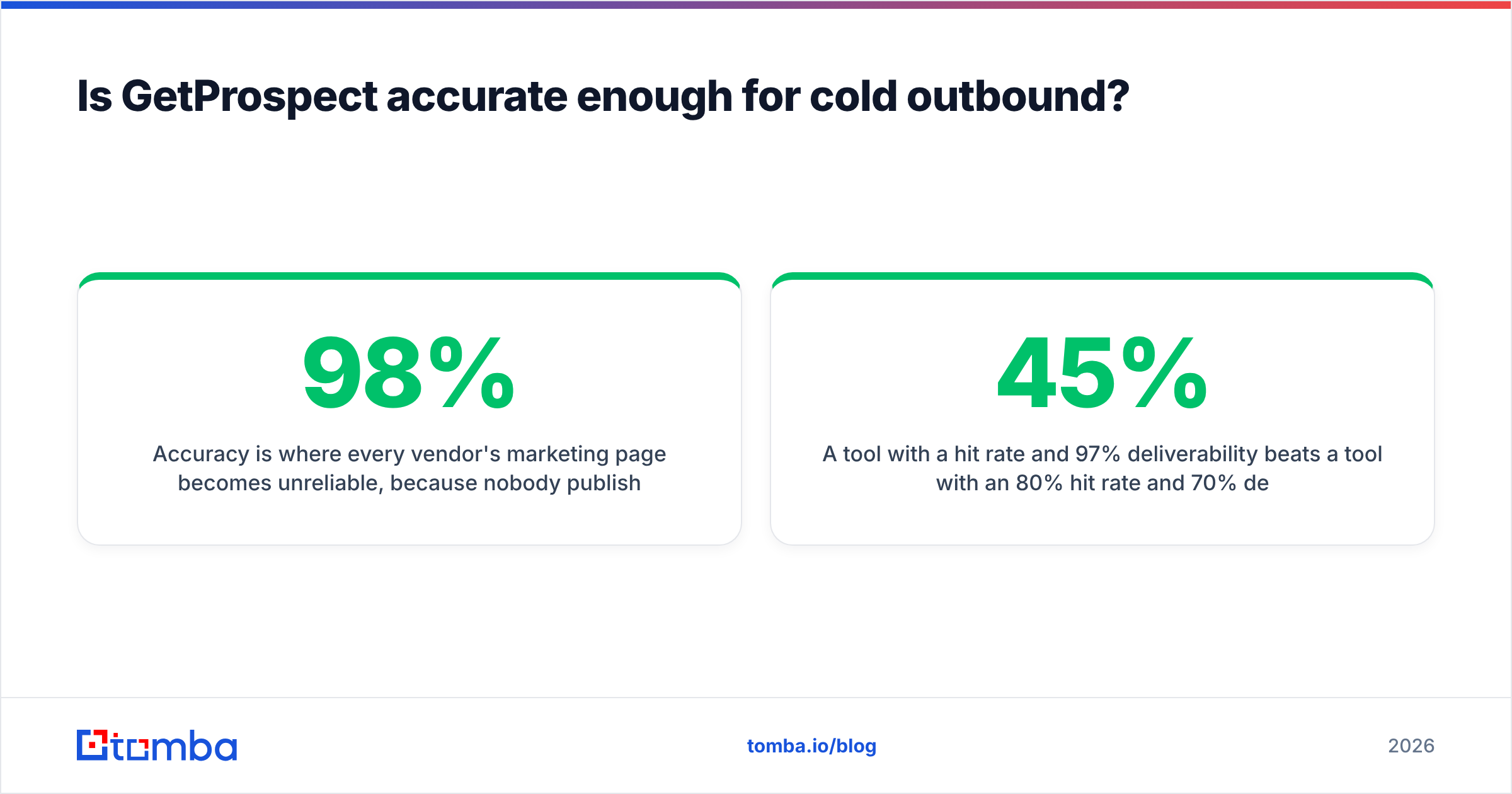
Here is the honest side-by-side. Prices are list prices at the time of writing. Funded vendors quote custom numbers constantly, so treat their column as a range, not a promise.
| Attribute | GetProspect | VC-backed platforms (Apollo, ZoomInfo, Seamless.AI) | Tomba |
|---|---|---|---|
| Pricing model | Credit-based, self-serve | Seat + credit, mostly annual | Credit-based, self-serve |
| Entry paid price | ~$49/mo range | $99–$1,500+/mo, often annual | $49/mo Starter |
| Free tier | Yes, limited monthly credits | Limited or demo-gated | 25 searches/mo |
| Contract required | No | Frequently yes | No |
| Primary workflow | LinkedIn extension + CSV | All-in-one GTM suite | API, bulk, extension, spreadsheets |
| Intent / org charts | No | Yes (upper tiers) | No |
| Built-in verification | Basic | Varies by tier | Included, plus catch-all handling |
| Best for | Solo/small outbound teams | 15+ seat revenue orgs | Devs, agencies, lean GTM teams |
The pattern is clear. GetProspect and Tomba compete on cost per verified contact. Funded platforms compete on breadth of workflow. The choice is a question about your org chart, not about who has 'better data'.
Is GetProspect accurate enough for cold outbound?#
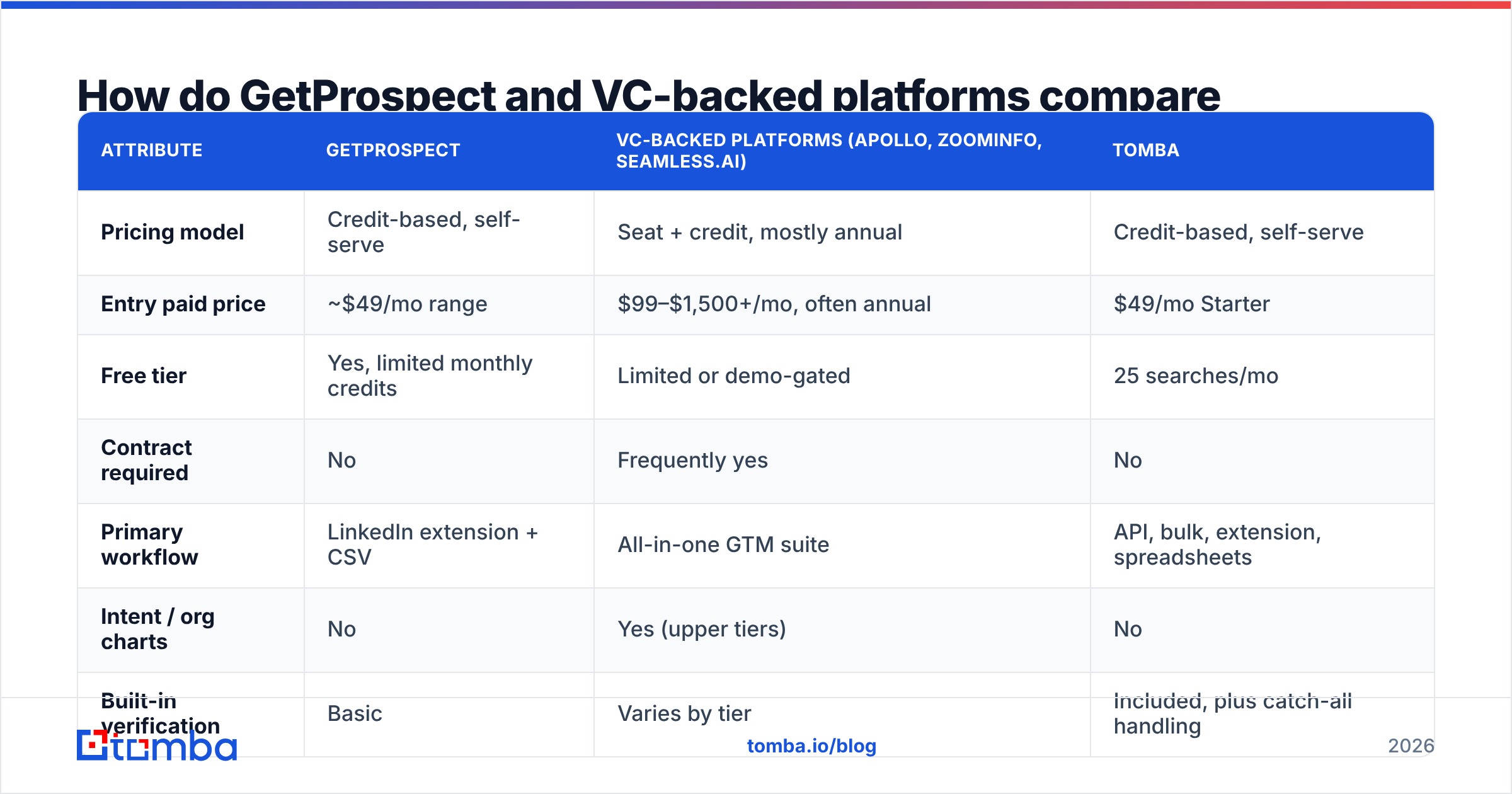
Accuracy is where vendor marketing stops being useful, because nobody publishes the denominator. '98% accuracy' usually means this: of the emails we chose to return, 98% passed our own SMTP check. It quietly ignores every contact the tool never found.
Two numbers actually matter:
- Hit rate — of 1,000 target contacts, how many emails did the tool return?
- Deliverable rate — of those returned, how many survive an independent check and a real send?
A tool with a 45% hit rate and 97% deliverability beats a tool with an 80% hit rate and 70% deliverability. The second one burns your domain reputation. Most buyers get this trade-off backwards.

In practice, GetProspect performs like most LinkedIn-first tools. It is strong on tech, SaaS, and North American mid-market. It is weaker on non-English domains, SMB service businesses, and companies with no LinkedIn footprint. VC-backed platforms license bigger datasets, so they tend to win on coverage — especially in enterprise accounts and mobile numbers. They also return more stale records in the long tail, because scale rewards recall over precision.
The fix is the same either way. Run every export through an email verifier before it touches your sequencer. Treat catch-all domains as their own bucket, not a coin flip.
What do you actually lose by skipping the funded platform?#
Be honest about which of these you will use in the next 90 days:
- Intent data. Useful if you have enough inbound volume and an ops person to act on it. Dead weight otherwise.
- Org charts and reporting lines. Valuable for multi-threaded enterprise deals. Irrelevant if you sell to one decision-maker.
- Native sequencing. Convenient. But standalone senders usually deliver better and cost less than a bundled sequencer.
- Mobile numbers at scale. A real advantage for the funded vendors. If cold calling is core, price it seriously, or pair a lean finder with a dedicated phone finder.
- Compliance paperwork. DPAs, SOC 2, security reviews. If your buyer's procurement team asks, the funded vendor already has the PDF.
- A human to yell at. Underrated. Enterprise teams pay for accountability, not just data.
If you checked one or none of those, the funded platform is selling you insurance you will never claim. If you checked three or more, the premium is probably fair.
What does each option really cost per verified contact?#
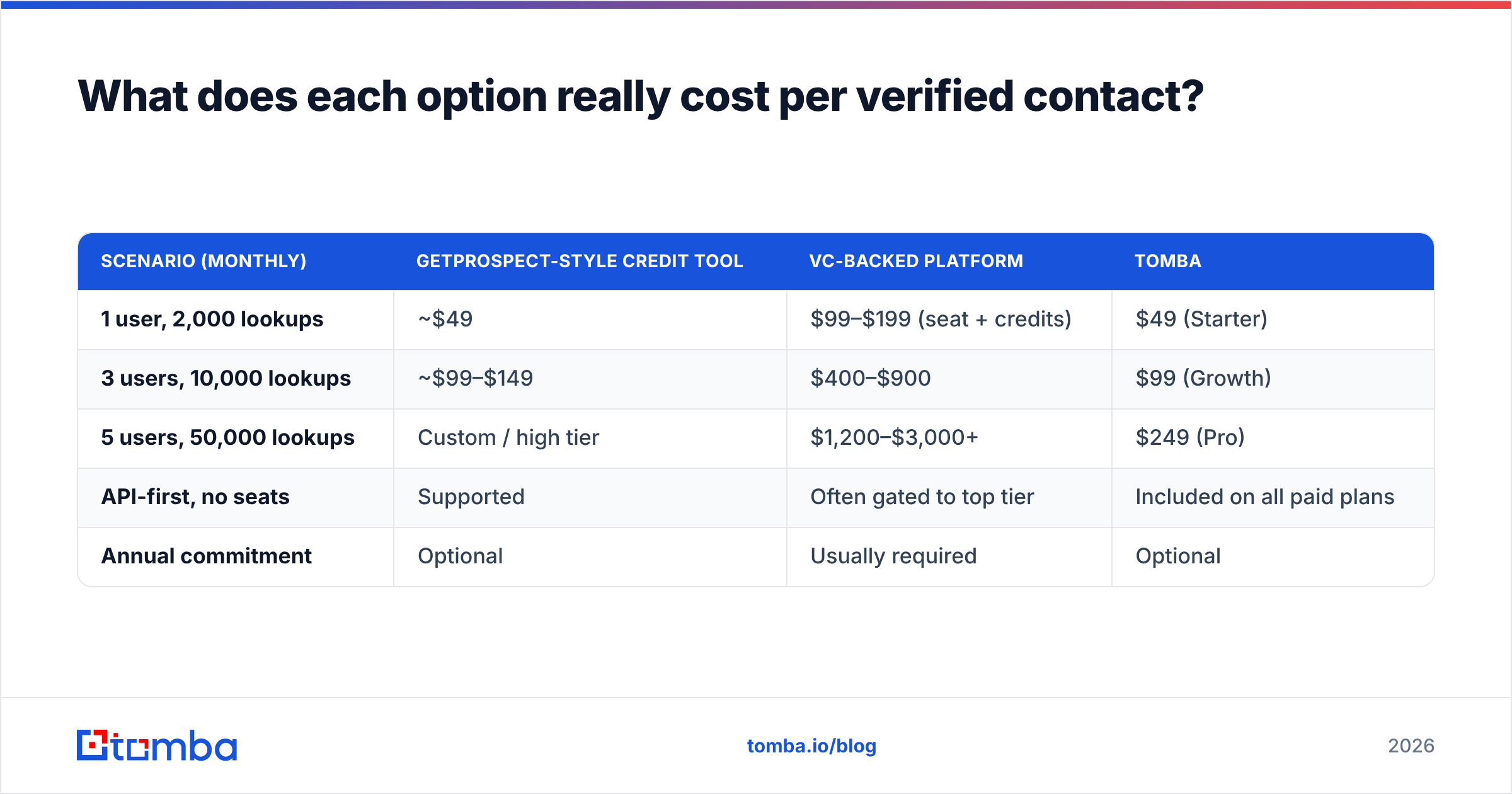
List price is the wrong unit. Model it as cost per usable contact, after failed lookups and after verification drops.
| Scenario (monthly) | GetProspect-style credit tool | VC-backed platform | Tomba |
|---|---|---|---|
| 1 user, 2,000 lookups | ~$49 | $99–$199 (seat + credits) | $49 (Starter) |
| 3 users, 10,000 lookups | ~$99–$149 | $400–$900 | $99 (Growth) |
| 5 users, 50,000 lookups | Custom / high tier | $1,200–$3,000+ | $249 (Pro) |
| API-first, no seats | Supported | Often gated to top tier | Included on all paid plans |
| Annual commitment | Optional | Usually required | Optional |
Two things drive that gap. First, seat licensing. A credit-based tool does not care whether one person or five people pull the same 10,000 records. Second, API access. Funded vendors often reserve it for the top tier. That is how a $99 problem turns into a $2,000 one the moment you want to enrich inside your own app. Tomba lists its plans on the pricing page — Free (25 searches/month), Starter $49, Growth $99, Pro $249, Enterprise custom. The email finder API is on every paid tier, not an enterprise upsell.

A third category is worth naming. Fixed-price database vendors like BookYourData sell verified lists outright instead of metering lookups. For a one-off campaign into a tight ICP, that model can beat both subscriptions on total cost. It is a different shape of purchase, not a worse one.

Is the underlying data actually different between vendors?#
Partly. And less than the pricing gap implies.
Every B2B contact provider builds from the same kinds of inputs: public web crawls, pattern guessing against verified domains, opt-in contributor networks, licensed third-party files, and user corrections. The differences show up at the edges. Which verticals get refreshed most often. How aggressive the pattern guessing is. Whether the vendor ships a guess as a confirmed record.
That last one is the real quality signal. Some tools return firstname.lastname@domain.com with high confidence because the pattern matched. They never checked that mailbox. That is a bounce with good posture. Ask any vendor two questions before you buy:
- Do you separate pattern-derived addresses from verified ones in the API response?
- How do you label catch-all domains, and do you charge a credit for them?
Vendors who answer those crisply are usually the ones worth trusting. Tomba publishes its data sources and returns a confidence score plus source attribution on every result. You want that on record before a deliverability incident, not after.
Cross-check the sales deck against real user reviews on G2. Filter for reviewers in your company-size band. A 500-seat enterprise's experience of a data platform has almost nothing in common with a 4-person team's.
Which one should you choose in 2026?#
Match the tool to the motion, not to the brand. Here is how the GetProspect vs VCBacked call breaks down by team type.
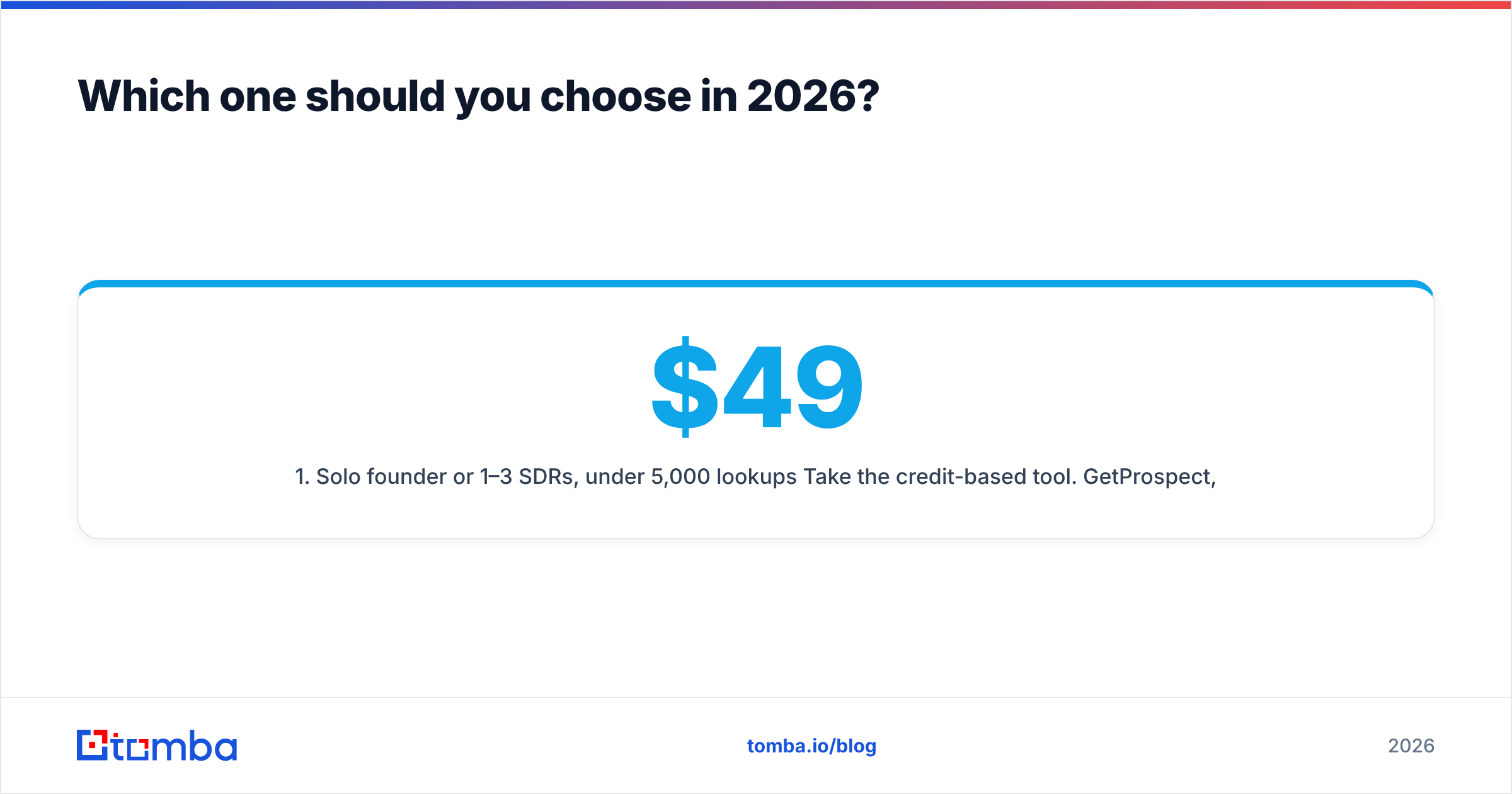
- Solo founder or 1–3 SDRs, under 5,000 lookups a month. Take the credit-based tool: GetProspect, Tomba, or a similar lean finder. You will spend $49–$99 where a platform charges $500. The coverage gap will cost you fewer deals than the budget gap costs you runway.
- Agency running outbound for several clients. Credit-based, with bulk and API access. Seat pricing is punitive when your operator count changes every month. Check bulk lookup throughput and per-client data separation.
- Product team enriching signups in-app. API-first, always. Check whether API access is tier-gated before you fall in love with a UI. This is the most common reason teams leave a funded platform mid-contract.
The math flips once you sell upmarket:
- 15+ seat revenue org with an ops function. The funded platform earns its price here: intent, org charts, CRM hygiene, and a support contract. Negotiate hard on seat minimums and credit rollover. Both are more flexible than the first quote suggests.
- Enterprise sales into regulated buyers. Pick the vendor whose compliance documents your security team will accept without a six-week review. That is often, though not always, the funded one.
- Cold calling as your primary channel. Put mobile coverage first, then bolt on a cheap email finder. Do not pay platform prices for emails you barely use.
A hybrid works too, and it is increasingly common. Keep one funded seat for the researcher who needs org charts and intent. Run the rest of the team on credit-based lookups. Teams that do this often cut their data spend in half without losing anything they actually used.
Already committed to a funded suite and just want to stop paying enterprise rates for basic lookups? The Apollo alternative breakdown covers where the swap works and where it does not.
What is the fastest way to test this yourself?#
Run a 200-contact bake-off before you sign anything. It takes an afternoon.
- Pull 200 real target contacts from your ICP. Not a random sample, your actual next campaign.
- Run the same list through each vendor's free tier or trial.
- Record hit rate per vendor.
- Run every returned address through one independent verifier, so the scoring stays neutral.
- Send a real 100-contact batch from a warmed domain and record the bounce rate.
- Divide total cost by the count of contacts that survived all three steps.
That last number is the only one that should drive the decision. Vendors that look expensive on the pricing page sometimes win on cost per usable contact. Vendors with generous credit counts often lose, because half the credits go to records you cannot send to. That single number settles the GetProspect vs VCBacked question for your team better than any brand argument. For a wider view, review data from sources like Gartner Peer Insights beats any vendor's own comparison page, including this one.
Start with the lookups, not the platform#
Is your bottleneck simple? Accurate work emails for a defined list of people, at a price that scales with usage instead of headcount. Start there, and add complexity only when you feel the pain. The Tomba Email Finder does exactly that job. Find emails by domain, name, or company. Every result carries a confidence score and source attribution. Catch-all handling is built in, and API access comes with every paid plan. It starts free at 25 searches a month, then $49 a month for Starter. Run your own 200-contact bake-off against whatever you use today, and let the cost per verified contact decide.
Related guides#
Ready to find emails that actually work?
Join 150,000+ professionals who stopped guessing and started sending. Free credits on signup — no credit card required.
Get the Tomba newsletter
Practical outbound tactics and product updates — once every two weeks.
About the author