GetProspect vs ZeroBounce 2026: Finder vs Verifier Compared
GetProspect finds B2B emails. ZeroBounce verifies them. They are not the same product — and buying the wrong one is why your bounce rate or your lead volume is stuck. Here is the honest breakdown.
GetProspect vs ZeroBounce is a fight that never really happens. One tool finds B2B emails. The other checks that those emails are real. Buy the wrong one and either your lead volume stalls or your bounce rate stays stuck.
TL;DR
- GetProspect and ZeroBounce are not rivals. GetProspect is a B2B email finder and contact database. ZeroBounce is an email verification and deliverability platform. One digs the well; the other filters the water.
- Short on contacts? GetProspect is the tool. Bounce rate at 7% and Google throttling you? ZeroBounce is the tool.
- Most teams end up buying both. That runs $150–$250 a month before you send a single email, plus two dashboards and two credit systems.
- Bundled platforms (Tomba, Hunter, Apollo) do both jobs on one credit pool. Tomba starts at $49/mo, with a free tier of 25 searches.
- The real question is not "which is better." It is "which layer of my pipeline is broken right now?"
What is GetProspect, and what is ZeroBounce?#
They sit at opposite ends of the same workflow. Here is the split in plain terms.
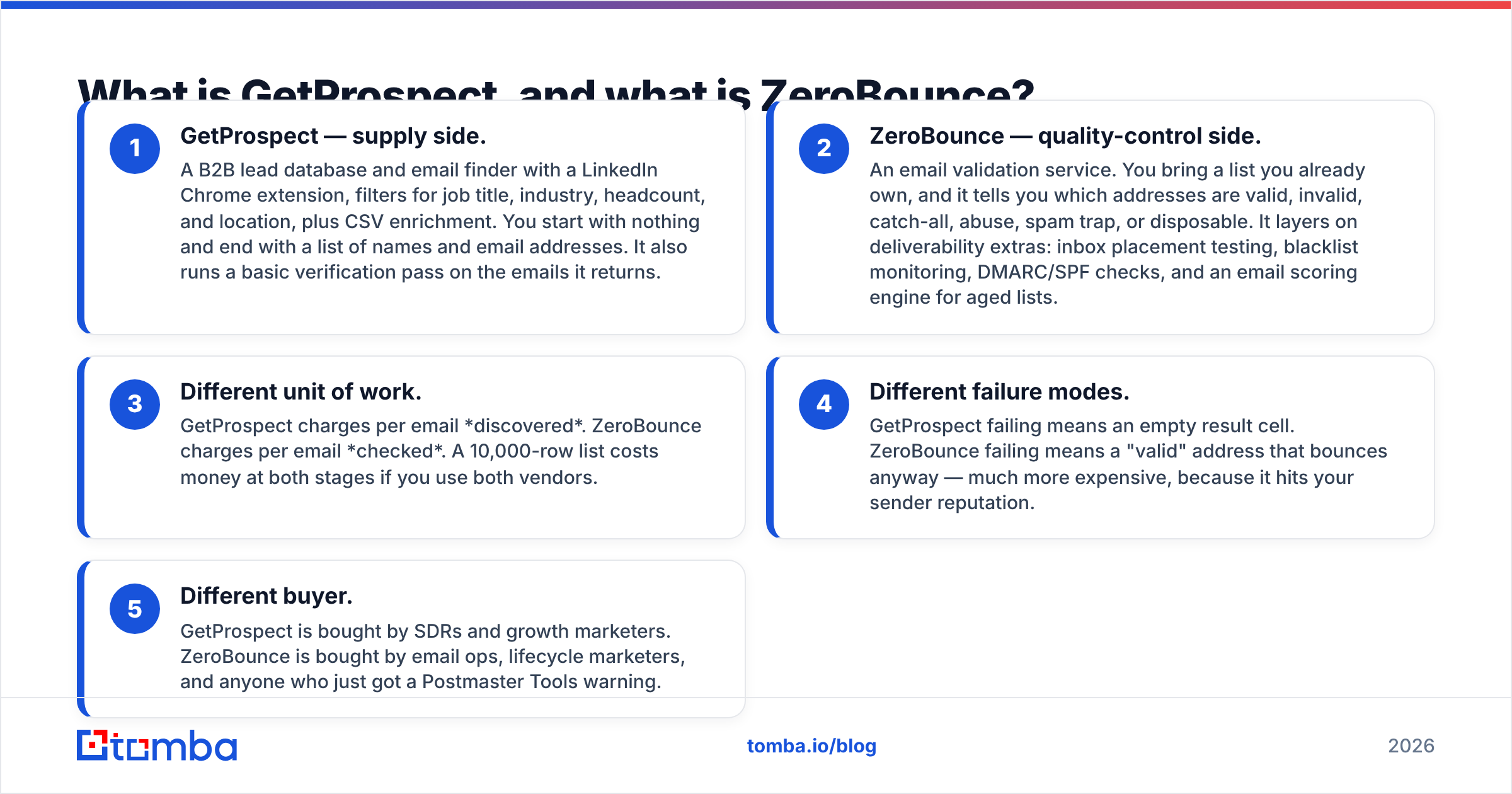
- GetProspect — supply side. A B2B lead database and email finder. It ships a LinkedIn Chrome extension, filters for job title, industry, headcount, and location, plus CSV enrichment. You start with nothing and end with names and email addresses. It also runs a basic verification pass on what it returns.
- ZeroBounce — quality-control side. An email validation service. You bring a list you already own. It tells you which addresses are valid, invalid, catch-all, abuse, spam trap, or disposable. On top of that it adds inbox placement testing, blacklist monitoring, DMARC/SPF checks, and scoring for aged lists.
The billing and the failure modes differ just as much.
- Different unit of work. GetProspect charges per email discovered. ZeroBounce charges per email checked. A 10,000-row list costs money twice if you use both vendors.
- Different failure modes. GetProspect failing means an empty result cell. ZeroBounce failing means a "valid" address that bounces anyway. The second one is far more expensive, because it hits your sender reputation.
- Different buyer. SDRs and growth marketers buy GetProspect. Email ops and lifecycle marketers buy ZeroBounce — often right after a Postmaster Tools warning.
If you only read one line: the tools overlap by about 15%. That overlap is GetProspect's built-in verification. It is decent, but it is not a substitute for a dedicated checker on a cold, aged, or purchased list.
GetProspect vs ZeroBounce: head-to-head comparison#
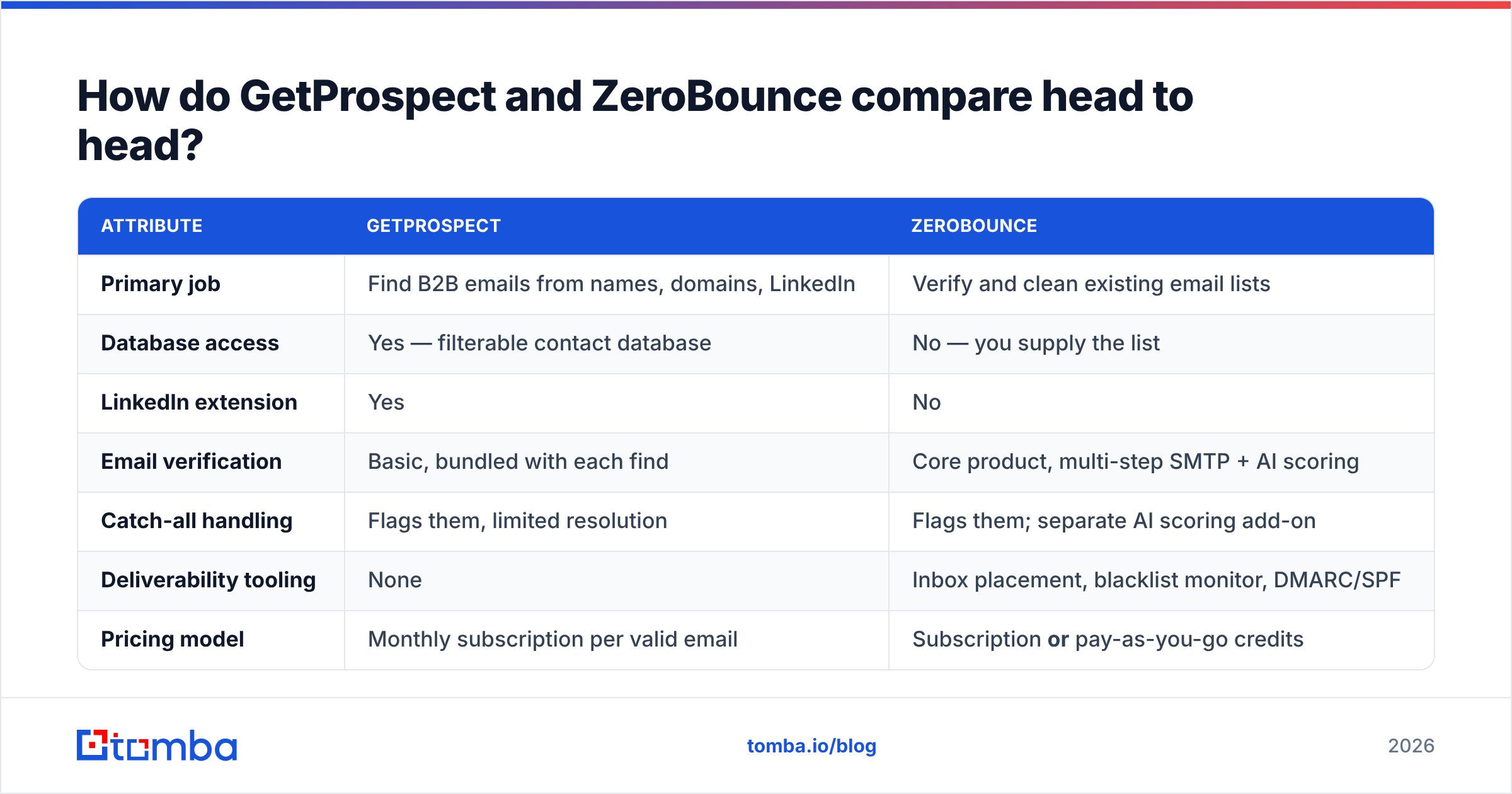
| Attribute | GetProspect | ZeroBounce |
|---|---|---|
| Primary job | Find B2B emails from names, domains, LinkedIn | Verify and clean existing email lists |
| Database access | Yes — filterable contact database | No — you supply the list |
| LinkedIn extension | Yes | No |
| Email verification | Basic, bundled with each find | Core product, multi-step SMTP + AI scoring |
| Catch-all handling | Flags them, limited resolution | Flags them; separate AI scoring add-on |
| Deliverability tooling | None | Inbox placement, blacklist monitor, DMARC/SPF |
| Pricing model | Monthly subscription per valid email | Subscription or pay-as-you-go credits |
| Free tier | ~50 valid emails/month | ~100 verifications/month |
| Typical entry cost | ~$49/month | ~$16 for 2,000 credits |
| API | Yes | Yes |
| Best for | Building lists from scratch | Protecting an existing sender reputation |
Pricing above reflects publicly listed plans at the time of writing on getprospect.com and zerobounce.net. Both vendors change tiers, so confirm before you buy.
Cross-check user sentiment on G2 rather than either vendor's own testimonials page.
Which one is more accurate — and accurate at what?#
Most comparison posts get lazy here, because "accuracy" means two different things.
GetProspect's accuracy is about coverage. Ask for the email of a VP of Engineering at a 200-person SaaS company and you get one of three outcomes: the right address, the wrong one, or nothing at all. Finders trade these against each other. A tool that guesses hard shows high hit rates and high bounce rates. A tool that stays quiet unless it is sure returns fewer emails and cleaner sends.
GetProspect leans a little conservative. That is the right call. But it means your list-building speed depends on how well your target segment is covered. Mid-market North American SaaS: strong. European industrials, small agencies, non-English domains: noticeably thinner.
ZeroBounce's accuracy is about the verdict. Given an address, does the "valid" label hold when you actually send? Independent tests put the serious players — ZeroBounce, NeverBounce, Bouncer, Tomba's verifier — within a few points of each other on standard mailboxes. The gap opens on catch-all domains. There the mail server gives no honest answer, so vendors fall back on inference. ZeroBounce sells that inference as an AI score. Treat those scores as odds, not verdicts.

The practical implication: a finder's built-in check is only as good as the record it just pulled. If GetProspect surfaced the contact from a two-year-old crawl, the "verified" flag reflects a check run in the past, not one run at query time. That is the strongest argument for running a dedicated email verifier over any list before a first send — whatever finder produced it.
What does each one actually cost in 2026?#
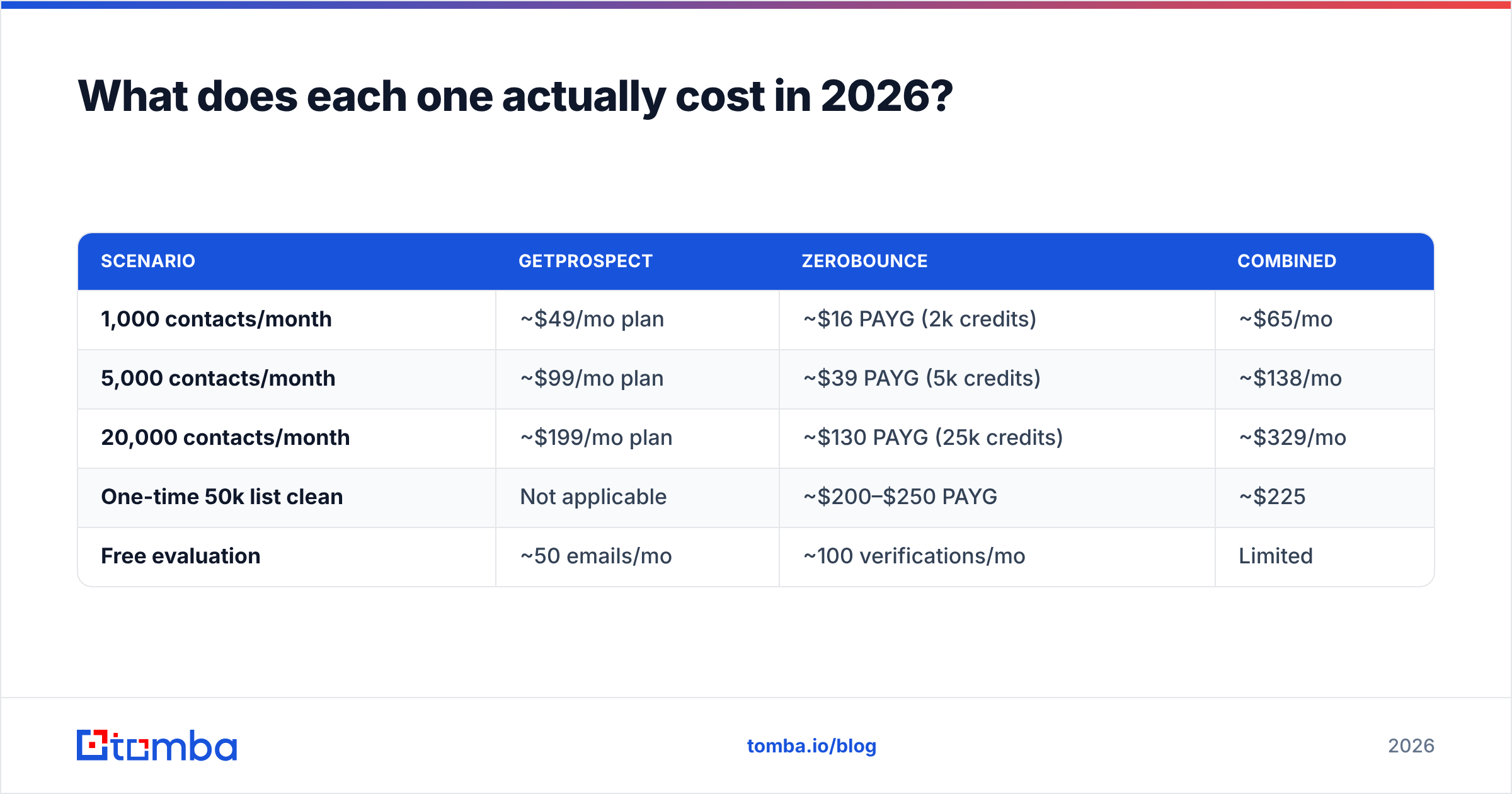
Money is where the "they're not competitors" framing gets expensive. You end up paying twice for the same 10,000 contacts.
| Scenario | GetProspect | ZeroBounce | Combined |
|---|---|---|---|
| 1,000 contacts/month | ~$49/mo plan | ~$16 PAYG (2k credits) | ~$65/mo |
| 5,000 contacts/month | ~$99/mo plan | ~$39 PAYG (5k credits) | ~$138/mo |
| 20,000 contacts/month | ~$199/mo plan | ~$130 PAYG (25k credits) | ~$329/mo |
| One-time 50k list clean | Not applicable | ~$200–$250 PAYG | ~$225 |
| Free evaluation | ~50 emails/mo | ~100 verifications/mo | Limited |
Two things worth flagging. First, ZeroBounce's pay-as-you-go credits do not expire on most plans. That makes them well-suited to occasional list hygiene: the quarterly clean, the pre-campaign scrub, the CRM audit.
Second, GetProspect bills per valid email returned. A search that produces nothing usually does not burn credit. That is fairer than the per-query model some rivals use, and it matters when you prospect into thin segments.
The awkward middle ground is the team doing continuous outbound: 3,000–10,000 new contacts a month, every month. You pay a subscription to find them, top up credits to check them, then reconcile two usage dashboards at month end.
Do you actually need both tools?#
Sometimes yes. Run this checklist honestly:
- You buy or inherit lists from events, partners, or data brokers. You need a dedicated verifier. A finder never touched those records, so its confidence flags do not apply. This is ZeroBounce's strongest use case.
- You are being throttled or filtered right now. Bounce rate above 3%, spam complaints climbing, Postmaster reputation dropping. Fix verification and deliverability first; add contacts second. Volume on a damaged domain only speeds up the damage.
- You have zero contacts and a defined ICP. You need a finder. Verifying an empty list is a philosophical exercise.
- You send under 2,000 cold emails a month from a clean domain. One finder with built-in verification is almost certainly enough. Two vendors is over-engineering.
- You run enrichment inside a product or workflow. You want one API, not two. Chaining a find call to a separate verify call means two auth schemes, two rate limits, and two failure paths.
The honest read: most small and mid-size outbound teams do not need both. They need one tool that finds and verifies on the same credit pool. Add free deliverability checks they can run monthly — an SPF checker, a blacklist checker, and a spam-score test — and you cover most of what a standalone deliverability suite offers at the small-team tier.

How does a consolidated platform compare to running both?#
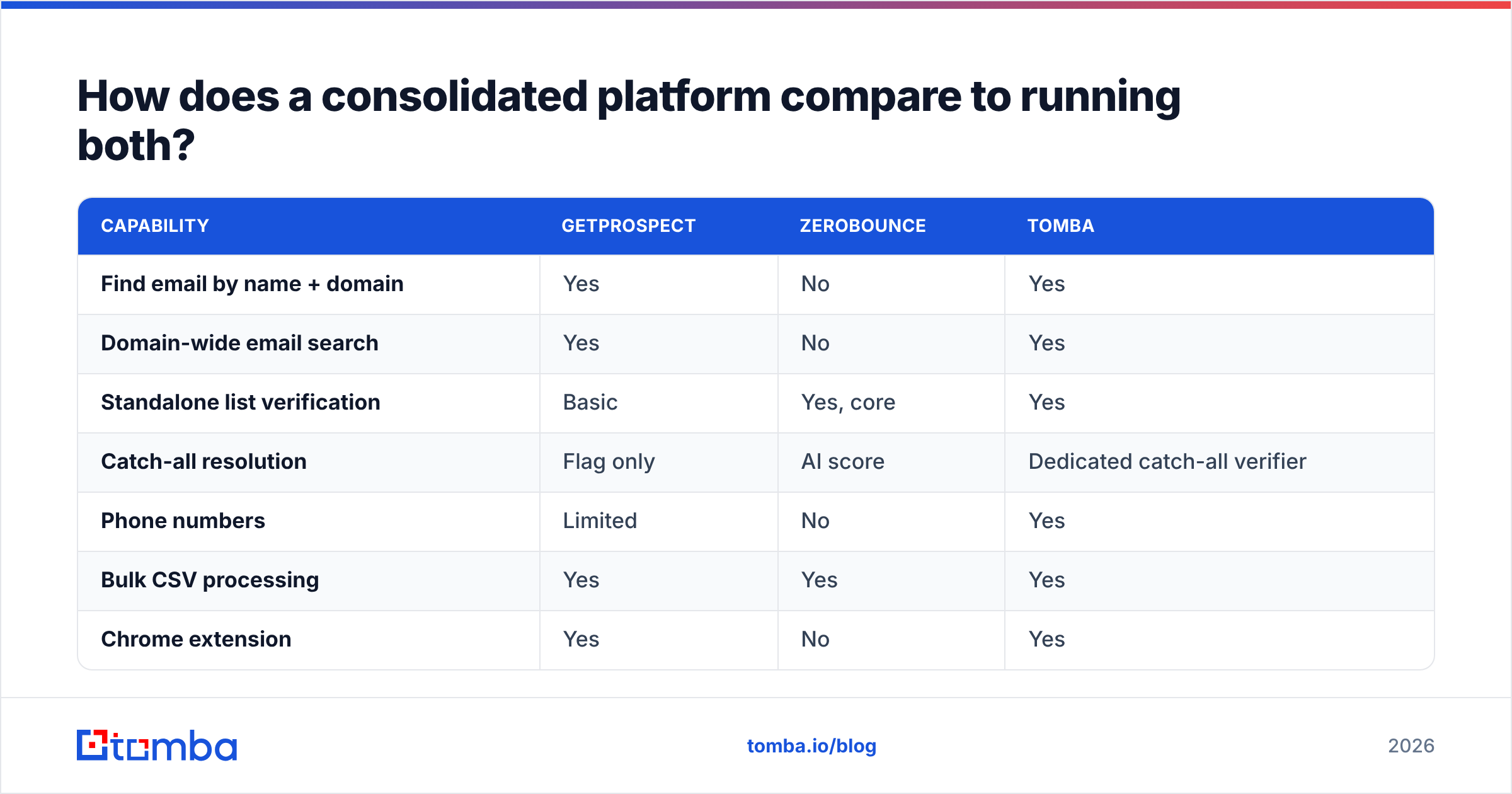
Here is the three-way view, since "GetProspect + ZeroBounce" is a stack, not a product:
| Capability | GetProspect | ZeroBounce | Tomba |
|---|---|---|---|
| Find email by name + domain | Yes | No | Yes |
| Domain-wide email search | Yes | No | Yes |
| Standalone list verification | Basic | Yes, core | Yes |
| Catch-all resolution | Flag only | AI score | Dedicated catch-all verifier |
| Phone numbers | Limited | No | Yes |
| Bulk CSV processing | Yes | Yes | Yes |
| Chrome extension | Yes | No | Yes |
| Entry price | ~$49/mo | ~$16 PAYG | $49/mo |
| Free tier | ~50 emails | ~100 verifications | 25 searches |
| Deliverability suite | No | Yes | Free standalone tools |
| One credit pool for find + verify | Partial | N/A | Yes |

Where consolidation wins: one credit pool, one API key, no CSV shuttling between dashboards. And — underrated — one support thread when a result looks wrong.
Tomba's bulk email finder takes a CSV of names and companies and returns found-and-verified rows in one pass. The catch-all verifier handles the domains that plain SMTP probing cannot resolve. Pricing runs Free (25 searches/mo), Starter $49/mo, Growth $99/mo, Pro $249/mo, with Enterprise custom — see Tomba pricing for current credit allocations.
Where consolidation loses: ZeroBounce's deliverability stack is deeper than anything a finder bundles. Inbox placement testing across seed accounts, ongoing blacklist monitoring, and DMARC reporting are specialist features. If email is your main revenue channel and you send hundreds of thousands of messages a month, that depth is worth paying for on top of your finder.
Which should you choose for your situation?#
The GetProspect vs ZeroBounce call depends less on features than on where you are today.
| Your situation | Pick |
|---|---|
| Building a first outbound list, no contacts yet | GetProspect or Tomba — a finder, not a verifier |
| Cleaning a purchased or 12-month-old list | ZeroBounce — dedicated verification |
| Continuous outbound, 3k–10k contacts/month | One consolidated platform; add a verifier only if bounces exceed 3% |
| Enterprise ESP sending 500k+/month | ZeroBounce for deliverability, plus a separate data provider |
| Developer embedding enrichment in a product | Single-vendor API; two vendors doubles the integration surface |
| Recruiter sourcing from LinkedIn | GetProspect's extension, or a LinkedIn finder |
| Agency reselling list-building | Consolidated platform with predictable per-seat cost |
One note on method, because vendor-reported accuracy numbers are marketing. Build a 100-row test list of contacts you can confirm yourself: people who have emailed you, published addresses, colleagues at partner companies.
Then run it through every candidate on their free tier. Measure three numbers: hit rate (rows returned), precision (returned rows that are correct), and false-positive rate (rows marked valid that bounce on a real send). That takes an afternoon, and it beats every comparison article on the internet, including this one.
What is the verdict?#
Neither tool is "better" — they answer different questions. GetProspect answers "who can I email?" ZeroBounce answers "will this email land?" So the GetProspect vs ZeroBounce decision comes down to one thing: which of those questions is costing you pipeline right now?
If it is the first, buy a finder, and make sure it checks addresses at query time. If it is the second, buy a verifier and stop adding volume until the reputation problem is fixed.
If it is honestly both — and for most growing outbound teams it is — the two-vendor stack works. Just check whether one platform covers you for less before you commit to two subscriptions, two credit systems, and two renewal dates. Also worth reading: our breakdown of the ZeroBounce alternative landscape and where each verifier's pricing model bites.
Ready to test the consolidated path? The Tomba Email Finder finds professional addresses by name, domain, or company and verifies them on the same credit. You get 25 free searches a month, no card required. The same API powers the Chrome extension, Sheets add-on, and bulk CSV processing.
Run your 100-row test list through it alongside GetProspect and ZeroBounce, and let the numbers decide instead of the pricing pages.
Related guides#
Ready to find emails that actually work?
Join 150,000+ professionals who stopped guessing and started sending. Free credits on signup — no credit card required.
Get the Tomba newsletter
Practical outbound tactics and product updates — once every two weeks.
About the author