GetProspect vs ZoomInfo: Which B2B Data Tool Wins in 2026?
GetProspect costs under $100/month. ZoomInfo often lands north of $15,000/year. We break down accuracy, coverage, contracts, and which one actually fits your outbound motion in 2026.
TL;DR
- GetProspect is a LinkedIn-first email finder with self-serve pricing starting around $49/month and a free tier — good for solo founders, agencies, and small SDR teams building lists from LinkedIn searches.
- ZoomInfo is an enterprise GTM data platform with intent signals, org charts, phone numbers, and CRM workflows — priced by annual contract, commonly $15,000–$40,000+ per year with seat minimums.
- The real decision isn't "which has better data." It's whether you need intent and org-chart depth enough to sign an annual contract, or just accurate work emails on demand.
- ZoomInfo wins on US direct dials, technographics, and intent. GetProspect wins on cost-per-contact, contract flexibility, and speed to first list.
- If your job is mostly "turn a name and a company into a verified email," a focused email finder at $49/month does that job without the procurement cycle.
What are GetProspect and ZoomInfo, actually?#
They solve overlapping problems from opposite ends of the market.
GetProspect is a lead-generation tool built around finding and verifying B2B email addresses. Its core workflow: run a LinkedIn Sales Navigator search or upload a list of names and domains, and GetProspect returns work emails with a verification status. It ships a Chrome extension, a CSV-based bulk finder, a small built-in contact database, and a light CRM-ish list manager. Pricing is self-serve and monthly.
ZoomInfo is a full go-to-market intelligence platform. Beyond contact data, it sells buyer intent (which companies are researching your category right now), technographics (what software a company runs), org charts, scoops (job changes, funding, hiring signals), conversation intelligence via ZoomInfo Copilot, and deep CRM/MAP integrations. It's sold by an account executive on an annual contract with credit allocations and seat minimums.
The mismatch matters. Comparing them feature-for-feature makes ZoomInfo look like an obvious winner — it has more of everything. Comparing them on cost-per-verified-contact flips the result hard.

How do GetProspect and ZoomInfo compare on price and features?#
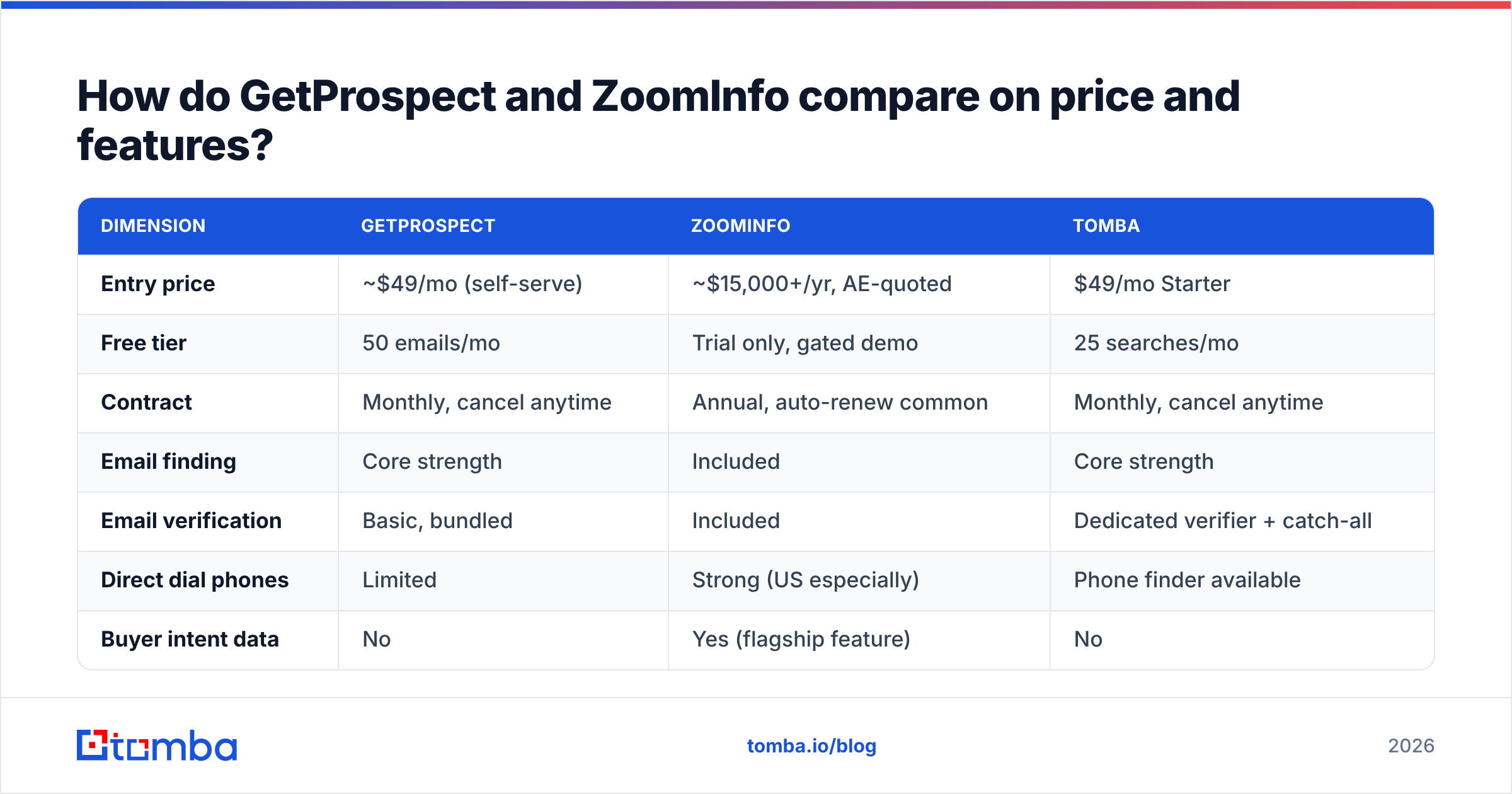
Here's the honest side-by-side. ZoomInfo does not publish list pricing, so the figures below reflect the range consistently reported by buyers on G2 and in public procurement records.
| Dimension | GetProspect | ZoomInfo | Tomba |
|---|---|---|---|
| Entry price | ~$49/mo (self-serve) | ~$15,000+/yr, AE-quoted | $49/mo Starter |
| Free tier | 50 emails/mo | Trial only, gated demo | 25 searches/mo |
| Contract | Monthly, cancel anytime | Annual, auto-renew common | Monthly, cancel anytime |
| Email finding | Core strength | Included | Core strength |
| Email verification | Basic, bundled | Included | Dedicated verifier + catch-all |
| Direct dial phones | Limited | Strong (US especially) | Phone finder available |
| Buyer intent data | No | Yes (flagship feature) | No |
| Technographics | No | Yes | Partial via enrichment |
| Org charts | No | Yes | No |
| API access | Yes, paid tiers | Yes, enterprise add-on | Yes, all paid tiers |
| Credit rollover | Limited | Varies by contract | Plan-dependent |
| Best for | SMB, agencies, solo SDRs | Enterprise sales orgs | API-first teams, dev-heavy stacks |
Two lines in that table decide most deals: contract and intent data. If you need intent, ZoomInfo (or 6sense, or Demandbase) is the category. If you don't, you're paying enterprise pricing for a spreadsheet of emails.
Is ZoomInfo worth the price premium?#
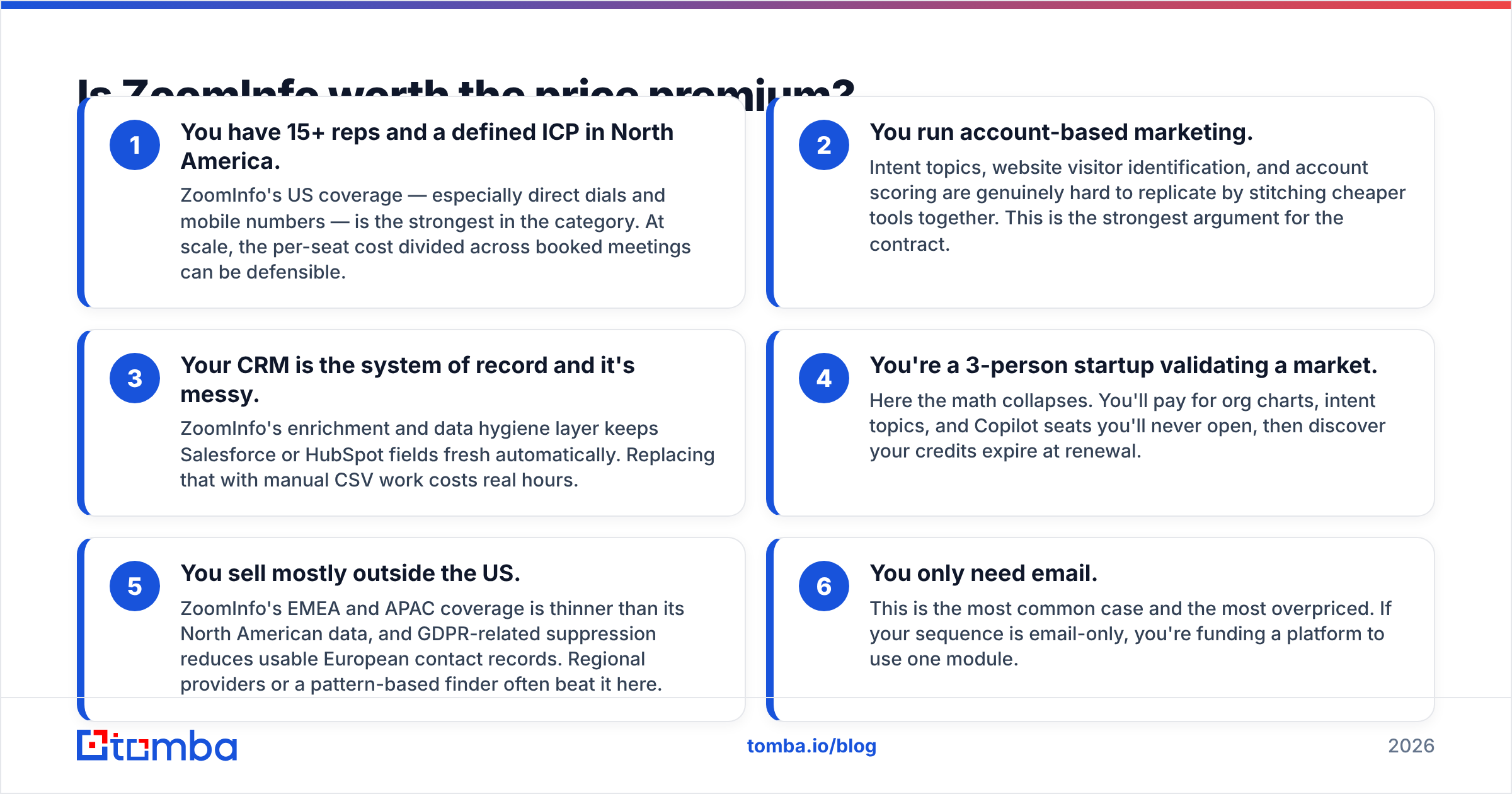
Sometimes. Here's when the math works and when it doesn't.
- You have 15+ reps and a defined ICP in North America. ZoomInfo's US coverage — especially direct dials and mobile numbers — is the strongest in the category. At scale, the per-seat cost divided across booked meetings can be defensible.
- You run account-based marketing. Intent topics, website visitor identification, and account scoring are genuinely hard to replicate by stitching cheaper tools together. This is the strongest argument for the contract.
- Your CRM is the system of record and it's messy. ZoomInfo's enrichment and data hygiene layer keeps Salesforce or HubSpot fields fresh automatically. Replacing that with manual CSV work costs real hours.
- You're a 3-person startup validating a market. Here the math collapses. You'll pay for org charts, intent topics, and Copilot seats you'll never open, then discover your credits expire at renewal.
- You sell mostly outside the US. ZoomInfo's EMEA and APAC coverage is thinner than its North American data, and GDPR-related suppression reduces usable European contact records. Regional providers or a pattern-based finder often beat it here.
- You only need email. This is the most common case and the most overpriced. If your sequence is email-only, you're funding a platform to use one module.
Point six is the whole post, really. Most teams evaluating GetProspect vs ZoomInfo are trying to answer "how do I get accurate work emails without overpaying," and they've been dragged into an enterprise sales cycle to answer it.
How accurate is each tool's data?#
Accuracy claims in this category are marketing until you test them. Both vendors quote high-90s percentages; neither number survives contact with a real list.
What actually drives accuracy:
- Verification method. SMTP-level verification catches dead mailboxes that pattern-guessing misses. GetProspect verifies, but its handling of catch-all domains is basic — catch-alls get flagged as "risky" and you're left guessing. A dedicated catch-all verifier resolves a meaningful slice of those instead of discarding them.
- Data recency. ZoomInfo's advantage is refresh frequency at scale, backed by community contribution and a large research operation. GetProspect's database is smaller and refreshed less aggressively, though its live-lookup finder partly compensates.
- Role seniority. Both tools degrade on senior executives at large enterprises, where personal emails are deliberately obscured, and on companies under ~20 employees, where there's little public footprint.
- Region. Expect a noticeable drop-off for both outside North America and Western Europe.

The practical move: run the same 200-contact test list through any tool you're evaluating, send to it, and measure the actual bounce rate — not the tool's self-reported confidence score. A 3% hard bounce rate is fine. Above 5% and your email deliverability is at risk regardless of what the dashboard claimed.
Which one fits your team size and workflow?#
Match the tool to the motion, not to the feature list.
Solo founder or 1–3 person sales team. GetProspect's monthly plan is the right shape. You need volume flexibility more than you need intent signals. Watch the credit expiry terms — unused credits typically don't roll indefinitely.
Agency running outbound for clients. GetProspect works, but check seat and export limits carefully. Agencies burn through credits unevenly across client accounts, and per-seat pricing gets awkward when a contractor needs access for two weeks. An API-first tool with pooled credits is usually cheaper here — pull contacts programmatically via a bulk email finder rather than paying for UI seats nobody uses.
Mid-market team, 10–30 reps. This is the genuine gray zone. You're big enough that ZoomInfo's AE will call you, small enough that the contract stings. Ask specifically: what's the minimum viable ZoomInfo config for email + phone only, without intent and Copilot? Sometimes it lands near $12K–$15K. Then compare against a stacked approach — a finder plus a separate intent tool — and see which wins.
Enterprise, 50+ reps, ABM motion. ZoomInfo is likely the answer, or a direct competitor at the same tier. At that scale the data-ops burden of stitching point solutions together exceeds the license cost.
Developer-led or product-led GTM. Neither is ideal. You want raw API access with predictable per-call pricing and no seat tax. The email finder API pattern — call it from your enrichment pipeline, pay for what you use — fits better than either UI-first product.
What are the hidden costs buyers miss?#
Three line items that don't show up in the demo.
Credit expiry and rollover. ZoomInfo contracts typically allocate credits annually with limited rollover. If your team ramps slowly, you may forfeit a large share of what you bought. GetProspect's monthly credits usually expire monthly — smaller stakes, but the same trap.
Seat minimums. ZoomInfo's pricing is heavily seat-driven. Adding a junior SDR mid-contract often triggers a co-terminous amendment at full annual rate, not a prorated monthly bump.
Auto-renewal windows. Read the renewal clause. Enterprise data contracts commonly require 60–90 days' written notice to cancel. Buyers who miss the window get another full year. This appears in a large share of negative enterprise-software reviews and it is entirely avoidable with a calendar reminder.
Data cleanup labor. Whatever you buy, someone has to dedupe, normalize, and verify before import. Budget for it. A remove duplicates pass and a verification pass before sequencing costs an hour and saves your sender reputation.

What are the alternatives to both?#
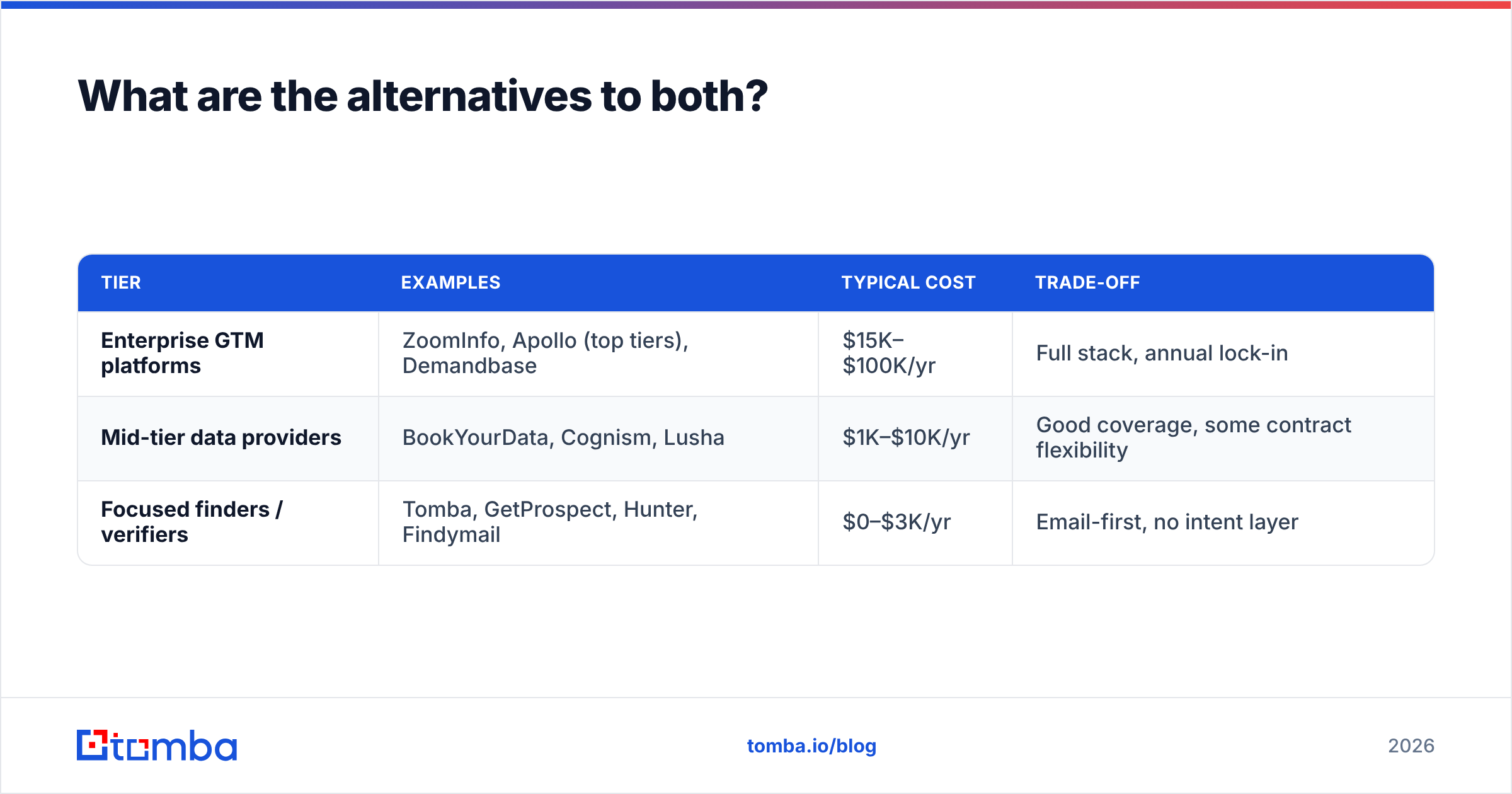
The GetProspect-vs-ZoomInfo framing is a false binary. The market splits into three tiers:
| Tier | Examples | Typical cost | Trade-off |
|---|---|---|---|
| Enterprise GTM platforms | ZoomInfo, Apollo (top tiers), Demandbase | $15K–$100K/yr | Full stack, annual lock-in |
| Mid-tier data providers | BookYourData, Cognism, Lusha | $1K–$10K/yr | Good coverage, some contract flexibility |
| Focused finders / verifiers | Tomba, GetProspect, Hunter, Findymail | $0–$3K/yr | Email-first, no intent layer |
BookYourData deserves a mention in the middle tier — it sells pay-as-you-go verified B2B lists with a bounce guarantee, which suits teams that want a one-time list rather than a subscription. That's a genuinely different purchase model from both tools in this comparison, and for a single campaign it can be the cheapest path.
For teams that landed here because ZoomInfo quoted too high and GetProspect felt too thin, the middle path is usually: a reliable finder plus a real verifier plus your existing CRM. You give up intent data. You keep about $14,000 a year.

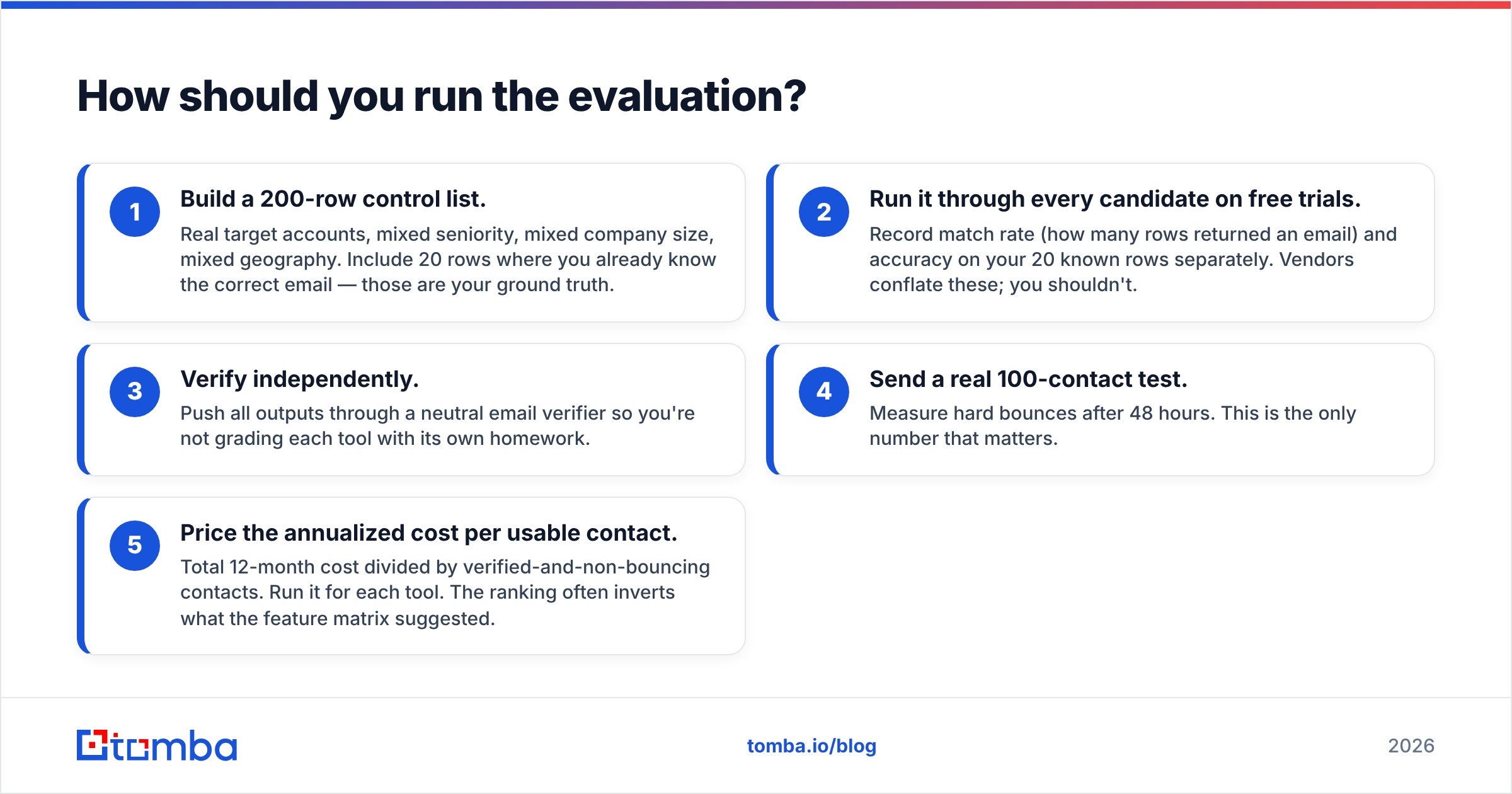
How should you run the evaluation?#
Don't take the demo. Run a bake-off.
- Build a 200-row control list. Real target accounts, mixed seniority, mixed company size, mixed geography. Include 20 rows where you already know the correct email — those are your ground truth.
- Run it through every candidate on free trials. Record match rate (how many rows returned an email) and accuracy on your 20 known rows separately. Vendors conflate these; you shouldn't.
- Verify independently. Push all outputs through a neutral email verifier so you're not grading each tool with its own homework.
- Send a real 100-contact test. Measure hard bounces after 48 hours. This is the only number that matters.
- Price the annualized cost per usable contact. Total 12-month cost divided by verified-and-non-bouncing contacts. Run it for each tool. The ranking often inverts what the feature matrix suggested.
That process takes about a week and routinely saves five figures. Do it before the quarter-end discount pressure starts, not during — ZoomInfo's steepest discounts land in the last two weeks of a quarter, which is exactly when you're least equipped to evaluate calmly.
Which should you pick?#
Pick ZoomInfo if you're an enterprise sales org running ABM, you need US direct dials and intent signals, and you have the budget and the procurement patience. It's the most complete product in the category and the price reflects that.
Pick GetProspect if you're a small team or agency that needs LinkedIn-sourced work emails at a monthly price point, and intent data isn't part of your motion. It does its narrow job at a fair cost.
Pick neither if what you actually need is accurate email discovery you can call from code or a spreadsheet, without a seat tax or an annual contract. That's the largest group of people reading this comparison, and it's the group both vendors are least designed for.
For that group: Tomba's email finder starts free with 25 searches a month, moves to $49/month on Starter, and $99/month on Growth — with the same Tomba pricing whether you use the web app, the Chrome extension, Google Sheets, or the API. Verification, catch-all handling, and domain search are part of the same account, so you're not paying three vendors to do one job. Start on the free tier, run your own 200-row bake-off, and let the bounce rate decide.
Related guides#
Ready to find emails that actually work?
Join 150,000+ professionals who stopped guessing and started sending. Free credits on signup — no credit card required.
Get the Tomba newsletter
Practical outbound tactics and product updates — once every two weeks.
About the author