Getro Alternatives 2026: 7 Talent Network Tools Compared
Getro owns the VC job board niche, but annual quote-based contracts don't fit every fund, accelerator, or community. Here are seven alternatives and how to tell which one matches your stage.
TL;DR
- Getro is the default job-board-plus-talent-network platform for VC firms and accelerators, but it sells through demos and annual quote-based contracts, which is why most searches for Getro alternatives start with budget.
- If you only need a branded job board that aggregates portfolio roles, white-label platforms like Niceboard or SmartJobBoard cover 80% of the job at self-serve prices.
- If you need the network side — a searchable talent pool, warm intros, matching — the honest alternatives are Consider, a relationship CRM like Affinity, or a DIY Airtable stack.
- Enterprise publishers and associations should look at Madgex or Jobiqo instead; they are built for job board businesses, not portfolio support.
- Whatever you pick, the contact-data layer is separate. Platforms store the profiles you already have; a tool like Tomba Email Finder is what fills the gaps.
What is Getro, and who is it built for?#
Getro sells two things that usually get bought together. The first is a job board product that pulls open roles from your portfolio companies' career pages and republishes them on a branded board at your domain. The second is a talent network layer — a searchable pool of candidates who opted into your community, plus tooling to route them to portfolio hiring managers.
The buyer is almost always a venture fund, an accelerator, a private equity platform team, or a large professional community. The pitch is platform value: your portfolio founders get hiring help without you staffing a full talent partner, and your LPs see a differentiated service line.
It works. The reason people go looking for Getro alternatives is rarely that the product is bad. It's that the shape of the deal — annual commitment, quote-based pricing, a demo before you see numbers — doesn't match a 12-company seed fund or a community running on a $500/month tooling budget. Always verify current terms directly; vendor packaging changes more often than review sites update.
Why do teams start looking for Getro alternatives?#
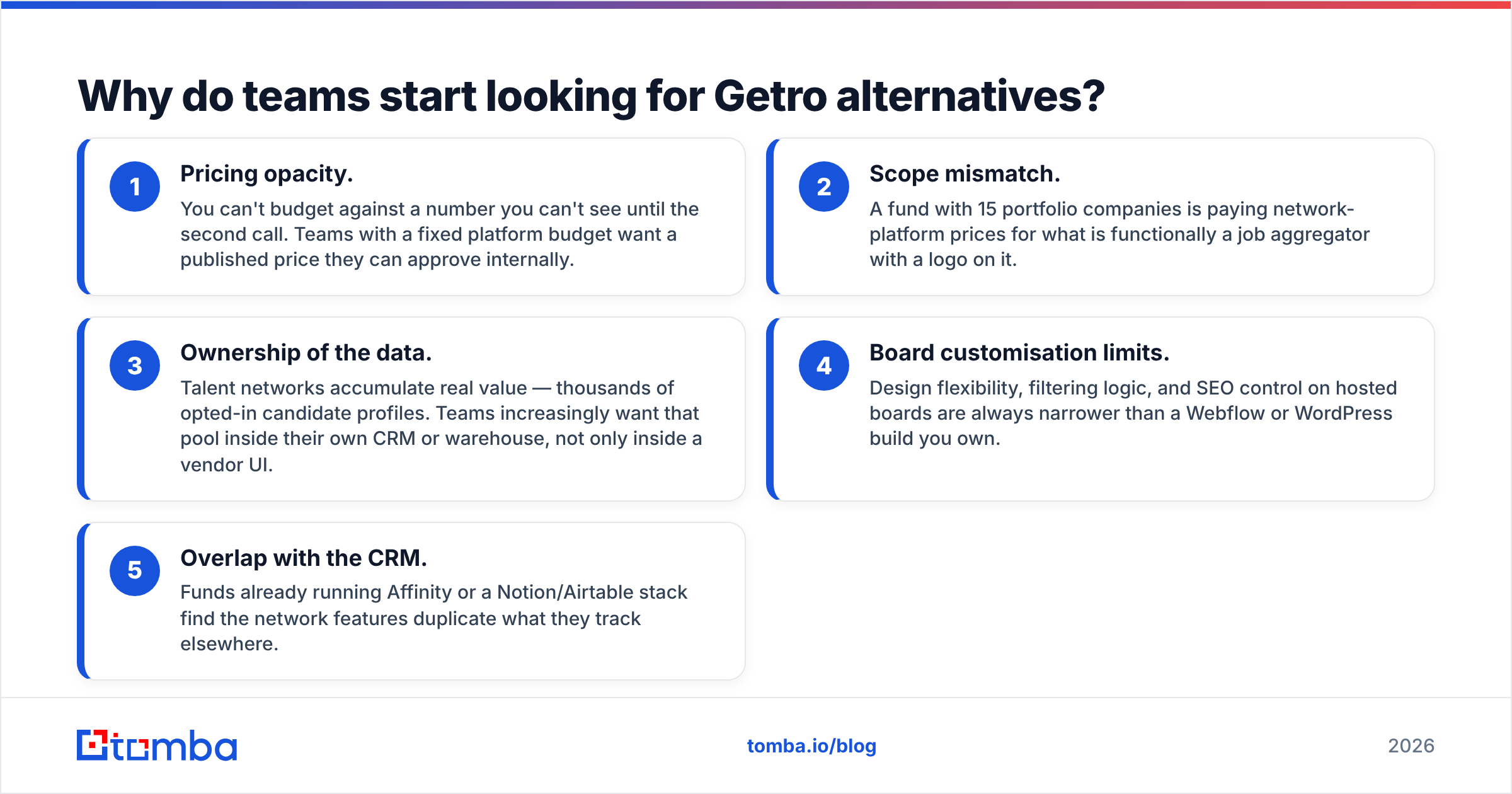
Five reasons come up repeatedly in buyer conversations and in public reviews on G2:
- Pricing opacity. You can't budget against a number you can't see until the second call. Teams with a fixed platform budget want a published price they can approve internally.
- Scope mismatch. A fund with 15 portfolio companies is paying network-platform prices for what is functionally a job aggregator with a logo on it.
- Ownership of the data. Talent networks accumulate real value — thousands of opted-in candidate profiles. Teams increasingly want that pool inside their own CRM or warehouse, not only inside a vendor UI.
- Board customisation limits. Design flexibility, filtering logic, and SEO control on hosted boards are always narrower than a Webflow or WordPress build you own.
- Overlap with the CRM. Funds already running Affinity or a Notion/Airtable stack find the network features duplicate what they track elsewhere.
None of these are dealbreakers for every buyer. They are the specific pressures that push a team toward one of the options below.
What are the best Getro alternatives in 2026?#
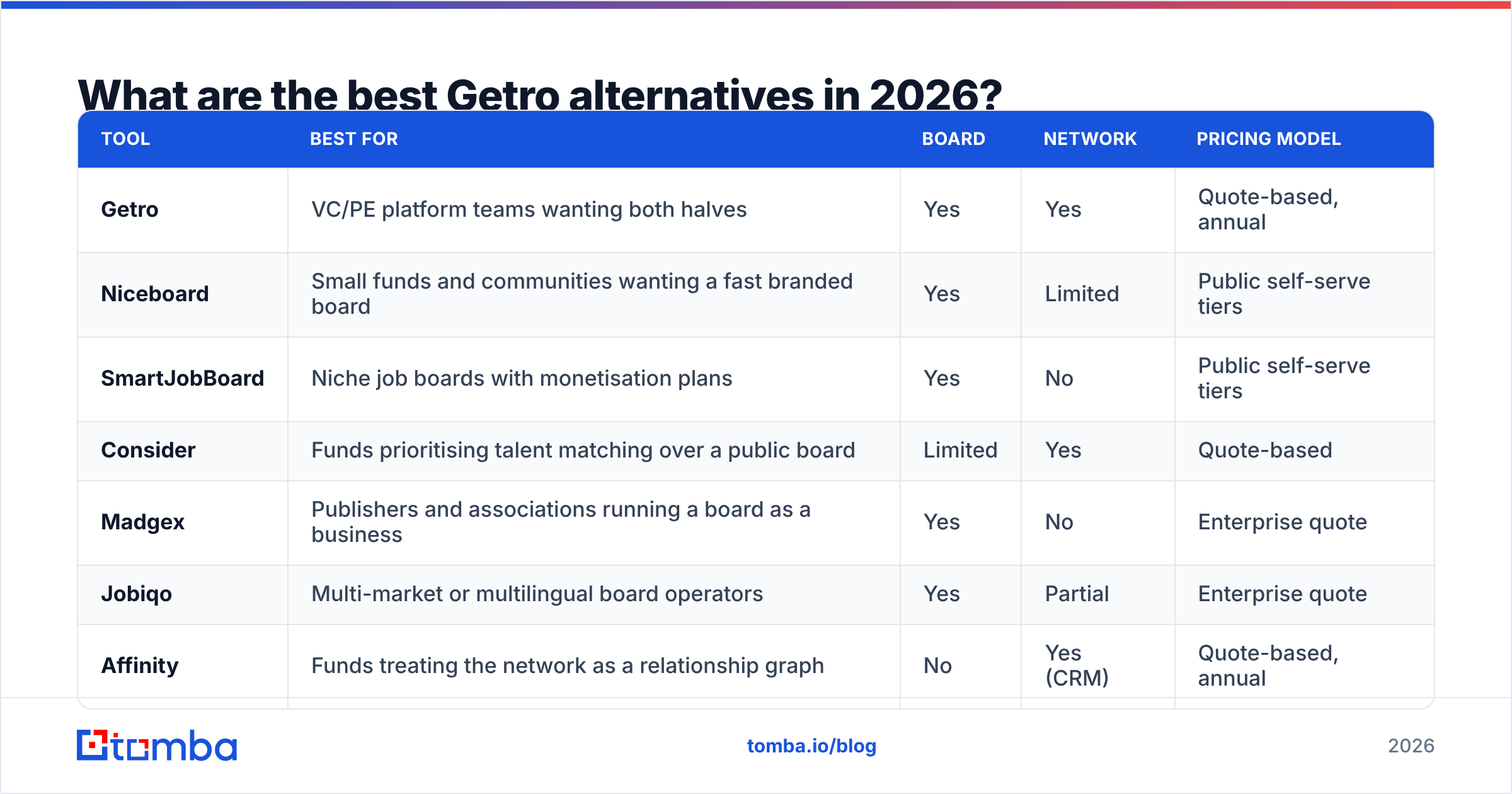
Here's the honest landscape. "Board" means a public, branded job board. "Network" means a searchable talent pool with matching or routing. Pricing models are the shape of the deal, not a quote — check each vendor's page before you budget.
| Tool | Best for | Board | Network | Pricing model |
|---|---|---|---|---|
| Getro | VC/PE platform teams wanting both halves | Yes | Yes | Quote-based, annual |
| Niceboard | Small funds and communities wanting a fast branded board | Yes | Limited | Public self-serve tiers |
| SmartJobBoard | Niche job boards with monetisation plans | Yes | No | Public self-serve tiers |
| Consider | Funds prioritising talent matching over a public board | Limited | Yes | Quote-based |
| Madgex | Publishers and associations running a board as a business | Yes | No | Enterprise quote |
| Jobiqo | Multi-market or multilingual board operators | Yes | Partial | Enterprise quote |
| Affinity | Funds treating the network as a relationship graph | No | Yes (CRM) | Quote-based, annual |
| Airtable + Softr | Sub-20-company portfolios, technical operators | DIY | DIY | Low, mostly your time |
The table hides one important thing: only Getro and Consider treat the two halves as one product. Everything else means you assemble the board and the network yourself, and that assembly cost is real.
How do you pick the right replacement?#
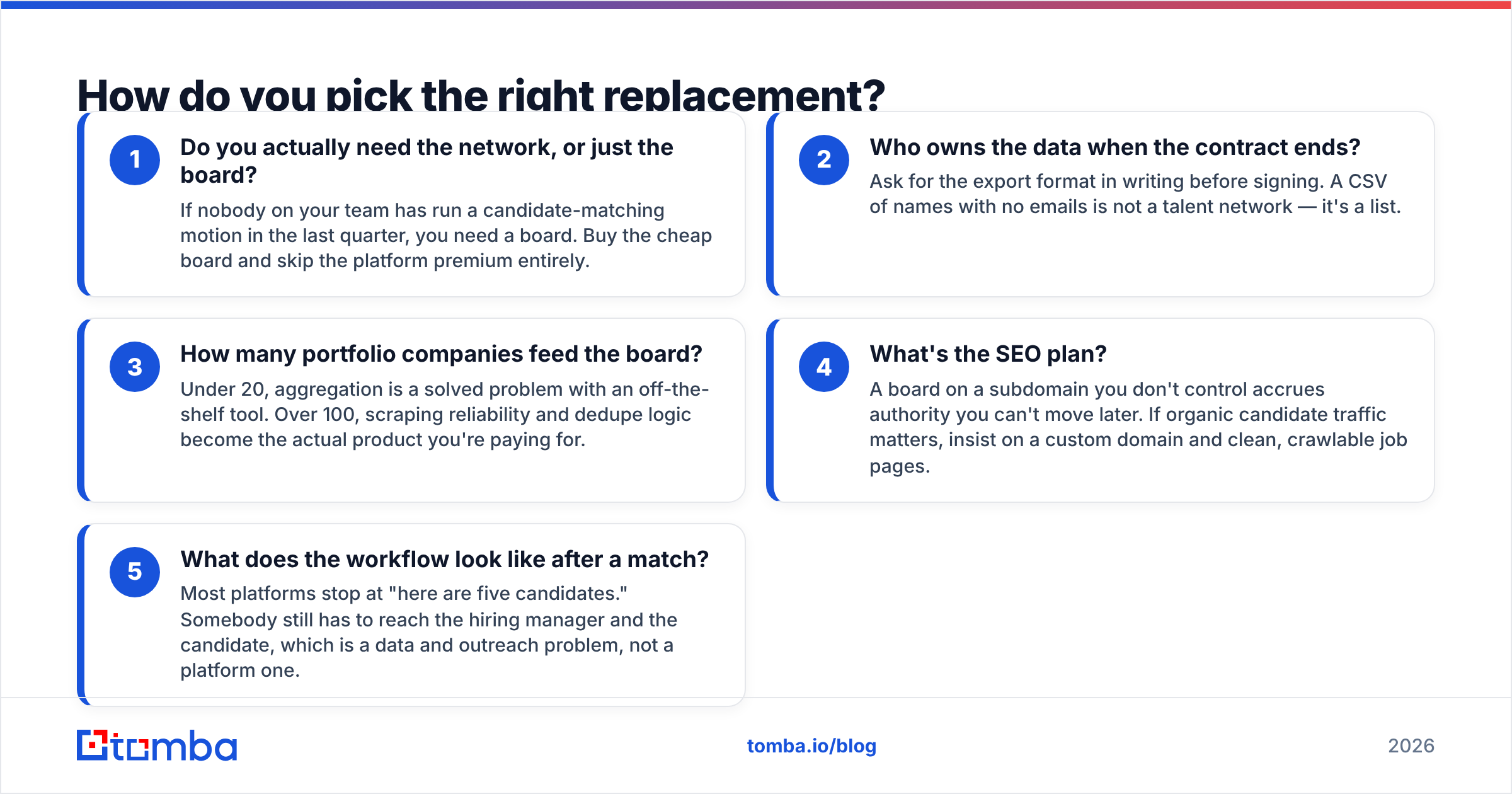
Run these five questions in order. The answer to the first usually eliminates half the list.
- Do you actually need the network, or just the board? If nobody on your team has run a candidate-matching motion in the last quarter, you need a board. Buy the cheap board and skip the platform premium entirely.
- Who owns the data when the contract ends? Ask for the export format in writing before signing. A CSV of names with no emails is not a talent network — it's a list.
- How many portfolio companies feed the board? Under 20, aggregation is a solved problem with an off-the-shelf tool. Over 100, scraping reliability and dedupe logic become the actual product you're paying for.
- What's the SEO plan? A board on a subdomain you don't control accrues authority you can't move later. If organic candidate traffic matters, insist on a custom domain and clean, crawlable job pages.
- What does the workflow look like after a match? Most platforms stop at "here are five candidates." Somebody still has to reach the hiring manager and the candidate, which is a data and outreach problem, not a platform one.
Is a white-label job board enough on its own?#
For most sub-$100M funds, yes.
Niceboard and SmartJobBoard both do the core job: branded board, custom domain, filters, job ingestion, application routing. Niceboard leans toward communities and smaller operators with a cleaner setup path; SmartJobBoard leans toward people who want to run the board as a revenue line, with employer accounts and paid postings baked in.
What you give up versus Getro is the automation depth around portfolio ingestion. Getro's scraping of hundreds of ATS variants and career page layouts is genuinely hard engineering, and a generic board platform will need more manual mapping per company. If your portfolio uses Greenhouse, Lever, and Ashby almost exclusively, that gap is small. If it's a long tail of custom career pages, the gap is where your ops person's Tuesdays go.
A rough rule: under 30 portfolio companies, the manual overhead of a generic board is a few hours a month. Above that, you're rebuilding what you refused to buy.
What are the best options for a talent network without a public board?#
Some funds don't want a board at all. They want a private pool of vetted people they can route to founders on request. That's a different product.
Consider is the closest direct competitor to Getro's network half, built specifically for investor talent teams and matching workflows. Affinity approaches it from the other side: it's a relationship intelligence CRM for dealflow that many funds already own, and a talent pool modelled as contacts with tags and relationship scores is a legitimate use of it. You lose purpose-built matching; you gain one system instead of two, and you gain a CRM your investment team already lives in.
The trap in both cases is data decay. Candidate records age out fast — people change jobs, personal emails go stale, titles drift. A network of 4,000 profiles where 30% of the emails bounce is a network of 2,800 profiles, and you won't know which is which until you send. Periodic bulk verification of the pool is the unglamorous maintenance step that separates a working network from a dashboard number.
Can you build a Getro replacement in-house?#
Yes, and for small portfolios it's often the right call.
The standard build is Airtable (or a Postgres table) as the source of truth, a scraper or an ATS API integration pulling roles on a schedule, and Softr or Webflow rendering the public board. Budget a week of setup and a few hours a month of maintenance. You get complete design control, full data ownership, and a cost measured in tens of dollars a month.
You also get to own every failure. When a portfolio company migrates from Lever to Ashby and your ingestion silently drops their roles, nobody sends you an alert. That's the tradeoff — you're not buying software, you're buying somebody else's on-call rotation.
Teams that already run automation infrastructure handle this fine. Teams where the platform lead is also running events, LP reporting, and founder onboarding should not build.

Where does contact data fit into a talent network stack?#
This is the part every platform comparison skips, and it's where most talent networks quietly fail.
Every option above manages profiles you already have. None of them find the contact you don't have. When a portfolio founder says "we need a VP Eng who has scaled a marketplace team past 50," the answer isn't in your 4,000-person pool — it's a list of 40 people you have to source and reach. The platform helps you organise; it doesn't help you make contact.
That's a separate, cheaper layer:
- Finding work emails for sourced candidates and hiring managers by name and company — a find email addresses lookup rather than a guess-and-hope permutation.
- Verifying before send, because a talent network's reply rate collapses the moment your sending domain picks up bounces. Run the pool through an email verifier before any batch outreach.
- Enriching thin records — a name and a LinkedIn URL becomes a role, company, and seniority via contact enrichment, which is what makes matching filters actually work.
- Automating the loop so ingestion, enrichment, and verification run without a human — that's an email finder API call inside whatever ETL you already run.
Keeping this layer separate from your board platform is a feature, not a compromise. Board vendors change; your contact data shouldn't be hostage to that.
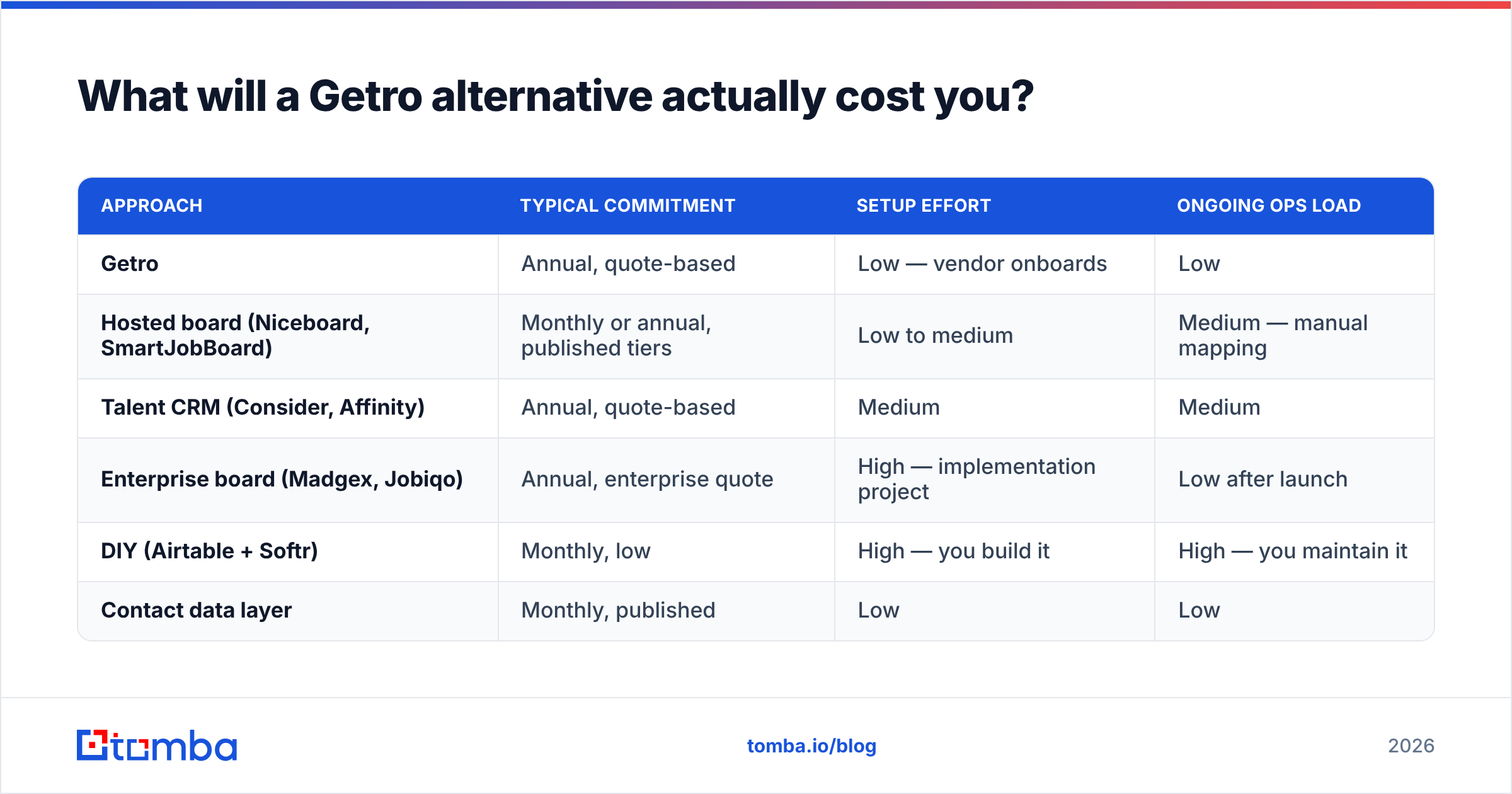
What will a Getro alternative actually cost you?#
Prices below are the shape of each deal, not quotes. Verify with the vendor.
| Approach | Typical commitment | Setup effort | Ongoing ops load |
|---|---|---|---|
| Getro | Annual, quote-based | Low — vendor onboards | Low |
| Hosted board (Niceboard, SmartJobBoard) | Monthly or annual, published tiers | Low to medium | Medium — manual mapping |
| Talent CRM (Consider, Affinity) | Annual, quote-based | Medium | Medium |
| Enterprise board (Madgex, Jobiqo) | Annual, enterprise quote | High — implementation project | Low after launch |
| DIY (Airtable + Softr) | Monthly, low | High — you build it | High — you maintain it |
| Contact data layer | Monthly, published | Low | Low |
The last row is the cheap one. Tomba pricing starts with a free tier at 25 searches per month, then $49/mo for Starter, $99/mo for Growth, and $249/mo for Pro — which means the sourcing layer costs less than the difference between two board vendors' annual quotes.
Which Getro alternative should you choose?#
- Under 25 portfolio companies, no dedicated talent lead: Niceboard or a DIY Airtable board. Spend the saved budget on sourcing.
- 25–100 companies, active talent function: Consider if matching is the core motion; Getro remains defensible if you want both halves from one vendor and can clear the budget.
- You already run Affinity: extend it into a talent pool before buying a second platform. One system beats two integrations.
- Running the board as a revenue business: SmartJobBoard for self-serve, Madgex or Jobiqo at enterprise scale.
- Multilingual or multi-region: Jobiqo, which is built for it. Retrofitting localisation onto a US-centric board is painful.
Getro is not a bad product, and if the network half genuinely drives portfolio outcomes at your firm, the annual number is defensible. But a lot of teams are buying a platform to solve what is really a sourcing problem — and sourcing is solved further down the stack, for two orders of magnitude less.
Start by separating the two. Pick the cheapest board that meets your design and SEO requirements, keep the candidate pool in a system you own, and wire the contact layer underneath both. If you want to test that last piece before committing to any platform decision, the Tomba Email Finder free tier gives you 25 lookups a month — enough to source a full shortlist for one portfolio role and see whether your bottleneck was ever really the software.
Related guides#
Ready to find emails that actually work?
Join 150,000+ professionals who stopped guessing and started sending. Free credits on signup — no credit card required.
Get the Tomba newsletter
Practical outbound tactics and product updates — once every two weeks.
About the author