Getro vs Jet Leads Pro (2026): Which Fits Your Pipeline?
Getro powers talent networks and community job boards. Jet Leads Pro sells outbound lead lists. They get shortlisted together and shouldn't be. Here's what each actually does, what it costs, and where both leave you short on verified contact data.
Getro vs Jet Leads Pro is a matchup that looks tidy on a shortlist and falls apart on inspection. One tool runs talent networks. The other sells cold lead lists. Here is what each one does, what it costs, and where both leave you short.
TL;DR
- These two tools are not really competitors. Getro is community and talent-network infrastructure: job boards, member directories, portfolio-wide talent pooling. Jet Leads Pro sits in the lead-list and prospecting bucket. Same shortlist, two different jobs.
- Pick Getro if your "leads" are people inside a network you already own: a VC portfolio, an accelerator cohort, a community, an association.
- Pick a prospecting tool like Jet Leads Pro if you need net-new contacts outside any network you control, and you accept the verification work.
The rest of the Getro vs Jet Leads Pro question comes down to data quality:
- Neither is an email-verification layer. Both hand you contact records. Neither promises the mailbox is alive on the day you send.
- The honest stack for most teams: a network platform for warm relationships, a dedicated finder-and-verifier for cold, and a CRM that both write into.
What are Getro and Jet Leads Pro, exactly?#
Start here, because the category confusion is the whole story.
Getro (getro.com) is built for organizations that run networks. It sells two well-known products. One is a job board engine, used heavily by venture funds to surface portfolio-company roles. The other is a talent-network layer that lets a community's members be searched, tagged, and matched to open roles. The buyer is usually a platform lead at a VC firm, an accelerator program manager, or a community operator. What Getro sells is placements and network activity, not outbound email volume.
Jet Leads Pro sits in the lead-generation and prospecting space. Pull contact records for a target profile, export them, work them. Public documentation is thinner than Getro's. Plans and credit allowances have shifted. Independent reviews are sparse next to the established players on G2 or Capterra. Treat any number you read online, including the ones in this post, as a starting point. Check the vendor's own pricing page before you sign.
That difference in category drives everything else. One tool deepens a graph you already own. The other buys you rows you don't.
Getro vs Jet Leads Pro: how do they compare feature by feature?#
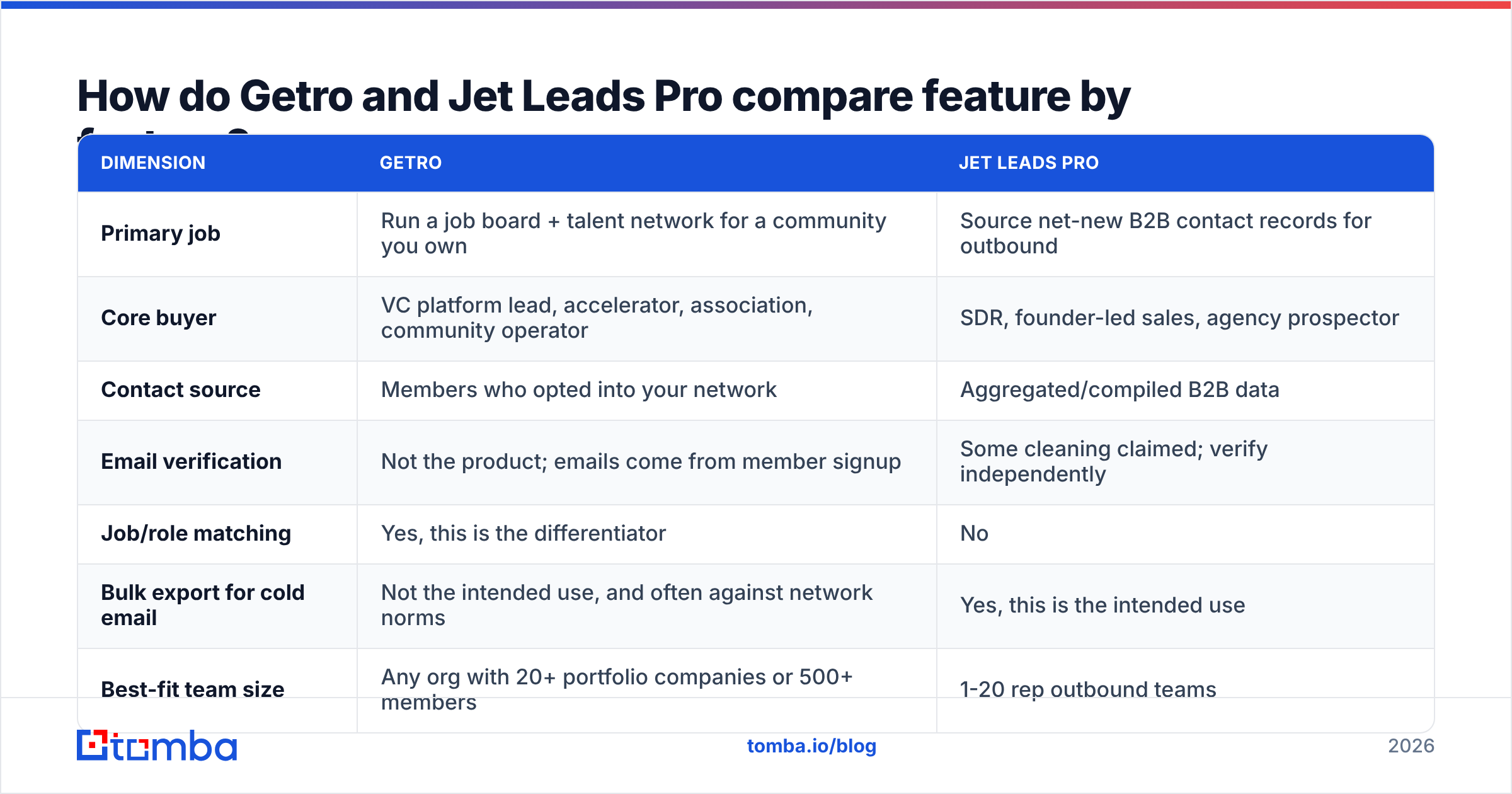
| Dimension | Getro | Jet Leads Pro |
|---|---|---|
| Primary job | Run a job board + talent network for a community you own | Source net-new B2B contact records for outbound |
| Core buyer | VC platform lead, accelerator, association, community operator | SDR, founder-led sales, agency prospector |
| Contact source | Members who opted into your network | Aggregated/compiled B2B data |
| Email verification | Not the product; emails come from member signup | Some cleaning claimed; verify independently |
| Job/role matching | Yes, this is the differentiator | No |
| Bulk export for cold email | Not the intended use, and often against network norms | Yes, this is the intended use |
| Best-fit team size | Any org with 20+ portfolio companies or 500+ members | 1-20 rep outbound teams |
| Pricing model | Annual, quote-based, tiered by network size | Subscription/credit tiers, verify current page |
| Deliverability risk if misused | High (burning your own community's trust) | High (unverified rows to a cold domain) |
Read that table once and the decision usually makes itself. Getro's job-matching row has no equivalent on the right. Jet Leads Pro's bulk-export row has no legitimate equivalent on the left.

What does Getro do best?#
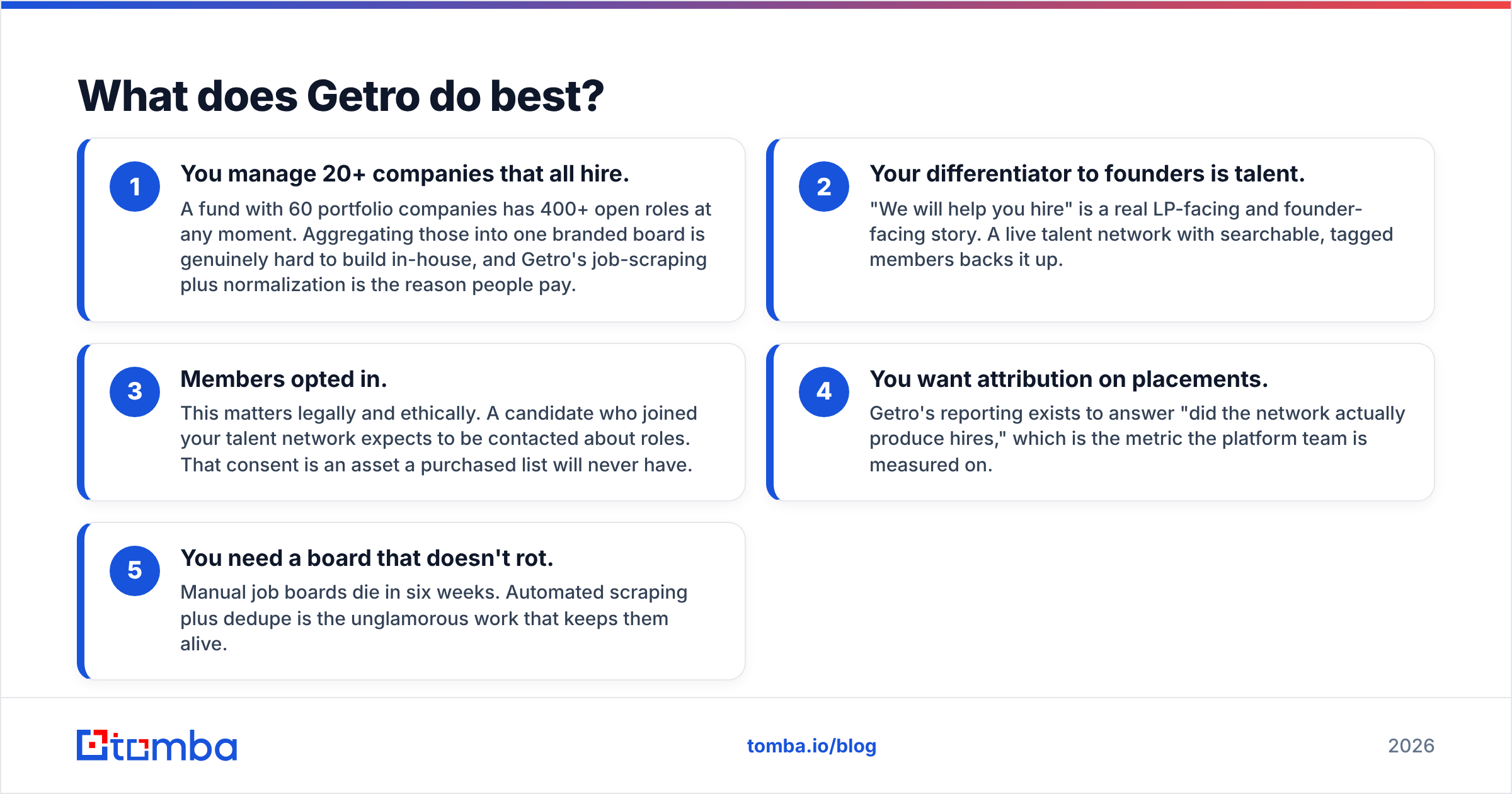
Getro earns its money in one specific situation. You have a network. The network holds more value than you can surface by hand. And the people in it want to be found.
Concretely, it's strong when:
- You manage 20+ companies that all hire. A fund with 60 portfolio companies has 400+ open roles at any moment. Pulling those into one branded board is hard to build in-house. Getro's job scraping and normalization is the reason people pay.
- Your differentiator to founders is talent. "We will help you hire" is a real story for LPs and founders. A live talent network with tagged, searchable members backs it up.
- Members opted in. That matters legally and ethically. A candidate who joined your network expects to hear about roles. A purchased list never carries that consent.
Two more reasons show up after the board goes live:
- You want attribution on placements. Getro's reporting answers one question: did the network produce hires? That is the metric the platform team is judged on.
- You need a board that doesn't rot. Manual job boards die in six weeks. Automated scraping and dedupe keep them alive.
Where Getro is the wrong tool: any moment your goal is reaching people who have never heard of you. It isn't built for that. Forcing it there is how community operators burn their own reputation.
Where does Jet Leads Pro actually fit?#
Prospecting tools in this tier compete on three things. How many records they return for your filters. How fresh those records are. And how much of the price is credits rather than seats.
The value is real when your motion is genuinely cold and high-volume. You know your ICP by firmographic filters. You need a few thousand contacts a month. Your team already has a sequencing tool and warmed sending domains.
The cautions are just as real, and they apply to nearly every tool in this segment:
- Compiled data decays fast. B2B contact churn is high. A list built six months ago already has a meaningful share of dead mailboxes. That decay belongs to the category, not to one vendor.
- "Verified" is not a standard. For one vendor it means a syntax and MX check. For another it means a full SMTP handshake with catch-all handling. Same word, very different guarantees.
- Credits are the real price. A cheap seat with expensive or expiring credits can cost more per usable contact than a pricier plan with generous limits.
- Thin public documentation is a risk signal. Not a dealbreaker. It just means you carry the testing burden. Run a paid pilot on 200 records before you commit for a year.
Which one gives you contact data you can actually send to?#
Neither, on its own. This is the part most comparison posts skip.
Getro's contact data comes from members. It is accurate at signup and less accurate every month after. People change jobs. They switch which address they check. They stop updating profiles. Nothing in a talent-network platform re-validates a mailbox before you email it.
Prospecting tools do claim validation, but the depth varies a lot. The number that matters is not the vendor's headline accuracy claim. It is your bounce rate, on your domain, this month, on your list.
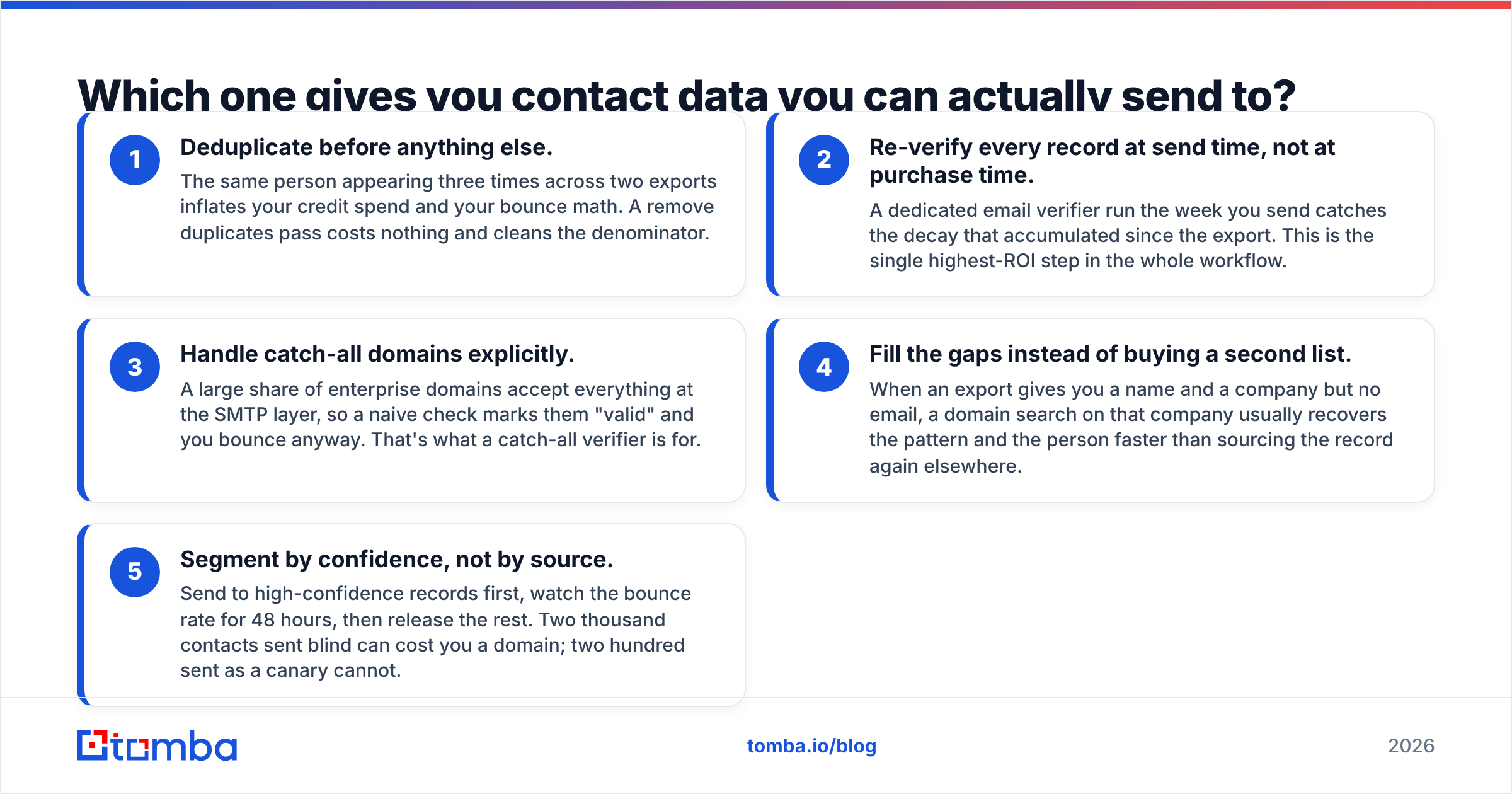
Here's the check sequence that protects your sender reputation, whichever side of this comparison you buy:
- Deduplicate before anything else. The same person in three rows across two exports inflates both your credit spend and your bounce math. A remove duplicates pass costs nothing and cleans the denominator.
- Re-verify at send time, not at purchase time. Run a dedicated email verifier the week you send. It catches the decay that piled up since the export. This is the highest-ROI step in the workflow.
- Handle catch-all domains explicitly. Many enterprise domains accept everything at the SMTP layer. A naive check marks them "valid" and you bounce anyway. That is what a catch-all verifier is for.
Two more steps protect the send itself:
- Fill gaps instead of buying a second list. When an export gives you a name and a company but no email, run a domain search on that company. It usually recovers the pattern and the person faster than sourcing the record again.
- Segment by confidence, not by source. Send to high-confidence records first. Watch the bounce rate for 48 hours. Then release the rest. Two thousand contacts sent blind can cost you a domain. Two hundred sent as a canary cannot.

Pricing: what does Getro vs Jet Leads Pro cost?#
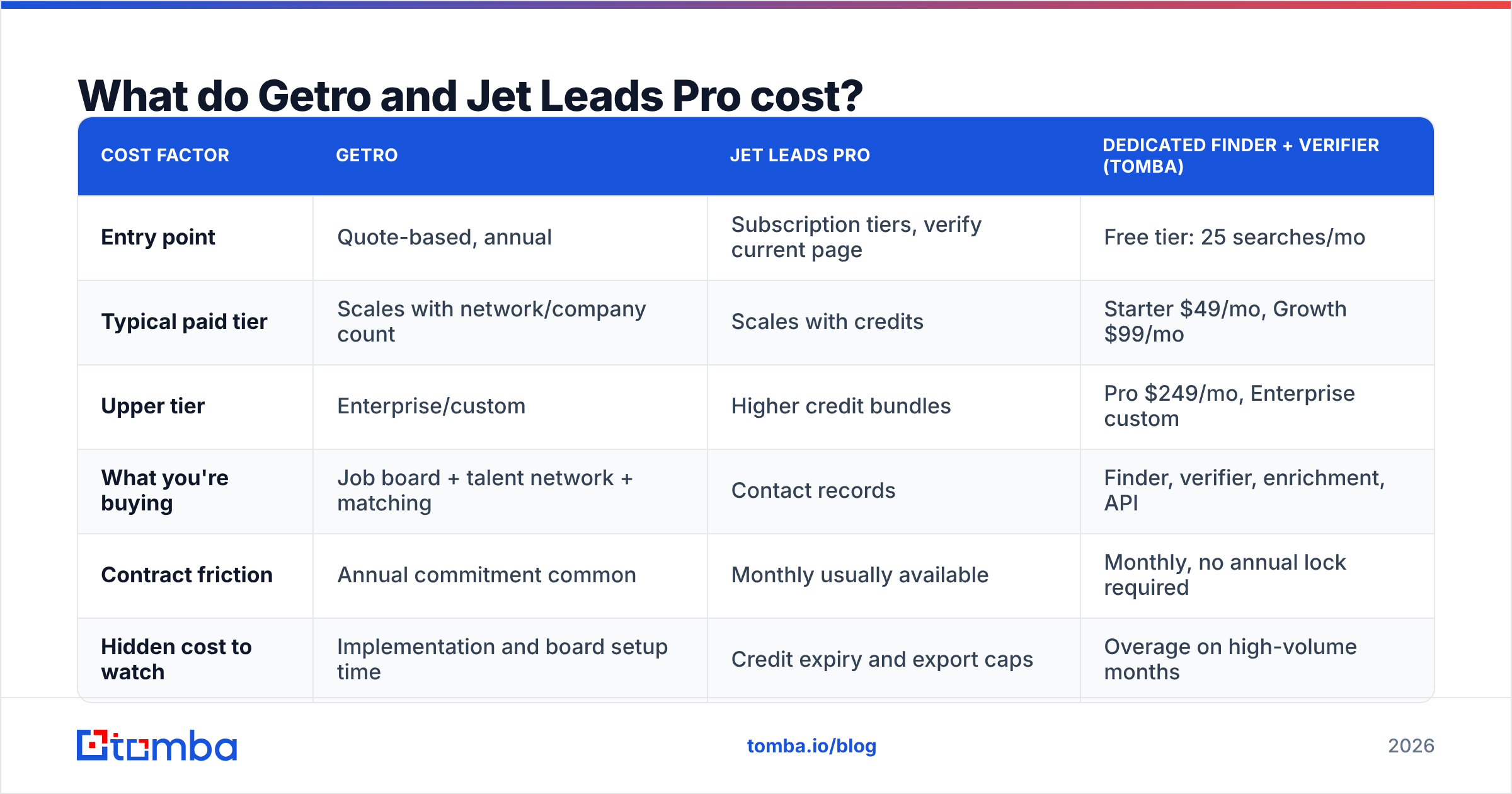
Neither publishes a simple public number you can quote with confidence. So here is the honest shape of it, rather than invented figures.
| Cost factor | Getro | Jet Leads Pro | Dedicated finder + verifier (Tomba) |
|---|---|---|---|
| Entry point | Quote-based, annual | Subscription tiers, verify current page | Free tier: 25 searches/mo |
| Typical paid tier | Scales with network/company count | Scales with credits | Starter $49/mo, Growth $99/mo |
| Upper tier | Enterprise/custom | Higher credit bundles | Pro $249/mo, Enterprise custom |
| What you're buying | Job board + talent network + matching | Contact records | Finder, verifier, enrichment, API |
| Contract friction | Annual commitment common | Monthly usually available | Monthly, no annual lock required |
| Hidden cost to watch | Implementation and board setup time | Credit expiry and export caps | Overage on high-volume months |
Two practical notes. First, judge Getro's cost against the alternative: building and maintaining a job board plus a candidate database in-house. That is a multi-quarter engineering project, not a weekend. Against that baseline the quote usually looks reasonable.
Second, for prospecting tools, compute cost per usable, verified contact, not cost per credit. A $99 plan that returns 60% deliverable records costs more than a $149 plan at 92%. You can sanity-check the math against public Tomba pricing, since those tiers are listed openly.
Is there a scenario where you need both?#
Yes, and it is more common than the either/or framing suggests. This is where Getro vs Jet Leads Pro stops being a choice at all.
Picture a seed fund with 45 portfolio companies. The platform team runs Getro, so every portfolio role lands on one board and the talent network stays searchable. That covers warm supply. Meanwhile the fund sources new deals, which is a cold outbound motion: find operators at Series A companies in three verticals, reach out about a raise. Getro cannot help there, and it shouldn't try.
In that world the split is clean:
- Getro owns the warm graph: members, portfolio jobs, matching, placement reporting.
- A prospecting layer owns net-new discovery for deal sourcing or GTM.
- A verification and enrichment layer sits under both, so nothing goes out unverified and CRM records stay complete. Running exports through a bulk email finder before they reach your sequencer is the cheapest insurance in the stack.
If budget forces one purchase, ask which asset you would rather compound. A network you own and can query forever? Or a list that decays from the day you download it? Community-led organizations answer that one way. A two-person startup with no network yet answers it the other way.
What should you check before you commit to either?#
Run this before signing. It takes an afternoon and saves quarters.
- Ask for a live demo on your own data. For Getro, ask them to ingest three portfolio careers pages and show the normalized output. For a prospecting tool, hand over ten target companies and ask for the contacts. Then verify those contacts yourself.
- Measure a real bounce rate, not a claimed accuracy rate. Export 200 records, run them through an independent verifier, and count. If your test and the vendor's claim disagree, believe your test.
- Confirm the export and API terms. Some contracts restrict bulk export or downstream use. Read the clause before you build a workflow on it.
Then check the boring parts that bite later:
- Check integration reality. "Integrates with HubSpot" can mean a native two-way sync. It can also mean a Zapier hop with field mapping you maintain. Ask which.
- Price the exit. If you leave in 12 months, what do you keep? With a talent network you keep the member relationships. With a list tool you keep a stale CSV.
- Test coverage in your geography. Data providers are uneven outside the US. If half your ICP sits in DACH or APAC, sample-test there before you trust the headline accuracy figure.
Getro vs Jet Leads Pro: so who wins?#
Getro wins if you operate a network and your metric is placements, member engagement, or founder satisfaction. It is purpose-built, and no contact-list subscription replaces it.
Jet Leads Pro (or any comparable prospecting tool) wins if you run cold outbound at volume, you have no network to mine, and you accept that verification is your job. Pilot it against one or two alternatives on identical target accounts. Let the verified-contact-per-dollar number decide.
Neither wins the job of guaranteeing that your next email lands. That is a separate layer. It is cheap, and skipping it turns a good list into a blocklisted domain.
If your bottleneck is finding and confirming work emails, put a real finder under the stack. Start with the Tomba Email Finder on the free tier: 25 searches a month, no card. Run your existing export through it. Then compare the verified count against what you paid for. If the gap stings, you have found the highest-leverage fix in your pipeline, and it costs less than either tool in this Getro vs Jet Leads Pro comparison.
Related guides#
Ready to find emails that actually work?
Join 150,000+ professionals who stopped guessing and started sending. Free credits on signup — no credit card required.
Get the Tomba newsletter
Practical outbound tactics and product updates — once every two weeks.
About the author