Getro vs SignalHire (2026): Which Tool Fits Your Team?
Getro vs SignalHire is an odd matchup. Getro builds talent networks and job boards. SignalHire reveals emails and phone numbers. They get compared constantly, yet they solve almost nothing in common. Here is the honest breakdown.
Getro vs SignalHire is an odd matchup. Getro builds talent networks. SignalHire sells contact data. Buyers still line them up side by side every week, so here is the honest breakdown.
TL;DR
- They are not real competitors. Getro is job-board and talent-network software for VC firms, accelerators, and communities. SignalHire is a contact tool. It reveals emails and phone numbers from public profiles.
- Pick Getro if your job sounds like this: "our 80 portfolio companies need one shared careers hub and a warm talent pool."
- Pick SignalHire if your job sounds like this: "I need to reach 500 named people this month, and I don't have their details."
- Pricing works differently. Getro is quote-based with annual contracts. SignalHire is self-serve and credit-metered. Entry plans run about $39–$49 per month today.
- Neither is a full outbound data stack. For domain-level prospecting or verified emails at scale, a dedicated email finder plus verification does that job cheaper and more accurately.
Why do people compare Getro vs SignalHire?#
Both tools show up when a talent or growth team searches for a way to find and reach the right people. That is where the overlap stops.
Think of a farmers' market and a delivery van. Getro builds the market. Your community's companies post roles there, and candidates opt in. SignalHire is the van. You already know the address. You just need the route and a phone number.
Teams weigh Getro vs SignalHire in two spots:
- A VC platform lead is told to improve talent support for portfolio companies, and gets a budget line. Getro is the obvious answer. But someone on the team also wants sourcing data, so SignalHire lands in the same spreadsheet.
- A recruiting or GTM lead wants one tool for community building and outbound. No such tool exists. Knowing why saves you a bad annual contract.
What is Getro, and who actually uses it?#
Getro is community-owned job board and talent network software. Two products work together:
- Getro Jobs — pulls open roles from every company in your network. It crawls career pages. It syncs with ATS platforms like Greenhouse, Lever, and Ashby. The board stays current, and nobody pastes listings by hand.
- Getro Network — a talent pool layer. Candidates opt in and say what they want. Operators match them to portfolio roles, send intro emails, and report on placements.
The buyer is almost always a platform or community team. Think of a fund with 40–200 portfolio companies, an accelerator cohort, an economic development agency, or a trade group. They track hires driven by the network, not emails sent.
Getro's real value is dull automation. It keeps hundreds of career pages in sync, so the board never rots. Anyone who has kept that list by hand in a spreadsheet knows what it is worth.

What is SignalHire, and what does it return?#
SignalHire reveals contact details. You find a person on LinkedIn, GitHub, a company site, or in SignalHire's own search. The tool returns a work email, a personal email, and often a direct or mobile number. It runs on credits. Each reveal burns some, and phone numbers cost more than emails.
Beyond the reveal, SignalHire ships:
- A Chrome extension that adds contact buttons to profiles and search results
- Bulk enrichment by CSV upload
- An API for lookups in code
- Light candidate tracking — pipelines, notes, team sharing — which is why recruiters like it more than SDRs do
- A free tier with a few credits a month, so you can test quality before you pay
Its sweet spot is people-first sourcing. You know who. You need how to reach them. Domain-first prospecting is the opposite. There you know the company, and you have to work out who to talk to.
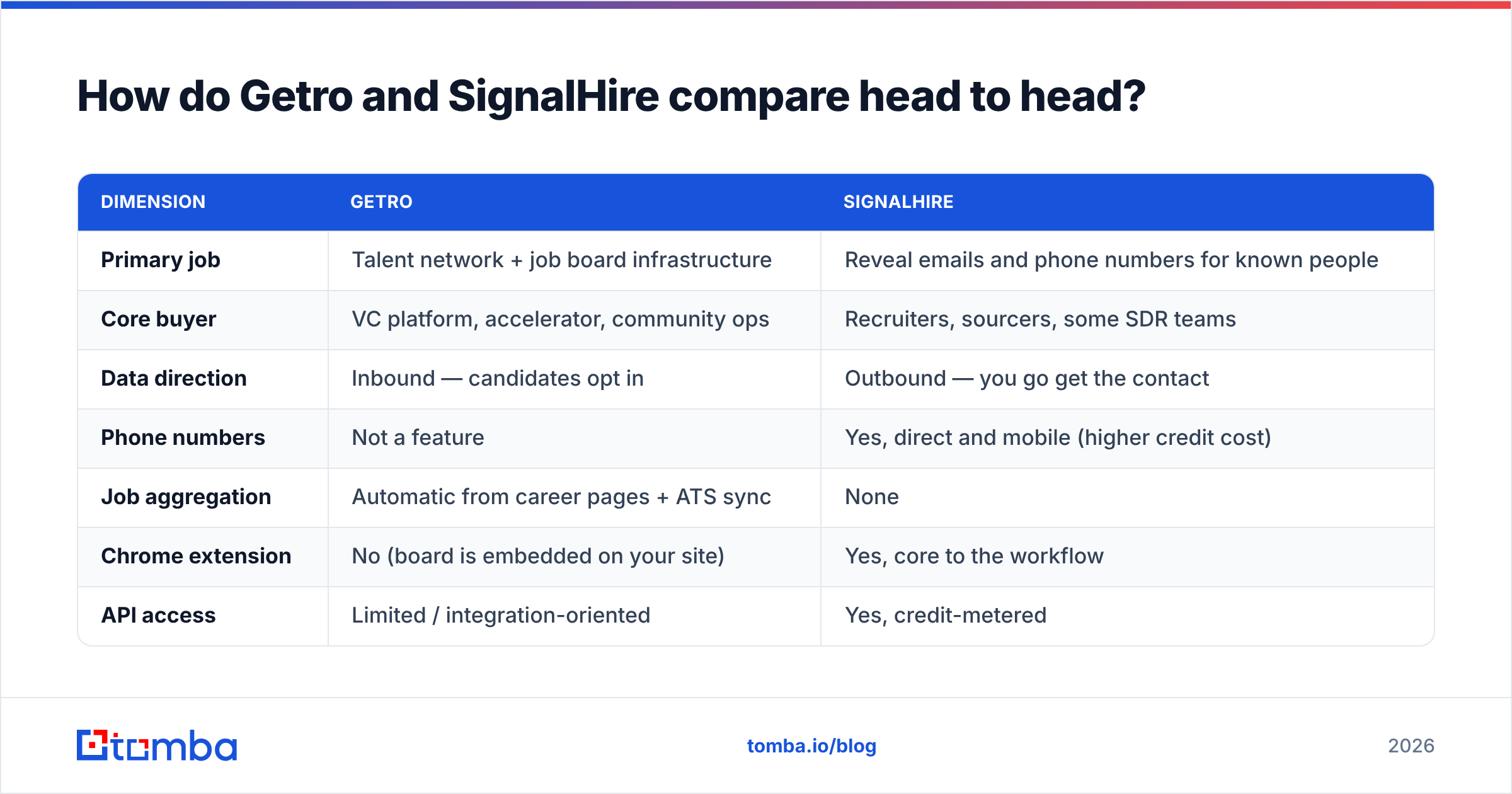
How do Getro vs SignalHire compare head to head?#
| Dimension | Getro | SignalHire |
|---|---|---|
| Primary job | Talent network + job board infrastructure | Reveal emails and phone numbers for known people |
| Core buyer | VC platform, accelerator, community ops | Recruiters, sourcers, some SDR teams |
| Data direction | Inbound — candidates opt in | Outbound — you go get the contact |
| Phone numbers | Not a feature | Yes, direct and mobile (higher credit cost) |
| Job aggregation | Automatic from career pages + ATS sync | None |
| Chrome extension | No (board is embedded on your site) | Yes, core to the workflow |
| API access | Limited / integration-oriented | Yes, credit-metered |
| Pricing model | Quote-based, annual contract | Self-serve, monthly or annual credits |
| Entry price | Not published — expect four figures annually | ~$39–$49/mo range at time of writing |
| Free option | Demo only | Free tier with limited monthly credits |
| Compliance surface | Opt-in candidate data, lower risk | Scraped/aggregated data — check GDPR/CCPA posture |
| Time to first value | Weeks (setup, company onboarding) | Minutes |
Check current pricing on each vendor's own page before you budget. Both changed tiers in the past 18 months, and G2 reviews often quote old numbers.
Which one has better data quality?#
Wrong question, and it trips up most evaluations. The two tools hold different data.
Getro's data quality comes down to job freshness and candidate fit. Does the board show roles that are open? Do opt-in candidates match what portfolio companies want? Getro does well on the first, because the crawling and ATS sync run on their own. The second depends on your team. Software does not create demand.
SignalHire's data quality works like any contact database: hit rate, bounce rate, and phone accuracy. User reports put its email hit rate in a solid band for well-documented tech and enterprise profiles. It drops off sharply for SMBs, non-English markets, and people with a thin public trail. Phone numbers are the stronger asset. That is where most users say the credits pay off.
One catch applies to every reveal tool, SignalHire included: a returned email is not a verified email. These databases hold records that were right when collected. Then they decay. B2B contact data churns 25–30% a year as people change jobs. Export 1,000 contacts, mail them with no verification pass, and the bounce rate will get you flagged before the campaign ends.
That is the most common mistake in this category. It has nothing to do with the vendor you picked.

What does each tool cost in 2026?#
Getro does not publish prices. You book a demo, describe your network size, and get a quote. Reported deals sit in the low-to-mid four figures a year for a job board. Talent network features, custom branding, and more companies push it up. Contracts run annually. Budget for setup time too. Someone on your side has to collect company domains and chase career-page URLs.
SignalHire is self-serve and open about price. Credits are the unit. Entry plans sit near $39–$49 a month today, based on whether you need phone numbers. Per-credit cost drops on bigger bundles and annual commitments. There is a free tier with a small monthly allowance. Use it. Test 20 contacts in your real target segment before you commit.
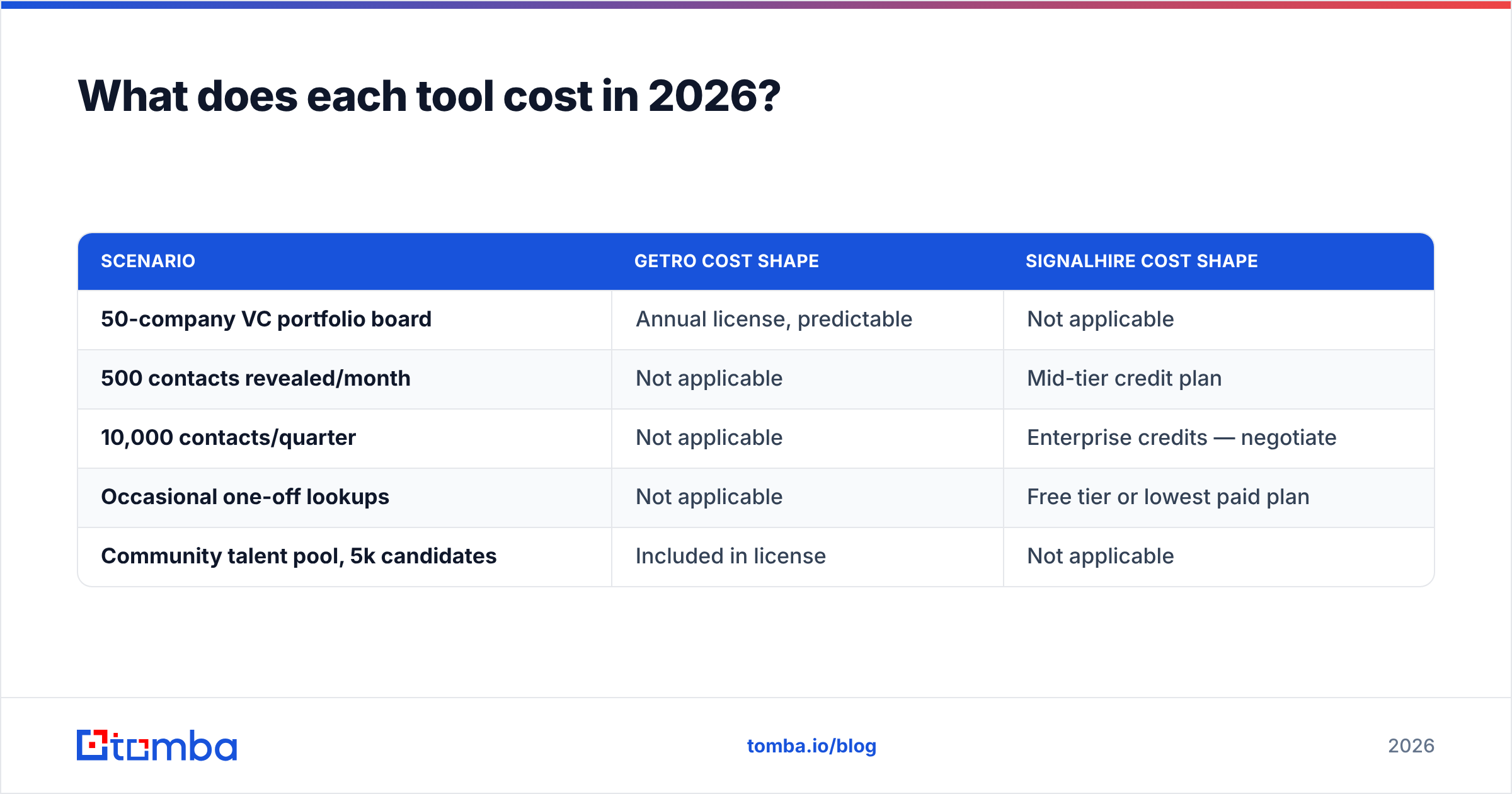
The honest cost comparison:
| Scenario | Getro cost shape | SignalHire cost shape |
|---|---|---|
| 50-company VC portfolio board | Annual license, predictable | Not applicable |
| 500 contacts revealed/month | Not applicable | Mid-tier credit plan |
| 10,000 contacts/quarter | Not applicable | Enterprise credits — negotiate |
| Occasional one-off lookups | Not applicable | Free tier or lowest paid plan |
| Community talent pool, 5k candidates | Included in license | Not applicable |
If your budget line has to cover a talent hub and outbound contact data, you are buying two products. Plan for that. Do not hope one stretches.
Where do Getro vs SignalHire both leave a gap?#
Both are strong at their own job. Neither covers domain-first prospecting. That is the workflow where you start with 300 target companies and have to find the right person at each one.
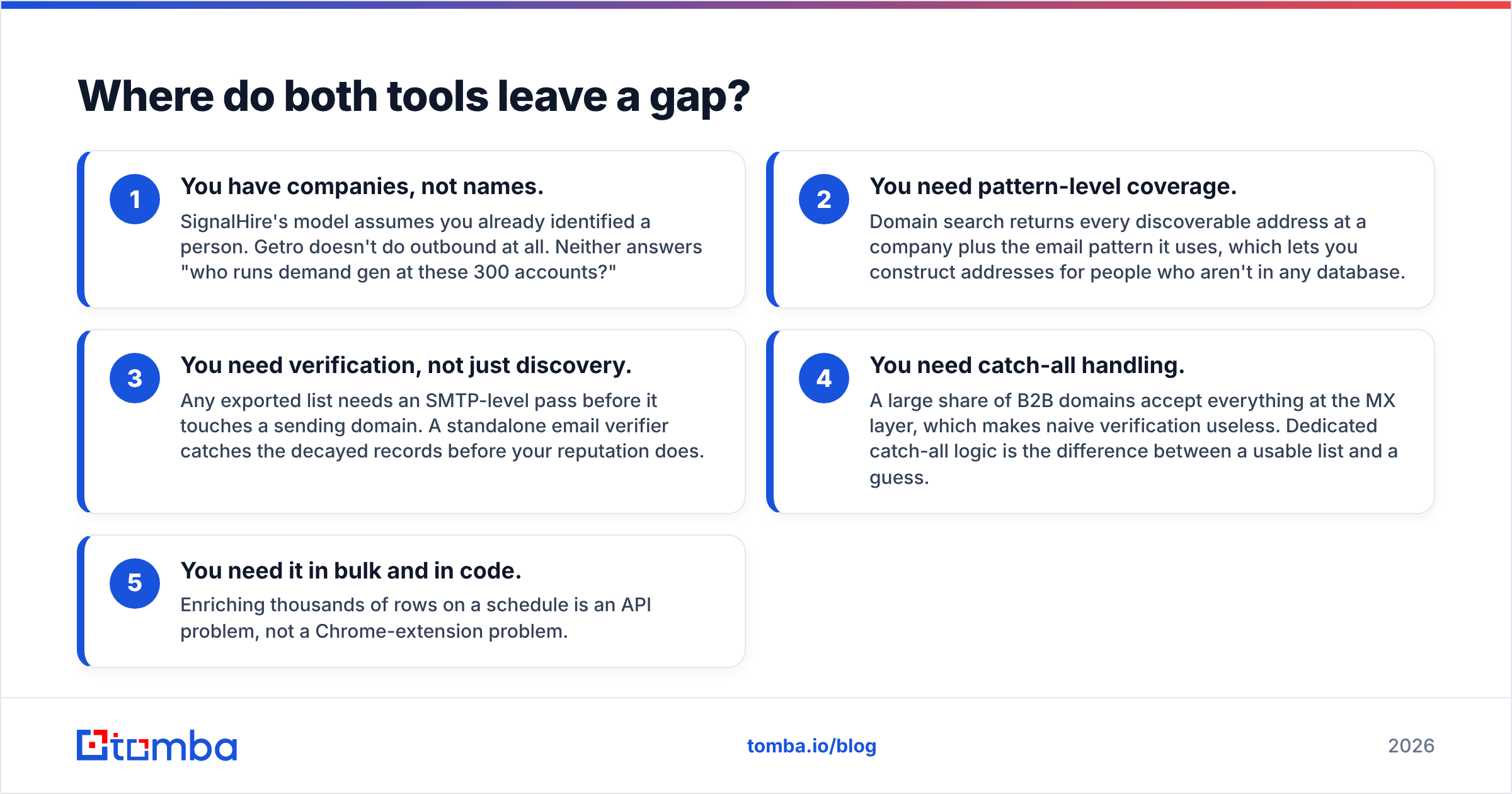
Here is what the gap looks like in practice:
- You have companies, not names. SignalHire assumes you already picked a person. Getro does no outbound at all. Neither one tells you who runs demand gen at those 300 accounts.
- You need pattern-level coverage. Domain search returns every address it can find at a company, plus the email pattern in use. You can then build addresses for people who sit in no database.
- You need verification, not just discovery. Any exported list needs an SMTP check before it touches a sending domain. A standalone email verifier catches the decayed records first.
- You need catch-all handling. Many B2B domains accept every address at the MX layer. Naive verification is useless there. Catch-all logic separates a usable list from a guess.
- You need bulk, and you need code. Enriching thousands of rows on a schedule is an API job, not a Chrome-extension job.
So a dedicated finder sits beside your pick, not instead of it. A bulk email finder run on your target-account list gives you the raw addresses. Verification filters them. Only then do they belong in a sequence.
Who should choose Getro?#
Choose Getro if you can say yes to most of these:
- You run a network of companies — portfolio, cohort, membership, or regional — and they all hire.
- Your metric is hires influenced, and you are expected to report it.
- Career-page upkeep eats someone's week today.
- You want candidates to come to you and stay in a pool you own.
- You hold annual budget and can absorb a multi-week rollout.
Getro fits poorly if you are one company filling five roles. The aggregation engine is its main draw, and it would have nothing to aggregate.
Who should choose SignalHire?#
Choose SignalHire if:
- You source people one by one and live in LinkedIn or GitHub search all day.
- Phone numbers matter to your process — recruiting, exec search, or outbound where a call beats an email.
- You want self-serve with no sales call and no annual lock-in.
- Your volume is moderate. Credit math gets rough at high volume next to flat-rate finders.
- You like the light candidate tracking and do not already run a full ATS.
SignalHire fits poorly if your workflow is "upload 10,000 domains, get verified emails back." That is a different product category. Paying reveal-credit prices for it is expensive.
Can you run both — and what should you add?#
Yes. Mature venture platform teams often do exactly that. Getro powers the public board and the talent network. SignalHire sits in the sourcer's browser for the hard-to-reach candidates the network misses.
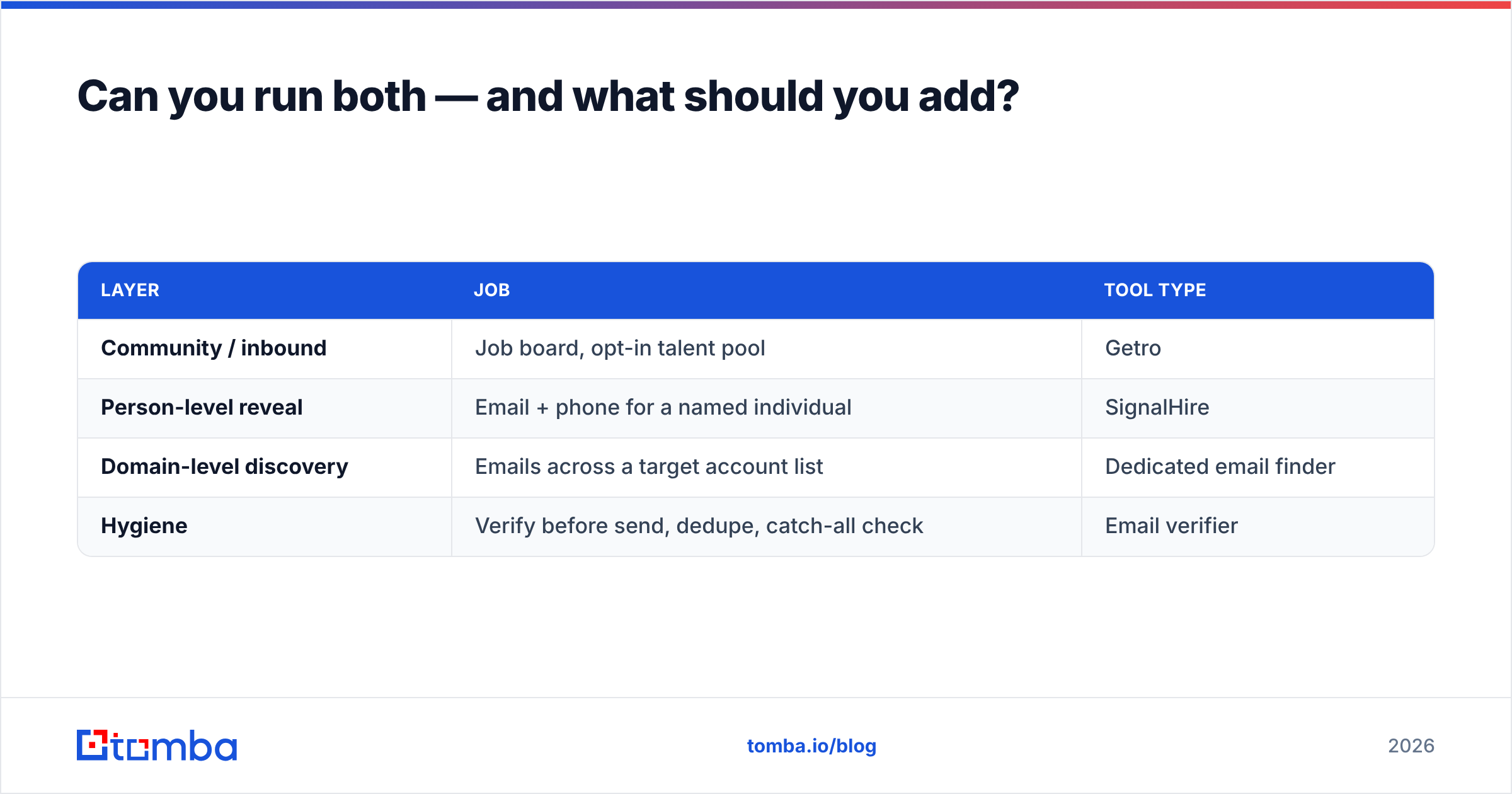
The piece both leave open is the domain-driven layer. A practical three-tool stack looks like this:
| Layer | Job | Tool type |
|---|---|---|
| Community / inbound | Job board, opt-in talent pool | Getro |
| Person-level reveal | Email + phone for a named individual | SignalHire |
| Domain-level discovery | Emails across a target account list | Dedicated email finder |
| Hygiene | Verify before send, dedupe, catch-all check | Email verifier |
Tomba covers the bottom two layers. Tomba pricing starts with a free tier at 25 searches a month. Paid plans run $49 a month for Starter, $99 for Growth, and $249 for Pro. These are flat monthly limits, not per-reveal credits, so the cost curve looks very different once volume climbs. The Tomba API handles the code side if you enrich a CRM or a data warehouse instead of clicking through profiles.
What is the verdict on Getro vs SignalHire?#
Getro wins for network operators. SignalHire wins for one-by-one sourcing. They are not substitutes. Any Getro vs SignalHire verdict that crowns a single winner is comparing tools that do not compete.
Ask yourself one question. Do I need people to find me, or do I need to find people? Getro is the first. SignalHire is the second. If your honest answer is "both, at scale, starting from a company list," you need a third piece. That piece is a finder plus a verifier, not another seat on either platform.
Whatever you buy, add the verification step. It is the cheapest line in the stack, and it protects everything downstream.
Ready to fill the gap neither tool covers? Start with the Tomba Email Finder. Find professional email addresses by domain, name, or company. You get pattern detection and built-in verification, so what lands in your sequence is deliverable. The free tier gives you 25 searches a month, no card required. That is enough to benchmark it against whatever export you are working from now.
Related guides#
Ready to find emails that actually work?
Join 150,000+ professionals who stopped guessing and started sending. Free credits on signup — no credit card required.
Get the Tomba newsletter
Practical outbound tactics and product updates — once every two weeks.
About the author