Getro vs Tami AI (2026): Which Talent Network Platform Wins?
Getro built the job-board-plus-talent-network standard. Tami AI attacks the same job with an AI-first search layer. Here is how the two actually differ on setup, matching, data quality and cost.
Getro vs Tami AI is a choice between two ideas of what a talent network is. Getro gives you a job board and an opt-in talent pool. Tami AI gives you an AI search layer over the network data you already hold. This guide compares both on setup, matching, data quality and cost.
TL;DR
- Getro is the established option: a hosted job board plus a talent network your portfolio companies and members can search. Pricing is quote-based and annual.
- Tami AI is the AI-first challenger. You ask a question in plain language, and it surfaces people, companies and warm paths across your network.
- Pick Getro if your main deliverable is a public jobs page plus a talent pool a non-technical ops team can run.
- Pick Tami AI if your bottleneck is finding the right person in data you already own.
- Neither is a contact-data vendor. Both hand you a name and a company, then stop. An email finder does the last mile.
Getro vs Tami AI: what is each one, exactly?#
Different problems that look identical from the outside.
Getro (getro.com) grew out of the venture-capital world. Every firm there wanted two things. First, a branded job board that shows every open role across the portfolio. Second, a talent network where candidates opt in once and get matched to portfolio companies for years. Getro packaged both. GetroJobs handles the scraping, deduplication and hosting of portfolio job listings. GetroNetwork handles the member directory, opt-in flows and candidate matching. It is used well beyond VC now — accelerators, associations, alumni groups, chambers of commerce.
Tami AI (tami.ai) starts from the opposite end. Most networks already own the data: a CRM, a member list, LinkedIn connections, a warm-intro graph. The problem is finding things, not collecting them. So the interface is a question, not a filter panel. "Who in our network has scaled a Series B fintech in Germany?" returns people, the reasoning behind the match, and who can introduce you.
That split drives almost every other difference. Getro is a system of record for a network. Tami AI is a query layer over a network. Both vendors ship fast. Treat any feature claim here as a snapshot, and check their own sites before you sign.
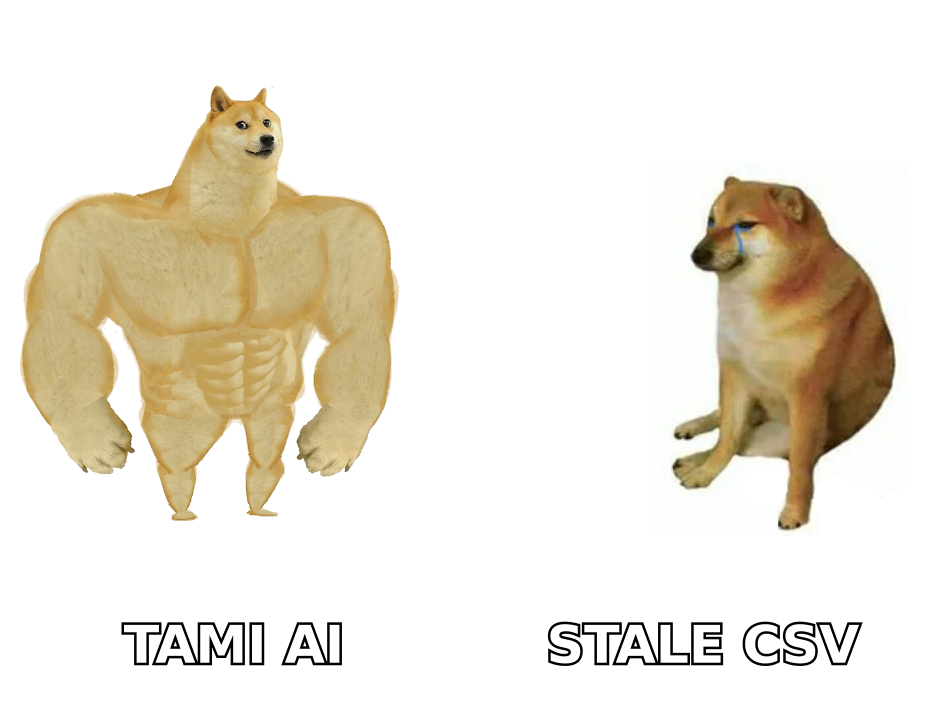
Getro vs Tami AI: how do they compare feature by feature?#
| Capability | Getro | Tami AI |
|---|---|---|
| Core model | Job board + opt-in talent network | AI query layer over your existing network data |
| Primary interface | Filters, tags, saved searches | Natural-language questions |
| Public-facing job board | Yes — hosted, branded, auto-scraped from portfolio sites | Not the core focus |
| Candidate matching | Rules, tags and recruiter-side filtering | Semantic matching plus stated reasoning per match |
| Warm-intro pathing | Limited | Central to the product |
| Data ingestion | Company career pages, ATS feeds, member signup forms | CRM, spreadsheets, connection graphs, member records |
| ATS integrations | Broad catalog (Greenhouse, Lever, Ashby and similar) | Narrower — verify for your stack |
| Non-technical admin friendly | Strong — built for portfolio ops teams | Strong on search, thinner on ops workflows |
| Verified contact emails | No | No |
| Maturity | Established, hundreds of networks | Younger, smaller install base |
| Pricing model | Quote-based, annual | Quote-based, annual |
The third row matters most for buyers. If your board expects a public jobs page with your logo on it next quarter, Getro ships that in days. Tami AI is not trying to be that.
Is Tami AI's natural-language search actually better?#
Better at one thing, worse at another — and the split is predictable.
Filter-based search fails when the criteria are fuzzy. "Someone who has been employee number 10 at a hardware startup and now advises consumer brands" is not a checkbox. You either tag for it in advance (nobody does) or you scroll. Semantic search handles that query well. It is Tami AI's whole pitch, and its strongest demo moment.
Filter-based search wins when the criteria are exact and the stakes are legal. "All members in the EU who opted into recruiter contact after March 2025" should return the same list every time. Language models are probabilistic. A filter is not. Getro's plainer model is the safer instrument there.
The honest read: most networks need both, and neither vendor gives you both at full strength today. If you run high-volume, exact-criteria queries — compliance exports, opt-in segmentation, board reporting — start from Getro. If your queries are exploratory and human-shaped, start from Tami AI.
Which platform fits a VC talent network best?#
Getro, in most cases, and the reason is boring: portfolio ops.
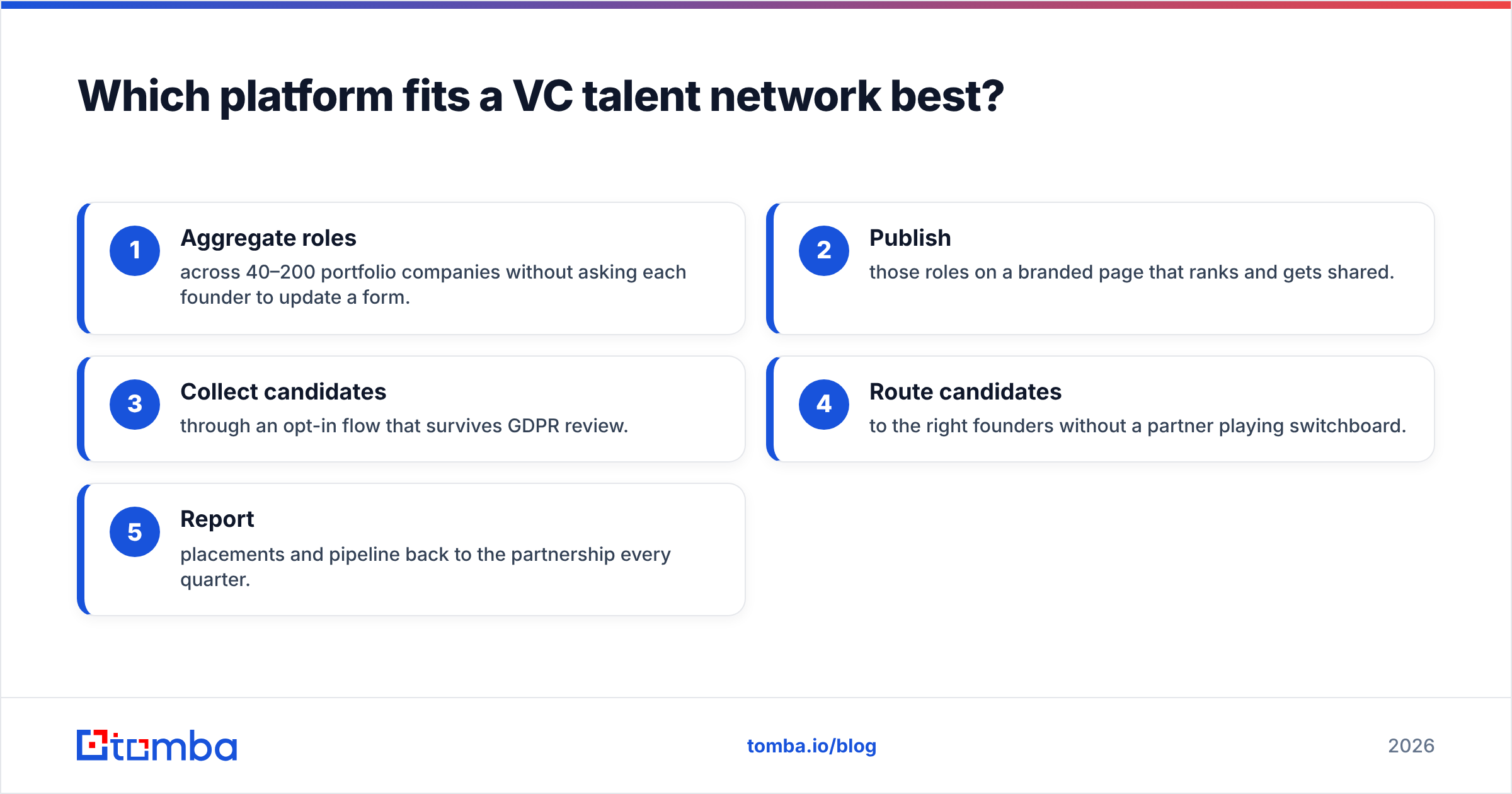
A VC talent function has a workflow shaped like this:
- Aggregate roles across 40–200 portfolio companies without asking each founder to update a form.
- Publish those roles on a branded page that ranks and gets shared.
- Collect candidates through an opt-in flow that survives GDPR review.
- Route candidates to the right founders without a partner playing switchboard.
- Report placements and pipeline back to the partnership every quarter.
Getro was designed around exactly that loop. Steps 1, 2 and 5 are the ones that eat a talent partner's week. Tami AI helps most on step 4, and it helps a lot. But a query layer does not scrape 200 career pages or write your quarterly placements report.
The exception: firms that already run a strong job board (self-built, or a legacy vendor they will not rip out) and whose actual pain is "we have 14,000 people in Affinity and cannot find anyone." That firm should look hard at Tami AI as a layer, not a replacement.
What about accelerators, communities and alumni networks?#
Here the answer flips more often than you would expect.
Accelerators and alumni networks usually have a smaller hiring surface and a much bigger relationship surface. The value is not "here are 300 open jobs." It is "who in this community can help this founder with FDA clearance." That is a pathing question, and pathing is where Tami AI is built to win.
Communities that monetize a job board — associations, niche professional groups, newsletters with a careers page — go the other way. The job board is the product. Getro.
One more variable: who runs it. Getro is designed for a program manager who does not write SQL. If your community ops person is that profile, weigh mature workflow tooling heavily. Peer reviews on directories like G2 are worth reading here. The recurring complaint across this whole category is not features. It is time-to-value.
What do Getro and Tami AI cost in 2026?#
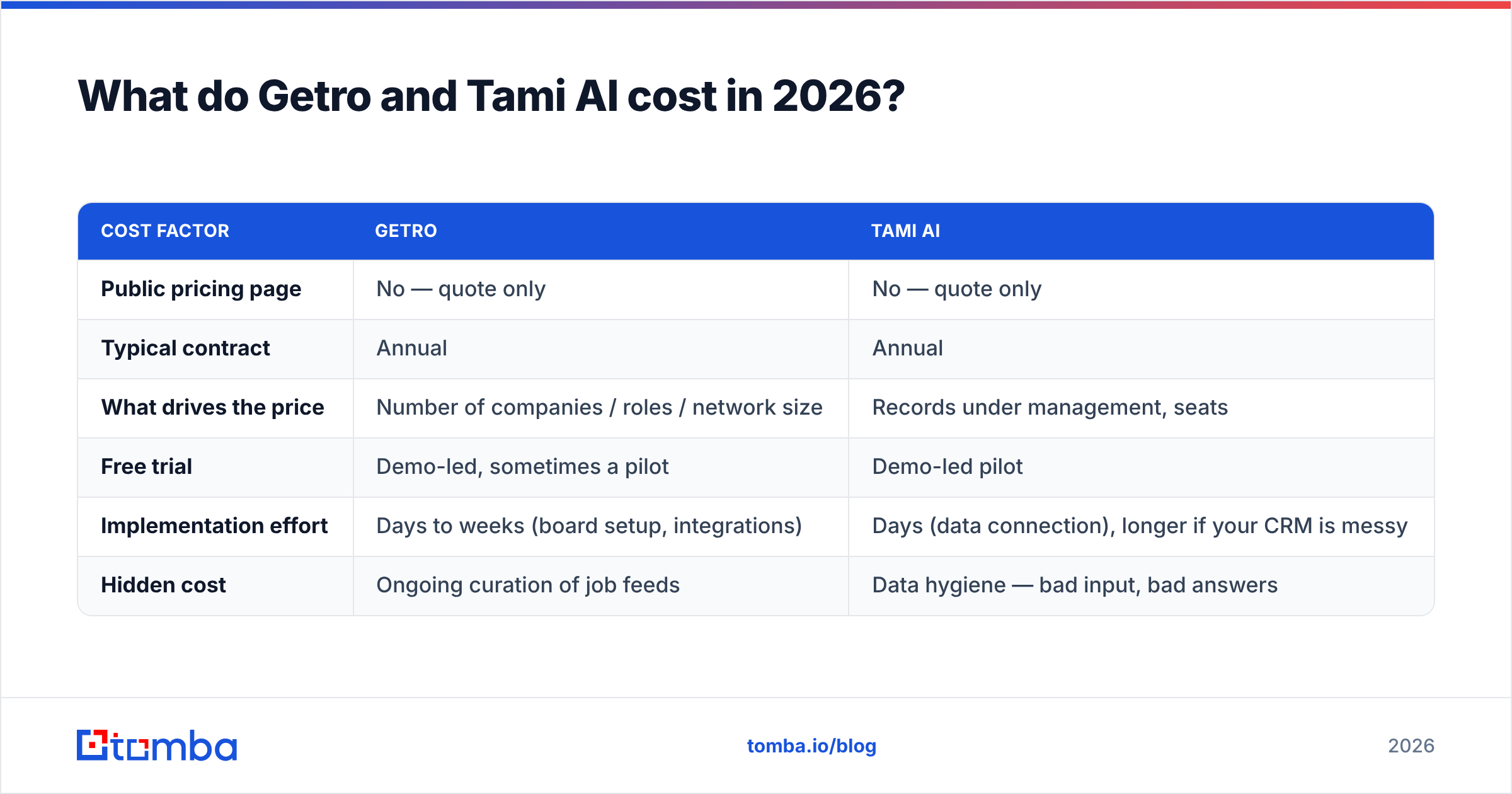
Neither publishes a public price list. That alone tells you the sales motion: annual contracts, a quote per network size, and a demo before numbers.
| Cost factor | Getro | Tami AI |
|---|---|---|
| Public pricing page | No — quote only | No — quote only |
| Typical contract | Annual | Annual |
| What drives the price | Number of companies / roles / network size | Records under management, seats |
| Free trial | Demo-led, sometimes a pilot | Demo-led pilot |
| Implementation effort | Days to weeks (board setup, integrations) | Days (data connection), longer if your CRM is messy |
| Hidden cost | Ongoing curation of job feeds | Data hygiene — bad input, bad answers |
Buyers underestimate the hidden-cost row. Getro's cost is maintenance: dead links, duplicate roles, companies that changed ATS. Tami AI's cost is input quality. A semantic layer over a stale CRM gives confident answers about people who left three years ago. Budget for someone to own the data either way.
Ask both vendors the same three questions on the call. What happens at renewal if our network doubles? What does the data export look like if we leave? Who owns the candidate consent records? The answers separate vendors faster than any feature grid.
Where do both platforms leave a gap?#
Contact data. Specifically, reachable, verified, current contact data.
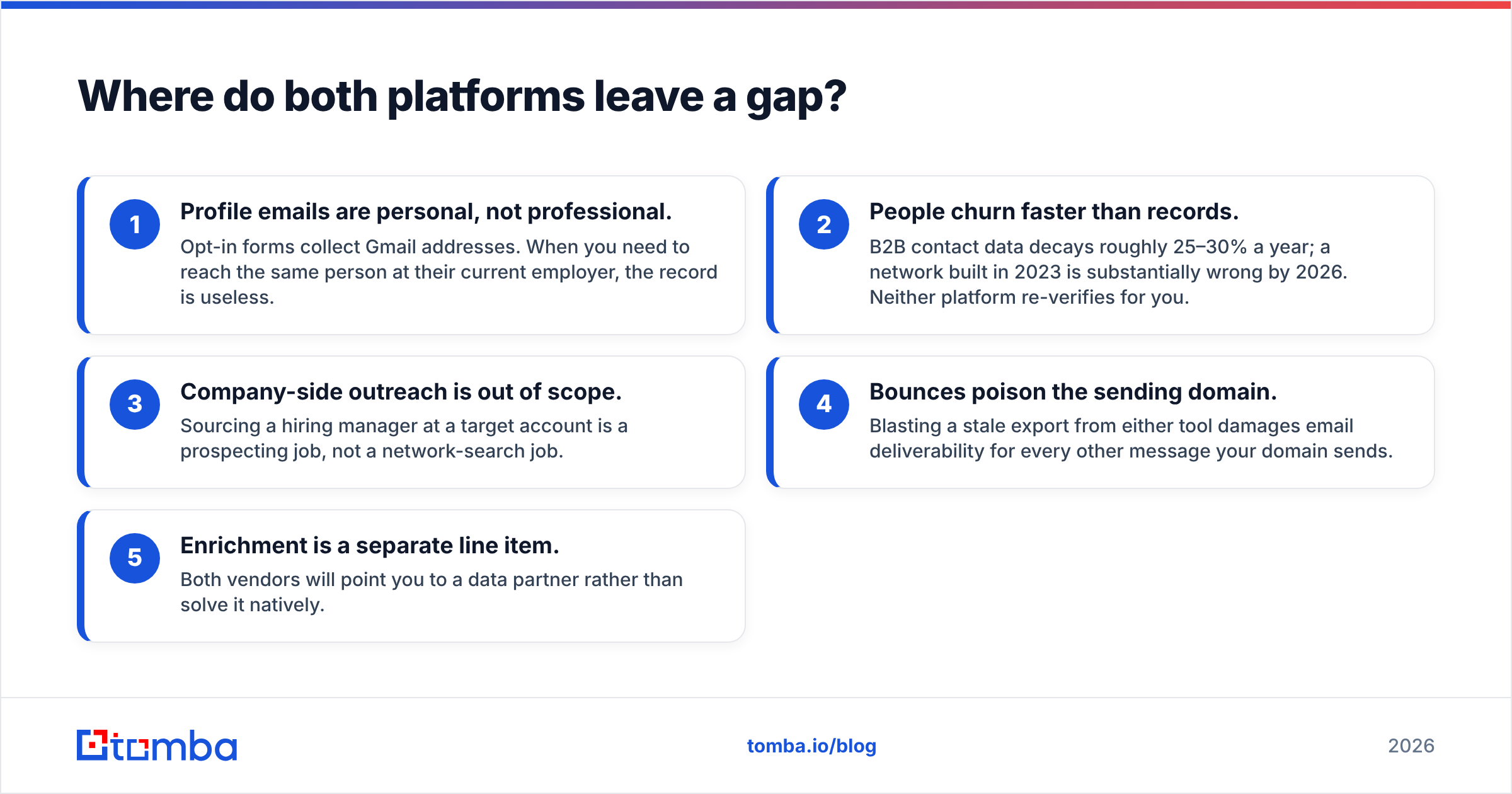
Both products are excellent at telling you who. Both stop at the moment you need to send something. That gap shows up in five concrete ways:
- Profile emails are personal, not professional. Opt-in forms collect Gmail addresses. When you need the same person at their current employer, the record is useless.
- People churn faster than records. B2B contact data decays roughly 25–30% a year. A network built in 2023 is badly wrong by 2026, and neither platform re-verifies for you.
- Company-side outreach is out of scope. Sourcing a hiring manager at a target account is a prospecting job, not a network-search job.
- Bounces poison the sending domain. Blasting a stale export from either tool damages email deliverability for every other message your domain sends.
- Enrichment is a separate line item. Both vendors point you to a data partner rather than solve it natively.
The fix is a thin layer, not another platform. Take the names and companies either tool surfaces, run them through a bulk email finder, and verify before you send. Feed the result back into the network record. The next person searching then gets a live address instead of a 2023 artifact. Adding contact enrichment as a scheduled job — not a one-off cleanup — is what keeps either platform useful in year three.
How should you actually decide?#
Run the Getro vs Tami AI decision in this order, rather than sitting through two demos and guessing.
- Write your five hardest queries first. Real ones, in the words you would say out loud. Send the same five to both vendors and ask them to answer live, on your data, in the pilot.
- Count your job feeds. More than 20 companies whose roles must appear publicly? Getro's aggregation does heavy lifting no query layer replaces.
- Audit your record freshness before the pilot. Pull 50 random contacts and check how many are still at the listed company. Under 70% and your first project is hygiene, not software.
- Check the export path. Confirm you can get a clean CSV of people, companies and consent status without a support ticket.
- Price the total, not the license. Add the admin time: feed curation for Getro, data cleanup for Tami AI. That number decides more budgets than the subscription line.
The verdict: Getro vs Tami AI#
Getro wins the default case. Run a portfolio or member network where a public job board plus a searchable talent pool is the deliverable, and it is the lower-risk choice. You get mature workflows, broad ATS coverage, and a product a non-technical program manager can operate alone.
Tami AI wins the retrieval case. If you already have the data and nobody can find anything in it, an AI-native query layer with warm-intro pathing solves a problem filters never solved well. Go in knowing it is a younger product with a narrower integration surface. Pilot it against your genuinely hard questions, not the vendor's demo dataset.
They are not mutually exclusive. Several firms run a job board from one vendor and a search layer over their relationship graph from another. That is a legitimate architecture, not a hedge.
What neither one does is turn a name into a deliverable message. When your talent network surfaces the right person — or your team sources a hiring manager at a target account — Tomba's Email Finder resolves the professional address from a name and domain. The built-in email verifier confirms it is live before you send. The free tier covers 25 searches a month, so you can test it against your own export today. Paid plans start at $49/mo, with full Tomba pricing published up front — no demo call required.
Related guides#
Ready to find emails that actually work?
Join 150,000+ professionals who stopped guessing and started sending. Free credits on signup — no credit card required.
Get the Tomba newsletter
Practical outbound tactics and product updates — once every two weeks.
About the author